
Muddy dog paws can turn a five-minute walk into twenty minutes of cleaning.
Your dog comes through the door, shakes off rainwater, runs across the hallway, and suddenly there are brown paw prints leading from the entrance to the sofa. If this happens regularly, the natural reaction is to keep buying cleaning products. But constant floor cleaning treats the result rather than the source.
A better strategy is to stop as much mud and moisture as possible at the doorway before your dog reaches the rest of the house. That does not require an elaborate grooming station. For most households, an effective muddy-paw routine can be built around a few simple steps: create a designated entry point, place an absorbent dog mat where the paws first land, pause briefly on the mat, wipe or wash paws when the mess is heavier, dry paws before releasing the dog into the home, and keep cleaning supplies close to the door.
The important word is routine. A mat by itself can help, but it cannot remove every piece of dirt packed between the paw pads. A towel can dry wet legs, but if the dog has already crossed ten feet of hardwood flooring, the damage is already done. The most effective system combines the right tool with the right order. That is what this guide will help you build.
📋 What’s Inside
- Quick Answer: Fastest Way
- Why Muddy Paws Create Big Mess
- Routine Starts Outside the Door
- 3D Infographic: How Muddy?
- Step 1: One Main Entry Point
- Step 2: Absorbent Mat Placement
- Step 3: Teach the Pause
- Step 4: Let the Mat Work
- Step 5: Check Between Toes
- Step 6: Towel for Moderate Mud
- Step 7: Rinse Heavy Mud
- Step 8: Dry Thoroughly
- Step 9: Release After Cleanup
- Build a Cleaning Station
- Winter Muddy Paws
- Common Mistakes (3D Cards)
- Interactive FAQ
- Final Checklist
Quick Answer: What Is the Fastest Way to Deal With Muddy Dog Paws?
Step 1: Have the dog step onto an absorbent entry mat.
Step 2: Pause for a few seconds instead of letting the dog immediately run inside.
Step 3: Check all four paws, including between the toes and pads.
Step 4: For light moisture, use the mat and towel.
Step 5: For heavier dirt, rinse or use a suitable paw-cleaning method.
Step 6: Dry paws and lower legs.
Step 7: Release the dog only when excess moisture and loose dirt are gone.
The American Kennel Club recommends checking between the toes and paw pads because dirt, salt, and debris can remain trapped there even after a quick wipe. This seven-step sequence is faster than letting your dog run through the house and then cleaning multiple rooms.
Why Muddy Dog Paws Create Such a Big Indoor Mess
Mud is not just water. It can contain soil, sand, tiny stones, grass, organic debris, road dust, moisture, and winter salt or de-icer residue. Some of this sits on the outside of the paw. Some gets trapped between the toes, around the pads, under the nails, in long paw hair, and around the lower legs. When the dog walks indoors, each step releases a little more. That is why one quick wipe across the top of a paw often fails.
AKC specifically advises checking between the toes and around the paw pads because debris can remain hidden in those areas. During winter, the issue can also become more than a cleanliness problem. Cornell University’s veterinary guidance recommends wiping or washing paws after outdoor exposure to remove salt, de-icers, and snow buildup. So a doorway routine serves two purposes: protect the floors and check the paws.
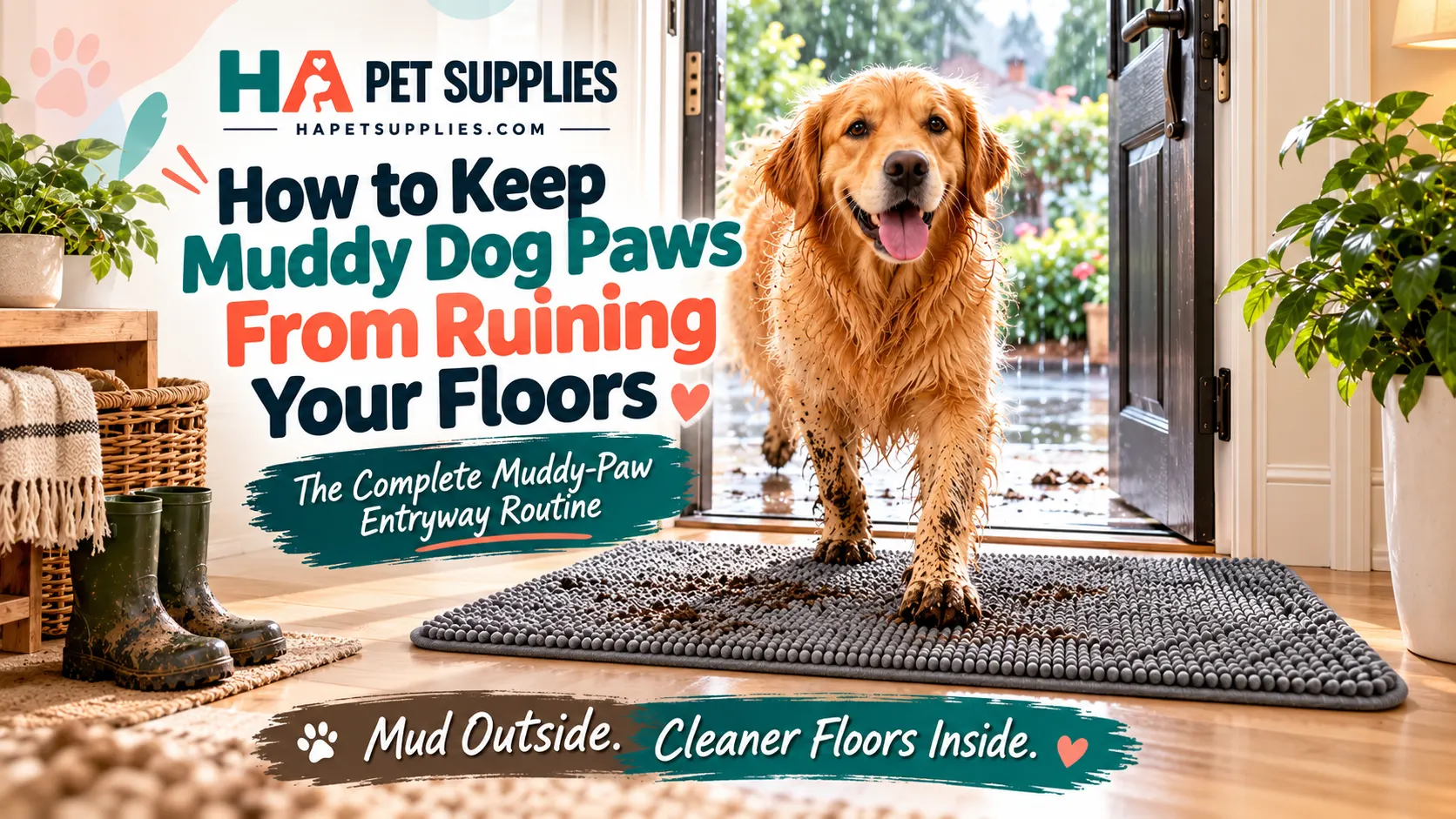
An absorbent entry mat gives muddy paws a first landing zone before dirt and moisture spread farther into the home.
The Best Muddy Dog Paw Routine Starts Outside the Door
A common mistake is beginning the cleanup after the dog is already inside. If possible, start before crossing the threshold. Before opening the door, quickly look at: how wet the dog is, whether the paws are lightly damp or heavily packed with mud, whether mud has reached the legs or belly, and whether there may be salt, sand, or debris between the pads. This ten-second assessment determines which cleanup method you need.
Not every walk requires a full paw wash. That is important because an entryway routine has to be realistic enough to use every day. If every slightly damp walk becomes a full bathing session, people stop following the routine. Instead, match the method to the mess.
3D Infographic: “How Muddy Are Those Paws?”
🌤️ Light Mess Mat only
Examples: slightly damp paws, light dust, dry dirt, short walk.
Start with: Absorbent dog mat. Let the dog walk or stand on the mat so loose dirt and moisture begin transferring away from the paws.
🌧️ Moderate Mess Mat + towel
Examples: noticeably wet paws, wet lower legs, damp grass residue, small amounts of mud.
Add: Towel drying. Use the mat first, then dry areas the mat cannot reach.
🥾 Heavy Mess Rinse + towel
Examples: mud packed between pads, visible clumps around toes, muddy fur, sticky soil.
Use: Rinse or paw washer + towel. A simple mat is not designed to remove compacted mud from between the toes.
🛡️ Prevention Boots
Examples: heavy rain, winter salt, very muddy trails, repeated outdoor trips.
Consider: Dog boots or other paw protection. AKC notes that boots can help protect paws from mud, salt, ice, and other outdoor hazards.
Step 1: Create One Main Dog Entry Point
If your dog enters through a different door every day, the mess becomes harder to control. Whenever practical, use one primary entrance after walks, backyard play, rainy outings, hikes, or trips to the park. This lets you create a predictable cleanup zone. The ideal area should have enough room for the dog, an absorbent mat, a towel, a leash hook, cleaning supplies, and a small waste bin or basket.
If you use the back door most often, a dedicated dog mat for muddy paws can sit directly inside the entrance rather than being moved around the house. Consistency also makes the routine easier for the dog to learn.
Step 2: Put an Absorbent Mat Where the Dog Actually Steps
Placement matters almost as much as the mat itself. A beautifully designed dog mat sitting three feet away from the doorway cannot catch the first muddy steps. Position it so your dog has to step onto it immediately after entering. Ideally: outside ground → threshold → absorbent mat, not outside ground → hardwood floor → absorbent mat.
For a large dog, the mat should provide enough usable surface for several paw contacts. The more steps the dog takes on the absorbent surface, the more chance loose dirt and moisture have to transfer. For readers deciding between different options, naturally send them to the supporting buying guide on how to choose an absorbent, non-slip, washable dog door mat for muddy paws.
Step 3: Teach Your Dog to Pause on the Mat
This small behavior can dramatically improve the routine. Instead of door opens → dog runs → paw prints everywhere, teach door opens → dog steps onto mat → brief pause → cleanup → release. You can use a simple cue such as: wait, paws, mat, or stay. Choose whichever word already fits your training style.
Do not turn the doorway into a stressful confrontation. Reward calm standing. For many dogs, a few seconds is enough. The objective is not to make the dog stand perfectly still for five minutes. The objective is to give you enough time to assess the paws before the dog reaches the rest of the home.
Step 4: Let the Mat Handle Light Mud and Moisture First
For lightly dirty paws, the mat should do the first part of the work. Encourage the dog to step fully onto it, stand briefly, turn once if comfortable, and avoid immediately jumping onto the next floor surface. This can transfer loose soil, light moisture, and small debris. But remember: a mat is a first-line cleanup tool, not a substitute for checking the paws. Even if the tops look clean, dirt can remain between the pads.
Step 5: Check Between the Toes and Paw Pads
This is one of the most important steps. Gently inspect each paw. Look for packed mud, stones, seeds, ice, salt, cuts, redness, or irritation. AKC advises gently parting the toes because dirt and salt can accumulate around and between the pads and beneath the nails. Cornell also advises checking paws frequently during winter because ice and road salt can contribute to cracks, irritation, and discomfort.
If you notice bleeding, a deep cut, persistent limping, swelling, marked redness, or a foreign object lodged deeply, stop treating it as a cleaning problem and contact your veterinarian.
Step 6: Use a Towel for Moderate Muddy Dog Paws
A towel complements the mat. The mat works well for the bottom surface of the paws. A towel can reach paw tops, ankles, lower legs, around the toes, and belly fur. Keep one dedicated dog towel near the entrance. That prevents the frustrating moment when the muddy dog is waiting while you search another room.
For moderate mess: let the dog stand on the absorbent mat, wipe each paw, gently clean between toes when needed, wipe lower legs, and dry excess moisture. The key is having everything within reach.
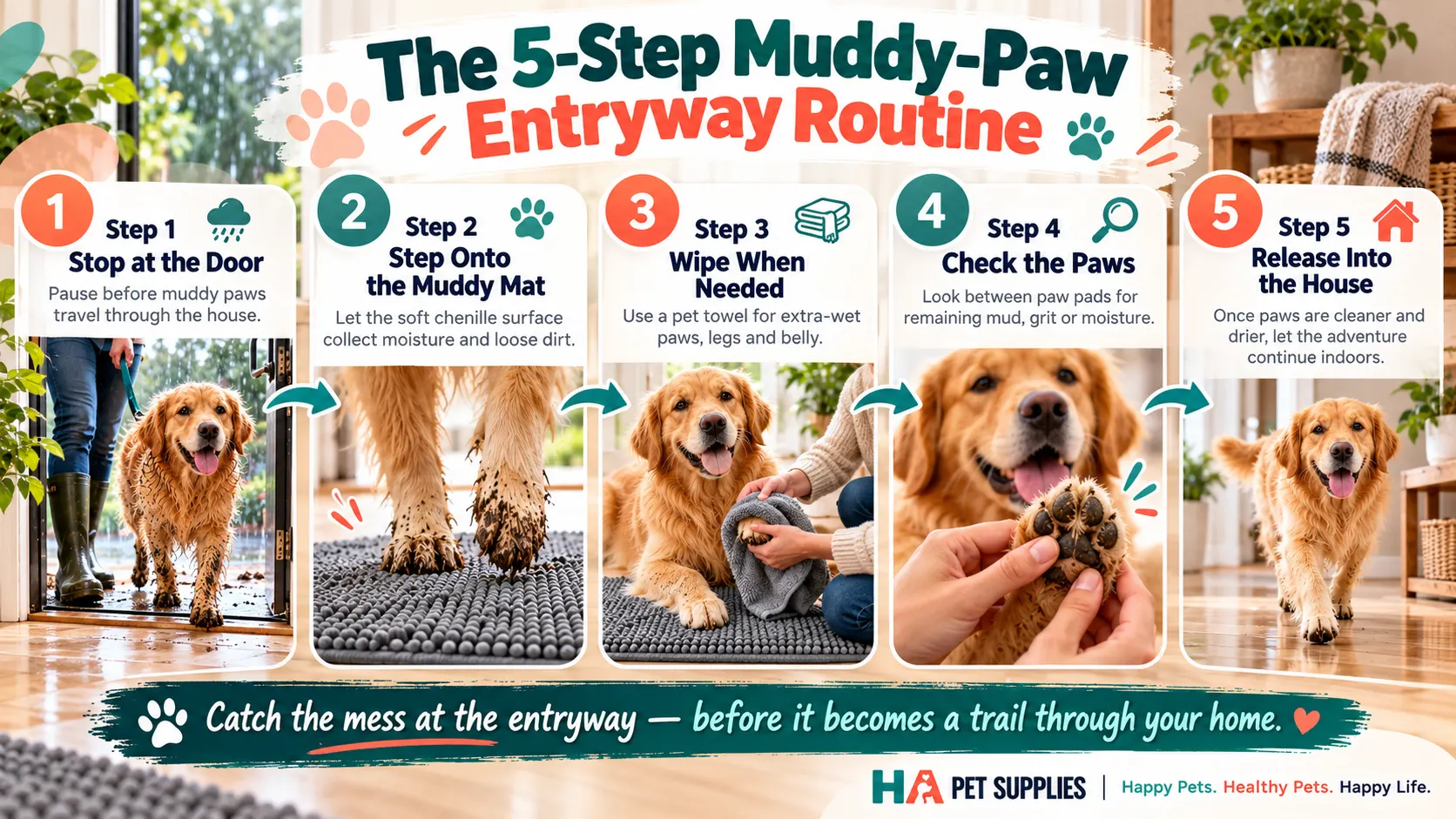
A consistent doorway routine catches moisture first, checks the paws, removes remaining mud, dries the dog, and only then releases them indoors.
Step 7: Rinse Heavy Mud Instead of Smearing It Around
When paws are heavily coated, rubbing them repeatedly with a dry towel may simply spread the mud. At that point, use water. Possible methods include: shallow basin, paw washer, handheld shower, sink for a small dog, damp washcloth, or bath when the mess extends beyond the paws. AKC notes that serious mud, sand, or salt may require washing rather than a simple wipe, and advises thoroughly drying paws afterward.
This is where the third article in your cluster becomes useful. Readers unsure whether they need a mat, towel, paw washer, or boots can continue to the comparison of dog mats, towels, paw washers, and boots for muddy paws.
Do You Need Soap Every Time?
No. Routine mud does not automatically require shampoo or disinfectant. For normal dirt, water may be sufficient. If you do use a cleanser on the dog itself, choose something specifically suitable for dogs and follow the product directions. Avoid reaching for random household floor cleaner or disinfectant and using it on the dog’s paws. Household cleaning products are formulated for surfaces, not necessarily for skin. ASPCA notes that household cleaners vary greatly in composition and that pets should be kept away from products until they are used and dried according to the label.
Step 8: Dry Muddy Dog Paws Thoroughly
Do not stop after rinsing. Wet paws can leave fresh prints, make smooth floors slippery, keep dirt trapped between toes, and keep fur damp. Use a clean towel and gently dry pads, between toes, nail areas, and lower legs. AKC specifically recommends drying thoroughly after paw washing. If your dog has long hair between the toes, pay extra attention because that fur can retain moisture and debris.
Step 9: Release the Dog Only After the Cleanup Is Finished
This sounds obvious. In practice, it is where the whole routine often fails. Owners clean two paws, the dog gets excited, escapes, and runs through the house. Create a clear finish signal. For example: wait → wipe → dry → okay. Once the dog learns that “okay” ends the routine, the process becomes much easier.
3D Infographic: The Complete Muddy-Paw Entryway Routine
Catch the mess at the door instead of chasing it across the house.
How to Build a Muddy-Paw Cleaning Station
The most successful system is the one you can use quickly. You do not need an expensive mudroom. A small corner near the entrance can work. Keep: absorbent dog mat, two clean towels, pet-safe paw wipes if you use them, shallow bowl or paw cleaner, leash hook, waste bags, small basket, and optional dog boots.
The HA Pet Supplies muddy mat for dogs can form the main landing surface, while the remaining tools deal with heavier messes. If you need other everyday dog products, the HA Pet Supplies dog supplies collection can be referenced naturally here because this section is about building a complete dog-care station.
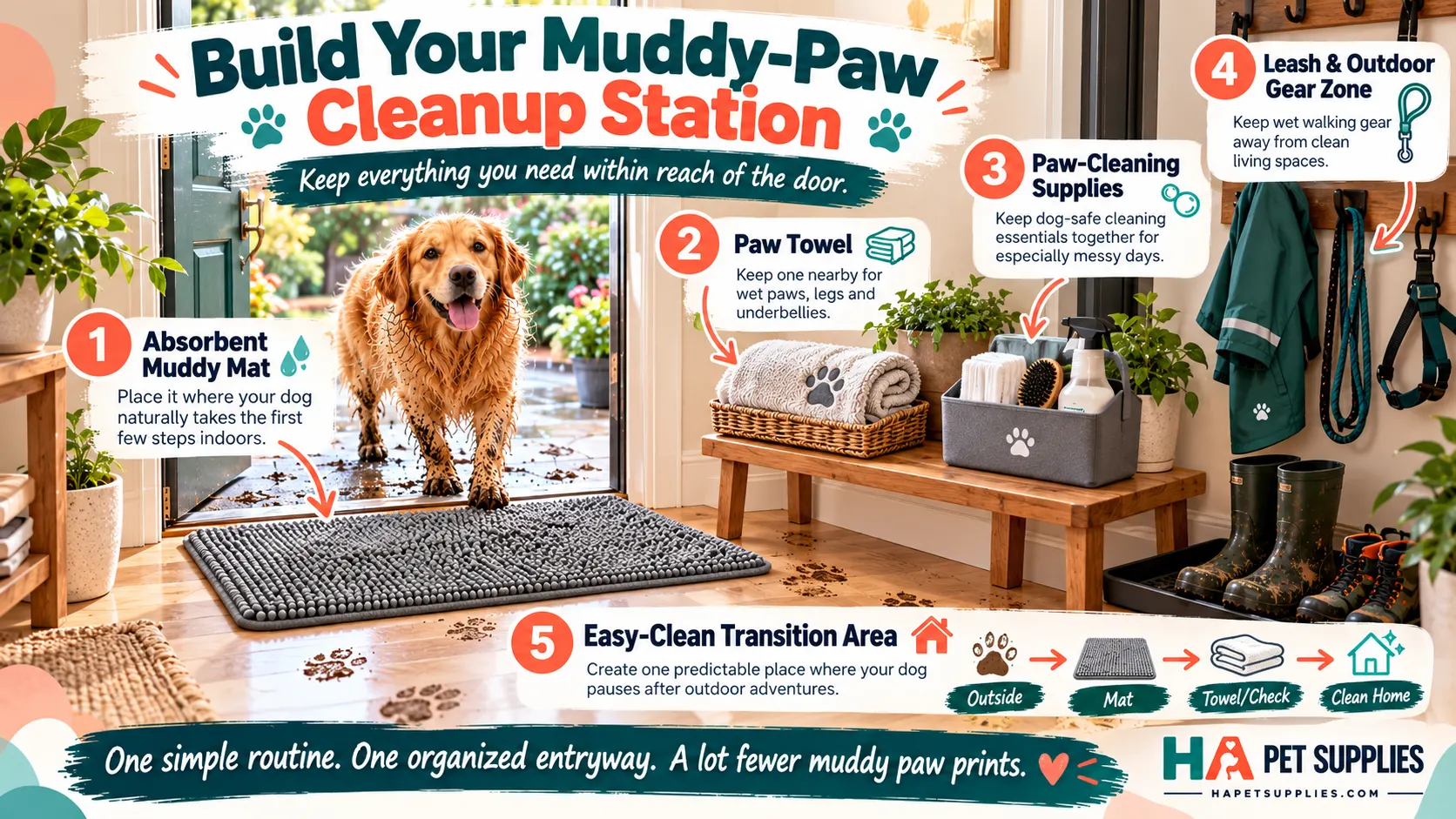
Keeping the mat, towels, and paw-cleaning supplies together makes the muddy-paw routine easier to follow every day.
How Often Should You Wash a Muddy Dog Mat?
There is no universal schedule because usage varies. A household with two large dogs, daily rain, and a muddy yard will need more frequent cleaning than a household with one small dog, dry weather, and paved walks. Use condition rather than a calendar alone. Wash or clean the mat when it looks visibly dirty, begins to smell, feels saturated, stops trapping dirt effectively, or has been contaminated with urine, feces, or another significant mess.
CDC advises cleaning pet items regularly and more often when they are visibly dirty or smell. It also recommends following the item’s specific care instructions. That is an excellent general rule for a washable dog mat too.
Cleaning vs Disinfecting: They Are Not the Same Thing
Cleaning removes dirt, mud, debris, and some germs. Disinfecting uses chemicals to kill germs on a surface. CDC notes that ordinary cleaning is sufficient for many pet items and that disinfection is an additional step for certain situations. You do not need to treat a muddy mat like a hospital floor every time your dog comes indoors. Follow the manufacturer’s washing instructions.
Be Careful With Household Cleaning Products Around Dogs
A muddy doorway often leads owners to reach for powerful cleaners. Use them correctly. ASPCA advises following label directions and keeping pets away from freshly cleaned areas until products have been used appropriately and surfaces are dry. The CDC likewise advises following disinfectant labels exactly and keeping pets away from wet disinfectants. For owners comparing household cleaning products, the EPA’s Safer Choice program identifies products that meet its ingredient and performance criteria. Browse EPA Safer Choice certified cleaning products.
Do not assume that a product described online as “natural” is automatically appropriate for every pet or every surface.
Should You Use Vinegar to Clean Everything?
Vinegar is frequently recommended online as a universal pet-friendly solution. The reality is more nuanced. CDC notes that there is not enough evidence to treat vinegar as an effective general disinfectant for pet items and recommends soap or detergent for cleaning and appropriate disinfectants when disinfection is required. So if the goal is simply removing ordinary dirt, follow your flooring or mat manufacturer’s cleaning instructions. If the goal is actual disinfection, use a product designed for that purpose and follow its label.
Winter Muddy Dog Paws Need Extra Attention
Winter changes the problem. What looks like ordinary wet dirt may contain rock salt, calcium chloride, other de-icers, ice, or compacted snow. ASPCA warns that de-icers can irritate paws and can cause problems if dogs lick significant residues from their feet. Cornell recommends wiping or washing paws after winter walks to remove salt, de-icer residue, and snowballs. Pet Poison Helpline also recommends wiping paws after exposure to road salt and notes that ingestion can cause gastrointestinal problems and, in larger amounts, more serious toxicity.
That means a winter routine should be: mat → inspect → rinse/wipe → dry rather than simply: mat → finished.
When Dog Boots Are Better Than Extra Cleaning
Sometimes prevention is faster. Dog boots can make sense when streets are heavily salted, trails are extremely muddy, snow repeatedly packs between toes, paw pads are sensitive, or your dog tolerates boots well. AKC explains that properly fitting boots can protect paws from weather, rough terrain, salt, and de-icing products. Cornell also recommends well-fitting boots as one option for winter paw protection. The downside is that some dogs need training to accept them. For light everyday rain, a mat and towel may still be the faster solution.
Muddy Mats for Dogs vs Towels
These tools should work together rather than compete. Muddy mat is best for first paw contact, loose dirt, light moisture, and daily convenience. Towel is best for lower legs, paw tops, fur, and drying after rinsing. A towel does not provide a permanent landing zone. A mat cannot wrap around a wet leg. Using both creates a more complete routine.
Muddy Mat vs Paw Washer
A paw washer is useful for mud packed between pads, sticky soil, and heavier outdoor mess. A mat is useful for quick daily entry, light moisture, loose debris, and preventing the first wet paw prints. If you use a paw washer after every slightly damp walk, the process may become unnecessarily complicated. Match the tool to the problem. Your comparison article on dog mat vs towel vs paw washer vs boots should handle the full comparison in more detail.
Common Muddy Dog Paw Mistakes
❌ Mistake 1 — Letting the Dog Run Inside First
Once the prints are across three rooms, the routine has already failed. Better: Stop at the threshold.
❌ Mistake 2 — Putting the Mat Too Far From the Door
If the dog must cross hardwood or tile to reach the mat, you lose the main benefit. Better: Position it at the first indoor step.
❌ Mistake 3 — Using a Mat That Is Too Small
A large dog may step over a tiny mat. Better: Choose enough surface area for multiple paw contacts.
❌ Mistake 4 — Wiping Only the Paw Tops
Most hidden debris is not on top. Better: Check between the toes and around the pads.
❌ Mistake 5 — Using the Same Dirty Towel for Days
You may simply be transferring dirt back onto clean paws. Better: Keep multiple washable towels in rotation.
❌ Mistake 6 — Ignoring Wet Lower Legs
Even perfectly clean paws can be followed by dripping leg fur. Better: Dry the legs too.
❌ Mistake 7 — Assuming Every Mess Needs the Same Method
Light rain and deep trail mud are completely different. Better: Use the least complicated method that actually cleans the paws.
How to Protect Hardwood Floors From Muddy Dog Paws
Hardwood can show mud and moisture quickly. Your best defense is preventing the mess from spreading. At the entrance: use a sufficiently large absorbent mat, remove excess moisture, wipe heavy mud, and dry paws before release. For floor cleaning, follow the flooring manufacturer’s instructions. Avoid saturating wood with water. The entryway mat is valuable here because every ounce of moisture captured at the door is moisture that does not reach the wood.
How to Protect Tile Floors
Tile itself can be durable, but wet paw prints can make the surface slippery. This matters for both people and dogs. A textured absorbent mat near the entrance can help remove the first layer of water. Drying the paws afterward further reduces tracking. If your dog is older or has mobility problems, slippery flooring may deserve extra attention.
How to Protect Carpet From Muddy Dog Paws
Carpet is particularly frustrating because mud can become embedded in the fibers. Prevention is much easier than cleaning repeated tracks. Create a “clean zone” before the dog reaches carpeted rooms. For example: back door → muddy mat → towel station → washable hard-floor area → carpet. That buffer gives you a chance to catch remaining moisture.
What If Your Dog Hates Having Their Paws Wiped?
Do not wait until the dog is covered in mud to begin handling training. Practice when the paws are clean. Start by briefly touching one paw, rewarding, gently lifting the paw, rewarding, touching a towel to it, rewarding, gradually wiping. Keep sessions short. The goal is to make paw handling ordinary. If the dog shows fear, growling, snapping, or significant distress, seek help from a qualified trainer or veterinary behavior professional rather than forcing the procedure.
What If Your Dog Runs Off the Mat?
Make the mat part of daily training. When the dog steps onto it: reward, pause, release. Do this even on dry days. If the dog only sees the mat when something unpleasant is about to happen, they may begin avoiding it. A predictable positive routine is much easier to maintain.
How to Set Up a Small Apartment Entryway
You do not need a mudroom. For limited space: place the mat immediately inside the door, hang towels on a wall hook, keep wipes or supplies in a narrow basket, store the paw washer under a bench, and use a washable runner if needed. If the mat is washable and easy to move, even a small entrance can function as an effective dog-cleaning zone. Readers comparing sizes or mat construction can naturally move to the muddy mat buying guide.
How to Set Up a Back-Door Mudroom
If you have more space, create zones. Zone 1 — Arrival: Large absorbent muddy dog mat. Zone 2 — Cleaning: Towels, paw washer, wipes. Zone 3 — Storage: Leash, raincoat, dog boots, waste bags. Zone 4 — Release: Clean floor leading into the main living area. This reduces clutter and speeds up the routine.
Hygiene Matters Too
Mud itself is not the only issue. Dogs can carry microorganisms on their bodies and supplies even when they appear healthy. CDC recommends good hygiene around pets, including washing hands after handling animals, waste, or pet equipment. For households with small children, older adults, or people with weakened immune systems, consistent cleaning may be particularly important because CDC identifies these groups as being at higher risk from some animal-associated infections. This does not mean you should panic every time your dog gets muddy. It simply supports a sensible rule: Keep the dirty outdoor zone separate from food-preparation and living areas as much as practical.
3D Infographic: Your Ideal Muddy-Paw Station
🧽 Absorbent Landing Zone
Captures moisture and loose dirt.
🧺 Towel Hook
Always keep one within reach.
🔍 Paw Inspection
Check between toes and pads.
🚿 Heavy-Mud Cleaner
Paw washer or rinse option nearby.
🥾 Boot Storage
Useful for severe weather.
🍖 Treat Jar
Rewards calm doorway behavior.
🧴 Washable Supplies Basket
Keeps the area organized.
A 30-Second Routine for Busy Dog Owners
This is important for readers who want a fast solution. When the mess is light:
- 0–5 seconds: Dog steps onto mat.
- 5–10 seconds: Quick paw check.
- 10–20 seconds: Wipe damp paws.
- 20–30 seconds: Dry and release.
That is often faster than wiping floors, cleaning carpets, washing sofa covers, or following paw prints into another room. The goal of the routine is not perfection. It is containment.
A 2-Minute Routine for Heavy Mud
When the paws are heavily coated: Step 1: Hold the dog on the mat. Step 2: Remove large loose clumps. Step 3: Rinse or use a paw washer. Step 4: Inspect between pads. Step 5: Dry thoroughly. Step 6: Wipe legs and belly if needed. Step 7: Release. Spending two minutes at the doorway can prevent a much larger cleanup.
When to Call a Veterinarian Instead of Continuing to Clean
A muddy paw routine should not become DIY treatment for injury. Contact a veterinarian when you notice: deep cuts, persistent bleeding, swelling, significant redness, burns, severe cracking, limping, a deeply embedded object, repeated licking or chewing, or suspected chemical exposure. If you suspect ingestion of a potentially toxic product, ASPCA Poison Control provides guidance on household toxic exposures. Winter salt exposure also deserves attention if the dog has consumed a substantial amount. Pet Poison Helpline notes that larger salt exposures can lead to serious toxicity.
Interactive FAQ: Muddy Dog Paws and Entryway Cleaning
Start with an absorbent mat to remove loose moisture and dirt, inspect between the toes and pads, then use a towel or rinse depending on how heavy the mud is.
They can help trap loose moisture and dirt at the entry point, particularly when they are absorbent, correctly sized, washable, and placed where the dog first steps indoors. They work best as part of a routine rather than as the only cleanup method.
You do not necessarily need a full wash after every dry walk, but it is useful to check the paws when the ground is wet, muddy, salty, sandy, or contaminated.
Not every muddy paw needs soap. Water may be enough for ordinary dirt. If using a cleanser on the dog, use a dog-appropriate product and follow directions.
Gently separate the toes and use a damp cloth, rinse, or suitable paw-cleaning tool. AKC recommends checking between the toes and pads rather than only wiping the surface.
Yes. ASPCA, Cornell, and Pet Poison Helpline all warn that de-icers or road salt may irritate paws and should be removed after exposure.
For light or moderate dirt, often yes when combined with an absorbent mat. Heavy packed mud may require rinsing.
They solve different problems. A mat catches moisture and loose dirt as the dog enters. A paw washer is more useful when mud is packed around the pads.
They can be useful in deep mud, snow, on salted roads, or for dogs with sensitive paws. Fit and acclimation are important. AKC explains more about dog boots.
Wash it according to the manufacturer’s instructions whenever it becomes visibly dirty, smells, remains damp, or stops functioning effectively.
Only if it is appropriate for the material and used according to label and manufacturer instructions. Keep pets away from wet disinfectants and allow surfaces to dry as directed. CDC provides detailed guidance.
CDC does not recommend relying on vinegar as a general disinfectant because evidence for its effectiveness against all relevant germs is limited.
Train a consistent mat or wait cue on dry days, reward calm standing, and use a clear release word after cleaning.
Choose enough usable surface that the dog can place multiple steps on the mat rather than immediately stepping beyond it. Measure your entryway and consider the dog’s body size and stride.
Repeated moisture and tracked grit can make floor maintenance harder. The best strategy is to remove as much water and debris as possible before the dog reaches the wood and to follow the flooring manufacturer’s cleaning recommendations.
An absorbent mat, towels, leash storage, suitable paw-cleaning supplies, waste bags, and optional boots are usually enough.
Final Muddy Dog Paws Checklist
Entryway
- Absorbent mat positioned immediately inside the door
- Enough room for the dog to pause
- No unnecessary clutter
Cleaning
- Clean towels ready
- Paw washer or rinse option available
- Pet-appropriate wipes if used
Paw Check
- Inspect between toes
- Inspect pads
- Check nails
- Look for debris or irritation
After Cleaning
- Dry paws
- Dry lower legs
- Hang wet towels
- Allow the mat to dry
- Wash dirty supplies when needed
Weather Extras
- Boots during severe mud or salt exposure
- Extra towels during rain
- Warm water for winter cleanup
Conclusion: Stop Mud at the Door, Not Across the House
Keeping muddy dog paws under control does not require constantly mopping your floors or turning every walk into a bath. The biggest improvement comes from changing where the cleanup happens. Instead of: dog enters → dog runs → floor gets dirty → owner cleans house, build this routine: dog enters → absorbent mat → paw check → towel or rinse → dry → release. That simple sequence catches the mess while it is still concentrated in one small area.
An absorbent muddy mat forms the foundation because it gives the dog a dedicated place to land before reaching hardwood, tile, or carpet. A towel handles the moisture the mat cannot reach. A rinse or paw washer deals with heavy mud. Boots can reduce the problem during severe weather. And the paw check itself has benefits beyond cleaner floors. It gives you a regular opportunity to notice stones, salt, cuts, irritation, cracked pads, or foreign objects.
For households looking to create this type of entrance setup, the HA Pet Supplies muddy mat for dogs can serve as the primary absorbent landing area. If the bigger question is which mat features are actually worth paying for, the next logical guide is Best Dog Door Mat for Muddy Paws: How to Choose an Absorbent, Non-Slip, Washable Mat. And when the mess becomes too heavy for a mat alone, continue to Muddy Dog Paws After Walks: Dog Mat vs Towel vs Paw Washer vs Boots — What Actually Works?.
For other practical dog-care products, the HA Pet Supplies dog supplies collection is the natural place to continue browsing, while owners who need help choosing a suitable product can contact HA Pet Supplies before ordering.
The main takeaway is simple: Do not wait until muddy dog paws have crossed the whole house. Build a routine that stops the mess at the first step.
For additional authoritative guidance on paw cleaning and home hygiene, the article can naturally reference AKC paw-care guidance, Cornell veterinary winter paw advice, ASPCA de-icer guidance, CDC pet-supply cleaning recommendations, EPA Safer Choice resources, and Pet Poison Helpline information exactly where those topics are discussed above.