
A dog door mat for muddy paws should do more than look good beside the back door. It needs to work in the few seconds between your dog coming inside and muddy water reaching the rest of your floor. That sounds simple, but many mats fail because they are designed mainly for human shoes.
Dogs create a different kind of mess. A dog may bring in wet paw pads, mud between the toes, damp lower legs, grass, sand, loose soil, snow, road salt, and fur carrying moisture. A thin decorative mat may catch some dirt, but a dog can step across it in one stride and leave the rest of the mess behind. That is why choosing the right mat comes down to more than color or price.
You need to compare absorbency, surface texture, backing, size, thickness, washability, drying time, durability, placement, and how well it fits your dog and entryway. If your main problem is not choosing the mat but controlling the entire cleanup process, start with the pillar guide on how to keep muddy dog paws from ruining your floors.
This article answers a more specific question: What makes one dog mat better than another for muddy paws?
📋 What’s Inside
- Quick Answer: 7 Essential Features
- Why It’s Different From a Regular Doormat
- Feature 1: Absorbency
- Feature 2: Mud-Trapping Texture
- Feature 3: Non-Slip Backing
- Feature 4: Washability
- Feature 5: Size
- Feature 6: Thickness
- Feature 7: Durability
- 3D Infographic: 7 Features
- Muddy Mats vs Thin Doormats
- Indoor vs Outdoor Placement
- 3D Infographic: Size Guide
- Best Mat for Your Floor Type
- Common Buying Mistakes
- 3D Decision Tree
- Interactive FAQ
- Final Buying Checklist
Quick Answer: What Should the Best Dog Door Mat for Muddy Paws Have?
If you want the fast answer, look for these seven things:
- Strong moisture absorption
- Enough texture to trap loose dirt
- A stable non-slip or anti-skid backing
- Washable construction
- Enough size for several paw contacts
- A surface that is soft enough for dogs to stand on comfortably
- Durability for repeated wet and dirty use
The best choice is not always the thickest mat. It is the mat that fits your dog, your doorway, your flooring, your cleaning routine, and your local weather.
Why a Dog Door Mat for Muddy Paws Is Different From a Regular Doormat
A regular household doormat is usually designed for shoes. Shoes are relatively predictable. A person steps down, wipes forward or backward, and lifts the foot. Dogs do not use a mat that way. They may enter quickly, step at different angles, turn in place, shake, place only half a paw on the mat, carry water in paw fur, and bring mud up the lower legs.
That means a useful dog mat needs to deal with repeated, scattered contact rather than one deliberate wipe. This is why a deeper, textured surface is often more useful than a flat decorative mat. It gives moisture and debris more places to settle instead of simply sitting on top.
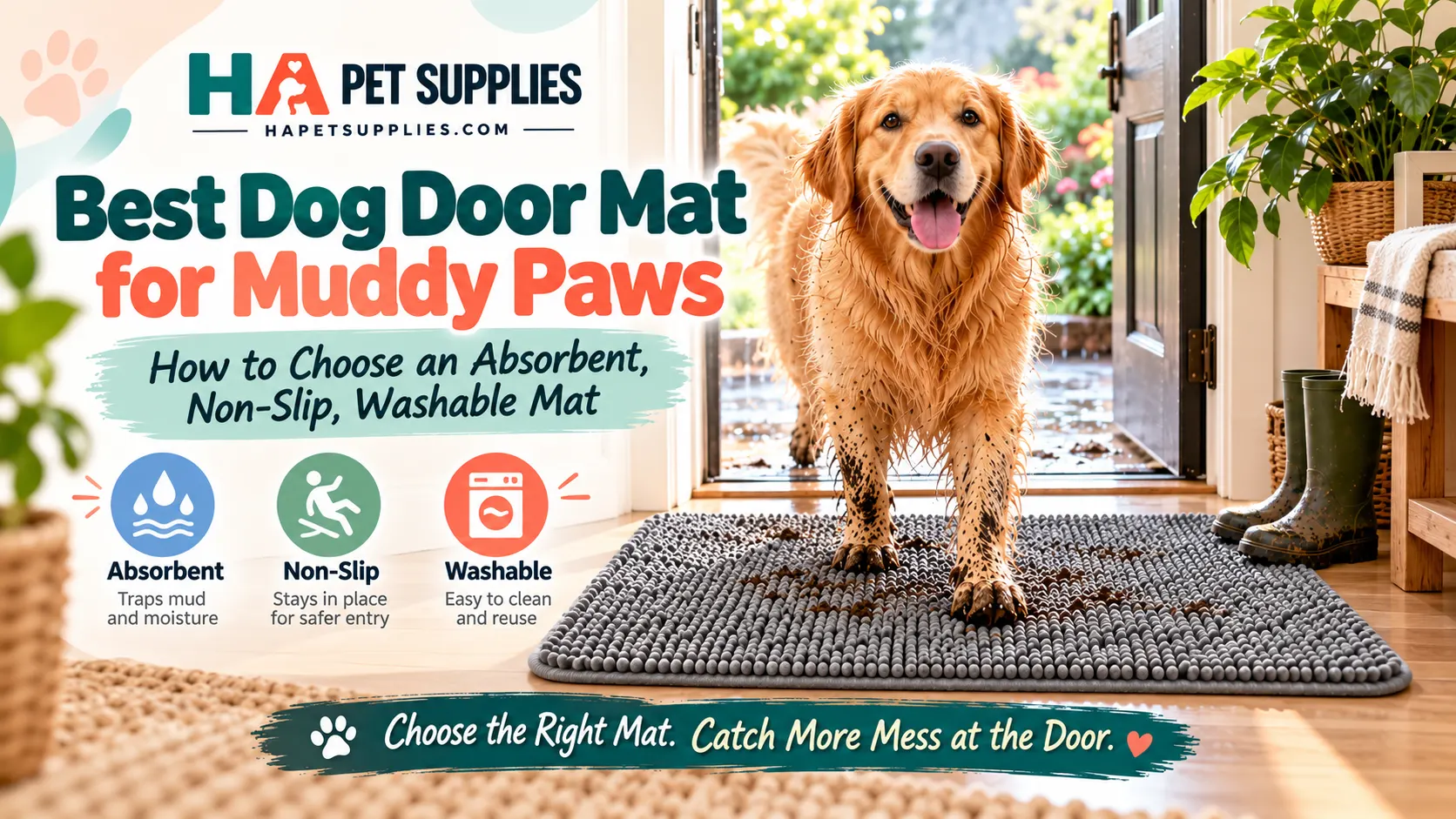
A properly placed absorbent dog mat gives wet and muddy paws a dedicated landing zone before they reach the rest of the floor.
Dog Door Mat for Muddy Paws Feature 1: Absorbency
Absorbency is one of the biggest reasons people buy these mats. But the word absorbent is used very loosely in product descriptions. What matters is how the surface behaves with wet paw prints, dripping lower legs, rainwater, damp fur, and melted snow. A mat should be able to pull moisture away from the top surface rather than letting water remain pooled where the dog keeps stepping.
This is especially useful when the dog enters after rain, backyard play, snow, swimming, or wet grass. An absorbent mat does not remove mud packed deep between the paw pads, but it can reduce the first wave of moisture. That is why it works best as the first stage of the cleanup process.
How Much Absorbency Do You Really Need?
That depends on your climate and dog. A small dog in a dry climate may only need moderate absorption. A Labrador coming in from wet grass every day needs more. Think about dog size, coat length, paw fur, rainfall, number of dogs, how often the mat gets used, and whether the dog also enters after swimming. If your entryway regularly deals with soaked paws, thin mats may become saturated quickly. A thicker, more absorbent construction usually makes more sense.
Dog Door Mat for Muddy Paws Feature 2: Mud-Trapping Texture
Absorbency handles water. Texture helps with dirt. A good mud-trapping mat should have enough surface structure to catch dust, loose soil, small clumps of mud, sand, and grass particles. This is one reason chenille-style surfaces are popular. The raised fibers create multiple contact points around the paw instead of offering one flat surface. That can help transfer loose debris away from the dog.
Do not assume that “soft” automatically means “effective.” The key is the combination of pile depth, fiber density, absorbency, grip, and easy cleaning.
What Is Chenille and Why Is It Common in Muddy Mats for Dogs?
Chenille refers to a soft textured textile with a fuzzy, tufted surface. For dog mats, this type of construction can be useful because the raised fibers create many small areas that can contact the paw. Potential advantages include soft feel, high surface area, moisture absorption, dirt trapping, and comfort for standing. The trade-off is that deep-pile mats can hold more dirt and therefore need regular washing. That is not necessarily a problem if the mat is designed to be washable. It simply means washability becomes just as important as absorbency.
Dog Door Mat for Muddy Paws Feature 3: Non-Slip Backing
This feature is easy to ignore until the mat moves. A lightweight mat on smooth flooring can shift when a medium or large dog steps onto it. That can create poor paw contact, reduced mud trapping, bunching, and a slipping hazard. A non-slip or anti-skid backing helps the mat stay more stable during normal entry and exit. This is especially important on tile, laminate, vinyl, and polished wood.
However, no backing works perfectly on every surface. The floor should also be clean, dry, free from dust, and compatible with the backing material. A dirty floor under a “non-slip” mat can still reduce grip.
Can Rubber or Anti-Slip Backing Affect Flooring?
Potentially. Some flooring manufacturers caution that certain rubber or latex-backed mats may interact with finishes or discolor surfaces over time. That means you should check the care instructions for your specific flooring. This is particularly relevant for luxury vinyl, certain hardwood finishes, and specialty flooring. If you are unsure, check the flooring manufacturer’s recommendations before leaving a backed mat in place long term. This is another reason good product guidance should not promise “safe for every floor type” unless that claim has been verified.
Dog Door Mat for Muddy Paws Feature 4: Washability
A muddy dog mat will get dirty. That is not a flaw. It is the point. The question is how easy it is to clean afterward. A useful dog mat should ideally fit into the owner’s regular cleaning routine. Before buying, check machine washable or hand wash only, water temperature, detergent restrictions, tumble dry or air dry, drying time, and whether backing survives repeated washing.
CDC recommends cleaning pet items regularly and following manufacturer instructions for washing and drying. That principle applies well here. A mat that traps dirt effectively but is miserable to clean will eventually stop being used.
How Often Should You Wash a Dog Door Mat?
There is no universal answer. Wash more frequently when the mat smells, mud is visibly built up, it stays damp, several dogs use it, the weather is persistently wet, or the mat becomes less effective. For light use, shaking or vacuuming may be enough between washes. For heavy muddy conditions, frequent washing is more realistic. The important point is not to wait until the mat becomes permanently dirty.
Dog Door Mat for Muddy Paws Feature 5: Size
Many buyers underestimate this. A mat may look large in a product photo but be too small for a large dog. You want enough space for multiple paw contacts. If the dog only places one paw on the mat and the next step lands on hardwood, the mat has limited opportunity to work. For larger dogs, consider body width, stride, doorway width, entry direction, and turning behavior.
A larger mat can be especially useful at back doors, patio doors, garage entrances, and mudrooms.
How to Measure Your Entryway for a Dog Mat
Door width: Make sure the mat covers the area where the dog naturally steps.
Available floor depth: Check how much space you have before reaching stairs, cabinets, furniture, or rugs.
Door swing: A thick mat may interfere with a door that opens inward.
Dog path: Watch your dog enter naturally. Do they walk straight? Turn immediately? Jump across the threshold? Place the mat where the dog actually lands, not where it looks most decorative.
Dog Door Mat for Muddy Paws Feature 6: Thickness
Thickness can help with comfort, absorbency, and dirt trapping. But thicker is not automatically better. Too much thickness can cause door clearance problems, edge curling, slower drying, tripping, and difficult washing. The right thickness is one that provides enough material to work without creating a new problem at the doorway. This is especially important for small apartments and tight entrances.
Dog Door Mat for Muddy Paws Feature 7: Durability
A dog mat near the door takes more abuse than a decorative rug. It may be stepped on wet, scratched by claws, washed frequently, folded, shaken outside, and exposed to mud and grit. Look at stitching, edge construction, backing, fiber attachment, and washing instructions. If the mat frays after a few washes, its low price may not actually make it good value.
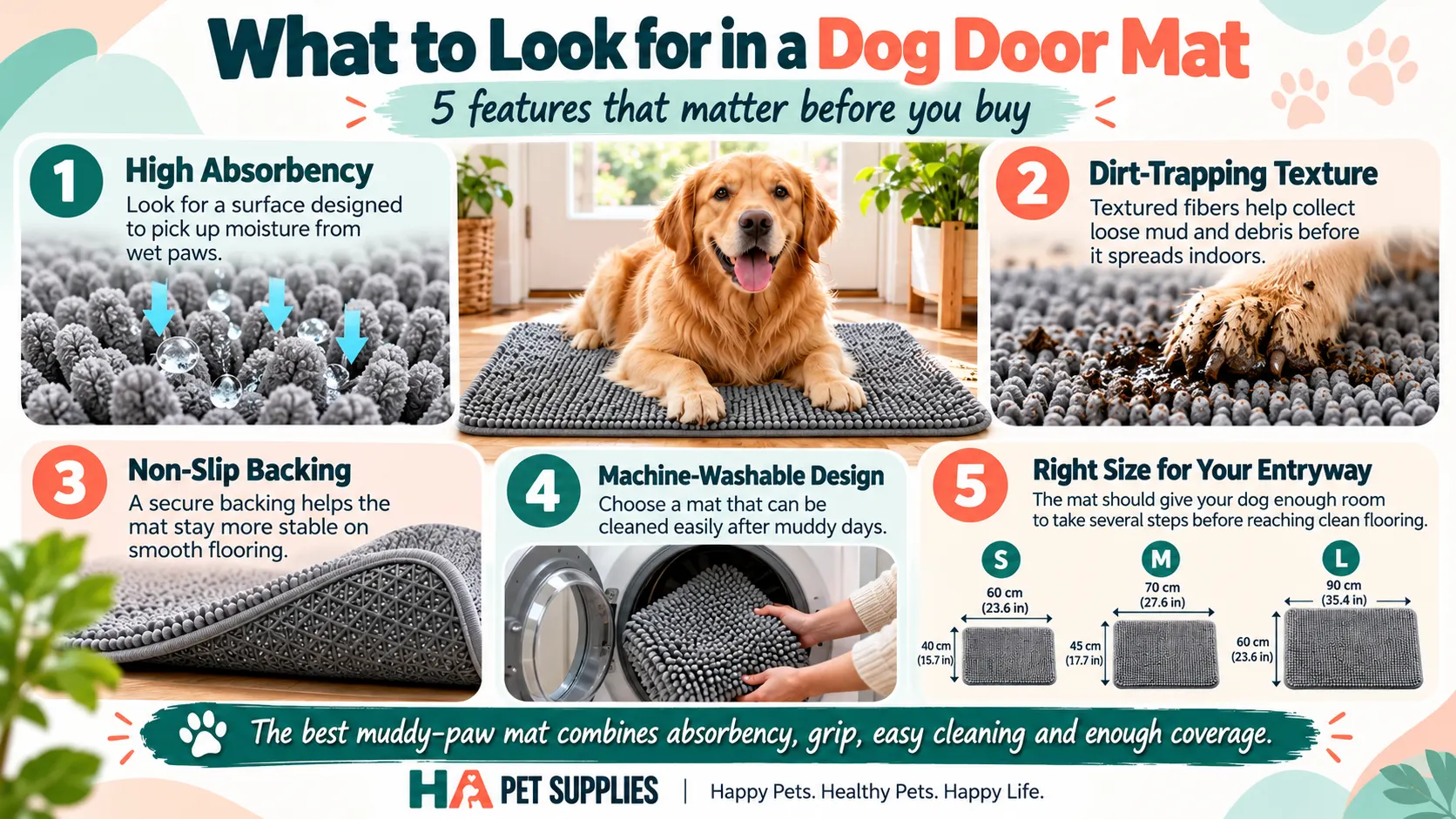
Absorbency, traction, washability, size, texture and durability are the core features to compare before buying a muddy-paw mat.
3D Infographic: “7 Features That Actually Matter”
💧 Absorbency
Helps manage wet paws and moisture.
🧶 Texture
Helps trap loose dirt and debris.
🛡️ Non-Slip Backing
Helps keep the mat stable during normal use.
🧼 Washability
Makes repeated muddy use practical.
📏 Size
Provides enough surface for multiple paw contacts.
📐 Thickness
Balances comfort, absorption and door clearance.
🏗️ Durability
Supports frequent washing and everyday use.
Muddy Mats for Dogs vs Ordinary Thin Doormats
This is one of the most useful buyer-comparison sections. A standard thin mat may be fine for dry shoes. A muddy dog mat is intended for a different problem.
🧻 Ordinary thin doormat
May provide: basic surface wiping, lightweight design, easy movement.
Potential limitations: low absorbency, limited paw contact, less cushioning, may slide, can saturate quickly.
🐾 Muddy mat for dogs
May provide: deeper texture, more absorption, softer standing surface, larger mud-trapping area, washable construction, non-slip backing.
This does not mean every dog mat automatically outperforms every human doormat. It means the features need to match the use case.
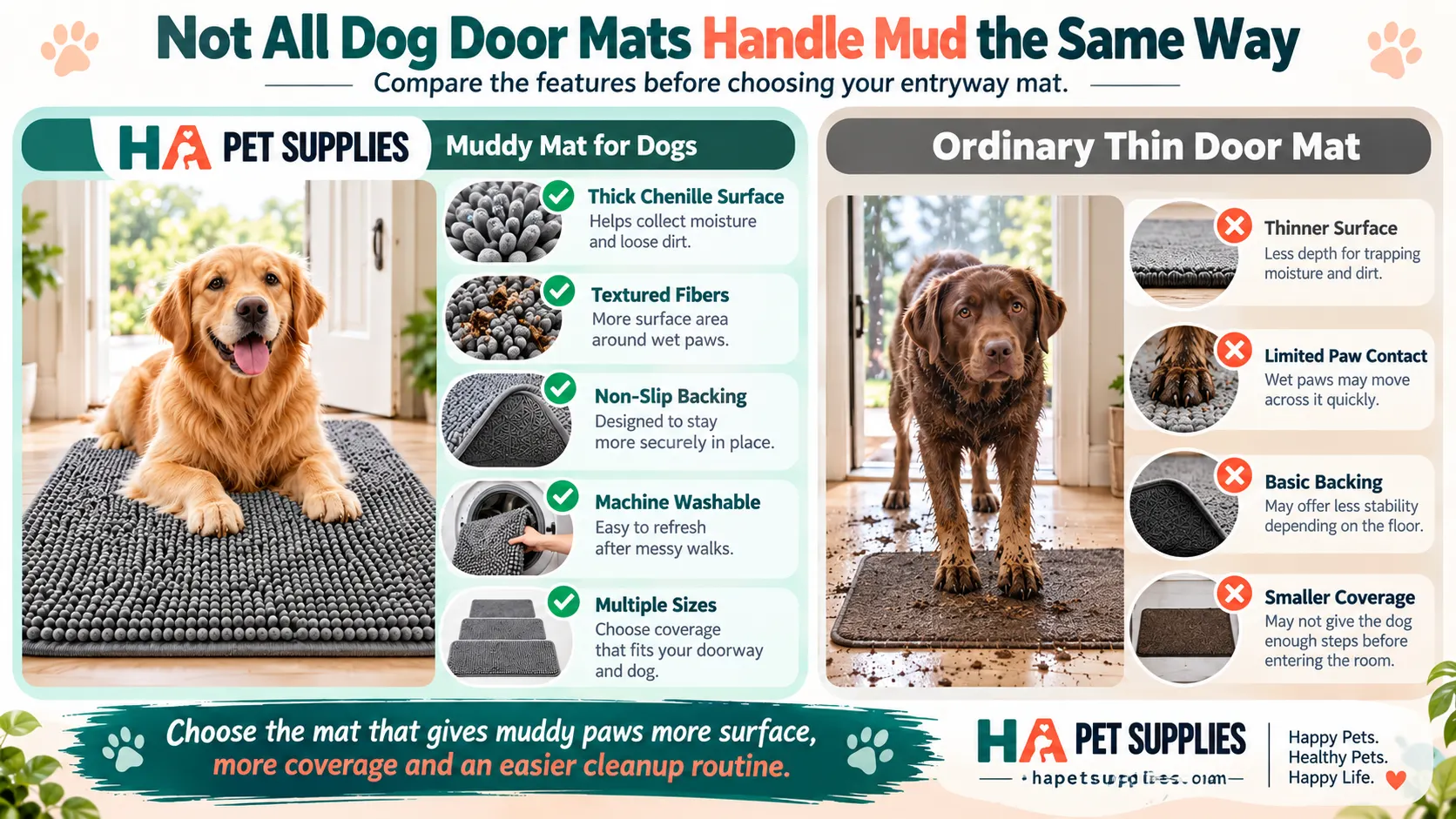
A thicker textured muddy-paw mat can provide more contact area and moisture handling than a basic thin entrance mat.
Indoor vs Outdoor Placement
For muddy dog paws, the most useful absorbent mat is usually just inside the door. Outdoor mats can help remove large clumps, stones, and coarse dirt. The indoor mat can then focus more on moisture, smaller debris, and paw drying. This creates a two-stage system: outside scraper mat → indoor absorbent dog mat. That can work well in very muddy climates.
Back Door vs Front Door
Most muddy-dog households use the back door more often. If that is your situation, prioritize function over appearance. A washable muddy mat for dogs belongs where the dog actually enters after backyard trips, rainy walks, garden play, or hikes. There is little benefit in placing the main mat at the front door if the dog always uses the back.
3D Infographic: How to Choose the Right Size
Choose by paw path and doorway size, not just by breed label.
Best Mat for Your Floor Type
Best Mat for Hardwood Floors
For hardwood, focus on moisture capture, backing compatibility, and edge stability. Do not let a saturated mat remain wet against the floor for long periods. Follow the flooring manufacturer’s instructions. The mat should help reduce tracked moisture, not become a source of trapped moisture underneath.
Best Mat for Tile Floors
Tile can become slippery when wet. Look for stable backing, good absorption, and flat edges. A mat that slides defeats its purpose.
Best Mat for Laminate Floors
Laminate can be sensitive to prolonged moisture. Use a mat that absorbs quickly, does not remain saturated, and can be removed and dried easily. Again, check the flooring manufacturer’s care guidance.
Best Mat for Carpeted Entrances
If the area immediately inside the door is carpeted, the mat becomes even more important. Mud can become embedded into carpet fibers. Use a large absorbent mat, enough coverage around the door, and a washable option. The goal is to create a removable dirty zone over the permanent flooring.
How to Clean the Floor Around the Mat
The mat catches a lot, but not everything. Loose grit may accumulate around edges, underneath, and near the threshold. Clean underneath regularly. CDC recommends routine cleaning of pet-related areas and supplies, especially when visibly dirty. This prevents the area beneath the mat from becoming a hidden dirt trap.
Cleaning Products Around Dogs
Use household cleaners according to label instructions. ASPCA advises keeping pets away from wet cleaning products until surfaces are dry and products have been used correctly. The EPA’s Safer Choice program can also help consumers identify household products that meet the program’s ingredient and performance criteria. Do not assume “natural,” “green,” or “pet-friendly” automatically means risk-free. Follow the label.
Should You Disinfect a Muddy Mat Every Time?
Usually not. Routine cleaning and disinfection are different tasks. CDC explains that cleaning removes dirt and many germs, while disinfection is an additional process used in situations where it is needed. For ordinary mud, the main goal is wash, rinse, and dry. Disinfection may be more relevant after certain types of contamination. Always follow the mat manufacturer’s instructions.
Common Buying Mistakes
❌ Mistake 1 — Buying Based on Color
A beautiful mat that barely absorbs anything will not solve the problem.
❌ Mistake 2 — Choosing Too Small a Size
The dog steps around it instead of onto it.
❌ Mistake 3 — Ignoring Door Clearance
A thick mat may block an inward-opening door.
❌ Mistake 4 — Assuming “Non-Slip” Means It Can Never Move
Floor condition and backing wear still matter.
❌ Mistake 5 — Choosing a Mat That Cannot Be Washed Easily
A muddy-paw mat will need cleaning.
❌ Mistake 6 — Expecting the Mat to Remove Deep Mud
Packed mud still requires wiping or rinsing.
❌ Mistake 7 — Putting It in the Wrong Place
The mat must sit where the dog actually steps.
3D Infographic: Mat Buying Decision Tree
Who Benefits Most From a Muddy Dog Mat?
This type of mat is particularly useful for households with dogs that use a backyard, rainy weather, muddy gardens, hiking dogs, dogs that swim, large breeds, multiple dogs, hardwood or carpet near the entrance. It is also useful for owners who are tired of cleaning the same trail of paw prints every day.
Is the HA Pet Supplies Muddy Mat Right for You?
This should remain practical rather than overly promotional. The HA Pet Supplies muddy mat for dogs is designed around the same features discussed throughout this guide, including an absorbent textured surface, washable construction and entryway use for wet or muddy paws.
Before purchasing, compare dimensions, your doorway space, your dog’s stride, flooring compatibility, and washing instructions. If you are comparing broader dog-care products, the HA Pet Supplies dog supplies category is the relevant next place to browse.
If you still are not sure whether the mat dimensions suit your entryway, contact HA Pet Supplies before ordering instead of guessing. For wholesale, retailer or bulk requirements, the request a quote page is the appropriate commercial route.
Interactive FAQ: Dog Door Mat for Muddy Paws
The best mat is one that combines strong absorbency, mud-trapping texture, stable backing, washable construction, appropriate size and good durability for your dog’s size and entryway.
They can reduce loose dirt and moisture when placed where the dog first steps indoors. They work best as part of a broader muddy-paw routine.
Chenille-style fibers can provide a soft textured surface with high contact area for moisture and loose dirt. Performance still depends on density, backing and overall construction.
For frequent muddy use, machine washability can make maintenance much easier. Always check the manufacturer’s instructions.
Choose enough width and depth for your dog to take several steps on the mat. Large dogs usually need more area than small dogs.
Check both the mat and flooring manufacturer’s instructions. Some backing materials may not be recommended for every floor finish.
Not always. It works well for light dirt and moisture, but packed mud and debris between the toes may require wiping or rinsing.
Immediately inside the door the dog uses most often.
No. Very thick mats may interfere with door clearance or dry more slowly.
Check the manufacturer instructions. Some absorbent indoor mats are not designed for prolonged outdoor exposure.
Wash it when visibly dirty, smelly, saturated or less effective, and follow the care instructions.
Only if the manufacturer allows it. Some non-slip backings can be damaged by high heat.
Supervise and remove access if the dog is chewing or ingesting material. AKC provides guidance on destructive chewing.
They solve different problems. A mat is better for first contact and light moisture; a paw washer is more useful for mud packed around the paw pads.
Use whatever layout gives your dog enough absorbent surface before they reach the main floor.
Final Buying Checklist
Your Dog
- Size
- Stride length
- Coat
- Paw fur
- Activity level
Your Doorway
- Width
- Depth
- Door swing
- Floor type
The Mat
- Absorbency
- Texture
- Backing
- Size
- Thickness
- Washability
- Durability
Your Routine
- How often it gets muddy
- Whether you also use towels
- Whether you need a paw washer
- How often you want to wash the mat
If those four areas line up, you are far more likely to choose a mat that actually gets used.
Conclusion: Choose the Mat That Fits the Real Mess
The best dog door mat for muddy paws is not necessarily the most expensive or the thickest. It is the one that matches your actual problem.
If your dog mostly brings in rainwater, prioritize absorbency. If the problem is loose soil and dirt, focus on texture. If you have slippery tile, pay close attention to backing. If you have a large dog, make sure the mat is big enough. If you live somewhere muddy for half the year, washability and durability become much more important.
And if your dog’s paws are routinely packed with heavy mud, do not expect a mat to solve everything by itself. Use it as the first step in a larger cleanup routine.
For readers who need the complete routine rather than just the product-selection advice, link them back to How to Keep Muddy Dog Paws From Ruining Your Floors: The Complete Muddy-Paw Entryway Routine.
For heavier mess, the next useful guide is Muddy Dog Paws After Walks: Dog Mat vs Towel vs Paw Washer vs Boots — What Actually Works?.
That gives this post a clear purpose inside your SEO cluster:
- Blog 1: How do I stop muddy paws ruining my floors?
- Blog 2: Which dog door mat should I buy?
- Blog 3: Which cleaning method works best for different levels of mud?
Together, the three posts cover the full buyer journey without repeating the same search intent.