
Muddy dog paws after walks create one of those small daily problems that can become surprisingly frustrating. You get home after rain. Your dog is excited. The paws are wet. There is mud between the toes. The dog wants to run inside. You have only a few seconds to decide what to do.
Should you let an absorbent mat handle it? Grab a towel? Use a paw washer? Or would boots have prevented the entire problem? The answer is not that one method is always best. The best solution depends on how muddy the dog actually is.
For light dampness, a full paw wash may be unnecessary. For mud packed between the pads, simply standing on a mat will not be enough. For road salt or winter chemicals, wiping the surface may still leave residue between the toes. And when you know the trail ahead will be extremely wet or muddy, prevention with well-fitting dog boots can sometimes be easier than cleaning afterward.
The fastest approach is therefore: Match the cleanup method to the level and type of mess.
If your bigger problem is building a complete doorway system rather than comparing individual tools, start with the pillar guide on how to keep muddy dog paws from ruining your floors.
If you are specifically deciding which mat to buy, the supporting guide on choosing an absorbent, non-slip and washable dog door mat for muddy paws covers that purchase decision in greater detail.
This article focuses on something more immediate: Your dog has just come back from a walk. What should you use right now?
📋 What’s Inside
- Quick Answer: What Works Best
- Why Different Cleanup Methods
- Method 1: Dog Mat
- Method 2: Towel
- Method 3: Paw Washer
- Method 4: Boots
- 3D Infographic: Comparison
- Which Method Is Fastest?
- Best for Daily Use
- Best for Muddy Hiking Dogs
- Best for Winter Salt
- 3D Decision Guide: How Muddy?
- Best Method Is Often a Combination
- How to Check the Paws
- Common Mistakes
- Interactive FAQ
- Final Decision Checklist
Quick Answer: What Works Best for Muddy Dog Paws After Walks?
Light moisture or dust: Use an absorbent dog mat.
Wet paws and lower legs: Use the mat first, then a towel.
Heavy mud between the paw pads: Use a paw washer or gentle rinse, then dry thoroughly.
Very muddy, snowy or salted routes you use regularly: Consider properly fitted dog boots as prevention.
AKC’s paw-care guidance similarly distinguishes between lighter cleaning, where pet-safe wipes or a damp cloth may be enough, and more serious dirt or salt exposure, where washing may be necessary. It also emphasizes checking between the toes and pads after cleaning. The mistake is assuming every walk needs exactly the same cleanup routine. It does not.
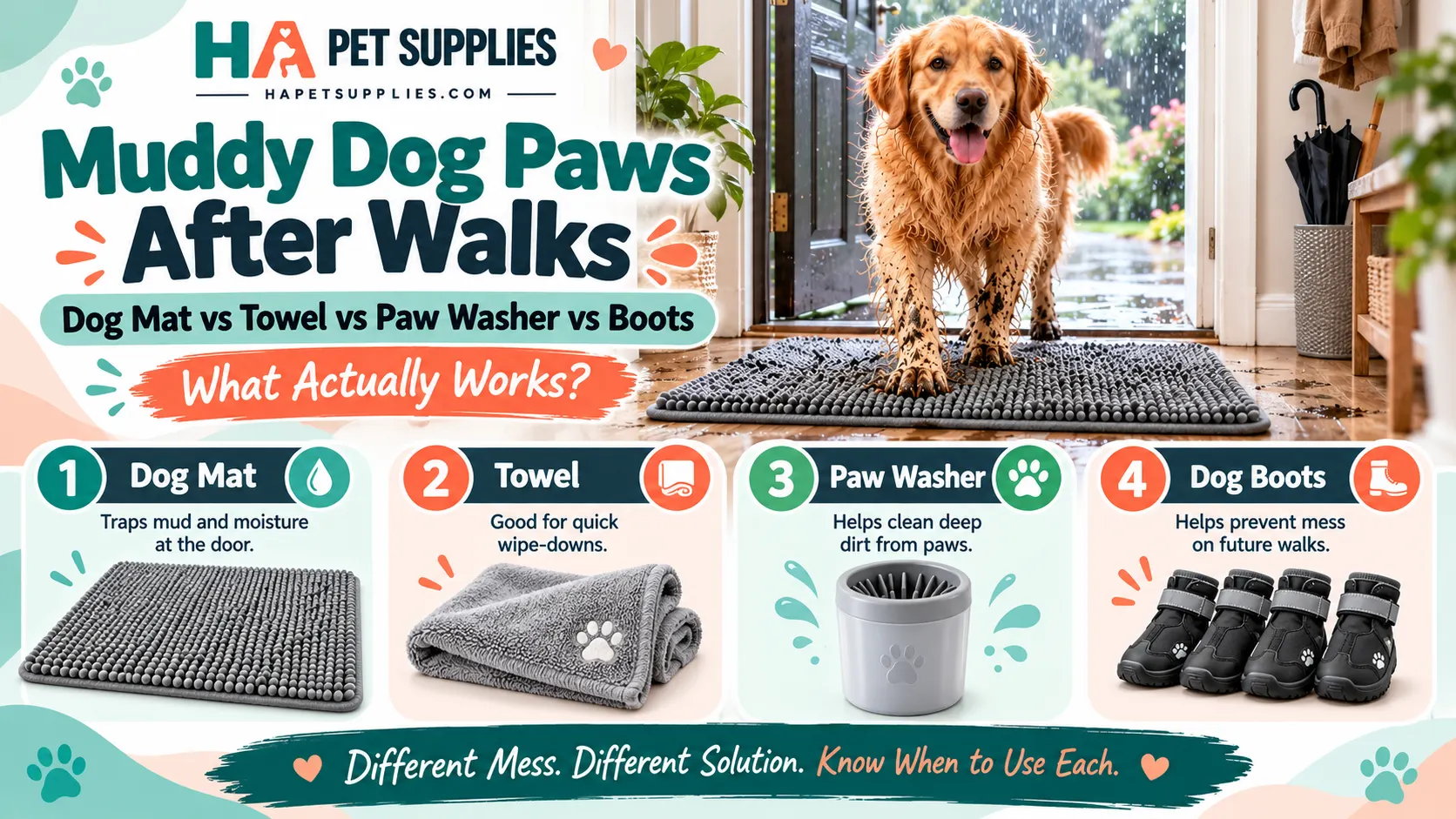
Different levels of mud call for different solutions, from an absorbent mat for light moisture to washing or boots for more difficult conditions.
Why Muddy Dog Paws After Walks Need Different Cleanup Methods
The phrase muddy paws covers several very different situations. One dog may come back with slightly damp pads from wet grass. Another may return with thick clay packed between every toe. A third may look relatively clean but have walked over salted winter pavement. Treating all three dogs the same makes the process either ineffective or unnecessarily complicated.
A useful system starts by asking three questions: How wet are the paws? Where is the dirt located? Is the substance ordinary mud, or could it include salt, de-icer, sand or other debris?
AKC recommends checking between the toes, around the paw pads and under the nails because dirt and salt can remain trapped there even when the outside of the paw appears relatively clean. That means your eyes should determine the next step—not habit.
Method 1: Dog Mat for Muddy Dog Paws After Walks
For light everyday mess, the simplest option is often the best. A textured absorbent dog mat placed immediately inside the doorway can help collect light rainwater, damp paw prints, loose soil, fine dirt, small bits of grass, and superficial mud.
The biggest advantage is speed. Your dog simply walks or pauses on the surface. There is no equipment to fill with water. There is no need to hold each paw individually. And there is much less chance of turning a lightly damp walk into a full grooming session.
The HA Pet Supplies muddy mat for dogs fits naturally into this role as the first landing zone inside the doorway. For confused buyers, keep the explanation simple: The mat handles what transfers through normal paw contact. It does not dig mud out from between the toes.
When a Dog Mat Works Best
A dog mat is particularly useful after wet grass, light rain, dusty walks, mildly muddy sidewalks, quick backyard toilet breaks, and slightly damp morning walks. It is also the easiest method to leave permanently ready. That matters because the best cleaning system is not necessarily the most powerful. It is the one you will actually use every day.
When a Dog Mat Is Not Enough
The mat becomes less effective when mud is packed between paw pads, thick mud covers the paw tops, mud reaches the lower legs, there is road salt between the toes, there are sticky substances on the fur, or the dog is soaked from rain or swimming. In these situations, use the mat as stage one, not the entire solution. Think: mat → inspect → clean remaining dirt → dry rather than: mat → assume everything is clean.
Why Mat Placement Matters
An absorbent mat cannot catch the first paw prints if the dog crosses the hallway before reaching it. Place the mat where the dog first lands indoors. The ideal path is: outside → threshold → mat, not: outside → hardwood → three paw prints → mat.
If you are still deciding on dimensions, backing, absorbency and texture, the full dog door mat for muddy paws buying guide explains those factors separately.
Method 2: Using a Towel for Muddy Dog Paws After Walks
The humble dog towel is probably the most versatile option in this comparison. A towel can reach places a flat mat cannot: paw tops, ankles, lower legs, long leg fur, belly fur, and between toes when handled carefully.
For moderate mud, the most efficient combination is often: mat first → towel second. The mat removes some moisture through normal standing. The towel finishes the job.
When a Towel Works Best
Use a towel when paws are noticeably wet, the lower legs are damp, mud is still superficial, the dog has wet fur around the feet, you have already rinsed the paws, or the dog has walked through wet grass.
RSPCA advises drying dogs after wet walks and wiping paws and the tummy after winter walks where dogs may encounter substances such as grit and rock salt. A towel is therefore more than a floor-protection tool. It is also useful for removing residual moisture from the dog’s coat.
What Kind of Towel Should You Use?
You do not need something complicated. The most important qualities are absorbency, softness, washability, suitable size, and easy access near the door. Keep at least two or three in rotation if muddy walks are frequent. That prevents the common mistake of reusing the same saturated towel for several days. A dirty wet towel does not become more effective because it is labelled “the dog towel.” Wash it. Dry it. Rotate it.
Can You Clean Between the Paw Pads With a Towel?
For light dirt, yes. But do it gently. Do not aggressively push a thick towel between sensitive toes. Instead: lift the paw, separate the toes gently, check visually, use a damp corner of the towel if needed, and dry carefully.
AKC specifically recommends gently parting the toes while cleaning because mud, salt and debris can remain around the pads and beneath the nails.
When a Towel Is Not Enough
A towel struggles with dried clay, sticky deep mud, compacted debris, heavy salt residue, and mud embedded in long paw hair. At that point, rubbing more aggressively is not the answer. Water becomes more useful.
Method 3: Paw Washer for Muddy Dog Paws After Walks
A paw washer is designed for a more difficult level of mess. Most versions use a cup-like container filled with water, sometimes with soft internal bristles or silicone structures. The dog places one paw inside at a time. The goal is to loosen debris that a mat or dry towel cannot reach easily.
A paw washer makes the most sense when the problem is mud around and between the paws, not when the entire dog is soaked.
When a Paw Washer Works Best
Consider one when mud is packed around the pads, the dog has walked on sticky soil, the paws are muddy but the rest of the dog is relatively clean, you do not want to put the dog into the bathtub after every walk, or you frequently hike or walk on muddy trails.
AKC notes that serious mud, sand or salt may require more thorough washing and mentions portable paw cleaners as one possible method. That makes the paw washer a targeted cleaning tool, rather than a replacement for every other method.
How to Use a Paw Washer Without Making More Mess
The cleanup tool should not become another source of muddy water. Use a simple sequence: keep the dog standing on the muddy mat, fill the washer as directed, clean one paw at a time, inspect between the toes, replace dirty water when necessary, dry each paw immediately, and clean the washer after use.
Placing the dog on an absorbent mat during this process helps catch drips, spilled water, and loosened mud. This is why these tools often work better together than individually.
Paw Washer vs Full Rinse
A paw washer is convenient when the dirt is concentrated on the feet. A rinse is better when mud covers the legs, the belly is dirty, the dog rolled in mud, there is heavy contamination, or multiple areas need cleaning. Do not spend ten minutes trying to clean a completely muddy dog through a tiny paw cup. Sometimes the fastest method is simply the bath or shower.
ASPCA’s grooming guidance recommends washing paws after exposure to salt and chemical ice melters and notes that deeper wounds or significant paw problems should be evaluated by a veterinarian.
Method 4: Boots for Preventing Muddy Dog Paws After Walks
Dog boots work differently from the other three methods. The mat, towel and washer clean after the mess happens. Boots attempt to reduce direct paw exposure before it happens. That makes them particularly interesting for owners dealing with the same difficult conditions every day.
Boots may be useful for deep mud, salted winter sidewalks, snow, grit, rough terrain, and dogs with sensitive paw pads.
Cornell recommends well-fitting booties as one option for protecting paws from salt, snow and other winter conditions. AAHA likewise recommends considering properly fitted booties where snow, ice or road salt could irritate the paws.
Do Dog Boots Stop All Mud?
No. Mud may still reach leg fur, belly fur, boot edges, and the dog’s coat. And wet boots themselves need cleaning. The more accurate promise is: Boots can reduce direct contact between the paw pads and muddy or contaminated ground. That can make after-walk cleanup easier.
The Biggest Problem With Dog Boots: Fit
Boots are only useful if they stay on, do not restrict circulation, do not rub, allow normal movement, and fit the paw shape properly. RSPCA recommends comfortable fitting protective clothing and notes that dog boots can help protect paws from cold surfaces and substances such as rock salt and grit.
Loose boots can twist or fall off. Overly tight boots can create pressure. Do not buy them solely by looking at a breed name. Measure according to the manufacturer’s sizing instructions.
The Second Problem: Your Dog May Hate Them at First
Dogs do not automatically understand footwear. A dog wearing boots for the first time may lift the legs dramatically, freeze, bite at the boots, walk awkwardly, or refuse to move. Introduce them gradually. Start indoors. Reward calm behavior. Use short sessions. Do not wait until a freezing, muddy morning to introduce all four boots for the first time.
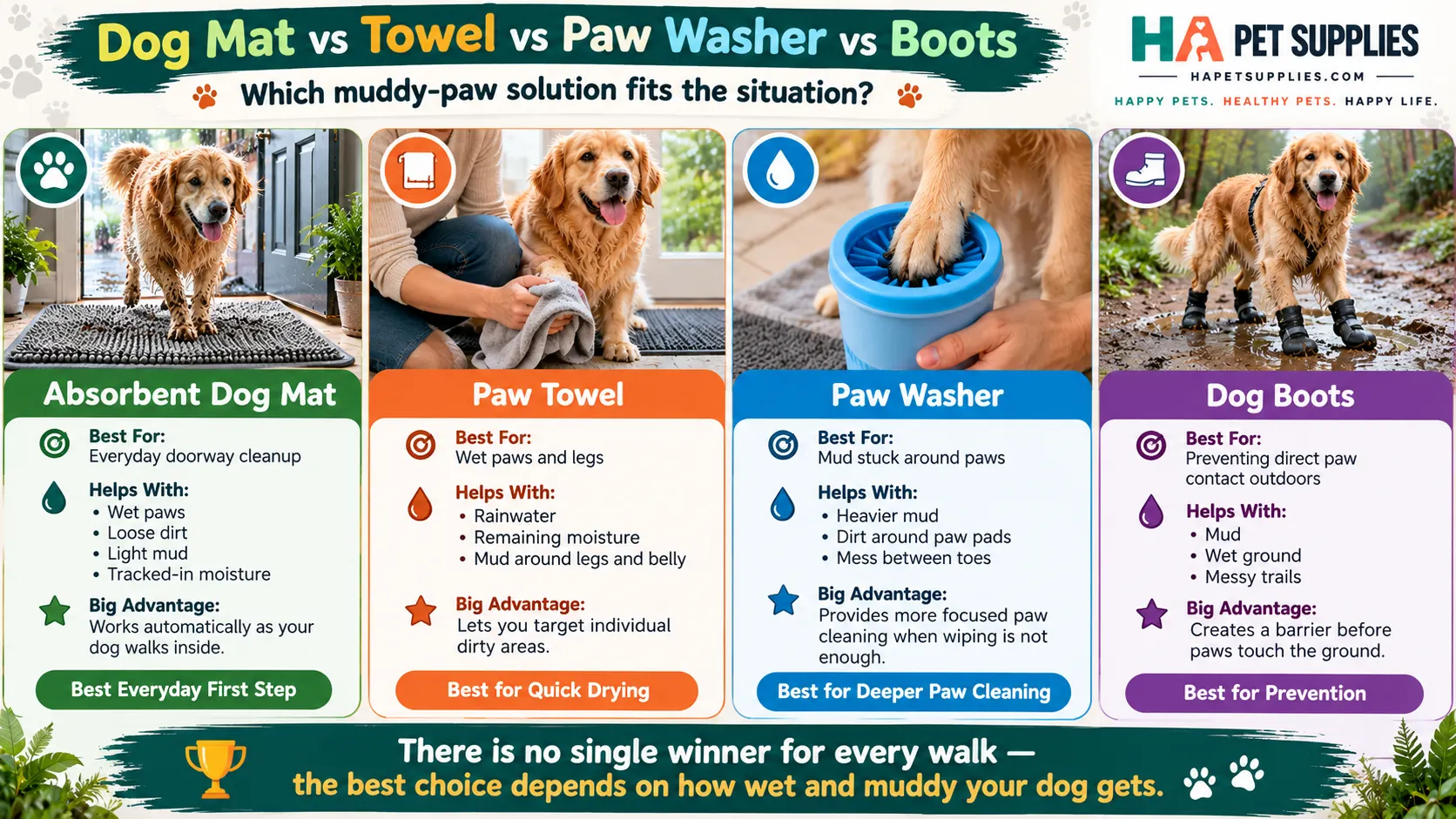
A mat is fastest for light mess, towels handle moderate moisture, paw washers target packed mud, and boots can reduce direct exposure before the walk.
3D Infographic: Dog Mat vs Towel vs Paw Washer vs Boots
🐾 Dog Mat
Best for: Light mud and moisture
Speed: Very fast
Hands-on cleaning: Low
Main advantage: Always ready at the doorway
Main limitation: Cannot clean deep between paw pads
🧻 Towel
Best for: Wet paws, legs and moderate mess
Speed: Fast
Hands-on cleaning: Moderate
Main advantage: Flexible and inexpensive
Main limitation: Can smear thick mud rather than remove it
🚿 Paw Washer
Best for: Heavy mud concentrated around paws
Speed: Moderate
Hands-on cleaning: Higher
Main advantage: Reaches dirt around paw pads more effectively
Main limitation: Needs water, drying and cleaning afterward
🥾 Dog Boots
Best for: Prevention during severe conditions
Speed: Fast after the dog is trained to wear them
Hands-on cleaning: Mostly before the walk
Main advantage: Reduces direct paw contact with mud, salt and grit
Main limitation: Fit and acclimation matter
Which Method Is Fastest?
For ordinary everyday use: Dog mat wins. The dog simply steps onto it. No filling. No drying equipment. No boot fastening. But speed is only useful if the method is strong enough for the actual mess. A mat that takes ten seconds but leaves mud between every toe has not solved the problem.
So instead of asking: “Which tool is fastest?” ask: “Which is the fastest tool that is strong enough for this level of dirt?” That is a much more useful buying decision.
Which Method Cleans the Most Thoroughly?
For mud concentrated around the paws, washing or a paw washer is more thorough than simply standing on a mat. AKC explicitly notes that serious messes may need washing and stresses drying thoroughly afterward. But a paw washer would be excessive for slightly damp paws. The most thorough method is not automatically the best everyday method.
Which Method Is Best for Daily Use?
For many households: mat + towel is the most practical daily combination. Why? Because it handles the most common middle ground: wet paws, light mud, wet lower legs, and loose debris. The mat reduces the first wave of mess. The towel finishes the remaining moisture. The paw washer then remains available for heavier days.
Which Method Is Best for Very Muddy Hiking Dogs?
For regular hiking: mat + paw washer/rinse + towel is usually the more logical system. The mat gives you a controlled cleaning zone. The washer or water removes packed mud. The towel dries afterward. If the trail conditions are predictably severe, well-fitting boots may reduce the amount of cleaning required.
Which Method Is Best for Rainy Backyard Trips?
Usually: absorbent mat or mat + towel. A complete paw wash after every 60-second backyard toilet break is rarely practical. The aim is to create a routine simple enough that the household will follow it consistently.
Which Method Is Best for Winter Salt?
Do not depend on a mat alone. Road salt and de-icer residues can remain between the toes.
ASPCA warns that common de-icers can irritate paws and may create gastrointestinal or electrolyte problems if substantial material is ingested. Cornell recommends wiping or washing the paws after returning indoors to remove salt, de-icers and snowballs. AAHA similarly recommends wiping paws with a warm damp cloth and checking between toes for debris after winter outings.
So winter should look more like: mat → wipe/rinse → inspect → dry. Boots may provide additional preventive coverage.
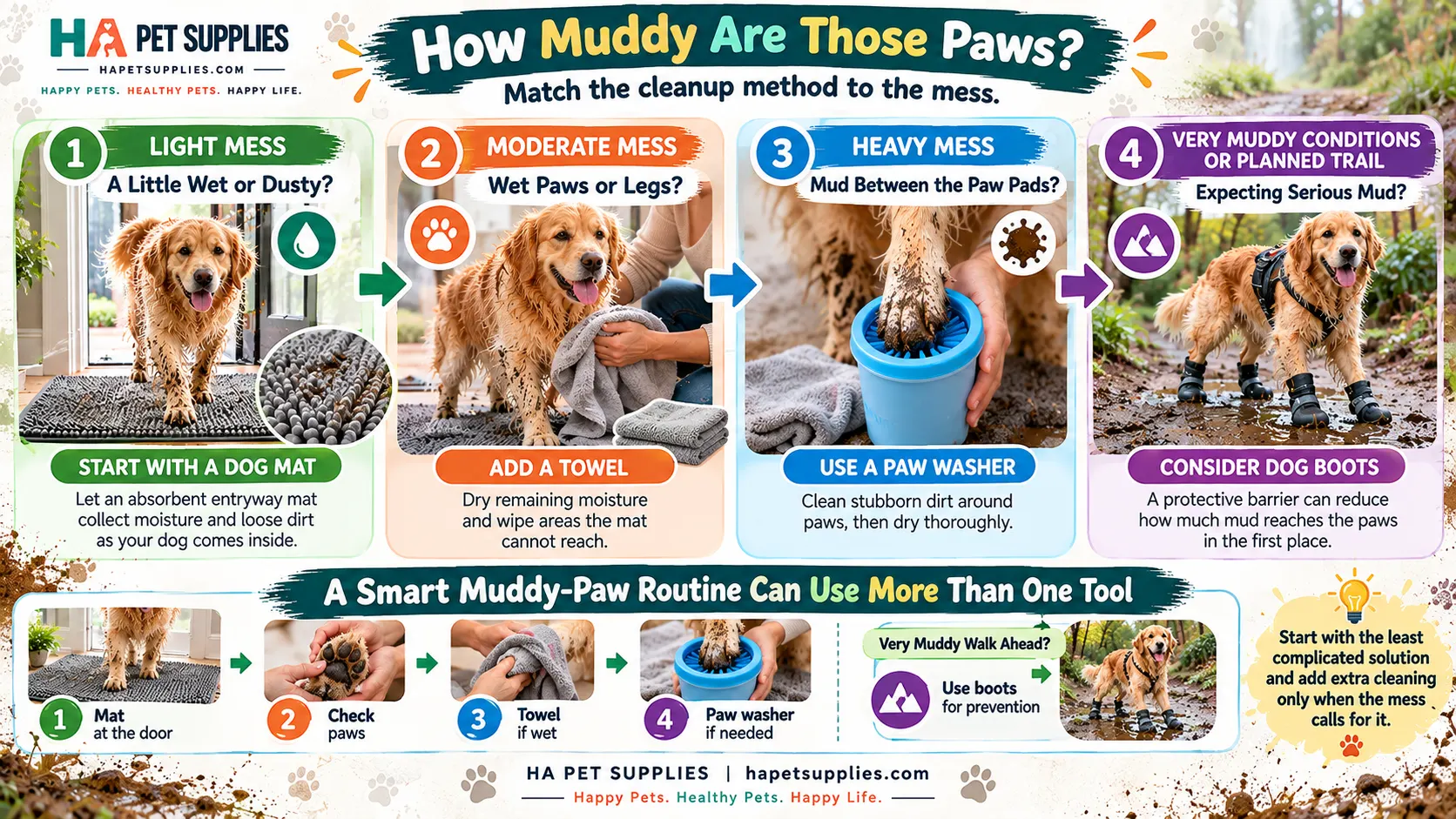
Match the cleanup method to the mess: mat for light dirt, towel for moderate moisture, paw washing for packed mud, and boots when prevention makes more sense.
3D Decision Guide: How Muddy Are Those Paws?
The Best Method Is Often a Combination
This is the most important conclusion of the comparison. These products should not be treated as four competing solutions where you must permanently choose one. They perform different jobs.
A highly practical home system might be:
- Everyday: absorbent muddy mat
- Wet day: mat + towel
- Very muddy hike: mat + rinse or paw washer + towel
- Winter salt: boots outdoors + wipe/rinse indoors
This is why the complete muddy-paw entryway routine uses multiple layers instead of depending on one product.
How to Check the Paws After Any Method
Whatever tool you use, finish with a quick inspection. Look between the toes, around each pad, underneath the nails, along the paw edges, and through long paw fur. Check for remaining mud, stones, grass seeds, salt, redness, cuts, cracking, and swelling.
AKC emphasizes checking between the toes and pads rather than stopping after a superficial wipe. ASPCA also recommends paying close attention to paw condition and contacting a veterinarian for deeper cuts or more serious injury.
Do You Need Soap for Muddy Dog Paws After Walks?
Usually not for every walk. Ordinary mud can often be removed with water, a damp towel, or appropriate paw cleaning. Constant use of unnecessary products may complicate a simple task. If a cleanser is needed, use something intended for dogs and follow the label. Do not use random household cleaners on the dog’s paws.
Can You Use Human Wet Wipes?
Do not assume every human wipe is suitable. Some contain fragrances, alcohol, cleaning chemicals, or other ingredients not intended for repeated dog paw use. Use wipes specifically labelled as suitable for pets when you need a portable option. AKC identifies pet-safe wipes as one option for lighter muddy, sandy or salty paws.
How to Deal With Long Fur Around the Paws
Long-haired dogs often hold more mud, snow, water, and grit. The problem may be partly the hair rather than the paw surface itself. Cornell recommends strategic trimming around areas where snowballs accumulate rather than shaving a dog’s coat excessively short in winter. ASPCA also notes that keeping excess hair around the toes managed may reduce the amount of ice, salt and de-icing material clinging to the coat. If you are uncomfortable trimming paw hair yourself, ask a groomer or veterinarian.
What About Cracked or Irritated Paw Pads?
At that point, you are no longer dealing with only a floor-cleaning problem. Cold weather, salt, rough terrain and repeated exposure can contribute to irritated or cracked pads. AAHA notes that winter conditions can cause cracking and irritation and recommends wiping away salt, ice and debris after walks. If the paws are bleeding, swollen, badly cracked, painful, or causing persistent limping, contact your veterinarian.
Cleaning Your Dog Mat and Paw-Care Equipment
Anything designed to catch mud will eventually become dirty. That includes the mat, towel, paw washer, and boots.
CDC distinguishes ordinary cleaning from disinfection and recommends following the manufacturer’s care directions for pet items. Cleaning is generally sufficient for many everyday pet supplies, while disinfection is an additional step for certain contamination or health situations.
- Mat: Shake out loose debris and wash according to care instructions.
- Towel: Machine wash regularly and dry fully.
- Paw Washer: Empty muddy water, wash the container and allow it to dry.
- Boots: Remove soil, clean according to the manufacturer instructions and dry before reuse.
Do not store wet equipment in a closed basket.
Should You Disinfect Everything After Every Walk?
No. Mud does not automatically mean that every item needs strong disinfectant. CDC explains that cleaning physically removes dirt and germs, while disinfection uses chemicals to kill germs and is an additional step in certain circumstances. For an ordinary muddy walk, good washing and drying are usually the more relevant tasks. If a pet item is contaminated with feces, urine, illness-related material or another higher-risk substance, stronger cleaning measures may be appropriate. Follow the product’s instructions.
3D Infographic: One-Minute Muddy Paw System
Do not over-clean a light mess or under-clean a heavy one.
Can You Train a Dog to Make Paw Cleaning Easier?
Yes. The ideal time to teach paw handling is before the dog is standing at the door covered in mud. Practice on clean days. Start with: touch the paw, reward, briefly lift the paw, reward, touch with towel, reward, gradually increase handling. Make the routine predictable. Do not chase the dog around the house with a towel. If your dog becomes fearful, growls, snaps or shows significant handling sensitivity, seek help from a qualified trainer or veterinarian.
What If Your Dog Hates the Paw Washer?
Do not force it immediately. The cup can feel strange. Introduce it without water first. Let the dog sniff it. Reward calm investigation. Touch the paw near the opening. Reward again. Gradually work toward placing the paw inside. A product that creates a wrestling match after every walk is unlikely to become part of a sustainable routine.
What If Your Dog Refuses Boots?
Again, gradual introduction matters. Try: one boot indoors, reward, remove, repeat later, increase to two boots, short indoor walking, then all four. The goal is for the dog to move naturally. If the boots repeatedly twist, fall off or create rubbing, reassess the fit rather than assuming the dog simply needs to “get used to it.”
Which Method Is Cheapest?
Usually: towel because many households already have suitable towels. But cost alone is not a useful comparison. A towel may be inexpensive but require much more manual work than a permanently placed mat. A paw washer may cost more but save time after particularly muddy walks. Boots can require the most fitting and training effort but may reduce repeated exposure in difficult environments. Think about cost per use, not just purchase price.
Which Method Is Best for Large Dogs?
Large dogs often bring in more moisture simply because paws are larger, legs are larger, and there is more wet fur. A small towel or tiny doormat can quickly become inadequate. For a large dog, a practical setup might include a large absorbent mat, full-size towel, paw rinse option, and larger correctly sized boots if needed.
The HA Pet Supplies dog supplies collection can be linked naturally here for readers comparing additional dog-care and travel accessories.
Which Method Is Best for Multiple Dogs?
With two or three dogs, efficiency becomes much more important. Imagine washing 12 paws individually after every light shower. That may be unnecessary. A larger washable mat can handle first contact for everyone. Then towel or rinse only the dogs that still need it. The same principle applies: start with the least complicated method, escalate only when necessary.
If you need broader dog-care products for a multi-dog household, readers can browse the HA Pet Supplies shop without interrupting the cleanup advice.
What Works Best for Apartment Owners?
Apartment owners often lack large mudrooms, garden hoses, and utility sinks. A compact system is more practical: absorbent mat + towel + portable paw washer. Keep everything near the entrance in a small basket. For very muddy walks, clean paws before the dog reaches carpeted rooms.
If you need additional practical dog-care ideas, the HA Pet Supplies blog can be linked here because readers are already looking for home-management guidance rather than just a product page.
What Works Best in a House With a Mudroom?
A mudroom gives you more flexibility. You can create:
- Zone 1: Outdoor scraper mat
- Zone 2: Absorbent dog mat
- Zone 3: Paw washer and towels
- Zone 4: Boot and leash storage
- Zone 5: Clean release area
If you are planning a larger household setup or need product guidance, the main HA Pet Supplies website can be referenced naturally as the brand hub rather than inserted as an unrelated promotional link.
Dog Mat vs Towel vs Paw Washer vs Boots: Which Should a General Buyer Choose First?
For most general dog owners, start with:
- Absorbent dog mat — Because it is useful every day and requires almost no extra effort.
- Dedicated towel — Because it handles the areas the mat cannot.
Then add:
- Paw washer — if deep mud is common.
- Boots — if prevention is valuable because you regularly deal with road salt, snow, severe mud, or sensitive paw pads.
This avoids buying four products when two may solve most of your problem.
If you are specifically deciding on the first item, review the HA Pet Supplies muddy mat for dogs alongside the mat-selection criteria in Blog 2. If dimensions or suitability are unclear, it is better to contact HA Pet Supplies before purchasing rather than guessing. For retailers or larger commercial orders, the request a quote page is the relevant place to direct trade buyers.
Common Mistakes With Muddy Dog Paws After Walks
❌ Mistake 1 — Using a Paw Washer for Every Tiny Mess
A slightly damp paw does not need a complicated cleaning session. Better: Use the mat first.
❌ Mistake 2 — Expecting a Mat to Remove Packed Mud
A flat surface cannot reach everything between the toes. Better: Escalate to washing when needed.
❌ Mistake 3 — Rubbing Heavy Mud With a Dry Towel
This can spread dirt rather than remove it. Better: Rinse first, dry second.
❌ Mistake 4 — Removing Boots and Letting the Dog Run Immediately
The leg fur or inside of the boots may still be wet. Better: Inspect before releasing the dog.
❌ Mistake 5 — Ignoring Winter Salt
The paw may look clean while residue remains between the pads. Better: Wipe or wash after exposure. ASPCA, Cornell, AAHA and RSPCA all provide winter paw-care guidance emphasizing removal of salt, snow, grit or chemical residue after walks.
❌ Mistake 6 — Never Cleaning the Cleaning Tools
Dirty towels, wet mats and muddy paw washers become part of the problem. Better: Wash and dry them routinely.
❌ Mistake 7 — Forgetting to Inspect the Paw
A clean-looking paw can still contain a tiny stone, grass seed, salt, cut, or irritation. Better: Use cleanup time as a quick paw-health check.
Interactive FAQ: Muddy Dog Paws After Walks
For light mud, let your dog stand or walk on an absorbent mat, inspect the paws and wipe remaining moisture with a towel. Heavy mud packed around the pads may require washing.
It can be enough for light moisture and loose dirt. Deep mud, salt and debris between the pads require more hands-on cleaning.
They do different jobs. A mat handles first contact at the doorway, while a towel can reach paw tops, legs and fur.
They can be useful for dogs that regularly return with mud packed around the paws while the rest of the body stays relatively clean.
They can be useful when mud or harsh winter conditions are predictable, but correct fit and gradual training are important.
Not necessarily. Match the cleaning method to what the dog encountered. Dry clean walks may require little or no cleaning, while salt, chemicals or heavy mud deserve more attention.
Water can be appropriate when the paws need rinsing, but there is no need to turn every minor mark into a full wash. Dry thoroughly afterward.
It is better to choose wipes specifically labelled as suitable for pets rather than assuming any human wipe is appropriate.
Gently separate the toes, remove visible debris and use a damp cloth, rinse or suitable paw-cleaning tool. AKC recommends checking around and between pads during paw cleaning.
Not automatically. Ordinary mud may only require water. If you use a cleanser, choose a dog-appropriate product and follow its directions.
A large absorbent mat plus a full-size towel works well for everyday use. Keep a washing option available for heavier mud.
Start with a sufficiently large absorbent mat and only use more intensive cleaning on paws that still need it.
Not always. Mud may still reach the legs or enter around the boot opening, but boots can reduce direct contact between paws and difficult ground.
Follow the manufacturer’s instructions and wash it whenever it becomes visibly dirty, smelly, saturated or less effective. CDC recommends cleaning pet items more often when they look dirty or smell.
Usually not for ordinary mud. Cleaning and disinfection are separate processes, and CDC notes that routine cleaning is sufficient for many pet items.
Seek veterinary advice if you notice deep cuts, significant bleeding, swelling, persistent limping, marked redness, burns, severe cracking or a foreign object you cannot safely remove.
Final Decision Checklist
What Is on the Paw?
- Water or dust: Mat
- Wet fur: Mat + towel
- Loose mud: Mat + towel
- Packed mud: Wash or paw washer + towel
- Road salt: Wipe/rinse + inspect + dry
- Snow and repeated winter exposure: Consider boots + post-walk inspection
Where Is the Mess?
- Pads only: Mat may be enough.
- Between toes: Hands-on cleaning needed.
- Lower legs: Towel.
- Whole body: A full rinse or bath may be faster.
How Often Does It Happen?
- Occasionally: Keep the setup simple.
- Every day: Build a permanent entryway station.
- Predictable severe conditions: Consider prevention as well as cleanup.
Conclusion: Choose the Least Complicated Method That Actually Works
The best solution for muddy dog paws after walks is not one universal product. It is a simple decision: How dirty are the paws right now?
For a little rainwater or surface dirt, an absorbent dog mat may be all you need. For wet paws and lower legs, add a towel. For thick mud trapped around the paw pads, use water or a paw washer and dry thoroughly. And when you know you are heading into heavy mud, snow, grit or salted conditions, properly fitted dog boots can reduce how much cleanup you need later.
That creates a practical hierarchy:
- Light mess → mat
- Moderate mess → mat + towel
- Heavy mess → wash + towel
- Predictable harsh conditions → prevention + post-walk check
You do not need to turn every walk into a grooming session. You also should not expect one absorbent mat to remove deep dirt that needs washing.
For most households, the strongest everyday setup is still simple: an absorbent mat at the door, a clean towel within reach, and a stronger cleaning option reserved for genuinely muddy days. That approach keeps your routine fast enough to use consistently while still giving heavy muddy dog paws after walks the attention they need.
For owners who want to build the whole home routine around this system, the natural next step is the complete muddy-paw entryway routine. For shoppers trying to decide which absorbent mat deserves the first position at the door, the detailed dog door mat for muddy paws buying guide covers size, non-slip backing, washability, texture and durability in more depth.
The three-post content cluster then answers three different questions without competing with itself:
- Blog 1: How do I stop muddy paws from taking over my house?
- Blog 2: Which muddy dog mat should I buy?
- Blog 3: Which cleanup method should I use after this particular walk?
That makes Blog 3 the practical decision article of the cluster: the page readers can return to whenever they are standing at the door looking at four muddy paws and wondering what to do next.