
Dog bath towel vs regular towel sounds like a very simple comparison. After all, a towel is a towel, right? If your dog is wet, almost any clean towel can remove some water. That part is true. But anyone who has tried drying a large wet dog with an ordinary bathroom towel knows the practical problem.
The towel may become heavy and saturated quickly. Your dog may still be damp around the belly and legs. A dense undercoat may remain wet. Then the towel itself takes a long time to dry before you can use it again.
This is why microfiber dog towels have become popular. They are typically designed to offer strong moisture pickup, lower bulk, softer contact, faster drying, easier handling, and convenient storage. But does that mean a microfiber dog towel is always better? No. A regular household towel can still be perfectly adequate for some dogs.
The correct answer depends on your dog’s size, coat type, how wet the dog gets, how often you dry them, whether you travel, whether the towel needs to dry quickly, and how many dogs you own. So this article will not simply tell you: “Microfiber is always better because it is made for dogs.” Instead, we will compare both options feature by feature.
If your main question is how to use the towel correctly, start with the pillar guide on how to dry a dog after a bath for different coat types. If you already know you want a dedicated dog towel but are unsure what features matter, the supporting guide on choosing the best absorbent microfiber dog bath towel covers the buying decision in greater detail. This comparison focuses on one question: Is a dedicated microfiber dog towel actually more practical than using a normal bath towel?
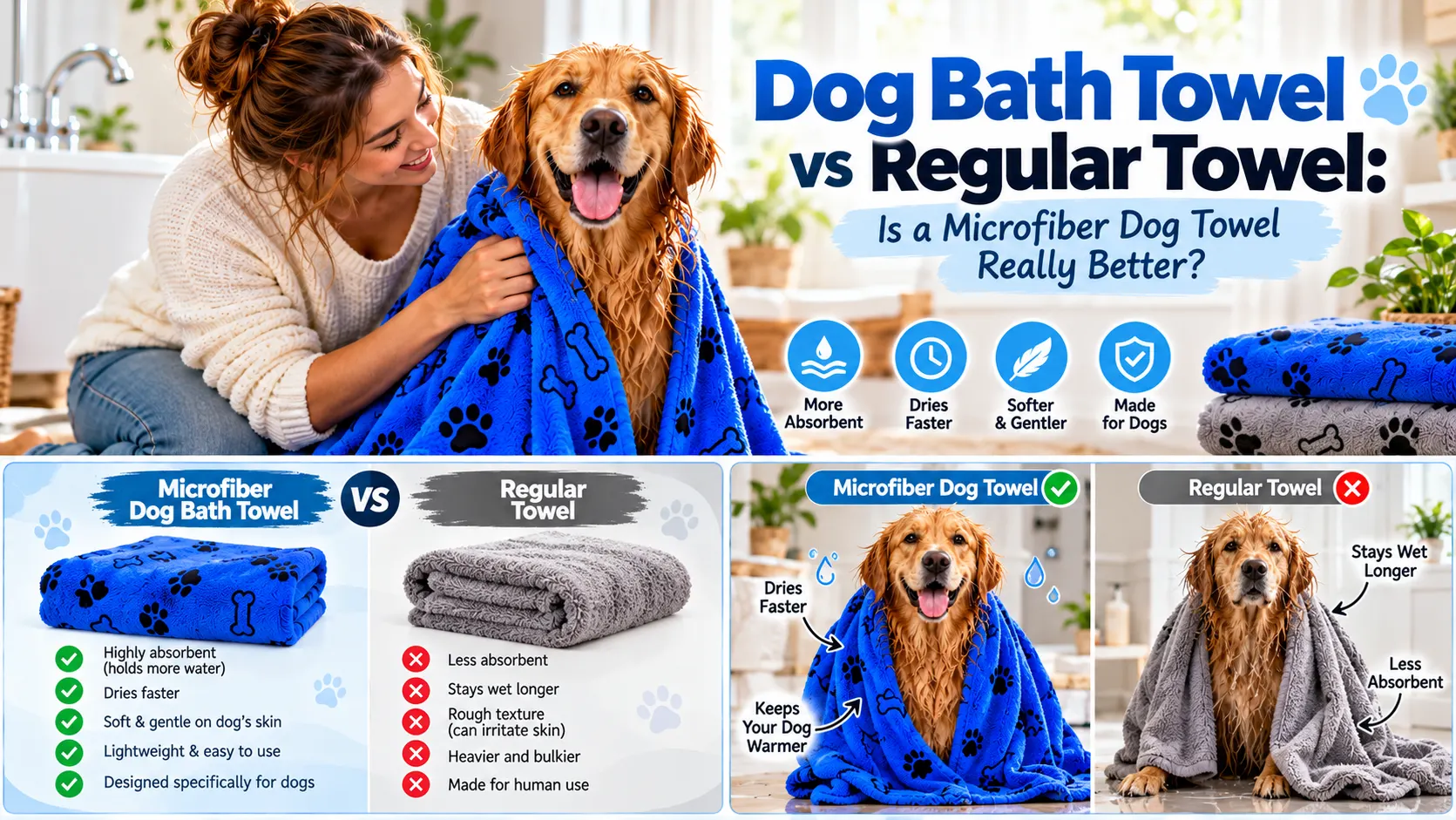
A microfiber dog towel can provide strong absorbency with less bulk, while a regular bath towel may become heavier as it absorbs water.
⚡ Quick Answer: Is a Microfiber Dog Towel Better Than a Regular Towel?
For many dog owners, yes—especially for frequent drying. A microfiber dog towel can be more practical because it may offer:
- Higher absorbency relative to weight
- Lighter handling when wet
- Quicker drying between uses
- Less bulk
- Easy storage
- Good flexibility around paws, legs and belly
The AKC notes that microfiber dog towels can absorb more water than an average bath towel while remaining relatively lightweight. That is one of the strongest practical reasons to consider microfiber for pet drying.
But a regular cotton bath towel can still work well when your dog is small, the coat is short, baths are infrequent, you already have suitable towels, and drying speed does not matter much.
So the answer is not: microfiber good, cotton bad. It is: microfiber is often more convenient for repeated dog drying, while a regular towel may still be adequate for simpler situations.
Difference 1: Absorbency
Absorbency is the most obvious place to start. The towel has one primary job: take water away from the dog’s coat. A traditional cotton bath towel can absorb plenty of water. That is why cotton towels work perfectly well for people. But microfiber uses extremely fine synthetic fibers that create substantial surface area for moisture pickup.
The AKC specifically notes that microfiber pet towels can absorb more water than an average bath towel. That can matter when drying large dogs, long-haired dogs, double-coated dogs, swimming dogs, and multiple dogs. A towel that stays useful for longer before becoming saturated can reduce the number of towel changes required.
Why Absorbency Matters More With Dogs Than People
Humans usually step out of the shower and stand upright. Dogs can carry water across back, sides, chest, belly, legs, paws, tail, and undercoat. A dense-coated dog may hold much more hidden water than their appearance suggests. That means the towel is often working harder.
PetMD recommends using multiple towels for dogs with thick coats because one towel may become saturated before drying is complete. So even if microfiber and cotton both absorb water, the more useful question is: How much moisture can the towel remove before it becomes too wet to keep working efficiently?
Difference 2: Weight When Wet
This is where the difference becomes noticeable during actual use. A thick household towel can become heavy as it absorbs water. That may not matter when drying a small dog. It matters more when you are trying to maneuver around a Labrador, Golden Retriever, German Shepherd, Newfoundland, or large doodle.
A lighter towel is easier to lift, fold, wrap, press around legs, and reposition around the belly. Microfiber can provide good water pickup without requiring the same heavy, bulky construction as many traditional cotton bath towels. That can make the drying process easier on both the dog and owner.
Why Towel Weight Matters for Nervous Dogs
Some dogs dislike being wrapped in heavy fabric. A large wet towel can feel restrictive, hot, awkward, and uncomfortable. A lighter towel may be easier to place over the dog’s back without creating as much pressure. This does not automatically mean the dog will love microfiber. Some dogs dislike towel handling in general.
The AKC recommends introducing drying towels gradually to dogs who are uncomfortable with grooming. That training principle matters regardless of material.
Difference 3: Drying Speed
The dog is only half the equation. The towel must also dry. A regular cotton towel can remain damp for a long time, especially if it is thick, the weather is humid, airflow is poor, or it absorbed a lot of water. Microfiber towels are often valued because they can dry relatively quickly.
That is particularly useful when your dog swims regularly, you bathe multiple dogs, you travel, you need to reuse the towel later that day, or you have limited drying space. A faster-drying towel is also less frustrating to pack away. You still need to let it dry completely before storage.
Why Quick Drying Matters More Than Buyers Expect
Imagine this routine: Your dog swims in the morning. You dry them. The towel stays damp. Later that afternoon, it rains during a walk. You need the towel again. If it is still soaking wet, it is far less useful. A towel that dries faster between uses becomes more practical even if both towels remove a similar amount of water initially. This is why drying speed belongs in the buying decision, not just absorbency.
Difference 4: Bulk and Storage
A thick household bath towel can take up considerable space. At home, that may not matter. During travel, it does. Think about camping, hotel stays, road trips, dog shows, beach visits, swimming, and hiking. A bulky towel takes up space that could otherwise hold dog food, leash, water, bowls, or bedding.
A compact microfiber dog towel can therefore be more convenient for travel. This is especially useful for owners who already carry a lot of dog equipment. Readers putting together a broader dog travel or care kit can naturally browse the HA Pet Supplies dog supplies collection at this point.
Difference 5: Softness and Coat Handling
Softness matters because towel drying should not become aggressive scrubbing. A good towel should allow you to press, blot, squeeze, and wrap without creating unnecessary friction. The AKC recommends pressing the towel into the dog’s coat instead of rubbing vigorously because excessive rubbing can lead to tangles and matting.
This is particularly important for long coats, curly coats, silky coats, and feathered coats. The towel material matters, but technique matters just as much. A microfiber towel used badly can still create tangles. A regular towel used gently can still work effectively.
Difference 6: Ease of Use Around Legs and Paws
A dog’s body is not one flat surface. You need to reach chest, armpits, paws, lower legs, belly, tail, and neck. A thick bulky bath towel can be difficult to control in smaller areas. A flexible lightweight towel may be easier to manipulate. This is one reason dedicated pet towels can feel more practical despite doing essentially the same basic job.
For detailed technique around each body area, readers should naturally return to the pillar guide on how to dry a dog after a bath.
Difference 7: Repeated Pet Use
A household towel may be used occasionally for the dog. A dedicated dog towel can remain permanently with the grooming supplies. That creates practical benefits. You always know where it is. You do not need to search through the bathroom cabinet. It can also stay separate from human towels that may otherwise collect dog hair, mud, outdoor debris, and dog shampoo residue.
That does not make dog towels inherently more hygienic. It simply makes the household routine easier to organize.
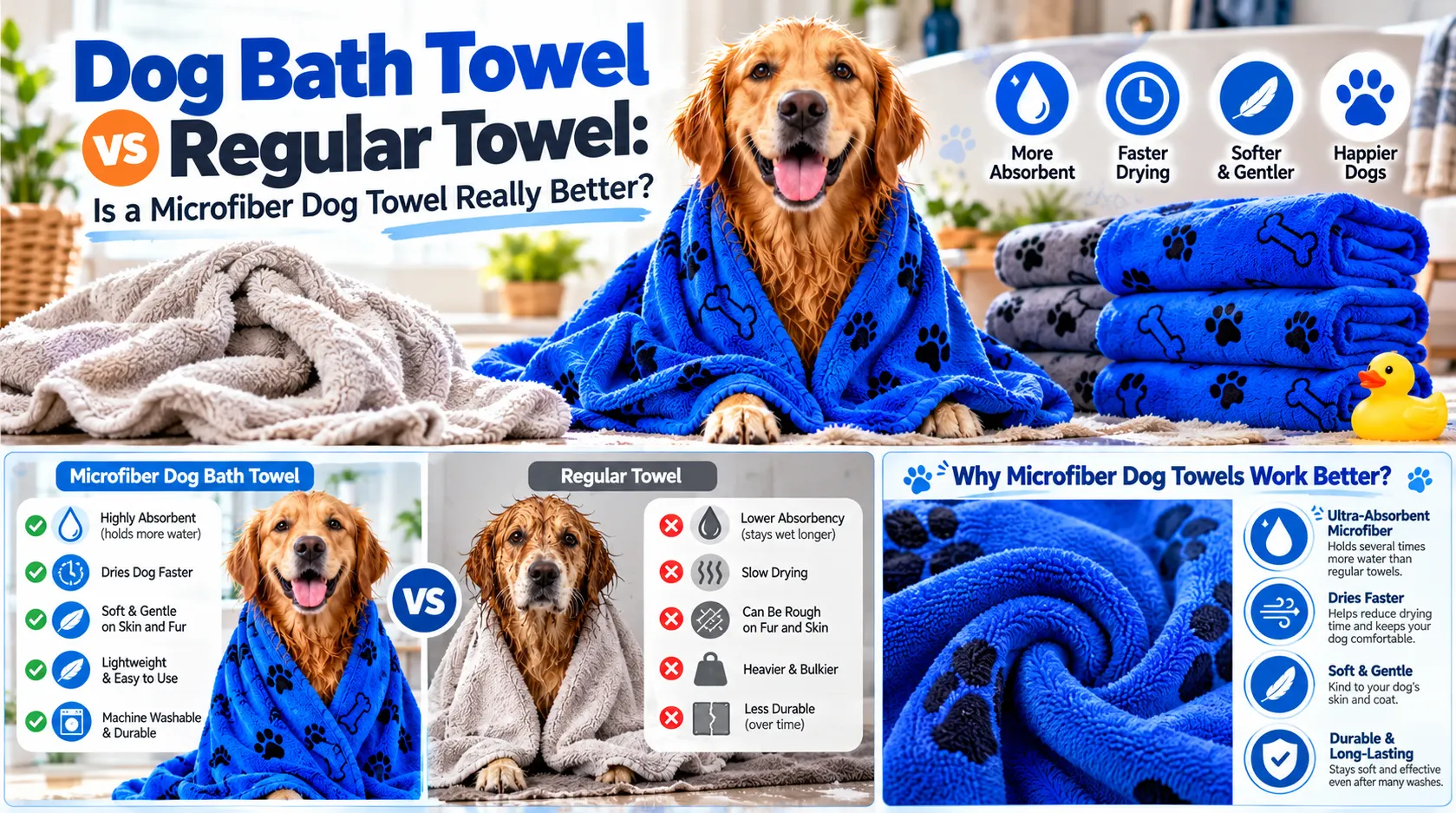
Microfiber can offer a useful combination of absorbency, lighter handling and faster drying for repeated dog grooming.
🧊 3D Infographic: Microfiber Dog Towel vs Regular Towel
Absorbency: High relative to weight
Wet Weight: Usually lighter and easier to handle
Drying Speed: Generally faster
Storage: Compact
Coat Handling: Soft and flexible when well made
Best For: Frequent baths, swimming, large dogs, travel
Absorbency: Good, depending on construction
Wet Weight: Can become heavier
Drying Speed: Often slower if thick
Storage: Bulkier
Coat Handling: Perfectly usable when handled gently
Best For: Occasional baths, short-haired or smaller dogs
Microfiber usually wins on convenience—not because ordinary towels suddenly stop working.
Is Microfiber Actually More Absorbent Than Cotton?
This question deserves nuance. The answer depends on the specific fabric construction. You cannot honestly claim that every microfiber towel absorbs more than every cotton towel. Some thick cotton towels are extremely absorbent. Some cheap microfiber towels are poorly constructed.
The advantage of microfiber is often absorbency relative to thickness and weight. That makes it useful when you want moisture pickup, low bulk, and faster drying. The AKC’s dog-drying guidance specifically highlights microfiber pet towels because they can absorb more water than average bath towels. That supports the general comparison without making an absolute claim about every fabric in existence.
Why Microfiber Works Differently
Microfiber consists of very fine synthetic fibers. These fine fibers create substantial surface area. In practical terms, that can help the towel interact with water efficiently. But buyers should still evaluate fiber density, pile, towel dimensions, stitching, and softness. The word microfiber by itself does not guarantee premium performance.
This is exactly why Blog 2 exists. If buyers want a full feature checklist, direct them naturally to Best Dog Bath Towel: How to Choose an Absorbent Microfiber Towel for Fast, Easy Drying.
Is Cotton Better for Anything?
Yes. Cotton bath towels still have advantages. They are familiar, widely available, easy to replace, comfortable, and often highly absorbent. If you already have several clean cotton towels and only bathe your short-haired dog occasionally, you may not need to buy a separate dog towel immediately. That is an important part of giving readers trustworthy advice.
The dedicated microfiber towel becomes more compelling when drying happens frequently, the dog is large, coat density is high, storage matters, and towels must dry quickly.
When a Regular Towel Is Perfectly Fine
A regular towel may be enough if:
Your Dog Is Small
There is not much coat to dry.
Your Dog Has a Short Coat
Less water becomes trapped in the fur.
Baths Are Rare
You may not need specialized equipment.
Storage Is Not an Issue
You have enough bathroom towels and space.
You Already Have Multiple Towels
Using two regular towels may work perfectly well. This comparison should help people make a rational decision, not force every reader toward a purchase.
When a Microfiber Dog Towel Makes More Sense
Microfiber becomes more appealing when:
Your Dog Is Large
More body surface means more water.
Your Dog Has Long Hair
More fur means more moisture to remove.
Your Dog Has a Double Coat
Dense undercoat can retain water underneath the surface.
Your Dog Swims Frequently
The towel needs to dry between repeated uses.
You Travel
Compactness matters.
You Own Multiple Dogs
Fast washing and drying become more important. In these situations, the HA Pet Supplies dog bath towel can be introduced naturally as the relevant product example rather than as a random CTA.
Which Towel Is Better for Different Coat Types?
Large Dogs
Microfiber usually has a stronger practical argument here. A large dog can saturate a small towel quickly. You need generous surface area, good absorbency, and manageable wet weight. A heavy cotton towel may work but become cumbersome after absorbing significant water. A larger microfiber towel can reduce bulk while still providing useful moisture removal. Still, large double-coated dogs may require more than one towel plus additional drying. PetMD notes that thick coats may need multiple towels or pet-safe dryer assistance.
Short-Haired Dogs
For short-coated dogs, the difference may be less dramatic. Examples include Boxer, Doberman, Beagle, and many short-haired mixed breeds. A regular bath towel may dry them perfectly well. The microfiber advantage becomes mainly lighter weight, faster towel drying, and convenience. That is useful, but not necessarily essential.
Long-Haired Dogs
Long coats need two things: absorbency and low-friction handling. The most important rule is not to aggressively rub. Instead: press, blot, and gently squeeze sections. The AKC advises this approach specifically to reduce tangles. A soft microfiber towel can work well because it is flexible and absorbent. But technique remains critical.
Double-Coated Dogs
For double coats, strong initial moisture removal matters. Examples include Golden Retriever, Husky, German Shepherd, and Malamute. The outer layer can feel dry while the undercoat remains damp. The AKC notes that thick-coated dogs may require a dog dryer after towel drying. So the goal of the towel is to remove as much surface and accessible coat water as possible before the next step. A large absorbent microfiber towel is usually very useful here.
Curly Coats
Curly coats can be prone to tangling. A soft microfiber towel may reduce the temptation to scrub aggressively. Use it by pressing, blotting, and squeezing sections gently. Do not rub the coat in circles. If the dog mats easily, combine appropriate drying with regular coat maintenance and professional grooming advice where needed.
Wrinkled Dogs
For wrinkled breeds, towel size matters less than precision. You need something soft and absorbent enough to dry skin folds, neck folds, and facial wrinkles. The ASPCA and veterinary grooming guidance generally emphasize keeping skin folds dry and clean because trapped moisture can contribute to irritation. A smaller microfiber towel can be useful for these targeted areas after the main body has been dried.
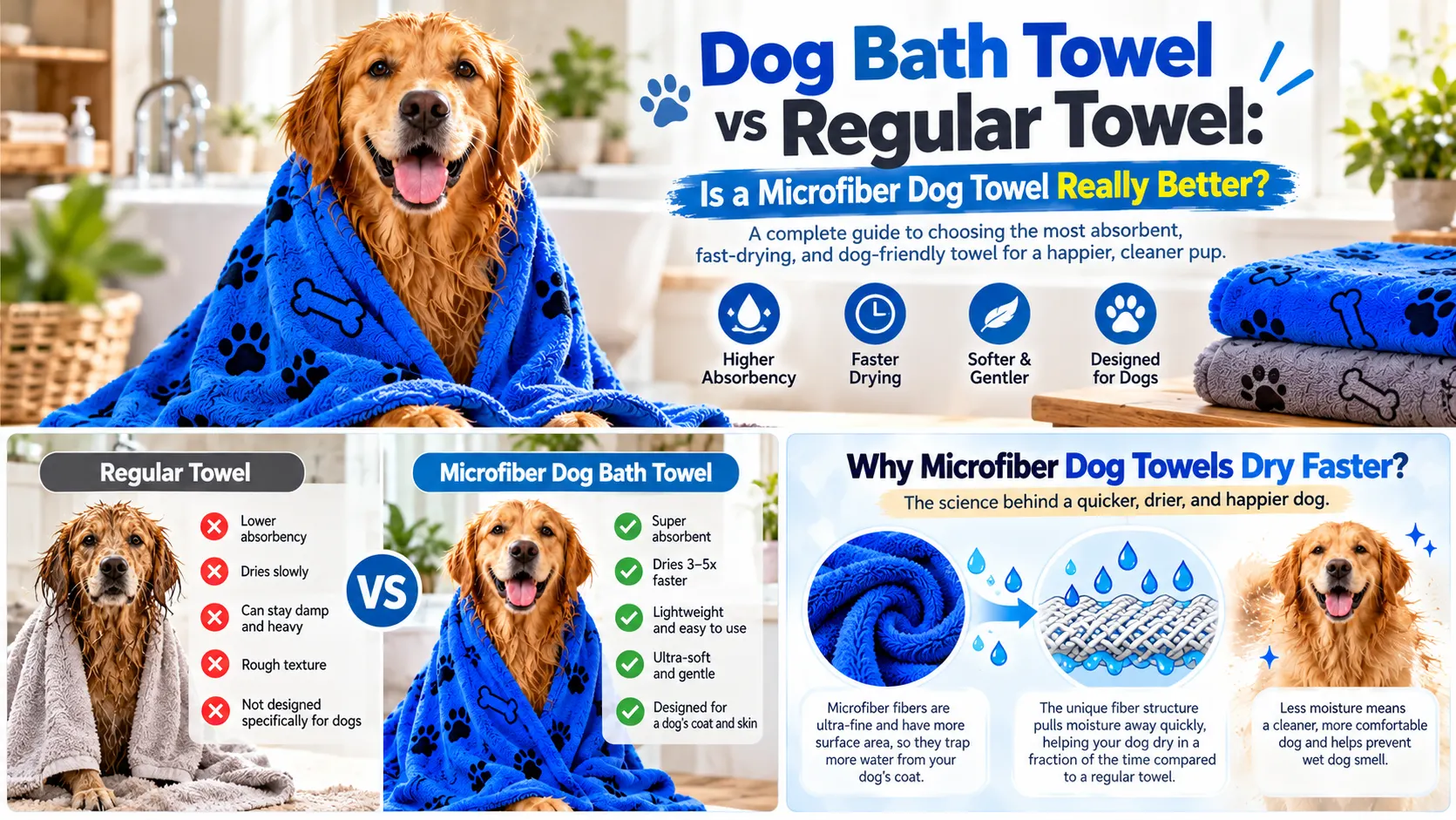
The best towel depends on dog size, coat density, drying frequency and how much convenience matters in your routine.
🧊 3D Decision Guide: Which Towel Should You Choose?
Small + Short-Haired
Regular towel: Usually adequate.
Microfiber: More convenient if you value quick drying and compact storage.
Large Dog
Microfiber: Usually easier to manage because good absorbency can be achieved with less bulk.
Long-Haired Dog
Microfiber: Useful for gentle section-by-section blotting.
Double-Coated Dog
Microfiber: Useful for removing substantial initial moisture, but additional drying may still be required.
Swimming Dog
Microfiber: Strong choice because drying speed and portability become more important.
Occasional Home Bath Only
Regular towel: May be completely sufficient.
Multiple Dogs
Microfiber: Quick drying and easier storage can become valuable.
Choose based on frequency and coat—not because one towel has the word “pet” printed on the label.
Is a Dog Towel Worth the Money?
For some households, definitely. For others, it may be optional. Ask yourself: How often do I dry my dog? If the answer is once every few months, a regular towel may be enough. If the answer is after every bath, after swimming, after rainy walks, after beach trips, or several dogs every week — then a dedicated towel becomes much easier to justify.
The value is not only absorbency. It includes convenience, faster towel drying, lighter storage, and dedicated pet use.
Can Microfiber Save Drying Time?
It can reduce the amount of water remaining on the dog before air drying or blow drying. That can make the overall process more efficient. PetMD notes that microfiber or shammy-style towels can help shorten drying time before the use of a dryer. The AKC similarly recommends removing as much water as possible with a towel before continuing. This matters particularly for dogs who dislike the sound of dryers. The more water removed with the towel, the less dryer time may be necessary.
Can a Microfiber Towel Replace a Dog Dryer?
Not always. A short-haired dog may become sufficiently dry with towel drying alone. A thick double-coated dog may remain damp underneath. The AKC notes that dogs with thicker coats can need an appropriate dog dryer after towel drying. So microfiber should not be marketed as: “eliminates the need for a dryer for every dog.” A more accurate message is: “helps remove more initial moisture and may reduce additional drying time.”
Which Is Better After Swimming?
Microfiber has a particularly strong advantage for swimming dogs. Why? You often need to carry the towel, dry the dog outdoors, put the towel back in a bag, wash it frequently, and dry it again before the next outing. Bulk and drying speed matter much more here than in a bathroom cabinet. The AKC advises rinsing and drying dogs after pool exposure where appropriate. A quick-dry towel is therefore useful for beaches, lakes, pools, camping, and road trips.
Which Is Better for Rainy Walks?
For light rain, either towel works. A microfiber towel may be easier to keep by the door because it is compact and dries relatively quickly. Use it for paws, lower legs, belly, and chest. You do not need to wrap the entire dog after every drizzle. A smaller dedicated microfiber towel near the entryway can become a useful everyday tool.
Which Is Easier to Wash?
Both can be easy to wash. The most important factor is the manufacturer’s instructions. For microfiber, check whether the care label restricts fabric softener, bleach, or high heat. For cotton, check washing temperature and tumble-drying instructions. Do not assume every microfiber towel needs identical care. Always follow the actual product label.
Can Fabric Softener Reduce Microfiber Performance?
Some microfiber products advise against fabric softener because residue may affect the fibers’ interaction with moisture. The safest wording is: Follow the specific care instructions for your microfiber dog towel, especially regarding fabric softener, bleach and dryer temperature.
Which Towel Holds More Odor?
Odor depends more on how dirty the towel becomes, how long it stays damp, washing frequency, and storage than simply whether the towel is microfiber or cotton. Any towel left wet in a pile can develop unpleasant smells. After use: hang it, let it dry, wash when needed, and store only when dry. Do not blame the towel material for poor drying and storage habits.
Which Towel Collects More Dog Hair?
Both can collect fur. Microfiber’s fine structure may sometimes hold loose hairs noticeably. A cotton towel may also end up covered in fur. Before washing: shake loose hair outside where appropriate, remove large clumps, and follow normal washing instructions. Do not expect the towel to remain hair-free after drying a shedding dog.
How Many Towels Should You Own?
One small dog: one dedicated towel may be enough. One large dog: two towels can be more practical. Double-coated dog: keep a backup. Two or more dogs: multiple towels simplify the routine. Frequent swimming: keep one for home and one for travel. The best system is the one that prevents you from trying to finish the dog with an already saturated towel.
Dog Bath Towel vs Regular Towel for Travel
This is one of the clearest microfiber advantages. A thick regular towel may occupy a large part of a travel bag. A compact microfiber towel is easier to store with leash, bowl, dog food, toys, and waste bags. For readers building broader travel kits, link naturally to the HA Pet Supplies shop rather than inserting the store as an unrelated footer CTA.
Dog Bath Towel vs Regular Towel for Groomers
A professional or high-frequency setting changes the calculation. A groomer values absorbency, drying speed, washing efficiency, storage, and repeat use. A towel that dries slightly faster may produce much more practical value when dozens of drying sessions are involved. For professional or bulk requirements, the HA Pet Supplies request-a-quote page can be introduced naturally here rather than in a consumer-focused paragraph.
🧊 3D Infographic: Who Benefits Most From Microfiber?
Large-Dog Owner
Why microfiber helps: More water with less handling bulk.
Swimming Dog Owner
Why microfiber helps: Quick drying and easy packing.
Multi-Dog Home
Why microfiber helps: Fast laundry turnover.
Traveller
Why microfiber helps: Compact storage.
Occasional Small-Dog Owner
Do you need microfiber? Not necessarily. A clean regular towel may work perfectly well.
This last card is important because it makes the comparison credible rather than overly promotional.
Common Myths About Dog Towels
Myth 1: Any Product Labelled “Dog Towel” Is Automatically Better
✅ Truth: Look at actual material, dimensions, construction, and care instructions.
Myth 2: Microfiber Means Unlimited Absorbency
✅ Truth: Every towel eventually saturates.
Myth 3: The Thickest Towel Is Always Best
✅ Truth: Thickness can increase bulk and drying time.
Myth 4: A Microfiber Towel Means You Can Rub Hard
✅ Truth: Technique still matters. The AKC recommends blotting rather than aggressive rubbing.
Myth 5: One Towel Can Fully Dry Every Breed
✅ Truth: Dense coats can require multiple towels or additional drying.
Myth 6: Regular Towels Are Bad for Dogs
✅ Truth: A clean household towel can work perfectly well, particularly for occasional use.
Myth 7: A Dog Towel Replaces Grooming
✅ Truth: Drying is only one part of coat care.
How to Dry a Dog Properly With Either Towel
No comparison article should let readers think material is everything. Use either towel correctly:
- Allow excess water to drain
- Place towel over the dog
- Press instead of scrubbing
- Work in sections
- Squeeze longer fur gently
- Dry belly and legs
- Dry paws
- Switch towels when saturated
- Check dense areas near the skin
For the full coat-by-coat process, direct readers to How to Dry a Dog After a Bath. Technique can matter as much as towel choice.
What If Your Dog Hates Being Towel Dried?
Do not automatically blame the towel material. The dog may dislike pressure, restraint, paw handling, face handling, or bath-associated stress. Introduce the towel gradually. Let the dog see it, sniff it, receive rewards near it, and experience brief gentle contact. Then gradually increase drying. The AKC recommends positive, gradual introduction to grooming tools for dogs that find drying stressful.
Are Dog Towels Good for Puppies and Senior Dogs?
Yes. A soft dedicated towel can be useful because puppies are small, may chill more quickly when wet, may dislike heavy towels, and need positive grooming experiences. Use gentle blotting and keep the puppy warm. Do not overwhelm them with a huge saturated towel.
A senior dog may have arthritis, reduced balance, and sensitive joints. The advantage of a highly absorbent towel is efficiency. If you can remove more water in less time, the senior dog may spend less time standing during grooming. Dry on a stable non-slip surface and allow comfortable positions.
Which Towel Is Better for Dogs With Sensitive Skin?
Softness and technique matter more than the word microfiber or cotton alone. Choose a towel that feels soft, does not have rough seams, and allows gentle blotting. If your dog has dermatitis, open lesions, recurring irritation, or medically managed skin disease, follow your veterinarian’s grooming guidance. VCA notes that dogs with skin disease may require individualized bathing schedules and products.
What About Skin Folds?
Dogs with wrinkles need special drying attention regardless of towel type. Moisture can remain between folds. Dry those areas gently with a clean dry portion of towel. If folds develop redness, odor, discharge, or recurring irritation, contact a veterinarian. A microfiber towel may make the process easier because it is flexible and absorbent, but careful technique is the important part.
Should You Use Separate Towels for Different Dogs?
It can be useful, especially if several dogs are being bathed at once, one dog has a skin problem, or towels become saturated quickly. Labeling or color-coding towels can make multi-dog grooming easier. If one dog has a contagious or medically managed skin condition, follow veterinary instructions regarding towel sharing and laundering.
Is the HA Pet Supplies Dog Bath Towel a Better Choice Than a Household Towel?
The HA Pet Supplies dog bath towel is designed specifically for pet drying, making it relevant for owners looking for an absorbent, soft and reusable towel for baths, swimming, rainy outings, and routine grooming. That dedicated design may make it more convenient than repurposing a heavy household towel, particularly for frequent use.
However, buyers should still compare dimensions, material, care instructions, their dog’s size, their dog’s coat, and their actual drying routine. If a buyer only dries a short-haired small dog occasionally, a household towel may already meet the need. If the dog is large, frequently wet or regularly bathed, a purpose-made microfiber towel becomes easier to justify.
For further product comparison, readers can browse the broader HA Pet Supplies dog supplies category. If they have questions about product suitability or ordering, use the HA Pet Supplies contact page contextually here.
Interactive FAQ: Dog Bath Towel vs Regular Towel
Is a microfiber dog towel really better than a regular towel?
It can be more convenient because microfiber typically offers strong absorbency relative to weight, lower bulk and faster drying. A regular towel can still work well for occasional use.
Can I use a normal bath towel on my dog?
Yes. A clean household towel can dry a dog. The difference is mainly convenience and performance characteristics rather than whether the towel is labelled for pets.
Is microfiber more absorbent than cotton?
Microfiber can offer high absorbency relative to weight, but performance varies by construction. Not every microfiber towel is automatically better than every cotton towel.
Why do dog towels use microfiber?
Because microfiber can combine absorbency, soft handling, lower bulk and relatively quick drying.
Is microfiber safe for dog fur?
A soft microfiber towel is generally suitable for drying dogs when used correctly. Avoid aggressive rubbing regardless of towel material.
Does microfiber reduce tangles?
The material can help with gentle moisture removal, but technique matters most. Press and blot rather than scrub.
Which towel is better for long-haired dogs?
A soft absorbent towel that allows low-friction blotting is ideal. Microfiber is often convenient for this purpose.
Which towel is better for a Golden Retriever?
A large absorbent towel is useful, and a microfiber dog towel can make initial moisture removal easier. Dense double coats may still require additional drying.
Which towel is better for a Labrador?
Either can work, but a large microfiber towel may offer convenient moisture pickup with less bulk.
Which towel is best after swimming?
Microfiber is particularly useful because it is portable, absorbent and relatively quick drying.
Can a microfiber towel completely dry a dog?
Sometimes for short coats. Thick, long or double coats may need additional drying.
Do I need two towels for a large dog?
Often it is useful. Change towels once the first becomes heavily saturated.
Does microfiber dry faster than a regular bath towel?
It often does because microfiber pet towels can be relatively lightweight, although drying time also depends on thickness, humidity and construction.
Are thick towels better?
Not automatically. A thick towel may be absorbent but bulky and slower drying.
Can I machine wash a microfiber dog towel?
Many can be machine washed, but follow the specific care label.
Should I use fabric softener?
Follow the manufacturer’s instructions. Some microfiber products recommend avoiding softener because it can affect performance.
Can I tumble dry microfiber?
Only according to the product’s care instructions.
Does a microfiber towel smell less?
Not automatically. Any damp towel can smell if stored wet. Dry and wash it appropriately.
Can I use the same towel for people and dogs?
You can, but many owners prefer dedicated dog towels for easier organization and because pet towels may collect fur and dirt.
Is buying a dedicated dog towel worth it?
It is most worthwhile for large dogs, frequent baths, swimming, travel, multiple dogs or owners who value quick-drying, compact equipment.
✅ Final Comparison Checklist
About Your Dog
- Small + short coat? Regular towel may be enough.
- Large dog? Microfiber becomes more convenient.
- Long coat? Prioritize softness and absorbency.
- Double coat? Prioritize maximum initial water removal.
About Your Routine
- Bath once every few months? Regular towel may be fine.
- Weekly water activities? Microfiber likely offers more convenience.
- Multiple dogs? Quick-drying towels become valuable.
- Frequent travel? Compact microfiber has an advantage.
About the Towel
- Size
- Absorbency
- Softness
- Wet weight
- Drying speed
- Washability
- Durability
The label alone should not make the decision.
Conclusion: Microfiber Usually Wins on Convenience, Not Necessity
So, in the dog bath towel vs regular towel debate, is a microfiber dog towel really better? For many owners, yes. But the reason is not that a regular towel suddenly becomes useless when it touches dog fur. A regular household towel can absolutely dry a dog.
The advantage of microfiber is usually the combination of strong absorbency, lower bulk, easier handling, softer flexible contact, faster drying, and convenient storage. Those benefits become increasingly valuable when you have a large dog, a long-haired dog, a double-coated dog, a frequent swimmer, several dogs, limited storage, or regular travel.
For a small short-haired dog that gets bathed occasionally, a regular towel may already do the job perfectly well. That is the most useful buying conclusion: You do not need microfiber simply because the product says “dog towel.” You choose microfiber when its performance and convenience solve problems your regular towel is not solving well.
And no towel material can compensate for poor technique. Whichever towel you use: press, blot and gently squeeze rather than aggressively rubbing the coat.
For the full technique, readers should naturally continue to How to Dry a Dog After a Bath: The Right Towel-Drying Method for Every Coat Type. For buyers who have decided they want microfiber but still need help comparing size, softness, absorbency and drying speed, direct them to Best Dog Bath Towel: How to Choose an Absorbent Microfiber Towel for Fast, Easy Drying.
The three-post cluster then has a clear purpose: Blog 1: How do I dry my dog correctly? Blog 2: What should I look for when buying a dog bath towel? Blog 3: Is a dedicated microfiber dog towel actually worth choosing over the towel I already own?
© HA Pet Supplies — Helping you make confident grooming decisions for your dog.