
Learning how to use a dog cooling vest safely is more important than simply buying one. A cooling vest can support your dog’s comfort during warm-weather walks, hikes, travel stops, training sessions, or outdoor play. But only when it is used correctly.
A common mistake is assuming: “If my dog is wearing a cooling vest, the heat is handled.” That is not how it works.
Most evaporative cooling vests depend on: water + airflow + evaporation. You soak the vest. Remove unnecessary excess water. Fit it correctly. Then, as moisture evaporates from the fabric, heat is carried away from the wet surface.
But the vest does not replace: fresh drinking water, shade, rest, choosing cooler exercise times, watching your dog’s behavior, or recognizing warning signs of overheating.
The CDC advises providing pets with plenty of fresh water and shade during hot weather and warns that animals should never be left in parked vehicles. CDC
The American Veterinary Medical Association similarly recommends limiting activity during hot weather, providing water and shade, and never leaving pets unattended in vehicles. AVMA
If you are still wondering whether the technology itself actually works, first read your pillar guide on how dog cooling vests work in hot weather.
This article starts one step later: You already have the vest. How do you use it properly?
📋 What’s Inside
- Quick Answer: The Safe-Use Routine
- Step 1: Check the Weather
- Step 2: Use Clean, Cool Water
- Step 3: Soak Thoroughly
- Step 4: Remove Excess Water
- Step 5: Check the Fit
- Step 6: Two-Minute Fit Test
- Step 7: Short Test Walk
- Step 8: Rewet Before It Dries
- 3D Safety Rules
- Hiking & Travel Safety
- Common Mistakes
- 3D Pre-Walk Checklist
- Interactive FAQ
Quick Answer: How Do You Use a Dog Cooling Vest Safely?
For an evaporative vest, the basic routine is usually:
- Check the weather first.
- Soak the vest in clean cool water.
- Let the material absorb water thoroughly.
- Gently wring or squeeze out excess water.
- Fit the vest securely without making it tight.
- Check that your dog can walk, sit and lie normally.
- Monitor the vest and the dog during activity.
- Rewet the vest when it begins drying.
- Stop activity if your dog shows heat-stress signs.
- Remove, rinse and dry the vest after use.
The exact manufacturer’s instructions should always take priority. Different cooling products may use evaporation, cooling packs, phase-change inserts, or gel systems. Do not assume every vest should be soaked in water. The advice in this article is primarily for evaporative dog cooling vests.
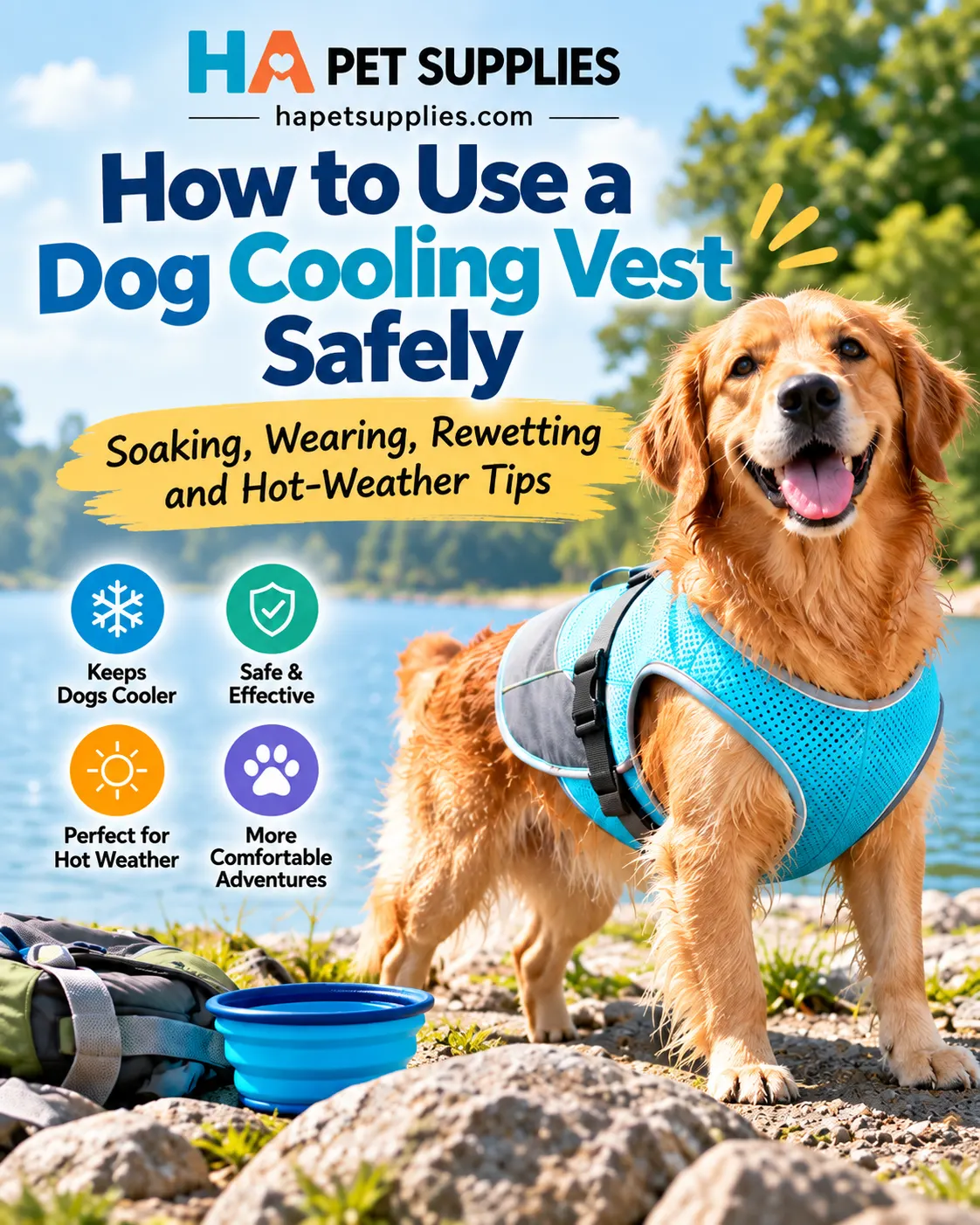
A dog cooling vest works best as one part of a broader hot-weather plan that includes shade, hydration, rest and careful monitoring.
Step 1: Check the Weather Before You Soak the Vest
The safest cooling-vest routine actually starts before the vest gets wet. Look at: temperature, humidity, direct sun, wind, pavement conditions, and length of activity.
A cooling vest should help make an already reasonable warm-weather outing more comfortable. It should not be used to justify a walk that would otherwise be unsafe.
Cornell’s veterinary heat-safety guidance recommends avoiding strenuous exercise during hot weather and shifting activity toward cooler parts of the day. Cornell Vet School
AAHA similarly advises pet owners to change exercise routines during hot weather rather than relying on cooling accessories alone. AAHA
If conditions are dangerous without the vest, they may still be dangerous with it.
Why Humidity Matters
Evaporative cooling depends on water turning into vapor. That process becomes less efficient in very humid air. In dry air, water can evaporate relatively quickly and the vest may feel noticeably cooler. In humid air, surrounding air already contains more moisture, so evaporation slows.
A vest staying wet for longer does not necessarily mean it is cooling better. If the air is very humid, reduce exercise duration, intensity, and exposure time, and monitor the dog closely.
Step 2: Use Clean, Cool Water
For most evaporative cooling vests, ordinary cool water is enough. You generally do not need ice water, frozen water, salt water, or chemical cooling solutions unless the manufacturer specifically instructs otherwise.
The vest works primarily through evaporation. That means extreme cold is not required. Using clean water is also sensible because the fabric sits directly against or close to coat, skin, chest, and shoulders.
If you are on a hike, do not automatically soak the vest in dirty puddles, stagnant water, or questionable streams if a cleaner water source is available.
Should You Use Ice-Cold Water?
Usually, there is no need. The goal of an evaporative vest is not to make the dog’s torso extremely cold. It is to maintain a wet surface that can continue losing heat through evaporation. Extremely cold material may also feel uncomfortable to some dogs.
The safest general rule is: cool water, not extreme cold.
Step 3: Soak the Dog Cooling Vest Thoroughly
The next step is saturation. Place the vest in water and allow the absorbent material to take it up. Do not simply splash a few drops over the outside if the design is intended to be fully soaked. You want moisture distributed through the sections that provide evaporative cooling.
A simple routine is: submerge → allow absorption → lift → gently squeeze. If the vest has multiple layers, give the fabric enough time to absorb water evenly.
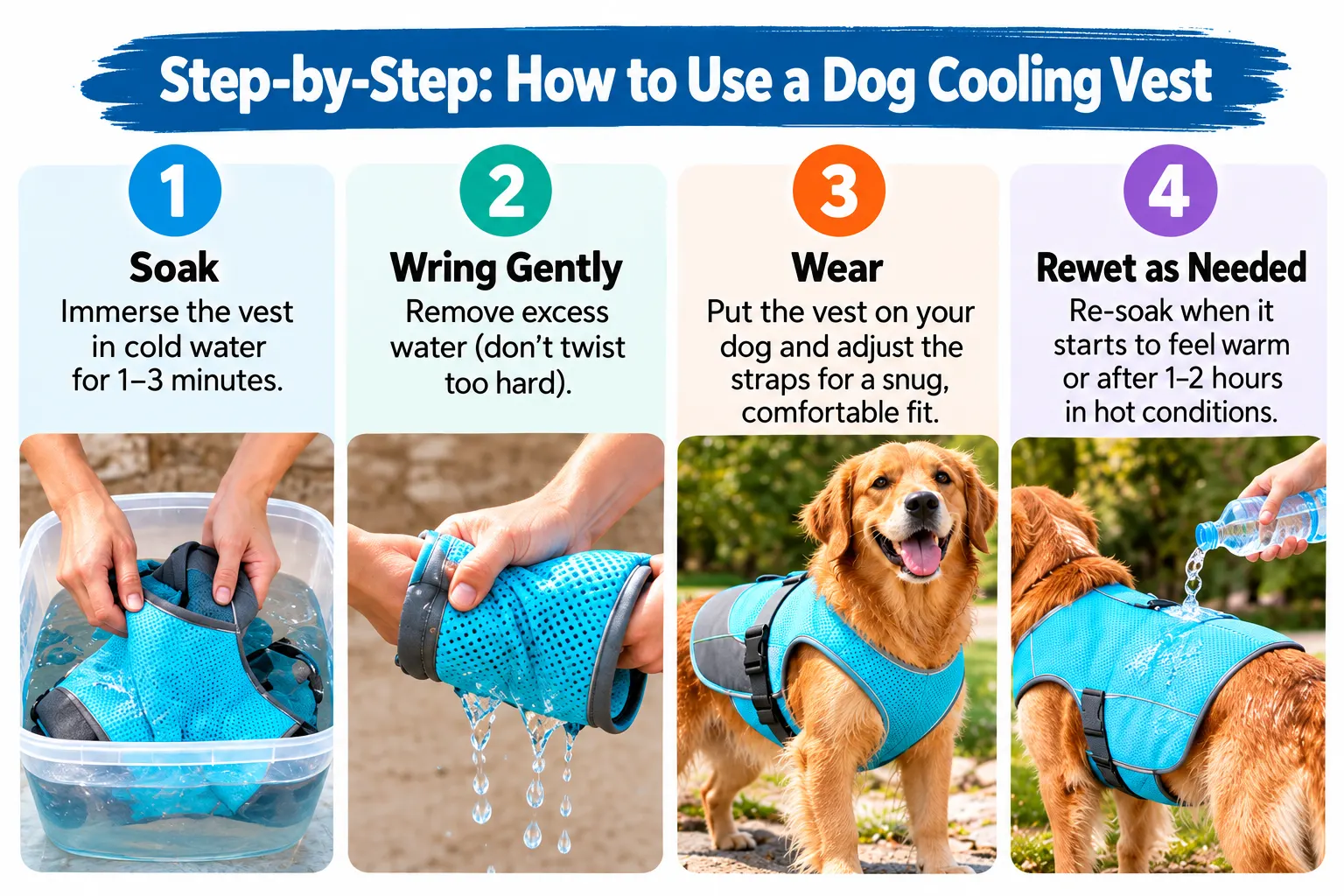
For an evaporative vest, the practical sequence is soak, remove excess water, fit correctly, monitor the dog and rewet when needed.
3D Infographic: Soak, Wring, Wear, Rewet
Hover or click each card to explore the four-step process.
1. SOAK
Fully wet the evaporative layers. The vest needs enough water to support evaporation.
2. WRING
Remove unnecessary excess water. The vest should be wet but not excessively heavy or dripping.
3. WEAR
Fit the vest securely and comfortably. Check the neck, chest, belly and leg openings.
4. REWET
Reactivate the vest when the fabric begins drying. Stop in shade, re-soak, squeeze excess water and refit.
Step 4: Remove Excess Water Before Putting It On
A cooling vest does not need to drip continuously to work. Too much retained free water can make the garment unnecessarily heavy, messy, less comfortable, and more likely to shift.
Once saturated, gently squeeze, press, or wring according to instructions until the vest is wet but not pouring water. Avoid aggressively twisting materials if the manufacturer’s care instructions warn against it.
The goal is: wet enough for evaporation, light enough for comfortable movement.
Step 5: Check the Fit Before Your Dog Starts Moving
Correct fit matters just as much as soaking. A cooling vest that is too tight can restrict movement, reduce airflow, rub sensitive areas, and become uncomfortable around the chest or armpits.
A vest that is too loose can twist, shift sideways, sag, interfere with walking, and reduce effective coverage.
You should be able to confirm that your dog can walk naturally, sit normally, lie down, turn, and move the shoulders freely. If you have not yet selected the correct size, direct readers naturally to your buying guide on choosing the right dog cooling vest by size, fit and material.
Where Should the Vest Sit?
The vest should generally cover the areas intended by the product design without blocking normal movement. Check: neck opening, shoulder area, chest strap, belly panel, leg clearance, and back length.
Avoid putting pressure directly into the armpits. Look for obvious bunching when the dog walks, turns, or sits. If the fabric folds sharply into one area, readjust before leaving.
Step 6: Perform a Two-Minute Fit Test Before the Real Walk
Do not discover a fit problem 20 minutes away from home. After fitting the vest, have the dog: stand, walk around, sit, turn, and lie down if possible.
Watch for: scratching at the vest, awkward stride, hesitation, shortened steps, or constant turning toward the garment. If the dog suddenly moves unnaturally, check the fit.
How Tight Should the Vest Be?
It should be secure but not restrictive. Do not overtighten straps simply because you are afraid the vest will move. A secure vest should stay in position during normal movement without compressing the body.
If the design includes adjustable straps, tighten gradually. Recheck after several minutes because wet fabric can settle differently once the dog starts moving.
Step 7: Begin With a Short Test Walk
The first time you use the cooling vest should not be during a long hike, a full-day outdoor event, or extreme summer heat. Start with a shorter outing.
This lets you evaluate: fit, fabric movement, drying speed, dog comfort, and rewetting needs. The dog should become comfortable with the vest before you rely on it during longer activities.
How to Use a Dog Cooling Vest Safely During a Walk
During the walk, monitor both the vest and the dog.
For the vest, check: still damp? drying rapidly? shifting? rubbing?
For the dog, check: panting, walking speed, willingness to continue, coordination, and behavior. The dog’s condition always matters more than whether the vest still feels cool.
Do Not Use Panting Alone as Proof the Vest Is Failing
Dogs naturally pant to regulate temperature. Some panting during exercise can be normal. The concern is when panting becomes unusually heavy, rapidly worsening, accompanied by weakness, associated with confusion, or accompanied by excessive drooling or vomiting.
Cornell lists heavy panting, drooling, vomiting, weakness, confusion, seizures and collapse among heatstroke warning signs. Cornell Vet School
VCA also identifies signs including increased respiratory effort, lethargy, disorientation and seizures. VCA
If these appear: stop the activity. Do not simply rewet the vest and continue.
Step 8: Rewet the Dog Cooling Vest Before It Dries Completely
Evaporative cooling relies on moisture. As the vest dries, the cooling effect decreases. During longer walks, regularly touch the fabric. If it feels mostly dry, warm, or much less damp than when you started, it may be time to reactivate it.
Stop somewhere safe, preferably shaded. Then:
- remove the vest if necessary
- add clean cool water
- allow the material to absorb it
- squeeze excess water
- refit the vest
- recheck straps
Do not try to pour water over the dog while continuing to walk if that creates a poor fit or leaves the vest unevenly soaked.
How Often Should You Rewet It?
There is no reliable universal schedule. Do not write: “Rewet every 30 minutes.” The actual drying rate depends on heat, humidity, wind, direct sun, vest thickness, dog movement, and amount of water used.
In dry windy conditions, the vest may dry quickly. In humid conditions, it may remain wet much longer. Monitor the material rather than the clock.
Carry Separate Water for Drinking and Rewetting
This is especially important during hiking. Do not reach a point where the only remaining water must be used either for your dog to drink or for the vest. Hydration takes priority.
CDC recommends constant access to fresh drinking water in hot weather. CDC AVMA provides similar guidance on keeping pets hydrated during warm-weather activity. AVMA
So when planning a hike, bring: drinking water, extra water for vest reactivation, and a portable bowl.
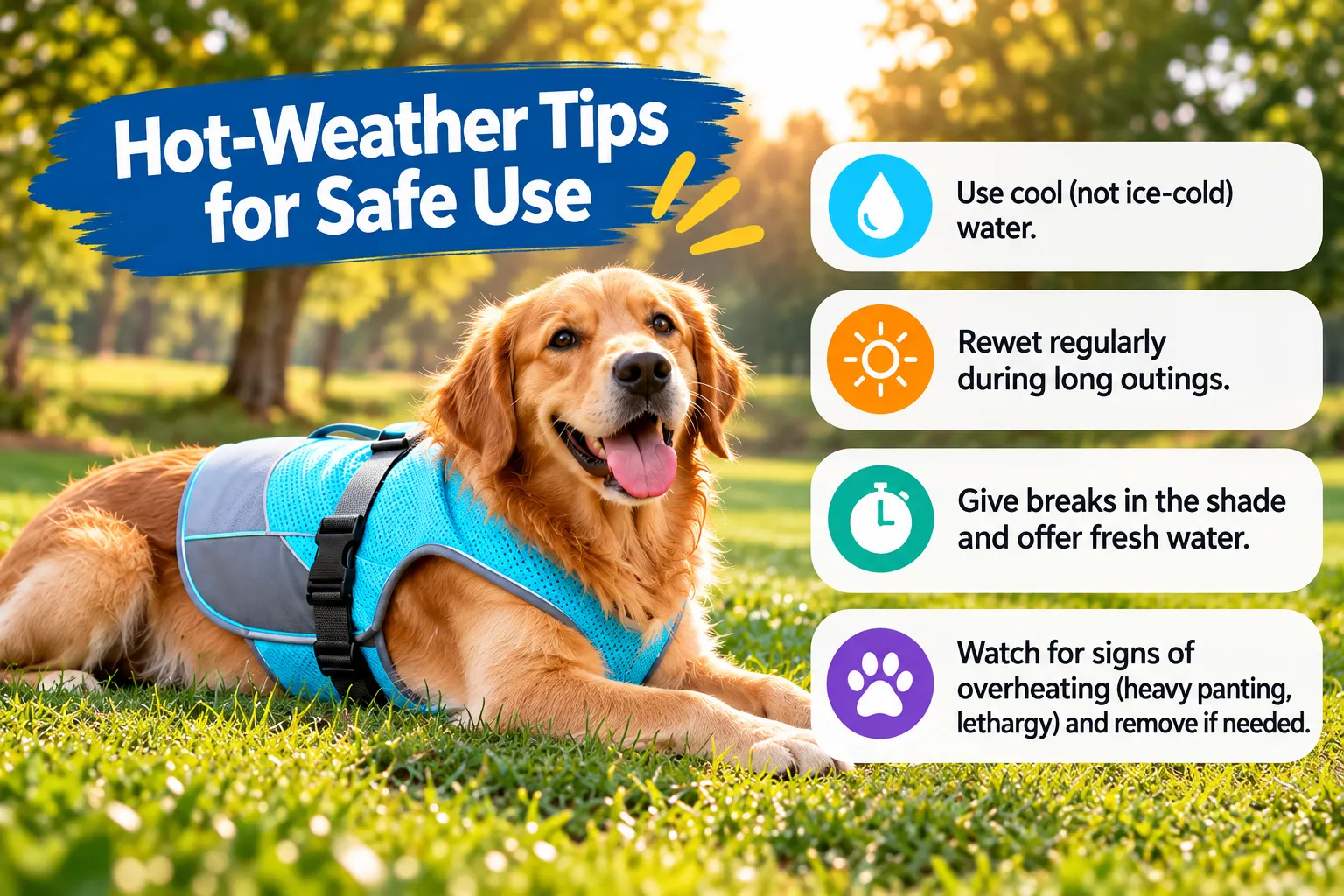
A cooling vest should always be combined with hydration, shade, rest, weather awareness and close observation of your dog.
3D Infographic: Dog Cooling Vest Safety Rules
COOLER HOURS
Prefer early morning or later evening.
FRESH WATER
Drinking water is mandatory.
SHADE
Plan places to stop.
CHECK THE VEST
Rewet when needed.
WATCH YOUR DOG
Behavior is more important than the vest.
STOP EARLY
Do not wait for collapse.
A Cooling Vest Does Not Make Midday Heat Safe
This is probably the most important safety message. Owners may think: “The vest is cooling my dog, so we can stay out longer.” That mindset can turn a helpful product into a risk.
The vest provides supplemental cooling. It does not eliminate solar heat, humid air, hot pavement, dehydration, or muscular heat from exercise.
Cornell advises avoiding peak heat and strenuous activity during high temperatures. Cornell Vet School AAHA likewise advises shifting activity to cooler periods and watching high-risk pets carefully. AAHA
Use the vest to support safer timing — not replace it.
Hot Pavement Is Still a Problem
The vest covers the torso. Your dog’s paws still touch the ground. Asphalt and pavement can become extremely hot under strong sunlight. AAHA warns that hot surfaces can burn paw pads. AAHA
Choose shaded routes, grass where appropriate, and cooler times. Do not think: cool torso = safe paws. These are separate risks.
How to Use a Dog Cooling Vest Safely for Hiking and Travel
Hiking adds extra variables: distance from home, limited water, changing elevation, direct sunlight, uncertain shade, and uneven terrain.
Before starting: check forecast, carry extra water, know where you can turn back, use a properly fitted vest, and keep activity conservative.
During the hike: stop frequently, check vest moisture, offer water, monitor panting, and shorten the route if conditions worsen. Do not plan a challenging hike and expect the vest to compensate.
Travel: Cooling vests can be useful during outdoor rest stops, campground setup, walking between vehicle and accommodation, and warm-weather sightseeing. They are not a solution for parked vehicles.
CDC warns that vehicle interiors can heat quickly and that cracking the windows does not make the environment safe. CDC AVMA gives the same warning. AVMA A cooling vest inside a parked vehicle does not change this.
Special Cases: Puppies, Seniors, and Brachycephalic Dogs
Puppies: Can be energetic and may not self-regulate well during play. Keep sessions short, supervised, and gentle. Because puppies grow rapidly, check sizing frequently. A vest that fit two months ago may now tighten around the chest, restrict shoulders, or become too short.
Senior Dogs: May have lower stamina, heart disease, respiratory problems, or arthritis. Cornell lists older dogs among groups at higher risk of heatstroke. Cornell Vet School For seniors: shorten outings, walk in cooler conditions, rest more frequently, and monitor breathing closely. The vest is additional support — not permission to exercise longer.
Brachycephalic Dogs: Include French Bulldogs, English Bulldogs, Pugs, and Boston Terriers. These dogs can have greater difficulty moving air efficiently through shortened airways. Cornell specifically identifies brachycephalic breeds as higher-risk for heatstroke. Cornell Vet School A cooling vest may support comfort, but management should still be conservative.
Overweight Dogs: Can also be at increased risk in heat. Cornell lists obesity among heatstroke risk factors. Do not increase walking duration simply because the dog is wearing cooling equipment.
Dogs With Heart or Respiratory Disease: If your dog has heart disease, airway disease, or reduced exercise tolerance, hot-weather exercise may be especially risky. Cooling accessories do not replace medical advice.
When to Remove the Vest and How to Check for Chafing
Remove it if: it has become completely dry, it is rubbing, it has shifted, the dog seems uncomfortable, the dog is resting in a cooler indoor environment, activity has ended, or skin irritation appears.
Wet fabric plus movement can create friction. Inspect armpits, chest, neck, and belly strap area. Look for redness, hair breakage, irritation, or raw skin. If you see repeated rubbing, reassess size, strap tension, and vest position. The buying guide on dog cooling vest size and fit is the natural place to send readers who have repeated fit problems.
3D Infographic: Signs the Vest Needs Attention
VEST DRYING
Action: Rewet.
VEST SHIFTING
Action: Stop and readjust.
STRAPS RUBBING
Action: Loosen or reassess fit.
DOG SLOWING
Action: Stop and rest.
HEAVY PANTING
Action: Move to shade and assess.
WEAKNESS OR CONFUSION
Action: Treat as possible heat illness and seek veterinary help.
What Are the Warning Signs of Heat Stress?
Warning signs can include: unusually heavy panting, excessive drooling, slowing down, weakness, difficulty coordinating movement, vomiting, diarrhea, confusion, abnormal gum color, collapse, and seizures.
Cornell describes heatstroke as a veterinary emergency. Cornell Vet School VCA similarly emphasizes that severe hyperthermia requires immediate treatment. VCA AAHA also provides practical heatstroke prevention guidance. AAHA
Do not wait for every symptom to appear.
What Should You Do if the Dog Starts Overheating?
Stop exercise immediately. Move the dog into shade, into air conditioning, or to a cooler environment. Begin appropriate cooling while arranging veterinary help when heat illness is suspected.
Cornell recommends immediate cooling and veterinary care for heatstroke. Cornell Vet School VCA also emphasizes prompt treatment. VCA
Do not waste time continuing the hike, trying another vest, or assuming the dog just needs a few minutes.
⚠️ Should You Leave the Cooling Vest On During Suspected Heatstroke?
Do not rely on the vest as treatment. If emergency cooling is required, follow veterinary emergency guidance. The vest may need to be removed so more effective cooling methods can be applied. Suspected heatstroke has moved beyond product use and into emergency care.
Indoor Use, Sleeping, and After It Dries
Should a Dog Wear a Cooling Vest Inside the House? Possibly, but it is often unnecessary if the environment is already comfortably cooled. If your home has air conditioning, good airflow, and cool flooring, the dog may be more comfortable without an extra garment.
Can a Dog Sleep in a Cooling Vest? Generally, do not leave wearable cooling equipment on an unsupervised sleeping dog unless the manufacturer specifically indicates that use. Reasons include shifting fit, skin moisture, chafing, chewing, and reduced supervision.
Can You Leave the Vest on After It Dries? If the vest is designed primarily for evaporative cooling, once dry it may no longer provide the same benefit. A dry vest can simply become another layer of material. In hot weather, that may be counterproductive. So when the vest dries: rewet or remove it.
How to Clean and Store the Dog Cooling Vest
After use: rinse according to instructions, remove dirt, wash when necessary, air dry completely, and store only when dry. Do not put it away wet in a closed bag — that can encourage odor, mildew, and material deterioration.
Can You Machine Wash a Dog Cooling Vest? Only if the product care label allows it. Cooling vests may contain mesh, absorbent layers, reflective strips, hook-and-loop fasteners, elastic, and special coatings. High heat or harsh cycles could damage some materials.
How to Store It: Before storage, rinse dirt, dry completely, close hook-and-loop fasteners where appropriate, and avoid folding it while soaking wet. For seasonal storage, check for damaged straps, cracked hardware, and loose stitching before using it again the next summer.
Common Dog Cooling Vest Mistakes
❌ Mistake 1
Using the Vest Without Soaking It. An evaporative vest needs water. Better: Activate it according to instructions.
❌ Mistake 2
Leaving It Dripping Heavy. Better: Remove unnecessary excess water.
❌ Mistake 3
Tightening It Too Much. Better: Secure fit without restricting movement.
❌ Mistake 4
Forgetting to Rewet. A dry vest has lost much of its intended evaporative function.
❌ Mistake 5
Depending on the Vest Instead of Water. Drinking water still comes first.
❌ Mistake 6
Using It During Dangerous Heat. Change the activity or stay indoors.
❌ Mistake 7
Ignoring Humidity. Cooling may be less effective.
❌ Mistake 8
Continuing After the Dog Shows Distress. Stop activity.
❌ Mistake 9
Leaving the Vest On After Exercise Without Checking the Dog. Remove it and inspect skin, coat, and pressure points.
3D Pre-Walk Checklist
🌤️ WEATHER
- Appropriate temperature
- Humidity considered
- Cooler route or time selected
🧥 VEST
- Properly soaked
- Excess water removed
- Correct fit
- No damaged straps
🐕 DOG
- Healthy enough for activity
- Normal breathing
- No heat stress before starting
🎒 SUPPLIES
- Drinking water
- Bowl
- Extra vest water
- Shade/rest plan
🗺️ ROUTE
- Shortened if needed
- Paw-safe surfaces
- Easy way to turn back
Is the HA Pet Supplies Dog Cooling Vest Suitable for This Routine?
The HA Pet Supplies dog cooling vest fits naturally into the evaporative cooling category discussed in this guide.
When evaluating it, or any similar product, confirm: soaking instructions, sizing, adjustable fit, breathable material, drying/re-wetting method, and care requirements.
Readers comparing additional dog summer products can naturally browse the HA Pet Supplies dog supplies collection. If sizing or suitability remains unclear, direct readers to contact HA Pet Supplies rather than guessing. For retail, wholesale or larger-volume requirements, the request a quote page belongs in that commercial context.
Interactive FAQ: How to Use a Dog Cooling Vest Safely
How do I use a dog cooling vest safely?
Soak the evaporative vest according to instructions, remove excess water, fit it comfortably, monitor your dog and the vest, provide drinking water and shade, and rewet when needed.
Do you have to wet a dog cooling vest?
Evaporative models generally require water. Other technologies may not. Follow the specific product instructions.
How long should you soak a dog cooling vest?
Follow the manufacturer instructions. The important goal is to allow the absorbent layers to become evenly wet.
Should the vest be dripping?
Usually not. Remove unnecessary excess water so the vest remains comfortable and manageable.
How tight should a dog cooling vest be?
Secure enough to stay in place but loose enough for natural shoulder, chest and leg movement.
How often should I rewet it?
Whenever it begins drying. There is no universal time interval because temperature, humidity and airflow affect evaporation.
Can I use ice water or freeze the vest?
Usually ordinary cool water is sufficient. Only freeze if the manufacturer explicitly allows it.
Can my dog wear the vest all day?
Do not use a fixed all-day rule. Check moisture, fit, skin, weather and dog comfort frequently.
Can the cooling vest stay on when dry?
A dry evaporative vest may no longer provide meaningful cooling. Rewet or remove it.
Can I rewet it while my dog wears it?
Possibly, depending on the product. Removing it briefly may allow more even soaking and gives you a chance to inspect the dog’s skin.
Does my dog still need drinking water?
Absolutely. Cooling equipment does not replace hydration. CDC
Can I walk my dog at midday if they wear a cooling vest?
Do not use cooling equipment to override dangerous weather. Choose cooler times whenever possible.
Do cooling vests work in humidity?
Evaporative cooling generally becomes less effective as humidity rises.
Can the vest cause chafing?
Yes, if the fit is poor, straps are too tight, or wet material rubs repeatedly.
Should I remove it during rest breaks?
You can evaluate whether the dog is more comfortable with or without it. If it is drying, shifted or rubbing, remove and reactivate or adjust it.
Can puppies wear dog cooling vests?
Potentially, but sizing must be checked frequently as they grow, and outdoor activity should remain short and carefully supervised.
Can senior dogs use them?
Potentially, but older dogs may have greater heat risk. Keep activity conservative and discuss medical limitations with your veterinarian when appropriate.
Are cooling vests safe for Bulldogs and Pugs?
They may provide extra comfort, but brachycephalic dogs are at increased heat risk and should be managed conservatively. Cornell Vet School
Can a dog still get heatstroke while wearing a cooling vest?
Yes.
What signs mean I should stop immediately?
Weakness, worsening heavy panting, excessive drooling, vomiting, confusion, collapse or seizures should be treated seriously. VCA
Does a cooling vest treat heatstroke?
No. Heatstroke is a veterinary emergency.
Can I leave my dog in a car while wearing one?
No. Cooling vests do not make parked vehicles safe. AVMA
Should I wash the vest after every use?
Follow the manufacturer’s instructions. At minimum, rinse or clean dirt and allow the vest to dry completely before storage.
Final Safe-Use Checklist
Before every use, ask:
- Is the weather safe enough for the outing? If no: stay inside or change the time.
- Is the vest correctly activated? If no: soak it according to instructions.
- Does it fit correctly? If no: adjust or change size.
- Do I have enough drinking water? If no: do not start a longer outing.
- Can I rewet it later? If no: shorten the activity.
- Does my dog look comfortable? If no: stop.
- Is my dog showing possible heat illness? If yes: the vest is no longer the solution — move to emergency heat management and veterinary care.
Conclusion: Safe Cooling Is a Routine, Not Just a Vest
Understanding how to use a dog cooling vest safely is really about understanding what the vest can — and cannot — do.
For an evaporative design, the correct routine is straightforward: check weather → soak → remove excess water → fit correctly → monitor → rewet → rest → remove and dry.
But the most important rules happen outside the vest itself. Your dog still needs: fresh drinking water, shade, cooler exercise times, appropriate activity levels, paw protection from hot surfaces, and close monitoring.
A dog cooling vest can help support comfort. It cannot make dangerous heat harmless. It cannot compensate for dehydration. And it cannot treat heatstroke.
That is why your hot-weather plan should always be: safe conditions first, cooling equipment second.
For readers who still want to understand the science behind the product, naturally direct them back to the pillar article Do Dog Cooling Vests Really Work? How They Keep Dogs Cool in Hot Weather.
For readers ready to buy but uncertain about dimensions, fit, mesh, reflective trim or cooling materials, continue to How to Choose the Right Dog Cooling Vest: Size, Fit, Material and Cooling Features Explained.
That creates a clean content journey: Blog 1: Does a dog cooling vest actually work? Blog 2: How do I use one safely? Blog 3: Which dog cooling vest should I choose? Blog 2 therefore becomes the practical action guide — the article readers return to before a summer walk, hike, road trip or outdoor activity when they need clear instructions rather than product marketing.