
A dog cooling vest can be a useful summer accessory, but only if it actually fits your dog and works for the conditions in which you plan to use it.
This is where many buyers get confused. One vest says evaporative cooling. Another says ice cooling. Another promotes breathable mesh. Another focuses on reflective trim.
Then there are size charts based on chest girth, back length, neck circumference, breed, and weight. And somehow, a dog that normally wears a “medium” harness can be a “large” in one cooling vest and a “small” in another.
The most important thing to understand is that the best dog cooling vest is not necessarily the one with the most features. It is the one that fits your dog’s body dimensions, coat type, activity, climate, heat sensitivity, and movement pattern.
A cooling vest that is too tight can rub or restrict movement. A vest that is too loose can shift and reduce effective coverage. A thick cooling garment may hold plenty of water but feel heavy. A lightweight vest may be comfortable but dry faster.
So this guide will help confused buyers answer a practical question: What should I actually check before buying a dog cooling vest?
If you are still deciding whether cooling vests work at all, read Do Dog Cooling Vests Really Work? How They Keep Dogs Cool in Hot Weather. If you already own one and need the correct soaking and rewetting routine, your next guide should be How to Use a Dog Cooling Vest Safely. This article focuses on the purchase decision.
📋 What’s Inside
- Quick Answer: 9 Features to Compare
- Feature 1: Chest Girth
- Feature 2: Back Length
- Feature 3: Neck Opening
- Feature 4: Adjustability
- Feature 5: Breathability
- Feature 6: Cooling Method
- Feature 7: Weight
- Feature 8: Reflective Details
- Feature 9: Rewetting & Cleaning
- Material & Construction
- Best Vest by Use Case
- Common Buying Mistakes
- How to Test Fit at Home
- Interactive FAQ
- Final Buying Checklist
Quick Answer: What Should You Look for in a Dog Cooling Vest?
If you need the fast answer, compare these nine features:
- correct chest girth
- appropriate back length
- comfortable neck opening
- secure but adjustable fit
- breathable material
- suitable cooling method
- low enough weight for your dog’s activity
- reflective or high-visibility details where useful
- easy soaking, rewetting and cleaning
The right vest should allow your dog to: walk naturally, sit, lie down, turn, move the shoulders, breathe normally, and cool without carrying unnecessary weight.
A cooling vest should support safe summer activity, not make unsafe heat acceptable.
Cornell University notes that heatstroke can become a medical emergency and that certain dogs, including brachycephalic, older and overweight dogs, may be at greater risk. Cornell Vet School
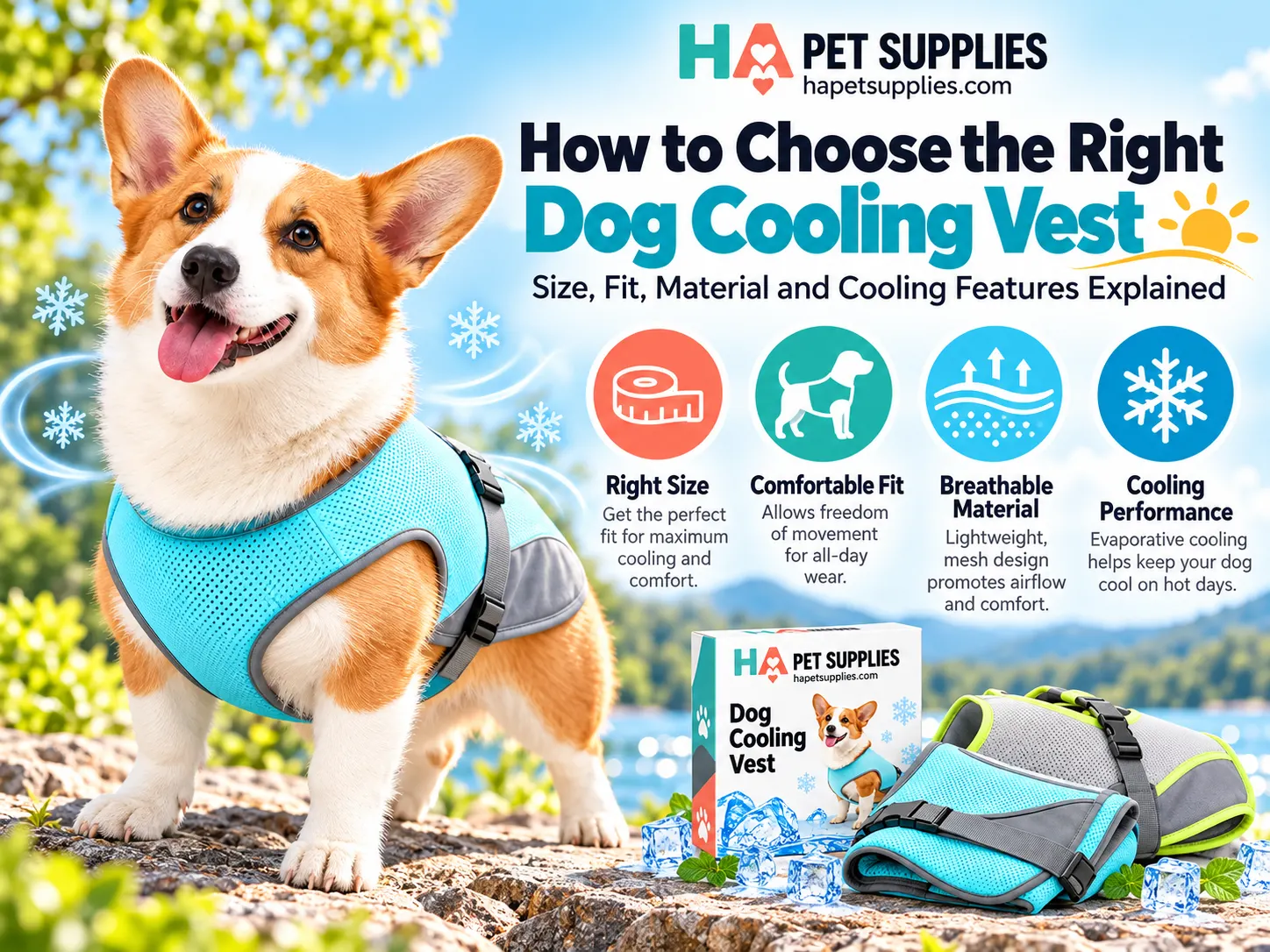
The right dog cooling vest should fit securely while allowing natural movement, airflow and comfortable summer activity.
Dog Cooling Vest Feature 1: Get the Chest Girth Right
Chest girth is usually one of the most important measurements. Why? Because the main body of the cooling vest wraps around the chest and torso.
If the chest fit is wrong, the vest may slide, twist, bunch, restrict breathing, or interfere with shoulder movement.
Measure around the widest part of the chest, usually just behind the front legs. Keep the measuring tape flat, level, snug, and not tight. Do not measure over a thick coat that has been heavily fluffed if that significantly changes the result.
Why Weight Alone Is Not Enough
A 20-kilogram dog can have a completely different body shape from another 20-kilogram dog. Compare a deep-chested Greyhound, a compact Bulldog, and a long-bodied mixed breed. The scale may say the same weight. The chest measurements may be completely different.
That is why choosing a dog cooling vest based only on weight can lead to a poor fit. Use the manufacturer’s size chart. Breed and weight should be treated as supporting references, not your primary measurement.
Dog Cooling Vest Feature 2: Check Back Length
Back length determines how much of the torso the vest covers. Measure from the base of the neck toward the base of the tail according to the brand’s sizing instructions.
Too short may mean poor body coverage or cooling concentrated only over a small area. Too long may cause bunching, rubbing, interference with sitting, or fabric extending too close to the tail.
The aim is not to cover every inch of the dog. The aim is effective torso coverage without limiting movement.
How Much Back Coverage Should a Cooling Vest Have?
For most vest-style designs, the fabric should cover a meaningful portion of the dog’s torso. But it should not hang over the tail, restrict hip movement, or bunch behind the shoulders.
Long-bodied dogs can be particularly difficult to fit using generic size labels. Examples include Dachshunds, Corgis, and some mixed breeds. For these dogs, actual length measurements matter more.
Dog Cooling Vest Feature 3: Check the Neck Opening
The neck opening should sit comfortably without pressing against the throat, restricting breathing, rubbing, or sliding excessively.
If the vest pulls backward toward the dog’s throat during walking, something may be wrong with neck size, chest adjustment, or overall vest length.
A dog should be able to look left, look right, and lower the head without the neckline digging into the body.
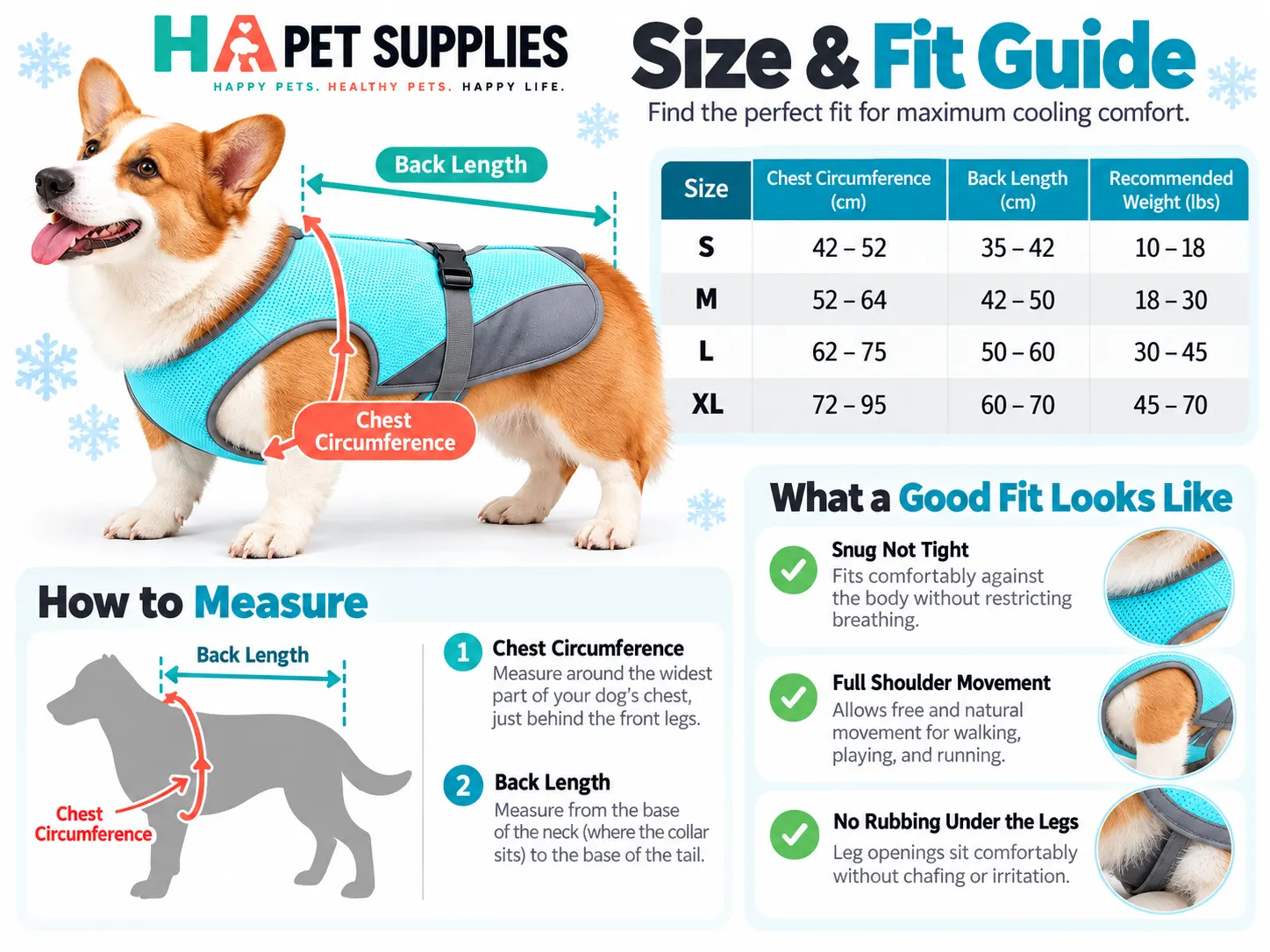
Measure chest girth, back length and the neck area before choosing a dog cooling vest instead of relying only on breed or weight.
3D Infographic: How to Measure for a Dog Cooling Vest
Hover or click each card to explore the three key measurements.
CHEST GIRTH
Measure around the widest part of the rib cage.
Most important for: overall body fit
BACK LENGTH
Measure from the base of the neck toward the base of the tail.
Most important for: coverage and movement
NECK AREA
Measure according to the product’s sizing guide.
Most important for: comfort and stability
What If Your Dog Falls Between Two Sizes?
This is one of the most common buyer questions. Do not automatically choose the smaller size for “better contact” or the larger size for “more cooling.” First check which measurement is limiting.
For example: if chest girth is at the top of Medium but comfortably within Large, Large may provide better adjustability. But if Large would be much too long across the back, it may shift. The best option depends on the specific size chart.
If needed, contact the retailer or manufacturer rather than guessing. For HA Pet Supplies buyers, this is a natural place to direct sizing questions to the HA Pet Supplies contact page.
Dog Cooling Vest Feature 4: Look for Adjustability
Dogs are not rectangles. Even dogs of the same breed may have different chest depth, waist, shoulder width, and neck shape.
Adjustable straps can make fit more forgiving. Useful adjustment points may include chest, belly, and side panels. The goal is to achieve secure contact without compression.
A vest that shifts with every step is too loose. A vest that changes the dog’s gait may be too tight or the wrong shape.
How Tight Should a Dog Cooling Vest Be?
It should stay in position without restricting natural movement. Check the dog while standing, walking, sitting, and turning. Look around the armpits, chest, neckline, and belly for pressure.
Do not overtighten just to stop all movement. A little fabric movement can be normal. The concern is major twisting, rubbing, or restriction.
Dog Cooling Vest Feature 5: Breathability
Breathability is particularly important for an evaporative cooling vest. Evaporation works best when air can move around or through the wet material.
A vest that holds water but creates a heavy, poorly ventilated layer may not be ideal. Look for materials designed to balance moisture retention, airflow, and low weight.
This is why many cooling vests combine an absorbent interior, breathable mesh, and a lightweight exterior. The exact construction differs by product.
Why Breathability Matters More Than Maximum Thickness
A buyer may see a very thick cooling vest and think: More material = more cooling. Not necessarily. More thickness can mean more water storage and longer wet time, but may also mean more weight, slower evaporation, and reduced airflow.
The best design is a balance. You want enough moisture to support evaporation without turning the dog into a heavily wrapped package.
Dog Cooling Vest Feature 6: Understand the Cooling Method
Not every product marketed as a cooling vest works the same way. Common designs include evaporative cooling, ice packs, gel inserts, and phase-change materials. This matters because each system behaves differently.
Evaporative Dog Cooling Vest
This is the simplest and most common design. Typical use: soak → wring → wear → rewet.
Advantages: no freezer required, simple to reactivate, relatively lightweight, practical for walks and hiking. Limitations: needs water, performance depends on evaporation, high humidity can reduce effectiveness.
The underlying mechanism is explained in detail in Do Dog Cooling Vests Really Work?.
Ice-Pack Cooling Vests
These use frozen packs, cooling inserts, or cold gel. Potential advantages: cooling does not depend entirely on evaporation and may feel cooler initially. Potential limitations: requires pre-freezing, extra weight, limited cooling duration, may create cold spots, and less convenient away from home.
Phase-Change Cooling Vests
Some designs use phase-change materials that maintain a particular temperature range while changing state. These may provide more controlled cooling than ordinary ice. However, they are more complex, may be heavier, and require pre-conditioning.
Do not assume these are automatically superior to evaporative systems. One study involving military working dogs found an evaporative cooling vest performed better than the other cooling vest design tested in that specific experiment, but that does not prove every evaporative vest beats every phase-change product. PubMed Central (PMC)
Which Cooling Method Is Best?
Use-case matters. For everyday walks, evaporative vests are usually easy to use. For travel, evaporative designs are convenient if water is available. For high humidity, evaporative effectiveness may decrease, so environmental management becomes even more important. For short controlled events, other cooling technologies may have advantages depending on the product.
The right question is: Where and how will my dog actually use this vest?
Dog Cooling Vest Feature 7: Weight
This is often overlooked. A cooling vest becomes heavier after it absorbs water. That matters for small dogs, senior dogs, dogs with mobility problems, and long hikes.
A product may feel lightweight when dry but substantially heavier after soaking. Check dry weight, how much water it holds, and whether the dog still moves normally when wet.
If the dog walks differently while wearing it, reassess.
Cooling Vest for Small Dogs
Small dogs usually need lighter construction, minimal bulk, and precise strap placement. A vest that is acceptable for a Labrador may feel cumbersome on a Chihuahua. For small dogs, prioritize low weight, good adjustability, soft edges, and free shoulder movement.
Cooling Vest for Large Dogs
Large dogs generally need a larger cooling surface, durable straps, enough chest coverage, and secure adjustment. More material means the vest may also hold more water. That can increase wet weight. The vest should still feel manageable during longer activities.
Dog Cooling Vest Feature 8: Reflective Details
Reflective trim does not make the vest colder. But it can improve visibility during early morning walks, evening walks, and low-light conditions.
This is useful because safer summer walking often means moving activity away from peak daytime heat. Cornell recommends exercising dogs during cooler times of day when temperatures are high. Cornell Vet School
If that means walking earlier or later, reflective details can add practical value.
Reflective Does Not Mean High Visibility in Every Situation
Do not treat reflective trim as a complete safety system. Visibility also depends on lighting, vehicle headlights, contrast, and vest color. For very low-light walking, owners may still need a reflective leash, collar light, or other visibility equipment.
The reflective feature should be viewed as an advantage, not a guarantee.
Dog Cooling Vest Feature 9: Easy Rewetting and Cleaning
A product that is annoying to reactivate will be used less often. Before buying, ask: Can I rewet it quickly? Does it need a freezer? Can I soak it in a sink? Can I pour water over it during a hike? Is it easy to rinse? Is it machine washable? Does reflective trim require special care?
For evaporative vests, ease of rewetting is particularly important. Blog 2 gives the full safe-use routine, so naturally direct readers to How to Use a Dog Cooling Vest Safely.
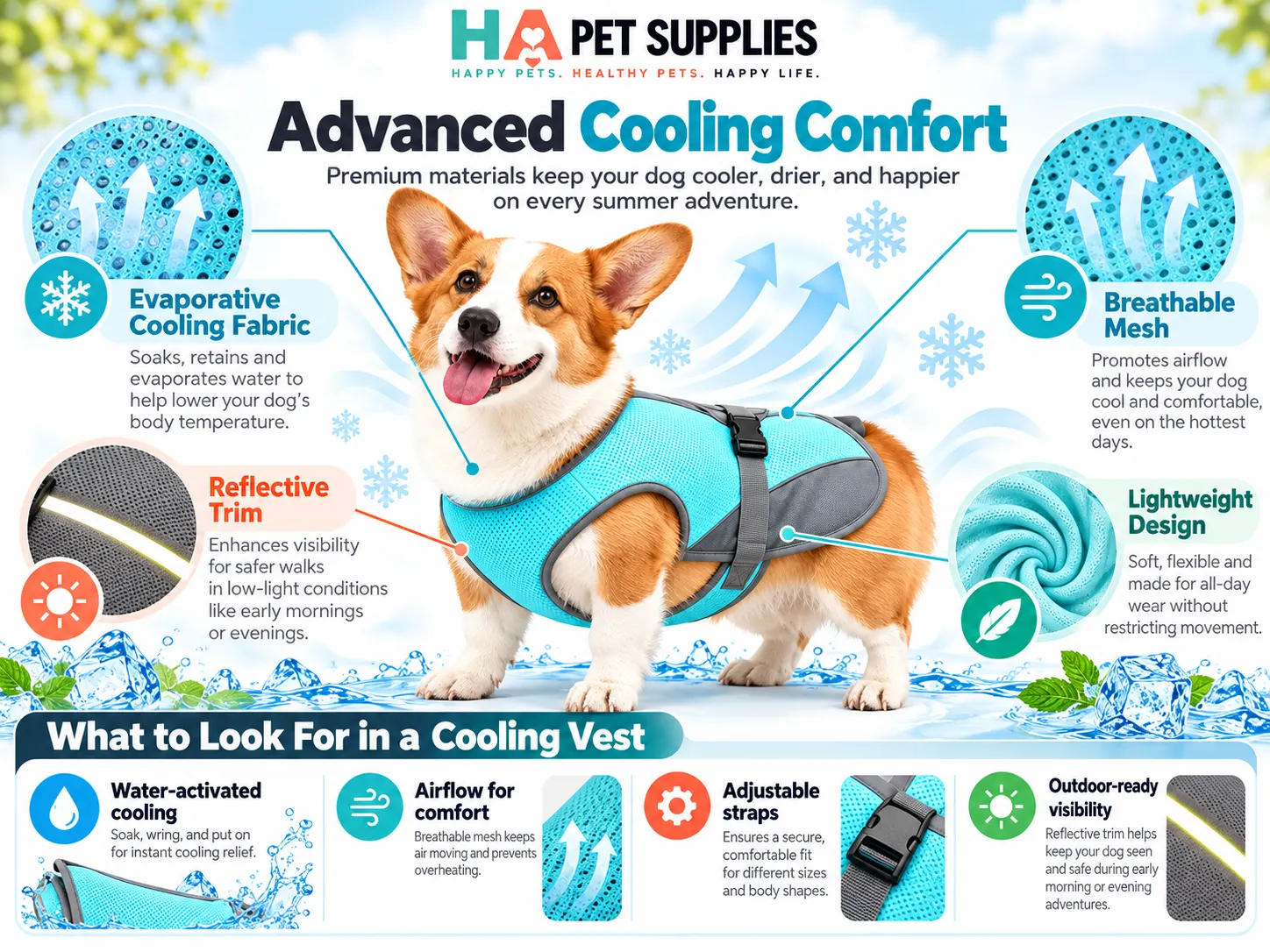
Breathable mesh, adjustable sizing, low weight and reflective details can make a cooling vest more practical for everyday summer use.
3D Infographic: 9 Dog Cooling Vest Features That Matter
Hover or click each card to explore the nine key features.
CHEST FIT
Controls overall stability.
BACK LENGTH
Determines useful coverage.
NECK COMFORT
Helps prevent pressure and rubbing.
ADJUSTABILITY
Allows more accurate fit.
BREATHABILITY
Supports airflow.
COOLING METHOD
Determines how the vest is activated.
WEIGHT
Affects mobility and comfort.
REFLECTIVE DETAILS
Helps visibility in low light.
EASY REWETTING
Makes long outings more practical.
What Material Should a Dog Cooling Vest Use?
The ideal material needs to perform several jobs. It may need to absorb water, allow evaporation, remain soft against fur, stay lightweight, and survive repeated soaking.
Common constructions combine multiple layers. For example:
- Outer Layer — may help with durability, sunlight exposure, and water distribution.
- Absorbent Layer — stores water.
- Mesh or Breathable Layer — supports airflow, comfort, and moisture movement.
Do not judge the product by one material name alone. The overall construction matters.
Is Mesh Better?
Mesh can improve ventilation. But a vest made only from open mesh may not hold enough water for meaningful evaporative cooling. The ideal design may combine breathable mesh and absorbent cooling material rather than choosing one or the other.
Does Vest Color Matter?
Light colors may absorb less solar energy than very dark fabrics. That can be useful in direct sunlight. But color should not outweigh fit, airflow, material, and body coverage. A perfectly white vest that fits badly is still a poor choice.
Does More Coverage Mean Better Cooling?
Not automatically. Greater coverage may increase wet surface area, but it can also increase weight, restrict movement, and cover areas unnecessarily. A good vest focuses on useful torso coverage while keeping shoulders, legs, and neck free enough to move naturally.
Should the Belly Be Covered?
Some cooling vest designs include partial belly panels. This may increase cooling surface and improve vest stability. But a belly panel should not interfere with urination, rub the legs, or restrict chest expansion.
Can a Cooling Vest Be Too Long or Too Short?
Yes to both. An overly long vest can bunch near hips, interfere with sitting, move toward the tail, and rub during running. A very short vest may cover only the shoulders and provide less effective torso cooling area. Evaluate the intended cooling zone.
Best Dog Cooling Vest by Use Case
Best Dog Cooling Vest for Walking: Prioritize low weight, breathability, easy soaking, good adjustability, and reflective trim. You do not need a highly complicated cooling system for every neighborhood walk.
Best Dog Cooling Vest for Hiking: Prioritize secure fit, minimal movement, durable straps, low wet weight, easy rewetting, and high visibility. Carry enough water for dog hydration and vest rewetting. Hydration always comes first. CDC recommends providing pets with fresh water during hot weather. CDC
Best Dog Cooling Vest for Travel: Travel-friendly features include compact design, quick activation, easy cleaning, and fast drying. A vest that requires long freezing or bulky inserts may be less practical when traveling. Evaporative vests can be convenient because they generally need only water.
Best Dog Cooling Vest for Brachycephalic Dogs: Dogs such as Bulldogs, Pugs, and French Bulldogs can be at increased risk in hot weather. Cornell specifically identifies brachycephalic breeds among dogs at higher risk of heatstroke. Cornell Vet School For these dogs: prioritize lightweight design, avoid restricting the chest, keep activity short, and use cooler times of day.
Best Dog Cooling Vest for Senior Dogs: Older dogs may benefit from low weight, soft straps, and simple fit. Avoid bulky designs if mobility is already limited. Cornell also identifies older dogs as higher-risk for heat-related illness.
Best Dog Cooling Vest for Thick-Coated Dogs: Thick coats can make buyers think: “I need the strongest possible vest.” Not necessarily. The dog still needs airflow, comfort, and free movement. A heavy garment layered over a heavy coat can become cumbersome. Prioritize breathable construction, fit, and appropriate cooling coverage. AKC notes that dogs rely on natural coat and panting mechanisms for temperature management and that coat type matters in heat. American Kennel Club
3D Infographic: Best Vest by Use Case
DAILY WALK
Lightweight + breathable
HIKING
Secure + easy to rewet
TRAVEL
Compact + simple activation
LARGE DOG
Wide coverage + strong adjustment
SMALL DOG
Low weight + minimal bulk
LOW-LIGHT WALK
Reflective + visible
Common Dog Cooling Vest Buying Mistakes
❌ Mistake 1
Choosing by Weight Only. Problem: Different body shapes can share the same weight. Better: Measure chest, back and neck.
❌ Mistake 2
Buying the Tightest Size. Problem: May restrict movement or airflow. Better: Use adjustability.
❌ Mistake 3
Assuming More Fabric Means More Cooling. Problem: More fabric also means more wet weight. Better: Balance coverage with breathability.
❌ Mistake 4
Ignoring Humidity. Problem: Evaporative cooling may perform differently in humid conditions. Better: Match technology to climate.
❌ Mistake 5
Buying an Ice Vest for Long Hiking Without a Re-Cooling Plan. Problem: Once cold packs warm up, you need another cooling source. Better: Think about reactivation.
❌ Mistake 6
Ignoring Shoulder Movement. Problem: Poor shaping can change gait. Better: Test walking before long use.
❌ Mistake 7
Forgetting Wet Weight. Problem: Vest becomes heavier after soaking. Better: Evaluate it wet.
❌ Mistake 8
Ignoring Reflective Features for Evening Walks. Better: Consider visibility if you avoid daytime heat.
❌ Mistake 9
Buying the Biggest Marketing Claim. Better: Compare measurable features.
How to Test the Fit at Home
Once the vest arrives, run through these six tests:
- Test 1 — Standing: Does it sit centered?
- Test 2 — Walking: Does the gait look normal?
- Test 3 — Sitting: Does material bunch?
- Test 4 — Turning: Does the vest twist sideways?
- Test 5 — Shoulder Movement: Are the front legs unrestricted?
- Test 6 — Wet Test: Does soaking make the vest too heavy?
This last test is important. A vest can fit beautifully when dry but behave differently when saturated.
3D Fit Check Infographic: Can Your Dog Do All Five?
WALK
Normally and naturally
SIT
Without bunching or pressure
TURN
Freely without twisting
LIE DOWN
Comfortably and fully
SHOULDERS
Move without restriction
What About Chafing?
Chafing can occur when material rubs repeatedly, straps are overtightened, sand gets underneath, or the vest twists. Check armpits, chest, neck, and belly edges after early uses. If irritation develops: stop use, inspect fit, clean the vest, and reassess size. Persistent skin irritation may need veterinary advice.
How Often Should You Recheck Fit?
For adult dogs: check periodically, after weight change, after coat clipping, and after major grooming changes. For puppies: check much more often. A rapidly growing dog can outgrow a vest quickly.
Is the Most Expensive Dog Cooling Vest the Best?
No. Price can reflect construction, materials, branding, and extra features. But expensive does not guarantee correct fit, better airflow, or suitability for your climate. Buy based on fit, cooling system, and use case — not prestige.
What Is the Best Dog Cooling Vest for General Buyers?
For many general owners, a practical evaporative vest with breathable material, adjustable fit, secure chest coverage, lightweight construction, reflective details, and easy rewetting is a sensible starting point.
It is simple to understand. It does not require freezing or batteries, and can be reactivated with water. That makes it convenient for walks, hiking, travel, and outdoor play.
Is the HA Pet Supplies Dog Cooling Vest Right for You?
The HA Pet Supplies dog cooling vest fits naturally into the type of summer cooling product discussed in this guide.
When evaluating it, compare the product details against your dog’s chest girth, back length, activity, climate, need for reflective details, and preferred cooling method. Do not choose only by visual appearance. The correct size matters more.
For other warm-weather or general dog products, readers can naturally browse the HA Pet Supplies dog supplies collection. If they are comparing more than one product category, the broader HA Pet Supplies shop can be introduced in that shopping context.
For uncertain sizing or product-fit questions, direct them to contact HA Pet Supplies. For retailer or bulk purchasing needs, the request a quote page is appropriate for that commercial audience.
Interactive FAQ: Dog Cooling Vest Size, Fit and Features
How should a dog cooling vest fit?
It should stay securely in position without restricting normal walking, sitting, turning or shoulder movement.
How do I measure my dog for a cooling vest?
Measure the widest part of the chest, the back length and the neck area according to the manufacturer’s size chart.
Is weight enough for choosing a size?
No. Dogs of similar weight can have very different body shapes.
What if my dog is between sizes?
Compare the individual measurements and adjustment range. Contact the retailer or manufacturer if uncertain.
Should a cooling vest be tight?
No. It should be secure but not restrictive.
Can a cooling vest be too loose?
Yes. A loose vest may twist, sag or move during activity.
What material is best for a dog cooling vest?
For evaporative designs, look for a balance of absorbency, breathability, comfort and low weight.
Is mesh important?
Breathable mesh can help airflow, but the vest also needs a material that retains enough water for evaporation.
Which cooling technology is best?
It depends on your climate and activity. Evaporative vests are convenient for water-based reactivation, while other systems may use gel, ice or phase-change materials.
Do evaporative cooling vests work in humidity?
They may be less effective in very humid conditions because water evaporates more slowly.
Is an ice vest better?
Not necessarily. Different cooling systems suit different uses.
Are reflective strips useful?
Yes, particularly if you walk early or late to avoid peak summer heat.
Does vest color matter?
Light colors may absorb less solar heat than very dark materials, but fit and breathability are more important.
How much should a cooling vest weigh?
There is no universal ideal weight. It should remain comfortable for your dog’s size and activity even after soaking.
Do large dogs need a heavier vest?
Not necessarily. They need enough coverage, but excessive wet weight can still be uncomfortable.
What is best for small dogs?
Look for lightweight construction, accurate adjustment and unrestricted shoulder movement.
What is best for hiking?
Prioritize secure fit, low wet weight, easy rewetting and durability.
What is best for travel?
Compact, quick-activation and easy-drying designs are practical.
Can a cooling vest rub the skin?
Yes, particularly if the fit is poor or material bunches.
How can I tell if the vest is too tight?
Watch for restricted movement, strap marks, rubbing or unusual gait.
Can my dog wear a cooling vest under a harness?
Only if the products are designed to work together and do not create excessive pressure or heat. Check both manufacturers’ instructions.
Does a cooling vest replace water?
No. Fresh drinking water remains essential. CDC
Does a cooling vest prevent heatstroke?
No. It may provide cooling support but cannot guarantee heatstroke prevention.
Should I buy the vest with the most coverage?
Not automatically. Coverage must be balanced with airflow, fit and mobility.
Can puppies use cooling vests?
Potentially, but sizing needs frequent reassessment because puppies grow quickly.
Are cooling vests safe for Bulldogs and Pugs?
They may provide support, but brachycephalic dogs are at increased heat risk and still require conservative activity and close monitoring. Cornell Vet School
Final Dog Cooling Vest Buying Checklist
Before buying, check all five categories.
📏 SIZE
- chest measured
- back measured
- neck checked
- size chart reviewed
- adjustment range confirmed
🧥 FIT
- shoulders free
- chest unrestricted
- belly comfortable
- no rubbing
- no major shifting
🧵 MATERIAL
- breathable
- lightweight
- absorbent where appropriate
- easy to clean
- comfortable against fur
⚙️ FEATURES
- cooling method understood
- easy rewetting
- reflective trim if useful
- secure straps
- suitable wet weight
🗺️ YOUR ROUTINE
- walking
- hiking
- travel
- outdoor play
- climate & humidity
Do not buy until the vest makes sense for all five areas.
Conclusion: Fit Matters More Than Marketing
Choosing the right dog cooling vest becomes much easier when you stop comparing slogans and start comparing practical features.
The most important buying priorities are: accurate measurements, secure but unrestricted fit, breathable comfortable material, a cooling method that matches your climate, low enough weight for your dog’s activity, easy rewetting and cleaning, and useful visibility features where needed.
A vest that claims extreme cooling but rubs the armpits is the wrong vest. A vest that absorbs huge amounts of water but becomes too heavy is the wrong vest. A vest that fits beautifully when dry but twists when soaked is the wrong vest.
The correct product should feel like a comfortable cooling layer, not a burden.
For general buyers, the simplest decision process is: measure → compare fit → check cooling method → check weight → check breathability → check rewetting → choose.
If you still need to understand whether the technology itself makes sense, go back to Do Dog Cooling Vests Really Work? How They Keep Dogs Cool in Hot Weather.
Once you have selected the right vest, the next practical step is How to Use a Dog Cooling Vest Safely: Soaking, Wearing, Rewetting and Hot-Weather Tips.
That gives your full SEO cluster a strong buyer journey: Blog 1: Does a dog cooling vest really work? Blog 2: How do I use a dog cooling vest safely? Blog 3: Which size, fit, material and cooling features should I choose? Blog 3 therefore becomes the purchase-decision guide — the article designed for confused buyers who are ready to purchase but need to understand what actually matters before choosing a size or product.