
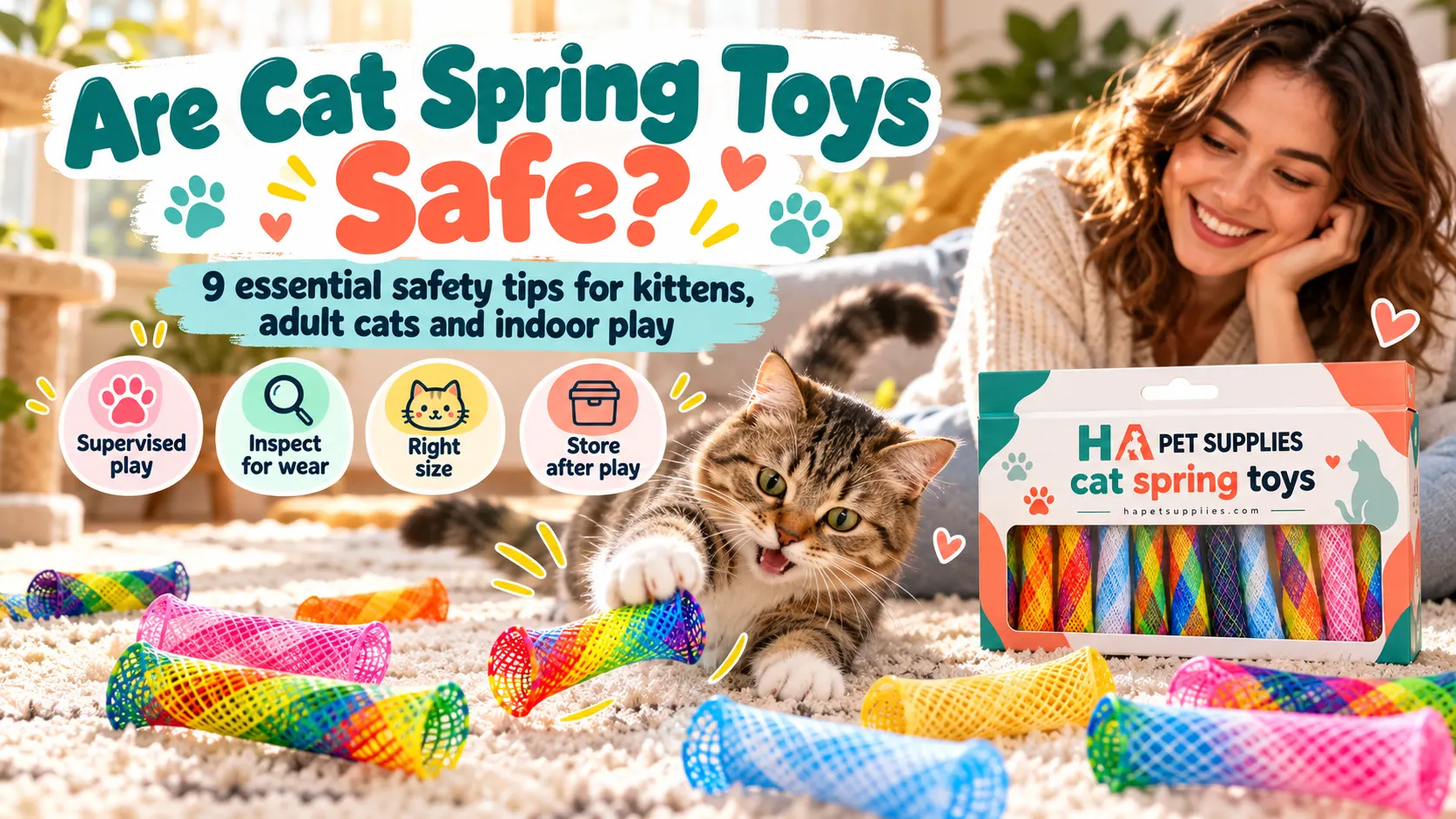
HA Pet Supplies cat spring toys during supervised indoor play
Your cat loves chasing colorful spring toys. But are they actually safe?
Maybe you recently purchased a set of spring toys for your kitten. Perhaps your adult cat has been batting one around the living room, carrying it in its mouth, or chewing on the flexible material.
Suddenly, a worrying thought crosses your mind. What if my cat accidentally swallows a piece? Could the mesh unravel? Are spring toys safe to leave on the floor overnight? And should kittens play with the same toys as adult cats?
These are reasonable questions for anyone choosing toys for a curious pet.
Are cat spring toys safe? The answer depends on the toy’s size, construction, condition, and how your individual cat interacts with it. An appropriately sized, intact spring toy may be suitable for supervised play. However, small pieces, loose strands, damaged mesh, and chewing behavior can create hazards. This is especially important for flexible woven mesh toys, which may fray or separate if damaged.
Fortunately, you do not need to avoid every moving or spring-shaped toy simply because potential hazards exist. You need to understand how to evaluate toys, recognize unsafe conditions, supervise play, and select products that suit your cat’s behavior.
In this comprehensive guide, we will cover nine essential safety precautions, explain possible ingestion and choking hazards, compare toy materials, and show you how to introduce spring toys to kittens, adult cats, and senior cats. We will also discuss what to do when your cat chews a toy, how to recognize warning signs after suspected ingestion, and how to make indoor play safer.
Quick answer for worried cat owners: Cat spring toys can be appropriate for supervised play when they are intact, appropriately sized, and not being chewed apart. Remove toys with loose strands, sharp edges, broken pieces, or signs of deterioration. If you suspect your cat swallowed toy material, contact your veterinarian promptly rather than waiting for symptoms.
The goal is not to eliminate every possible risk from playtime. It is to make sensible choices that allow your cat to explore and play while reducing avoidable hazards.
📋 Table of Contents
- Are cat spring toys safe? The quick safety answer
- What are cat spring toys made from?
- Nine essential cat spring toy safety tips
- Are woven mesh spring toys safer than plastic coils?
- Can kittens safely play with spring toys?
- Are spring toys suitable for adult and senior cats?
- What happens if a cat swallows part of a spring toy?
- How to recognize a damaged cat spring toy
- Can cats play with spring toys without supervision?
- How to introduce a new spring toy safely
- Cleaning, storage and replacement guidelines
- Cat spring toys compared with other toys
- How to create a safer indoor play area
- A practical spring toy safety checklist
- Frequently asked questions
- Final recommendations
1. Are Cat Spring Toys Safe? The Quick Safety Answer
If you are worried about your cat right now, start with this section. There are three common situations.
Situation 1: Your cat is playing normally with an intact spring toy
If your cat is batting or chasing an appropriately sized toy without attempting to chew off pieces, this may be a suitable supervised activity. Remain nearby during play. Observe how your cat interacts with the material. Check the toy afterward. Remember that an intact appearance does not guarantee a toy is appropriate for every cat.
Situation 2: Your cat is chewing or tearing the toy
Stop the play session. Remove the toy and inspect it for missing pieces, unraveling, or other damage. Do not give the same toy back if it is compromised. If material appears to be missing and ingestion is possible, contact your veterinarian for advice.
Situation 3: Your cat may have swallowed part of the toy
Contact your veterinarian or an emergency veterinary service promptly, even if your cat initially appears normal. Swallowed foreign objects can cause serious complications. Do not try to induce vomiting at home. If string-like material is visible coming from your cat’s mouth or rectum, do not pull it.
The Cornell Feline Health Center’s safe toys and gifts guidance recommends avoiding toys with pieces or linear strands that can separate and be swallowed. This guidance is particularly relevant when evaluating flexible woven toys.
Why supervision matters
Cats interact with toys differently. One cat may simply bat a spring toy across the floor. Another may repeatedly bite the ends or attempt to tear the material apart. You cannot determine suitability based only on the product category. You must also consider the individual animal.
The safest approach is to assess the toy and observe the cat together.
2. What Are Cat Spring Toys Made From?
Not all spring toys have the same construction. Before deciding whether a product is appropriate, understand what you are purchasing.
Traditional plastic coil spring toys
Some toys are molded into a spiral or coil shape. They are often lightweight and may bounce or roll when touched. Depending on the material, a plastic coil may become brittle, crack, or develop sharp edges with wear. Some cats may also bite or chew pieces from the material. These toys require inspection just like other products.
Flexible woven mesh spring toys
Other toys use a woven lattice or mesh structure. They may have an elongated tubular shape and flexible construction. For example, HA Pet Supplies Cat Spring Toys feature colorful woven mesh designs intended for indoor batting and chasing activities. The product images show flexible, lightweight mesh toys rather than traditional tightly coiled plastic springs.
This distinction matters. Different designs can have different movement characteristics and potential failure points. Woven materials should be inspected for loose threads, open ends, splitting, and fraying. Do not assume the toy is safe simply because the material feels soft.
Are soft materials automatically safer?
No. Softness may influence how an object feels, but it does not guarantee suitability. A soft toy may still contain small detachable pieces. A woven toy may develop loose strands. A hard toy may crack or expose sharp edges. The correct question is not simply whether the material is soft or hard. It is whether the complete toy remains intact, appropriately sized, and suitable for your cat’s play style.
What should you check before buying?
Evaluate the product’s dimensions, construction, visible edges, and materials. Consider whether your cat frequently chews toys or tries to swallow non-food objects. Check the product description for manufacturer guidance and intended use. Avoid assuming that terms such as pet-friendly, durable, or lightweight establish formal safety certification.
🔍 Interactive 3D: Inside a Cat Spring Toy
Hover over each material to explore its inspection points.
Plastic Coil
Woven Mesh
Check Cracks
Check Fraying
Inspect Ends
Replace if Damaged
3. Are Cat Spring Toys Safe? 9 Essential Safety Tips Every Owner Should Follow
A few straightforward habits can reduce common toy-related hazards. These nine precautions are especially useful for owners introducing new toys to curious kittens or cats that frequently chew objects.
🎲 Interactive 3D: Nine Essential Safety Rules
Hover to pause. Each face shows one essential rule.
1. Inspect
Check for fraying, cracks, or loose strands before every session.
2. Choose Size
Never choose a toy your cat can fit entirely into its mouth.
3. Supervise
Stay close during play. Watch for chewing or tearing behavior.
4. Remove Damage
Discard toys with loose strands, missing pieces, or sharp edges.
5. Clear Area
Remove cords, fragile items, and hazards before play begins.
🖱️ Hover to pause · 9 safety rules in rotation
Safety Tip 1: Always Inspect the Toy Before Play
Start by examining the spring toy closely. Look at the entire surface. For a woven mesh toy, pay special attention to the ends and intersections of the material. Check for fraying, separated strands, deformation, or damage. If the toy contains molded plastic, look for cracks or sharp edges. Do not assume a toy is still appropriate merely because your cat played with it safely yesterday. Damage can develop over time.
Practical inspection routine: Before each session, hold the toy under good lighting and examine its structure. Gently check whether any parts appear loose. If the toy is damaged, discard it rather than attempting an unreliable repair with tape, glue, or string. The VCA guide to cat play and play toys emphasizes observing cats during play and preventing ingestion of non-food items.
Safety Tip 2: Choose an Appropriate Toy Size
Toy size matters. An object that is too small may be swallowed. However, an object that is excessively large or heavy may be difficult for your cat to manipulate. There is no universal safe diameter or length for every cat. A suitable size depends on the animal’s age, mouth size, chewing behavior, and the toy’s shape. For kittens, be particularly cautious because they may attempt to mouth unfamiliar objects. The VCA guidance on kitten play and investigative behavior advises avoiding objects small enough to be ingested.
Practical buying tip: Compare the toy’s actual measurements rather than relying only on photographs. Look for clear product dimensions. Avoid choosing a toy that your cat can readily fit entirely into its mouth.
Safety Tip 3: Supervise Spring Toy Play
Supervision is one of the most important precautions for unfamiliar toys. Some cats play by tapping and chasing. Others chew, bite, or pull at the material. During the first few sessions, remain close enough to intervene. Watch how the cat uses its mouth and paws. If your cat repeatedly bites the toy or attempts to remove pieces, stop the session. Do not assume the toy will remain safe when you leave the room.
Practical rule: Treat woven mesh spring toys as supervised-play items unless you have reliable evidence that the particular product and your cat’s behavior make independent access appropriate. For kittens and known chewers, direct supervision is especially important.
Safety Tip 4: Remove Damaged Spring Toys Immediately
A damaged toy should not remain in your cat’s play area. Fraying mesh can create loose strands. Broken plastic can produce sharp edges or smaller fragments. These may pose ingestion or injury hazards. A common mistake is continuing to use a toy because only one small section appears damaged. But even minor deterioration can worsen during active play.
Remove the toy if you notice: loose woven strands or unraveling; missing material or detached pieces; sharp or cracked edges; significant deformation; signs that your cat has chewed through part of the structure. Do not wait for the toy to break completely. Replacing one damaged item is preferable to risking an avoidable veterinary emergency.
Safety Tip 5: Keep the Play Area Free From Hazards
Even a suitable toy can become part of an unsafe situation. Imagine your cat chasing a spring toy beneath a heavy shelf or across a slippery surface. The toy itself may not be the only concern. Cats can become distracted while pursuing moving objects. The Cornell Feline Health Center recommends considering the surrounding environment and avoiding locations where heavy objects could fall or cats could be injured while playing.
Before introducing a spring toy, clear the area. Remove electrical cords, fragile decorations, and small household objects. Ensure there are no dangerous gaps where a cat might become trapped. Use a floor surface that provides appropriate traction.
Safety Tip 6: Introduce New Toys Gradually
Not every cat responds positively to a new object. Some become excited immediately. Others need time. Place the toy on the floor and allow your cat to approach voluntarily. Do not force the toy into the cat’s face or paws. If the cat appears comfortable, gently roll the toy a short distance. Observe the response. Start with a short supervised session. Increase opportunities only when the cat shows interest.
Safety Tip 7: Avoid Encouraging Rough or Dangerous Chewing
Some cats chew objects during play. Occasional mouth contact is different from aggressively tearing material or swallowing fragments. If your cat begins to pull apart a mesh toy, remove it. Do not encourage chewing by repeatedly pushing the toy toward the cat’s mouth. Offer another appropriate activity instead. The Cornell Feline Health Center’s guidance on destructive behavior explains that fabric chewing can sometimes become dangerous when pieces are swallowed.
Safety Tip 8: Clean and Store Toys Properly
Cat toys can collect dirt, fur, saliva, and debris. A clean toy is more pleasant to handle and easier to inspect. Follow the manufacturer’s cleaning instructions for the specific material. Do not assume every woven mesh toy is dishwasher-safe, machine-washable, or suitable for hot water. If cleaning instructions are unavailable, seek manufacturer guidance. Avoid harsh chemical cleaning products that may leave harmful residues. Allow the toy to dry completely before storage. When the session ends, place inspected toys in a clean container outside your cat’s reach when supervision is unavailable.
Safety Tip 9: Know When to Stop Play and Contact Your Veterinarian
A responsible toy routine includes recognizing warning signs. Stop play if your cat appears distressed, becomes unusually fatigued, or develops discomfort. If the cat bites off material, examine the toy for missing pieces. If ingestion is possible, contact a veterinarian promptly. Signs such as vomiting, retching, abdominal pain, loss of appetite, or lethargy may indicate a problem. The VCA veterinary resource on foreign-body ingestion explains why swallowed materials can cause serious gastrointestinal problems. Do not wait for severe symptoms when ingestion is suspected.
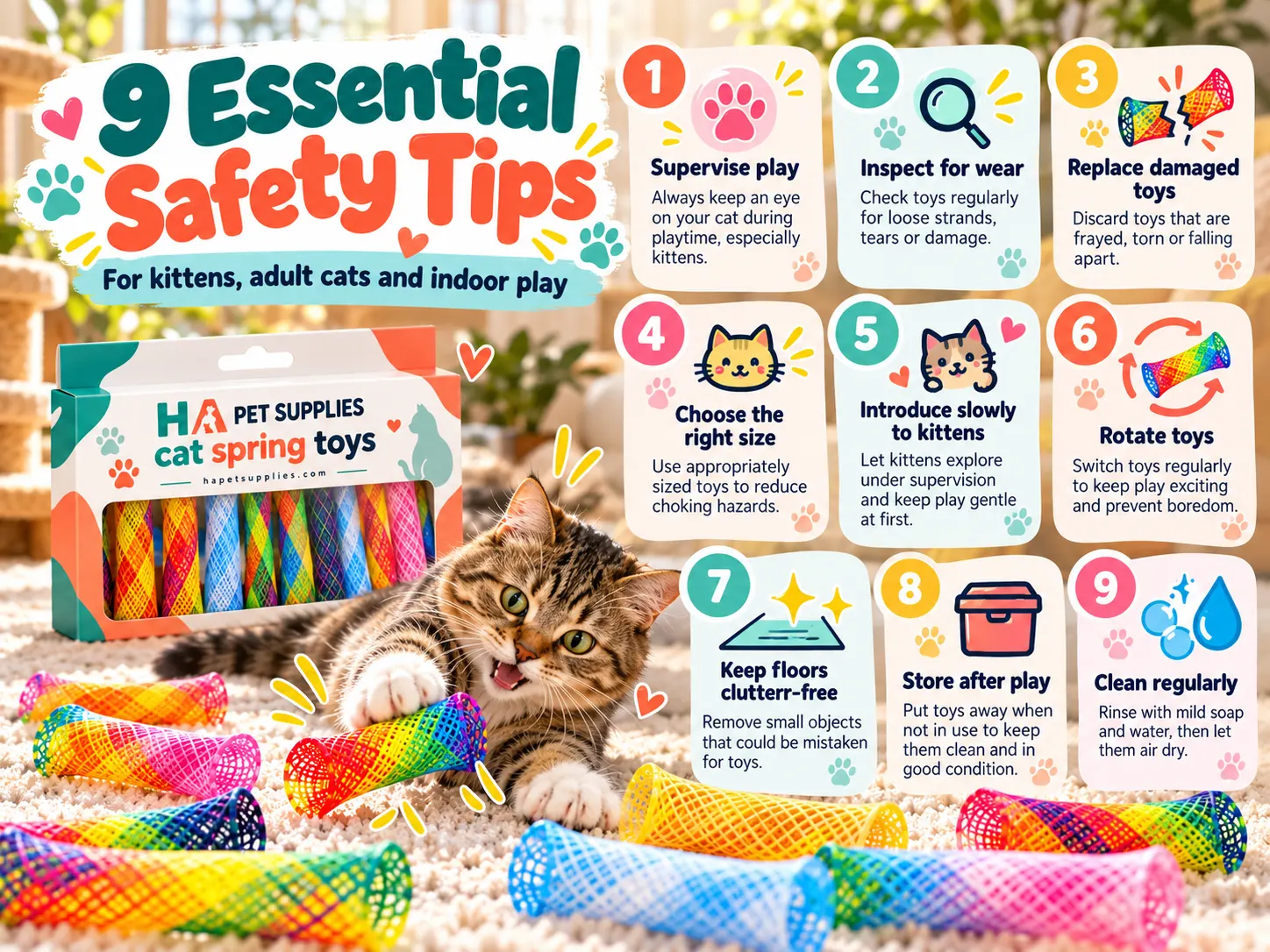
Nine practical cat spring toy safety tips for supervised play
4. Are Woven Mesh Spring Toys Safer Than Plastic Coil Toys?
Many cat owners compare different spring toy materials before purchasing. The two common options are molded plastic coil toys and flexible woven mesh designs. But one should not automatically be described as safer than the other. Safety depends on construction quality, size, wear, and how an individual cat uses the product.
Plastic coil spring toys
Plastic coil designs may roll and bounce when touched. Some cats enjoy chasing them across smooth floors. However, damaged plastic may crack, break, or develop sharp edges. Smaller fragments may become ingestion hazards.
Woven mesh spring toys
Woven mesh designs can flex and move when handled. Their different texture may interest cats that enjoy manipulating objects. However, woven material may unravel or fray. Loose strands can be particularly concerning if chewed and swallowed. The ASPCA’s advice on household string hazards explains that swallowed string-like material can cause serious intestinal complications.
| Feature | Plastic Coil Toys | Woven Mesh Spring Toys |
|---|---|---|
| Common construction | Molded plastic coil | Flexible woven tubular mesh |
| Typical movement | Rolling and bouncing | Rolling, flexing and shifting |
| Potential wear | Cracking or broken edges | Fraying or loose strands |
| Main inspection priority | Check for cracks and fragments | Check for unraveling and separation |
| Suitable for every cat? | No | No |
| Supervision | Recommended | Especially important for chewers |
| Replacement needed when damaged? | Yes | Yes |
Which material should you choose?
Consider your cat’s individual behavior. If the cat aggressively chews plastic, a different material may be worth evaluating. If the cat pulls apart woven fabrics, a mesh spring may not be appropriate. Neither choice eliminates the need for supervision and inspection. The right option is the toy your cat can interact with safely without damaging or swallowing material.
5. Can Kittens Safely Play With Cat Spring Toys?
Kittens are curious, active, and often enthusiastic about moving objects. They may bat, chase, wrestle, and investigate toys using their mouths. These behaviors are a normal part of development. However, kittens also require additional attention to toy size and construction.
Why kittens need closer supervision
Young cats may be more likely to investigate unfamiliar items by chewing. Their play can involve rapid movements and frequent changes in attention. A toy that appears suitable for an adult cat may be too small for a kitten. Similarly, a woven material that an adult cat ignores may become an object of chewing for a curious youngster. The VCA kitten toy safety recommendations advise supervising kittens, avoiding swallowable objects, and keeping hazardous strings away.
How to introduce a spring toy to a kitten
Begin with an age-appropriate, intact product. Place the toy on a clear floor. Stay close and watch how the kitten interacts. If the kitten bats or chases it without damaging the material, continue briefly. If chewing becomes aggressive or pieces begin separating, remove the toy.
What about very young kittens?
Very young kittens need toys appropriate to their development and coordination. Do not assume that a product intended for adult cats is suitable for a very young kitten. Ask your veterinarian when uncertain.
Is it safe to leave spring toys inside a kitten’s playpen?
Do not leave woven or potentially chewable spring toys with an unsupervised kitten unless the specific product is confirmed appropriate for that situation. A playpen should not contain objects that could create an ingestion hazard. Provide appropriate bedding, water and other necessities according to the kitten’s age and circumstances.
6. Are Cat Spring Toys Safe for Adult and Senior Cats?
Adult cats can benefit from activities that encourage movement, curiosity and natural behavior. Many enjoy batting and chasing small objects. Spring toys may be one part of a varied enrichment routine. However, adult cats are not automatically immune to chewing or ingestion hazards.
Adult cats that enjoy chasing
A healthy adult cat may enjoy following a spring toy across the floor. Choose a clear playing area. Allow the cat to investigate and capture the toy. Stop if the cat becomes distressed or begins damaging the material.
Adult cats that chew fabric
Some cats have a strong tendency to chew textiles or other non-food objects. Woven mesh toys may be unsuitable for these individuals. Observe carefully and consider alternative play materials.
Senior cats with reduced mobility
Older cats can still enjoy appropriate play. However, pain, arthritis, impaired vision or other health conditions may affect their behavior. A senior cat may prefer gentle floor-based batting rather than repeated jumping. Avoid encouraging movements that cause discomfort. The Cornell Feline Health Center’s senior-cat information includes resources about aging and recognizing changes in activity.
When an older cat suddenly stops playing
Do not automatically blame boredom. A sudden reduction in activity could indicate pain or illness. If the change is unusual, particularly alongside appetite, mobility or behavior changes, arrange a veterinary assessment.
7. What Happens if a Cat Swallows Part of a Spring Toy?
This is one of the most important sections for owners searching whether cat spring toys are safe. Swallowing a toy fragment may cause an obstruction or other gastrointestinal injury. Long, thin materials may create a particular danger.
🚨 Interactive 3D: What to Do if Your Cat Swallows Toy Material
Cat Behaving Normally
Continue appropriate supervision and inspect the toy after play.
Watch for any changes in behavior, appetite, or energy.
Action: Keep playing safely, but stay alert.
Material Missing or Swallowed
Stop play. Remove the toy from your cat’s reach.
Contact your veterinarian or emergency service promptly.
Action: Do NOT induce vomiting. Do NOT pull visible string.
What is a foreign-body obstruction?
A foreign body is an object inside the digestive tract that should not be there. Some swallowed objects may pass naturally. Others become lodged and prevent normal movement of food and digestive contents. A veterinarian must determine the appropriate approach.
Why string-like materials are especially dangerous
Long, thin material can become anchored inside the gastrointestinal tract. As the intestines move, the material may pull against intestinal tissue. This can cause serious damage. The VCA explanation of holiday ribbon and string hazards explains how linear foreign bodies can cause intestinal bunching and injury. This is why loose mesh strands should never be dismissed as harmless.
⚠️ Warning signs after suspected toy ingestion: Vomiting or repeated retching · Loss of appetite · Unusual tiredness or hiding · Abdominal discomfort · Changes in bowel movements · Restlessness or unusual vocalization · Pain when handled. Some cats may initially show few obvious symptoms. Do not wait for symptoms before seeking veterinary guidance if ingestion is suspected.
What should you do immediately?
Remove any remaining damaged toy from your cat’s reach. Contact your veterinarian or local emergency veterinary hospital. Explain what material may have been swallowed, when the event occurred and whether your cat is showing symptoms. Keep the remaining toy or packaging available to help identify the material. Do not give home remedies or induce vomiting unless a veterinarian directs you to do so. Do not pull string-like material that may be protruding from the mouth or rectum. The Cornell guidance on common feline hazards also recommends prompt veterinary consultation when dangerous ingestion is suspected.
8. How to Recognize a Damaged Cat Spring Toy
One of the simplest ways to reduce toy-related hazards is to examine products regularly. But what exactly should you look for?
Loose woven threads
Inspect the ends and surface. If strands protrude or the weave begins separating, the toy should be removed.
Cracks or sharp edges
Hard plastic toys may become damaged after repeated impacts. Check for rough or broken sections.
Missing pieces
If part of the toy appears to be missing, determine whether it may have been swallowed. Contact your veterinarian if ingestion is possible.
Significant distortion
A toy that no longer maintains its original structure may be weakened. Do not assume it is suitable for continued play.
Visible bite damage
Repeated deep bite marks, tears, or punctures may indicate that the cat is using the product as a chew object rather than simply a play object.
Unusual material changes
Changes in texture, stickiness, brittleness, or deterioration can indicate that a toy should be replaced.
A practical five-second inspection
Before a session, briefly check the complete toy. Look for loose strands, missing pieces, sharp edges, signs of chewing and overall deterioration. If you are uncertain about its condition, remove it. A new toy is generally less costly than treating a preventable injury.
9. Can Cats Play With Spring Toys Without Supervision?
Many owners purchase small toys because they want their cats to remain entertained while they work or leave home. However, a toy’s ability to move independently does not prove it is appropriate for unsupervised use.
The difference between independent and unsupervised play
Independent play means the cat interacts without a person directing every action. Supervised play means a person remains present and able to intervene. A cat can play independently while its owner supervises. This distinction is important.
Why woven mesh deserves attention
Woven mesh toys may be damaged through repeated biting or pulling. If loose strands develop, they can create ingestion hazards. Consequently, owners should take a conservative approach to leaving such items accessible.
What can you provide when you are busy?
Consider suitable environmental enrichment that does not introduce unacceptable risks. This may include a secure window perch, stable scratching furniture, safe hiding places, comfortable resting areas and age-appropriate enrichment equipment. The VCA guidance on indoor cat enrichment explains why environmental features are valuable alongside toys.
Should you leave spring toys out overnight?
For woven mesh spring toys, putting them away after supervised play is a sensible precaution, especially with kittens and cats that chew. Do not assume a toy is harmless simply because it is lightweight or marketed for independent play.
10. How to Introduce a New Cat Spring Toy Safely
A good introduction can help you understand how your cat interacts with an unfamiliar object.
Step 1: Examine the product
Check that the toy is intact and appropriately sized.
Step 2: Prepare a safe environment
Remove loose household objects and choose a comfortable play surface.
Step 3: Place the toy on the floor
Allow your cat to approach naturally.
Step 4: Watch the first reaction
Does your cat sniff, bat, chase or bite the object? Observe without forcing interaction.
Step 5: Introduce gentle movement
Roll the spring toy a short distance if your cat appears comfortable.
Step 6: Allow successful captures
Let your cat catch and investigate the object.
Step 7: Keep the first session brief
Stop if the cat becomes uncomfortable, overexcited or uninterested.
Step 8: Inspect after use
Look for damage or missing material.
Step 9: Store appropriately
Place the toy somewhere secure when supervised play ends.
You can learn more about the behavioral reasons behind these games in our companion article explaining why cats love spring toys and enjoy chasing colorful springs. This can help you choose movements that suit your cat rather than repeatedly encouraging overly intense activity.
11. How to Clean, Store and Replace Cat Spring Toys
Cleaning and storage are often overlooked when choosing pet toys. However, regular care makes it easier to identify changes in a toy’s condition.
Cleaning woven mesh toys
Follow the manufacturer’s instructions for the specific product. Avoid assuming all woven mesh materials can tolerate hot water, chemical disinfectants, washing machines or dryers. If the appropriate cleaning method is unclear, contact the supplier.
Inspect while cleaning
Check for fraying, separated strands and visible deterioration. Do not try to conceal damage with tape or adhesive.
Allow complete drying
A toy should be thoroughly dry before being placed into enclosed storage.
Store toys in a clean container
Keep inspected toys organized in a secure location. Separate damaged items for disposal.
When should you replace a toy?
There is no universal replacement interval. A toy used frequently may wear faster than one used occasionally. Replace it based on condition, not an arbitrary number of weeks. If it develops loose pieces, fraying, cracks or other damage, remove it immediately.
Why toy rotation helps
Rotating appropriate toys may maintain novelty. The VCA guidance on play and toy rotation recommends providing variety and changing available toys to maintain interest. However, rotating a damaged toy does not make it suitable for reuse. Inspect every toy before reintroduction.
12. Cat Spring Toys vs Other Cat Toys: Which Are Safer?
No toy category is completely free from potential hazards. Different products require different precautions.
| Toy Type | Main Benefit | Potential Hazard | Main Precaution |
|---|---|---|---|
| Woven mesh spring toys | Batting and chasing | Loose strands if damaged | Inspect and supervise |
| Plastic coil spring toys | Rolling and bouncing | Cracks and broken fragments | Check plastic condition |
| Feather wands | Interactive hunting-style play | Detached feathers and swallowed strings | Supervise and store |
| Plush mice | Carrying and wrestling | Detached parts or exposed stuffing | Inspect seams and attachments |
| Rolling balls | Floor-based activity | Small components or inappropriate size | Select suitable size |
| Puzzle feeders | Mental enrichment | Broken components or food-related issues | Inspect and monitor |
| Cat tunnels | Exploring and hiding | Damaged fabric or unstable construction | Check integrity and placement |
Are spring toys safer than string toys?
They have different risk profiles. Loose strings and ribbons pose recognized linear foreign-body hazards. An intact spring toy may avoid some risks associated with dangling cords, but woven spring toys can also develop loose strands if damaged. The ASPCA’s warnings about yarn and thread hazards reinforce why access to loose string-like materials should be prevented.
Are expensive toys safer?
Not necessarily. A high price does not guarantee appropriate construction or safe use. Choose toys according to condition, size, material, and the way your cat interacts with them.
Should you buy multiple toy types?
Variety is useful when it provides different safe activities. For example, a cat may enjoy a supervised spring toy session, a properly stored wand toy, and a suitable puzzle feeder. Our guide to the best cat toys for bored indoor cats explains how to create a balanced collection based on movement, enrichment, and individual preferences.
13. Creating a Safer Indoor Play Area
A suitable toy is only one part of safe play. The surrounding environment also matters.
Use a clear floor space
Choose a location without fragile decorations, loose electrical cords or other clutter. Allow enough room for your cat to move naturally.
Avoid slippery surfaces
Some cats may struggle to maintain traction on very smooth floors. Choose a comfortable surface suited to the activity.
Check nearby furniture
Ensure large objects are stable. Do not encourage chasing beneath dangerous equipment or unstable shelving.
Provide escape routes
Cats should be able to move away from play whenever they choose. Avoid trapping a cat between furniture or family members.
Separate play resources in multi-cat homes
Two cats may have different levels of interest and confidence. If one cat frequently interrupts or intimidates the other, provide separate supervised play opportunities.
Keep dangerous household objects away
String, rubber bands, electrical cords and small objects can all create hazards. The ASPCA’s guidance on keeping cats out of trouble explains why everyday household objects may be dangerous when chewed or swallowed.
Build a wider enrichment routine
Play should be combined with suitable scratching areas, resting places, climbing opportunities and positive interaction. Cats need more than continuous stimulation. They also need predictable access to comfortable, secure spaces.
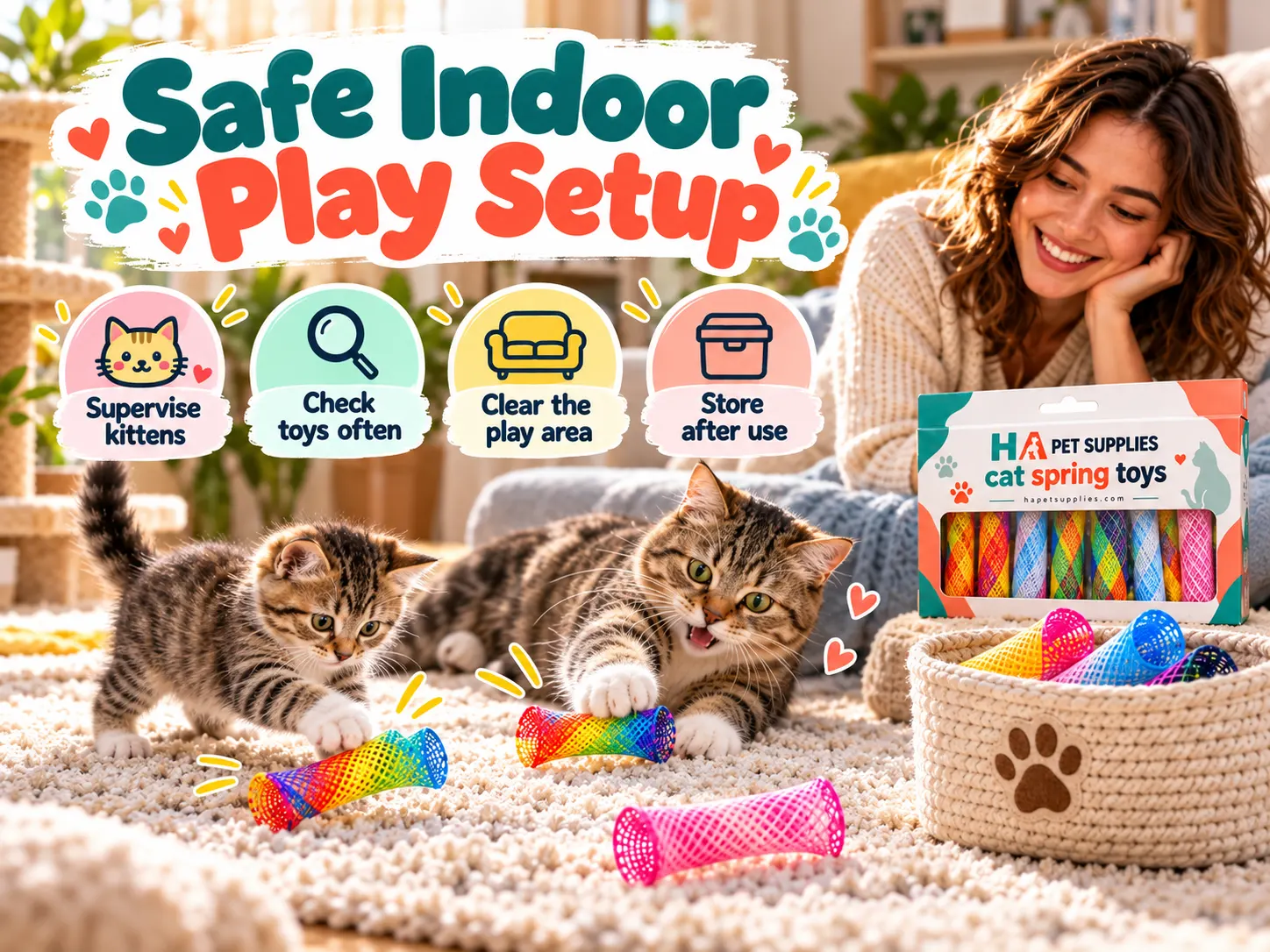
Two tabby cats enjoying colorful spring toys during supervised play
14. The Cat Spring Toy Safety Checklist
✅ Before Purchasing
✅ Before Each Play Session
✅ During Play
✅ After Play
🚨 If Something Goes Wrong
15. Frequently Asked Questions About Cat Spring Toy Safety
Appropriately sized, intact spring toys may be suitable for regular supervised play when the cat does not chew them apart. Inspect toys before each session and remove damaged items.
Woven mesh toys may be suitable for supervised play, but they can become hazardous if they fray or develop loose strands. They are not appropriate for every cat, particularly those that chew or ingest fabric-like materials.
Some kittens may enjoy appropriately sized spring toys. However, kittens require close supervision because they may chew or attempt to swallow unfamiliar objects.
A cat may swallow a small toy or broken component if it fits into the mouth. This is why size selection and toy inspection matter.
Swallowed material may cause gastrointestinal injury or obstruction. Contact a veterinarian promptly if ingestion is suspected.
For woven mesh toys, storing them after supervised play is a conservative safety choice, especially if your cat chews toys. Do not assume every spring toy is suitable for unsupervised access.
Neither material is automatically safer. Plastic toys may crack or break, while woven mesh may fray or unravel. Choose based on the specific toy and your cat’s behavior.
Replace toys with loose strands, missing pieces, significant wear, sharp edges or visible structural damage.
A damaged or unsuitable toy could potentially cause oral injury. If your cat shows mouth pain, bleeding, broken teeth or discomfort, stop use and seek veterinary advice.
Clean toys according to the manufacturer’s instructions. Do not assume every material tolerates hot water, machine washing or strong cleaning chemicals.
Some senior cats enjoy gentle floor-based batting. Choose activities appropriate to their mobility and health.
Remove the spring toy and select an alternative better suited to your cat’s behavior. Discuss persistent chewing or ingestion of non-food materials with a veterinarian.
Two cats may enjoy playing in the same area when both are comfortable. Supervise interactions and provide enough space to prevent competition or conflict.
Color alone does not establish safety. Construction, size, condition and the cat’s behavior are more important.
They may be useful for cats that enjoy batting and chasing moving objects. However, spring toys are only one possible part of a varied enrichment routine.
Do not rely on glue, tape or improvised repairs to make a damaged toy safe. Replace the toy instead.
Check safe hiding locations, such as beneath furniture. If the toy cannot be found and there is reason to believe your cat swallowed it, contact your veterinarian. Do not assume disappearance automatically means ingestion.
Some may not be appropriate. A cat that habitually tears apart toys or swallows non-food items requires more careful product selection and veterinary guidance.
Suitable spring toys may provide movement-based enrichment. They should be combined with interactive play, scratching opportunities, resting areas and environmental variety.
Inspect the product, choose a clear play area, supervise the initial interaction, start slowly, and remove the toy if your cat chews or damages it.
16. Final Thoughts: Are Cat Spring Toys Safe for Your Cat?
So, are cat spring toys safe? They can be an appropriate addition to supervised indoor play, but the answer is not the same for every cat or every toy. Safety depends on construction, size, condition, chewing behavior and the environment.
An intact spring toy may provide enjoyable opportunities for batting, chasing and exploring movement. However, damaged woven mesh, loose strands, cracked plastic and missing pieces should never be ignored.
The most effective safety habits are straightforward. Inspect toys regularly. Choose appropriate sizes. Supervise unfamiliar or chewable materials. Remove damaged items immediately. Keep the playing area clear. And seek veterinary guidance whenever ingestion or injury is suspected.
For owners whose cats enjoy chasing lightweight objects, HA Pet Supplies Cat Spring Toys offer a colorful woven mesh option to consider for supervised indoor enrichment. Before purchasing, evaluate the toy’s dimensions and construction against your cat’s individual habits.
You can also browse the HA Pet Supplies cat supplies collection for other enrichment options. If you are comparing toys for a kitten, a playful adult or an older cat, the broader HA Pet Supplies shop can help you explore additional products suited to different activities.
For further information about feline play, behavior and choosing appropriate pet products, explore the HA Pet Supplies educational blog. If you need clarification about the product, its construction, or available options, contact the HA Pet Supplies team. Retailers and business buyers can also request a quote for HA Pet Supplies products.
At HA Pet Supplies, our aim is to help pet owners make informed choices about everyday products for their animals.
A fun toy should support your cat’s natural curiosity without introducing avoidable hazards.
Choose carefully, supervise responsibly, and make safety part of every play session.
Shop Cat Spring Toys Browse Cat Supplies