
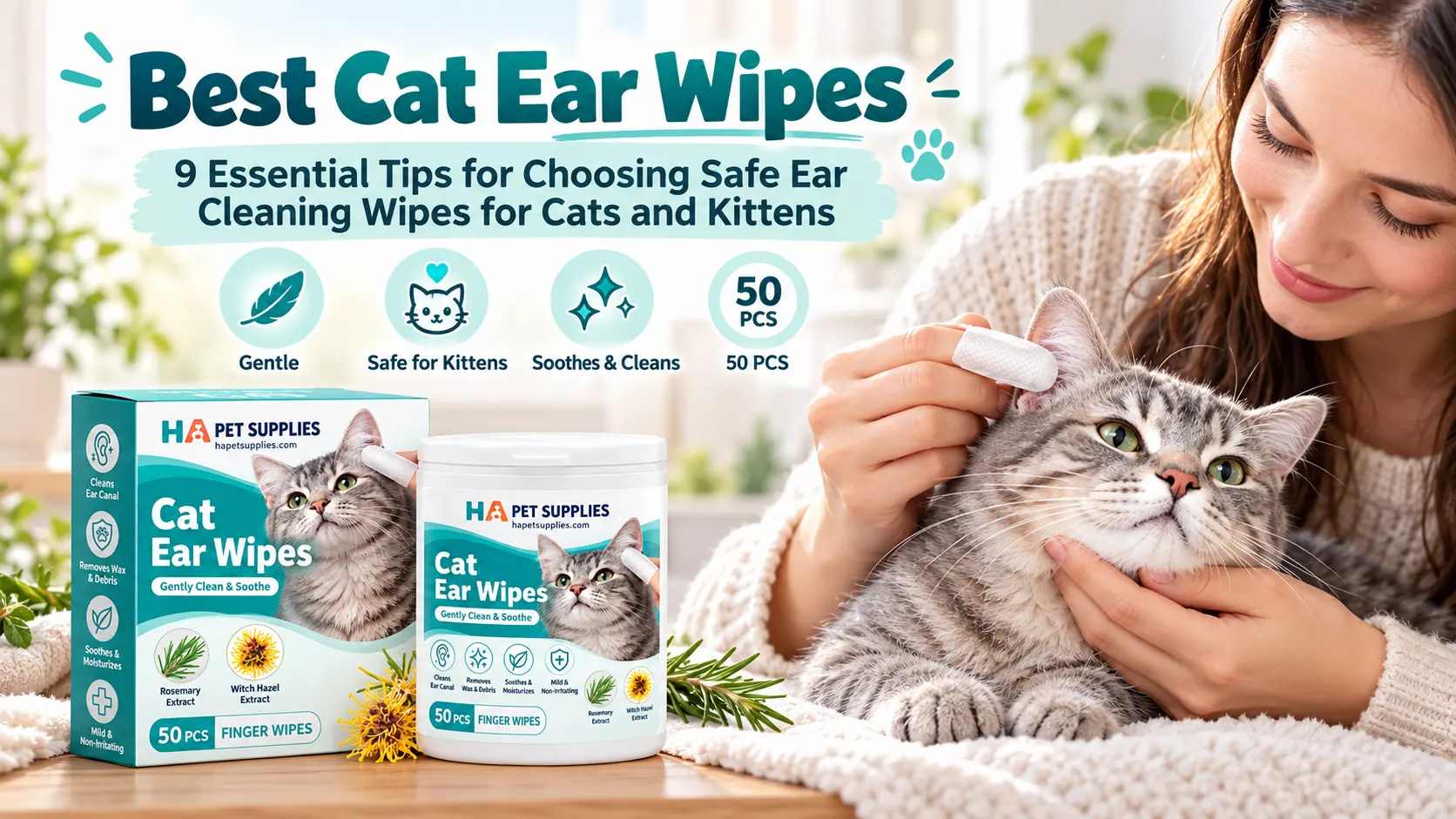
HA Pet Supplies finger wipes for routine cat grooming
Finding the best cat ear wipes can be surprisingly difficult, especially when your cat has visible ear wax, sensitive ears, or dislikes traditional cleaning methods.
Perhaps you recently noticed a small amount of brown wax in your tabby cat’s ears. Maybe you have adopted a kitten and want to establish a gentle grooming routine. Or perhaps you are comparing finger wipes, cotton pads, and liquid ear cleaners because you want to choose the safest option.
When you begin shopping, almost every product seems to promise easier cleaning, improved hygiene, and greater comfort. But not all cat ear cleaning products are the same.
Some are designed for wiping visible dirt from the outer ear. Others are liquid solutions intended for cleaning the ear canal under veterinary guidance. Certain products contain botanical extracts, fragrances, preservatives, or active ingredients that may not be appropriate for every cat.
The best cat ear wipes are products that suit your cat’s age, health, sensitivity, and actual cleaning needs—not necessarily those with the longest list of marketing claims.
There is also an important fact many owners overlook: most healthy cats do not need frequent ear cleaning.
According to VCA Animal Hospitals’ veterinary guide to cleaning cat ears, healthy cats commonly maintain clean ears without routine cleaning, while excessive cleaning can cause irritation.
So before buying any ear-cleaning product, ask whether your cat actually needs one.
This complete guide explains nine essential factors to consider when choosing cat ear wipes, how finger wipes compare with cotton pads and liquid cleaners, what ingredients deserve attention, and whether ear wipes are suitable for kittens.
📋 What You’ll Learn
- Quick Answer: Best Cat Ear Wipes
- 1. What Are Cat Ear Wipes?
- 2. 9 Essential Buying Tips
- 3. 3D Infographic: 9 Features
- 4. Wipes vs Cotton vs Liquid
- 5. How Often to Use Wipes
- 6. How to Use Finger Wipes Safely
- 7. Best Wipes for Kittens
- 8. Ingredients to Avoid
- 9. When Wipes Are Not Enough
- 10. HA Pet Supplies Cat Ear Wipes
- 11. Common Buying Mistakes
- 12. Building a Calm Routine
- 13. FAQ
- 14. Final Buying Checklist
- 15. Final Thoughts
⚡ Quick Answer: What Are the Best Cat Ear Wipes?
The best cat ear wipes for routine grooming are those specifically confirmed suitable for feline use, with clearly disclosed ingredients, comfortable cleaning materials, and appropriate directions.
For a cat with healthy, comfortable ears and a small amount of visible outer-ear dirt, soft finger-style wipes may provide convenient cleaning.
However, wipes should never be used as an alternative to treatment for infections, ear mites, or painful inflammation.
Before purchasing, check these nine essentials:
- Confirm the wipes are designed and formulated for cats.
- Review the complete ingredients and avoid unsuitable substances.
- Choose soft, comfortable material for delicate ear skin.
- Compare finger-cover wipes with regular flat cleaning pads.
- Understand the difference between external wiping and liquid ear cleaning.
- Verify claims about antibacterial, anti-mite, or medicinal effects.
- Confirm the product is appropriate for kittens and sensitive cats.
- Check package quantity, storage requirements, and hygiene instructions.
- Match the product to your cat’s individual ear condition and cleaning frequency.
If your cat has red, swollen, painful, smelly, or heavily discharging ears, contact your veterinarian rather than trying additional cleaning products.
The ASPCA’s cat grooming recommendations emphasize observing the ears for abnormal discharge, swelling, redness, and other warning signs.
Explore HA Cat Ear Wipes →1. What Are Cat Ear Wipes and Why Do Pet Owners Use Them?
Cat ear wipes are disposable grooming products intended to remove accessible dirt and ordinary loose wax from the visible outer ear.
They are available in different formats. Some resemble flat cleaning pads or moist tissues. Others are shaped like small sleeves that fit over the fingertip. Their main purpose is convenience during external cleaning.
Why do cats develop ear wax?
Ear wax is a normal part of feline ear function. It contributes to the protective environment inside the ear and helps trap small particles.
Cats also naturally groom their coats, paws, and faces. However, they cannot easily clean every visible fold of the inner ear flap.
Some cats occasionally accumulate loose dirt or wax in these accessible areas. This does not automatically indicate disease or poor hygiene.
The VCA ear-cleaning guide notes that many cats have healthy, clean ears without regular cleaning.
Do all cats need ear wipes?
No. A healthy cat with clean, comfortable ears may need nothing more than periodic inspection.
Using wipes without a clear need can introduce unnecessary friction or ingredients to sensitive skin. A grooming product should solve a genuine cleaning problem rather than create another task for pet owners.
How are finger wipes different?
Finger wipes are designed to fit over a fingertip. The owner can gently move the cleaning surface across accessible outer-ear folds without holding a loose cloth.
This can make ordinary external cleaning convenient. However, a finger wipe should never be inserted deep into the ear canal. The fingertip design provides control; it does not make deep cleaning safe.
What can ear wipes actually remove?
Suitable wipes may remove ordinary loose surface dirt and small amounts of accessible wax. They cannot reliably remove deeply impacted wax, treat parasites, cure infections, or correct underlying inflammation.
Recognizing these limits is essential for safe product selection.
2. Best Cat Ear Wipes: 9 Essential Buying Tips
The following nine tips are designed to help buyers compare products without relying solely on advertisements. Each addresses a practical concern that can affect your cat’s comfort, safety, and grooming experience.
Tip 1: Choose Ear Wipes Specifically Suitable for Cats
The first requirement is species suitability. Cats are not small dogs, and products intended for one species are not automatically appropriate for another.
Some substances tolerated by dogs may be inappropriate for feline use. Household cleaning wipes, human cosmetic wipes, and general-purpose disinfecting wipes should never be treated as substitutes for cat ear products.
Even ordinary pet wipes may be designed for paws, coats, or external body cleaning rather than the sensitive ear area.
Look for a label clearly identifying the product as suitable for feline ear hygiene. Read the directions to determine whether the product is intended for the visible ear flap or another specific application.
If the instructions are unclear, ask the manufacturer or your veterinarian before use.
The PetMD veterinarian-reviewed cat ear cleaning guide recommends appropriate cleaners and emphasizes understanding when at-home cleaning is safe.
Tip 2: Review the Complete Ingredient List
Ingredients are among the most important considerations when selecting cat ear cleaning wipes. Cats may be sensitive to particular substances, and ear tissue can become irritated when exposed to unsuitable products.
Do not assume that a product is safe merely because its packaging includes words such as natural, herbal, botanical, or gentle. Certain plant extracts and essential oils require particular caution in cats.
Fragrance ingredients may also be unnecessary in products intended for delicate skin. Check the ingredient list carefully and look for clear information about the final formulation.
If your cat has sensitive skin, prior allergic reactions, or a history of ear inflammation, consult your veterinarian about appropriate products.
VCA’s veterinary ear-cleansing product information explains that ear products vary significantly in composition and intended use.
Tip 3: Choose Soft Material That Does Not Encourage Scrubbing
The surface texture of an ear wipe influences how it feels against the cat’s skin. A textured wipe may help lift loose surface dirt. However, its texture should not be so rough that it encourages aggressive rubbing.
Feline ear tissue is delicate. Repeated scrubbing can create irritation, particularly when the skin is already sensitive.
A suitable cleaning pad should allow light contact and controlled movement. Look for material that remains intact during use and does not shed loose fibers easily.
Tip 4: Compare Finger Wipes With Traditional Flat Pads
Cat ear wipes are commonly sold in two formats: finger-cover wipes and flat cleaning pads. Both formats can be useful for external grooming when applied correctly.
Finger wipes fit over the fingertip and move directly with the user’s hand. Flat wipes are held between the fingers and may need to be folded.
Benefits of finger-cover wipes: Finger wipes can provide direct control. This may be helpful when cleaning small visible folds of the inner ear flap. The sleeve design also reduces the need to hold a separate piece of material at its edge.
Benefits of flat cleaning pads: Flat pads may be convenient for wiping broader external surfaces. They can also be used with veterinarian-approved cleaning solutions when appropriate.
Neither format is automatically safer for every cat. Safety depends on product suitability, technique, the cat’s condition, and how gently the owner works. Neither should be used to probe deeply into the canal.
Tip 5: Understand the Difference Between Surface Wipes and Liquid Ear Cleaners
This distinction is especially important for first-time buyers. Cat ear wipes generally serve an external grooming purpose.
Liquid ear-cleaning solutions may be recommended for cleaning material within the ear canal. The canal has a different structure and cannot be cleaned effectively with a fingertip wipe alone.
If your cat has a little ordinary dirt on the visible ear flap, a suitable wipe may be convenient. The owner can gently remove loose debris without pouring liquid into the ear.
If your veterinarian identifies significant canal buildup or prescribes a cleaning regimen, an appropriate liquid solution may be necessary. The veterinarian can recommend the formulation and demonstrate the correct procedure.
The VCA feline ear-cleaning instructions describe how cleaning solutions, cotton balls, and gauze may be used when appropriate.
Tip 6: Be Careful With Antibacterial and Anti-Mite Claims
Products marketed as antibacterial or anti-mite may appear attractive to owners worried about dark wax or scratching. However, these claims describe specific functions that should be supported by evidence.
Ordinary grooming wipes cannot be assumed to treat ear mites, bacterial infections, or yeast-associated disease. A wipe may remove some visible debris without eliminating the underlying problem.
An established ear infection requires the underlying cause to be identified. A veterinarian may recommend a particular medication after examination and, when appropriate, laboratory testing.
Ordinary grooming wipes are not reliable ear-mite treatments. The Cornell Feline Health Center’s ear mite guide explains why mites require appropriate diagnosis and treatment.
Tip 7: Confirm Suitability for Kittens and Sensitive Cats
Kittens have delicate skin and may be less tolerant of unfamiliar grooming. Not every product intended for adult cats is automatically appropriate for young kittens.
Before buying kitten ear cleaning wipes, confirm any age restrictions and ask whether the formula is suitable for young animals.
Kittens may develop dark debris associated with ear mites, but that does not mean they should immediately receive ordinary cleaning wipes. If a kitten scratches intensely or has unusual discharge, veterinary assessment is preferable.
Senior cats may have mobility limitations, medical conditions, or sensitivity to handling. Choose a comfortable position and avoid forcing prolonged grooming sessions.
Cats with a history of inflammation or infections may need a specifically selected cleaner. Ask your veterinarian before introducing a new formulation.
Tip 8: Check Packaging, Quantity, Expiry, and Hygiene
A convenient container can make grooming supplies easier to organize. However, packaging appearance is not the same as product suitability.
Look for a container that closes properly and protects the remaining wipes from contamination. Check the pack quantity and storage instructions.
Some products contain a large number of wipes, but this does not mean they should be used frequently. A 50-piece pack may be convenient for owners who occasionally need suitable external cleaning materials.
However, many healthy cats rarely need cleaning. Consider your actual grooming requirements rather than purchasing based only on quantity.
Follow the manufacturer’s directions. Keep the lid closed, avoid contaminating the remaining wipes, and protect the product from unsuitable temperatures.
Tip 9: Choose According to Your Cat’s Actual Ear Condition
The final tip is the most important. The best cat ear wipes must match your cat’s actual needs.
A cat with healthy, clean ears may not need cleaning products. A cat with a small amount of loose surface dirt may benefit from gentle external wiping. A cat with heavy discharge, redness, persistent scratching, or pain needs veterinary assessment.
Do not purchase a product solely because you want to remove every trace of wax. Ear wax is part of the normal ear environment.
The Merck Veterinary Manual’s overview of external ear inflammation in cats explains why the cause of abnormal ear symptoms must be identified before treatment.
3. 3D Infographic: Nine Features of the Best Cat Ear Wipes
Infographic heading: How to Choose Safe Cat Ear Cleaning Wipes
A high-quality 3D-style visual using a white background, teal accents, navy text, and warm lighting. A realistic gray tabby cat sits in the center next to an HA Pet Supplies ear wipes container. Nine raised cards surround the main illustration.
Cat-Specific
Formulation designed for feline ear hygiene
Feature 1Transparent Ingredients
Full disclosure of every component
Feature 2Soft Material
Gentle cleaning surface for delicate skin
Feature 3Fingertip Control
Comfortable finger-cover design
Feature 4External Use Only
Designed for visible outer-ear surfaces
Feature 5Evidence-Backed
Claims supported by appropriate testing
Feature 6Age-Appropriate
Suitable for adult cats and kittens
Feature 7Hygienic Storage
Sealed container protects remaining wipes
Feature 8Matches Your Cat’s Needs
Veterinary-informed product selection
Feature 9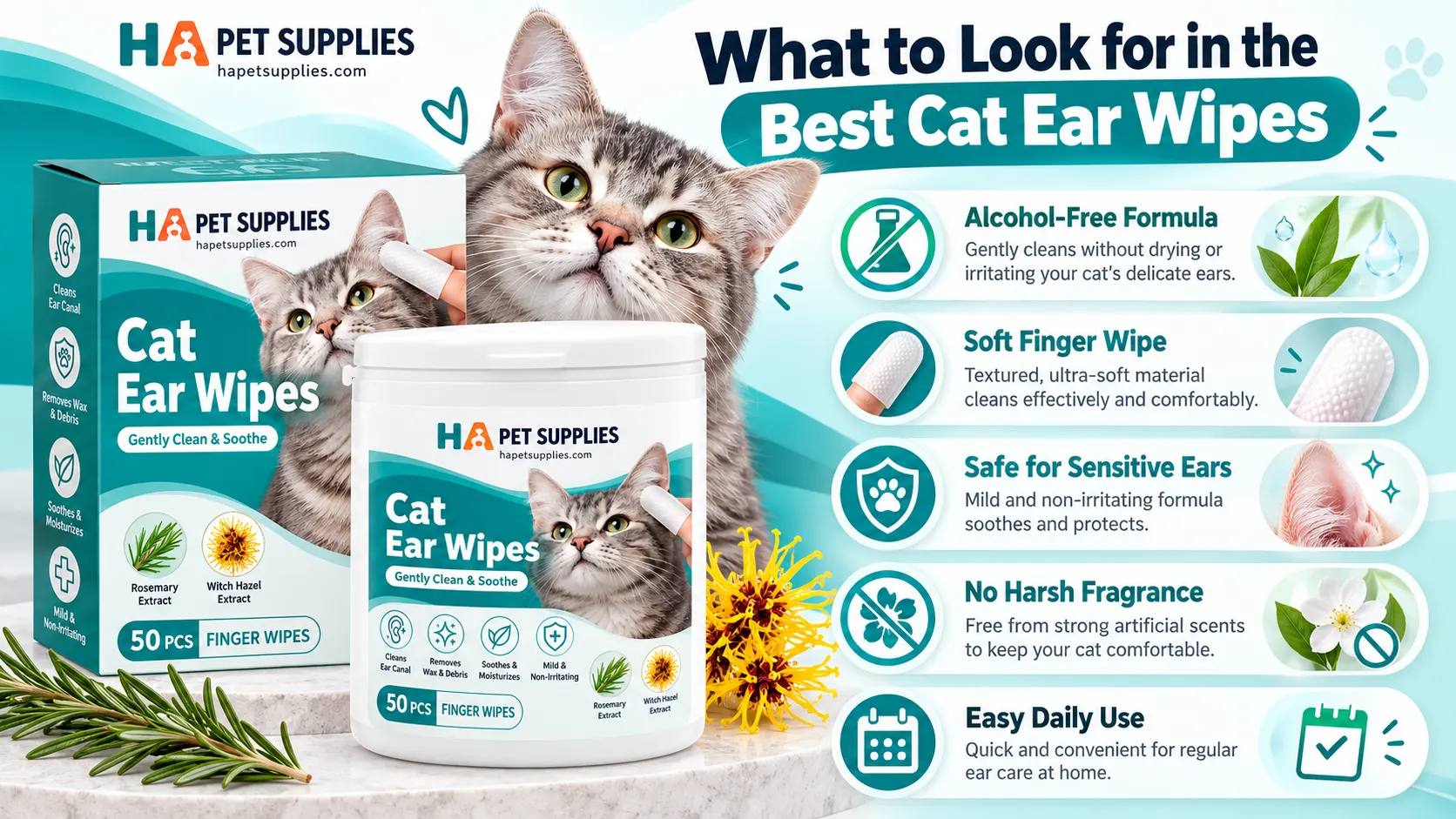
4. Cat Ear Wipes vs Cotton Pads vs Liquid Ear Cleaner
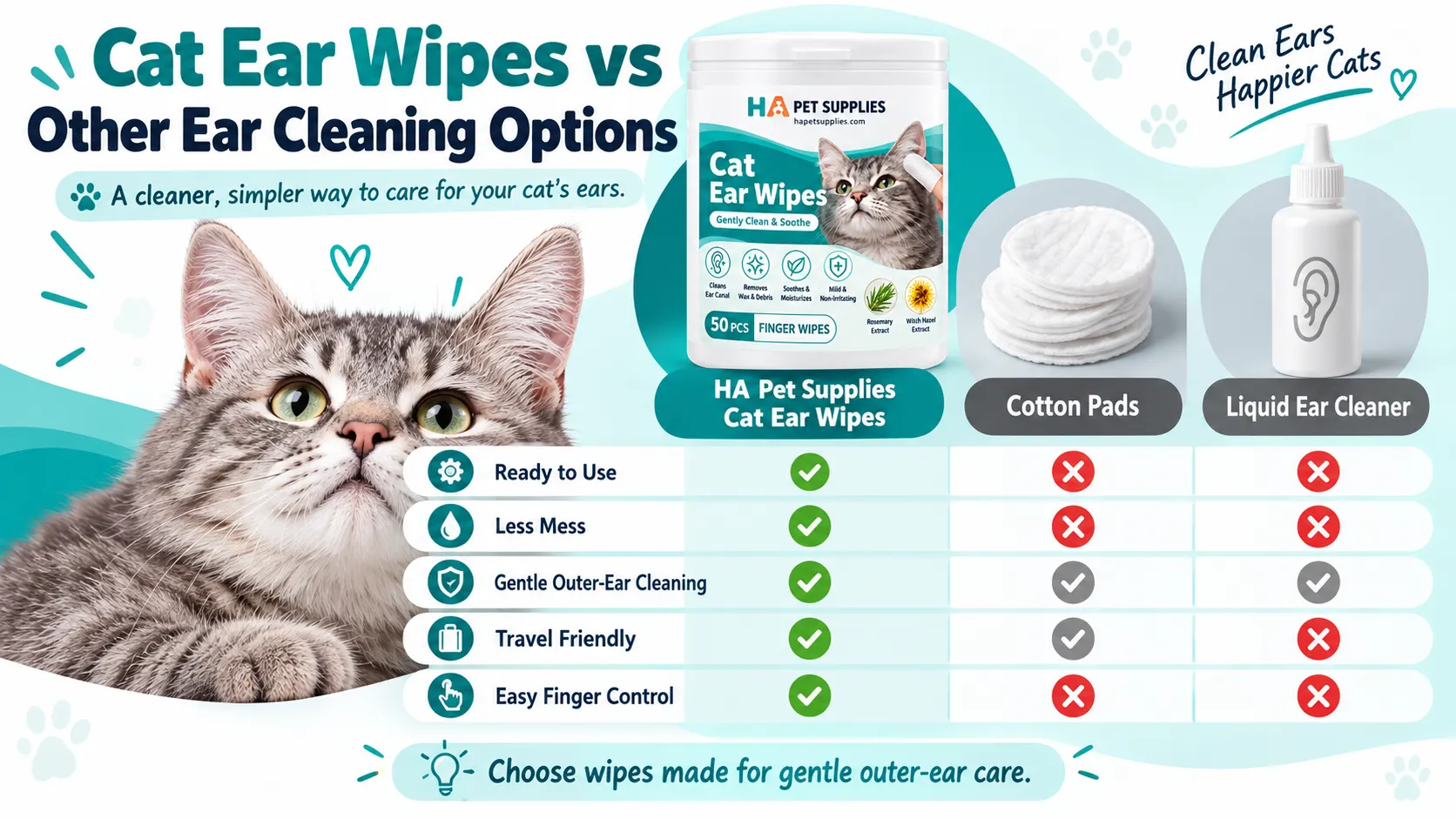
One of the biggest buying questions is which ear-cleaning method works best. The answer depends on the purpose of cleaning.
Finger wipes, cotton pads, and liquid cleaning solutions can all have roles, but they do not perform exactly the same function.
Cat ear finger wipes
Finger wipes are primarily suitable for gently removing ordinary loose dirt from visible outer-ear surfaces. They are convenient because the wipe fits over the fingertip.
The owner can adjust movements carefully and stop when the cat becomes uncomfortable. However, finger wipes cannot adequately clean wax trapped deep within the canal.
Cotton pads and gauze
Cotton balls or gauze can be used for accessible cleaning when paired with an appropriate liquid cleaner. They are frequently recommended in veterinary cleaning instructions.
However, they should not be used to probe deeply into the canal. The ASPCA’s cat ear-care guidance recommends lifting away visible wax and debris rather than rubbing it inward.
Liquid ear cleaning solutions
Liquid cleaners are formulated for different purposes. Some help loosen wax, while others have drying properties or additional veterinary applications.
A veterinarian can recommend an appropriate formula when canal cleaning is necessary. Do not pour an arbitrary product into a painful or inflamed ear.
| Feature | Finger wipes | Cotton pads or gauze | Liquid ear cleaner |
|---|---|---|---|
| Visible outer-ear dirt | Convenient | Suitable | May be unnecessary |
| Minor accessible wax | May be appropriate | May be appropriate | Depends on need |
| Deep canal wax | Cannot clean adequately | Not for probing | May be veterinarian-recommended |
| Application control | Direct fingertip control | Handheld | Requires specific technique |
| Preparation | Usually minimal | May require cleaner | Additional steps |
| Disposable format | Usually yes | Usually yes | Bottle may be reused |
| Suitable for kittens | Formula-dependent | Technique-dependent | Product-dependent |
| Ear infection treatment | Not ordinary grooming wipes | Not a treatment | Only prescribed treatment when indicated |
| Painful or inflamed ear | Avoid before assessment | Avoid before assessment | Use only as directed |
| Main advantage | Simple external wiping | Flexible external cleaning | Can reach canal debris |
| Main limitation | Surface cleaning only | Not intended for deep probing | Formula and technique must be appropriate |
If your cat has healthy, comfortable ears and a little ordinary external debris, a suitable finger wipe may be straightforward.
However, if the cat has heavy wax accumulation or recurring ear problems, ask your veterinarian before attempting canal cleaning.
The PetMD step-by-step feline ear-cleaning guide explains why correct product selection and technique matter.
Compare Cat Ear Cleaning Options →5. How Often Should You Use Cat Ear Wipes?
Many buyers assume that purchasing wipes means establishing a daily or weekly cleaning routine. However, cats are different from many other pets.
Healthy cats often maintain clean ears without frequent human intervention. The VCA veterinary ear-cleaning guide explicitly notes that many cats do not require routine cleaning.
Healthy indoor cats
A healthy indoor cat may only need periodic inspection. If the visible ears look clean and there are no abnormal symptoms, cleaning may be unnecessary. Do not wipe simply because a week has passed.
Outdoor cats
Outdoor cats may encounter more environmental debris. However, outdoor access alone does not establish a need for daily cleaning. Inspect regularly and respond to actual findings.
Long-haired cats
Long-haired cats may need extra coat grooming around the ears. But coat length does not automatically mean the ear canal needs frequent cleaning.
Kittens
Kittens benefit from gentle handling experiences. However, they should not receive unnecessary cleaning. A kitten with heavy dark ear debris should be examined for mites and other possible problems.
Senior cats
Older cats may become less flexible or develop conditions that affect grooming. Adjust handling to their comfort and consult your veterinarian when ear changes appear.
Cats with recurring ear disease
Some cats require specific maintenance regimens. Follow your veterinarian’s instructions rather than choosing a cleaning frequency based on a product advertisement.
| Cat or situation | Recommended approach |
|---|---|
| Healthy indoor cat | Inspect periodically; cleaning may not be needed |
| Minor visible external dirt | Gentle wiping if appropriate |
| Healthy kitten | Encourage calm handling; avoid unnecessary cleaning |
| Senior cat | Inspect gently and adapt to comfort |
| Cat with recurring infections | Veterinary-directed care plan |
| Cat with black crumbly discharge | Veterinary diagnosis |
| Cat with painful ears | Do not clean before assessment |
| Cat with strong odor or swelling | Veterinary examination |
6. How to Use Cat Ear Finger Wipes Safely
Even the best cat ear wipes must be used correctly. A suitable product can still irritate an ear if the owner applies excessive pressure or attempts to clean deep inside the canal.
The following method applies only to gentle cleaning of visible outer-ear surfaces when the ears are healthy.
Step 1: Examine both ears
Check the visible ear flaps for redness, swelling, discharge, strong odor, or pain. If these signs are present, avoid routine cleaning and contact your veterinarian.
Step 2: Choose a calm environment
Use a quiet room where your cat feels secure. Avoid loud sounds, sudden movements, and unnecessary restraint.
Step 3: Wash your hands
Clean hands help reduce transfer of dirt to sensitive areas. Prepare the wipes before lifting your cat’s ear.
Step 4: Take one fresh finger wipe
Remove a clean wipe from the container. Check that the material is intact and suitable for use.
Step 5: Position the wipe securely
Slide the finger-cover wipe onto a fingertip. Make sure it does not slip easily.
Step 6: Gently lift the ear flap
Support your cat’s head without pulling, twisting, or forcing the ear. Stop if the cat becomes distressed.
Step 7: Clean visible surfaces only
Use gentle wiping movements to remove ordinary loose dirt. Never insert the wipe deep into the ear canal. Do not scrape or scrub stubborn wax.
Step 8: Use a fresh wipe when necessary
Discard the used wipe. If the second ear also needs cleaning, use a fresh one.
Step 9: Reward your cat
Finish with a treat, affection, or another positive experience. Observe whether your cat remains comfortable after cleaning.
For a more detailed explanation, follow our nine-step guide to cleaning cat ears at home.
Read the Complete Cat Ear Cleaning Tutorial →7. Best Cat Ear Wipes for Kittens: What Makes a Product Appropriate?
Choosing wipes for kittens requires extra caution. Young kittens are still developing, and their skin and general health may differ from those of adult cats. An adult product should not automatically be used on a kitten.
Check the minimum recommended age
Some manufacturers specify age restrictions. Read these directions carefully. If no age guidance is available, ask the manufacturer or your veterinarian.
Review the ingredients
Avoid assuming that a product is kitten-safe based only on general marketing language. Ask whether the formulation has been evaluated for the kitten’s age and intended use.
Watch for dark debris
Kittens are vulnerable to ear mite infestations, particularly when exposed to infected animals.
If your kitten has heavy black discharge, scratches intensely, or repeatedly shakes its head, arrange veterinary evaluation. The Cornell Feline Health Center’s ear mite guide explains why early diagnosis matters.
Introduce handling gradually
Rather than beginning with a full cleaning session, help the kitten become comfortable with gentle head and ear touching. Reward calm behavior. Keep sessions short.
Never force cleaning
A struggling kitten can become frightened or injured. Stop if the kitten resists strongly. If cleaning is medically necessary, ask your veterinarian to demonstrate the correct technique.
8. What Ingredients Should You Avoid in Cat Ear Cleaning Products?
The best cat ear wipes should use a formulation appropriate for feline ear tissue. Avoid substituting household products simply because they are easy to obtain.
Hydrogen peroxide
Hydrogen peroxide is not recommended for routine feline ear cleaning. It may irritate delicate or inflamed tissue.
The Merck Veterinary Manual’s feline ear infection guidance warns against irritating home remedies, including hydrogen peroxide and vinegar.
Rubbing alcohol
Do not apply household rubbing alcohol inside a cat’s ear. Some veterinary otic products contain specialized drying ingredients, but these are not the same as general household alcohol.
Undiluted essential oils
Avoid applying concentrated essential oils or homemade mixtures to cat ears. Cats can be sensitive to certain compounds, and formulation matters greatly.
Strong household fragrances
Heavily fragranced human or household wipes should not be substituted for cat ear products. Choose a product clearly formulated for feline use.
Unverified antimicrobial ingredients
Do not assume that a wipe can treat bacterial or yeast infections simply because it contains ingredients marketed as antimicrobial. Medical treatment requires appropriate diagnosis.
Homemade vinegar mixtures
Household vinegar is not an appropriate substitute for a veterinarian-selected ear cleaner. It can irritate inflamed tissues.
The safest approach is to use products intended for cats and follow veterinary advice whenever the ears are abnormal.
9. Recognizing When Cat Ear Wipes Are Not Enough
One of the most important responsibilities of a product guide is explaining when the product should not be used. Cat ear wipes are intended for grooming, not diagnosis.
Black coffee-ground-like discharge
Heavy, dark, crumbly material can occur with ear mites, but other conditions are possible. Do not diagnose mites based on appearance alone.
The Cornell Feline Health Center’s ear mite resource explains the association between mites and dark debris.
Persistent ear scratching
Repeated scratching may indicate parasites, inflammation, infection, or another underlying condition. Ordinary wipes are not a substitute for diagnosis.
Repeated head shaking
Occasional head shaking may occur, but repeated or vigorous shaking deserves investigation.
Strong unpleasant odor
A strong smell may accompany infection or inflammation. Do not attempt to cover the problem through repeated wiping.
Redness or swelling
Inflamed ears may be painful. Stop cleaning and arrange veterinary advice.
Yellow or bloody discharge
Abnormal discharge requires professional evaluation. Do not scrape or wipe repeatedly in an attempt to remove it.
Head tilt or loss of balance
These signs can indicate deeper ear or neurological problems. Seek urgent veterinary attention.
The Merck Veterinary Manual’s guide to middle and inner ear infections in cats explains why balance changes should be treated seriously.
If your cat has unusual dark debris, our guide to black wax in cat ears and signs of ear mites explains how to recognize warning signs.
Understand Cat Ear Mite Warning Signs →10. Why HA Pet Supplies Cat Ear Wipes May Be a Convenient Choice
HA Pet Supplies Cat Ear Wipes are presented as disposable finger-style cleaning wipes intended for routine external ear hygiene. The supplied product imagery shows a 50-piece container with a finger-cover wipe format.
This design may appeal to cat owners who prefer direct fingertip control when cleaning small visible areas.
Finger-cover cleaning design
The wipe fits over the fingertip. This can make it easier to guide movements around the accessible folds of the outer ear. The design should be used gently and only on appropriate external surfaces.
Textured wiping surface
The pictured product uses a textured cleaning material. Its purpose is to help contact ordinary loose surface debris. Avoid pressing hard or scrubbing.
Convenient disposable format
Single-use wipes are easy to discard after grooming. A fresh wipe should be used for the other ear if cleaning is necessary.
Compact storage container
The lidded jar is convenient for organizing supplies at home. Keep the container closed and follow verified storage instructions.
Practical 50-piece quantity
The product imagery indicates 50 finger wipes per container. This quantity may suit occasional hygiene needs. However, it does not mean a cat should be cleaned 50 times or on a fixed schedule.
Ingredient suitability should be confirmed
Review the actual product ingredients, manufacturing instructions, and age guidance before using the wipes. Claims involving antibacterial effectiveness, mite removal, or medical treatment should not be assumed without appropriate evidence.
Routine hygiene, not medication
HA Pet Supplies Cat Ear Wipes should be described as grooming products for ordinary visible outer-ear dirt. They should not replace treatment for diagnosed infections, mites, or painful conditions.
Shop HA Cat Ear Wipes Online →For other grooming essentials, explore the HA Pet Supplies cat supplies collection, which includes additional products for feline care.
11. Common Mistakes When Buying Cat Ear Wipes
Even experienced cat owners can make poor purchasing decisions when product claims are unclear.
Mistake 1: Buying wipes without checking feline suitability
Not every pet wipe is formulated for cats. Always check the intended species.
Mistake 2: Assuming natural means completely safe
Botanical ingredients may still be irritating or unsuitable in certain formulations. Review the complete ingredient list.
Mistake 3: Buying based only on fragrance
A pleasant smell does not establish product safety. Strong fragrances may be unnecessary for ear grooming.
Mistake 4: Expecting wipes to cure ear mites
Ordinary wipes may remove surface debris but do not reliably eliminate mites. Veterinary treatment is necessary when infestation is confirmed.
Mistake 5: Ignoring the distinction between external and deep cleaning
Finger wipes are for visible external surfaces. Deeper canal cleaning may require a veterinarian-recommended liquid cleaner.
Mistake 6: Purchasing a large package and cleaning too frequently
Many healthy cats do not need routine ear cleaning. More wipes do not necessarily mean better hygiene.
Mistake 7: Using an adult product on a kitten without checking
Young kittens may need age-specific products or veterinary advice.
Mistake 8: Ignoring pain or inflammation
A painful ear is not simply a dirty ear. Avoid cleaning and seek veterinary assessment.
Mistake 9: Choosing products with unsupported medical promises
Claims about killing bacteria, preventing infections, or eliminating mites should be supported by evidence.
The Merck Veterinary Manual’s veterinary-reviewed guidance emphasizes the importance of identifying underlying causes rather than relying on generic home treatments.
12. Building a Calm Cat Ear-Care Routine
The best grooming routine is one that your cat can tolerate comfortably. A product may have appropriate ingredients and packaging, but the experience can still become stressful if the handling technique is poor.
Begin with gentle inspection
During normal grooming, briefly look at the visible ear flaps. Check for unusual wax, discharge, redness, or swelling. If everything looks healthy, cleaning may not be needed.
Choose a quiet environment
Cats are often more cooperative in familiar spaces. Avoid loud sounds and unnecessary distractions.
Keep sessions short
A brief inspection is better than forcing a prolonged cleaning. Do not continue if your cat becomes distressed.
Reward calm behavior
Use appropriate treats, gentle affection, or play to build positive associations.
Keep products organized
Store grooming supplies together and follow product storage instructions.
Use separate wipes when appropriate
Disposable wipes should not be reused. Use fresh material when cleaning another ear.
Observe changes over time
If your cat repeatedly develops unusual wax or odor, make a note and seek veterinary guidance.
The ASPCA cat grooming resource recommends professional assistance when grooming becomes unsafe or highly stressful.
For additional feline care education, visit the HA Pet Supplies blog and browse guidance on hygiene, grooming, and cat accessories.
13. Frequently Asked Questions About the Best Cat Ear Wipes
The best wipes are products specifically suitable for cats, with appropriate formulations, comfortable material, and clear instructions. Healthy cats may not need regular cleaning.
Finger wipes can provide convenient fingertip control. Cotton pads and gauze may also be suitable for external cleaning. Neither format is universally better.
They may remove ordinary loose wax from accessible outer-ear surfaces. They cannot reliably remove deeply impacted wax.
Only use products confirmed suitable for the kitten’s age and health. Ask your veterinarian if the label does not provide clear guidance.
Many healthy cats never need routine cleaning. Inspect periodically and clean only when appropriate or veterinarian-directed.
Ordinary grooming wipes do not reliably eliminate ear mites. Veterinary diagnosis and antiparasitic treatment are required.
No. Ordinary grooming wipes do not replace medical treatment for ear infections.
Not for every grooming situation. Antibacterial claims require evidence, and suspected infections need veterinary assessment.
Human baby wipes may contain ingredients inappropriate for cats. Use products specifically confirmed suitable for feline ear care.
Only when the manufacturer confirms feline suitability. Products intended for dogs are not automatically safe for cats.
Neither is universally better. Finger wipes suit external cleaning, while liquid products may be appropriate for veterinarian-directed canal cleaning.
Heavy black debris may indicate mites or another ear condition. Seek veterinary advice before attempting repeated cleaning.
A strong unusual odor warrants veterinary assessment rather than repeated wiping.
No. Natural ingredients can still cause irritation or other adverse effects, depending on their formulation and concentration.
A product without unnecessary fragrance may be preferable for some sensitive cats, but formulation suitability matters more than a single marketing label.
Do not use hydrogen peroxide as a general home ear-cleaning solution. It can irritate sensitive tissue.
Do not use homemade vinegar mixtures without veterinary direction. They may irritate inflamed ears.
Yes. Unsuitable ingredients, excessive rubbing, or frequent cleaning can irritate ear tissue. Stop use if discomfort develops.
Using separate wipes is preferable to avoid transferring visible residue between ears.
Single-use wipes can be convenient when handled properly. Store them appropriately and discard them after use.
Use only as many as needed for appropriate, gentle external cleaning. There is no reason to use additional wipes when the ears are already clean.
A brief response to handling may occur, but persistent shaking or discomfort requires veterinary advice.
No. Ear infections can have several underlying causes. Appropriate cleaning cannot replace diagnosis and treatment.
Arrange veterinary assessment, particularly if the kitten is scratching, shaking its head, or has heavy discharge.
Review the formulation, avoid unnecessary irritants, and consult your veterinarian if the cat has allergies or previous ear problems.
No. Inspect both ears, but clean only where appropriate.
Follow the manufacturer’s instructions, close the lid securely, and avoid contaminating the unused wipes.
Stop if your cat becomes distressed. Practice gentle handling when appropriate, and seek veterinary help if cleaning is necessary.
Visit the HA Pet Supplies Cat Ear Wipes product page to review product information and ordering options.
Choose a product appropriate for your cat’s actual needs, and never use ordinary grooming wipes to treat unexplained ear symptoms.
14. Final Cat Ear Wipes Buying Checklist
Before purchasing the best cat ear wipes for your feline companion, answer these questions.
Is the product clearly intended for cats?
Choose a product with appropriate feline labeling and directions.
Are the ingredients fully disclosed?
Avoid products with unclear or unsupported formulation claims.
Is the wipe material gentle?
Select a surface designed for comfortable contact with visible outer-ear skin.
Do you prefer finger wipes or flat pads?
Choose the format you can use carefully without forcing the cat.
Does your cat actually need ear cleaning?
Many healthy cats require only inspection.
Are the ears healthy and comfortable?
Pain, swelling, discharge, and strong odor require veterinary evaluation.
Is the product appropriate for the cat’s age?
Confirm kitten suitability before use.
Are the storage and disposal instructions clear?
Good product hygiene matters.
Are the marketing claims supported?
Do not rely on unsupported antibacterial, anti-mite, or infection-treatment promises.
If these questions can be answered confidently, a suitable finger-style wipe may be a practical grooming accessory.
If your cat has abnormal symptoms, veterinary assessment should come first.
15. Final Thoughts: Choose the Best Cat Ear Wipes for Safety, Not Marketing Claims
Choosing the best cat ear wipes is about understanding what your cat needs. A convenient finger-cover design can help owners gently clean ordinary loose dirt from visible outer-ear surfaces.
However, not every cat requires routine cleaning. Healthy ears often maintain their natural balance without frequent intervention.
The most important factors are feline suitability, ingredient transparency, soft materials, comfortable handling, correct application, and appropriate cleaning frequency.
Never attempt to remove deeply impacted wax with a finger wipe. Do not treat black discharge, strong odor, repeated scratching, or painful inflammation as ordinary dirt.
Seek veterinary advice whenever ear symptoms are unusual or persistent.
HA Pet Supplies Cat Ear Wipes may be a convenient choice for routine external hygiene when the ears are healthy and the formulation is suitable for the individual cat.
A thoughtful buying decision begins with safety and ends with your cat’s comfort.
Make Gentle Cat Ear Care Easier
Discover HA Pet Supplies Cat Ear Wipes for convenient fingertip cleaning of ordinary visible outer-ear dirt and loose wax.
Buy Cat Ear Wipes Online →For product availability, ordering details, or bulk purchasing inquiries, the HA Pet Supplies team can provide additional information.
Request a Quote →Explore additional feline grooming products through the HA Pet Supplies online shop, or contact the team through the HA Pet Supplies contact page.
HA Pet Supplies — Happy Pets. Healthy Pets. Happy Life.