
Your dog is standing beside the car, looking up at the seat, but suddenly refuses to jump. Yesterday, getting into the vehicle seemed effortless. Today, your dog hesitates, tries once, and steps backward. What should you do?
Maybe your senior dog is struggling with joint stiffness. Perhaps your small dog cannot comfortably reach a high bed. Or your large dog has become too heavy for you to lift safely into an SUV. Whatever the situation, you need a practical solution that helps your dog access elevated spaces without unnecessary discomfort.
Choosing the best dog ramp for cars, SUVs and beds can make daily routines easier, but not every ramp is appropriate for every dog. A short ramp might fit conveniently inside a vehicle yet create a steep incline. A lightweight model may be portable but lack the stability required for a large dog. And a beautiful set of pet stairs might work perfectly beside a sofa while being unsuitable for a dog with significant joint limitations.
These differences matter. The right mobility aid depends on your dog’s size, physical condition, confidence, and the height of the surface they need to reach. According to Cornell University’s Riney Canine Health Center, ramps, non-slip rugs and other lifestyle modifications can help dogs with osteoarthritis navigate everyday environments more comfortably.

Wooden pet stairs help suitable dogs reach furniture with less jumping
📋 Table of Contents
- 1. Quick Answer: What Is the Best Dog Ramp for Cars?
- 2. Why Dogs May Need Ramps or Pet Stairs
- 3. Dog Ramp vs Dog Stairs: Understanding the Difference
- 4. Seven Essential Features of the Best Dog Ramp for Cars
- 5. How to Measure Ramp Height, Length and Incline
- 6. Choosing a Dog Ramp for Cars and SUVs
- 7. Choosing the Best Dog Ramp for Beds and Sofas
- 8. Dog Ramp Size Guide for Small, Medium and Large Dogs
- 9. Non-Slip Dog Ramp Materials and Safety Features
- 10. Best Dog Ramp for Senior Dogs and Dogs With Arthritis
- 11. Dog Ramp vs Pet Stairs Comparison Table
- 12. How to Train Your Dog to Use a Ramp Safely
- 13. Common Problems and Fast Solutions
- 14. Mistakes to Avoid When Buying a Dog Ramp
- 15. How to Maintain Dog Ramps and Wooden Pet Stairs
- 16. How to Choose HA Pet Supplies Mobility Products
- 17. Frequently Asked Questions
- 18. Final Buying Checklist and Recommendation
1. Quick Answer: What Is the Best Dog Ramp for Cars?
The best dog ramp for cars is one that provides a stable, suitably gentle walking surface between the ground and the vehicle. It should support your dog’s weight, offer reliable traction, fit the vehicle’s loading height, and remain securely positioned during use.
But the correct choice depends on your dog and your vehicle. A small dog entering a low sedan does not need the same equipment as a large senior dog accessing a tall SUV.
| Your Situation | What to Prioritize | What to Avoid |
|---|---|---|
| Small dog reaching a sofa | Low access height, compact stable design | Oversized or unstable equipment |
| Senior dog entering a car | Gentle incline, non-slip surface, adequate width | Short, steep ramps |
| Large dog entering an SUV | Verified load rating, long ramp, secure attachment | Narrow, flimsy ramps |
| Dog reaching a high bed | Suitable length or appropriately sized steps | Incorrect height |
| Dog with arthritis | Veterinarian-approved approach, gradual incline | Painful climbing or jumping |
| Frequent car travel | Portable construction, safe deployment, secure placement | Heavy equipment that is difficult to handle |
Before shopping, measure the surface your dog needs to reach. For a car, measure from the ground to the actual entry point. For a bed, measure from the floor to the top of the mattress. For a sofa, measure from the floor to the seating surface.
The American Kennel Club’s dog stairs and ramp buying guide identifies traction, width, height, strength and intended use as important purchasing considerations.
Immediate Help If Your Dog Suddenly Refuses to Jump
If your dog previously jumped comfortably but now refuses, do not assume laziness or stubbornness. Stop encouraging the jump and observe your dog’s behavior. Look for limping, stiffness, reluctance to move, or signs of pain. A veterinary assessment is particularly important if the change is sudden.
2. Why Dogs May Need Ramps or Pet Stairs
Jumping is a natural activity for many dogs, but repeatedly reaching elevated surfaces can become difficult as dogs age or develop physical limitations. A dog may be excited to enter a car or join the family on a sofa yet struggle with the movement required.
Repeated Jumping and Joint Stress
When dogs jump down from elevated surfaces, their front limbs help absorb the landing force. Repeated high-impact activity may be especially uncomfortable for dogs with existing joint disease. According to Canine Arthritis Resources and Education, ramps and steps can help reduce the need for jumping, particularly when dogs leave elevated surfaces such as beds and vehicles.
Why Senior Dogs Often Benefit
Older dogs may develop reduced muscle strength, joint stiffness or mobility difficulties. A dog that previously entered a vehicle independently may begin hesitating. A suitable ramp can provide an alternative to a direct jump. However, the ramp still requires walking, balance and muscle control.
Why Small Dogs May Need Assistance
Small dogs often encounter furniture that is proportionally much taller than their bodies. For example, a bed that appears low to a human may represent a significant climb for a small breed. Compact pet stairs or a suitably sized ramp can help bridge the height difference.
Large Dogs and Vehicle Access
Large dogs can be difficult to lift, particularly when they become older or develop mobility problems. A properly rated dog ramp may allow them to access a vehicle with less lifting by the owner. The equipment should support their actual weight and provide enough walking width.
Dogs Recovering From Surgery
Some dogs recovering from surgery may need restricted activity. A mobility aid might be useful in certain situations, but climbing may also be prohibited during recovery. The American College of Veterinary Surgeons’ osteoarthritis guidance describes how activity modification and rehabilitation form part of individualized joint-disease management.
3. Dog Ramp vs Dog Stairs: Understanding the Difference
Before purchasing any mobility product, understand the difference between a dog ramp and dog stairs. These terms are sometimes used interchangeably in online stores, but they describe different designs.
What Is a Dog Ramp?
A dog ramp is a continuous inclined surface. Instead of lifting each foot onto a separate step, the dog walks along a slope. Ramps may be made from plastic, metal, wood or composite materials.
What Are Dog Stairs?
Dog stairs have individual steps, each with a horizontal tread and vertical rise. The dog must lift and lower its paws from one level to another. The blue-carpeted wooden HA Pet Supplies product shown in your Blog 1 images is an example of stepped pet stairs.
Which Design Is Better?
A ramp generally allows a continuous walking movement, which may be useful for dogs that find step climbing difficult. The PetMD article on dog stairs versus ramps, written by veterinarian Brittany Kleszynski, explains that ramps are generally preferable for dogs with arthritis or certain joint and back conditions, while steps may suit smaller agile dogs.
For a detailed condition-by-condition comparison, read our companion article, Dog Ramp vs Stairs: Which Is Better for Senior Dogs, Small Dogs and Dogs With Joint Problems?.
4. Seven Essential Features of the Best Dog Ramp for Cars
Choosing the best dog ramp for cars requires more than comparing product appearance. Here are seven features that deserve attention.
🔍 Seven Features of a Safe Dog Ramp
Click any card to reveal a buying tip
Usable Ramp Length
Walking Width
Non-Slip Grip
Weight Rating
Stable Support
Foldable/Fixed
Comfortable Incline
The right ramp is more than a board between two heights.
Feature 1: Correct Ramp Length
Length influences the incline. For the same vehicle height, a longer ramp generally creates a gentler slope. Always compare the usable ramp length with the actual loading height.
Feature 2: Appropriate Ramp Width
A ramp must provide enough space for your dog to walk comfortably without feeling that its paws are close to the edges. Check the walking surface width, not merely the overall dimensions.
Feature 3: Reliable Non-Slip Traction
Traction is essential. A dog that slips once may become frightened of using a ramp again. Look for a textured walking surface that helps maintain paw contact.
Feature 4: Suitable Weight Capacity
A dog ramp must be rated to support your dog’s actual weight. Do not assume that a wooden construction automatically supports large dogs.
Feature 5: Stable Construction
The ramp should not wobble, twist or slide during normal use. If a product rocks when you test it, do not encourage your dog to climb it.
Feature 6: Appropriate Portability
Car ramps are often moved, folded and stored repeatedly. A portable model should be manageable for the person using it.
Feature 7: Dog Confidence and Comfort
Even a technically suitable ramp may fail if your dog is frightened. The best dog ramp for cars is the one your dog can use comfortably after appropriate introduction. The AKC guide to making homes accessible for senior dogs emphasizes the importance of stable, non-slip ramps or stairs.
5. How to Measure Ramp Height, Length and Incline
This is one of the most important sections of the pillar guide. A ramp may look appropriate in photographs but become unsuitable when installed at your vehicle or bed.
Measurement 1: Vertical Height
Measure the vertical distance from the ground or floor to the actual entry surface. Write down the number.
Measurement 2: Available Horizontal Space
Measure the floor or ground space available in front of the destination. A long ramp needs room to extend.
Measurement 3: Usable Ramp Length
Identify the manufacturer’s stated usable walking length. Do not assume the folded length equals the deployed length.
Understanding Ramp Incline
The incline becomes steeper when a ramp covers a greater height over a shorter horizontal distance.
Ramp length = √(vertical height² + horizontal distance²)
Example 1: A Bed Measuring 20 Inches High
Suppose the top of the mattress is 20 inches above the floor. If you have 60 inches of available horizontal space, the required straight-line ramp length is approximately 63.2 inches. The incline is approximately 18.4 degrees.
Example 2: An SUV Loading Surface Measuring 30 Inches High
Now imagine an SUV with a 30-inch loading height. If there are 72 inches of available horizontal ground space, the straight-line ramp length is approximately 78 inches. The incline is approximately 22.6 degrees.
Example 3: A Short Ramp Against a Tall Vehicle
Suppose a ramp has a usable length of 48 inches and the destination height is 30 inches. The angle would be approximately 38.7 degrees. This is considerably steeper.
Is There One Perfect Ramp Angle?
No single ramp angle is appropriate for every dog. For senior or mobility-impaired dogs, aim for a gentle incline and consult your veterinarian. The Canine Arthritis Resources and Education guide to lifestyle modifications emphasizes safe mobility aids.
📐 Ramp Incline Calculator
This calculation is geometric only. It does not replace a professional fit or safety assessment. Always test the ramp with your dog under supervision.
Illustrative Ramp Geometry Comparison
| Vertical Height | Horizontal Space | Required Straight Ramp Length | Approximate Angle |
|---|---|---|---|
| 16 inches | 48 inches | 50.6 inches | 18.4° |
| 20 inches | 60 inches | 63.2 inches | 18.4° |
| 24 inches | 60 inches | 64.6 inches | 21.8° |
| 30 inches | 72 inches | 78 inches | 22.6° |
| 36 inches | 84 inches | 91.4 inches | 23.2° |
6. Choosing a Dog Ramp for Cars and SUVs
Vehicles create different challenges from furniture. The entry height varies, the ramp may be deployed on outdoor surfaces, and the dog may be near traffic.
Best Dog Ramp for Cars
A ramp for a lower vehicle may require less length than one used for a tall SUV. Measure the specific entry point.
Best Dog Ramp for SUVs
SUVs often create a more demanding height difference. A longer telescoping ramp may offer more adjustment than a short fixed-length model.
Loading Through the Rear Cargo Area
Rear loading may offer a straightforward ramp path. Check that the ramp can contact an appropriate load-bearing surface without slipping.
Loading Through a Side Door
Side-door access can be complicated by door openings, seat height and limited surrounding space.
Parking Surface Safety
Before deploying a ramp, park on stable, level ground wherever possible. Avoid slippery, loose or uneven surfaces.
Vehicle Restraint Is Still Essential
A ramp helps the dog enter and exit the vehicle. It is not a travel restraint. The AKC dog car safety guide discusses the importance of suitable travel restraints.
7. Choosing the Best Dog Ramp for Beds and Sofas
Indoor ramps and pet stairs solve a different problem from vehicle ramps. They generally remain in one location and must fit around furniture.
Measuring for a Dog Ramp for Bed
Measure from the floor to the top of the mattress. A high bed may require a long ramp if a gentle slope is needed.
Choosing Dog Steps for Bed Access
For smaller dogs that can comfortably climb steps, pet stairs may use floor space efficiently.
Two-Step, Three-Step and Four-Step Options
Different step counts can accommodate different furniture heights, but step count alone is insufficient. You need to consider total height, individual riser height, tread depth, width and stability.
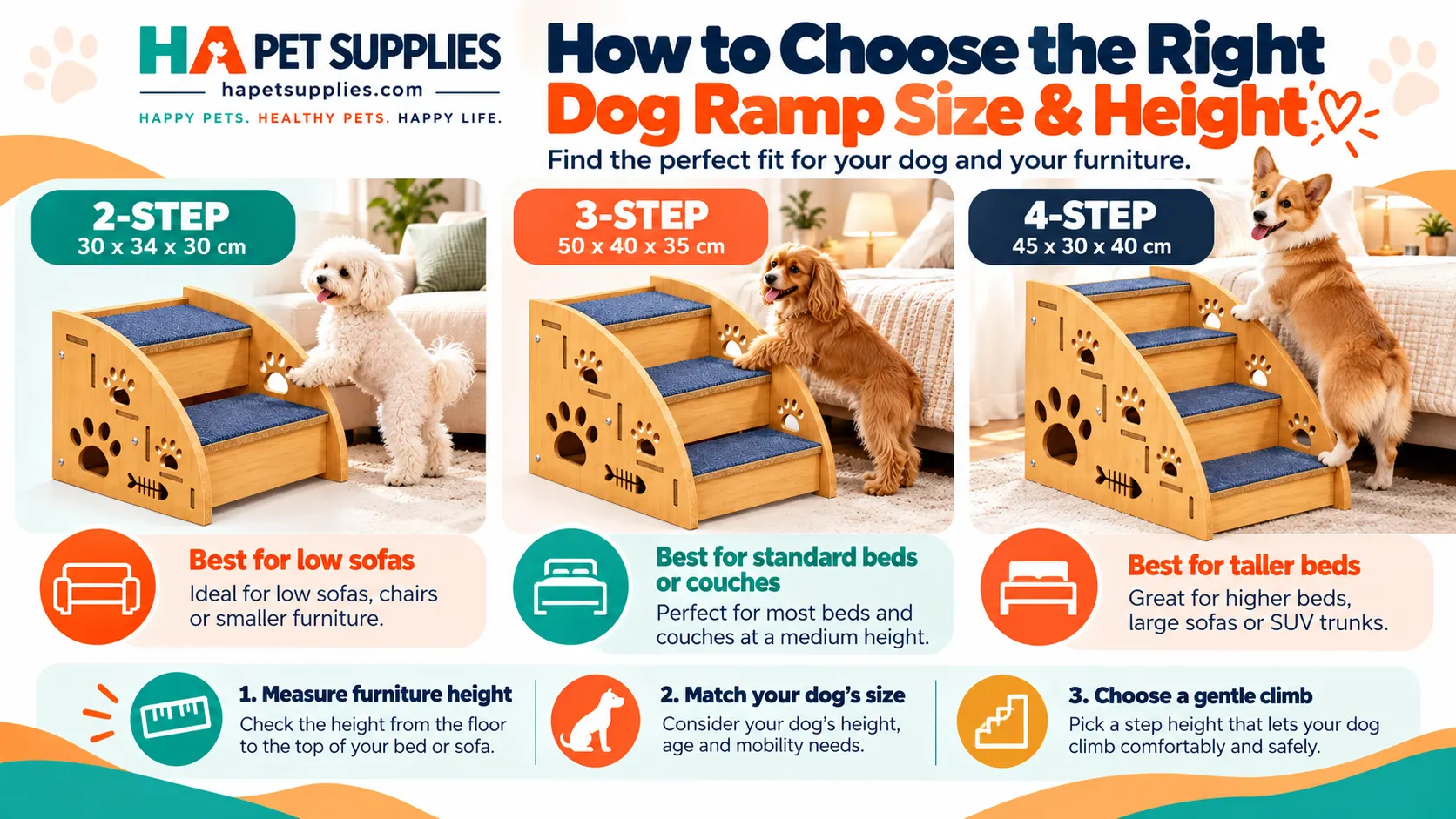
Compare total height and step dimensions before choosing pet stairs
Measuring for a Dog Ramp for Couch
Measure the seat height from the floor. Choose a location where the dog can approach the ramp or stairs directly.
Carpeted Wooden Dog Stairs
Wooden pet stairs with carpeted treads can be a practical furniture-access option when the dimensions and weight rating suit the dog.
8. Dog Ramp Size Guide for Small, Medium and Large Dogs
Different dogs need different walking widths, support capacities and access heights. But breed labels alone cannot determine the correct equipment.
Small Dog Ramp Requirements
Small dogs may need help reaching sofas and beds because of their shorter legs.
Medium Dog Ramp Requirements
Medium-sized dogs may use either ramps or steps depending on their health, body shape and confidence.
Large Dog Ramp Requirements
Large dogs typically need equipment with an appropriate load rating, stable structure and enough walking width.
Senior Dog Ramp Requirements
Older dogs may benefit from gentler slopes, secure traction and supportive handling when recommended by a veterinarian.
| Dog Category | Important Considerations | Potential Product Type |
|---|---|---|
| Small agile dog | Furniture height, step depth, stable placement | Compact stairs or ramp |
| Medium adult dog | Width, grip, destination height | Suitable ramp or stairs |
| Large dog | Weight rating, walking width, stability | Sturdy appropriately sized ramp |
| Senior dog | Gentle slope, balance, traction | Gradual ramp where appropriate |
| Dog with arthritis | Veterinary advice, comfortable movement | Often a ramp rather than stairs |
| Recovering dog | Specific activity restrictions | Only veterinarian-approved equipment |
9. Non-Slip Dog Ramp Materials and Safety Features
A ramp's surface can make the difference between a confident climb and a frightening slip.
Carpeted Walking Surfaces
Carpet provides texture and may improve paw grip. Inspect the surface regularly.
Rubberized Walking Surfaces
Textured rubber may offer useful traction in certain conditions.
Side Rails and Edge Protection
Raised sides may help some dogs feel more secure. However, rails should not create a narrow passage.
Why Surface Grip Matters for Arthritic Dogs
Dogs with painful joints may have difficulty recovering from slips. The VCA Animal Hospitals osteoarthritis home-care guide highlights the value of improving traction with non-skid surfaces.
10. Best Dog Ramp for Senior Dogs and Dogs With Arthritis
Older dogs may need assistance with mobility, but not every problem is caused by age alone.
Recognizing Possible Joint Problems
Common signs include stiffness after resting, reluctance to exercise, limping, difficulty climbing and reduced enthusiasm. According to Cornell's canine osteoarthritis guidance, difficulty jumping onto couches may be among the signs.
Can a Ramp Help a Dog With Arthritis?
An appropriately selected ramp may reduce the need for repeated jumping. However, the dog must still be capable of walking up and down the incline.
Joint Care Requires More Than a Ramp
A mobility aid can be helpful, but it is not a treatment for arthritis. The American College of Veterinary Surgeons identifies weight management, activity modification and rehabilitation as parts of osteoarthritis care.
11. Dog Ramp vs Pet Stairs Comparison Table
| Feature | Continuous Dog Ramp | Wooden Pet Stairs | General Household Steps |
|---|---|---|---|
| Walking surface | Continuous slope | Individual treads | Individual treads |
| Movement required | Walking along an incline | Repeated stepping | Repeated stepping |
| Vehicle suitability | Vehicle-rated designs | Only specifically suitable designs | Usually impractical |
| Arthritis considerations | Often preferred when gentle | May be difficult for some dogs | May be difficult |
| Size selection | Height, length, width, load rating | Total height, tread depth, width, load rating | Fixed dimensions |
If your dog is comfortable using steps and needs furniture access, our blue-carpeted wooden pet stairs may be an option worth evaluating. However, they should not be represented as a continuous vehicle ramp. You can review the available mobility product information on the HA Pet Supplies dog ramp product page.

Stable carpeted pet steps can help suitable dogs access furniture
12. How to Train Your Dog to Use a Ramp Safely
Buying a ramp does not guarantee that your dog will immediately understand it. Positive, gradual training is usually the most effective approach.
Step 1: Introduce the Equipment
Place the ramp flat on the floor if its design allows safe flat use. Let your dog sniff and investigate.
Step 2: Reward Approaching
Encourage your dog to move toward the equipment voluntarily. Offer treats for calm exploration.
Step 3: Practice One Paw at a Time
Reward your dog for comfortably placing a paw onto the ramp or first step.
Step 4: Encourage Short Movement
Once the dog is comfortable, encourage a few steps along a flat or very gentle ramp.
Step 5: Introduce a Small Height
If appropriate, begin with a low incline or short step sequence.
Step 6: Practice Ascending and Descending
Some dogs find descending more difficult. Train both directions separately and gradually.
Step 7: Move to the Intended Location
Once your dog understands the movement, introduce the equipment at the bed, sofa or vehicle.
The AKC guidance on teaching dogs to use ramps and stairs recommends rewarding exploration and gradually increasing difficulty. For a more detailed training plan, see our related article, How to Train a Dog to Use a Ramp: Seven Easy Steps for Cars, Beds and Sofas.
13. Common Problems and Fast Solutions
Problem: My Dog Refuses to Enter the SUV
Check whether the ramp incline is too steep or the surface is unstable. Try training on a flat or gentler setup.
Problem: The Ramp Slides During Use
Stop immediately. Inspect contact points and attachment mechanisms.
Problem: My Dog Slips on the Ramp
Check the surface material and condition. Consider whether the incline is too steep.
Problem: My Dog Can Climb but Cannot Descend
Descending requires control and balance. Practice gradual descent only when the dog is physically able.
14. Mistakes to Avoid When Buying a Dog Ramp
- Buying before measuring – Always measure first.
- Choosing the shortest product – Shorter ramps may create steeper inclines.
- Ignoring weight capacity – Check verified manufacturer specifications.
- Ignoring traction – A smooth or worn surface may create slipping risks.
- Assuming stairs and ramps are identical – They require different movements.
- Placing equipment on uneven ground – Unstable installation may create a fall hazard.
- Forcing an anxious dog – Use gradual, reward-based introduction.
15. How to Maintain Dog Ramps and Wooden Pet Stairs
A mobility product should remain stable, clean and comfortable throughout its useful life.
Inspect the Structure
Look for cracks, loose fasteners, worn joints or other damage.
Clean the Walking Surface
Remove dirt, hair and debris. Follow the manufacturer's instructions.
Inspect Foldable Mechanisms
For portable ramps, check hinges, telescoping sections and locking systems.
If your dog also struggles with hot-weather outdoor activity, the HA Pet Supplies dog cooling vest is another accessory you can evaluate separately for heat-management needs.
16. How to Choose HA Pet Supplies Mobility Products
When shopping for dog mobility equipment, the most useful starting point is understanding your dog's specific difficulty.
Explore the HA Pet Supplies Dog Ramp Product Page
You can begin by reviewing our dog ramp and pet stairs product information. Check the available product images, dimensions, materials and listed specifications.
Why Consider HA Pet Supplies?
At HA Pet Supplies, we aim to help customers evaluate pet accessories according to practical needs. Our dog supplies category provides access to related products. You can also browse the HA Pet Supplies shop when comparing available accessories.
Need Help Before Ordering?
If you cannot identify the correct product dimensions, contact HA Pet Supplies through our contact page. If you need purchasing information, you can also request a quote from HA Pet Supplies.
17. Frequently Asked Questions About the Best Dog Ramp for Cars
18. Final Buying Checklist and Recommendation
Finding the best dog ramp for cars, SUVs and beds should begin with the needs of your dog rather than the appearance of the product.
Seven-Point Buying Checklist
- Measure the destination height.
- Check available space.
- Calculate the incline where relevant.
- Confirm usable width.
- Verify load capacity.
- Examine traction and stability.
- Consider your dog's health and confidence.
Final Thoughts: Choose Comfort, Not Just Convenience
Imagine your dog standing beside the bed after a long day. Your dog wants to reach a familiar resting place, but jumping has become difficult. A carefully selected mobility aid can help make familiar environments more accessible.
The best dog ramp for cars is not automatically the longest, most expensive or most attractive model. It is the ramp that offers the right combination of dimensions, stability, traction and suitability for your dog.
If you are comparing available mobility accessories, start with the HA Pet Supplies dog ramp and pet stairs product page. For more practical guidance, explore the HA Pet Supplies pet-care blog or visit HA Pet Supplies.
The right mobility aid does more than help your dog reach a higher surface. It can make everyday routines more comfortable, manageable and reassuring for both of you.