
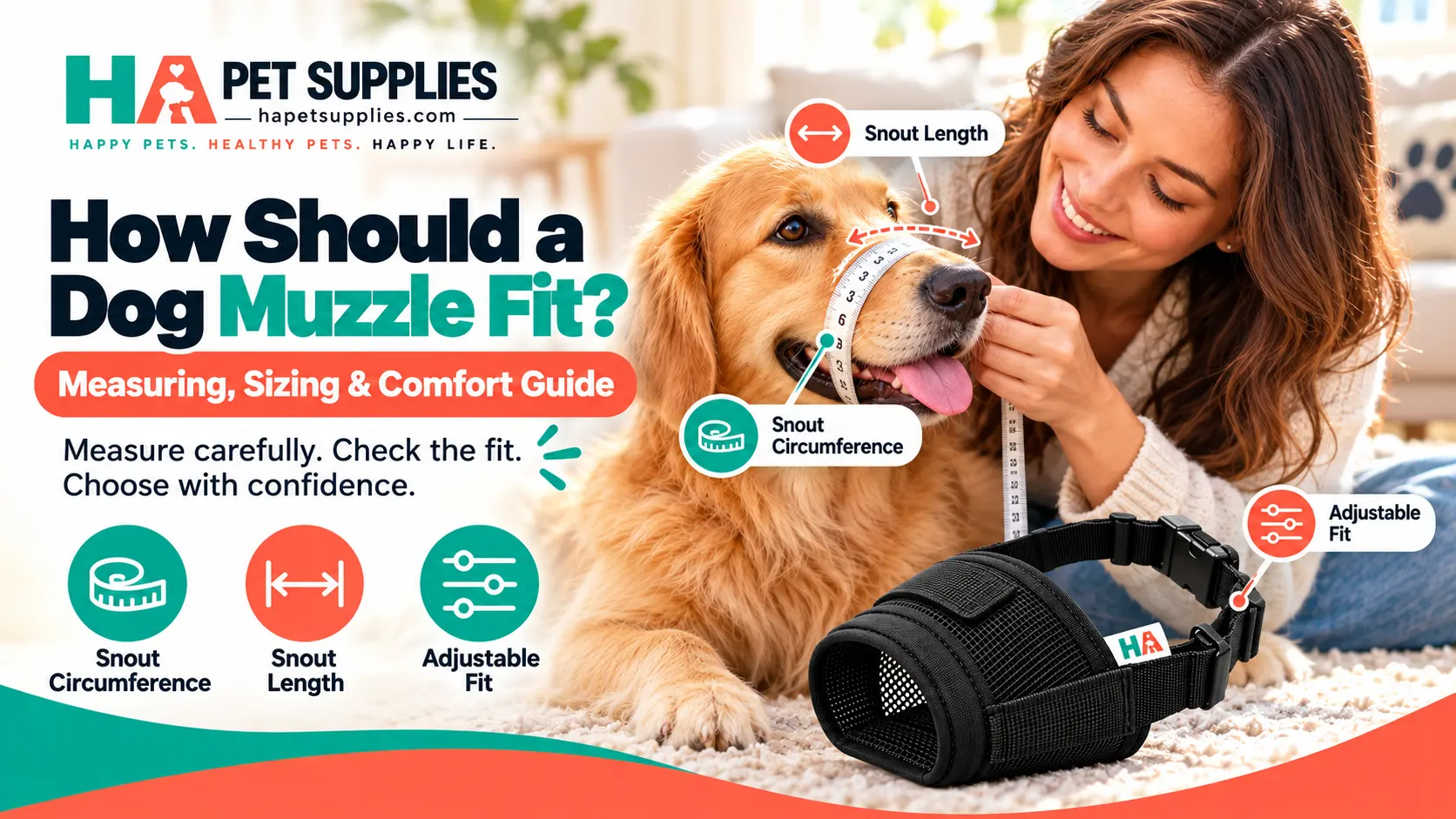
How should a dog muzzle fit? The short answer is: securely enough to stay in position, but not so tightly that it rubs, pinches, presses into the nose or interferes with the level of mouth movement the particular muzzle design is supposed to allow.
That sounds straightforward until you actually have a muzzle in your hand.
Is the strap too loose? Is the front sitting too close to the nose? Should you be able to fit a finger beneath the strap? What if the dog can move the muzzle with a paw? What if the dog keeps rubbing its face? Can you simply buy the size recommended for your dog’s breed?
These are exactly the questions that confuse first-time buyers.
The most important principle is that breed name alone is not enough to determine fit. Dogs of the same breed can have different snout lengths, head widths and facial proportions. PDSA advises measuring both nose length and circumference rather than depending solely on a breed recommendation. It also recommends checking nose clearance, strap tightness and whether the dog can remove the muzzle. PDSA dog muzzle sizing guidance.
If you are considering the product shown throughout this guide, start by reviewing the specifications and available sizing information for the HA Pet Supplies dog muzzle before ordering. This guide will then help you understand what those measurements mean and how to perform a practical fit check after the muzzle arrives.
Quick Answer: How Should a Dog Muzzle Fit?
If you are standing beside your dog with a muzzle right now and need a fast answer, check these seven things first:
- The muzzle should remain securely in position.
- It should not press into the eyes or obscure vision.
- It should not painfully rub, pinch or dig into the face.
- The straps should be secure without being excessively tight.
- The nose should not be crushed against the front of the muzzle.
- The muzzle should provide the mouth movement appropriate for its design and intended use.
- Your dog should not be able to shake or easily pull it off.
VCA advises that a suitable muzzle should not sit on the soft flesh of the nose or nostrils, should not touch the eyes, and should be secure enough that the dog cannot remove it independently. VCA veterinary muzzle guidance.
There is one important qualification: different muzzle types are designed to allow different amounts of mouth movement. A roomy basket muzzle and a close-fitting soft muzzle should not be evaluated as though they are identical products. That distinction runs throughout this guide.
Why Correct Dog Muzzle Fit Matters
A muzzle has a safety purpose. Poor fit can undermine that purpose in two opposite ways. A muzzle that is too loose may slide, rotate, move toward the eyes or be removed by the dog. A muzzle that is too tight may create unnecessary pressure, rub the skin, restrict movement beyond what the design intends or make the dog increasingly uncomfortable.
Dogs Trust recommends choosing a muzzle that does not obscure vision, dig into the face or restrict the mouth movement the design should permit, while remaining secure enough to stay in place. Dogs Trust guide to selecting and fitting a dog muzzle.
Correct fit also affects training. Imagine spending several days building positive associations with a muzzle that rubs the bridge of your dog’s nose every time it is fastened. Your training may appear to be failing when the real problem is physical discomfort. That is why answering how should a dog muzzle fit should happen before expecting a dog to wear one comfortably for real-world handling. Fit and training work together.
Before Measuring: Know Which Type of Muzzle You Are Fitting
Not all muzzles are built for the same purpose. Two broad categories appear frequently:
Basket muzzles
A correctly fitted basket muzzle typically leaves considerably more space around the dog’s mouth. Veterinary and welfare organisations commonly favour this design when a dog needs enough room to pant, drink and accept rewards. VCA notes that properly fitted basket muzzles can allow mouth opening, panting and treat delivery. VCA. The American Kennel Club similarly explains that many basket designs allow dogs to pant, drink and eat while providing bite protection. AKC overview of different dog muzzle designs.
Soft or sleeve-style muzzles
These sit closer to the dog’s mouth. Depending on the specific construction, they can restrict how widely the mouth opens. PDSA warns that designs holding the mouth closed should only be used briefly because a dog needs to pant for temperature regulation and may also need access to water. PDSA. Blue Cross likewise distinguishes roomy basket-style muzzles from mouth-closing designs and emphasizes the importance of allowing appropriate panting. Blue Cross guide to dog muzzle fit and training.
The HA Pet Supplies product pictured in this article is a soft mesh-style design, so do not automatically apply claims about prolonged basket-muzzle wear to it. Check the product’s intended use, monitor your dog closely and select the type of muzzle according to the situation. You can compare the muzzle with other items in the broader HA Pet Supplies dog supplies collection while deciding what is suitable for your setup.
📏 Measure → Match → Check
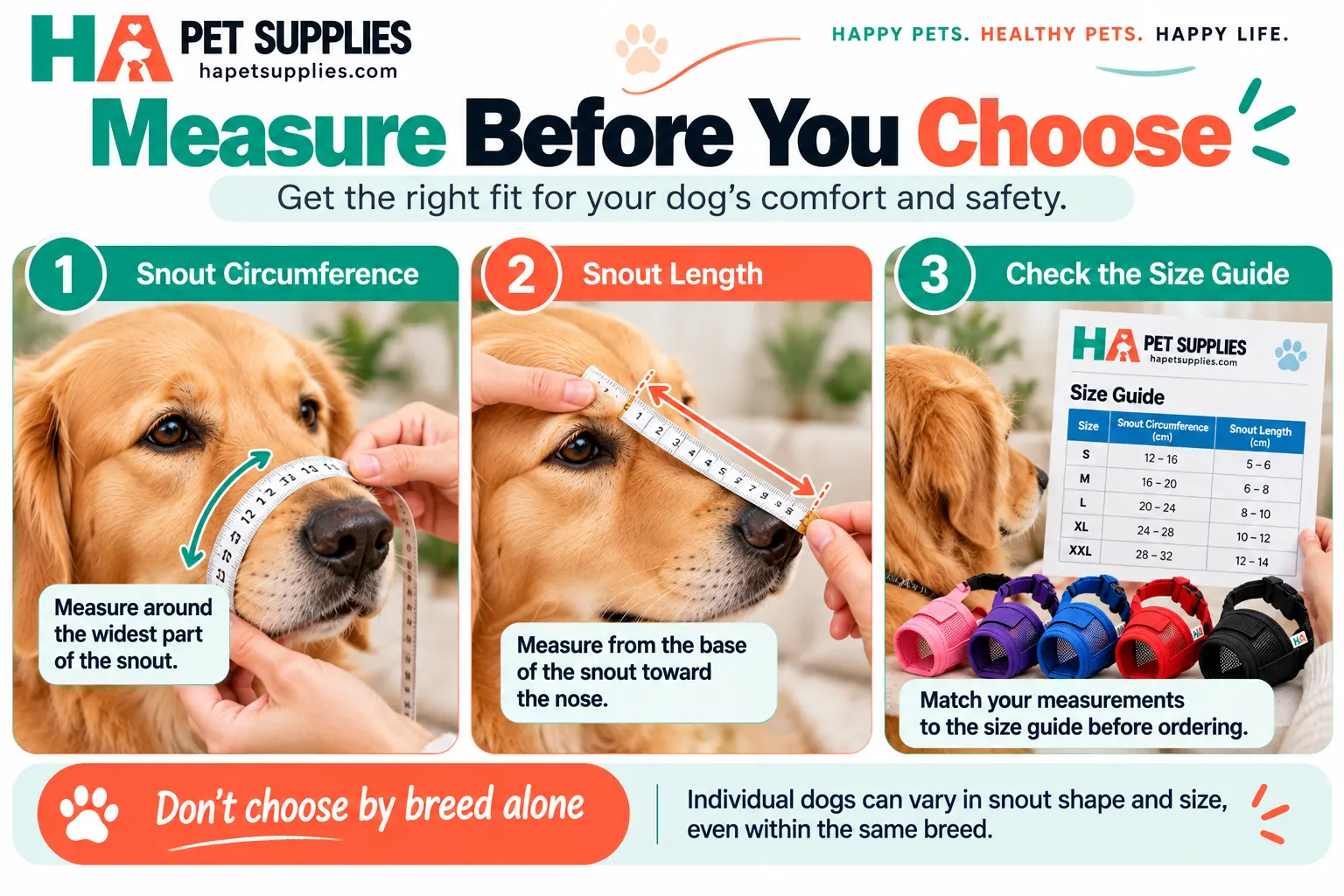
Measure around the broad part of the snout according to the manufacturer’s measuring instructions.
Snout length
Measure from the appropriate point near the base of the snout toward the nose as directed by the size chart.
Do not rely only on breed. Sizing systems are not universal — a “Medium” in one muzzle may not match a “Medium” in another.
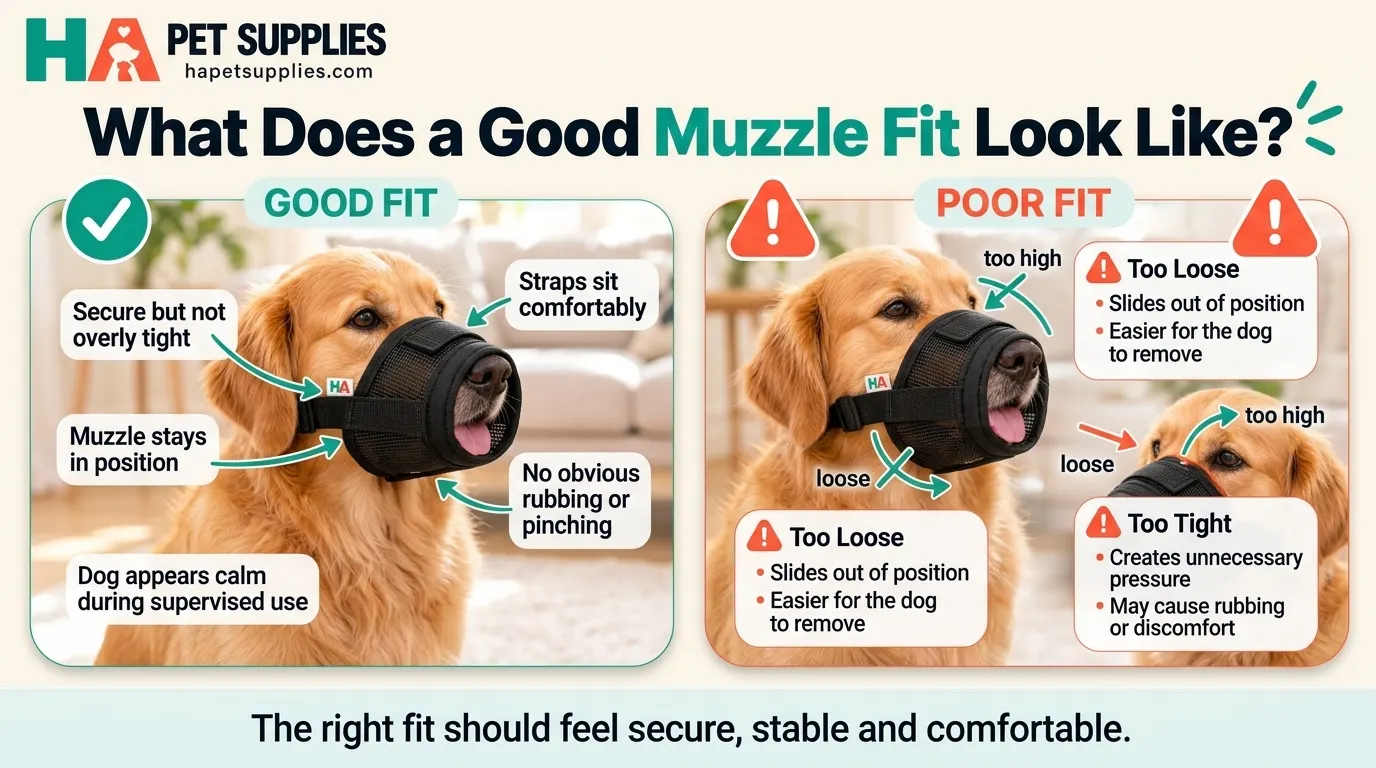
- eye clearance
- nose clearance
- strap security
- rubbing
- movement
- removal resistance
- appropriate mouth movement
How Should a Dog Muzzle Fit? Start With Accurate Measurements
The safest way to approach sizing is to follow the manufacturer’s specific chart for the exact model you intend to purchase. That matters because sizing systems are not universal. A “Medium” in one muzzle may not have the same dimensions as a Medium in another. You therefore need actual measurements.
Two of the most commonly requested measurements are snout circumference and snout length. PDSA recommends measuring around the widest part of the nose and measuring nose length from the tip toward the point below the eyes. PDSA.
However, use the exact starting and ending points specified by the manufacturer because measurement methods can vary by product design. A soft measuring tape is easiest. If your dog becomes uncomfortable when a tape is placed around the face, do not turn measurement into a wrestling match. Introduce the tape gradually and reward calm cooperation.
How to Measure Snout Circumference
Snout circumference tells you how much space the muzzle needs around the dog’s nose and mouth area. Follow the muzzle manufacturer’s measuring diagram first. For many sizing systems, you will measure around a broad part of the snout behind the nose.
The tape should lie flat. Do not pull it so tightly that it compresses the dog’s face. At the same time, do not leave such a large gap that you record an artificially oversized measurement. Record the number. Then repeat the measurement. If the two results differ significantly, measure again. This simple double-check can prevent an incorrect size choice caused by the tape slipping or the dog moving.
When people ask how should a dog muzzle fit, they often focus only on the final strap adjustment. In reality, the process starts before purchase. A poor base size cannot always be corrected simply by tightening the straps.
How to Measure Snout Length
The second common measurement is snout length. PDSA describes measuring from the nose tip to the point just below the eyes as part of its general sizing guidance. PDSA.
Again, follow the diagram supplied for your specific product because different manufacturers can define measurement points differently. The important practical issue is that the muzzle should not finish in a position that creates unwanted pressure against the nose. You also do not want the muzzle pushed so far backward that it interferes with the dog’s eyes.
Think of muzzle length as a clearance problem, not simply a number. You are trying to find enough space for the muzzle to sit in its intended position without crushing the nose or creeping toward the eyes.
Seven Essential Checks: How Should a Dog Muzzle Fit After You Put It On?
Measurements choose the starting size. The real fit test happens once the muzzle is on the dog. Use these seven checks.
1. Check Eye Clearance
The muzzle should not sit against the eyes or repeatedly slide upward toward them. VCA specifically advises selecting a muzzle that does not touch the eyes. VCA. Dogs Trust likewise says a properly fitted muzzle should not obscure vision. Dogs Trust. Look at your dog from the side and front. Does the muzzle remain below the eyes? Does it shift upward as your dog walks? Are straps pulling the muzzle toward the eye area? If yes, reassess the size or adjustment.
2. Check the Nose Area
The nose should not be painfully compressed against the muzzle. PDSA suggests approximately 1 cm of space between the dog’s nose and the end of the muzzle as a general fit check in its guidance. PDSA. Treat that as general guidance rather than a universal specification for every product. Manufacturer instructions take priority because muzzle designs differ. VCA also advises that the muzzle should not sit against the soft flesh of the nose or nostrils. VCA. If the nose is being pushed hard against the front, the size or shape may not suit your dog.
3. Check Strap Tightness
The straps need to perform two jobs at once: hold the muzzle securely without creating excessive pressure. PDSA suggests being able to slip approximately one finger between the strap and the dog. PDSA. Blue Cross gives similar guidance and says the neck strap should be secure enough that more than one small finger cannot be inserted beneath it. Blue Cross. Do not treat this as a reason to force exactly one finger beneath every possible strap on every muzzle. Use it as a practical reference while following the manufacturer’s fitting instructions. The correct strap setting is secure, stable and not painfully tight.
4. Check Whether the Muzzle Moves
Have your dog calmly turn its head. Walk several steps. Allow normal supervised movement. The muzzle should not rotate dramatically or slide into the eyes. A small amount of movement may occur depending on design, but the muzzle should remain in its intended position. If your dog can push it sideways with minimal effort, the adjustment may be too loose or the shape may be unsuitable.
5. Check Whether Your Dog Can Remove It
A beautifully comfortable muzzle is not useful for safety if the dog can immediately pull it off. PDSA recommends checking that the dog cannot shake or pull the muzzle off. PDSA. VCA similarly advises selecting a muzzle the dog cannot remove independently. VCA. Do not test this by deliberately making your dog panic or fight the equipment. Instead, assess security during normal supervised movement.
6. Check for Rubbing and Pinching
Look closely at the contact points: across the bridge of the nose, beneath the jaw, around the cheeks, behind the ears, wherever straps meet skin or fur. Blue Cross states that a well-fitting muzzle should not rub or dig into the dog’s face. Blue Cross muzzle fit checklist. Watch for redness, hair disturbance, repeated rubbing, pressure marks or your dog consistently pawing at one particular area. Those signals deserve investigation rather than being dismissed as stubbornness.
7. Check Appropriate Mouth Movement
This point depends heavily on design. For a basket muzzle intended for longer wear, welfare organisations generally recommend enough room for a dog to open its mouth, pant and drink. Dogs Trust specifically recommends choosing a muzzle that permits eating, drinking and panting and does not restrict necessary mouth movement. Dogs Trust. Fear Free also favours basket designs for situations requiring treat delivery and panting. Fear Free guidance on choosing and introducing a muzzle. A soft muzzle may intentionally allow less mouth opening and therefore requires a different use case and shorter duration. Never assume “breathable fabric” automatically means unrestricted panting.
On mobile, tap any card to expand. On desktop, hover to see details elevate.
How Tight Should a Dog Muzzle Be?
This is one of the most common buying questions. The answer is not “as tight as possible.” Tightening a poor-fitting muzzle harder does not convert it into a well-fitting one.
The strap should prevent excessive slipping and removal while avoiding painful pressure. PDSA’s general one-finger check is useful as a starting point. PDSA. But also observe what happens when the dog moves. If the muzzle slides despite the strap being extremely tight, the shape or size may be wrong.
That is an important distinction. Many owners respond to movement by continuing to tighten. Sometimes the better answer is a different size or muzzle shape.
Signs a Dog Muzzle Is Too Tight
When asking how should a dog muzzle fit, look for these warning signs:
- visible pressure on the snout
- straps digging deeply into the skin or fur
- rubbing near the eyes
- marked redness after brief use
- nose pressed firmly against the front
- excessive restriction beyond what the muzzle design intends
- dog repeatedly targeting one pressure point with a paw
- immediate discomfort that appears only after fastening
Do not assume every pawing behaviour proves poor fit—dogs also need gradual training—but investigate fit first. Dogs Trust notes that rubbing, soreness or inability to behave normally can indicate that the muzzle’s size, shape or material is unsuitable. Dogs Trust.
Signs a Dog Muzzle Is Too Loose
An overly loose muzzle has its own problems. Watch for:
- straps repeatedly slipping
- muzzle rotating significantly
- muzzle moving toward the eyes
- dog easily pushing it away with a paw
- dog shaking it off
- fit changing significantly during normal movement
The objective is not simply comfort. The muzzle must also remain functional. This is why you need both security and comfort, not one at the expense of the other.
- excessive pressure
- rubbing
- poor clearance
- straps digging in
- stable
- secure
- clear of eyes
- no obvious pinching
- appropriate movement for design
- sliding
- rotating
- strap movement
- easier to remove
On mobile, these cards stack vertically. Essential safety information is never hidden behind hover effects.
How Should a Dog Muzzle Fit for Panting?
This is an area where oversimplified advice can become unsafe. Dogs primarily cool themselves through panting. A basket muzzle designed for longer use should therefore offer meaningful panting space.
Blue Cross recommends basket muzzles partly because they allow dogs to breathe freely, drink and accept treats. Blue Cross. AAHA also notes that basket muzzles can allow dogs to drink and accept treats and generally present fewer health concerns than restrictive non-basket designs in veterinary handling. AAHA behaviour guidance on basket muzzles and handling.
This does not mean every muzzle must have the same amount of pant room. A temporary soft muzzle has a different function. What it does mean is that you must select the muzzle type according to how long it will be worn, environmental temperature, activity level and intended purpose. If a dog needs extended wear or exercise, do not assume a close-fitting mouth-restricting design is appropriate just because it physically fits around the snout.
Why Breed-Based Dog Muzzle Sizing Can Be Misleading
Breed recommendations can be useful as an initial reference. They are not a substitute for measuring the actual dog. Two adult dogs of the same breed may differ in sex, age, overall body size, snout width, skull structure, facial proportions, weight and coat thickness. Mixed-breed dogs make visual guessing even less reliable.
PDSA therefore directs owners to measure the dog’s individual nose when they are unsure of size. PDSA. If two measurements fall between manufacturer sizes, do not automatically choose whichever size sounds closest. Read the manufacturer’s instructions or ask for product-specific assistance. If you are unsure which HA Pet Supplies option suits your measurements, use the HA Pet Supplies contact page rather than guessing.
What About Flat-Faced Dogs?
Flat-faced, or brachycephalic, dogs require additional caution. Their facial anatomy differs substantially from dogs with longer snouts, and some brachycephalic dogs already have compromised breathing.
PDSA specifically advises extra care when muzzling breeds such as Pugs, Pekingese and French Bulldogs and recommends speaking with a veterinarian if suitable fit is difficult to achieve. PDSA. Blue Cross explains that brachycephalic dogs can experience airway restriction because their shortened skulls contain relatively large amounts of soft tissue around the nose and throat. Blue Cross explanation of breathing issues in flat-faced dogs.
Do not force a conventional long-snout muzzle to fit a face for which it was not designed. Get professional guidance instead.
What If My Dog Keeps Pawing at the Muzzle?
First determine whether you have a training problem or fit problem. Check the physical fit again. Look for rubbing. Check the eye area. Check strap placement. Check whether the muzzle is rotating. Check whether the nose is pressing against the front.
If all of those appear appropriate, consider whether the dog has been introduced to the muzzle gradually. Dogs Trust advises going back to an earlier training stage if a dog begins rubbing or pawing at the muzzle during conditioning. Dogs Trust. If the skin becomes irritated or sore, that is more reason to stop and reassess. Do not simply tighten the muzzle harder.
Frequently Asked Questions: How Should a Dog Muzzle Fit?
It should remain clear of the eyes and should not obstruct vision. Both VCA and Dogs Trust identify eye clearance as an important part of correct fit. VCA. If the muzzle repeatedly moves upward toward the eyes, reassess the size, shape and strap adjustment.
Secure but not painfully tight. PDSA uses approximately one finger beneath the strap as a general guide, while Blue Cross offers similar advice for neck-strap security. PDSA. Always follow the specific manufacturer’s instructions as well.
Generally, you want appropriate nose clearance rather than the nose being crushed against the end. PDSA suggests around 1 cm of clearance as a general check. PDSA. Different muzzle designs can vary, so verify the manufacturer’s fitting instructions.
Yes. An excessively loose muzzle may rotate, shift toward the eyes or be pulled off. A correct fit balances comfort with sufficient security.
Yes. Excessive tightness can create pressure, rubbing, pinching and unnecessary restriction. Tightening should not be used to compensate for an unsuitable shape.
A muzzle intended for prolonged or active use should generally provide enough room for effective panting. Basket designs are commonly recommended for this reason by VCA, PDSA, Blue Cross and Dogs Trust. VCA. Close-fitting soft muzzles require a different use profile and should not automatically be treated as long-duration equipment.
If drinking is expected while the muzzle is being worn, select a design that permits it. Basket muzzles are generally better suited to that requirement. Do not assume all soft muzzles allow normal drinking.
Possible explanations include unfamiliarity, insufficient training, poor fit, rubbing or an unsuitable shape. Inspect the fit first. Then, if the equipment appears correct, return to gradual reward-based conditioning.
Breed can provide a rough starting point, but measure the individual dog. PDSA explicitly recommends actual nose measurements when choosing size. PDSA.
Only if the current adjustment is genuinely too loose and the manufacturer’s instructions permit further adjustment. If the dog can remove a muzzle even when straps are already appropriately secure, the problem may be size or shape. Do not simply keep tightening.
That depends on the design. Many basket muzzles are designed to allow reward delivery, which can help with positive conditioning. AAHA and AVSAB both discuss basket muzzles in the context of reward-based handling and training. AAHA and AVSAB introduction to positive muzzle conditioning.
A dog should not be left to sleep unattended in ordinary muzzle equipment. Muzzle use requires active supervision, and the equipment can move, catch or cause problems the owner needs to notice. Use appropriate environmental management instead of treating the muzzle as unattended containment.
Do not use a muzzle as a replacement for supervision. This is particularly important when a dog is still learning to wear it or when the design closely restricts the mouth.
Movement can expose fit problems that are not obvious while the dog is sitting still. Recheck strap tension, muzzle shape, eye clearance, head movement and whether the size is too large. Always evaluate fit during controlled movement before depending on the muzzle in a demanding environment.
When Professional Help Is Better Than Guessing
Some dogs do not fit conventional size charts well. Others have unusually short faces, old injuries, skin sensitivity or behavioural concerns that make fitting more complicated.
VCA recommends asking a veterinarian, experienced trainer or behaviour consultant for guidance when selecting an appropriate muzzle. VCA. AAHA’s more recent discussion of muzzle use likewise emphasizes matching equipment to its intended function and maintaining humane handling alongside muzzle use. AAHA discussion of responsible muzzle use.
If the question is specifically about HA Pet Supplies product dimensions, availability or ordering, use the company’s contact page rather than relying on a generic sizing assumption. Retailers, pet businesses and volume buyers who need product quantities or commercial information can use the HA Pet Supplies quote request page in the relevant purchasing context.
Final Answer: How Should a Dog Muzzle Fit?
So, how should a dog muzzle fit? It should be secure, stable and appropriate for the muzzle’s intended function without causing unnecessary pressure, rubbing or poor positioning.
Measure your dog instead of relying only on breed. Follow the manufacturer’s size chart. Check nose and eye clearance. Check strap security. Make sure the muzzle stays in position when your dog moves. Look for rubbing or pinching. Confirm that your dog cannot easily remove it. And most importantly, make sure the amount of mouth movement matches the kind of muzzle and the situation in which it will be used.
For longer periods or circumstances requiring normal panting, drinking and reward delivery, authoritative veterinary and welfare organisations generally favour appropriately fitted basket muzzles. Close-fitting soft designs have a different role and should not automatically be treated as interchangeable with basket muzzles.
Correct sizing also does not eliminate the need for training. A dog should be introduced to muzzle equipment gradually and positively. Fear Free, Dogs Trust, AVSAB and veterinary organisations consistently recommend building familiarity and rewarding voluntary participation rather than simply forcing unfamiliar equipment onto the dog. Fear Free Happy Homes.
If you are evaluating the mesh design featured in this guide, compare your dog’s measurements with the information on the HA Pet Supplies dog muzzle page before making a size choice. If you are building a wider pet-care setup, the HA Pet Supplies shop and dog supplies collection provide the relevant product categories without turning this sizing decision into an unrelated product list.
For additional educational guidance, continue through the HA Pet Supplies blog or return to the HA Pet Supplies homepage when you need the wider product and support navigation. You can also review our related guide on how to muzzle train a dog and when a dog should wear a muzzle.
The best fit is not simply the tightest fit. It is the fit that gives you appropriate security without sacrificing the dog’s comfort and the functional requirements of the muzzle design. That is the standard to keep in mind every time you measure, adjust or recheck a dog muzzle.
Not Sure Which Size to Choose?
Measure first. Compare second. Fit-check third.
If you are still uncertain after measuring your dog’s snout, review the product specifications rather than guessing from breed alone.