
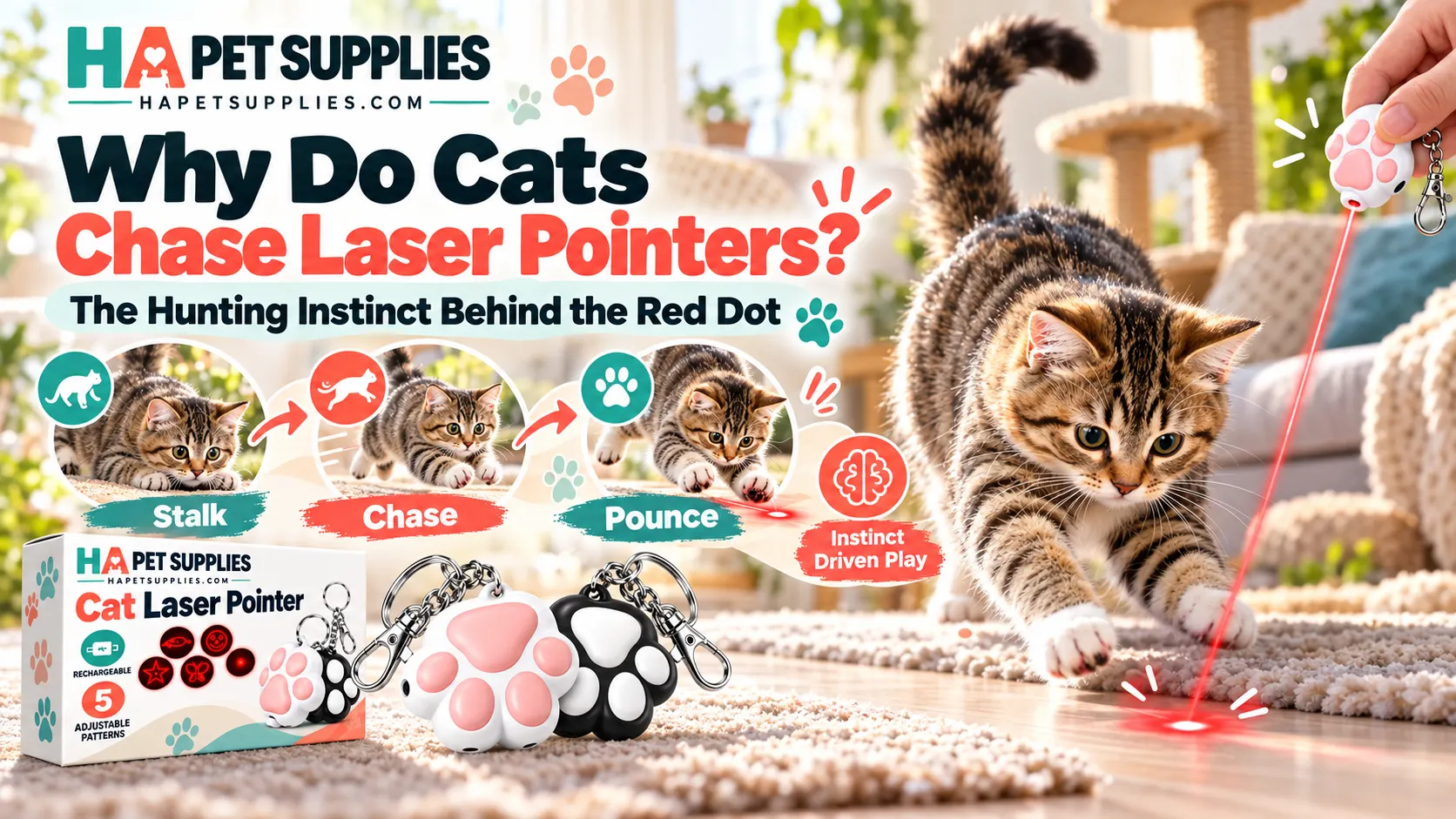
Why do cats chase laser pointers? The answer has less to do with the color red and much more to do with movement.
A tiny dot slides across the floor. It stops. It darts behind a chair. It reappears. Your cat’s body changes almost instantly. The ears point forward. The pupils may widen. The body lowers. The hind legs prepare. Then comes the chase.
To us, it is obviously a point of light. To the cat’s hunting system, it behaves enough like small moving prey to trigger attention, stalking and pursuit.
Cats are predators by design. Even a well-fed indoor cat still has a strong visual response to movement, stalking instincts, chase behavior, pouncing behavior and prey-capture sequences. That is why a cat that ignores a motionless toy on the floor may suddenly become intensely focused when a tiny light begins moving unpredictably.
Cornell University’s Feline Health Center explains that play helps cats express natural stalking, chasing and pouncing behaviors while providing exercise and mental stimulation. Read Cornell guidance on safe cat toys and enrichment.
The Feline Veterinary Medical Association likewise identifies opportunities for predatory play and environmental enrichment as important parts of indoor-cat welfare. Read the FelineVMA indoor-cat position statement.
The red dot is compelling because it plugs directly into this ancient behavioral system. But there is one major difference between a laser dot and real prey: the cat can never physically catch the light. That is where laser play becomes more complicated.
Before using a laser pointer regularly, owners need to understand both sides: why the chase is so rewarding and why an incomplete hunt can sometimes become frustrating.
If your main concern is safety rather than behavior, read the pillar guide on whether laser pointers are safe for cats and how to avoid eye injury and frustration. This article focuses on the cat’s brain and behavior: why does that little dot seem almost impossible for some cats to ignore?
Quick Answer: Why Do Cats Chase Laser Pointers?
Cats chase laser pointers because the moving dot can trigger several parts of their natural predatory sequence:
- notice movement
- orient toward the target
- stalk
- chase
- pounce
- attempt to capture
- search when the target disappears
The laser is especially effective because it can move quickly, unpredictably, silently, in short bursts and around obstacles. Those characteristics resemble prey movement more than a static toy does.
But the laser also has a limitation: it cannot provide real physical capture. That is why safer laser play should eventually transition to a toy mouse, wand toy, kicker toy or food reward so the cat gets a more complete ending to the hunting sequence.
What’s Inside This Guide
The Red Dot Triggers Movement Detection First
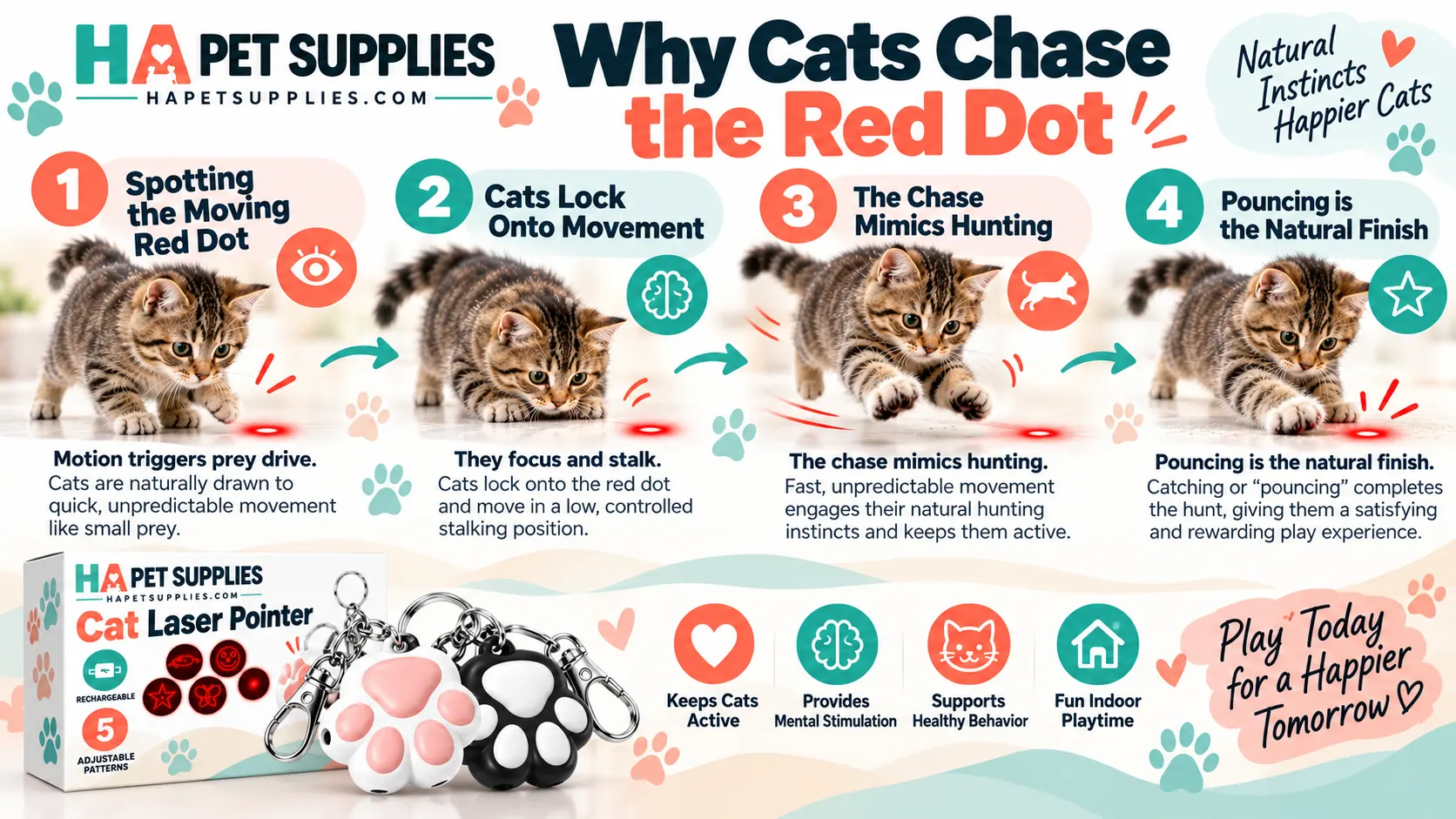
Cats are extremely sensitive to movement. That makes sense for a predator. A small animal sitting completely still can be difficult to detect. The moment it moves, it becomes much more obvious.
Your cat’s visual system is therefore tuned to pay attention to sudden motion, directional changes and tiny moving targets. A laser pointer takes advantage of exactly that. The dot can sit still for one second and then shoot across the floor. That sudden change is often enough to trigger the cat’s attention immediately.
This is one reason the laser often works better than simply placing a toy mouse in front of the cat. A motionless toy provides shape. A moving laser provides behavior.
Is the Red Color Important?
Not as much as many owners assume. The main attraction is movement, not the color itself. Cats do not perceive color exactly as humans do. Research and veterinary resources generally describe cats as having more limited color discrimination than people, with sensitivity centered more strongly around blue and greenish wavelengths than rich red tones.
So when your cat chases the “red dot,” the cat is not necessarily fascinated because the dot looks vibrantly red. The attraction is: small target + contrast + movement + unpredictability. That is why different light colors can still trigger chase behavior. The prey-like motion matters far more.
Cats Are Built to Watch Before They Chase
A common laser session starts with the owner moving the dot rapidly. But watch a cat carefully before the sprint. Often the most interesting behavior happens first. The cat may freeze, lower the body, focus the eyes, move the ears forward, creep slowly, shift weight onto the hind legs.
That is stalking. Stalking is not wasted time. It is part of the hunt. The Feline Veterinary Medical Association emphasizes the importance of allowing cats to express species-appropriate hunting and predatory behavior as part of environmental enrichment. See FelineVMA environmental-needs guidance.
That means good laser play should not only be: run, run, run. It should also include: watch → stalk → pause → chase.
3D Infographic: The Cat Hunting Sequence
1. DETECT
Something moved. The cat’s attention locks onto the target.
2. ORIENT
Eyes, ears and body face the prey.
3. STALK
Slow, controlled approach. The cat minimizes unnecessary movement.
4. CHASE
Rapid pursuit begins.
5. POUNCE
The cat attempts to intercept the target.
6. CAPTURE
With real prey or a physical toy, the cat grabs the target.
7. COMPLETE
The hunt ends with physical possession, eating or disengagement.
The red dot triggers the hunt—but cannot complete the hunt by itself.
Why Unpredictable Movement Makes the Laser So Exciting
Prey does not move in a straight predictable line forever. A mouse may freeze, run, turn, hide, reappear. An insect may dart, stop, change direction. A laser pointer can mimic this unpredictability very easily. That is one reason it keeps the cat mentally engaged.
The cat cannot simply predict: “The toy will move left every time.” Instead, the brain has to keep updating: where is it now? Where is it going? When should I pounce? That unpredictability can make the game feel much more intense than pushing a stationary ball across the floor.
Why Does the Cat Wiggle Before Pouncing?
That famous “butt wiggle” is part of preparation. Before jumping, a cat may shift weight between hind legs, lower the body, adjust footing and prepare the muscles. The movement helps the cat line up the pounce. You may see it during laser play, wand play, bird watching or stalking another toy. It is a good example of how seriously the cat’s predatory system treats the target, even when the “prey” is only light.
Why Cats Crouch So Low During Laser Play
The crouch is another predatory behavior. Lowering the body makes the cat less visible, prepares the muscles and supports a sudden burst forward. During play, the cat may instinctively reproduce this hunting posture even though there is no real animal involved. This is why cat play often resembles miniature hunting. The mechanics are not random. They are inherited behavioral patterns.
Why Indoor Cats Still Hunt
This confuses many owners. “My cat gets fed twice a day. Why does it still want to hunt?” Because hunger and hunting are related—but not identical.
A cat can be well fed, healthy and completely safe indoors and still want to stalk, chase and pounce. Predatory behavior is deeply rooted. Cornell notes that even indoor cats benefit from opportunities to engage in play and simulated hunting because these behaviors provide both physical and mental stimulation. Read Cornell guidance on cat enrichment.
This is why a cat may finish dinner and then immediately chase a toy. The food bowl satisfies nutritional hunger. It does not completely erase the predatory system.
Does Laser Play Count as Enrichment?
It can. Laser play may provide visual tracking, physical movement, owner-cat interaction, short bursts of exercise and novelty. But it is incomplete enrichment if used alone.
The Feline Veterinary Medical Association recommends giving cats multiple forms of environmental enrichment, including scratching, climbing, hiding, foraging, play and predatory behavior. Read more from FelineVMA. That means a laser pointer can be one tool. It should not become the entire enrichment program.
The Missing Piece: Physical Capture
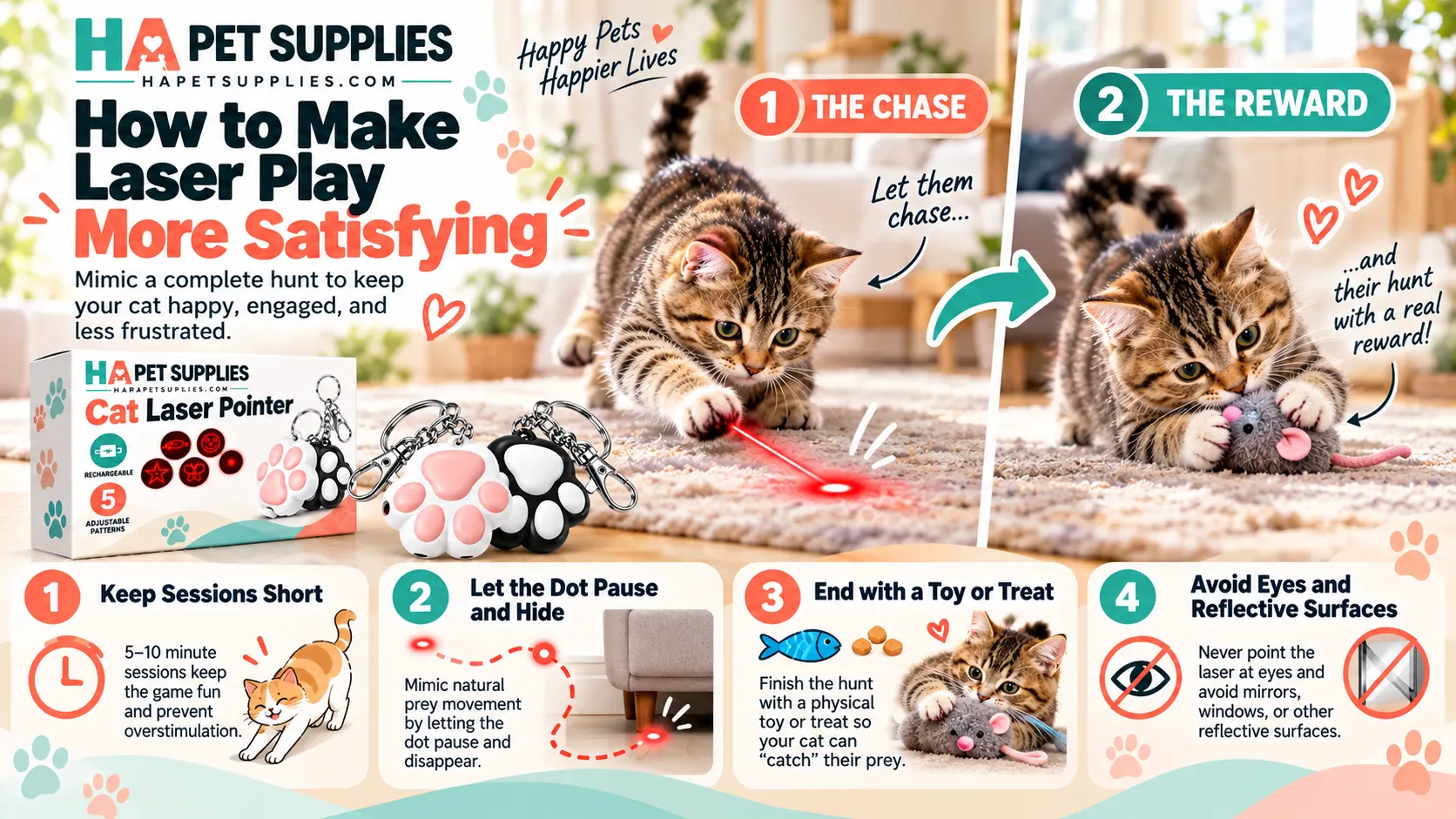
This is the part that separates a laser pointer from a good wand toy. With a wand toy, the cat can catch it, hold it, bite it, kick it and carry it. With a laser, the cat lands on the dot and gets nothing. There is no texture. No resistance. No object. The light simply moves.
This creates an important behavioral question: Does the cat feel frustrated because the hunt never ends successfully? For some cats, possibly.
Cats Protection specifically cautions that laser pointers can be frustrating because cats cannot physically capture the target. Read Cats Protection guidance. The Feline Veterinary Medical Association recommends allowing cats to capture their simulated prey at least intermittently. See the environmental-needs guidelines.
That is why you should not end laser play by simply switching the light off at the most exciting point.
Why a Real Catch Matters
A real catch gives the cat a clear outcome. It changes the sequence from: see → chase → pounce → nothing to: see → chase → pounce → capture. That is psychologically more complete.
A “catch” can be a stuffed toy mouse, wand attachment, kicker toy, treat or food puzzle. The goal is not to convince the cat that the laser transformed into a mouse. The goal is to give the game a satisfying physical conclusion.
3D Infographic: Complete the Hunt
LASER ONLY
Detect ✓ Stalk ✓ Chase ✓ Pounce ✓ Capture ✗
Possible Result: The cat may continue searching for the missing target.
LASER + REAL TOY
Detect ✓ Stalk ✓ Chase ✓ Pounce ✓ Capture ✓
Better Finish: The cat gets a physical ending.
The safest laser routine should end in something the cat can actually catch.
Why Does My Cat Search for the Laser After I Turn It Off?
This is very common. Your cat may stare at the floor, look under furniture, scan the walls, wait beside the laser pointer, or search where the dot disappeared. Why? Because from the cat’s perspective, the target vanished without a normal conclusion. The cat’s hunting system may still be activated.
This does not automatically mean your cat has developed a serious behavioral disorder. A little searching immediately after play may simply mean: “Where did the prey go?”
But if the searching becomes prolonged, intense or repeated long after sessions, then the game may be creating more arousal than satisfaction. In that case: shorten sessions, improve the physical ending, reduce laser frequency, and use more catchable toys.
Can Cats Become Obsessed With the Red Dot?
Some cats can become unusually fixated on laser-related movement or reflections. Possible signs include staring at floors or walls, chasing reflections repeatedly, waiting for the laser for long periods, or becoming agitated when the game ends.
Not every cat develops this behavior. But some individuals appear more prone to persistent searching or fixation. PetMD’s veterinary-reviewed laser guidance notes that some cats may become frustrated because they cannot physically capture the target. Read PetMD on laser pointers and cats.
If you notice increasing fixation: stop treating the laser as the main toy. Shift toward wand toys, mice, food puzzles, balls, climbing, scratching and foraging. If the behavior becomes persistent or disruptive outside play sessions, talk to a veterinarian or feline behavior professional.
Why Some Cats Ignore Laser Pointers Completely
Not every cat cares. That is normal. One cat may immediately chase. Another may stare at the dot for three seconds and walk away. Individual cats differ in prey preferences, age, energy level, visual attention, confidence and past experiences.
Some cats prefer flying prey movements, crawling prey, physical objects or sound-producing toys. That does not mean the cat has “low hunting instinct.” It may simply mean the laser does not match the kind of prey cue that cat finds interesting.
Cats Can Have Different “Prey Preferences”
Some cats love toys that resemble ground prey — mice, insects, crawling objects. Others prefer air prey — feather wands, fluttering strings, bird-like movements. This is useful for owners. If your cat ignores the laser, you do not need to make the laser more intense. Try a different prey style. The goal is enrichment. Not getting the cat to perform for one specific toy.
Why Cats Love Fast Stops and Starts
Laser play becomes more effective when the dot alternates: move → stop → move → stop. This is because prey often pauses. A constantly moving target can become less realistic. A stop gives the cat time to orient, stalk, plan and prepare. Then the next burst triggers the chase. For a more natural game, do not wave the laser randomly at maximum speed. Use pauses, small movements and short bursts. This will also reduce excessive sprinting.
Why Cats Hide Before Pouncing
You may see your cat move behind a chair, table or doorway before attacking the dot. This is ambush behavior. Cats are both pursuit predators and ambush predators. They often prefer to use cover, stay low, wait and launch suddenly. That makes indoor furniture part of the game. However, make sure the room is safe. Cornell recommends checking the environment for hazards during interactive play. See Cornell toy-safety guidance.
Why Cats Get Big Pupils During Laser Play
Pupil dilation can occur during excitement, arousal, hunting or low light. During intense play, larger pupils may simply reflect heightened arousal. Do not judge the cat’s emotional state by pupil size alone. Look at the whole body: ears, tail, posture, movement, vocalization. This helps distinguish playful excitement, stress, fear and aggression.
Why the Tail Starts Twitching
A focused cat may twitch the tail tip, hold the tail low or move it sharply. This often reflects concentration or arousal. Again, body language should be read as a whole. A slowly stalking cat with a twitching tail tip is different from a cat hissing, with flattened ears, whipping tail and defensive posture. If the cat looks increasingly agitated rather than playful, reduce the intensity.
Laser Play and Predatory Arousal
Predatory play is stimulating. This is part of its value. But high stimulation can spill over into grabbing hands, chasing another cat, biting ankles or attacking moving feet. Cornell’s feline behavior guidance recommends directing play aggression toward appropriate toys rather than hands or body parts. Read Cornell guidance on feline aggression.
This is another reason a real toy at the end is useful. It gives the cat somewhere appropriate to direct the remaining arousal.
3D Infographic: Read Your Cat During the Chase
ENGAGED
Ears forward, crouching, focused gaze, controlled chase, pouncing.
Meaning: Normal play engagement.
OVER-AROUSED
Frantic running, tail whipping, redirected biting, unable to settle.
Meaning: Reduce intensity or end the session.
DONE
Walks away, stops responding, lies down, grooms, loses interest.
Meaning: Respect the ending.
Do not keep playing simply because you want another reaction.
Why Short Sessions Usually Work Better
Cats often play in bursts. They do not need a 30-minute continuous sprint. Blue Cross recommends several short interactive play sessions rather than one long session. Read Blue Cross cat-play guidance. Cats Protection similarly recommends short, frequent play sessions. Read Cats Protection play guidance.
Why? Short sessions better resemble hunting bursts, reduce exhaustion, help avoid overstimulation and make it easier to end on a successful catch. This makes laser play more useful for general owners.
Can Laser Play Help a Bored Indoor Cat?
Potentially. Indoor cats need exercise, mental stimulation and environmental complexity. A short laser game can create movement, attention and novelty. But it should be combined with climbing spaces, scratching posts, hiding areas, physical toys and food puzzles.
FelineVMA emphasizes providing a complex environment that supports normal cat behavior. See FelineVMA indoor-cat recommendations. So if your cat is bored: do not solve the whole problem with a laser pointer. Build a richer environment.
Can Laser Play Help Overweight Cats Exercise?
It may help encourage movement. But weight management is more complicated than exercise alone. An overweight cat may need calorie adjustment, feeding changes, veterinary assessment and gradual activity. Do not make an unfit cat sprint excessively because the laser generates an enthusiastic response. Use short distances, slower movement and controlled pauses. If your cat is significantly overweight, discuss weight management with your veterinarian.
Laser Pointer vs Wand Toy: Which Better Matches Hunting?
A wand toy usually provides a more complete predatory sequence because it can be watched, stalked, chased, pounced on and physically captured. That makes it excellent for satisfying the whole hunt. A laser pointer has advantages too. It can move very quickly, cover distance, stimulate visual tracking and encourage exercise.
The strongest approach is often: laser for chase + wand or mouse for capture rather than choosing only one.
Laser Pointer vs Ball
A ball gives the cat a physical object. It can roll, bounce, be batted and be chased. But it may not move as unpredictably as a laser unless the owner keeps interacting. Some cats prefer balls. Others prefer lasers. The important factor is whether the toy holds interest, encourages safe movement and provides an appropriate ending.
Laser Pointer vs Toy Mouse
A toy mouse excels at capture. That makes it one of the easiest items to use as the final target. Try: move laser toward mouse → let cat pounce → switch laser off → cat grabs mouse. This transition is simple and intuitive.
Laser Pointer vs Food Puzzle
Food puzzles engage a different part of the behavioral system. They encourage foraging, problem-solving and persistence. Cornell recommends food-dispensing toys as one method of environmental enrichment. Read Cornell guidance on feline enrichment.
A good daily routine may use both: chase play and food puzzles, because they challenge the cat in different ways.
What Does a Balanced Cat Play Routine Look Like?
Instead of playing only with the laser, rotate. For example: Morning: Food puzzle. Afternoon: Independent toy. Evening: Interactive laser play. Finish: Wand or toy mouse.
This gives the cat searching, stalking, chasing, grabbing and foraging. That is much richer than one repeated activity. Readers looking for other cat products can naturally browse the HA Pet Supplies cat supplies category at this point because the topic is broader enrichment rather than a random store link.
Is the Laser Pointer “Bad” Because It Has No Smell?
No. Cats use multiple senses during hunting. The visual cue alone can be enough to trigger chase. However, a physical toy provides touch, resistance, bite feedback and sometimes scent. That makes the physical end more complete. The lack of smell is not what makes laser play potentially frustrating. The bigger issue is lack of capture.
Why Does My Cat Chase Reflections After Laser Play?
If the cat is highly aroused by tiny moving light patterns, reflections may begin to resemble the laser. That can include phone reflections, watch reflections or sunlight on walls. A little occasional chasing may simply be play. But persistent fixation deserves attention. If the cat searches constantly, cannot settle, or chases reflections repeatedly outside play — reduce or stop laser use and shift to physical toys.
Why Does My Cat Know Where the Laser Pointer Is Stored?
Cats learn associations. If the pointer always comes from a drawer, shelf or pocket, the cat may learn that object or location predicts the game. This is normal associative learning. The same thing happens with food cupboards, treat bags and carriers. Some cats may even react to a click sound, keychain noise or the owner walking toward the drawer. This does not prove the cat understands what a laser is. It means the cat learned the cue.
Why Does My Cat Look at My Hand Instead of the Dot?
Some cats eventually notice the relationship between your hand, the pointer and the moving light. They may look back and forth. This shows that cats can learn patterns in how the game is produced. Some may become more interested in the device, your hand or the expected routine than the light itself.
Can Cats Understand That the Dot Isn’t Real?
It is impossible to know exactly what concept the cat forms. But we do know the movement can still trigger predatory behavior even if the cat eventually recognizes that the experience is unusual. Play does not require the animal to literally believe a toy is real prey. A cat can understand that a wand toy is connected to a human and still chase it. The important point is: the behavior pattern remains rewarding enough to trigger pursuit.
3D Infographic: Why the Red Dot Is So Hard to Ignore
SMALL TARGET
Resembles prey-sized movement.
FAST MOVEMENT
Triggers visual attention.
UNPREDICTABLE DIRECTION
Keeps the cat mentally engaged.
STOP-START PATTERN
Supports stalking and pouncing.
ESCAPE EFFECT
The dot always “gets away.”
The laser succeeds because it behaves like prey before capture—but unlike real prey, it never becomes physically catchable.
Are Laser Pointers Safe for the Hunting Instinct?
The hunting instinct itself is not dangerous. The question is how you use it. A well-structured session activates natural behavior, provides exercise and gives the cat a successful ending. A poorly structured session may create endless pursuit, encourage dangerous jumps or increase frustration.
For eye and physical safety rules, readers should naturally return to Are Laser Pointers Safe for Cats?. That keeps Blog 1 and Blog 2 from competing.
How Should You Move the Laser to Match Natural Prey?
Use three movement styles. CREEP: Move slowly for a few inches. Encourages stalking. DART: Move quickly for a short burst. Encourages chase. HIDE: Move behind a chair leg or safe object. Encourages searching. Then: pause. Do not keep the dot moving constantly. The pause is part of the game.
Do Not Make Every Chase Impossible
If the dot always escapes at maximum speed, the cat never gets a good pounce opportunity. Slow down sometimes. Let the dot stop, hesitate, appear “catchable.” Then transition to the physical toy. The goal is not to prove that you can outsmart the cat with a laser pointer. The goal is enrichment.
A Better 5-Minute Hunting Routine
This section should target your fast-solution readers.
For a full practical play guide, send readers to How to Use a Cat Laser Pointer the Right Way.
Common Misunderstandings About Why Cats Chase Lasers
❌ Myth 1
Cats think the red dot is a mouse
Reality: Not necessarily. The movement is the critical trigger.
❌ Myth 2
Cats chase it because they love the color red
Reality: Movement is far more important than the color.
❌ Myth 3
A cat that chases the laser is hungry
Reality: Not necessarily. Predatory play can occur even after eating.
❌ Myth 4
More chasing is always better exercise
Reality: No. Excessive sprinting can cause fatigue or overstimulation.
❌ Myth 5
If the cat keeps searching, it must want more laser
Reality: The cat may be searching because the hunting sequence ended incompletely.
❌ Myth 6
Laser play replaces all other toys
Reality: No. Physical capture and varied enrichment still matter.
❌ Myth 7
The red dot must stay fast to be interesting
Reality: No. Slow stalking phases are often just as important.
Interactive FAQ: Why Do Cats Chase Laser Pointers?
Why do cats chase laser pointers?
Is my cat actually trying to hunt the laser?
Do cats think the red dot is a bug?
Is red the reason cats like laser pointers?
Why does my cat crouch before chasing the laser?
Why does my cat wiggle before pouncing?
Why does my cat keep searching after the laser is off?
Can laser play frustrate cats?
How do I reduce frustration?
Should every laser session end with a toy?
Why does my cat attack my feet after laser play?
Should I punish redirected biting?
Why does my cat ignore the laser?
Why do indoor cats still have a hunting instinct?
Are laser pointers good mental stimulation?
Are laser pointers good exercise?
Can overweight cats play with lasers?
Can kittens chase lasers?
Can senior cats chase lasers?
Why does my cat chase shadows after using a laser?
Can laser play make cats obsessive?
How often should I use a laser pointer?
What is better than a laser pointer?
Final Hunting-Instinct Checklist
When using the laser, ask:
If all five are covered, laser play becomes much more meaningful.
3D Infographic: Why Cats Chase the Red Dot
MOVEMENT
The dot gets attention.
STALKING
The cat begins the hunt.
CHASING
Predatory pursuit activates.
POUNCING
The cat tries to intercept the target.
CAPTURE PROBLEM
Light cannot be physically caught.
REAL TOY FINISH
Give the cat something tangible.
The red dot starts the hunt. A physical toy should finish it.
Conclusion: Cats Chase Laser Pointers Because the Dot Acts Like Escaping Prey
So, why do cats chase laser pointers? Because the moving dot fits remarkably well into the early stages of the feline hunting sequence. It appears suddenly, moves quickly, changes direction, hides and escapes. Those cues activate: visual attention → stalking → chasing → pouncing.
The cat does not need to understand the light as a real animal. The movement alone can be enough. That is why even a well-fed indoor cat may suddenly become intensely focused on the floor when the dot appears.
The important limitation is that the laser only provides part of the hunt. It gives your cat the pursuit but not the capture. That is why better laser play should finish with a toy mouse, wand toy, kicker, treat or food reward — something the cat can physically possess.
For owners concerned about eye safety, frustration or whether laser play is appropriate at all, naturally direct them back to the pillar guide Are Laser Pointers Safe for Cats? How to Play Without Causing Frustration or Eye Injury.
For owners ready to turn this behavioral knowledge into a proper routine, continue to How to Use a Cat Laser Pointer the Right Way: Playtime Tips, Session Length and How to Let Your Cat Catch the Prey.
Readers looking for more feline toys and enrichment products can explore the HA Pet Supplies cat supplies category, while owners who want more practical cat-care guidance can naturally move into the HA Pet Supplies blog. If you need personalized help choosing enrichment products, you can contact us, and retailers or bulk buyers can request a quote. For general browsing, visit our shop or return to the homepage.
That gives the three-post cluster a clean structure: Blog 1: Is laser play safe? Blog 2: Why does the cat chase the dot? Blog 3: How should the owner structure the game?
Blog 2 therefore becomes the behavior-explanation article—the page that transforms the red dot from a mysterious obsession into an understandable expression of normal feline predatory instinct.