
Quick answer: Gravity vs timed automatic cat feeders solve different feeding problems. A gravity feeder keeps dry food available as the bowl empties, while a timed feeder releases food on a schedule. The better choice depends on how your cat eats, your household routine, and what problem you actually need to solve. If you’re feeling overwhelmed, start with the interactive 3D infographic below—then read the detailed comparison.
FEEDER SECOND
TIMED
Food releases at programmed times.
Scheduled mealsHow does your cat eat?
Calm grazer? Or eats everything at once?
What matters most?
Constant availability or scheduled release?
Household setup
One cat, multiple cats, separate diets?
Final check
Normal eating? Body condition? Vet advice?
Click any card to see guidance 👆
Cornell University’s feline health guidance explains that feeding frequency depends on age, health, and individual preferences. That’s why the decision should start with your cat—not the gadget.
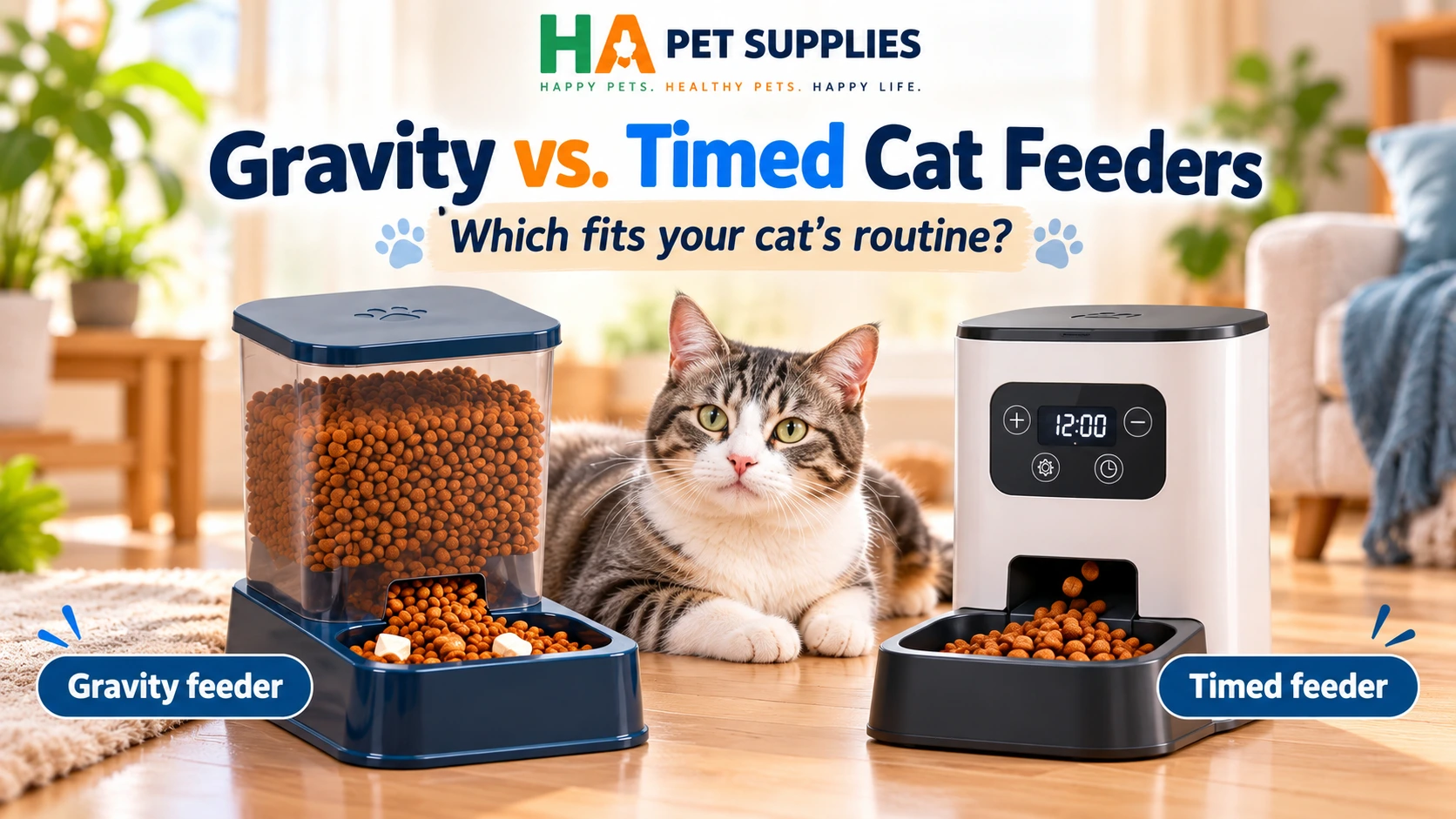
What Is the Difference Between Gravity vs Timed Automatic Cat Feeders?
The easiest way to understand gravity vs timed automatic cat feeders is to look at what each device controls. A gravity feeder controls food availability through physical refilling. A timed feeder controls food availability through time or programmed portions. That difference changes the entire feeding experience.
How a gravity cat feeder works
A typical gravity feeder has a storage reservoir above the bowl. As your cat eats kibble, more dry food moves from the reservoir into the bowl. No programming, timers, or complicated setup. This makes gravity feeding attractive if you want fewer moving parts. However, the feeder doesn’t decide when your cat has eaten enough. If food is always available, your cat’s eating behaviour becomes the key factor. You can view the automatic cat feeder available from HA Pet Supplies while comparing the principles below.
How a timed automatic feeder works
A timed feeder makes food available according to scheduled settings. Depending on the model, food may release from a compartment or a section may open at a programmed time. Always check the manufacturer’s instructions for portion settings, food type, power, and cleaning. The main idea: Gravity responds to an emptier bowl. Timed feeding responds to a schedule.
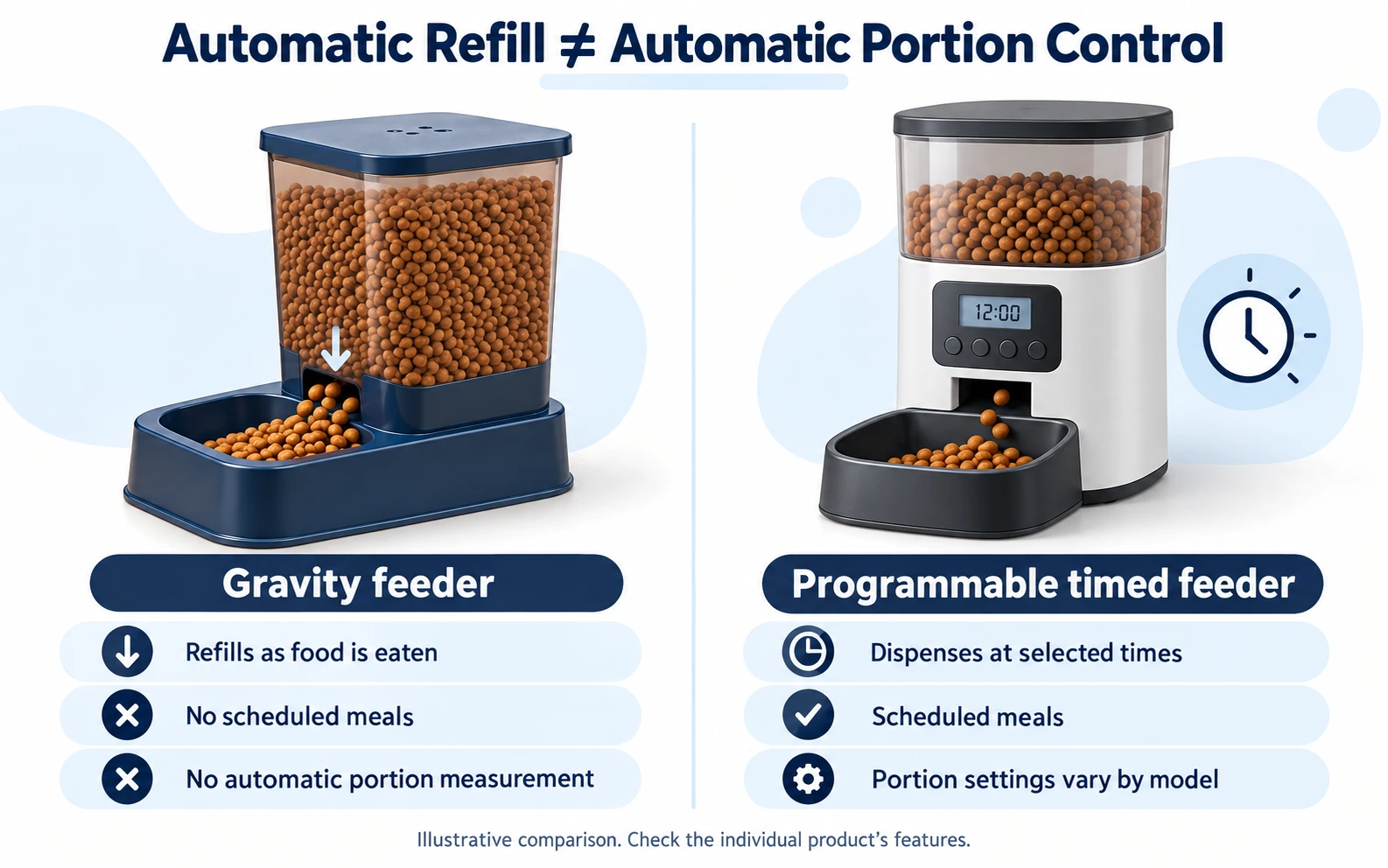
Gravity vs Timed Automatic Cat Feeders Comparison Table
| Question | Gravity Feeder | Timed Feeder |
|---|---|---|
| Main purpose | Keeps suitable dry food available | Makes food available on a schedule |
| Programming | Usually not required | Usually required |
| Feeding pattern | Continuous access/free-access style | Scheduled meal style |
| Portion timing | Not controlled by timer | Can be scheduled depending on model |
| Electronics | Typically low or none | Often batteries, electricity, or other power |
| Best reason to consider | Simplicity and easy food availability | Greater control over meal timing |
| Main consideration | Cat may continue eating while food is available | Device must be configured and maintained |
| Suitable for every cat? | No | No |
| Human supervision still needed? | Yes | Yes |
The AAHA Nutrition and Weight Management Guidelines emphasize individualized recommendations. Choose around the cat, not around the gadget.
When a Gravity Automatic Cat Feeder May Make Sense
1. Your cat already handles available food calmly
Some cats take small amounts, walk away, and return later. Continuous availability may fit that routine better than forced scheduled meals. But monitor eating patterns over time. Cornell notes that obesity is an important nutrition-related issue in cats and recommends working with a veterinarian. If your cat gains weight, empties the bowl repeatedly, or behaves differently around food, reassess the setup.
2. You want a simple feeding system
Some buyers don’t want Wi‑Fi, apps, or programming. They want something they can fill, position, check, clean, and refill. A gravity design suits that preference. Simple doesn’t mean maintenance-free—regular cleaning and inspection are still required. For a deeper dive, see our guide on how to use and clean a gravity cat feeder and water dispenser.
3. Your main concern is routine convenience
Maybe you work from home some days and commute on others. Maybe mornings are rushed. A gravity feeder reduces the need to manually add kibble every time the bowl looks low. But convenience should never replace checking how much your cat actually eats.
When a Timed Automatic Cat Feeder May Make More Sense
1. You want scheduled meals
Timed units help households that want food to become available at consistent times. VCA discusses scheduled feeding and notes that set meal schedules can be useful in some situations. The ideal frequency still depends on the individual cat.
2. Your cat quickly eats whatever is available
Imagine Cat A takes a few bites, walks away, returns later. Cat B hears food hit the bowl and tries to finish everything. Unlimited access produces very different results. If unrestricted access is causing problems, a timed device may give you more control over when food is made available. Do not suddenly restrict food because a cat looks overweight—Cornell advises veterinary involvement in weight-reduction programs.
3. You need consistency when your schedule changes
Maybe breakfast is normally at 7 a.m., but some days you leave much earlier. A timed feeder can help maintain a food-release routine even when your timetable changes. But it doesn’t remove the need to inspect the feeder, clean it, verify food suitability, and check that the cat is eating normally.
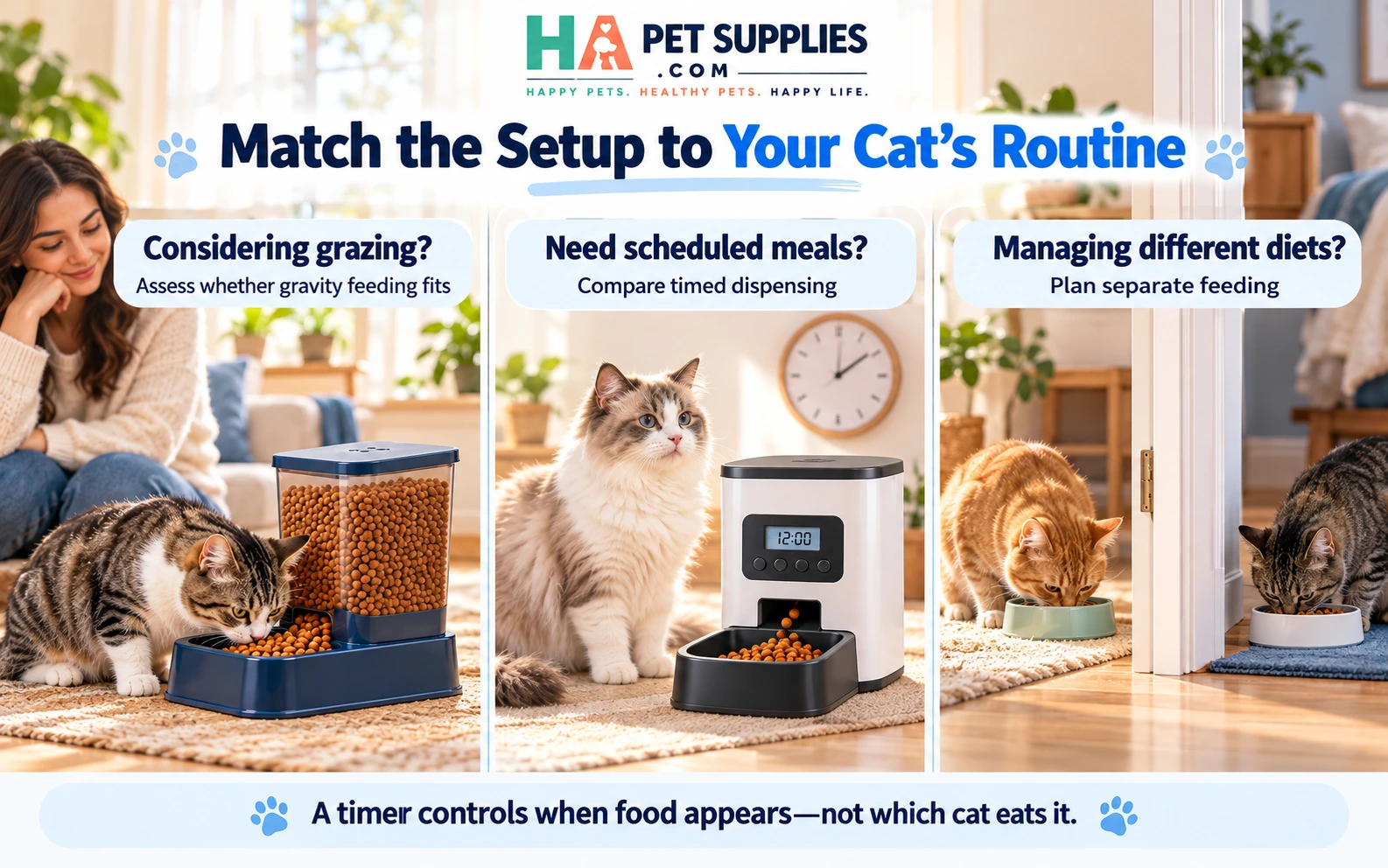
The Biggest Mistake When Comparing Gravity vs Timed Automatic Cat Feeders
The biggest mistake is asking “Which feeder is best?” before asking “How does my cat eat?” A feeder can only manage food according to its design. It cannot evaluate body condition, appetite changes, correct daily amount, food stealing, illness, or diet suitability. That requires human observation and veterinary advice. The World Small Animal Veterinary Association provides body-condition scoring tools. If weight gain, loss, or appetite changes are driving your decision, make the health issue the priority.
Free Feeding vs Scheduled Feeding: Why It Matters
A gravity feeder often supports free-access feeding; a timed feeder supports scheduled availability. Neither label tells you automatically whether the plan is appropriate. The amount, calorie density, cat’s age, activity, body condition, and health all matter. AAHA’s feeding-plan guidance notes that automated feeders can be useful tools for controlling food access in appropriate circumstances.
Gravity vs Timed Automatic Cat Feeders for Busy Cat Owners
Scenario A: The rushed morning. You leave early and want dry food available. A gravity feeder may match if continuous access is appropriate.
Scenario B: The unpredictable workday. Your cat has a defined meal schedule, but meetings keep you away. A timed feeder better matches because time—not reservoir capacity—is your main concern.
Scenario C: The weekend trip. Dangerous assumption: “If it’s automatic, my cat can be completely unattended.” Automatic feeding does not replace care. Feeders can jam, tip, become dirty, or malfunction. Before using any feeder for an absence plan, read our separate guide: Can You Leave a Cat Alone With an Automatic Feeder?
3D Infographic: Match the Feeder to the Problem
Design idea: central 3D cat bowl with orbiting cards.
Orbit Card 1 — “I forget to refill the bowl” → Gravity feeder. Reason: maintaining available dry food is your main problem.
Orbit Card 2 — “My cat eats too quickly” → Timed or controlled feeding. Reason: unlimited availability may not address the problem.
Orbit Card 3 — “My work hours change” → Timed feeder if consistent meal timing is the objective.
Orbit Card 4 — “I want the simplest setup” → Gravity feeder if free access fits the feeding plan.
CAT FIRST. FEEDER SECOND.
What About Portion Control?
“Portion control” is used casually. A timed feeder releases a predefined amount—but that doesn’t mean the amount is nutritionally correct. A gravity feeder lets food become available as the bowl empties, so it doesn’t limit total daily intake. For weight concerns, that distinction matters. The Pet Nutrition Alliance calorie calculator stresses that recommendations require monitoring and individual adjustment.
Does a Timed Feeder Automatically Prevent Overeating?
No. It controls access according to settings, but the programmed amount, number of releases, treats, family feeding, food stolen from other pets, and diet energy density all matter. A poorly configured timed feeder can still dispense an inappropriate daily amount. Timed = potentially more control over when food becomes available; health depends on the wider plan.
Does a Gravity Feeder Automatically Cause Overeating?
Also no. A gravity feeder doesn’t force a cat to eat continuously. The concern is that it makes food continually available, and some cats consume more than appropriate. Cornell discusses free feeding as a factor that can contribute to feline obesity in some cats. The useful question: Can this particular cat appropriately manage continuous access to this food?
Gravity vs Timed Automatic Cat Feeders in Multi-Cat Homes
Multiple cats complicate feeder choice. With a shared timed feeder, you may know how much food entered the bowl—but not which cat ate it. With a shared gravity feeder, food stays available, but individual intake is difficult to identify. This matters when one cat eats much faster, one is timid, one needs a different diet, or one has a condition requiring closer management. AAHA’s nutritional-assessment guidance considers competitive eating. Sometimes the solution is separate feeding locations or supervised meals—not just choosing gravity or timed.
What About Kittens?
Kittens are not small adult cats. Their needs vary with growth stage. Cornell notes that younger kittens generally need meals more frequently. Avoid choosing a feeder for a kitten based only on adult convenience. Consider age, food type, meal frequency, growth, eating behaviour, and veterinary advice.
What About Senior Cats?
Age alone does not determine feeder type. A senior cat may eat normally and maintain body condition; another may need closer management. AAHA and AAFP feline life-stage guidance recommends considering age, body and muscle condition, activity, and disease.
What If Your Cat Is Overweight?
Don’t treat the feeder as a weight-loss treatment. Overweight cats need a nutritional plan, monitoring, and veterinary support. A timed feeder may help manage access, but it doesn’t diagnose or treat obesity. Severe or abrupt food restriction can be unsafe for cats. AAHA weight-management resources recommend veterinary guidance and monitored changes.
Dry Food, Wet Food and Feeder Compatibility
Don’t assume every automatic feeder works with every food. Many gravity systems are designed around dry food. Timed feeders vary. Check manufacturer instructions rather than assuming from the word “automatic.” If the cat eats a therapeutic diet, follow the veterinary plan first.
Food Storage and Hygiene Matter More Than Buyers Think
Automatic feeders store food, so hygiene is part of the buying decision. The U.S. Food and Drug Administration recommends storing dry pet food in a cool, dry place, keeping storage equipment clean and dry, and washing bowls and utensils regularly. Ask: Can I access food-contact areas? Can the bowl be cleaned easily? Can the reservoir be emptied? Can everything dry properly? Can I inspect the food before refilling?
Gravity vs Timed Automatic Cat Feeders: Which Is Easier to Clean?
This cannot be answered universally. A basic gravity feeder may have few components. A timed feeder may contain dispensing mechanisms, electronics, or removable food-contact pieces. Follow the specific manufacturer’s instructions. For gravity-feeder owners, our detailed gravity feeder and water dispenser cleaning guide provides a practical routine. Never immerse electronic parts unless instructions say they are washable.
Power and Reliability: A Detail Many Buyers Forget
A gravity feeder depends on physical food movement, not electronics. A timed feeder may depend on batteries, mains electricity, or another power arrangement. Check power source, backup, how settings are stored, what happens after power interruption, and how you can tell whether food was dispensed. Verify specifications before purchase.
Is an Automatic Feeder a Replacement for You?
No. Even a correctly chosen feeder does not check body condition, notice vomiting, recognize loss of appetite, refresh water, clean the litter tray, notice injury, provide interaction, or call a veterinarian. Automation should support responsible care, not replace it. For time away, read Can You Leave a Cat Alone With an Automatic Feeder? before relying on a feeder.
A 7-Question Gravity vs Timed Automatic Cat Feeders Decision Test
1. Does your cat stop eating when satisfied? Usually → gravity may remain an option. No, food disappears → controlled approach may deserve consideration.
2. Is exact meal timing important? Yes → look at timed feeders. No → gravity may offer simplicity.
3. Are you trying to control access rather than reduce refilling? Yes → timed may match. No, just want available dry food → gravity.
4. Do several cats share the same feeding area? Yes → think beyond feeder type and consider monitoring individual intake.
5. Does one cat require a special feeding plan? Yes → follow that plan first.
6. Do you dislike programming and electronics? Yes → simple gravity design may appeal.
7. Has your cat’s appetite or weight changed unexpectedly? Yes → speak with your veterinarian.
Buyer Profile: Who Should Look at a Gravity Feeder First?
“My cat already manages dry food access reasonably, and my biggest problem is repeatedly refilling a small bowl.” You value simplicity, fewer settings, quick visual checks, and easy operation. Browse cat supplies from HA Pet Supplies to compare with other routine products.
Buyer Profile: Who Should Look at a Timed Feeder First?
“I want food access to happen at planned times rather than remaining continuously available.” Priorities: consistent meal timing, scheduled releases, greater control, or maintaining routine when unavailable. Verify specifications before buying.
Buyer Profile: Who Needs More Advice Before Buying Either?
Pause if: unexplained weight loss, significant excess weight, sudden appetite change, diagnosed medical condition, multiple cats eating different diets, or you don’t know how much your cat should eat. If your question is about the HA Pet Supplies product and its listed features, you can contact HA Pet Supplies before ordering.
Common Mistakes When Choosing Gravity vs Timed Automatic Cat Feeders
Mistake 1: Buying based only on reservoir size. Bigger is not automatically better.
Mistake 2: Assuming “automatic” means no supervision. It does not.
Mistake 3: Ignoring the cat’s eating personality. A calm grazer and a food-obsessed cat respond differently.
Mistake 4: Using the feeder to determine the diet. Food choice comes first.
Mistake 5: Changing everything overnight. Cats benefit from consistency.
Mistake 6: Forgetting to monitor body condition. WSAVA uses structured body-condition scoring.
Mistake 7: Choosing technology instead of solving the problem. A sophisticated machine is unnecessary if you only need simple food availability.
How to Switch to a New Automatic Cat Feeder
Step 1: Clean the feeder. Step 2: Place it in an appropriate feeding area. Step 3: Let your cat inspect it. Step 4: Use familiar food if suitable. Step 5: Watch the first feeding sessions. Step 6: Continue checking daily. Automatic does not mean “set once and forget forever.”
Maintaining the Feeder Safely
Whichever side you choose in the gravity vs timed automatic cat feeders comparison, establish a maintenance routine: check food, bowl, mechanism, reservoir, and for moisture or debris. Wash food-contact components and dry properly. Observe how much your cat eats. The FDA’s pet-food storage guidance emphasizes clean, dry storage. For a visual routine, use our step-by-step cleaning guide.
The Simplest Way to Make Your Final Choice
Complete this sentence: “The main feeding problem I need to solve is __________.”
If your answer is: “I need dry food to remain available without constantly topping up” → start with a gravity feeder.
If: “I need food to become available according to a schedule” → start with timed feeders.
If: “I need my cat to lose weight” → start with veterinary nutritional advice.
If: “My cat has stopped eating normally” → start with your veterinarian, not a new feeder.
If: “I want to leave my cat alone for an extended period” → start with a complete care plan.
Gravity vs Timed Automatic Cat Feeders: Final Comparison
There is no universal winner. A gravity feeder is practical when uncomplicated dry-food availability is the priority and continuous access is appropriate. A timed feeder is practical when scheduled access is the priority. The device should support your cat’s normal eating behaviour, an appropriate diet, a suitable daily amount, your household routine, and regular monitoring. It should not replace any of those things.
If gravity matches your cat’s routine, review the automatic cat feeder available at HA Pet Supplies and verify the listed details. If comparing other essentials, visit the HA Pet Supplies shop or browse the wider cat supplies collection. For product questions, use the contact page. Buyers or businesses needing a quotation can use the request a quote page. For more practical guides, visit the HA Pet Supplies blog or return to the HA Pet Supplies homepage.
Frequently Asked Questions About Gravity vs Timed Automatic Cat Feeders
A gravity feeder allows more food to move into the bowl as space becomes available. A timed automatic feeder makes food available according to programmed times or settings, depending on the product design. The practical difference is continuous availability versus scheduled availability.
They can be useful for some cats and households, particularly when simple access to suitable dry food is the objective. However, they are not automatically appropriate for every cat. Cats that consume too much when food remains continuously available may need a different feeding arrangement.
Not universally. A timed feeder is more relevant when scheduled access is your priority. A gravity feeder is more relevant when simplicity and ongoing availability are your priorities. Choose according to the feeding problem rather than assuming more technology means a better solution.
It may reduce the need to manually refill a dry-food bowl during the day, provided continuous access is suitable for your cat. However, it does not replace regular checks, water, hygiene or general care. If long absences are your main concern, read our automatic-feeder and leaving-cats-alone guide.
Some cats may consume more than is appropriate when food is constantly available, while others naturally eat smaller amounts throughout the day. Monitor actual intake and body condition rather than assuming your cat will automatically self-regulate.
No. A timed feeder can control food release according to its settings, but the owner still needs to determine an appropriate total feeding plan. The number of meals, serving size, food type, additional treats and food obtained elsewhere all contribute to total intake.
An overweight cat needs an appropriate weight-management plan rather than simply a feeder labelled “portion control.” A timed system may be useful as part of a controlled feeding routine, but the correct approach should be established with veterinary guidance. Do not sharply reduce a cat’s food without appropriate advice.
Neither design automatically solves multi-cat feeding problems. With a shared gravity feeder, you may not know which cat ate what. With a shared timed feeder, one cat may still eat food intended for another. Cats requiring different diets or individual monitoring may need separate feeding arrangements.
Do not assume a feeder supports wet food unless the manufacturer explicitly states that it does. Simple gravity feeders are commonly associated with dry food because the food needs to move through the reservoir system. Always check the specific product instructions.
Cleaning frequency depends on the feeder, food and manufacturer’s instructions. Food-contact areas should be kept clean, and food should not be allowed to accumulate as stale debris. FDA guidance recommends keeping pet-food equipment clean and dry. For the gravity setup discussed on HA Pet Supplies, see the gravity feeder cleaning guide.
An automatic feeder alone is not a complete care plan. Food dispensing does not replace access to fresh water, health monitoring, a clean environment, litter care, emergency response or human check-ins. Use our detailed guide on leaving a cat alone with an automatic feeder for this specific question.
Possibly, but feeding needs change as kittens grow. Cornell notes that kittens generally require more frequent feeding than adult cats during earlier stages of growth. Base the feeding method on the kitten’s age, diet and professional recommendations rather than simply using an adult feeding schedule.
Age alone does not determine suitability. Consider the senior cat’s health, body condition, diet, appetite and normal eating pattern. Cats with diagnosed health conditions may require a more specific feeding plan.
Cats can have individual preferences and needs. AAHA’s feline nutrition guidance notes behavioural and biological considerations around cats consuming multiple small feeding opportunities, while an appropriate feeding plan still needs to consider the individual animal. Rather than forcing every cat into the same schedule, discuss unusual feeding concerns with your veterinarian.
Start with the purpose. Ask whether you need continuous food availability, scheduled access, easy cleaning, simple operation, a specific food compatibility, or a solution for a particular household routine. Then verify individual product specifications instead of assuming all automatic feeders provide the same functions.
No. A larger reservoir may reduce refill frequency, but you should also consider food storage, cleaning, available space, your cat’s eating pattern and how frequently you can inspect the food.
A basic gravity feeder is generally conceptually simpler because it normally operates through gravity rather than programmed food-release times. Individual products vary, though, so check the actual design before buying.
Look beyond whether the bowl becomes empty. Monitor your cat’s body condition, weight trend, appetite and normal behaviour. Unexpected weight or appetite changes should be discussed with a veterinarian. Cornell provides feline feeding and body-condition information that can help owners understand why these factors matter.
Final Takeaway
When comparing gravity vs timed automatic cat feeders, do not start with technology. Start with your cat. Ask how your cat eats, what problem you need to solve, whether continuous food access is appropriate, whether meal timing matters and whether individual nutritional needs require professional guidance. Then choose the feeder that supports that routine with the least unnecessary complexity.
Gravity feeder = simple ongoing dry-food availability.
Timed feeder = scheduled food availability.
Neither removes the owner’s responsibility to monitor food intake, maintain hygiene, provide water, observe the cat and respond when something changes. That is the clearest way to turn a confusing product comparison into a sensible buying decision.