
Quick answer: If you’re wondering whether you can leave a cat alone with an automatic feeder, the most important thing to understand is that an automatic feeder can help with food availability, but it does not replace complete cat care. For a normal short absence, a properly tested feeder may make your feeding routine easier. But food is only one part of what your cat needs.
Your cat also needs fresh water, a usable litter tray, a safe environment, monitoring for illness or injury, a reliable feeding setup, appropriate social contact, and someone who can respond if something goes wrong. For longer absences, arranging human care is much safer than assuming an automatic food dispenser can manage everything.
Cats Protection advises that if an owner is away for longer than around 12 hours—or for shorter periods when a cat has special needs—a cat sitter, trusted person or suitable cattery should be considered. It also advises more frequent checks for kittens, elderly cats and cats with medical or complex needs.
So the practical answer is: An automatic feeder can support your absence. It should not be your entire absence plan.
FEEDER Solves only part of the care plan
WATER
Will fresh water remain available? Multiple safe sources?
LITTER
Is the tray clean and accessible? No blocked doors?
HOME
Are obvious hazards removed? Strings, medicines, toxic items?
CAT
Is your cat behaving normally? Appetite or behaviour changes?
HUMAN
Who checks your cat if you’re gone longer? Reliable backup?
FEEDER + WATER + SAFE HOME + LITTER + MONITORING + HUMAN CARE = BETTER ABSENCE PLAN
What Does an Automatic Cat Feeder Actually Solve?
Before deciding whether to leave a cat alone with an automatic feeder, separate the problem into two parts: feeding problem and complete care problem. An automatic feeder may help solve the first. It cannot solve the second by itself.
A feeder may help make dry food available while you are temporarily away, depending on the type of feeder and the cat’s normal feeding routine. What it cannot do is look around your home and ask: “Has my cat eaten normally?” “Is the water bowl still full?” “Has my cat vomited?” “Is my cat injured?” “Is the litter tray usable?” “Has the feeder jammed?” “Is the room too hot?” “Is my cat behaving strangely?” Those questions require human observation.
That is why an automatic feeder is best understood as a feeding tool, not an automatic cat sitter. If you are researching this type of feeding setup, you can examine the automatic cat feeder available from HA Pet Supplies while using this guide to decide whether an automatic feeding arrangement actually fits your situation.
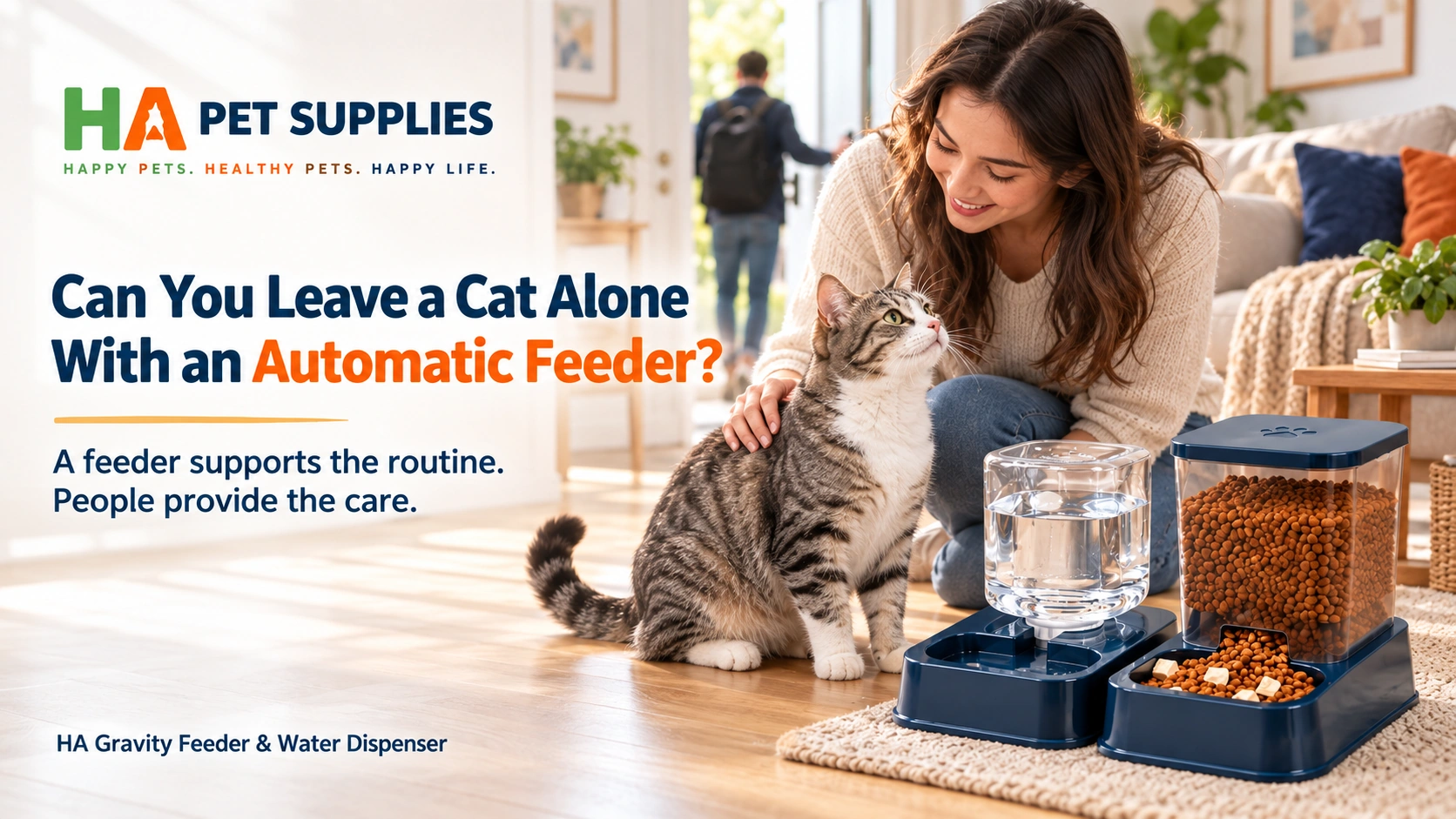
Can You Leave a Cat Alone With an Automatic Feeder for a Workday?
For many healthy adult cats, a normal working day is very different from leaving for an overnight stay or several-day trip. If you are going to work and returning the same day, your preparation might include enough appropriate food, clean drinking water, a clean litter tray, a safe indoor environment, suitable temperature and ventilation, safe independent enrichment, and a feeder you have already tested.
Cats Protection says cats left alone for a short period of up to about 12 hours should have enough food and fresh water, access to a litter tray, safe toys and a home free from obvious hazards. That does not create a universal “12-hour rule” for every cat. A kitten, senior cat, recently ill cat or cat with specific care needs may require much more frequent attention. Think about the individual cat rather than treating the maximum time as a target.
7 Checks Before You Leave a Cat Alone With an Automatic Feeder
If you need a quick decision, start here.
- Check the food. Is there enough suitable food for the period you will be away? More importantly, have you tested whether the feeder reliably makes that food available?
- Check the water. Never assume food is the only concern. Fresh drinking water must remain available.
- Check the litter tray. Clean the tray before leaving and make sure your cat can reach it without a closed door or other obstruction.
- Check the feeder itself. Do not use an unfamiliar automatic feeder for the first time immediately before leaving.
- Check the home. Remove obvious hazards such as accessible medicines, cleaning chemicals, dangerous plants and unsafe string-like objects.
- Check your cat. Has your cat been eating, drinking, moving and behaving normally? If something seems wrong, leaving the cat alone is no longer simply a feeder decision.
- Check the human backup. For extended absence, who will physically check the cat and what will they do if something is wrong?
If you cannot confidently answer all seven questions, the problem has not been solved just because there is food in a dispenser.
Why Food Alone Is Not Enough
Buyers often arrive at this question because feeding feels like the obvious challenge. You may think: “My cat has food. What else could go wrong?” Quite a lot. A cat might knock over water. A door could accidentally close. The feeder could fail to dispense food correctly. One cat could eat another cat’s portion. The cat might vomit. The room may become unusually hot or cold. A cat may become injured or unwell. The litter tray may become unpleasant. An automatic feeder cannot investigate any of those situations.
Cats Protection recommends arranging a cat sitter to visit at least twice a day when owners go on holiday, with additional attention potentially needed for very young, older or medically complicated cats. That is an important distinction between leaving home for your normal workday and leaving your cat unattended throughout a holiday.
Food Planning Before You Leave a Cat Alone With an Automatic Feeder
The feeder should follow an appropriate feeding plan. It should not decide one. The American Animal Hospital Association notes that automated feeders can be useful for managing food access and amount as part of an appropriate feeding plan.
That means there are two separate questions. Question 1: Does the machine dispense food? That is a product-function question. Question 2: Is it dispensing an appropriate amount for this cat? That is a nutritional question. Do not assume that filling a reservoir to the top automatically means your cat has been given an appropriate feeding plan.
A cat’s needs may depend on factors including age, body condition, activity, diet, health, reproductive status, and individual veterinary recommendations. The AAHA/AAFP feline life-stage guidance recommends individual nutritional assessment rather than treating every cat as having identical requirements.
Gravity Feeder or Timed Feeder When You Are Away?
This is where buyers often become confused. Both may be called “automatic feeders,” but they operate differently. A gravity feeder normally allows more dry food to move into the bowl as the available food is eaten. Its main advantage is simplicity. There may be no electronic programming or meal schedule. A timed feeder releases food or provides access according to programmed settings. Its main advantage is control over when food becomes available.
Neither system automatically makes it safe to leave a cat unattended for an extended time. If you are unsure which feeding approach better fits your cat, read the related pillar guide on gravity vs timed automatic cat feeders. That comparison is useful before you decide how much responsibility to place on the feeder while you are away.
Can You Leave a Cat Alone With a Gravity Feeder?
A gravity feeder can reduce repeated manual bowl refilling when suitable dry food is part of the cat’s normal diet. However, it has an important limitation: Food availability is not the same as food monitoring. If your cat eats more than expected, you may not know immediately. If the food stops flowing as expected, there is nobody there to correct the problem unless a person checks. If multiple cats use one gravity feeder, you may also have difficulty knowing which cat consumed the food.
VCA notes that free feeding can make it harder to determine exactly how much an individual cat has eaten, especially when multiple cats share a feeding area. A gravity feeder therefore works best when its role is clearly understood: convenient food availability, not complete supervision.
Water: The Part of the Plan You Cannot Ignore
It is easy to spend twenty minutes comparing feeder capacity and almost no time thinking about water. That is backwards. Before leaving home, ask: Is the water clean? Can my cat easily reach it? Could the bowl tip? Could another pet empty it? Could a door close and separate the cat from it? Would a second safe water location provide useful backup?
Cats Protection explicitly recommends leaving plenty of fresh drinking water when a cat is left home for a short period. If you use a water dispenser, apply the same rule as with an automatic feeder: test it while you are still home. Do not introduce a completely unfamiliar drinking arrangement on the morning you leave.
Why You Should Test the Automatic Feeder First
Imagine buying an automatic feeder on Friday evening. You fill it Saturday morning. Then you leave home. That is not a good test procedure. Instead, introduce the feeder while you are present. Observe whether your cat approaches it comfortably, food moves or dispenses correctly, the bowl is easy to reach, your cat can knock or move it, food becomes trapped, other pets interfere with it, the feeder remains stable, and the cat actually eats from it.
A feeder that works perfectly in your hands but is ignored by your cat has not solved the feeding problem.
A simple three-stage test
Stage 1: Introduce it. Place the feeder in the intended feeding location. Stage 2: Observe several normal feeding periods. Confirm the cat uses it correctly. Stage 3: Simulate an absence. Use the feeder while you are still at home but do not manually intervene unless necessary. If it fails during your test, you have found the problem while you are still available to fix it.
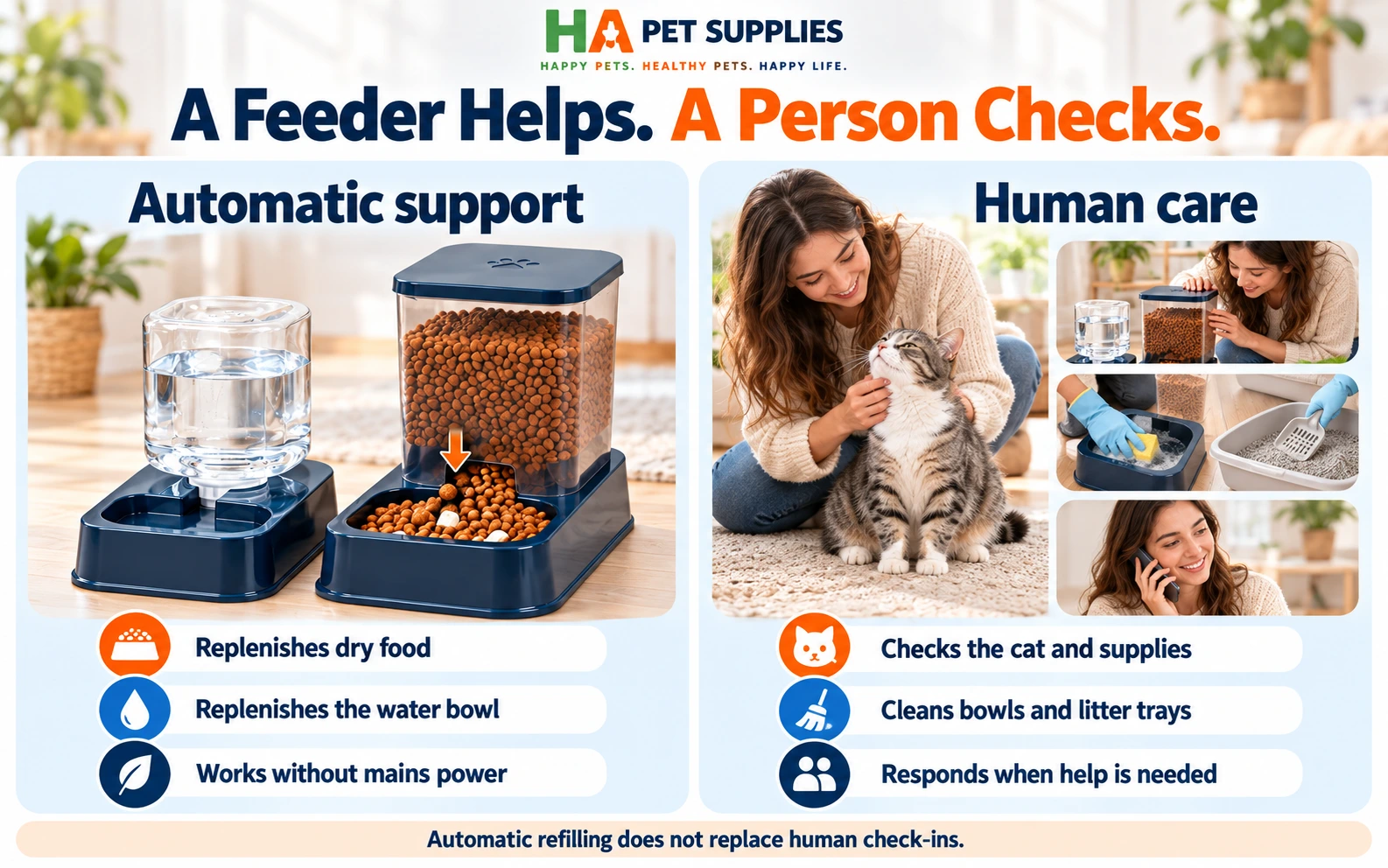
Litter-Tray Preparation Before Leaving Home
An automatic feeder cannot solve litter problems. Before going out: remove waste, check litter depth, make sure the tray is accessible, and ensure no door can accidentally block access. For longer absences, a human caregiver needs to include litter maintenance as part of the visit. Cats Protection recommends cleaning waste from the litter tray regularly and preparing it before leaving a cat alone.
If your cat normally has several litter trays, do not suddenly remove them simply because you are leaving home. Keep the environment as familiar and functional as practical.
Make the Home Safer Before You Leave a Cat Alone With an Automatic Feeder
The feeder might be working perfectly while an unrelated household hazard causes trouble. Before leaving, quickly scan the areas your cat can access. Look for string and ribbon, loose cords, open windows, accessible medicines, cleaning chemicals, unsafe food, breakable objects, unstable furniture, plastic bags, potentially harmful plants, and doors that could trap the cat in a room.
Cats Protection specifically recommends removing potentially dangerous items before leaving and avoiding unsupervised access to string-like toys that could cause entanglement. The purpose is not to make your house completely risk-free. It is to remove obvious, preventable problems before nobody is present to respond quickly.
Safe Entertainment Matters Too
Food, water and litter cover basic physical needs, but cats also interact with their environment. If your cat is accustomed to playing, climbing, scratching or watching activity from a window, leaving familiar safe options available may help maintain the normal routine. Cats Protection suggests safe independent toys and access to hiding places or elevated resting areas when cats are temporarily alone.
The word safe is important. An interactive wand toy that is excellent when you are holding it may be inappropriate when nobody is there because the cat could become tangled in the string. Choose unattended enrichment differently from supervised play.
Can You Leave a Cat Alone With an Automatic Feeder Overnight?
This question needs more thought than a simple yes or no. For a healthy adult cat with a familiar environment and normal routine, an overnight period is different from a multi-day trip. But you should still assess the individual cat. Ask: When exactly will I leave? When exactly will I return? Will the feeder cover the normal feeding schedule? Will fresh water remain reliably available? Is the litter setup adequate? Is the cat currently healthy and behaving normally? What happens if my return is unexpectedly delayed? Who could access the home in an emergency?
Cats Protection recommends additional care arrangements when a cat will be alone beyond a short period and advises getting a sitter or other caregiver for longer absences. Therefore, do not turn “overnight” into an automatic assumption. Assess the actual duration and circumstances.
Can You Leave a Cat Alone With an Automatic Feeder for Two Days?
An automatic feeder should not be used as justification for leaving a cat completely unchecked for a multi-day absence. For holidays or longer trips, arrange a responsible person to check and care for the cat. Cats Protection recommends a sitter visit at least twice daily when owners go away, while cats with additional needs may require more frequent visits.
The sitter’s job is not just: “put more food in.” A useful visit includes checking the cat is present and responsive, normal food appears to have been eaten, fresh water is available, the litter tray is maintained, there is no obvious vomiting or illness, the home remains safe, the feeder is working, medication or special care is given when appropriate, and veterinary help can be obtained if necessary. The machine handles dispensing. The human handles judgement.
Can You Leave a Cat Alone With an Automatic Feeder for a Week?
A week should be treated as a genuine care arrangement, not a feeder-capacity problem. The wrong question is: “Can my feeder hold seven days of food?” The right question is: “Who will care for my cat during those seven days?”
Cats Protection advises that cats going through a holiday period need suitable care and identifies options such as a reliable home sitter or suitable cattery. A week’s worth of kibble does not provide health monitoring, litter maintenance, fresh water checks, emergency response, interaction, or confirmation that the cat is actually eating. So do not use reservoir capacity as a measure of how long your cat can safely remain without human care.
What About Kittens?
Kittens require special consideration. They are not simply miniature adults. Cats Protection states that young kittens should only be left alone for relatively short periods and need more frequent checking. AAHA’s kitten guidance also notes that growing kittens have different energy and feeding needs from adult cats.
A curious kitten may also be more likely to climb, chew, squeeze into small spaces, knock objects over, or interact unexpectedly with a feeder. Therefore, buying an automatic feeder does not create permission to leave a kitten alone for the same duration you might consider for an established healthy adult cat.
What About Senior Cats?
Senior cats vary enormously. One may remain active and healthy. Another may require medication, dietary monitoring or closer observation. This is why an age number alone cannot determine whether you can leave a cat alone with an automatic feeder.
AAHA/AAFP feline life-stage guidance recommends considering health, body condition, activity and individual nutritional needs when creating a feeding plan. If your senior cat needs medication, close appetite monitoring, assistance moving around, or frequent health checks, an automatic feeder does not replace those tasks.
What About Cats With Medical Conditions?
If your cat has a diagnosed medical condition, follow the feeding and monitoring instructions provided by the veterinary team. Do not rearrange meal times or rely on an automatic feeder simply because it is convenient.
For example, recent AAHA diabetes guidance shows that meal planning can form part of individualized diabetes management and notes that timed feeders may be useful in some scenarios. That does not mean a timed feeder is a treatment or that all diabetic cats should use the same feeding schedule. The appropriate routine depends on the individual cat and treatment plan. If feeding timing is connected with medication, ask your veterinarian before changing the schedule.
Food Quantity: More Is Not Automatically Safer
One nervous reaction before leaving home is: “I’ll just leave extra food.” That can create a new problem. The correct amount depends on the cat and the food. AAHA recommends an appropriate feeding plan rather than uncontrolled access to excess calories, while the WSAVA provides body-condition and nutritional-assessment resources to help veterinary teams individualize recommendations.
If you do not know how much your cat should normally eat, do not guess simply because you are going away. Start with the food manufacturer’s guidance and your cat’s established feeding plan, and seek veterinary advice if intake or body condition is uncertain.
Food Hygiene When Using an Automatic Feeder
The reservoir itself deserves attention. Do not repeatedly add fresh food on top of old crumbs without inspecting or cleaning the feeder as directed. The U.S. FDA advises keeping dry pet food cool and dry, cleaning storage containers between bags when food is transferred into them, and regularly washing food bowls and utensils.
Before filling the feeder: inspect it, remove stale debris, wash appropriate removable parts, let washed parts dry properly, and add suitable food according to instructions. For a gravity setup, you can also follow our detailed guide on how to use and clean a gravity cat feeder and water dispenser. Regular cleaning matters whether you are at home or away.
Dry Food vs Wet Food When You Are Away
Never assume an automatic feeder is compatible with every type of cat food. Gravity feeders commonly rely on food moving through a reservoir, making them generally associated with dry food. Timed feeder designs vary. Some may be designed for dry food. Some may use compartments. Specific compatibility must be checked against the actual product instructions.
Wet food creates additional storage concerns because it cannot simply remain at room temperature indefinitely. The FDA recommends promptly refrigerating or discarding unused canned or pouched pet food. Cats Protection similarly warns that wet food spoils faster than dry food when left out. If your cat depends on wet food, do not improvise a long absence feeding plan without considering safe food storage.
Multi-Cat Homes Need an Extra Check
Suppose you have two cats and one automatic feeder. You fill it with enough food for both. Problem solved? Not necessarily. Cat A may eat most of the food. Cat B may avoid the feeder. One cat might guard the feeding area. One may need a different diet. The amount dispensed therefore does not automatically tell you how much each cat consumed.
AAHA’s feeding guidance identifies food competition and social hierarchy as factors worth considering when assessing a feeding plan. For multi-cat households, ask: Can both cats access food comfortably? Do they normally eat together? Does one steal food? Does either cat need a special diet? Can your sitter tell whether both cats are eating? Sometimes separate feeding locations are more important than feeder capacity.
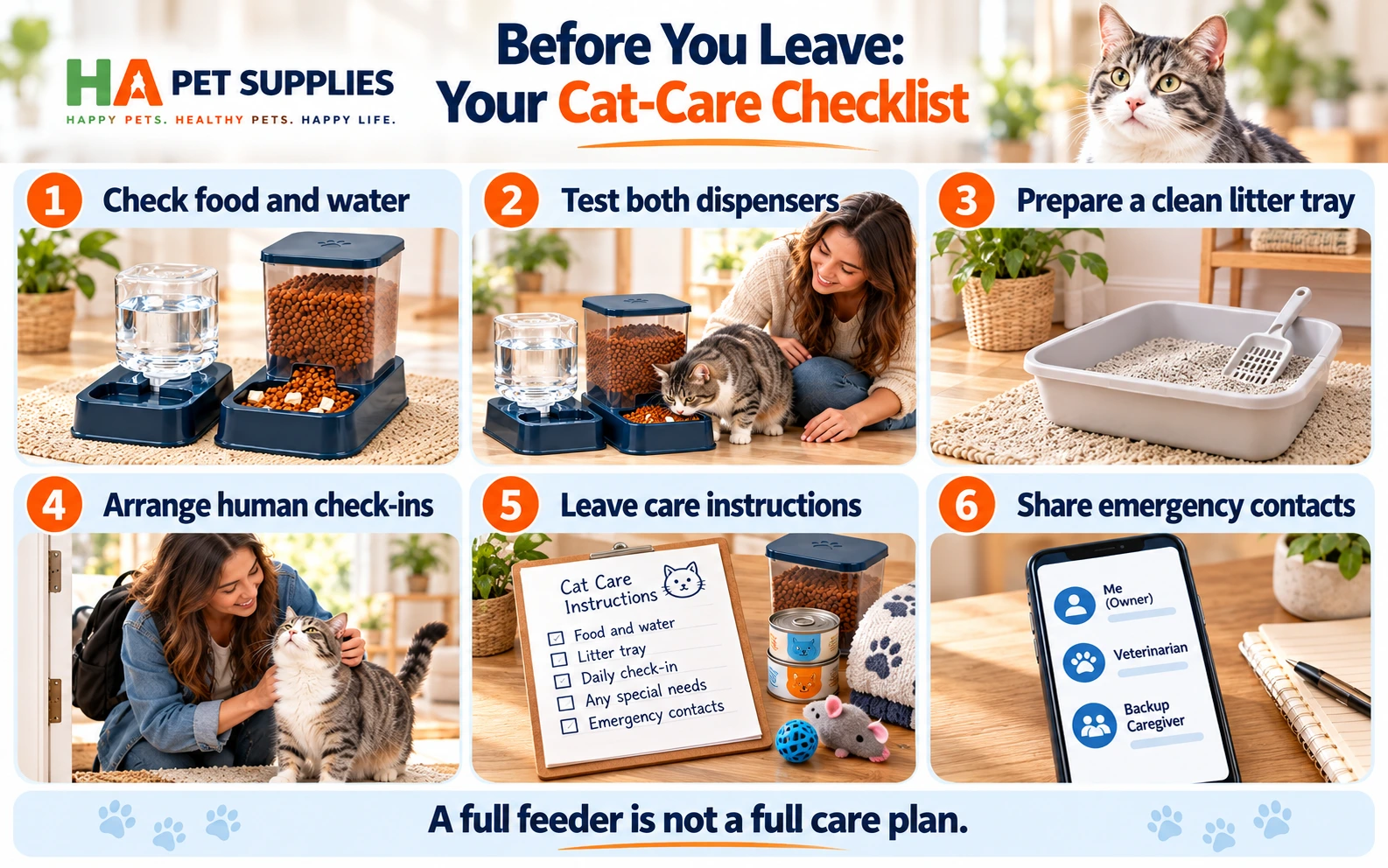
A Six-Step Checklist Before Walking Out the Door
Before you leave
- Observe your cat. Is your cat eating and behaving normally today? A noticeable change should not be ignored simply because your trip is already planned.
- Test the feeder. Confirm that food is actually available from the bowl. Do not rely only on the fact that the reservoir looks full.
- Refresh the water. Provide clean drinking water and check the stability of the bowl or dispenser.
- Clean the litter area. Remove waste and make sure the cat will retain access.
- Scan the home. Remove obvious hazards and make sure windows, doors and unsafe areas are secured appropriately.
- Confirm backup. For longer absence, confirm who is visiting, how they enter, what they need to do and which veterinarian or emergency contact they should use if required.
Emergency Information for a Cat Sitter
If another person is checking your cat, do not make them guess. Leave simple written instructions containing your contact information, veterinarian details, emergency contact, feeding instructions, feeder instructions, water locations, litter supplies, medication instructions where applicable, cat carrier location, normal hiding places, expected behaviour, and any relevant health information.
Cats Protection specifically recommends giving holiday caregivers emergency contact information, veterinary details, feeding instructions and medication information. This small preparation can become extremely important if something unexpected happens.
What Can Go Wrong With an Automatic Cat Feeder?
Buyers sometimes imagine only one failure: “No food comes out.” There are several possibilities.
- The food does not dispense properly. Mechanical obstruction or inappropriate kibble characteristics may interfere with some designs.
- The reservoir empties sooner than expected. Consumption may be higher than anticipated.
- The feeder is knocked or moved. Stability depends on the actual design, floor and pets using it.
- Another pet accesses the food. This is common enough to consider in multi-pet homes.
- Power-related problems affect electronic models. The exact behaviour depends on the model.
- Your cat refuses to use the feeder. Technology is irrelevant if the cat will not eat from it.
- Food hygiene deteriorates. Old crumbs, moisture or poor cleaning can create hygiene concerns.
The answer is not to become afraid of automatic feeders. It is to test the system while you are home and maintain it regularly.
Automatic Feeder vs Cat Sitter: They Solve Different Problems
This is not an either/or competition. An automatic feeder can help with food availability. A cat sitter can help with observation and care. Together, they can complement each other.
For example, the automatic feeder may maintain your cat’s familiar food-access routine while the sitter refreshes water, checks the cat, cleans the litter tray, confirms the feeder is functioning, and responds if something is wrong. That is a much more realistic use of automation than expecting the device to become the caregiver.
A Practical Absence Decision Table
| Situation | Role of automatic feeder | Human care consideration |
|---|---|---|
| Normal workday | May support normal feeding routine | Owner returns the same day |
| Short daytime absence | May provide familiar food access | Prepare food, water, litter and safe environment |
| Overnight absence | Useful as part of preparation | Consider duration, individual cat and backup |
| More than a short absence | Feeder alone is insufficient | Arrange a responsible caregiver |
| Holiday/multi-day trip | Can support sitter’s feeding routine | Regular physical care is needed |
| Young kitten | Limited role | Requires more frequent checking |
| Cat with medical needs | Depends on veterinary feeding plan | Follow professional care instructions |
| Multi-cat household | May provide food but not individual monitoring | Confirm each cat is actually eating |
Do not treat this table as a substitute for veterinary guidance where your cat has special health or nutritional requirements.
Should You Buy a Larger Automatic Feeder for Longer Trips?
Not for the purpose of avoiding human care. A larger reservoir can mean fewer manual refills. That is a convenience feature. It does not increase how long your cat can safely go without water checks, litter maintenance, health observation, home safety checks, or emergency assistance.
This distinction is important for buyers. Feeder capacity tells you how much food the device can hold. It does not tell you how long a cat should be left without a caregiver.
How an Automatic Feeder Can Still Be Useful
After all these warnings, you might wonder whether an automatic feeder is worth using. It absolutely can be useful when matched to the right problem. It may help maintain a familiar dry-feeding setup, reduce repeated manual bowl refills, support a routine during normal daily absences, or complement a human caregiver’s visits.
AAHA recognizes automated feeders as one possible tool for managing food access and amount. The key is simply to avoid asking it to perform jobs it cannot perform. If you are ready to compare feeding products after understanding those limitations, explore the HA Pet Supplies shop or browse the automatic cat feeder product page for the specific product information provided there.
Common Mistakes When You Leave a Cat Alone With an Automatic Feeder
- Mistake 1: Filling the feeder and leaving immediately. Test it first. A new device needs observation before it becomes part of an absence routine.
- Mistake 2: Forgetting water. A full feeder does not solve drinking-water needs.
- Mistake 3: Leaving excess food “just in case.” More food is not the same as a better feeding plan.
- Mistake 4: Assuming the machine will tell you if the cat is sick. A feeder dispenses food. It does not perform a health examination.
- Mistake 5: Ignoring the litter tray. The cat still needs an appropriate toilet environment.
- Mistake 6: Forgetting home hazards. Food availability does not protect the cat from an unsafe object or room.
- Mistake 7: Using a holiday as the first feeder test. Introduce the product before your departure.
- Mistake 8: Assuming every cat can be left for the same duration. Age, health, behaviour and routine matter.
- Mistake 9: Using reservoir size to decide absence length. The food-storage capacity of a feeder does not determine how frequently a cat needs human care.
- Mistake 10: Having no backup plan. If you are delayed, who can get into the house? That question should be answered before you leave.
Fast Decision Tool: Should I Leave Now?
GREEN — Short, familiar absence. Your adult cat is healthy and behaving normally. The feeder has been tested. Fresh water is available. The litter tray is clean. The environment is safe. You are returning after a normal short absence. Your automatic feeder may simply support the normal routine.
AMBER — Think more carefully. This is your first overnight absence. Your cat is older. You have multiple cats sharing food. The feeder is new. Your return time is uncertain. Add backup and human monitoring rather than relying entirely on the feeder.
RED — Feeder alone is not the plan. You are leaving for several days. Your cat is a young kitten. Your cat is unwell or has important care needs. The cat’s appetite has recently changed. Nobody can check the home. Arrange suitable human care rather than treating food automation as complete care.
When You Should Ask for Product Information Before Buying
Do not guess about specifications that are important to your situation. For example, if a product listing does not clearly answer a question about food compatibility, capacity, dimensions, cleaning, assembly, or included components, verify it before ordering.
For questions about the HA Pet Supplies feeder that are not answered on its listing, use the HA Pet Supplies contact page rather than assuming an unlisted feature. Businesses or larger-volume buyers who need pricing information can use the request a quote page. This is better for both the buyer and the store than making a purchase based on an assumption.
Frequently Asked Questions: Can You Leave a Cat Alone With an Automatic Feeder?
You can use an automatic feeder as part of the care setup during a short normal absence, but a feeder does not replace water, litter care, a safe home, monitoring or human attention. For longer absences, arrange suitable human care.
There is no universal duration that fits every cat. Cats Protection advises that when owners will be away for longer than around 12 hours—or when kittens, older cats or cats with additional needs are involved—additional care should be arranged. The cat’s age, health, normal routine and specific needs all matter.
For some healthy adult cats, an overnight absence may be manageable with careful preparation, but the answer depends on the actual duration and individual cat. Check food, fresh water, litter, home safety, feeder reliability and emergency backup before leaving.
Do not depend only on an automatic feeder for a multi-day absence. Arrange for a responsible person to physically check and care for your cat. Cats Protection recommends regular sitter visits during holidays.
Feeder capacity does not determine appropriate care frequency. For a week away, arrange a sitter, suitable boarding/cattery arrangement or another reliable care plan. A week’s supply of food cannot monitor health, refill water safely, clean litter or respond to an emergency.
Suitability depends on the specific product, how it is used, your cat and the feeding setup. Follow the manufacturer’s instructions, inspect the feeder regularly and test it before relying on it during an absence. Do not assume every automatic feeder has identical features or reliability.
A gravity feeder generally focuses on maintaining food availability. A timed feeder focuses on scheduled food access. Neither replaces human care. For a detailed comparison, see our guide to gravity vs timed automatic cat feeders.
It may help with feeding during a normal working day if your cat is healthy and the setup suits its normal routine. You must still provide fresh water, litter access and a safe environment.
A feeder does not change a kitten’s need for more frequent care and observation. Young kittens should only be left for shorter periods and checked more frequently than established adult cats.
Potentially, yes, but age alone does not decide suitability. Consider mobility, appetite, health, medication, diet and whether closer observation is required. For a senior cat with a medical condition, follow veterinary guidance.
If unrestricted food access appears to lead to excessive intake, a different feeding arrangement may be more suitable. Do not abruptly restrict an overweight cat’s diet without appropriate guidance. Veterinary organizations including WSAVA recommend individualized nutritional assessment and monitoring of body condition.
Provide the amount appropriate to the established feeding plan rather than assuming excessive food is safer. If you are uncertain how much your cat should eat, discuss it with your veterinarian. The Pet Nutrition Alliance also provides veterinary nutritional tools illustrating how calorie recommendations depend on factors such as weight and body condition.
Providing more than one safe source can give you backup if appropriate for your home, but all water containers should be stable, clean and accessible. Fresh water remains essential whether or not an automatic feeder is used.
That is exactly why the feeder should be tested in advance and why longer absences should include human check-ins. A caregiver can identify and correct problems that the feeder cannot.
For longer absences, yes. The sitter’s role includes much more than feeding. They can check the cat, water, litter tray, home environment and feeder and respond to unexpected problems.
Cats Protection recommends arranging sitter visits at least twice a day during holidays, with kittens, senior cats and cats with certain health needs potentially needing more frequent visits. Individual circumstances may require different arrangements.
Only if the specific feeder is designed for the food type and its instructions support that use. Do not assume wet food can be left unrefrigerated for a long absence. The FDA advises promptly refrigerating or discarding unused canned and pouched pet food.
Food-contact areas should be kept appropriately clean. Follow the product-specific cleaning instructions, remove old food debris and let washable components dry properly before refilling. The FDA recommends washing and drying pet food bowls and food-storage equipment appropriately.
Provide clear feeding instructions, veterinary information, emergency contacts, litter supplies and any necessary medication instructions. Also show them where the carrier is kept and how the automatic feeder works.
Treating automation as supervision. The feeder can make food available. It cannot determine whether your cat is safe, healthy and behaving normally. That distinction is the central message of this guide.
Final Answer: Can You Leave a Cat Alone With an Automatic Feeder?
If you are asking whether you can leave a cat alone with an automatic feeder, think of the feeder as one part of the plan rather than the entire plan. For a normal short absence, a tested automatic feeder can make your routine more convenient when it suits your cat’s established feeding pattern.
Before leaving, check: Food. Water. Litter. Home safety. Your cat’s condition. The feeder. Your backup plan.
For longer absences, arrange responsible human care. A feeder cannot notice that your cat suddenly stopped eating. It cannot refill spilled water. It cannot clean the litter tray. It cannot respond to illness. It cannot make an emergency decision.
If you are currently choosing the feeding equipment itself, you can review the HA Pet Supplies automatic cat feeder and verify the listed specifications against your needs. For additional cat feeding and pet-care information, continue through the HA Pet Supplies blog or browse the wider HA Pet Supplies shop.
If you have a product-specific question that the listing does not answer, contact HA Pet Supplies before making assumptions about an unlisted specification. The best automatic-feeder setup is not the one that lets you ignore feeding for the longest period. It is the one that supports a suitable routine while you continue providing the observation and care your cat still needs.