
When should a dog wear a muzzle? The answer is not “whenever a dog behaves badly,” and it is not “only if the dog is aggressive.”
A muzzle is best understood as a temporary safety management tool that can reduce bite risk or make certain handling situations safer while you address the real reason behind the dog’s behaviour.
That distinction matters. A dog may wear a muzzle because it becomes frightened during veterinary handling. Another may need one temporarily during grooming. A dog with a bite history may wear one while working through a behaviour plan. An injured dog may need one during emergency transport because severe pain can cause even a normally gentle dog to bite.
The American Kennel Club identifies emergencies, known bite risk, stressful handling, grooming, and certain legal requirements as situations where muzzle use can be appropriate. It also emphasizes that a muzzle does not solve the underlying behavioural problem. Read AKC’s guide to when and why dog muzzles are used.
If you are researching a muzzle for one of these situations, you can first review the HA Pet Supplies dog muzzle and compare its soft mesh construction, adjustment points and intended use with your dog’s needs. But before buying, it helps to answer the bigger question: Does your dog actually need a muzzle for this situation—and is this the right type of muzzle for the job?
This guide will help you decide.
Quick Answer: When Should a Dog Wear a Muzzle?
A dog may benefit from appropriate muzzle use when there is a realistic risk of biting or unsafe handling, including:
- veterinary examinations
- grooming or nail care
- known bite-risk situations
- training and behaviour-management work
- emergencies involving injury or pain
- unfamiliar or stressful handling situations
- situations where regulations require one
A muzzle may also be used in certain scavenging-management situations depending on the muzzle type. However, a muzzle should not be used simply to silence barking, stop chewing, punish a dog, or force a frightened dog through an unnecessary stressful situation. AKC specifically warns against using muzzles for ongoing behaviour problems such as barking and chewing because the equipment does not address the underlying cause. American Kennel Club.
The right question is therefore not just: “Can I put a muzzle on my dog?” It is: “Will a muzzle improve safety here while I also deal with the reason it is needed?”

What Does a Dog Muzzle Actually Do?
A muzzle primarily helps reduce the risk of a dog using its mouth to bite. That may sound obvious, but misunderstanding this simple function leads to many poor uses.
A muzzle does not:
- remove fear
- eliminate anxiety
- cure aggression
- teach calm behaviour automatically
- make a dog enjoy grooming
- make a dog comfortable at the veterinarian
- replace supervision
- replace behaviour modification
It manages one part of the risk. AAHA’s veterinary behaviour guidance makes this point indirectly by recommending that muzzles be combined with calm handling and reward-based conditioning rather than treating the equipment as a complete solution. It notes that staff may be able to use less restraint when a difficult patient is already accustomed to an appropriate muzzle, but the dog still requires careful handling. AAHA guidance on humane animal restraint.
This distinction is especially important if you are searching when should a dog wear a muzzle because something has already gone wrong. If your dog growled at a groomer, snapped during nail trimming, or lunged during a veterinary exam, your immediate concern may understandably be preventing another bite. A muzzle may help with that. But the next question should still be: Why did the dog feel the need to bite or threaten to bite? That is the part training, behaviour support, environmental management or veterinary care needs to address.
🐾 When Can a Muzzle Help?
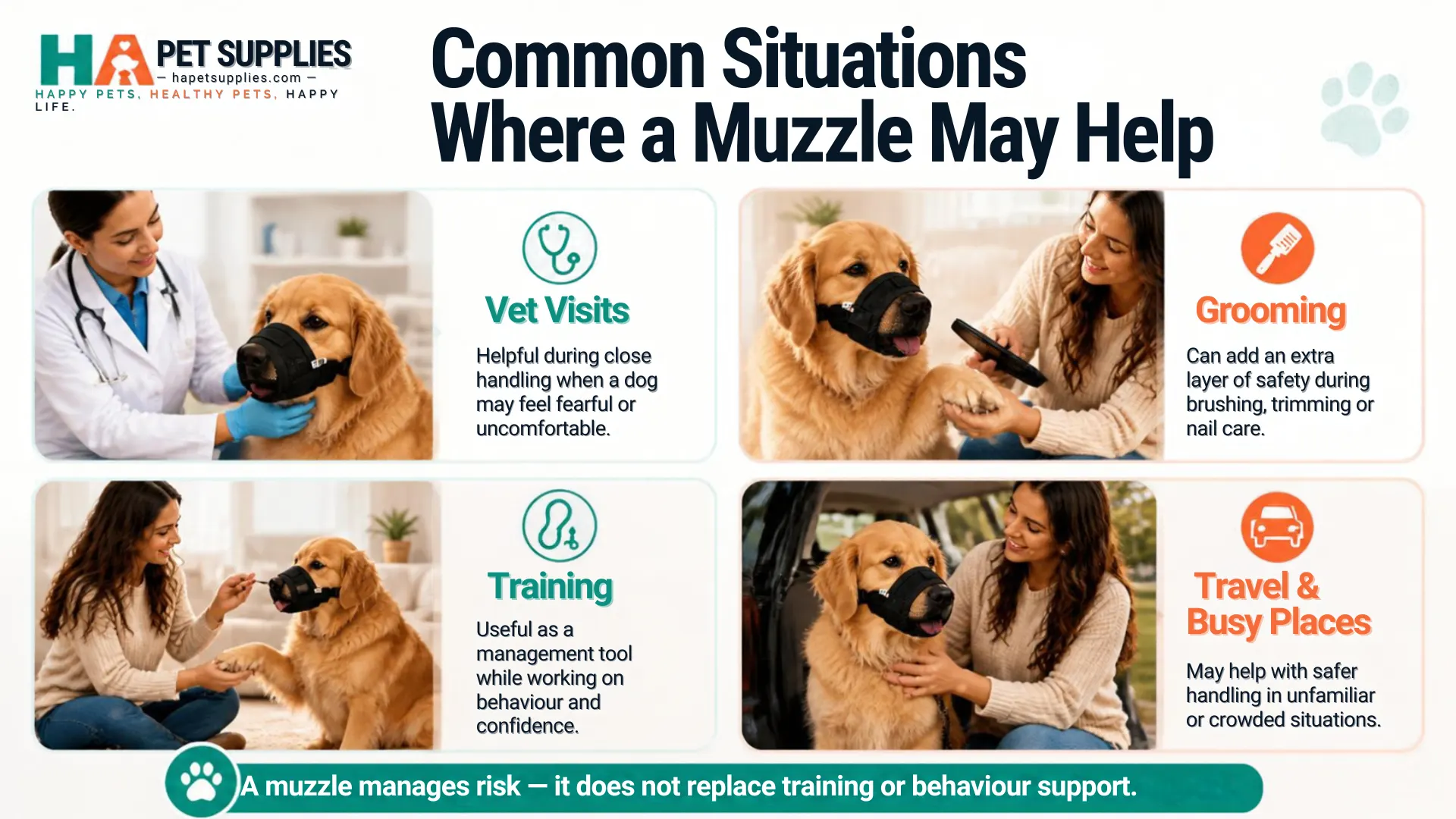
When Should a Dog Wear a Muzzle at the Vet?
Veterinary visits are one of the clearest examples of appropriate muzzle use. Dogs can experience fear at a clinic because of unfamiliar people, restraint, unfamiliar smells, slippery surfaces, previous painful experiences, injections, examination of sensitive body parts, illness or injury.
Pain is especially important. A dog that has never bitten before may behave differently when injured. AKC specifically identifies serious injury as a situation where bite risk can rise because a dog in pain may react when being moved or treated. American Kennel Club.
AAHA recommends behaviour-centred handling and says veterinary practices should consider training dogs to accept basket muzzles in advance so they are familiar if the equipment is needed. AAHA guidance on reducing restraint and stress.
So, when should a dog wear a muzzle at the vet? Potentially when the dog has previously attempted to bite during examination, pain makes defensive behaviour more likely, the dog becomes highly fearful during handling, the veterinary team believes bite-risk management is necessary, or specific procedures require close handling.
But advance training matters. The first time a dog sees a muzzle should ideally not be when several unfamiliar people are already trying to examine it. AVSAB recommends reward-based training methods generally and supports humane management techniques, including muzzle use that has been properly conditioned using non-punitive methods. AVSAB’s current humane dog-training guidance.
If your dog becomes extremely fearful at veterinary appointments, contact the clinic before arriving. Veterinary professionals may modify the handling plan or discuss appropriate medication where medically indicated. You can also read our guide on when a dog should wear a muzzle for vet visits, grooming and training.
When Should a Dog Wear a Muzzle for Grooming?
Grooming is another common reason owners begin researching muzzles. Think about what grooming can involve: ears being touched, paws being lifted, nails being clipped, fur being pulled during brushing, sensitive areas being handled, loud clippers or dryers, unfamiliar groomers, restraint on a grooming table.
A dog that is calm during everyday petting may still find some of these procedures uncomfortable. AKC includes grooming among situations in which temporary muzzle use may provide additional safety, particularly while the dog is still learning to tolerate grooming procedures. American Kennel Club. Its professional grooming standards also specifically identify muzzles as one possible preventive safety measure when groomers assess bite risk. AKC professional grooming safety standards.
That does not mean every difficult grooming session should simply continue because a muzzle has been fitted. If your dog is extremely distressed, the underlying handling problem still matters. A better long-term strategy may include gradual paw handling, short brushing sessions, reward-based nail-care practice, breaks, calmer equipment introductions and professional behaviour help when needed. The muzzle adds a safety layer. It should not become a way to ignore severe distress.
When Should a Dog Wear a Muzzle During Training?
This is where terminology can become confusing. A muzzle is not primarily a device for teaching obedience. You should not think: “My dog is misbehaving, so I’ll put a muzzle on.”
Instead, muzzle use may form part of a behaviour-management plan where bite risk exists while training is happening. For example, a dog may react aggressively toward other dogs at close distances. A behaviour professional may work on changing that emotional response through controlled training. An appropriately fitted muzzle can provide an additional safety layer during carefully managed sessions.
AVSAB explains that humane behaviour modification should use reward-based methods and identifies appropriately conditioned muzzle use as a management strategy rather than an aversive training technique. AVSAB explanation of reward-based methods.
So when should a dog wear a muzzle during training? When genuine bite risk makes additional safety management appropriate—not simply because the owner wants faster obedience. And the training should continue to address the underlying trigger. For a step-by-step conditioning plan, see our guide on how to muzzle train a dog.
When Should a Reactive Dog Wear a Muzzle?
“Reactive” can describe dogs that bark, lunge, growl or become highly aroused around particular triggers. Not every reactive dog bites. But some may have a genuine bite risk.
If that risk exists, an appropriately fitted muzzle may be useful during carefully managed situations while behaviour work continues. AKC states that a muzzle can provide extra protection where a dog has a history of aggression or where there is a realistic risk of biting, but it stresses that the muzzle does not solve the behaviour itself. American Kennel Club.
This is crucial. A muzzle should not be used to take a dog closer to triggers than it can emotionally handle. For example, suppose your dog panics around unfamiliar dogs. Putting on a muzzle and walking directly into a crowded dog park is not automatically safe or therapeutic. The dog may still be terrified. It may still lunge. It may still injure itself. It may still become more sensitised to the situation. Use management to reduce risk while training progresses—not to force exposure.
When Should a Dog Wear a Muzzle After Biting?
A previous bite is one of the clearest reasons to consider professional guidance and appropriate muzzle management. A bite history does not tell you everything about why the bite occurred. But it does change risk management.
Possible reasons for biting can include fear, pain, resource guarding, territorial behaviour, handling sensitivity, conflict around restraint, redirected arousal and defensive behaviour. The muzzle can reduce the probability of another bite during controlled situations. It does not identify the cause. That is why professional behaviour assessment becomes especially important.
AVSAB’s current guidance recommends reward-based approaches for behaviour modification and encourages owners to work with qualified professionals using humane methods. AVSAB position statements. If your dog has already bitten a person or another animal, general online advice should not replace an individual safety plan.
When Should a Dog Wear a Muzzle in an Emergency?
Emergency use deserves separate attention because even a dog with no behavioural history may bite when frightened or injured. Examples include road traffic injuries, broken bones, severe wounds, emergency transport, painful burns, sudden neurological problems and situations where strangers must move the dog.
AKC specifically notes that an injured dog may bite unexpectedly because severe pain changes behaviour. American Kennel Club. This is one reason preventive muzzle training can benefit dogs that have never shown aggression. You are not expecting your dog to become dangerous. You are preparing for the possibility that fear or pain may temporarily change how it responds.
That said, emergency circumstances can also involve breathing problems, vomiting, facial injury or other conditions where putting on a muzzle may be inappropriate. If you are dealing with an actual medical emergency, follow veterinary guidance rather than applying a general rule from an article.
When Should a Dog Wear a Muzzle During Travel?
Travel introduces unfamiliar environments. Depending on the dog, that can include crowded stations, veterinary transport, unfamiliar vehicles, airports, new people, shared public spaces, legal requirements and temporary handling by strangers.
A muzzle may be part of a travel-safety plan where there is genuine bite risk or where local rules require one. However, travel also raises an important question: What type of muzzle is being used and for how long?
A close-fitting soft muzzle is not equivalent to a roomy basket muzzle. PDSA advises that muzzles which hold the mouth closed should only be used for very short periods because they interfere with panting and drinking. It recommends basket muzzles for longer use because they generally allow better airflow and mouth opening. PDSA guidance on muzzle type and safe duration.
So if the intended use involves extended travel, warm environments or activity, choose the muzzle type accordingly. The soft mesh HA muzzle shown in this article should not automatically be treated as interchangeable with a roomy basket muzzle just because both are called “muzzles.” For a detailed fit guide, see how a dog muzzle should fit.
Situation → What the Muzzle Helps With → What Still Needs Attention
When Should a Dog NOT Wear a Muzzle?
This section is just as important as the situations where a muzzle may help.
Do Not Use a Muzzle Simply to Stop Barking
Barking has causes. These can include alarm, frustration, boredom, anxiety, attention seeking and territorial behaviour. A muzzle that mechanically limits mouth movement does not solve those causes. AKC specifically warns against muzzle use as a solution for barking or chewing. American Kennel Club.
Do Not Use a Muzzle as Punishment
A muzzle should not mean: “You did something wrong.” Punitive use can create a stronger negative association with the equipment. PDSA explicitly states that a muzzle should never be used as punishment. PDSA positive muzzle-training advice. That matters because one day you may genuinely need the muzzle during an emergency. You do not want the dog’s previous experience with it to be fear or punishment.
Do Not Use a Muzzle to Force a Dog Through Unnecessary Stress
Imagine a dog that is terrified of busy dog parks. Putting on a muzzle and forcing the dog into the park does not suddenly make the situation emotionally safe. AKC uses essentially this logic in its guidance: do not use a muzzle simply to push a dog through situations it cannot handle. American Kennel Club. Management may involve avoiding the trigger, creating more distance, or working gradually with a behaviour professional.
Do Not Use the Wrong Muzzle for Long Durations
This is particularly important for soft mouth-closing designs. PDSA warns that muzzles preventing adequate panting and drinking should only be used briefly because longer use can create serious welfare and overheating concerns. PDSA. AVSAB similarly notes that basket muzzles are valuable when longer wear is needed because the dog can pant and drink. AVSAB discussion of basket muzzles in behaviour management. The phrase “breathable muzzle” should therefore not be interpreted as permission for unrestricted wear. Air can pass through mesh while mouth opening is still limited. Those are different things.
Basket Muzzle vs Soft Muzzle: Which Situation Calls for Which?
A major part of answering when should a dog wear a muzzle is understanding what type is appropriate.
Basket muzzle
A properly fitted basket muzzle typically allows more jaw movement. That makes it more suitable for situations where the dog may need to pant, drink, accept treats, wear the muzzle for longer periods or move around more actively. AAHA specifically notes that basket muzzles allow dogs to accept treats and drink and generally present fewer health concerns than non-basket muzzles in clinical handling. AAHA. AVSAB also highlights the ability to pant, drink and receive treats as advantages during behaviour modification. AVSAB introduction to muzzle training.
Soft muzzle
A soft muzzle fits more closely around the mouth. It may be useful for short, closely supervised situations such as certain brief veterinary or grooming procedures. But if it prevents full panting or drinking, duration matters. That distinction is directly relevant to the HA Pet Supplies dog muzzle, which is a soft mesh-style product. Buy based on use case, not simply appearance.
When Should a Dog Wear a Muzzle for Scavenging?
Some owners look for muzzles because their dogs repeatedly pick up dangerous objects or food outdoors. PDSA lists dogs that eat inappropriate objects among situations where muzzles can sometimes be useful. PDSA. AAHA has also discussed muzzle use for dogs that repeatedly ingest unsafe objects outdoors. AAHA discussion of responsible muzzle use.
However, the equipment used for scavenging prevention should still permit appropriate panting, drinking and comfortable movement. That generally points toward a purpose-designed basket muzzle or scavenging guard rather than a tightly closing soft muzzle. The goal is preventing access to dangerous items—not preventing normal breathing and cooling.
When Should a Dog Wear a Muzzle Around Other Dogs?
A muzzle may be useful if your dog has a genuine risk of biting other dogs. But it does not automatically make off-leash interaction safe. Even a muzzled dog can body slam another dog, frighten another dog, trigger a fight, injure itself, become more distressed or strike with the muzzle itself.
AAHA cautions that a distressed muzzled dog can still cause injury, which is why calm, careful handling remains necessary. AAHA. If your dog has a history of aggressive interactions with other dogs, use distance, environmental management and qualified behavioural support rather than relying on the muzzle alone.
How to Prepare a Dog Before Muzzle Use
The best time to start muzzle training is before the situation becomes urgent. PDSA recommends introducing the muzzle positively, using high-value rewards and several short sessions rather than simply fastening it onto an unprepared dog. PDSA. AVSAB likewise recommends reward-based approaches and proper prior conditioning. AVSAB.
A simple progression is: See it → investigate it → nose inside → straps → fasten briefly → gradually increase duration. Do not start with: Hold dog → force muzzle on → wait for struggle to stop.
If you are building a wider handling or grooming setup, you can browse relevant items in the HA Pet Supplies dog supplies range rather than treating muzzle use as an isolated solution. For broader educational content, the HA Pet Supplies blog can support the training and care side of the purchase.
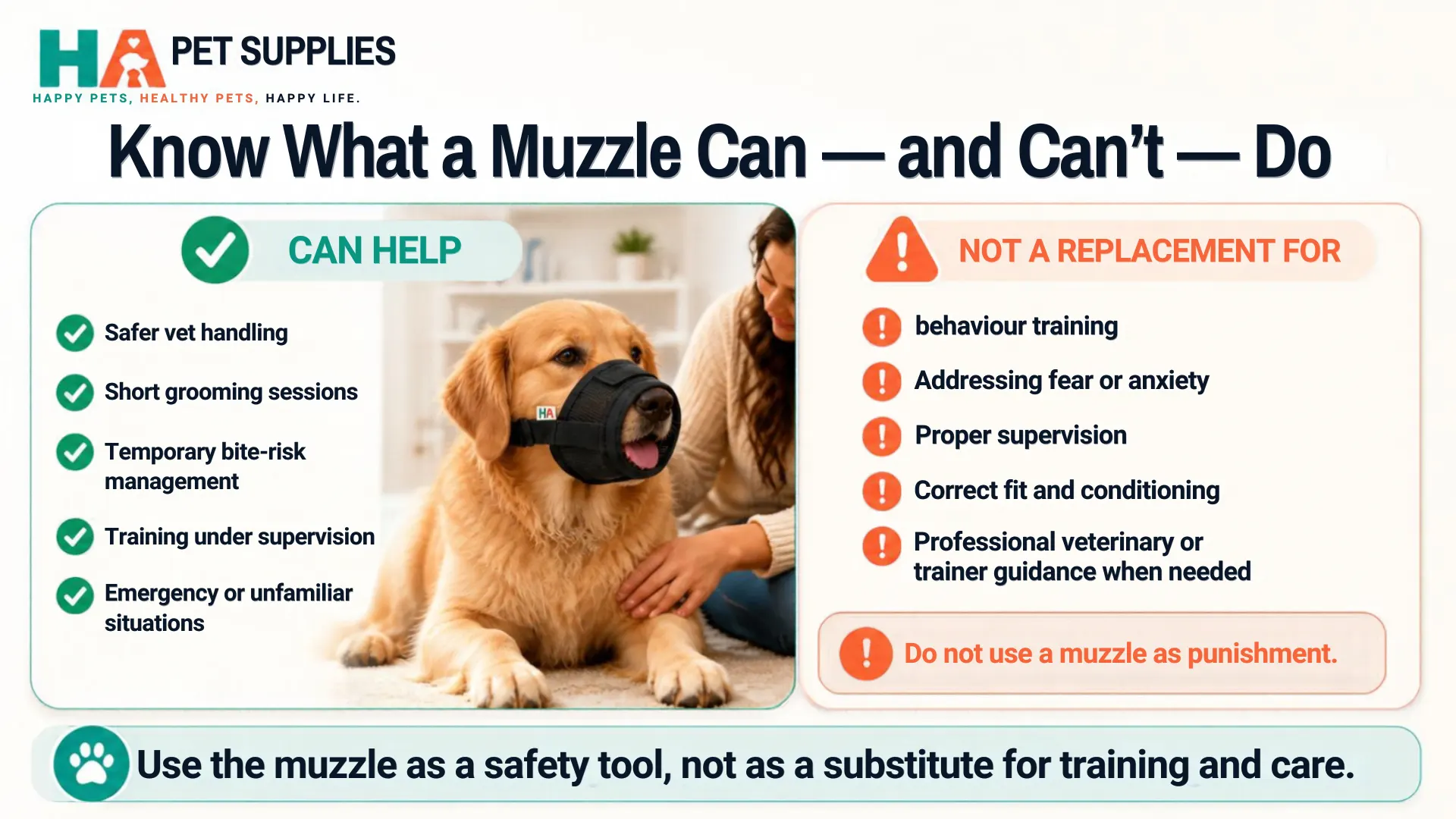
- safer veterinary handling
- short grooming procedures
- temporary bite-risk management
- behaviour work under supervision
- emergencies
- unfamiliar close handling
- behaviour training
- treatment of fear or anxiety
- correct fit
- supervision
- professional veterinary advice
- qualified behaviour support
Should a Friendly Dog Be Muzzle Trained?
Yes, familiarity can still be useful. The purpose is preparedness. Pain, injury and fear can change behaviour suddenly. AKC notes that even dogs without a previous history of biting may react differently when seriously injured. American Kennel Club. AAHA’s more recent discussion of muzzle stigma similarly argues that muzzles should not automatically be viewed as equipment only for “dangerous” dogs. AAHA.
That does not mean every friendly dog needs to wear one routinely. It means teaching familiarity can make future emergency or veterinary handling easier.
Does Wearing a Muzzle Mean a Dog Is Aggressive?
No. A muzzle tells you that someone is managing a situation. It does not tell you exactly why. Reasons can include fear, pain, grooming, veterinary handling, previous bite risk, scavenging, training, regulations and emergency preparation.
The stigma around muzzles can discourage owners from using an appropriate safety tool. AAHA specifically discusses this stigma and encourages veterinary professionals to normalize responsible muzzle training. AAHA discussion of muzzle stigma. Responsible management should not be confused with a personality label.
What If My Dog Needs a Muzzle Tomorrow?
If the situation is tomorrow and your dog has never been muzzle trained, do not try to compress a gradual conditioning process into a stressful marathon session. Contact the relevant professional.
For a veterinary appointment, explain that your dog is not muzzle trained. For grooming, tell the groomer about any bite history or handling concerns before the appointment. For training, tell the trainer exactly what has happened previously.
PDSA recommends progressing at the dog’s pace over multiple short sessions. PDSA. AAHA also supports lower-stress handling and, where appropriate, veterinary-prescribed anxiolytic medication for highly fearful patients. AAHA. The immediate goal is safety. The longer-term goal is proper preparation.
What If My Dog Panics When the Muzzle Appears?
Do not force the next step. PDSA advises stopping and returning to training later if a dog becomes stressed, and recommends behaviour support if progress remains difficult. PDSA.
You may need to return all the way to: muzzle visible across the room → reward rather than: muzzle fastened. A dog with previous negative muzzle experiences may need considerably slower conditioning. If the dog is also a bite risk, work with an appropriately qualified professional rather than experimenting at close range.
When Should a Dog Wear a Muzzle in Public?
There are two separate reasons:
Behaviour-related safety
A dog with a realistic bite risk may wear one as part of a responsible management plan.
Legal requirement
Some jurisdictions require certain dogs to wear muzzles in public. AKC notes that breed-specific legislation may include muzzle requirements in some places. American Kennel Club. Because laws vary widely, check the rules for your actual location rather than relying on generic advice. A legal requirement also does not change the dog’s physical needs. The muzzle still needs appropriate fit, ventilation and duration.
Frequently Asked Questions: When Should a Dog Wear a Muzzle?
When there is a meaningful risk of biting during examination, restraint or treatment, particularly when the dog is frightened, painful or has a history of defensive behaviour. Advance positive muzzle conditioning is preferable whenever possible.
A muzzle may provide temporary extra safety if a dog becomes defensive during grooming, nail care or close handling. It should not be used as an excuse to ignore severe fear or force a dog through prolonged distress.
A previous bite can justify stronger safety management. A muzzle may be part of that plan, but individual behaviour assessment is important because the cause of the bite still needs to be addressed.
An appropriately selected and fitted muzzle can reduce the opportunity to bite. But muzzle design matters. AAHA notes that not all muzzle types provide the same level of bite protection. AAHA.
It should not be used as a behavioural solution for barking. AKC explicitly warns against using muzzles to suppress ongoing behaviours such as barking or chewing. American Kennel Club. Identify and address the cause instead.
Potentially, if there is genuine bite risk. But the muzzle should supplement—not replace—distance, management and behaviour work. Reactivity without bite risk does not automatically mean a muzzle is required.
Potentially, depending on the reason, duration and muzzle type. For longer periods, the ability to pant and drink becomes especially important. A close-fitting soft muzzle should not automatically be used for prolonged travel.
That is not a safe general recommendation. Duration depends heavily on muzzle design. PDSA advises that muzzles holding the mouth closed should only be used for very short periods because dogs need to pant and drink. PDSA.
Do not use a standard muzzle as unattended sleep equipment. Muzzle use should involve active supervision and appropriate environmental management.
PDSA explicitly advises against leaving a dog alone while muzzled because equipment can become caught and cause injury. PDSA.
A muzzle is not inherently cruel. The welfare outcome depends on muzzle design, fit, duration, training, supervision, temperature, activity and the reason it is being used. A properly selected, positively conditioned muzzle can be a humane safety-management tool.
A soft mouth-closing muzzle is generally not the preferred design for extended active wear because panting may be restricted. For longer use, authoritative sources generally favour properly fitted basket muzzles that permit fuller mouth opening. PDSA.
Do not use a muzzle as the primary strategy for managing unsafe dog-child interactions. If a dog may bite a child, physical separation, adult supervision and professional behaviour guidance are essential. A muzzle may sometimes be one layer in a wider safety plan, but it should never create a false sense of security.
That can happen. A muzzle mainly addresses biting. A distressed or highly aroused dog can still body slam, paw, chase or strike with the muzzle. AAHA specifically warns that distressed muzzled dogs can still cause injury. AAHA.
Some appropriately designed basket or scavenging muzzles can help prevent ingestion of unsafe items while still allowing panting and drinking. PDSA includes inappropriate scavenging among reasons some dogs may benefit from muzzle use. PDSA. Use a design intended for that purpose rather than automatically selecting a mouth-closing soft muzzle.
When Professional Help Is the Better Next Step
Some situations exceed what a general blog post can safely solve. Get professional support if your dog:
- has bitten a person
- has bitten another animal seriously
- repeatedly attempts to bite during handling
- becomes extremely distressed
- has unpredictable aggressive episodes
- reacts suddenly without an obvious trigger
- has severe veterinary or grooming fear
- is painful or medically unwell
- cannot be safely fitted with a muzzle
Start with your veterinarian where pain, illness or sudden behaviour change may be involved. For behaviour concerns, use a qualified reward-based behaviour professional. AVSAB’s current position strongly supports reward-based methods for behaviour modification and advises against aversive approaches. AVSAB.
If your question is specifically about sizing, product materials, availability or ordering for the HA muzzle, use the HA Pet Supplies contact page instead of guessing. Businesses, retailers, grooming operations or higher-volume buyers can use the HA Pet Supplies quote request for purchasing enquiries.
Buying a Dog Muzzle: Ask These Questions First
Before buying, reduce the decision to six practical questions.
1. Why does my dog need it?
Vet handling? Grooming? Bite-risk management? Travel? Emergency preparation? Scavenging?
2. How long will it be worn?
Short duration and prolonged wear have different equipment requirements.
3. Will my dog need to pant?
If yes, choose accordingly.
4. Will my dog need to drink or receive treats?
Again, muzzle type matters.
5. Does the muzzle fit the individual dog?
Do not buy purely by breed name. See our dog muzzle fit and sizing guide.
6. Am I using it alongside training and supervision?
If the answer is no, reconsider the management plan.
You can compare the HA Pet Supplies dog muzzle with other products in the dog supplies collection when deciding what fits your broader care setup.
Final Answer: When Should a Dog Wear a Muzzle?
So, when should a dog wear a muzzle? A dog may appropriately wear one when there is a realistic need for temporary bite-risk management or safer handling, including veterinary appointments, grooming, known bite-risk situations, carefully managed behaviour training, emergencies, unfamiliar handling, travel situations, or certain legal requirements.
But the reason matters. The muzzle should not be used simply to stop barking. It should not punish the dog. It should not replace behaviour work. It should not be used to force a frightened animal through situations it cannot emotionally tolerate. And one muzzle type should not be assumed suitable for every duration or activity.
Veterinary and animal-behaviour organisations consistently favour gradual positive conditioning, appropriate fit and matching the equipment to the task. Basket muzzles are generally preferred when dogs need greater panting room, drinking access or longer wear, while soft mouth-closing styles have a more limited short-duration role. AAHA.
If you are considering the soft mesh product featured throughout this guide, review the HA Pet Supplies dog muzzle and make your decision based on the intended situation rather than the word “muzzle” alone. You can also browse the wider HA Pet Supplies shop when preparing other dog-care supplies, explore more practical guidance through the HA Pet Supplies blog, or return to the HA Pet Supplies homepage for broader navigation.
A well-used muzzle should communicate one thing: someone is taking safety seriously while still addressing the dog’s actual needs. That is the right way to think about muzzle use.
Need a Muzzle for a Specific Situation?
Identify the situation first. Then choose the equipment.
For short supervised handling needs, review the product specifications carefully before ordering.