
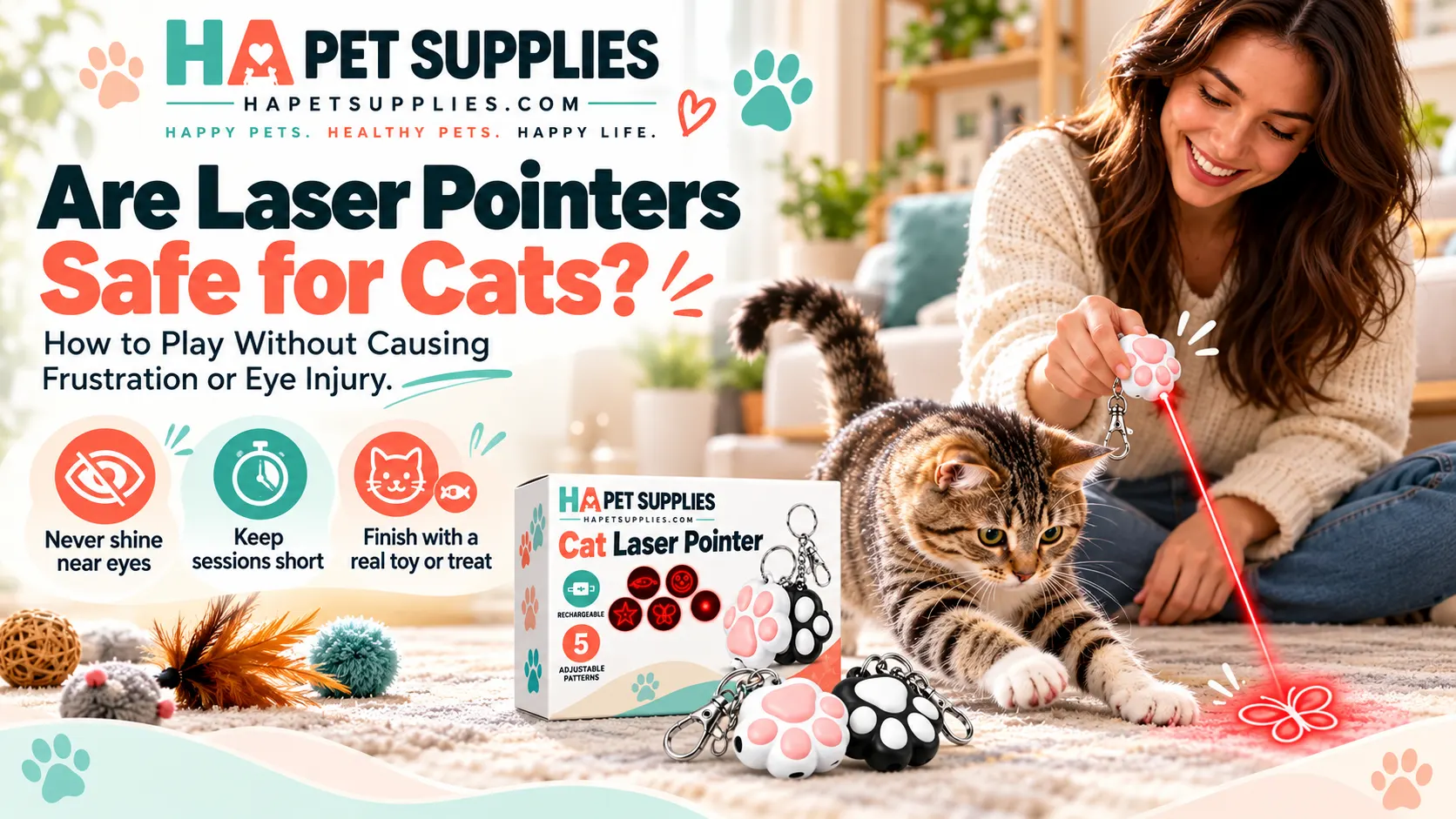
Are laser pointers safe for cats? They can be used as part of interactive play, but they are not completely risk-free and they should not be treated like an ordinary toy that you simply switch on and point anywhere.
Two concerns matter most: eye safety and frustration. A laser beam should never be deliberately aimed at your cat’s eyes. And the moving dot can trigger stalking and chasing, but your cat cannot physically grab, bite or hold the light.
That second problem is easy to overlook. Your cat may spend several minutes crouching, stalking, chasing and pouncing — only to discover that the “prey” disappears every time their paws land on it.
The U.S. Food and Drug Administration warns that direct laser exposure can injure the eye because the eye focuses the beam onto a very small area of the retina. The FDA specifically advises consumers never to aim a laser directly at a person or animal. U.S. Food and Drug Administration
At the same time, feline behavior guidance emphasizes that play should let cats express natural stalking, chasing, pouncing and capturing behaviors. The Feline Veterinary Medical Association notes that cats should be allowed to capture their simulated prey at least intermittently to help prevent frustration. catvets.com
If your cat seems obsessed with the red dot, searches for it after the game, or becomes increasingly agitated, the answer is not necessarily “more laser.” The answer may be to change how you structure the game. This guide explains exactly how.
Quick Answer: How to Use a Cat Laser Pointer More Safely
- Keep the laser pointed at the floor or another safe, non-reflective surface.
- Never deliberately direct the beam into the eyes.
- Move the dot like small prey rather than spinning it wildly.
- Avoid high walls, stairs and dangerous furniture jumps.
- Keep the session short enough that your cat stays controlled.
- Give the cat opportunities to “win.”
- Finish by guiding the dot onto a physical toy, treat or other safe reward the cat can actually capture.
That final step matters. Cats Protection advises ending interactive play with a successful catch because repeated chasing without physical capture can create frustration. Cats Protection and Blue Cross both recommend short sessions and a real catch.
What’s Inside This Guide
Why Do Cats Chase Laser Pointers So Intensely?
To understand laser-pointer safety, you first need to understand why the dot is so compelling. Cats are predators. Even indoor cats retain behaviors associated with hunting: watching, stalking, chasing, pouncing, grabbing, biting.
A moving light can rapidly activate the early stages of this sequence. The cat does not need to believe the light is literally a mouse. The unpredictable movement itself can be enough to trigger a chase.
Cornell University’s Feline Health Center explains that good cat toys allow cats to stalk, pounce and problem-solve while providing both physical exercise and cognitive enrichment. Cornell Vet College
The Feline Veterinary Medical Association likewise identifies opportunities for play and predatory behavior as one of the essential needs of indoor cats. catvets.com
For a deeper explanation of the behavioral mechanism, naturally direct readers to your second article, Why Do Cats Chase Laser Pointers? The Hunting Instinct Behind the Red Dot. That article can own the detailed hunting-instinct topic while this pillar article stays focused on safety.
The Biggest Physical Risk: Laser Pointer Eye Injury
The eye-safety question should never be buried halfway down the article. A laser beam is concentrated light. According to the FDA, a laser beam can remain tightly focused over distance, and the eye itself can focus that light to a very small point on the retina. Depending on the laser’s power and exposure, this can create retinal injury. U.S. Food and Drug Administration
Never Aim a Cat Laser Pointer at the Eyes
Do not shine it into your cat’s face, “test” whether the cat follows it near the eyes, sweep the beam across the eyes, point it toward another pet’s eyes, or give the pointer to a child for unsupervised use. The FDA explicitly recommends never shining a laser directly at a person or animal. U.S. Food and Drug Administration
Does Laser Color Tell You How Dangerous It Is?
No. Do not assume red means safe, green means dangerous, or dim-looking means weak. The FDA specifically warns that apparent brightness is not a reliable indicator of laser power or eye hazard. U.S. Food and Drug Administration
That is important for online shopping because some high-powered lasers may be mislabeled or sold in ways that make them look like harmless toys. The FDA advises checking product labeling for laser classification, manufacturer information, output information and required safety warnings. FDA labeling guidance
For U.S.-regulated handheld laser pointers, FDA rules limit pointing and demonstration products to specific power levels; the agency notes that higher-powered devices can present greater eye risk. FDA laser pointer rules
Should Children Use a Laser Pointer With the Cat?
Unsupervised? No. The FDA does not recommend treating handheld laser pointers as children’s toys. FDA A child may accidentally point toward the cat’s face, at another person, into a mirror, at a window, or wave it unpredictably. If a family uses one during cat play, an adult should control it.
Reflections Matter Too
Direct eye exposure is the obvious concern. Reflected beams also deserve common sense. Avoid deliberately aiming at mirrors, highly reflective metal, glass at awkward angles or shiny surfaces that can redirect the beam. Just choose a simple surface such as matte flooring, carpet, or a non-reflective wall area near floor level and keep the beam controlled.
3D Infographic: Cat Laser Pointer Eye Safety
SAFE TARGET
Floor-level, matte surface. Keep the dot away from the face.
NEVER TARGET
Eyes or face. Direct eye exposure is the primary physical laser hazard.
AVOID
Mirrors and reflective surfaces. Control where the light goes.
ADULT CONTROL
Do not hand the pointer to an unsupervised child.
The dot belongs on the play surface—not on the cat.
The Second Risk: Frustration From an Uncatchable Dot
Eye safety is physical. Frustration is behavioral. This is where laser play becomes more complicated than many owners expect.
A cat’s predatory play normally includes some version of: locate → stalk → chase → pounce → capture. The laser easily provides stalking, chasing, pouncing. But it cannot provide physical capture, grabbing, biting, kicking or holding the prey.
The Feline Veterinary Medical Association specifically recommends allowing cats to capture simulated prey at least intermittently to help prevent frustration. catvets.com
Cats Protection goes further and specifically warns that laser pointers can be frustrating because the cat can never physically catch the dot. Cats Protection
RSPCA’s play guidance similarly encourages owners to let cats successfully capture their toy and end a play session with a successful hunt. RSPCA
Does That Mean You Should Never Use a Laser?
Not necessarily. There is a difference between using a laser as one controlled part of a play routine and making the laser the cat’s only play experience. Veterinary-reviewed PetMD guidance says laser pointers can provide exercise and mental stimulation when used appropriately, while emphasizing eye safety, safe movement and giving the cat opportunities for a satisfying ending. PetMD
The safer compromise is: Use the laser to initiate the chase, then finish with something physical. Examples: toy mouse, kicker toy, wand-toy “prey,” small treat or puzzle feeder reward. The cat does not need to physically catch the laser itself. The cat needs an ending that makes sense.
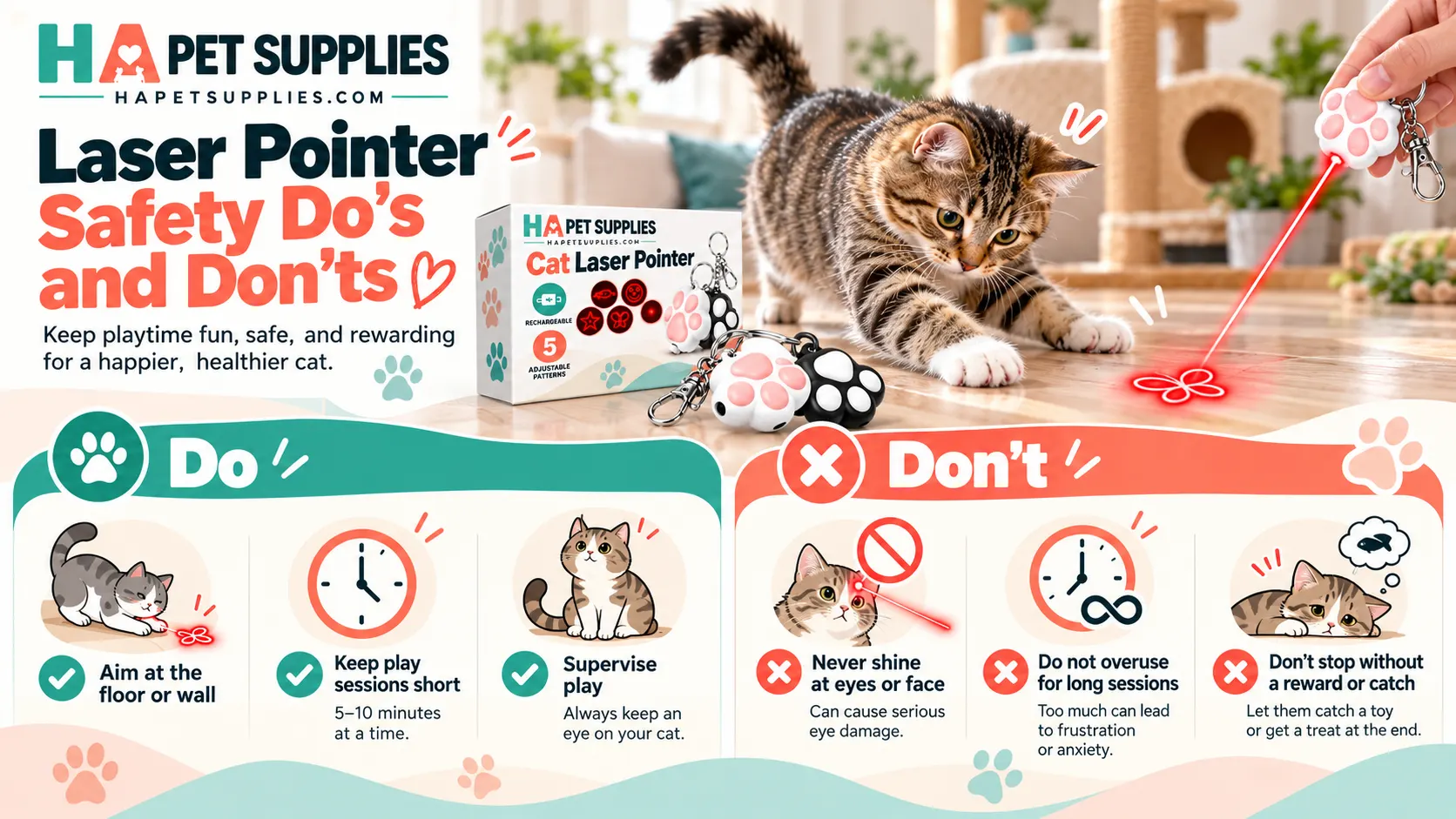
3D Flip Guide: Laser Pointer Do and Don’t
✅ DO
Keep the dot on safe surfaces
Mimic small prey movement — pause, creep, dart, hide. Use short play sessions and let the cat pause. Guide the game toward a physical toy and end with a successful catch.
🚫 DON’T
Shine at the eyes
Never race the dot up tall walls, encourage unsafe leaps, tease the cat continuously, make the dot impossible to reach, suddenly switch it off after an intense chase, or use laser play as the only enrichment.
A safe laser game should have a beginning, a chase and a real ending.
How Long Should a Cat Laser Pointer Session Last?
There is no magic number that fits every cat. But shorter sessions are generally better than an exhausting marathon.
Cats Protection suggests several short daily play sessions rather than one long session and gives examples of sessions around five minutes. Cats Protection Blue Cross also recommends multiple short sessions because this better resembles normal feline activity patterns. Blue Cross
That does not mean exactly five minutes for every cat. Instead, watch the individual. For a young energetic cat, several minutes may be appropriate, then short rest, another game later. For a senior cat, slower movement, shorter chase, lower physical intensity. For an overweight or sedentary cat, begin gradually and do not suddenly create an intense sprint workout.
Stop Before Your Cat Becomes Exhausted
Some cats become extremely focused on a laser. Do not assume “they are still chasing, so they must be fine.” Watch for slowing down, lying down repeatedly, loss of coordination, excessive agitation, open-mouth breathing or panting.
Cats do not normally pant after ordinary light play as readily as dogs do. Veterinary guidance notes that panting can occur after intense exertion but may also indicate overheating, stress or a medical problem. PetMD
If your cat begins panting: stop the game. Allow them to recover in a calm environment. If panting is persistent, severe, occurs with collapse, coughing, abnormal gum color or other concerning symptoms, seek veterinary care. PetMD
How Should the Laser Dot Move?
Think like prey. Not like a screen saver. Real prey does not usually spin in perfect circles indefinitely, teleport every half-second, or shoot six feet up a wall. Use movement such as: pause → creep → dart → hide → pause → escape. This gives the cat opportunities to watch, stalk, decide when to move, and pounce. That is more mentally useful than simply making the cat sprint randomly.
Do Not Make the Cat Jump Up Walls
This is a common mistake because watching a cat leap dramatically can be entertaining. But deliberately sending the dot high up walls, across narrow furniture, onto shelves or toward stair edges can create unnecessary injury risk. PetMD’s veterinary-reviewed laser guidance specifically recommends avoiding spots that encourage unsafe jumping. PetMD
Keep most play floor-level, predictable enough to navigate, and away from dangerous edges.
Prepare the Room Before Laser Play
A cat focused on “prey” may temporarily stop paying attention to the environment. Before playing, check for glass objects, unstable lamps, open stairs, sharp edges, loose cords and slippery clutter. Cornell advises considering the play environment when introducing toys and making sure cats cannot knock down heavy objects or fall while distracted. Cornell Vet College
That guidance applies perfectly to laser play. The safest laser pointer in the world is still a problem if the game sends the cat into a glass table.
How to End Laser Pointer Play Without Frustrating Your Cat
This is the single most useful behavior technique in the article. Do not simply switch the dot off in open space. Instead:
- Slow the dot.
- Let the cat stalk it.
- Guide the dot toward a physical toy.
- Land the light on or immediately beside a toy mouse, kicker, wand attachment or small food reward.
- Switch the laser off as your cat captures the physical item.
Now the sequence becomes stalk → chase → pounce → capture instead of stalk → chase → pounce → nothing exists.
RSPCA recommends ending play with successful capture. RSPCA Blue Cross gives essentially the same advice for interactive play. Blue Cross
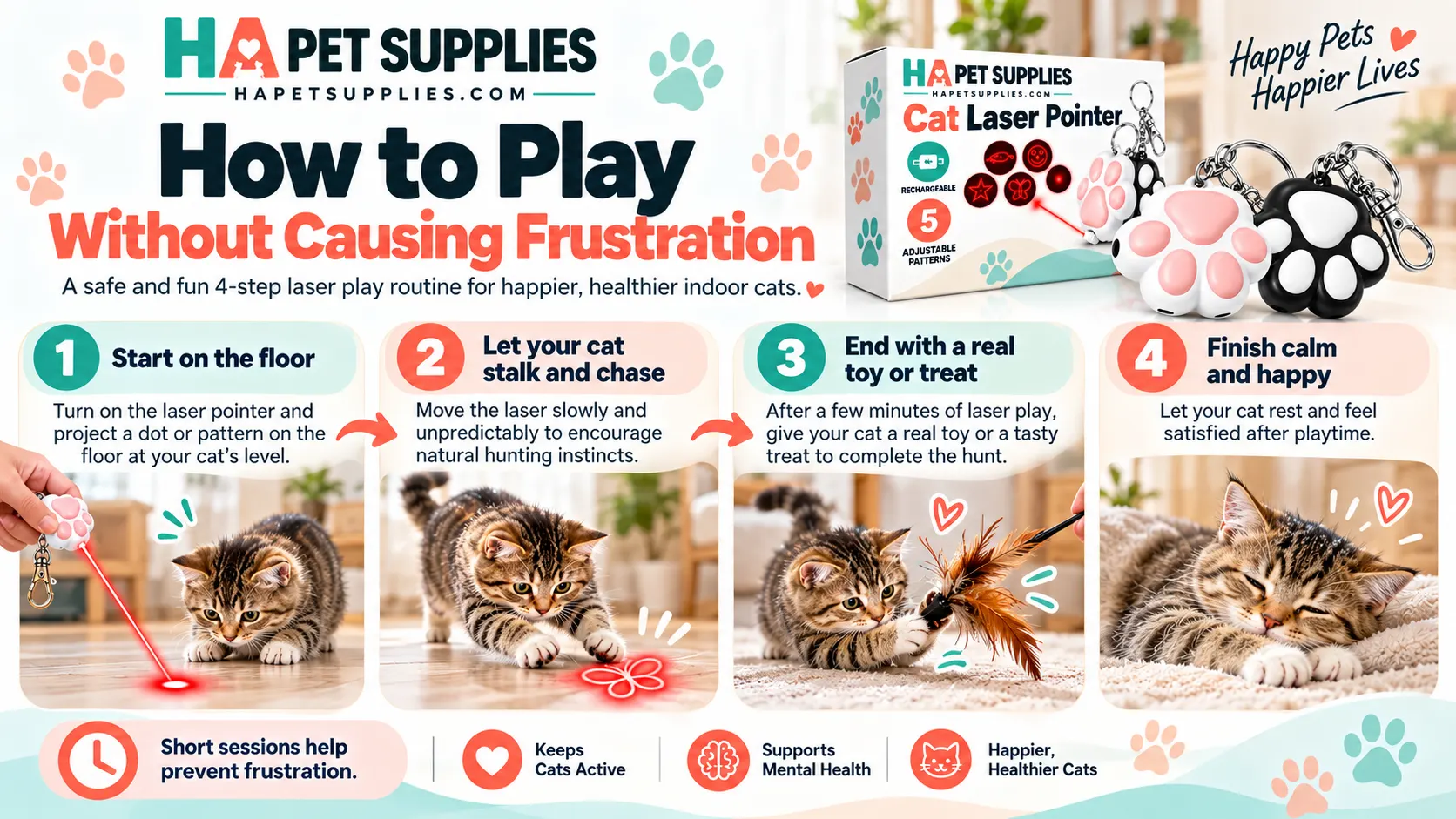
3D Infographic: The Safe 4-Step Laser Play Routine
STALK
Move the dot slowly and give the cat time to observe.
CHASE
Use short, prey-like bursts across a safe floor.
GUIDE
Move the dot toward a real toy.
CATCH
Turn off the laser as the cat captures the physical “prey.”
Never make “disappearing light” the reward for a successful hunt.
Should You Give a Treat After Laser Play?
A small treat can work well for some cats. It can help create a clear ending. You can also use part of the cat’s normal meal, kibble from the daily allowance, puzzle feeder or physical toy. Do not turn every laser session into unnecessary extra calories. If your cat is overweight or on a calorie-controlled diet, use part of their normal food allocation.
The goal is not “give snacks because laser toys are stressful.” The goal is to provide a clear, satisfying finish.
Can Laser Pointers Cause Obsessive Behavior?
Some owners report cats searching floors after the light is gone, staring at reflections, chasing shadows, waiting around the laser storage area, or becoming difficult to settle. This does not happen to every cat. But if your cat appears increasingly fixated, reduce or discontinue laser play and shift toward toys that provide real physical capture.
PetMD’s veterinary-reviewed guidance notes that laser play is not ideal for every cat and that some cats may become frustrated by the inability to physically capture the target. PetMD Cats Protection takes an even more conservative approach and generally recommends toys that allow physical capture instead of laser pointers. Cats Protection
If unusual repetitive behaviors persist outside playtime, discuss them with your veterinarian or a qualified feline behavior professional.
Signs Your Cat May Not Enjoy Laser Play
Stop or change the game if your cat becomes agitated after every session, repeatedly searches for the dot long afterward, redirects biting onto people, attacks another pet immediately after, vocalizes unusually, seems unable to settle, or loses interest and walks away. Do not force play. Cats have individual preferences.
Cornell emphasizes offering appropriate toys and rotating them to prevent boredom. Cornell Vet College Blue Cross similarly recommends toy variety rather than depending on one activity. Blue Cross
What If My Cat Gets Aggressive After Laser Play?
Redirected energy can occur when a highly aroused cat has no appropriate target. Do not punish the cat. Cornell’s guidance on play aggression recommends redirecting inappropriate play toward suitable toys and avoiding physical punishment. Cornell Vet College
If your cat becomes overstimulated: end the laser, offer an appropriate physical toy if safe, give the cat space, and allow arousal to drop. Do not immediately grab or restrain an agitated cat. If aggression is frequent or severe, seek veterinary behavior advice.
Laser Pointer vs Wand Toy
A wand toy has a major advantage: the cat can physically catch it. It can also simulate bird-like fluttering, ground prey, hiding and sudden escapes. RSPCA highlights wand toys as a way to give cats safe access to chasing and capturing behaviors. RSPCA Blue Cross also recommends fishing-rod-style toys while reminding owners to let the cat catch the toy periodically. Blue Cross
For many cats: use both. Use the laser for visual tracking and short chase bursts. Use the wand for grabbing, kicking, biting and physical completion.
Laser Pointer vs Toy Mouse
A toy mouse cannot move itself as dynamically unless thrown or moved by the owner. But it provides what the laser cannot: something to capture. Toy mice can therefore work especially well as the final target in a laser session. Guide the red dot toward the mouse. Then let the mouse become the prey.
Laser Pointer vs Food Puzzle
A food puzzle works a different part of the hunting/foraging system. The Feline Veterinary Medical Association recommends food puzzles and food balls as ways to encourage more natural foraging behavior. catvets.com Cornell also recommends food-dispensing toys for cats needing additional stimulation. Cornell Vet College
This means your enrichment routine might include: morning: food puzzle, afternoon: independent toy, evening: short interactive laser + wand game. Variety is better than making every interaction revolve around the dot.
3D Infographic: Build a Better Cat Play Routine
LASER
Best for visual chase, rapid movement, owner interaction.
WAND
Best for stalking, pouncing, physical capture.
TOY MOUSE
Best for grabbing, carrying, kicking.
FOOD PUZZLE
Best for foraging, problem-solving, slower mental enrichment.
The best cat toy is not one toy—it is a varied enrichment routine.
Are Automatic Cat Laser Toys Safe?
Automatic laser toys create additional questions. The biggest difference is supervision. With a handheld pointer, you control direction, height, session ending and environment. With an automatic device, you may have less control. If using one: follow the manufacturer’s instructions, supervise the first sessions, confirm where the beam travels, make sure it cannot point toward eyes, keep play away from hazards, and give the cat a real physical reward afterward. Do not assume “automatic” means suitable for unlimited unsupervised play.
How Often Can Cats Play With a Laser Pointer?
Instead of asking “How many laser sessions are allowed?” ask: “Is laser play balanced with other enrichment?” A healthy routine should include multiple ways to climb, scratch, hide, stalk, chase, capture, forage and rest. The Feline Veterinary Medical Association describes environmental enrichment and opportunities for play and predatory behavior as essential parts of indoor-cat welfare. catvets.com
If laser play dominates the cat’s entire enrichment routine, diversify.
Are Laser Pointers Good Exercise for Indoor Cats?
They can encourage movement. That can be useful for sedentary indoor cats, cats needing extra interactive play, or owners with limited space. But exercise should be appropriate for the cat. Do not force intense sprinting in senior cats, cats with mobility problems, obese cats, or cats with heart or respiratory disease. If your veterinarian has advised activity restrictions, follow those instructions. Cornell supports play as an important source of exercise and cognitive enrichment for cats. Cornell Vet College
Can Kittens Play With Laser Pointers?
A kitten may enthusiastically chase a laser. The same safety rules apply: eyes protected, safe floor, no high jumps, brief sessions, physical catch at the end. Kittens also need to develop appropriate play behavior with real toys. Do not make the laser their only interactive experience. Use small toy mice, safe balls, wand toys, tunnels and boxes. Always inspect toys for parts that can be swallowed. Cornell warns against toys with small detachable pieces and linear materials that can be ingested. Cornell Vet College
What About Senior Cats?
Senior cats may still enjoy play. Just adjust the intensity. Instead of fast room-to-room chasing: use shorter distances, slow the dot, allow longer pauses, keep play on one level. The goal is enrichment, not athletic performance. If an older cat suddenly loses interest in play, seems painful when moving, or shows major behavior changes, speak with a veterinarian.
Can Two Cats Chase the Same Laser?
This can create competition. One cat may dominate, block the other, or become frustrated. The Feline Veterinary Medical Association emphasizes that cats in multi-cat households need access to resources without competition. catvets.com If playing with multiple cats: keep enough space, use separate physical toys, watch for tension, stop if one cat becomes intimidated. Do not deliberately make cats collide over the same dot.
How to Know When to Stop Immediately
End laser play if: the beam accidentally enters the eye area, the cat slips or falls, the cat begins panting, the cat appears distressed, another animal becomes aggressive, the cat fixates on reflections afterward, or the room becomes unsafe.
If you suspect actual eye exposure and your cat later shows squinting, abnormal pupil response, apparent vision difficulty, bumping into objects, or unusual eye appearance — contact a veterinarian promptly. Laser eye injuries may not always be obvious immediately, and FDA guidance notes that laser-related eye injury can occur without immediate pain in people. FDA For pets, suspected eye injury warrants veterinary assessment rather than waiting for symptoms to become severe.
3D Infographic: Stop the Game If You See This
PHYSICAL WARNING
Slpping, limping, panting, collision.
Action: Stop play.
BEHAVIORAL WARNING
Agitation, redirected biting, prolonged searching, inability to settle.
Action: End laser use and switch enrichment style.
EYE CONCERN
Suspected direct exposure, squinting, apparent vision change.
Action: Contact a veterinarian.
A Simple 5-Minute Safe Laser Routine
This is the fast-solution section for overwhelmed owners.
Do not immediately restart simply because the cat stares at the pointer. A clean ending is part of the exercise.
Common Laser Pointer Mistakes
❌ Mistake 1
Pointing near the eyes
Better: Keep the beam on safe surfaces.
❌ Mistake 2
Making the cat sprint continuously
Better: Use stalk-pause-chase cycles.
❌ Mistake 3
Sending the dot high up a wall
Better: Keep play mostly floor-level.
❌ Mistake 4
Turning the laser off at the peak of the chase
Better: Guide the cat to a catch.
❌ Mistake 5
Using laser play as the only exercise
Better: Rotate with physical toys.
❌ Mistake 6
Ignoring signs of frustration
Better: Change or stop the activity.
❌ Mistake 7
Giving the pointer to a child unsupervised
Better: Adult-controlled use.
❌ Mistake 8
Buying an unknown high-powered laser
Better: Check product labeling and applicable safety information. The FDA warns consumers to be careful with lasers sold online when power and classification cannot be verified. FDA alert
What Should General Buyers Look for in a Cat Laser Toy?
This pillar article should not become a full product review, but buyers need a basic checklist. Look for: clearly stated laser classification/power information, reputable manufacturer, easy on/off control, comfortable handling, no unnecessary high-power claims, and clear safety instructions.
Do not choose a laser because it advertises “extra powerful beam” for cat play. More power is not a benefit here. FDA guidance makes clear that higher-powered lasers can create greater risk. FDA
Readers wanting broader cat products can naturally browse the HA Pet Supplies cat supplies collection at this stage. For other practical feline-care articles, the HA Pet Supplies blog is a relevant internal destination for readers who want further guidance. If you need personalized help choosing a toy, you can contact us — or if you’re a retailer or bulk buyer, request a quote. For general browsing, visit our shop or return to the homepage.
Interactive FAQ: Are Laser Pointers Safe for Cats?
Are laser pointers safe for cats?
Can a laser pointer damage a cat’s eyes?
What happens if a laser briefly hits my cat’s eye?
Are red laser pointers safer than green ones?
Can cats get frustrated by laser pointers?
How do I stop my cat getting frustrated?
How long should laser play last?
Is five minutes enough?
Should I let my cat “catch” the red dot?
Should I give my cat food after laser play?
Why does my cat keep looking for the laser afterward?
Can laser pointers make cats obsessive?
Are laser pointers good exercise?
Are laser pointers good for overweight cats?
Can kittens use laser pointers?
Can senior cats use laser pointers?
Should I point the laser up the wall?
Can I point the laser onto my cat’s body?
Are automatic laser toys safe?
What is a better alternative to a laser pointer?
Can I use a laser pointer every day?
What should I do if my cat gets aggressive after the laser?
Should children play laser games with cats?
Final Laser Pointer Safety Checklist
Before every session:
3D Infographic: The Safe Laser Formula
PROTECT
Never aim at eyes.
CONTROL
Keep movement low and safe.
LIMIT
Prefer short, focused sessions.
COMPLETE
End with a real catch.
ROTATE
Use other cat toys too.
Safe laser play is not just about where the light goes. It is about how the whole game begins, develops and ends.
Conclusion: Laser Pointers Can Be Used More Safely, but the Cat Needs More Than a Red Dot
So, are laser pointers safe for cats? They are not risk-free. The two biggest concerns are clear: direct eye exposure should be avoided. And repeated chasing without physical capture can frustrate some cats.
The FDA’s laser safety guidance supports the first point: concentrated laser light should never be deliberately aimed into the eyes. FDA Feline welfare organizations and veterinary guidance support the second: cats benefit from play that lets them stalk, chase, pounce and eventually capture something. catvets.com
That gives owners a simple safe-play framework: Keep the beam out of the eyes. Keep the chase physically safe. Keep sessions reasonably short. Do not make laser play the cat’s only enrichment. And always give the hunt a satisfying ending.
For owners who want to understand why the moving dot is so irresistible in the first place, the natural next read is Why Do Cats Chase Laser Pointers? The Hunting Instinct Behind the Red Dot.
For owners who already understand the risks and want a precise play routine, move them naturally into How to Use a Cat Laser Pointer the Right Way: Playtime Tips, Session Length and How to Let Your Cat Catch the Prey.
That creates a clean three-post SEO cluster: Blog 1: Are laser pointers safe for cats and what can go wrong? Blog 2: Why do cats become so interested in the red dot? Blog 3: What is the correct way to structure a laser play session? This makes Blog 1 your pillar safety guide—the page that answers the worried buyer’s first question while naturally leading them into feline hunting behavior and the correct play method.