
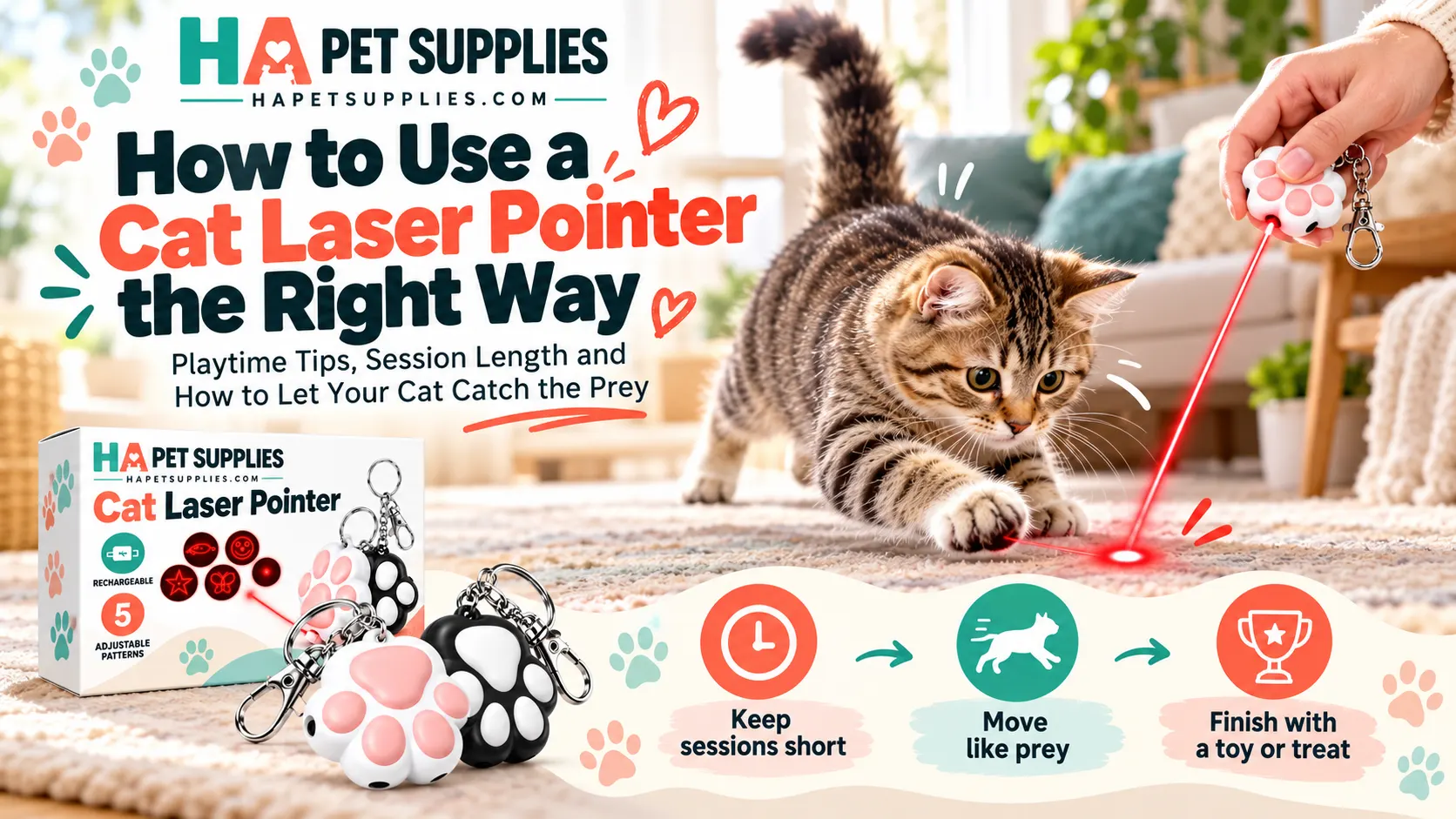
How to use a cat laser pointer correctly is not simply a matter of switching it on and making your cat run after the red dot. A better laser game has structure. It should have: a beginning, a chase, a pounce, and, importantly: a satisfying ending.
That last part is where many owners get it wrong. The laser dot is very good at triggering visual tracking, stalking, chasing and pouncing. But the cat cannot physically capture light. That means an intense play session can end with the cat landing on an empty patch of floor while the “prey” disappears. For some cats, that can be frustrating.
The Feline Veterinary Medical Association recommends allowing cats to successfully capture simulated prey during play rather than keeping the target permanently out of reach. Read the FelineVMA environmental-needs guidance.
Cats Protection similarly advises giving cats a successful catch at the end of interactive play rather than creating endless unsuccessful pursuit. See Cats Protection advice on play.
There is also a more obvious safety rule: never deliberately aim the laser at your cat’s eyes. The U.S. Food and Drug Administration warns that laser beams can injure the eye and advises consumers never to aim lasers directly at people or animals. Read FDA laser safety guidance.
So the best laser routine is not: switch on → make cat sprint → switch off. It is: prepare → stalk → chase → slow down → guide to real prey → catch → finish. This guide walks through that routine step by step.
Quick Answer: How to Use a Cat Laser Pointer the Right Way
If your cat is waiting to play right now, follow this simple sequence:
- Clear the room first.
- Keep the laser on the floor or another safe matte surface.
- Never deliberately point it at the cat’s face or eyes.
- Begin slowly so your cat can stalk.
- Add short prey-like chase bursts.
- Pause regularly.
- Keep the session relatively short.
- Slow the dot near the end.
- Guide it toward a real toy or small reward.
- Turn the laser off as your cat captures the physical target.
Think: stalk → chase → pounce → catch — not: chase forever → light vanishes.
If you want the detailed safety explanation behind these rules, your pillar guide Are Laser Pointers Safe for Cats? covers eye safety, frustration and common risks in greater detail.
What’s Inside This Guide
Step 1: Prepare the Room Before Laser Play Starts
A cat focused on a moving target may stop paying attention to the room. Before you start, remove or avoid: glass objects, unstable lamps, loose cords, narrow ledges, stair edges, slippery obstacles and fragile decorations.
Cornell University’s Feline Health Center recommends making play environments safe so cats are not encouraged to collide with objects or interact with dangerous items during intense play. Read Cornell guidance on safe toys and play.
A clear floor gives you much more control. Good places include: carpet, rug, open floor area, low furniture zones. Avoid turning the game into a vertical jumping contest.
Step 2: Keep the Laser Away From the Eyes
This is the non-negotiable rule. Do not deliberately aim the laser at the eyes, across the face, toward another pet’s eyes, toward a person, or into mirrors.
The FDA explains that the eye can focus a laser beam onto a very small retinal area, potentially increasing the risk of injury. Read the FDA FAQ on lasers.
The beam should stay on: floor, rug, matte wall near floor level, and the physical toy at the end. The rule is simple: the light belongs on the play surface, not on the cat.
Step 3: Start Slowly Instead of Making the Cat Sprint Immediately
Many owners switch the laser on and immediately sweep it across the room. That skips one of the most important parts of feline hunting: stalking.
Instead, begin with a slow-moving dot. Let it creep, pause, move a few inches, stop again. Watch your cat. You may see: crouching, ear orientation, weight shifting, slow approach, fixed gaze. That is part of the predatory sequence.
The Feline Veterinary Medical Association emphasizes opportunities for species-appropriate predatory play as part of healthy environmental enrichment. See the FelineVMA position on indoor-cat needs.
So do not think: slow play is boring. Slow play is often the setup.
Why Prey-Like Movement Matters
Real prey does not usually move at maximum speed continuously. A mouse may: stop → listen → move → hide → move again. An insect may: crawl → freeze → dart. That is the style you want.
Better laser movement looks like: short runs, pauses, directional changes, hiding behind furniture edges, slower final movement. Poor laser movement looks like: frantic circles, nonstop sprinting, impossible turns, repeated wall climbing.
A good laser session is not about exhausting the cat. It is about creating a controlled simulated hunt.
Step 4: Add Short Chase Bursts
After your cat has stalked the target, give them a chance to chase. Move the dot across: clear floor, short straight paths, gentle turns.
Avoid: steep wall runs, table jumps, stair edges, slippery surfaces. PetMD’s veterinary-reviewed laser guidance recommends avoiding play setups that encourage dangerous jumping or collisions. Read PetMD’s cat laser-pointer guidance.
The cat should have enough room to move safely without repeatedly crashing into obstacles.
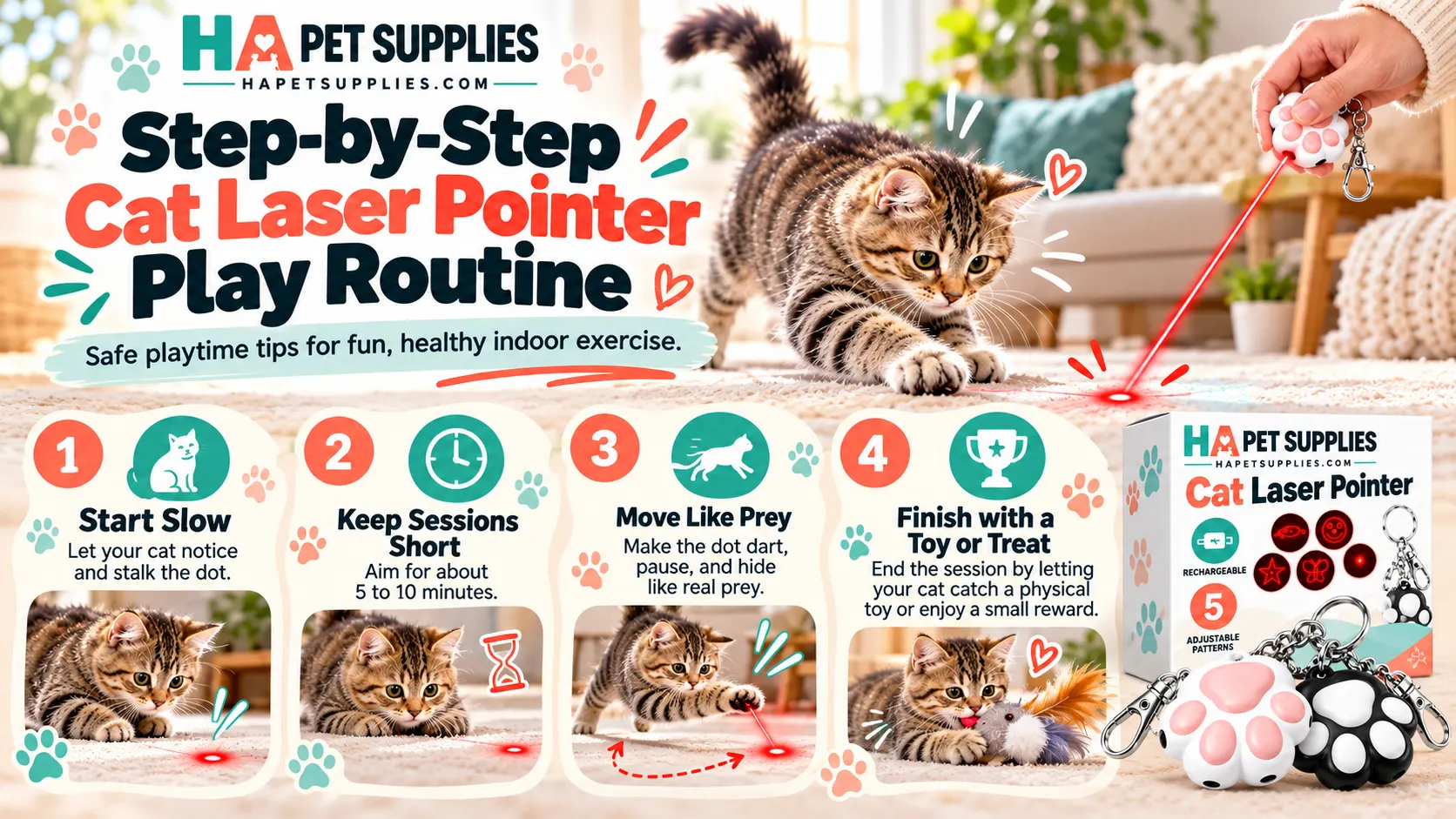
3D Infographic: The 4-Step Cat Laser Play Routine
STALK
Move the dot slowly. Let the cat watch and prepare.
CHASE
Add short quick bursts. Keep the movement safe and mostly floor-level.
GUIDE
Slow the dot and move it toward a physical toy.
CATCH
Turn off the laser as the cat captures the real toy or reward.
The laser starts the hunt. The physical toy finishes it.
Step 5: Give Your Cat Pouncing Opportunities
Do not make the dot impossible to catch every second. Pause occasionally. Let it stop near: rug edge, chair leg, toy tunnel. The cat needs moments where pouncing feels possible.
Even though the light itself cannot be grabbed, the attempt is part of the hunting sequence. For a deeper explanation of why pouncing behavior is so strong, link naturally to Why Do Cats Chase Laser Pointers? The Hunting Instinct Behind the Red Dot. That article handles the behavioral science, while this one remains focused on practical play.
How Long Should a Cat Laser Pointer Session Be?
There is no universal perfect duration. However, short sessions are usually better than long continuous chase sessions.
Cats Protection recommends several short play sessions during the day and gives around five minutes as an example of a useful session length for many cats. Read Cats Protection play guidance. Blue Cross similarly recommends multiple short play sessions rather than one long exhausting session. Read Blue Cross advice on playing with cats.
A practical starting point for many healthy adult cats is: around 3–7 minutes of focused laser play followed by a real capture and calm ending. But the cat matters more than the clock.
Signs the Session Should End Earlier
Stop before the planned time if your cat: walks away, lies down repeatedly, stops following the dot, becomes frantic, redirects biting, starts panting or appears distressed. Do not keep restarting the laser simply because you want a longer session. Cats should be allowed to disengage.
What If My Cat Wants to Keep Going?
A cat may still look for the light after the session ends. That does not necessarily mean: “Turn it back on.” The cat may simply still be in hunting mode.
This is why the finishing routine matters. Guide the dot toward: toy mouse, kicker, wand attachment, small food reward. Then let the cat capture that target. The physical ending can help signal: the hunt is complete.
3D Infographic: How Long Should Laser Play Last?
BEGINNER OR SENIOR CAT
2–4 minutes
Keep movement slow and low intensity.
HEALTHY ACTIVE ADULT CAT
Around 3–7 minutes
Use short stalk-and-chase cycles.
HIGH-ENERGY CAT
Instead of one very long session: use several short sessions with breaks and other toy types.
These are practical starting points, not medical limits. Adjust for age, fitness, health and interest.
Step 6: Slow the Game Before Ending
Do not end at maximum intensity. Imagine a cat has just spent four minutes sprinting after the dot. Then: click. Nothing. That abrupt ending can leave the cat searching, agitated or still highly aroused.
Instead, reduce the pace gradually. Move from: fast chase to slow chase to stalk to physical target. This gives the session a more natural progression.
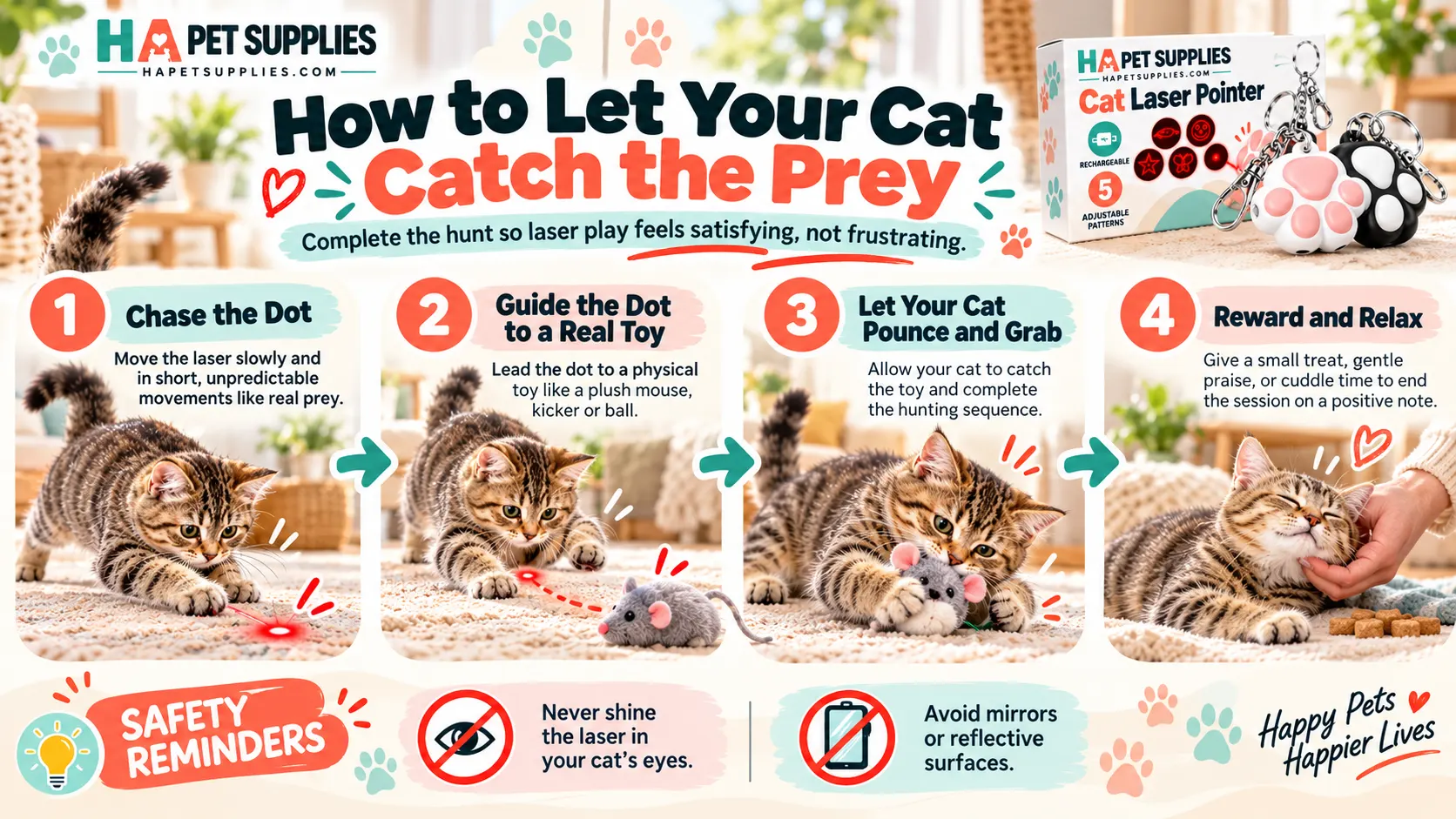
Step 7: Let Your Cat “Catch the Prey”
This is the most important part of the article. You cannot make light physically catchable. So you create a transition.
Place a real toy somewhere in the play area before starting. Examples: stuffed mouse, kicker toy, wand attachment, small treat, food puzzle.
Toward the end:
- Slow the laser.
- Move toward the toy.
- Circle the toy once.
- Place the dot on the toy.
- Let the cat pounce.
- Switch off the laser.
- Allow the cat to grab the real object.
Now the hunt ends with: capture instead of: disappearance.
Why Letting Your Cat Catch Something Matters
The Feline Veterinary Medical Association recommends allowing cats to capture simulated prey during play because repeated failure can increase frustration. Read the environmental-needs guidelines.
RSPCA play guidance likewise emphasizes allowing cats to catch toys during play sessions rather than keeping prey permanently unreachable. Read RSPCA cat-play guidance. Blue Cross gives the same practical advice: interactive toys should occasionally be allowed to “lose” so the cat can complete the hunt. Read Blue Cross cat-play guidance.
That is the behavioral logic behind the catch.
Should You Use a Treat as the Final Reward?
You can. But it does not have to be food every time. Possible finishes include:
- Physical toy — best for grabbing, biting, bunny kicking.
- Small treat — best for food-motivated cats.
- Portion of normal meal — useful if you want to avoid extra calories.
- Food puzzle — useful for transitioning from chase to foraging.
Do not accidentally add large amounts of extra food every day. If your cat is overweight, use part of their normal calorie allowance.
A Better Play Sequence: Hunt, Catch, Eat, Settle
Many owners like a simple sequence: play → catch → small food reward → rest. This can fit naturally into an evening routine. For example: 5-minute interactive play, toy capture, portion of dinner, grooming/rest. The purpose is not to create a rigid formula. It is to give the play session a clear ending.
Can You Use a Wand Toy After the Laser?
Yes. In fact, this is one of the best combinations. Use the laser for: visual tracking, running, stalking at distance. Then switch to a wand toy for: grabbing, biting, physical capture. This gives the cat a much more complete experience.
Cornell recommends interactive toys that allow cats to stalk, chase and pounce as part of healthy play. Read Cornell feline enrichment guidance.
Laser Pointer vs Wand Toy
Neither needs to replace the other. Laser Pointer is best at rapid movement, visual tracking, distance and owner-controlled chase. Limitation: cannot be physically captured. Wand Toy is best at stalking, chasing, pouncing, grabbing and biting. Limitation: requires safe handling of strings and attachments.
Better strategy: Use both for different parts of the hunt.
Laser Pointer vs Toy Mouse
A toy mouse is ideal for the ending. It may not create the same fast chase as a laser. But it gives your cat: weight, texture, resistance, physical possession. The simplest transition is: dot approaches mouse → cat pounces → laser off → mouse becomes prey.
Laser Pointer vs Food Puzzle
A laser pointer is active chase enrichment. A food puzzle is slower cognitive and foraging enrichment. Both can be useful. The Feline Veterinary Medical Association recommends feeding puzzles as part of environmental enrichment. See FelineVMA feline-environment guidance.
Cornell likewise supports food-dispensing toys as a way to provide mental stimulation. Read Cornell enrichment advice. So a better daily routine might include: laser + physical toy + food puzzle instead of endless laser use.
How to Use a Cat Laser Pointer With Kittens
Kittens can be extremely enthusiastic. That means extra control matters. Keep sessions: short, low to the ground, away from stairs, away from fragile objects. Kittens also need real toys for learning normal play behavior. Use: soft balls, toy mice, tunnels, wand toys, kickers.
Cornell warns owners to supervise toys that contain strings, ribbons or small detachable pieces because they can become ingestion hazards. Read Cornell safe-toy guidance.
How to Use a Cat Laser Pointer With Senior Cats
Senior cats may still enjoy a laser. You just need to change the game. Use: slower movement, shorter distance, fewer sprints, no high jumps. Let the red dot stay close enough that the cat can participate without repeated room-length runs. The goal becomes: mental engagement + gentle movement rather than high-intensity exercise.
How to Use a Cat Laser Pointer With Overweight Cats
Laser play can help encourage movement. But start gently. Do not make an overweight or sedentary cat sprint across the entire house on the first day. Use: short chases, frequent pauses, gradually increasing activity. Weight management should also consider diet, calorie intake and underlying health. If your cat is significantly overweight, veterinary advice is appropriate.
How to Use a Cat Laser Pointer With Two Cats
Multi-cat play needs extra care. One cat may dominate. Another may become frustrated, blocked or frightened. Do not make both cats repeatedly collide over one dot. Instead: create distance, use multiple physical toys, allow each cat opportunities to capture something, stop if tension develops.
FelineVMA guidance emphasizes minimizing competition between cats for important resources. Read the feline environmental-needs guidance. Play should enrich the relationship, not trigger conflict.
3D Infographic: Adjust Laser Play by Cat Type
KITTEN
Short + supervised + physical toy finish.
ACTIVE ADULT
Stalk + chase + catch.
SENIOR CAT
Slow + short + low-impact.
OVERWEIGHT CAT
Gradual + frequent breaks.
MULTI-CAT HOME
More space + separate reward opportunities.
How to Know If Your Cat Is Enjoying the Session
Positive engagement may look like: focused gaze, controlled stalking, playful pouncing, brief pauses, returning voluntarily. But stop if the cat: repeatedly runs away, hides fearfully, becomes aggressive, pants or seems exhausted.
A toy is supposed to enrich the cat. You do not need to “finish the five minutes” if the cat is finished after two.
What If the Cat Starts Panting?
Stop. Panting can happen after very intense exertion, but it is not something to intentionally produce during ordinary home play. PetMD notes that feline panting can occur after exertion but can also indicate stress, overheating or medical issues. Read veterinary guidance on cat panting.
Allow the cat to settle. If panting continues, occurs frequently, or is accompanied by weakness, coughing, abnormal gums or collapse — seek veterinary care.
What If the Cat Becomes Aggressive?
Some cats become highly aroused during predatory play. That energy can be redirected toward: hands, feet, another cat. Cornell advises redirecting play aggression toward appropriate toys rather than punishing the cat physically. Read Cornell guidance on feline aggression.
If the cat becomes over-aroused: stop the laser, avoid grabbing them, provide space, allow arousal to drop, shorten future sessions.
What If My Cat Keeps Searching for the Red Dot?
A little searching immediately afterward may simply mean: the hunt is not mentally finished. Improve the ending. Try: laser → toy → capture → treat or meal.
If searching continues for long periods after play: reduce laser use, increase physical toys, switch enrichment style. The pillar safety article Are Laser Pointers Safe for Cats? covers persistent frustration and fixation in more detail.
Should You Use a Cat Laser Pointer Every Day?
It can be part of a daily routine for some cats, but it should not be their only form of play. A balanced routine should include opportunities to: scratch, climb, hide, chase, capture, forage, rest.
RSPCA recommends varied play that lets cats practice different natural behaviors. Read RSPCA play-time guidance. Blue Cross similarly encourages a range of interactive toys rather than relying on a single play method. Read Blue Cross guidance.
A Sample Daily Enrichment Routine
For a typical indoor cat: Morning: Food puzzle or meal search. Midday: Independent toys. Evening: 3–7 minute interactive laser session. Laser Ending: Toy mouse or wand catch. Afterward: Meal, grooming or rest. This creates variety.
Automatic Cat Laser Toys: Same Rules, Extra Caution
Automatic lasers can be convenient. But automation removes some of your direct control. Before leaving one running: watch its movement pattern, check beam height, confirm it does not hit mirrors, ensure it does not encourage wall jumps, follow manufacturer instructions. Do not assume automatic means: unlimited unsupervised use. A real toy reward is still valuable afterward.
Can a Laser Pointer Be Used on Walls?
Keep most play near floor level. A small amount of low wall movement may not be a problem, but do not repeatedly send the dot high up a wall and encourage vertical jumping. Cats can misjudge: height, landing, furniture position. A floor-based game is much easier to control.
Should You Use the Laser Near Stairs?
Avoid it. The cat may become too focused on the target and lose awareness of: steps, edges, people. Choose a safer flat area instead.
Should You Use a Laser Near Mirrors?
Avoid deliberate reflective targeting. Reflected beams can travel in unexpected directions. FDA laser-safety guidance recommends avoiding eye exposure and treating handheld lasers carefully. Read FDA guidance. A matte floor is a much easier play surface.
Can Children Play Laser Games With Cats?
Adult supervision is strongly recommended. The FDA advises that handheld lasers should not be treated as ordinary children’s toys. Read FDA laser-toy safety advice. A child may accidentally: point at eyes, point at people, aim at a mirror, or send the cat into an unsafe jump. An adult should control the device.
3D Infographic: Safe Room Setup
GOOD
Open floor, carpet, toy mouse ready, no fragile items, no stairs.
AVOID
Mirrors, glass objects, stairs, narrow ledges, slippery clutter.
A safe game starts before the laser turns on.
Common Mistakes When Using a Cat Laser Pointer
❌ Mistake 1
Aiming near the eyes
Better: Keep the beam on the floor.
❌ Mistake 2
Making every session a sprint
Better: Include stalking and pauses.
❌ Mistake 3
Playing too long
Better: Use short sessions.
❌ Mistake 4
Turning it off suddenly
Better: Slow the prey first.
❌ Mistake 5
No physical catch
Better: Guide the dot to a real toy.
❌ Mistake 6
Sending the cat up walls
Better: Keep play low and controlled.
❌ Mistake 7
Using only the laser
Better: Rotate with other enrichment.
❌ Mistake 8
Ignoring frustration
Better: Change the ending or stop laser use.
❌ Mistake 9
Treating more exercise as always better
Better: Stop before exhaustion.
How to Build a 5-Minute Cat Laser Pointer Session
This should be the fast-action section for mid-crisis readers.
Five structured minutes can be more satisfying than twenty minutes of endless chasing.
What Physical Toy Should You Use for the Catch?
Good options include: stuffed mouse, soft ball, kicker toy, wand attachment. Choose based on your cat’s preferences. The toy should be appropriately sized, have no loose dangerous parts, and be safe for supervised play.
Cornell advises checking cat toys for strings, small pieces and other ingestion hazards. Read Cornell’s safe-toy guide.
Can You Finish With Food Instead?
Yes. A food reward can work especially well for food-motivated cats. Options include: one small treat, a few pieces of kibble, part of the normal meal. Do not overfeed simply because laser play occurs every day. For cats on weight-control diets, subtract rewards from their normal daily food.
What if the Cat Doesn’t Want the Toy at the End?
Try different rewards. One cat may prefer food. Another: mouse. Another: wand. Another: kicker. There is no universal finishing object. The principle is: give the cat access to something real and rewarding.
How to Use Laser Play as Exercise Without Overdoing It
Laser play can encourage movement, but quality matters more than distance. Instead of making the cat run room-length sprints repeatedly: mix short chase, stalking, turning and pouncing. This uses more of the cat’s natural movement repertoire and reduces nonstop running.
How to Use Laser Play for Mental Stimulation
Make the dot “solveable.” Hide it briefly. Let it disappear behind a chair, reappear slowly, pause near a tunnel. This creates anticipation. But do not create impossible games where the target constantly disappears before the cat can approach. The goal is engagement, not frustration.
Cat Laser Pointer and Broader Enrichment
A laser is only one tool. A strong indoor-cat setup should also include: scratching posts, climbing areas, hiding places, window access where safe, food puzzles and physical prey toys.
FelineVMA emphasizes that cats need opportunities to express normal species-specific behaviors in the indoor environment. Read FelineVMA recommendations.
Readers looking for broader feline accessories can naturally browse the HA Pet Supplies cat supplies category here because the section is specifically about wider cat enrichment. For more practical care content, the HA Pet Supplies blog is also a relevant internal path. If you need personalized product advice, contact us; retailers can request a quote. To browse the full range, visit our shop or return to the homepage.
Interactive FAQ: How to Use a Cat Laser Pointer
How do you use a cat laser pointer the right way?
How long should a cat laser pointer session last?
Is five minutes enough for cat laser play?
Can I play with my cat using a laser for 20 minutes?
Should I let my cat catch the laser?
Why should the cat catch something at the end?
What should I use as the final prey?
Should I give a treat after laser play?
Should the laser move quickly?
Should I move the laser in circles?
Can I point the laser up the wall?
Can the laser hit my cat’s eyes?
Are laser pointers safe for kittens?
Are laser pointers safe for senior cats?
Can overweight cats use laser toys for exercise?
What if my cat pants during laser play?
What if my cat attacks me afterward?
Why does my cat keep looking for the dot after play?
Can laser play make a cat frustrated?
Can my cat play with the laser every day?
Is a wand toy better than a laser?
Are automatic laser toys safe?
Should children use laser pointers with cats?
Is the color red important?
Why does my cat love the laser so much?
Final Safe Laser Play Checklist
Before pressing the button:
3D Infographic: The Right Way to Use a Cat Laser Pointer
PREPARE
Clear the room.
STALK
Start slowly.
CHASE
Add short bursts.
PAUSE
Let the cat reset.
SLOW
Reduce intensity before ending.
GUIDE
Move the laser to a physical toy.
CATCH
Let the cat capture something real.
A good laser game should end with satisfaction—not confusion.
Conclusion: Use the Laser to Start the Hunt, Not to Be the Whole Hunt
Learning how to use a cat laser pointer correctly is less about mastering the pointer and more about understanding your cat. The laser is excellent at triggering: attention, stalking, chasing and pouncing. But it cannot provide: physical capture.
That is why the best routine is: prepare → stalk → chase → pause → slow → guide → catch.
Keep the beam away from the eyes. Keep the game mostly on the floor. Avoid long exhausting sessions. Do not make the cat jump dangerously. And do not end the game with an unexplained disappearing dot.
Instead, let the red dot guide your cat toward something real. That might be: toy mouse, wand, kicker or small food reward. Then the laser becomes one component of a richer play routine rather than an endless impossible chase.
For owners worried about safety, direct them naturally to Are Laser Pointers Safe for Cats? How to Play Without Causing Frustration or Eye Injury.
For owners curious about why their cat seems almost hypnotized by the moving light, Why Do Cats Chase Laser Pointers? The Hunting Instinct Behind the Red Dot explains the predatory behavior behind the game.
That completes the SEO cluster: Blog 1: Is laser-pointer play safe? Blog 2: Why does the red dot trigger such intense chasing? Blog 3: How should the owner actually structure a laser session?
Blog 3 therefore becomes the practical how-to article—the page readers can return to immediately before playtime when they want a short, safe and satisfying routine rather than simply making their cat chase a light around the room.