
Dog arthritis and joint pain can gradually change the way your dog walks, plays, sleeps, and interacts with the family.
One day, your dog might hesitate before jumping onto the sofa. Another day, a short walk may seem unusually tiring. Eventually, getting up from a resting position might require extra effort.
For pet owners, watching these changes can be frustrating and upsetting. You want your dog to feel comfortable again, but the number of available treatments can make it difficult to know where to begin.
Should you try joint supplements? Is pain medication necessary? Would a different exercise routine help? Can cold laser therapy support mobility? And when should you consider a home-use red light therapy wrap?
The most important thing to understand is that arthritis treatment is not about finding one miracle product. Dog arthritis and joint pain are usually best managed through a coordinated approach that addresses discomfort, body weight, movement, muscle strength, and the dog’s everyday environment.
Cold laser therapy, also called photobiomodulation, may be a complementary option for selected dogs. Some research suggests possible pain and mobility benefits, but the evidence remains limited, and results are not guaranteed.
This comprehensive guide explains the warning signs of arthritis, how veterinarians diagnose joint problems, which treatments have stronger supporting evidence, and where cold laser therapy may fit into a responsible care plan.
If you are exploring supportive products, the HA Pet Supplies dog cold laser therapy wrap is one option to investigate after confirming its technical specifications and discussing suitability with your veterinarian.
Our goal is to help you move from confusion to a practical, informed plan for your dog’s comfort and quality of life.

Dog receiving supportive red light therapy for joint comfort
1. Quick Answer — What Should You Do If Your Dog Has Joint Pain?
If your dog has started limping, moving slowly, or struggling to stand, the first step is to identify the cause. Do not assume that every mobility problem is arthritis. Joint injuries, muscle disorders, neurological problems, and other medical conditions can create similar symptoms.
What should you do first?
If the symptoms began suddenly, are severe, or prevent normal walking, seek prompt veterinary attention. If the symptoms developed gradually, schedule a veterinary examination and document the changes you have noticed.
Until your dog has been assessed, avoid activities that appear to make the discomfort worse. Provide a comfortable resting area, non-slip flooring, and easy access to water. Do not give human pain medication or start intensive exercises without professional guidance.
Where does cold laser therapy fit?
Cold laser therapy may be discussed after the veterinarian identifies the cause of the pain. For some dogs with diagnosed osteoarthritis, it may be considered alongside established treatments. However, it should not replace appropriate medication, rehabilitation, weight management, or necessary surgery.
The American Animal Hospital Association’s pain management guidelines emphasize combining suitable treatments and reassessing the animal’s response rather than relying entirely on one intervention.
3D Infographic — What Should I Do Right Now?
🚨 Seek Urgent Care
Sudden inability to walk, serious injury, severe pain, or paralysis requires urgent veterinary care.
📅 Arrange Assessment
Arrange a veterinary assessment, reduce activities that worsen pain, and record changes in mobility.
✅ Follow the Plan
Follow the established care plan, monitor comfort, and ask whether complementary therapies may be appropriate.
2. Understanding Dog Arthritis and Joint Pain
Arthritis is not simply a normal part of getting older. It is a medical condition that can cause chronic discomfort and reduced joint function. One of the most common forms is osteoarthritis, sometimes called degenerative joint disease.
How healthy joints work
A joint is where two or more bones meet. Healthy cartilage helps the joint surfaces move smoothly while distributing mechanical forces. Joint fluid provides lubrication. Ligaments and muscles contribute to stability.
What changes when arthritis develops?
In osteoarthritis, cartilage and other joint structures progressively deteriorate. Inflammation and changes to the underlying bone can contribute to pain. As discomfort increases, a dog may reduce activity. Reduced movement can lead to muscle weakness, making the problem more difficult to manage.
The Cornell University College of Veterinary Medicine’s osteoarthritis guide explains how this condition affects dogs and outlines available management approaches.
What causes dog arthritis?
Several factors can increase the risk of osteoarthritis. These include previous joint injury, abnormal joint development, excess body weight, age-related changes, and chronic instability. Conditions such as hip dysplasia, elbow dysplasia, and cruciate ligament disease may contribute to secondary osteoarthritis.
Can young dogs develop arthritis?
Yes. Although arthritis is frequently associated with senior dogs, younger animals can develop joint degeneration following injury or developmental orthopedic disease. Age alone should never determine whether a dog needs examination.
Does arthritis always cause obvious limping?
No. Some dogs show subtle behavioral changes rather than dramatic lameness. They may become less enthusiastic about walks or avoid movements that previously seemed easy. Recognizing these changes early can help owners obtain a diagnosis and begin appropriate management.
3. Ten Warning Signs of Dog Arthritis and Joint Pain
Dogs cannot explain that their joints hurt. Instead, they communicate through movement, behavior, posture, and changes in daily habits.
Sign 1 — Stiffness after sleeping
Your dog may take several slow steps after getting up from a nap. Movement may appear easier after a short period.
Sign 2 — Difficulty standing
A dog may need several attempts to rise from the floor. You might notice trembling legs, hesitation, or shifting weight away from one side.
Sign 3 — Reluctance to climb stairs
Stairs place additional demands on joints and muscles. A dog may stop using a familiar staircase or climb more slowly. Do not force the dog to continue if the activity causes discomfort.
Sign 4 — Reduced interest in walking
A previously enthusiastic dog may begin stopping early during walks or appear unwilling to leave the house.
Sign 5 — Hesitation before jumping
Jumping into vehicles or onto furniture requires substantial joint movement and muscle force. A dog that suddenly avoids jumping may be trying to prevent discomfort.
Sign 6 — Changes in sitting or lying posture
Some dogs begin sitting asymmetrically, extending one limb differently, or avoiding particular resting positions.
Sign 7 — Limping after exercise
A limp that becomes more noticeable after activity should not be ignored. It may indicate joint inflammation, injury, or another orthopedic problem.
Sign 8 — Reduced enthusiasm for play
A dog that no longer wants to chase toys or interact normally may be uncomfortable. Behavior changes can be an early indication of chronic pain.
Sign 9 — Sensitivity when touched
Your dog may move away when you touch a particular joint or body area. Some dogs become irritable when painful regions are handled.
Sign 10 — Loss of muscle condition
Reduced activity may gradually lead to muscle loss. You might notice thinner hind legs or changes in body shape. Muscle weakness can further affect joint stability and movement.

Senior dog receiving supportive joint care for everyday mobility
Record when symptoms occur, how long they last, and whether they worsen after activity. A short video of your dog walking naturally may help your veterinarian evaluate the problem. The AAHA guidance on chronic pain assessment in dogs emphasizes owner observations alongside professional assessment.
4. When Is Dog Joint Pain an Emergency?
Some mobility problems require immediate attention. Owners should not assume that a dog experiencing sudden severe discomfort is simply having an arthritis flare-up.
🚨 Seek urgent veterinary care if your dog:
- Suddenly becomes unable to stand or walk.
- Cannot bear weight after an injury.
- Experiences severe pain or repeated distress.
- Develops weakness or paralysis.
- Drags a limb or loses normal coordination.
- Has a visibly deformed or severely swollen limb.
- Appears critically ill alongside mobility problems.
These symptoms may indicate a serious injury, neurological disorder, infection, or another urgent medical condition. Keep your dog calm and reduce unnecessary movement while arranging care. Do not attempt vigorous massage or stretching.
Should you use cold laser therapy during an emergency?
No. A home-use light therapy wrap should not delay urgent diagnosis or treatment. The World Small Animal Veterinary Association’s pain guidelines emphasize appropriate recognition and treatment of acute and chronic pain.
Never use human painkillers without veterinary advice
Medications such as ibuprofen and naproxen can be dangerous for dogs. The US Food and Drug Administration’s guide to pain relievers for pets explains why human medications should not be substituted for properly prescribed veterinary treatment.
5. How Veterinarians Diagnose Dog Arthritis and Joint Pain
A proper diagnosis is the foundation of any effective treatment plan. Your veterinarian needs to determine which structures are involved and whether the symptoms are consistent with osteoarthritis.
Step 1 — Review the medical history
The veterinarian may ask when symptoms began, which activities cause difficulty, and whether your dog has experienced previous injuries.
Step 2 — Perform a physical examination
The examination may include observing movement, checking muscle condition, and assessing joint function. The veterinarian may gently evaluate certain areas for discomfort, instability, or restricted movement.
Step 3 — Consider imaging
X-rays may be recommended to evaluate bones and joints. In some cases, additional imaging or tests may be necessary. Imaging findings and clinical pain severity do not always correspond perfectly.
Step 4 — Investigate other possible causes
Not every limp is caused by arthritis. Ligament injuries, neurological disorders, muscle problems, and other conditions can produce overlapping symptoms.
Step 5 — Establish a baseline
Before starting treatment, the veterinarian may document mobility, pain indicators, body condition, and other relevant findings. This information makes it easier to determine whether the care plan is helping.
Why this matters for laser therapy
If your dog has a ligament injury requiring stabilization, a home red light wrap cannot correct the underlying mechanical problem. Likewise, a dog with spinal disease may need urgent neurological assessment. Photobiomodulation should be considered only after the diagnosis and treatment priorities are understood.
6. Can Cold Laser Therapy Help Dogs With Arthritis?
Cold laser therapy for dogs is a form of photobiomodulation that uses selected wavelengths of light to influence biological processes. In veterinary practice, it is sometimes included among rehabilitation modalities.
Some studies have reported improvements in pain or physical function in dogs receiving therapeutic laser treatments. However, the overall evidence remains limited, and different equipment and treatment protocols make results difficult to generalize.
What happens during photobiomodulation?
Light interacts with tissues according to its wavelength and other physical properties. Researchers have investigated potential effects on cellular signaling, inflammatory pathways, and pain-related processes. These mechanisms are scientifically interesting, but they do not establish that every red light therapy device provides meaningful clinical benefits.
Can laser therapy reduce joint pain?
Some veterinary clinical studies suggest possible pain reduction in selected dogs. However, treatment response varies, and there is insufficient evidence to guarantee improvement. The American College of Veterinary Surgeons’ osteoarthritis guidance discusses laser treatment as a rehabilitation modality while acknowledging the overall shortage of strong supporting studies.
Can cold laser therapy improve mobility?
If treatment reduces discomfort in a particular dog, the animal may move more freely. However, mobility also depends on muscle strength, joint stability, neurological function, and overall health. Light therapy alone cannot address every reason a dog struggles to move.
Can laser therapy cure arthritis?
No. There is insufficient clinical evidence that photobiomodulation cures osteoarthritis or rebuilds cartilage destroyed by degenerative joint disease. Managing symptoms and maintaining function are more realistic goals.
Does every device work the same way?
No. Professional veterinary lasers and consumer LED wraps may differ in their output, wavelengths, treatment area, and tissue exposure. Research involving one device should not automatically be used to support claims about another.
For more detailed explanations of the research, read our pillar article, Does Cold Laser Therapy Really Work for Dogs? Benefits for Arthritis, Joint Pain and Mobility.
7. When Should You Consider Cold Laser Therapy for Dog Arthritis and Joint Pain?
The best time to discuss cold laser therapy is after your veterinarian has identified the condition and established the main treatment priorities.
Situation 1 — Your dog has diagnosed osteoarthritis
If your dog has chronic arthritis and receives appropriate veterinary treatment, photobiomodulation may be considered as an additional option. The goal should be specific, such as evaluating whether treatment helps reduce discomfort during walking.
Situation 2 — Your dog is participating in rehabilitation
A veterinarian or rehabilitation professional may consider light therapy alongside controlled exercises or other rehabilitation techniques.
Situation 3 — Your dog experiences persistent mobility limitations
If established treatments are helping but your dog remains uncomfortable, your veterinarian may discuss additional measures. However, the first step should be reassessing the existing plan rather than automatically adding a device.
Situation 4 — Home convenience is important
Repeated clinic visits can be difficult for some owners and pets. A suitable home-use device may offer convenience when the veterinarian considers the therapy appropriate.
Situation 5 — You want a measurable complementary treatment
Some owners prefer trying an additional therapy only when they can evaluate its results. A veterinary-approved trial with clearly defined mobility goals may help determine whether ongoing use is worthwhile.
When should you avoid starting?
Do not start independently when your dog has unexplained severe pain, a suspected tumor in the treatment area, a recent injury requiring diagnosis, or another potentially serious condition. Do not treat directly around the eyes.
The key principle: Cold laser therapy should be added because there is a defined clinical reason, not simply because a product advertisement promises faster recovery.
8. The Seven-Step Dog Arthritis and Joint Pain Treatment Plan
A successful arthritis plan should address the underlying condition and the dog’s everyday comfort. The AAHA guidelines on nonpharmacological pain management emphasize the importance of weight optimization, exercise, and rehabilitation alongside appropriate medical care.
Obtain a Veterinary Diagnosis
Before selecting treatments, establish whether osteoarthritis is actually present. Understanding the diagnosis helps prevent spending money on products that do not address the actual problem.
Establish Appropriate Pain Management
Pain relief is often essential. Veterinarians may prescribe anti-inflammatory medication or other treatments depending on the dog’s health and individual needs. The FDA’s guidance on veterinary NSAIDs explains the importance of correct prescribing and monitoring.
Maintain an Appropriate Body Weight
Weight management is particularly important for overweight dogs. Excess weight increases the forces acting on joints. Body fat also contributes to inflammation-related processes. Ask your veterinarian to evaluate your dog’s body condition.
Introduce Controlled, Low-Impact Exercise
Complete inactivity is not usually the best long-term strategy. Appropriate movement helps maintain muscle strength and function. For some dogs, several shorter walks may be more manageable than one exhausting outing.
Consider Professional Rehabilitation
Veterinary rehabilitation may include controlled therapeutic exercise, strength training, range-of-motion work, and other modalities. Rehabilitation aims to improve function and preserve movement where possible.
Evaluate Complementary Therapies
After the main treatment priorities are established, discuss whether photobiomodulation could provide additional value. The HA Pet Supplies dog cold laser therapy wrap is a product to evaluate if you are considering this type of home-care equipment.
Monitor Results and Adjust the Plan
Arthritis changes over time. Regularly review mobility, comfort, body condition, medication response, and exercise tolerance with your veterinarian. The purpose of tracking is to make treatment decisions based on meaningful changes.
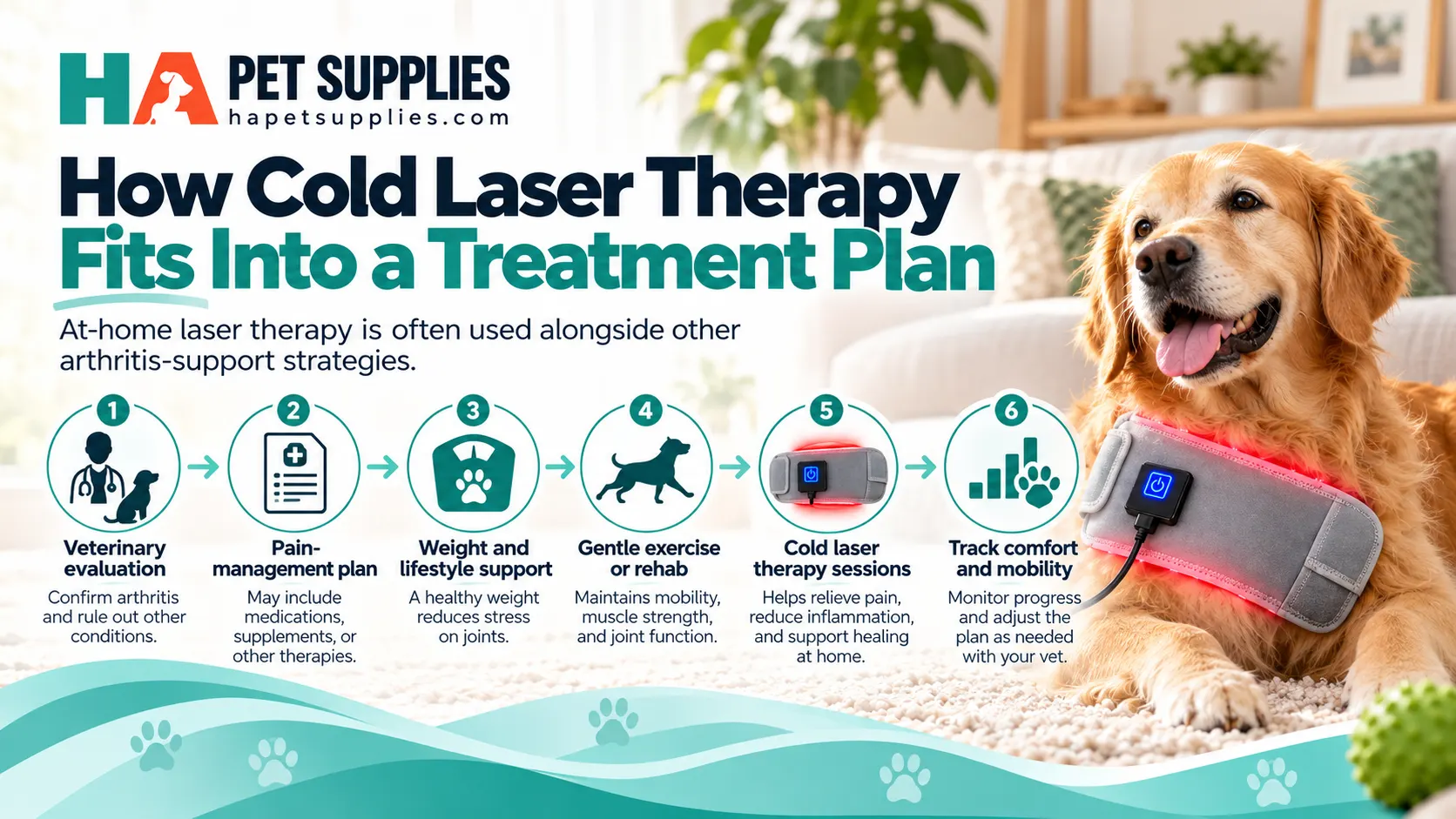
Cold laser therapy considered alongside comprehensive dog arthritis care
3D Infographic — Seven Steps Toward Better Joint Care
These steps are coordinated elements of a care plan, not a promise that every dog will need all seven interventions. Use the cards above to review each step — click or tap to see details.
9. Cold Laser Therapy vs Other Treatments for Dog Arthritis
Many owners wonder whether a cold laser device is a better investment than medication, rehabilitation, or joint supplements. There is no universal answer.
| Treatment | Main Purpose | Evidence and Limitations |
|---|---|---|
| Veterinary pain medication | Reduce pain and inflammation | Established options exist, but require medical monitoring |
| Weight management | Reduce excess joint loading and support health | Important, particularly for overweight dogs |
| Controlled exercise | Maintain strength and mobility | Must be tailored to the individual dog |
| Rehabilitation | Improve functional movement | Often requires professional assessment |
| Cold laser therapy | Potential complementary comfort support | Evidence is limited and device protocols differ |
| Joint supplements | Possible nutritional support | Benefits depend on the product and evidence |
| Home adjustments | Reduce everyday physical difficulty | Helpful for accessibility, not a cure |
Is cold laser therapy better than medication?
There is not enough evidence to conclude that cold laser therapy generally replaces established medication for canine osteoarthritis. Medication may be essential for appropriate pain control. Veterinarians sometimes combine pharmacological and non-pharmacological approaches because they address different parts of the problem.
Is rehabilitation more important?
Rehabilitation and photobiomodulation serve different purposes. Rehabilitation focuses on physical function, muscle strength, movement patterns, and other measurable goals. Light therapy may be considered as an adjunct when appropriate.
Are joint supplements enough?
Joint supplements vary considerably in composition and supporting evidence. They should not be assumed to provide adequate pain control for dogs with significant arthritis.
10. How to Choose a Cold Laser Therapy Device for Dogs
If you and your veterinarian decide that photobiomodulation is worth considering, the next challenge is choosing appropriate equipment.
Confirm the light source
Ask whether the device uses lasers, LEDs, or a combination. These technologies may have different beam characteristics and treatment capabilities.
Check wavelength and power
Wavelength and output power influence light exposure. Without clear technical information, it becomes difficult to compare products responsibly.
Review the treatment instructions
A credible device should provide instructions covering operating settings, treatment locations, cleaning, storage, supervision, and safety precautions.
Check the fit
A wearable wrap must suit your dog’s anatomy. It should not restrict breathing or movement. Look for adjustable fastenings and clear size information.
Assess the controller
Review the available controls and the process for starting and ending treatment. Do not assume that an illuminated power button indicates a built-in treatment timer.
Verify product claims
Be cautious of claims that a product permanently cures arthritis, rebuilds damaged cartilage, or guarantees improved mobility. The FDA’s explanation of animal-device regulation notes that animal devices are not subject to the same premarket approval requirements as human medical devices.
Is the HA Pet Supplies wrap worth considering?
The HA Pet Supplies product imagery shows a gray wearable wrap, adjustable fastening sections, and a wired controller with an illuminated blue power symbol. These are visible design features rather than proof of clinical effectiveness. Before making a purchase, verify its technical capabilities and discuss its suitability with your veterinarian.
For detailed operating considerations, read our companion article, Cold Laser Therapy for Dogs at Home: How to Use It Safely, How Often and What to Expect.
11. What Results Should You Expect From Cold Laser Therapy?
One of the most common buyer frustrations is expecting a visible change immediately. Dogs with arthritis may have longstanding joint degeneration, muscle weakness, and multiple sources of discomfort.
Possible signs of improvement
Some owners may notice easier rising after rest, smoother movement, or improved willingness to walk. A dog may appear more comfortable performing familiar tasks. These observations are useful, but they do not prove that light therapy alone caused the improvement.
What if nothing changes?
Do not automatically increase treatment time or frequency. The dose may be inappropriate, the therapy may not be effective for the individual dog, or another health problem may need attention. Contact your veterinarian to review the treatment plan.
What should you not expect?
Do not expect a home wrap to cure degenerative arthritis, repair severely damaged joints, or replace surgery when surgery is medically necessary. The aim should be meaningful, measurable improvement in comfort or daily function.
Why small improvements matter
For a senior dog, improved comfort may mean being able to stand and walk to the garden without obvious distress. For another dog, progress might involve tolerating an appropriate short walk. These functional goals can matter more than dramatic advertising claims.
12. Daily Home Adjustments That Help Dogs With Arthritis
Medical treatment is important, but the home environment also influences your dog’s comfort. Many practical modifications are inexpensive and easy to implement.
Provide non-slip walking surfaces
Slippery floors make it harder for dogs with weak or painful joints to maintain traction. Rugs or appropriate non-slip mats can improve footing.
Make resting areas accessible
Choose a supportive bed in a location your dog can reach without climbing stairs or jumping.
Consider ramps
A suitable ramp may reduce the need to jump into a vehicle or onto furniture. Introduce ramps gradually and make sure they have secure footing.
Adjust food and water placement
Keep essential items easy to reach. Some dogs benefit from changes to bowl placement, although the ideal arrangement depends on body size and mobility.
Maintain a predictable routine
Consistent daily activity can make it easier to monitor changes in comfort. Avoid alternating between complete inactivity and strenuous exercise.
Keep weight under control
An appropriate body condition can reduce unnecessary stress on painful joints. Your veterinarian can help you determine a healthy weight.
Maintain mental stimulation
Dogs with reduced physical activity still need enrichment. Gentle scent-based games, calm interaction, and suitable low-impact activities can support well-being.
For additional pet-care equipment, browse the HA Pet Supplies dog supplies collection and choose items based on your dog’s actual needs.
13. How to Monitor Dog Arthritis and Joint Pain Over Time
Tracking progress is especially important when a dog receives multiple treatments. Without records, owners may find it difficult to decide whether a new therapy has provided additional benefit.
Establish a starting point
Observe your dog’s usual movement before making changes. Record how easily the dog stands, walks, climbs familiar steps, and settles after activity.
Use the same activities for comparison
Compare similar situations. For example, evaluate the dog’s ability to rise after normal resting periods rather than comparing completely different conditions.
Record pain-related behavior
Watch for changes in mood, sleep, appetite, willingness to move, and sensitivity to handling.
Keep a simple mobility chart
| Activity | Baseline Observation | Follow-Up Observation |
|---|---|---|
| Rising after rest | Describe difficulty | Record changes |
| Walking | Note pace and comfort | Compare with baseline |
| Stairs | Note hesitation | Record progress or decline |
| Play | Record participation | Assess willingness |
| Resting | Note repositioning or discomfort | Record changes |
Use validated assessment methods where possible
Veterinary professionals may use structured pain questionnaires alongside clinical examinations. The AAHA chronic pain assessment recommendations explain how owner observations can contribute to evaluating chronic pain.
Review the results with your veterinarian
Improvement should not automatically lead to stopping medication. Likewise, a poor response should not lead to increasing light exposure independently.
Interactive Mobility Tracker
This tracker is educational and cannot diagnose arthritis. Share meaningful changes with your veterinarian.
14. Seven Common Dog Arthritis Treatment Mistakes
Well-intentioned owners sometimes make mistakes because they are desperate to help their dogs. Recognizing these problems can prevent unnecessary discomfort and wasted spending.
Assuming every limp is arthritis
Limping can have many causes. Treating an undiagnosed condition may delay necessary medical care. Obtain an appropriate veterinary examination.
Waiting until the dog can barely walk
Dogs may show subtle signs of chronic pain long before mobility becomes severely affected. Arrange an assessment when persistent changes first appear.
Giving human pain medication
Human medicines may be toxic or inappropriate for dogs. Use only veterinary-approved medication as prescribed.
Expecting a supplement to cure arthritis
Supplements cannot reliably reverse structural joint damage. Treat them as potential adjuncts only when supported by veterinary advice.
Stopping exercise completely
Long-term inactivity can contribute to muscle weakness. Follow an individualized controlled exercise plan.
Using a laser device without understanding it
Unverified settings, excessive exposure, or incorrect placement can create risks. Confirm device specifications and follow instructions.
Changing several treatments without monitoring
When multiple changes occur at once, it becomes difficult to understand which measures are helping. Establish clear goals and a consistent reassessment plan.
Click or tap each card to reveal the safer alternative reminder.
15. Why Consider HA Pet Supplies for Supportive Dog Care?
Pet owners researching arthritis treatments often want products that fit naturally into daily routines. HA Pet Supplies provides a range of dog-care products through its online store, including its dog cold laser therapy wrap.
Practical wearable design
The product imagery shows a flexible gray wrap with fastening sections designed for positioning around selected body areas. A wearable design may appeal to owners who prefer an alternative to holding a device throughout a supervised session.
Visible controller
The wrap includes a wired controller with an illuminated blue power symbol in the product photographs. Owners should verify the controller’s available functions before purchase.
Product information matters
The most important buying consideration is whether the product fits the dog’s needs and whether its operating information is sufficiently clear. Review the HA Pet Supplies dog cold laser therapy product listing and request any missing specifications.
Explore supportive dog-care products
If you are improving your dog’s home environment, the HA Pet Supplies online shop can help you explore other everyday supplies.
Get assistance before purchasing
If you have questions about the device’s dimensions, operating instructions, or availability, contact HA Pet Supplies. For product enquiries and quotations, use the HA Pet Supplies request a quote page.
The appropriate purchasing decision is one based on realistic expectations, suitable equipment, and professional veterinary guidance.
16. Frequently Asked Questions About Dog Arthritis and Joint Pain
Early signs may include stiffness after rest, reduced enthusiasm for walks, difficulty rising, hesitation before jumping, and changes in normal activity. Some dogs show behavioral changes before obvious limping. A veterinarian should investigate persistent symptoms.
Osteoarthritis is generally a progressive degenerative condition. Treatment aims to manage discomfort, maintain mobility, and protect quality of life. Some underlying orthopedic problems may require surgical treatment, but this does not mean all degenerative changes can be reversed.
Some veterinary studies suggest possible pain and function benefits for selected dogs. However, the evidence remains limited, and results vary. Photobiomodulation may be considered a complementary therapy rather than a guaranteed solution.
There is insufficient evidence to conclude that it generally replaces established veterinary medication. Pain management often requires several approaches working together. Never discontinue medication without veterinary approval.
Some senior dogs may be candidates for complementary photobiomodulation after veterinary assessment. However, age alone does not determine suitability. The dog’s diagnosis, health, and the device’s technical characteristics are more important.
Hip dysplasia can contribute to osteoarthritis and mobility difficulties. A veterinarian may consider photobiomodulation as an adjunct in selected cases. However, a therapy wrap cannot correct abnormal hip structure or instability.
The appropriate schedule depends on the device, diagnosis, and treatment protocol. There is no universal recommendation suitable for every home-use product. Follow verified device instructions and veterinary guidance.
There is insufficient clinical evidence that a home-use therapy wrap regenerates cartilage damaged by canine osteoarthritis. Owners should focus on realistic goals such as comfort and functional mobility.
Many dogs with stable osteoarthritis benefit from appropriate controlled exercise. However, the amount and type of activity should reflect the individual dog’s condition. Avoid forcing exercise when pain is significant.
Weight management can be particularly valuable for overweight dogs. Reducing excess weight decreases unnecessary mechanical loading and may support improved mobility. A veterinarian can recommend a suitable nutrition plan.
Seek urgent veterinary care. Sudden inability to stand, paralysis, or severe pain may indicate a serious medical condition. Do not attempt to manage these symptoms with a home laser device.
They should not be assumed to provide adequate treatment for significant pain. Evidence varies by formulation, and many dogs require established veterinary interventions. Discuss supplement use with your veterinarian.
Photobiomodulation may be included in some professional rehabilitation programs. However, recent surgical sites require special consideration. Do not apply a home device over a surgical area without approval from the treating veterinarian.
Not exactly. The terms are sometimes used interchangeably in marketing, but devices may use lasers, LEDs, or different wavelength combinations. Their treatment characteristics are not necessarily equivalent.
Stop if your dog becomes distressed, develops skin irritation, experiences worsening pain, or if the device becomes damaged or unusually warm. Consult your veterinarian before resuming treatment.
Ask about wavelengths, light source, power output, operating instructions, safety warnings, sizing, intended treatment areas, and evidence for advertised claims. Do not rely solely on photographs or promotional statements.
Monitor familiar activities such as standing, walking, sleeping, and playing. Record changes consistently and review them with your veterinarian. The goal is improved comfort and function, not simply completing a particular number of treatment sessions.
Many dogs with arthritis can maintain a good quality of life through appropriate veterinary care, environmental changes, weight management, and tailored activity. The treatment plan may need adjustment as the condition progresses. Early recognition and regular monitoring are important.
17. Final Verdict — Managing Dog Arthritis and Joint Pain With the Right Treatment Plan
Dog arthritis and joint pain can make daily life more difficult, but a diagnosis does not mean that every comfortable activity must disappear. The most valuable approach is a coordinated plan that addresses the dog’s actual needs.
That plan often begins with veterinary assessment and appropriate pain control. Weight management, controlled exercise, rehabilitation, and supportive home modifications may provide additional benefits.
Cold laser therapy may be considered as a complementary option for selected dogs, but it should not be viewed as a guaranteed cure. Scientific research suggests possible benefits in certain circumstances, yet available evidence remains limited and the performance of individual devices varies.
For owners considering home-use photobiomodulation, choosing suitable equipment and understanding its operating limitations are essential.
If you want to investigate a wearable product, explore the HA Pet Supplies dog cold laser therapy wrap and confirm its full technical specifications before purchasing.
For broader pet-care information, visit the HA Pet Supplies website and explore practical articles in the HA Pet Supplies blog.
If you need product details before making a decision, you can request information and a quotation from HA Pet Supplies.
The most important goal is not finding the fastest-selling treatment. It is helping your dog remain as comfortable, active, and engaged as possible through appropriate, evidence-informed care.
Even small improvements in everyday movement can matter. A more comfortable walk, an easier morning rise, or a relaxed afternoon beside the family can make a meaningful difference.
Because your dog deserves care based on understanding, patience, and genuine attention to their needs.
HA Pet Supplies — Happy Pets. Healthy Pets. Happy Life.