
Your cat just had surgery. You need fast, clear answers — not sales pressure.
Quick answer: Which cat recovery collar is best after surgery?
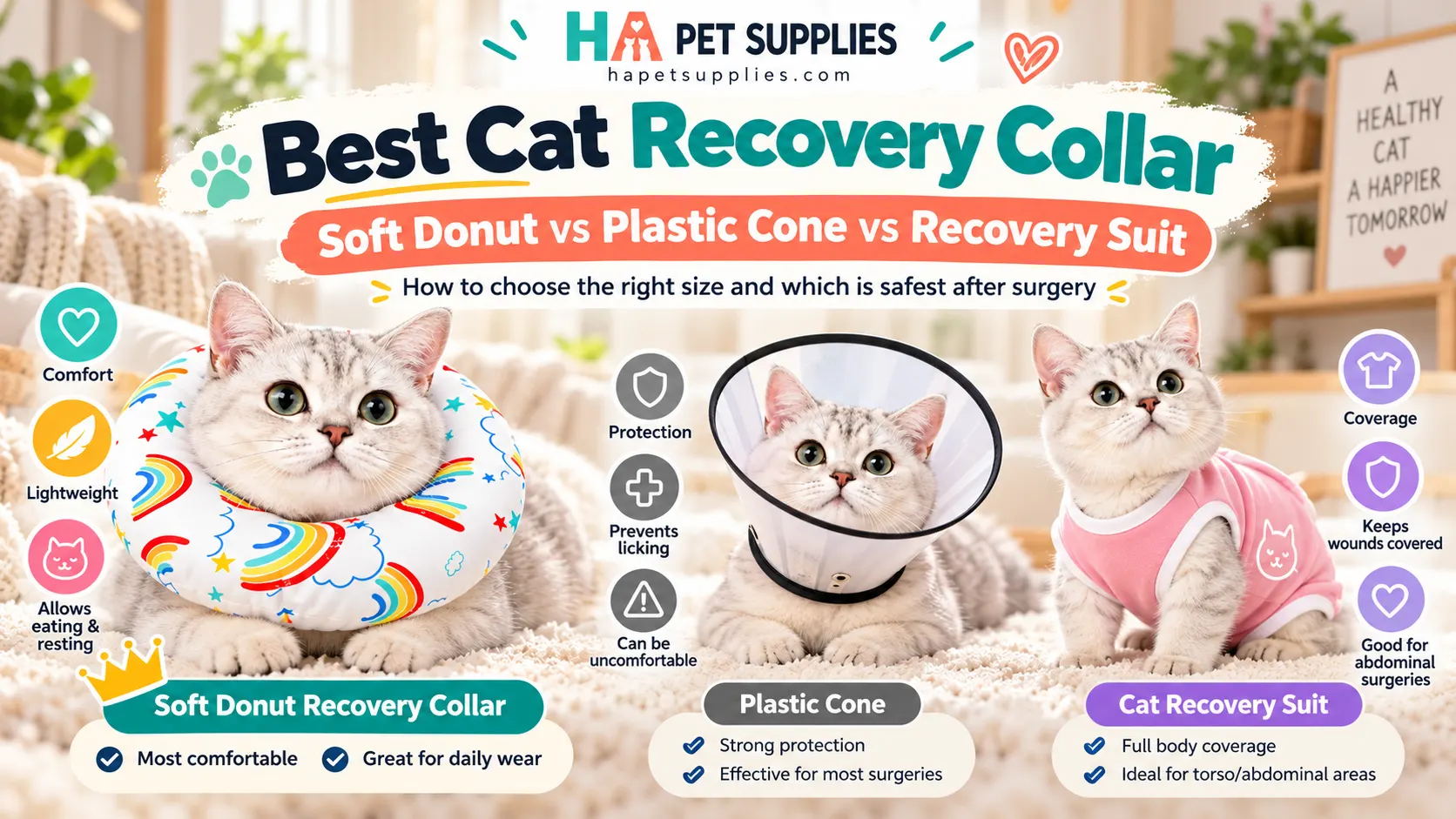
There is no single “best” option for every cat. The right choice depends on your cat’s surgery, incision location, and flexibility.
- Traditional plastic cone: Often provides the broadest protection against licking and chewing, especially for leg, tail, and lower-body wounds.
- Soft donut recovery collar: May offer better visibility and cushioned comfort, but some cats can still reach abdominal or lower-body incisions.
- Recovery suit: May be suitable for selected abdominal or torso incisions if your veterinarian approves it.
According to the American College of Veterinary Surgeons, protective equipment must be selected based on the incision’s location and the individual animal’s needs.
📋 Table of Contents
- 1. Why the best cat recovery collar matters
- 2. Soft donut vs plastic cone vs recovery suit
- 3. Which recovery collar is safest for different surgeries?
- 4. Seven essential features of the best collar
- 5. How to choose the correct recovery collar size
- 6. HA Pet Supplies cat recovery collar size guide
- 7. How to test whether a collar fits properly
- 8. Helping your cat adjust to its recovery collar
- 9. Common mistakes to avoid when buying
- 10. How long cats need protective collars
- 11. When to contact your veterinarian
- 12. Best cat recovery collar FAQs
- 13. Final buying checklist and recommendation
1. Why choosing the best cat recovery collar matters
Cats are naturally flexible groomers. After surgery, that same instinct can damage a healing incision. Licking or biting can introduce bacteria, loosen stitches, or reopen a wound. A properly selected recovery collar creates a protective barrier between your cat’s mouth and the injured area. The VCA Animal Hospitals guide to surgical incision care explains why preventing licking is a critical part of postoperative care.
But comfort alone is not enough. Imagine buying a soft collar your cat loves — then watching it bend around and lick its stitches. The collar may feel nice, but it has failed its primary purpose. An effective device must prevent wound access, fit securely, and support eating, drinking, and resting. If any of those fail, the collar needs adjustment or replacement.
2. Best cat recovery collar comparison: soft donut vs plastic cone vs recovery suit
Soft Donut Collar
A padded ring worn around the neck. Offers better visibility and cushioned comfort. Some cats eat and sleep more easily.
Limitation: Flexible cats may still reach abdominal, leg, or tail wounds.
Best for: Cats whose vet has confirmed the wound is unreachable.
Plastic Cone
Rigid plastic extends beyond the face, blocking access to many body areas. Commonly supplied by vets.
Limitation: Can bump furniture, restrict visibility, and feel awkward.
Best for: Lower-body, leg, tail, and eye procedures requiring reliable reach prevention.
Recovery Suit
Soft garment covering selected body areas. Allows unobstructed head movement and may suit abdominal incisions.
Limitation: Does not protect face, ears, tail, or legs. Must stay clean and dry.
Best for: Vet-approved coverage of specific torso or abdominal wounds.
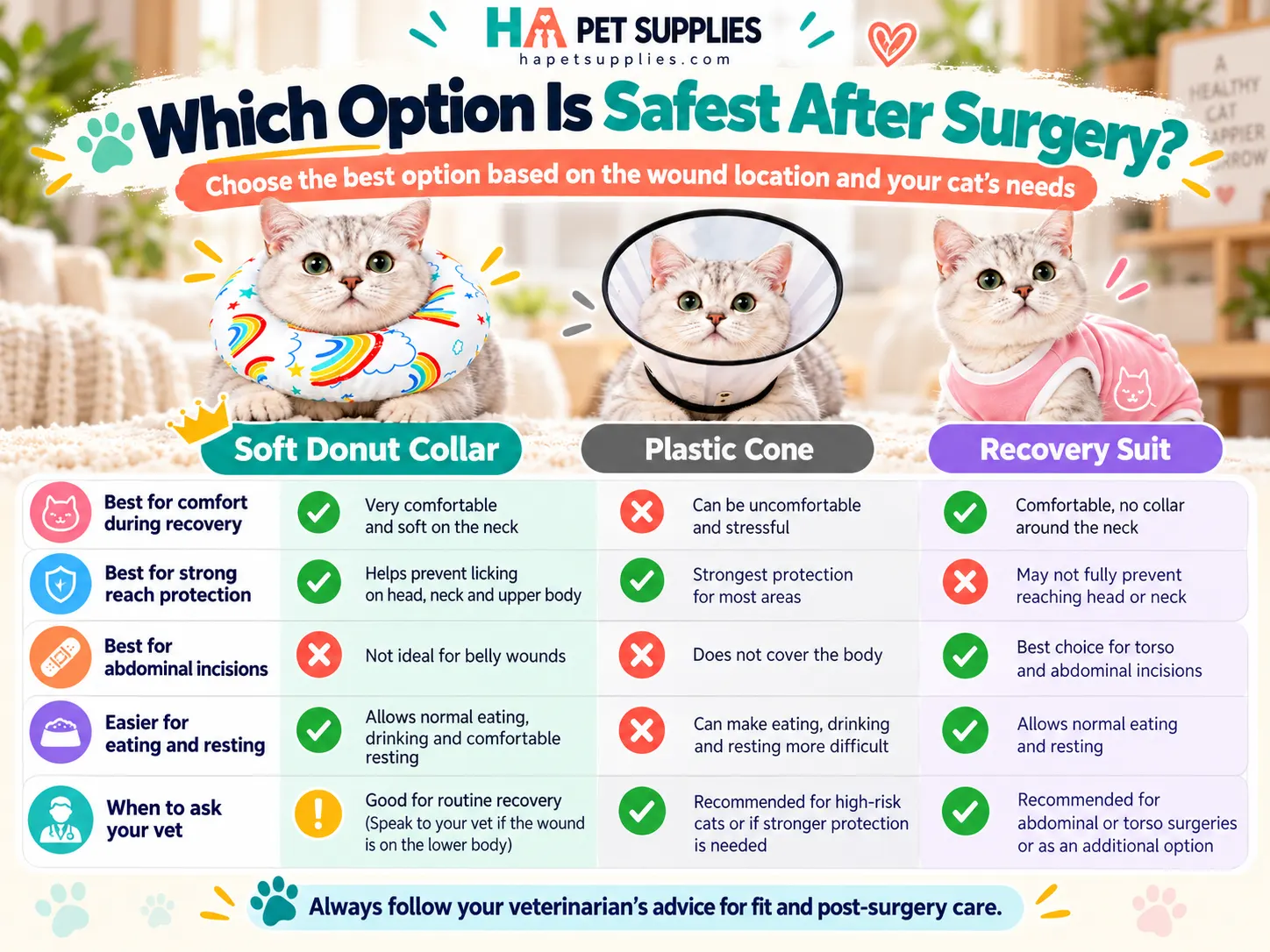
For a detailed breakdown of the advantages and limitations of each option, see the full comparison table below.
| Feature | Soft Donut Collar | Plastic Cone | Recovery Suit |
|---|---|---|---|
| Neck comfort | Soft padded surface | Rigid or semi-rigid | No large neck barrier |
| Visibility | Often better | May be restricted | Usually unobstructed |
| Eating and drinking | May be easier | May need bowl adjustments | Usually accessible |
| Lower-body wound protection | Frequently limited | Often stronger | Depends on coverage |
| Abdominal incision protection | May be insufficient | Often effective | Can be effective if approved |
| Head or face protection | Limited | Often better | Usually insufficient |
| Easy cleaning | Depends on fabric care label | Usually wipe-clean | Depends on garment |
| Secure fit | Correct ring size and closure | Correct length and neck fit | Correct body fit |
| Suitable for every surgery | No | No | No |
| Veterinary approval required | Yes for surgical substitution | Follow prescribed instructions | Yes for surgical substitution |
The PetMD guide to cone alternatives reinforces that padded rings and inflatable collars may allow animals to reach protected areas — always verify wound access before relying on a soft option.
3. Which cat recovery collar is safest for different surgeries?
The safest choice begins with the location of the incision, not the design of the collar. Here is how to think about common procedures:
After a spay surgery
A spay involves an abdominal incision. A rigid plastic cone often restricts bending effectively. A properly fitted recovery suit may also work if your vet approves. A soft donut collar is less reliable because flexible cats can still reach their belly. The PetMD spayed cat aftercare guide notes soft alternatives are acceptable only when the cat cannot reach the incision.
After a male cat neuter
Smaller incisions, but licking must still be prevented. Do not assume a donut is adequate just because the wound is small. Follow your vet’s discharge plan.
After leg or paw surgery
Leg and paw wounds are challenging because cats can bend and reach in many positions. A correctly sized plastic cone is often needed. The VCA guide to bandage and splint care emphasises preventing licking and chewing.
After eye or facial surgery
Rigid cones may be necessary to prevent rubbing or pawing at the face. Never switch protective equipment after eye surgery without veterinary approval.
After skin injury treatment
Minor wounds may allow a soft padded collar. Infected or painful skin conditions need veterinary treatment, not just a collar. The PetMD wound care for cats guide explains why severity matters.
4. Seven essential features of the best cat recovery collar
1. Effective protection against licking — the collar must block wound access, regardless of comfort or appearance.
2. Comfortable material — padded fabric can reduce hard edges; check seams and stitching.
3. Proper neck fit — typically two fingers should fit between the collar base and the neck, but follow manufacturer instructions.
4. Adequate size and reach restriction — outer diameter and depth matter as much as neck opening.
5. Comfortable eating and drinking — shallow bowls help; if your cat cannot eat, contact your vet.
6. Secure and simple adjustment — adjustable closures are helpful, but no loose drawstrings that can be chewed.
7. Practical cleaning and maintenance — plastic wipes clean; fabric may need washing according to care labels.
The Cats Protection post-operation guidance includes practical advice about protective-collar fitting, feeding, and creating a suitable recovery environment.
5. How to choose the right cat recovery collar size
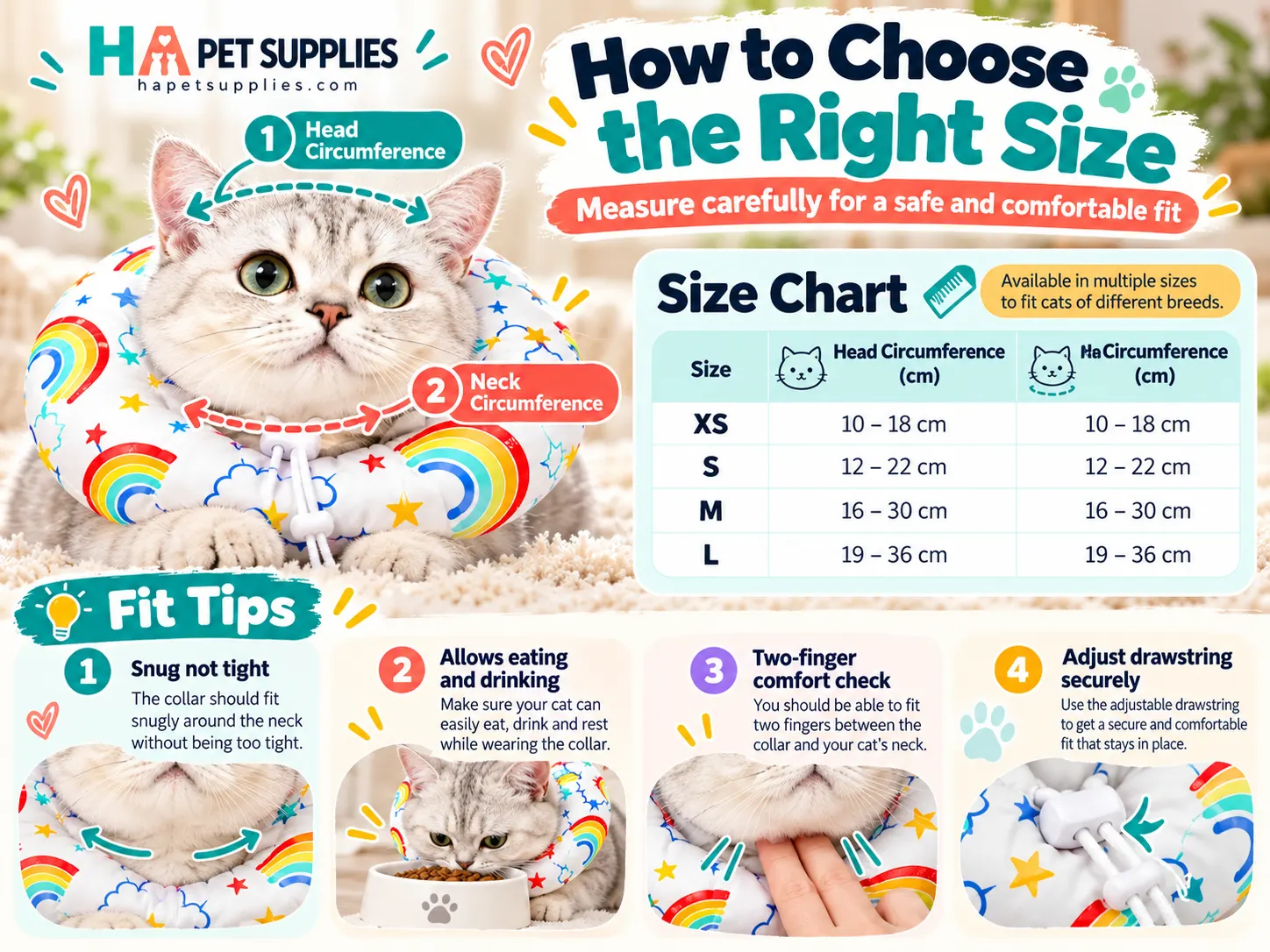
Weight and breed are not enough. Cats with similar weights can have very different neck and head measurements. Follow these steps:
- Prepare a flexible measuring tape — or a piece of non-stretch string measured against a ruler.
- Measure the neck — gently around where the collar will sit, without pulling tight.
- Check head measurement if required — some manufacturers size by head circumference. Confirm the method.
- Compare against the size chart — if between sizes, check outer diameter and adjustment range.
- Check the full collar shape — neck fit alone is not enough; observe whether the collar restricts wound access.
- Test the fit without forcing — introduce gently, observe walking, resting, and head lowering.
- Perform a supervised protection check — watch whether your cat can reach the wound. If it can, the collar has failed.
6. HA Pet Supplies cat recovery collar size guide
| Size | Published circumference range | Selection guidance |
|---|---|---|
| XS | 10–18 cm | Smallest published fitting range |
| S | 12–22 cm | Small adjustable fitting range |
| M | 16–30 cm | Medium adjustable fitting range |
| L | 19–36 cm | Largest published fitting range |
The product image identifies these values as head circumference. Confirm with the supplier before purchase. If your cat falls between sizes, do not guess — ask. A larger collar is not automatically safer; it may shift or interfere with movement. Kittens need careful fitting, and breed alone is not reliable.
You can review the HA Pet Supplies Cat Recovery Collar for available options and sizing details.
7. How to know if your cat recovery collar fits properly
Signs of a comfortable fit: normal breathing, easy swallowing, no excessive rubbing, collar stays in place, and — most importantly — your cat cannot reach the wound.
Signs too tight: visible pressure, difficulty swallowing, persistent distress, skin irritation. Difficulty breathing is an emergency — relieve the obstruction and seek urgent care.
Signs too loose: rotates excessively, slides off, cat can push it backward or escape, or reach the wound.
If your cat walks backward, that is not automatically a defect — but persistent panic or unsafe movement requires veterinary attention. The VCA guidance on adapting to Elizabethan collars notes that cats may initially resist and should be supervised during early adjustment.
Can a soft donut collar be worn overnight? Only if your veterinarian approves the specific device for continuous protection. Never replace a protective cone with a donut overnight simply because it appears softer.
8. Helping your cat adjust to its recovery collar
A protective collar changes how your cat navigates the world. Instead of removing it, make the environment easier.
Create a quiet recovery area — one calm room, remove clutter, block high furniture, keep food, water, and litter box within reach. The ACVS recovery guidance recommends controlling the home environment and following movement restrictions.
Offer comfortable bedding — low, stable surface, clean blanket, check for loose bedding that could catch the collar.
Make food and water accessible — wide, shallow dishes. If your cat cannot eat, contact your vet. Do not remove necessary protection without permission.
Keep other pets away initially — they may investigate or try to groom the recovering cat.
Use gentle reassurance — calm voice, no excessive handling, follow your cat’s comfort level.
Watch for pain — if your cat cannot settle, stops eating, hides, or becomes increasingly distressed, contact the clinic. The PetMD surgical recovery guidance explains why changes in appetite and behavior matter.
For additional practical techniques, read the HA Pet Supplies article Cat Hates Recovery Collar? 9 Easy Ways to Help Your Cat.
9. Common mistakes to avoid when buying a cat recovery collar
- Buying the softest collar without checking protection — comfort does not equal safety.
- Selecting based only on cat weight — always measure neck or head circumference.
- Choosing the largest size for extra protection — oversized collars may slip or interfere.
- Assuming a recovery suit protects every wound — it may not cover legs, tail, face, or ears.
- Replacing the vet’s cone without asking — a specific cone may be necessary for your cat’s surgery.
- Removing protection during sleep — cats can lick stitches quickly overnight.
- Ignoring collar hygiene — food, saliva, and dirt can cause irritation.
- Using human medication or home remedies — never give human pain meds or apply unapproved products.
- Assuming the cat is healed because it looks active — energy returns before internal healing completes.
- Ignoring persistent distress — may indicate pain or a complication, not just collar dislike.
10. How long should cats wear a recovery collar after surgery?
For many routine procedures, protection lasts approximately 7–14 days. Some cats need longer. The collar should remain in place until your veterinarian confirms it is no longer necessary. The first few days are especially vulnerable. Even after one week, the incision may itch as it heals — encouraging licking. For detailed timelines and removal guidance, read our Cat Recovery Collar After Surgery guide.
11. When should you contact your veterinarian?
Contact your vet promptly if you notice increasing redness, swelling, discharge, or unpleasant smell around the incision. Missing stitches, an open wound, or repeated licking also require professional advice. If your cat refuses food or water, becomes unusually weak, or appears increasingly painful, call the clinic. Difficulty breathing, collapse, or other severe symptoms require emergency care. The VCA post-operative instructions for cats explain that incision problems and major behavior changes should be reported to the treating veterinary team.
If your cat has already licked its stitches: do not panic, but do not ignore it. Prevent further access, inspect the incision without squeezing, and contact your vet if you see damage, bleeding, or missing stitches.
12. Frequently asked questions about the best cat recovery collar
13. Final buying checklist: choose the best cat recovery collar with confidence
✅ Recovery collar buying checklist
- ☐ My veterinarian has approved the type of protection.
- ☐ I know the exact location that needs protection.
- ☐ I have checked the correct size and measurement method.
- ☐ The collar fits without excessive pressure or slipping.
- ☐ My cat cannot reach the wound while wearing the device.
- ☐ My cat can breathe, swallow, eat, and drink safely.
- ☐ I understand how to clean and maintain the product.
- ☐ I know when to contact my veterinarian and when removal is allowed.
Final recommendation: Choosing the best cat recovery collar should never be rushed. Soft donut collars offer padded comfort. Plastic cones often provide stronger reach prevention. Recovery suits may suit selected abdominal incisions. The safest choice depends on your cat’s actual recovery requirements.
For owners seeking a padded alternative, the HA Pet Supplies Cat Recovery Collar offers a soft fabric design with adjustable drawstring and multiple size options. It should only replace prescribed protection when your vet confirms it is appropriate.
Browse the HA Pet Supplies cat supplies collection for other feline care products or explore the complete HA Pet Supplies online shop. If you have product questions or need size clarification, use the HA Pet Supplies contact page. For quantity or purchasing inquiries, use the HA Pet Supplies request a quote page.
Help your cat recover with suitable protection. The best cat recovery collar is not necessarily the most expensive, the largest, or the softest. It is the one that keeps your cat safely protected while supporting a manageable recovery experience.
Medical disclaimer: This article is intended for general educational purposes. Always follow your veterinarian’s postoperative instructions. Recovery collars and suits do not replace medical treatment, prescribed medications, or professional wound assessment.
For more pet care resources, visit the HA Pet Supplies homepage.