
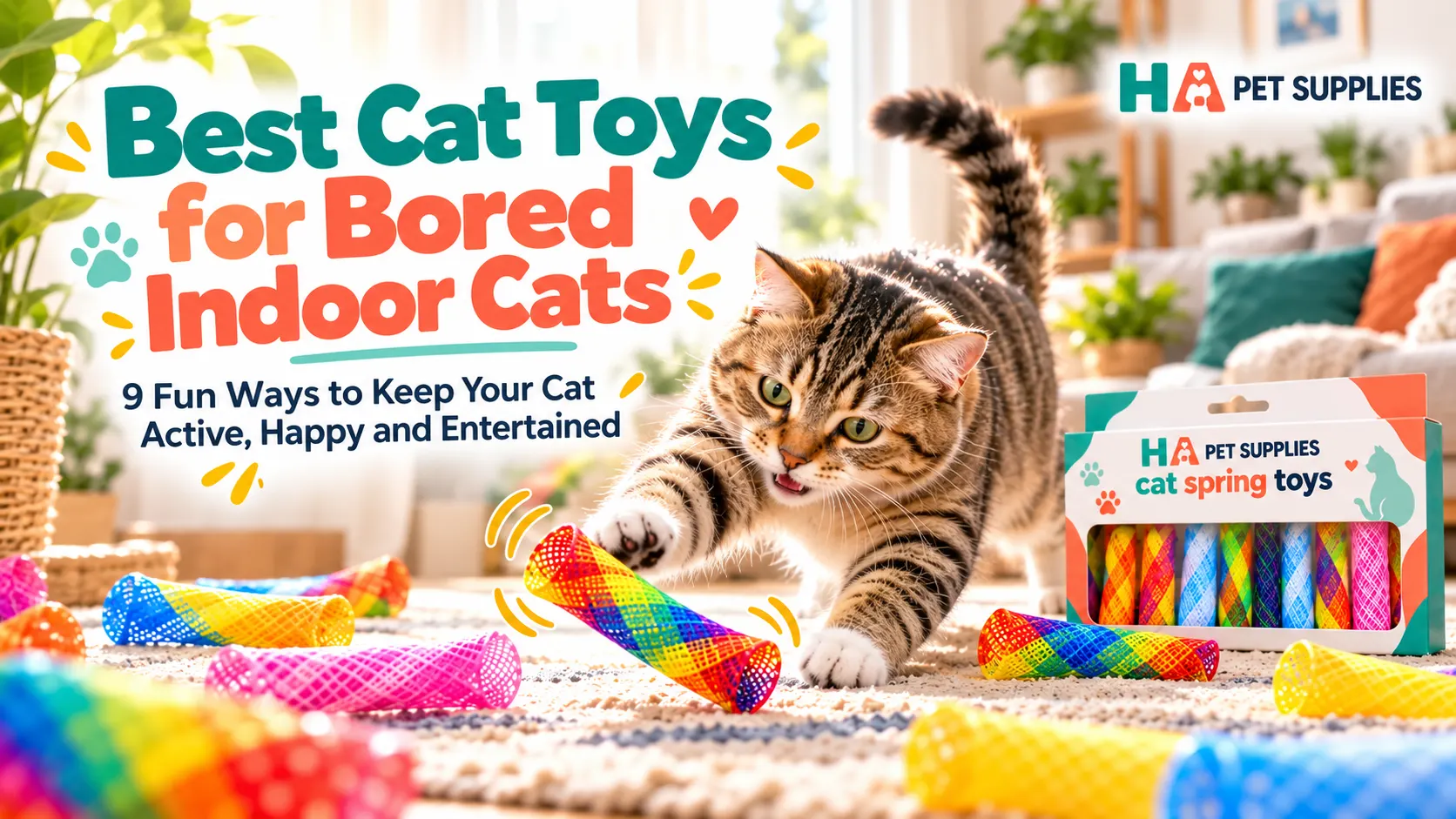
HA Pet Supplies spring toys for curious and active indoor cats
Your cat has food, a warm bed, and a comfortable home. So why does it still seem bored?
Maybe your cat sleeps all afternoon, scratches furniture, meows repeatedly, or suddenly races around the house late at night. Perhaps you have already purchased several toys, but your cat ignores them after a few minutes.
If this sounds familiar, you are probably searching for the best cat toys for bored indoor cats that genuinely encourage activity rather than becoming another forgotten purchase. The good news is that you do not necessarily need expensive electronic toys, a large home, or hours of uninterrupted free time. Often, the most useful solution is a combination of simple toys, predictable interactive play, and an indoor environment that supports your cat’s natural behaviors.
In this guide, you will discover nine practical ways to entertain an indoor cat, how to recognize possible boredom, which toy types suit different cats, and how to introduce lightweight spring toys into your pet’s daily routine. We will also explain why some cats refuse toys, how to choose safer products, and when changes in your cat’s behavior require veterinary attention.
Quick answer: The best cat toys for bored indoor cats usually encourage hunting-related behaviors such as stalking, chasing, batting, pouncing, and capturing. Good choices include lightweight spring toys, wand toys, rolling balls, puzzle feeders, catnip toys, and play tunnels. Variety and safe, regular interaction matter more than buying the largest collection of toys.
If your cat is normally healthy and simply needs more stimulation, start with a short interactive play session today. If your cat has suddenly become inactive, stopped eating, started hiding, or shows other concerning symptoms, contact your veterinarian rather than assuming boredom.
📋 Table of Contents
- Quick solution for a bored indoor cat
- Why indoor cats become bored
- Seven signs your cat needs more stimulation
- Best cat toys for bored indoor cats: nine fun ideas
- Why cat spring toys can be a useful addition
- Cat spring toys compared with other toys
- Choosing toys for kittens, adult cats, and seniors
- How much playtime indoor cats need
- How to entertain your cat when you are busy
- Creating a cat-friendly indoor play environment
- Common mistakes when buying cat toys
- How to introduce HA Pet Supplies Cat Spring Toys
- A seven-day indoor cat enrichment plan
- Safety precautions for indoor play
- Frequently asked questions
- Final recommendations
1. Quick Solution: What to Do When Your Indoor Cat Seems Bored
You have come home from work and your cat is following you everywhere, meowing, knocking objects from shelves, or attacking your ankles. You want something that works now. Start with a simple routine rather than immediately purchasing several new products.
Step 1: Create a safe play area. Choose a comfortable space with enough room for your cat to move. Remove loose cords, fragile objects, sharp items, and small objects that could be swallowed.
Step 2: Introduce a toy that moves. A lightweight rolling toy, spring toy, or wand toy can invite your cat to investigate. If using a spring toy, gently roll it across the floor and allow your cat to observe and pursue it.
Step 3: Encourage natural hunting behavior. Move an appropriate toy in short bursts, occasionally allowing it to stop or disappear behind a safe object. This can encourage stalking, chasing, and pouncing.
Step 4: Allow your cat to succeed. Let your cat catch or capture the toy regularly. Constantly preventing success may reduce enjoyment and increase frustration.
Step 5: Finish positively. When your cat shows signs of slowing down, allow the session to end naturally. Offer praise or a suitable food reward when appropriate. For some cats, following play with their normal meal works well.
A few short, enjoyable sessions can be more practical than trying to entertain a cat continuously. The VCA Animal Hospitals guide to cat play and toys explains that cats naturally stalk, chase, pounce on, and capture moving objects. This is why choosing toys that encourage movement is a sensible starting point.
Quick solution for different situations
My cat keeps attacking my feet. Redirect attention toward an appropriate toy rather than using your hands or feet as play objects.
My cat sleeps all day. Consider introducing short play opportunities during periods when your cat is naturally alert. Remember that cats also need substantial sleep, and sleeping itself is not proof of boredom.
My cat ignores every toy. Experiment with different movements, textures, toy sizes, and play locations. Introduce one option at a time.
My cat gets bored while I work. Provide an enriched environment with safe resting places, scratching opportunities, window views, and suitable supervised play sessions when you are available.
My cat suddenly stopped playing. Do not assume this is boredom. Pain, illness, stress, or aging-related changes may be involved. Seek veterinary advice, particularly if the change is sudden or accompanied by other symptoms.
🎮 Interactive 3D: Indoor Cat Boredom Rescue Plan
Hover to pause rotation. Each face shows one stage of the rescue plan.
🛡️ Safe Space
Remove hazards. Create a comfortable, clear play area.
🎯 Moving Toy
Roll a spring toy or wand lure to spark curiosity.
🐾 Chase & Capture
Let your cat stalk, pounce, and succeed regularly.
⏱️ Short Session
Keep it brief. End while your cat is still engaged.
😌 Relaxation
Allow natural wind-down. Reward with praise or food.
🔄 Repeat Daily
Consistency builds anticipation and reduces boredom.
🖱️ Hover to pause · Watch all 6 stages
2. Why Do Indoor Cats Get Bored?
Living indoors can protect cats from many outdoor hazards, including traffic, predators, and some infectious exposures. However, indoor living does not automatically provide everything a cat needs for a satisfying life.
Cats evolved as hunters. Even when their nutritional requirements are met, they may still be motivated to investigate movement, explore unfamiliar objects, climb, hide, scratch, and practice hunting-related behavior. A comfortable home does not eliminate these instincts.
According to the Feline Veterinary Medical Association’s indoor and outdoor lifestyle guidance, indoor cats need opportunities for simulated hunting, foraging, play, vertical exploration, and access to appropriate resting areas.
Lack of movement and novelty
Imagine spending every day in the same room with identical objects and no interesting activities. Even when your basic needs are satisfied, your environment may eventually become unstimulating. Cats can encounter similar limitations. A toy that never moves or changes position may eventually attract less attention. This is one reason why many cats respond to toys that roll, bounce, flutter, or move in ways that resemble potential prey.
Limited opportunities for hunting behavior
Wild and free-ranging cats perform sequences of searching, observing, stalking, pursuing, and capturing prey. Indoor cats do not need to hunt for survival, but suitable play can provide opportunities to perform portions of these behavioral sequences. The Feline Veterinary Medical Association’s environmental needs guidelines highlight the importance of creating environments that support natural feline behaviors. For pet owners, this means enrichment is not simply a luxury — it is part of responsible daily care.
Insufficient interaction
Some cats enjoy spending time near their people and participating in interactive games. Others prefer observing from a distance or playing independently. The important point is that every cat has individual preferences. Your cat may enjoy a five-minute chasing game more than prolonged cuddling, while another may appreciate both. The goal is not to force constant activity — it is to provide meaningful opportunities that your cat can choose to enjoy.
Predictable surroundings
A home with no new experiences may become less interesting. Fortunately, enrichment does not have to involve major changes. Rotating safe toys, opening access to a favorite window perch, placing a cardboard box in a new location, or offering a food puzzle can add variety. The ASPCA’s feline enrichment resource provides practical ideas using ordinary household materials. Always supervise homemade enrichment items and remove anything your cat attempts to chew apart or swallow.
3. Seven Common Signs Your Indoor Cat May Need More Stimulation
Before purchasing new toys, observe your cat. Some behavior changes may indicate that your cat needs additional opportunities for activity or exploration. However, these signs are not a diagnosis of boredom. Similar behaviors can result from pain, illness, anxiety, environmental conflict, or other problems.
Sign 1: Excessive meowing
Some cats become more vocal when seeking food, attention, social interaction, or activity. If your cat frequently follows you around and vocalizes during periods when it previously played, consider whether its routine provides enough interaction. However, unusual vocalization, especially in older cats, deserves veterinary attention.
Sign 2: Scratching inappropriate surfaces
Scratching is a normal feline behavior. Cats scratch to maintain their claws, stretch, and communicate through visual and scent markings. If furniture becomes the preferred scratching location, the problem may be an unsuitable scratching post, poor placement, or insufficient environmental resources. Adding toys alone may not solve it. Provide appropriate scratching surfaces in locations your cat naturally uses.
Sign 3: Frequent attention-seeking behavior
Your cat may repeatedly jump onto your keyboard, knock objects over, or interrupt activities. Sometimes, these behaviors receive attention and become reinforced. Introduce predictable play opportunities and reward appropriate behavior instead of assuming your cat is being deliberately mischievous.
Sign 4: Rough play or ankle chasing
A cat may direct hunting-style behavior toward moving hands, feet, or clothing. This is particularly common in playful younger cats. Use suitable toys to redirect the behavior. Avoid encouraging kittens to attack hands because the behavior can become difficult to manage as they grow.
Sign 5: Restlessness
Your cat may move repeatedly between rooms without settling. This can reflect a desire for activity, but it may also be associated with stress or medical conditions. Look for patterns and accompanying symptoms.
Sign 6: Overgrooming
Excessive grooming can sometimes occur alongside stress or behavioral problems. However, skin disease, parasites, pain, and allergies are also possible causes. If your cat is losing fur, licking one area repeatedly, or developing skin irritation, arrange a veterinary examination.
Sign 7: Reduced interest in familiar activities
If your cat no longer responds to its usual toys, it may need variety. However, a sudden loss of interest can be a warning sign of illness or pain. The PetMD guide to feline boredom and enrichment discusses how some behavioral changes can be associated with insufficient stimulation.
Important: A gradual lack of interest in one particular toy is different from a sudden overall decline in your cat’s activity, appetite, or behavior.
When to contact your veterinarian
Seek advice promptly if your cat is not eating, appears painful, repeatedly vomits, becomes unusually lethargic, or shows abrupt behavioral changes. Straining to urinate, particularly with little or no urine produced, is an emergency. No toy can replace medical evaluation when your cat is unwell.
4. Best Cat Toys for Bored Indoor Cats: 9 Fun Ways to Encourage Activity
When choosing the best cat toys for bored indoor cats, consider how each toy supports different aspects of feline behavior. One cat may prefer chasing objects across the floor. Another may enjoy carrying small toys. A third might prefer climbing, searching for treats, or following a feather wand. There is no single toy that every cat will love.
1. Colorful Cat Spring Toys for Batting and Chasing
Cat spring toys are lightweight objects designed to roll, shift, or move when pushed. They can encourage a curious cat to investigate, bat with its paws, chase the object, and sometimes pick it up. Different styles of spring toys are available. Some are made from molded plastic coils, while others use flexible woven mesh.
For example, HA Pet Supplies Cat Spring Toys feature colorful woven mesh designs intended for indoor play. Their lightweight structure makes them a potential option for cats that enjoy batting small objects and watching them move.
Why consider spring toys? A cat can interact with a lightweight spring toy using relatively simple movements. One paw tap may cause it to roll away. A second tap may change its direction. These changes can create new opportunities for chasing and pouncing.
Spring toys are especially worth trying if your cat frequently shows interest in bottle caps, lightweight balls, or other small rolling objects. However, choose toys that are appropriately sized and intact. Supervise use and remove any spring toy that becomes damaged or develops loose strands.
Practical game: Place one spring toy on a clear floor and gently roll it a short distance. Wait for your cat to investigate. If your cat approaches, allow it to bat the toy. Avoid forcing interaction.
2. Feather Wand Toys for Interactive Hunting Games
Feather wands are useful for cats that enjoy following moving objects. They allow a caregiver to guide movement while keeping hands separate from the toy. Move the lure along the floor, behind safe furniture, or briefly into the air according to your cat’s mobility and preferences. Avoid repeatedly encouraging high or dangerous jumps.
Best for: Cats that enjoy interactive attention and chase-based games.
Safety consideration: Put wand toys away after play, particularly when they include cords, strings, feathers, or other detachable components.
3. Rolling Balls for Floor-Based Play
Lightweight balls provide simple movement-based enrichment. Some cats enjoy batting a ball across a room and running after it. Others prefer carrying a small soft ball. Choose a ball that cannot be swallowed and that is made from materials unlikely to break into dangerous pieces.
4. Puzzle Feeders for Mental Stimulation
Some cats enjoy working to obtain food. Puzzle feeders create opportunities for exploration and problem-solving. Instead of receiving the entire meal in a bowl, a cat may need to move a component or manipulate a toy to release part of its normal food ration. The VCA guide to environmental enrichment for indoor cats recommends puzzle toys and other opportunities to encourage natural behavior. Introduce food puzzles at an easy level.
5. Catnip or Silvervine Toys for Sensory Variety
Some cats respond enthusiastically to catnip. They may rub against a toy, roll around, investigate it, or become temporarily more playful. Other cats show little interest. Responses vary according to the individual animal, including age and sensitivity. Silvervine is another plant-based enrichment option that may interest some cats. Choose products intended for cats and inspect them for loose parts.
6. Cat Tunnels for Hiding and Exploration
A play tunnel can create opportunities to move through, hide, and investigate a confined space. Some cats enjoy running through tunnels during chasing games. Others prefer using them as temporary hiding places. Position the tunnel where your cat can enter and leave comfortably.
7. Ball Tracks for Repeated Batting
Track toys usually contain a ball inside a circular or enclosed pathway. The cat can touch the ball and watch it move while the track keeps it contained. This may appeal to cats that enjoy repeated paw movements without running across the entire room. A stable track toy may also be convenient in smaller homes.
8. Soft Prey-Shaped Toys for Carrying and Pouncing
Small plush mice and other prey-shaped toys can encourage cats to grab, carry, and wrestle with an appropriate object. Some cats enjoy bringing these toys to their owners. Others may hide them beneath furniture. Choose products with securely attached components and appropriate stuffing.
9. Interactive Games Using Several Toy Types
The final idea is not a particular product — it is a method. Combine several appropriate toys into a structured enrichment routine. For example, begin with a short wand-toy chase, introduce a lightweight spring toy for batting, and finish with a food puzzle using part of the cat’s meal. Different activities stimulate different behaviors. The PetMD guide to keeping cats exercised and mentally stimulated describes the value of play sessions that respect a cat’s individual energy and signals.
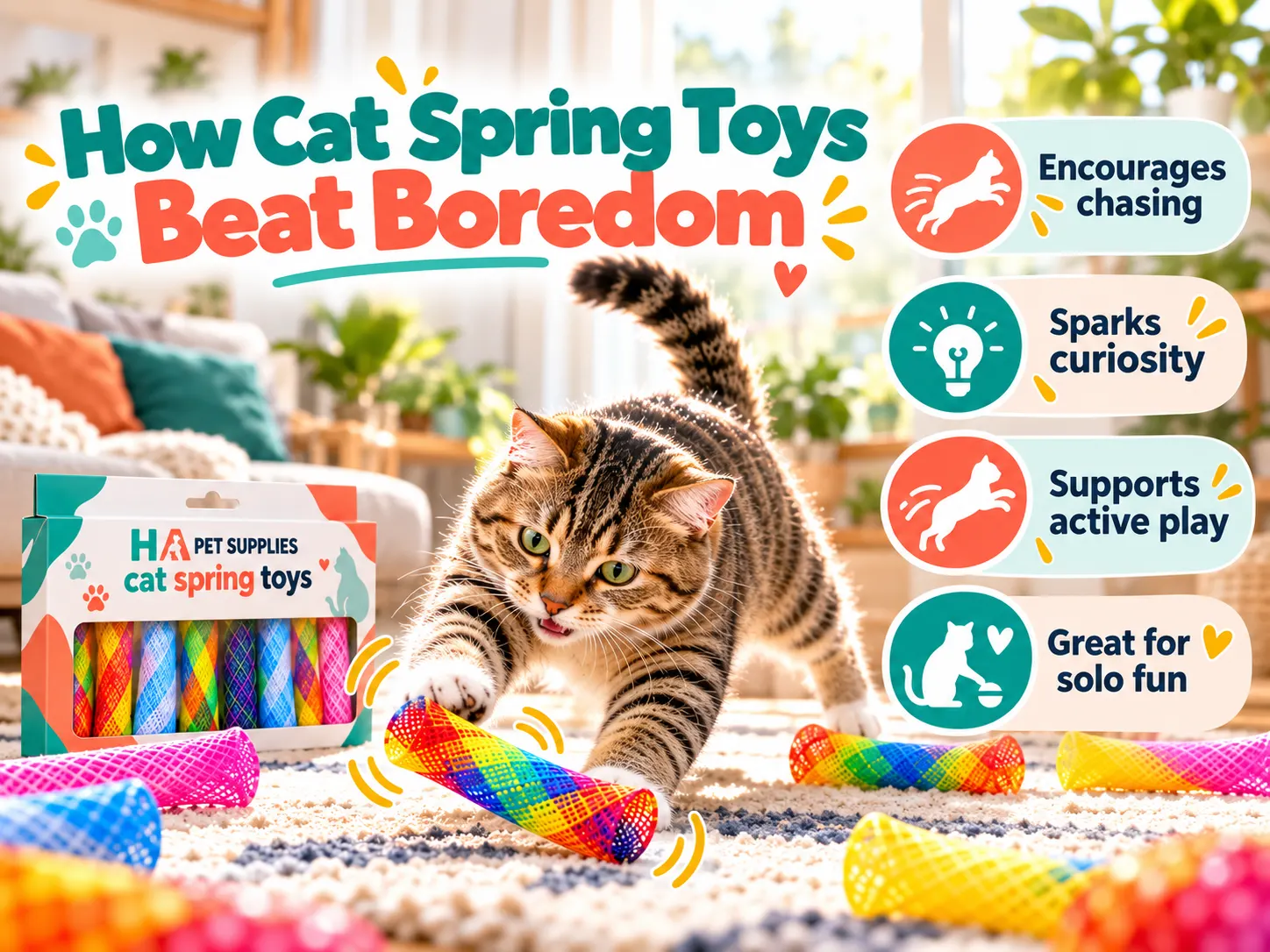
Colorful spring toys encourage indoor cats to bat, chase and play
🎡 Interactive 3D: The Nine-Toy Indoor Enrichment Wheel
Hover over each segment to explore the toy type.
Spring Toys
Feather Wand
Rolling Balls
Puzzle Feeder
Catnip Toys
Cat Tunnel
Ball Track
Prey Toys
Mixed Games
5. Why Cat Spring Toys Can Be a Useful Addition to Indoor Play
With so many available options, why consider cat spring toys specifically? Their appeal is often related to simplicity. A spring toy does not necessarily require batteries, complicated setup, or a large dedicated play space. Lightweight designs can respond to a cat’s paw movements.
Lightweight movement
A lightweight spring toy can move after a relatively small push. This may encourage interaction from cats that enjoy batting objects. It also allows owners to create simple games without requiring complex equipment.
Unpredictable movement
Depending on its design and the surface, a spring toy may roll or move in changing directions. Movement is often more relevant to a cat’s interest than a toy’s appearance alone. A cat may follow a moving toy because it resembles some aspects of prey behavior.
Colorful appearance
Bright colors make toys easy for owners to notice and retrieve. Cats have different color vision from humans, so it is inaccurate to assume that every bright color looks equally vivid to a cat. Movement, contrast, texture, and individual preferences can all influence interest.
Opportunities for independent interaction
Some cats enjoy batting suitable toys when an owner is nearby but not directly participating. However, do not assume that every spring toy is appropriate to leave with a cat unsupervised. Woven mesh can become damaged, and individual cats may chew or ingest toy materials. Inspect toys before play and remove them when supervision is unavailable if you cannot establish that they are safe for independent access.
Interactive play with your cat
You can also participate directly. Gently roll an intact spring toy across a clear floor. Let your cat chase it. Occasionally change the direction of your roll. Allow the cat to investigate and catch the toy. For a more detailed explanation of the behavior behind this activity, read our related guide on why cats love spring toys and enjoy chasing colorful springs.
6. Cat Spring Toys vs Other Popular Cat Toys
Choosing the best cat toys for bored indoor cats becomes easier when you compare the type of activity each option provides.
| Toy type | Main activity | Owner involvement | Best suited for |
|---|---|---|---|
| Cat spring toys | Batting and chasing | Low to moderate during supervised play | Cats that enjoy moving floor toys |
| Feather wand | Stalking and chasing | High | Interactive hunting games |
| Rolling balls | Batting and running | Low to moderate | Cats interested in rolling objects |
| Puzzle feeders | Foraging and problem-solving | Setup and monitoring | Food-motivated cats |
| Play tunnels | Hiding and exploration | Low to moderate | Curious or hiding-oriented cats |
| Plush prey toys | Carrying and wrestling | Low to moderate | Cats that enjoy capturing toys |
| Ball tracks | Repeated paw movement | Low to moderate | Cats that prefer contained play |
| Catnip toys | Scent exploration and play | Varies | Cats responsive to catnip |
Which toy should you buy first?
If your cat loves chasing small moving objects, an appropriately sized spring toy or rolling ball may be worth trying. If your cat seems most interested when you actively participate, consider a wand toy. If your cat is highly food-motivated, start with an easy puzzle feeder. If your cat spends much of its time hiding beneath furniture, consider offering a suitable tunnel or elevated hiding area.
No single product can satisfy every enrichment need. A thoughtful selection of complementary toys is usually more useful than several nearly identical products. You can explore additional options in the HA Pet Supplies cat supplies collection and choose according to your cat’s preferences rather than appearance alone.
7. Best Cat Toys for Kittens, Adult Cats, and Senior Cats
A kitten and a senior cat may enjoy different types of play. Consider your cat’s age, mobility, health, confidence, and experience before selecting a toy.
Best toys for kittens
Kittens are often curious and interested in frequent, short play opportunities. They may enjoy lightweight moving toys, soft balls, tunnels, and age-appropriate interactive games. However, kittens may also explore objects with their mouths. Avoid products containing small detachable pieces or materials that can be swallowed. Closely supervise new toys and remove anything your kitten begins to chew apart. Teach kittens to chase toys rather than human hands and feet.
Best toys for adult indoor cats
Adult cats vary substantially in their energy levels. Some enjoy vigorous chasing. Others prefer brief stalking sessions with longer observation periods. Try different activity types and watch your cat’s response. For active adults, a combination of suitable spring toys, wand toys, scratching areas, and feeding puzzles may provide variety.
Best toys for senior cats
Senior cats can benefit from enrichment, but they may have reduced mobility or medical conditions that affect movement. A senior cat with arthritis may prefer gentle floor-based batting rather than repeated jumping. A cat with reduced vision may respond better to familiar textures or sounds. Choose activities that your cat can perform comfortably. For age-related changes, the Feline Veterinary Medical Association’s clinical guidelines resources provide a useful starting point for understanding professional recommendations across life stages.
Important buying principle: Choose toys according to your individual cat, not simply the age printed on a product listing. An energetic senior cat may enjoy chasing a ball. A cautious young adult may prefer a slower-moving toy. Observation matters more than assumptions.
8. How Much Playtime Does an Indoor Cat Need?
There is no universal amount of daily playtime that fits every cat. Age, health, temperament, energy level, and physical ability all matter. As a practical starting point, many owners can try one or two short interactive sessions daily and adjust according to their cat’s response. Some younger, highly active cats may enjoy more frequent opportunities. Other cats prefer several very brief sessions. A common starting point is approximately 5 to 15 minutes at a time, but this is a flexible approach rather than a fixed medical requirement.
Morning play routine
Offer a short hunting-style game after your cat has settled into its morning routine. Use a wand or suitable rolling toy. Allow your cat to capture the toy periodically. Finish before the cat becomes exhausted.
Afternoon activity
If someone is home, offer a brief play opportunity. This might involve an inspected spring toy, a puzzle feeder, or exploration of a safe play area. If no one is home, focus on providing a secure environment with suitable resting areas and environmental stimulation rather than leaving unsafe toys accessible.
Evening play routine
Evening play can be particularly convenient for owners who work during the day. A short interactive session followed by an appropriate meal may help establish a predictable routine. Do not assume play will eliminate nighttime activity completely. Cats have individual natural activity patterns.
Signs that your cat wants a break
Stop or reduce play when your cat: walks away and stops responding; appears unusually distressed or fearful; begins breathing excessively or panting; shows signs of pain, limping, or discomfort; or becomes frustrated by the activity. Never force a cat to continue playing. The aim is voluntary engagement.
9. How to Entertain an Indoor Cat When You Are Busy
Many people searching for the best cat toys for bored indoor cats also want a solution that fits a busy schedule. You may be working full-time, studying, caring for children, or managing other responsibilities. Fortunately, enrichment does not require constant entertainment.
Create a predictable routine
Cats often benefit from consistent daily patterns. Try offering play at approximately similar times each day. A predictable routine can help your cat anticipate positive interaction.
Rotate toys instead of displaying everything
You do not need to leave every toy on the floor. Keep a selection available during supervised sessions and exchange toys periodically. This can help preserve novelty. The VCA play and toy guidance discusses rotating toys and offering variety rather than relying on one favorite item indefinitely.
Create a window observation area
A comfortable window perch can allow a cat to observe movement outside. Make sure windows and screens are secure. Do not place unstable furniture near an open window.
Provide scratching and climbing opportunities
Scratching posts and secure cat trees can provide additional ways to move and express natural behavior. Choose stable equipment suited to your cat’s size and mobility.
Use food enrichment where appropriate
Food puzzles can introduce additional mental activity. Start with easy designs and use part of your cat’s regular food allowance. Ensure your cat can access sufficient food and does not become frustrated or stop eating.
Spend quality time rather than constant time
Ten focused minutes of enjoyable play may be more useful than leaving your cat beside an inactive toy for hours. Your goal is to create opportunities for satisfying behavior, not to keep the cat moving all day.
10. Creating a Cat-Friendly Indoor Play Environment
Even the best toy may not attract your cat if the surrounding environment feels unsafe or uncomfortable. A well-designed play area should allow your cat to move, retreat, explore, and choose when to participate. The Feline Veterinary Medical Association’s 2025 statement on indoor cats emphasizes meeting physical, emotional, and behavioral needs rather than simply providing indoor shelter.
Choose a safe floor area
Remove loose wires, fragile decorations, sharp objects, and small items. Make sure there is enough space for short chasing movements. Avoid slippery surfaces that cause your cat to lose traction.
Include hiding places
Cats often appreciate having somewhere to retreat. A cardboard box, cat tunnel, or covered resting area may provide a sense of security. Do not force a nervous cat out of hiding to play.
Add vertical space
Stable cat trees or properly installed shelves can support climbing and observation. Provide easier access for cats with mobility limitations.
Keep important resources separated
Where practical, position food, water, litter, scratching areas, resting places, and play opportunities in appropriate locations. In multi-cat homes, provide sufficient resources to reduce competition. The Feline Veterinary Medical Association’s guidance on setting up a cat-friendly environment explains why a sense of safety, familiar spaces, and properly distributed resources matter.
Respect individual preferences
Some cats enjoy busy family spaces. Others prefer a quiet room. Watch where your cat naturally chooses to relax or play. Use these observations when deciding where to introduce new activities.
🏠 Interactive 3D: Cat Enrichment Room Zones
Six essential zones for a cat-friendly indoor environment.
Play Floor
Window Perch
Scratching Area
Climbing Space
Hiding Place
Puzzle Feeding
11. Common Mistakes When Buying Cat Toys
Buying more products is not always the same as providing better enrichment. Understanding common mistakes can save money and help you make better choices.
Mistake 1: Buying toys only because they look attractive
A visually impressive toy may not match your cat’s preferences. Observe how your cat naturally plays before purchasing. Does it chase rolling objects? Does it prefer soft prey toys? Does it respond to sounds or moving feathers? Choose accordingly.
Mistake 2: Expecting every cat to love the same toy
Cats have individual preferences. One cat may repeatedly chase a spring toy while another ignores it completely. Neither reaction means that the toy is universally good or bad.
Mistake 3: Leaving all toys available continuously
Constant exposure can make some toys less novel. Rotate suitable toys and introduce variety.
Mistake 4: Ignoring toy safety
Check every toy for damage before use. Frayed mesh, loose strands, detached decorations, and broken components can create hazards. Supervise toys when their safety for independent play is uncertain.
Mistake 5: Forcing play
If your cat is afraid of a toy, do not repeatedly push it toward the animal. Allow gradual investigation.
Mistake 6: Choosing inappropriate toy sizes
A toy that is too small may present a swallowing risk. A toy that is too large or heavy may be difficult for the cat to manipulate. Consider your cat’s body size and chewing behavior.
Mistake 7: Ignoring physical limitations
Avoid encouraging cats with joint pain or mobility concerns to perform difficult jumps. Adapt the activity.
Mistake 8: Replacing human interaction entirely
Independent enrichment can be valuable, but it should not automatically replace positive human-cat interaction.
Mistake 9: Confusing medical symptoms with boredom
Sudden inactivity, appetite changes, abnormal grooming, or unusual behavior should not be treated as simple boredom without consideration of potential illness.
12. How to Introduce HA Pet Supplies Cat Spring Toys
If you are considering a new toy for your indoor cat, a gradual introduction can improve the experience. HA Pet Supplies offers colorful woven mesh spring toys designed for playful indoor activity. Their lightweight appearance makes them an option worth evaluating for cats that enjoy batting and chasing small moving objects. However, the right product is only one part of successful play.
Step 1: Inspect the toy
Before offering a new spring toy, check the woven material. Look for loose strands, fraying, sharp edges, or damage. Confirm that the product is an appropriate size for your cat.
Step 2: Prepare the play area
Choose a clear, comfortable floor. Remove items that could become hazards during chasing.
Step 3: Allow your cat to investigate
Place the spring toy on the floor. Let your cat approach voluntarily. Avoid pushing the toy against your cat’s face or paws.
Step 4: Introduce gentle movement
Lightly roll the toy a short distance. Wait for your cat’s response. Some cats will immediately chase. Others may observe for several minutes.
Step 5: Encourage voluntary play
If your cat taps the toy, allow it to move naturally. Do not interrupt every successful capture.
Step 6: Keep the session short
For the first introduction, a few minutes may be sufficient. End the activity while your cat is comfortable.
Step 7: Inspect and store
Check the toy after play. Remove any damaged item. Store it appropriately when supervision is unavailable.
What makes this product worth considering?
The HA Pet Supplies spring toy range emphasizes colorful, lightweight woven mesh designs. These features may appeal to cats that enjoy tactile interaction and floor-based games. The product is not a guaranteed solution for every cat, and it should not be described as completely risk-free or indestructible.
If you want to examine the toy’s design and suitability, visit the HA Pet Supplies Cat Spring Toys product page. For a more detailed discussion of safety checks, kitten supervision, and replacing damaged toys, read our companion article on whether cat spring toys are safe for indoor play.
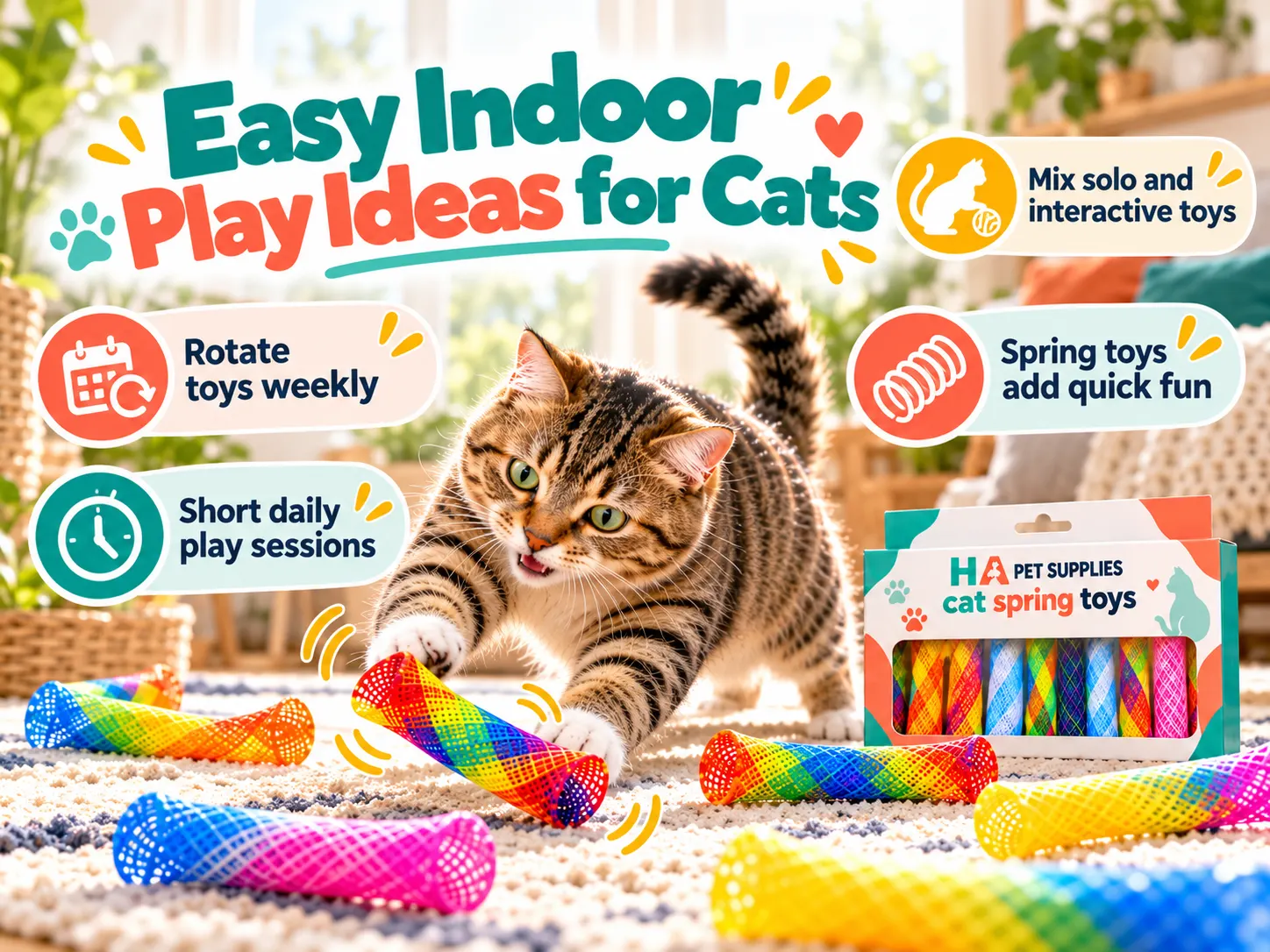
HA Pet Supplies spring toys support playful supervised indoor activity
13. Seven-Day Indoor Cat Enrichment Plan
If you are unsure where to begin, use this simple weekly plan as a starting point. It is flexible rather than mandatory. Choose activities according to your cat’s health, preferences, and attention span.
| Day | Main activity | Additional enrichment | Goal |
|---|---|---|---|
| Monday | Supervised spring toy game | Window observation | Encourage curiosity |
| Tuesday | Wand toy chasing | Scratching post | Support hunting-style play |
| Wednesday | Easy puzzle feeder | Quiet hiding area | Encourage exploration |
| Thursday | Rolling ball game | Short interactive session | Introduce movement |
| Friday | Supervised spring toy play | Toy rotation | Renew interest |
| Saturday | Tunnel exploration | Soft prey toy | Provide variety |
| Sunday | Cat’s favorite game | Calm social interaction | Reinforce enjoyable routines |
Monday: Discover movement
Introduce an inspected spring toy and observe whether your cat responds to gentle rolling. Do not force interaction.
Tuesday: Practice chasing
Use a suitable wand toy to encourage stalking and controlled chasing. Allow repeated opportunities to capture the toy.
Wednesday: Explore food puzzles
Place part of your cat’s normal food portion inside an easy puzzle feeder. Watch for frustration and ensure the cat can obtain the food.
Thursday: Add floor-based activity
Offer a rolling ball or another appropriate moving toy. Keep the activity suited to your cat’s mobility.
Friday: Reintroduce a familiar favorite
Bring back a toy that was temporarily stored away. Observe whether the change renews interest.
Saturday: Explore a safe tunnel
Allow your cat to investigate a tunnel or new hiding area.
Sunday: Follow your cat’s preferences
Choose the activity your cat enjoyed most during the week. Remember that enrichment should be enjoyable, not an obligation.
14. Safety Precautions for Indoor Cat Toys
Safety should be considered before every play session. A product that appears harmless can become dangerous if it breaks or is used inappropriately.
Inspect toys before and after play
Look for damaged material, loose components, broken edges, and exposed strands. Discard toys that cannot be safely repaired.
Avoid swallowing hazards
A cat may accidentally ingest small objects or detached toy pieces. Pay particular attention to cats that chew or attempt to eat non-food materials.
Supervise unfamiliar toys
When introducing a new product, remain nearby and observe how your cat interacts with it. Do not assume that a toy is safe for unsupervised use simply because it is marketed for cats.
Avoid long loose strings
Strings, ribbons, threads, and similar objects can pose serious risks if swallowed. Store string-based toys securely when play ends.
Use suitable play surfaces
Slippery floors and cluttered areas can increase the chance of accidents. Choose a space where your cat can move comfortably.
Watch for distress
Stop if your cat becomes frightened, excessively fatigued, or uncomfortable. Never force continued participation.
Maintain appropriate hygiene
Follow the manufacturer’s cleaning instructions. Allow toys to dry fully before storing them.
For additional general enrichment advice, consult the ASPCA’s feline DIY enrichment recommendations, which also emphasize active supervision of homemade items. If your cat swallows part of a toy, do not induce vomiting or pull visible string from the mouth or rectum. Contact a veterinarian promptly.
15. Frequently Asked Questions About the Best Cat Toys for Bored Indoor Cats
The best cat toys for bored indoor cats depend on how the individual cat likes to play. Popular options include lightweight spring toys, feather wands, rolling balls, puzzle feeders, tunnels, and soft prey toys. Try a small variety and observe which activities encourage voluntary engagement.
Yes, indoor cats can experience insufficient stimulation when they lack appropriate opportunities to explore, hunt, play, scratch, and interact. However, behavioral changes should not automatically be attributed to boredom. Medical conditions and environmental stress can cause similar signs.
Suitable spring toys may provide opportunities for batting, chasing, and investigating movement. Their usefulness depends on the individual cat’s preferences and the toy’s condition and size. Supervise play and remove damaged toys.
Observe patterns over time. A cat that normally sleeps during the afternoon but becomes active later may be following its usual rhythm. Sudden inactivity, loss of appetite, pain, or substantial behavioral changes require veterinary advice.
There is no universally correct number. A small variety of suitable toys is often more useful than a large collection of identical ones. Rotate toys periodically to maintain novelty.
Some cats enjoy manipulating spring toys without direct participation from their owner. However, independent play should only occur when the specific toy is appropriate and safe for that cat. Woven or damaged toys may present additional risks, especially for cats that chew or ingest materials.
Price does not determine a toy’s appeal. Your cat may prefer a different texture, movement pattern, or style of interaction. Try changing the way you introduce the toy rather than immediately purchasing something more expensive.
There is no single correct duration. Start with short interactive sessions and adjust according to your cat’s age, health, and enthusiasm. Several brief sessions may suit some cats better than one long session.
Regular play and predictable routines may help provide appropriate outlets for activity. However, nighttime vocalization or restlessness can have multiple causes. If the behavior is new, excessive, or accompanied by other symptoms, consult your veterinarian.
They provide different experiences. Spring toys may be useful for floor-based batting and chasing, while feather wands allow an owner to guide a moving target. Neither is universally better. A combination may be more useful for cats that enjoy varied activities.
Older cats may enjoy lightweight toys, gentle rolling games, puzzle feeders, and comfortable exploration activities. Adapt play to mobility and health. Avoid forcing strenuous jumping.
Appropriate activity can form part of a veterinary weight-management plan. However, weight control also depends on nutrition, underlying health, and measured food intake. Do not force prolonged activity or make major dietary changes without appropriate guidance.
Remove the toy if your cat chews off material or attempts to swallow pieces. Inspect it for damage. Consider alternative toys designed for your cat’s chewing behavior. Discuss persistent ingestion of non-food materials with a veterinarian.
Rotate safe toys, change the play location, introduce different movement patterns, and allow your cat to catch toys during hunting-style games. Do not overwhelm a nervous cat with constant novelty.
Absolutely. Suitable cardboard boxes, secure observation areas, simple play routines, and some homemade enrichment activities can provide useful stimulation. Always inspect materials and supervise homemade toys.
Color may influence visibility, but cats do not perceive colors exactly as humans do. Movement, contrast, texture, sound, and individual preference may be more important than bright colors alone.
Inspect it, place it in a safe play area, allow your cat to investigate voluntarily, and use gentle movement to encourage interest. Start with short supervised sessions.
Try storing the toy temporarily, offering a different activity, or changing the play routine. If your cat suddenly loses interest in all activities, particularly alongside other changes, consult your veterinarian.
16. Final Recommendations: Choosing the Best Cat Toys for Bored Indoor Cats
Choosing the best cat toys for bored indoor cats does not have to be complicated. You do not need every popular toy or the most expensive interactive gadget. Start by observing your cat. Notice whether it prefers chasing, batting, stalking, carrying, climbing, hiding, or solving food-related challenges. Choose a few appropriate products that support those preferences.
Offer short, enjoyable play opportunities and rotate toys to keep activities interesting. Make sure your home also provides suitable scratching surfaces, resting areas, hiding places, vertical spaces, and positive opportunities for interaction.
Most importantly, remember that enrichment is about helping your cat express natural behaviors safely. A lightweight spring toy may be a useful addition to this routine, particularly for cats that enjoy floor-based movement.
If your cat enjoys chasing and batting objects, consider exploring HA Pet Supplies Cat Spring Toys and checking whether their size and design suit your pet. You can also browse the wider HA Pet Supplies shop for complementary cat enrichment products.
For further educational advice on choosing toys, understanding cat behavior, and creating a safer home environment, explore the HA Pet Supplies blog. If you have product questions, visit our contact page. For product sourcing, bulk enquiries, or business orders, you can also request a quote from HA Pet Supplies.
At HA Pet Supplies, our goal is to help pet owners discover practical products that support enjoyable everyday care.
A happier indoor routine starts with understanding your cat—not simply buying more toys.
Choose appropriate toys, make time for positive interaction, and let your cat show you which activities it enjoys most.
Shop Cat Spring Toys Browse Cat Supplies