
HA Pet Supplies | Dog Mobility, Wheelchair Sizing and Buying Guide
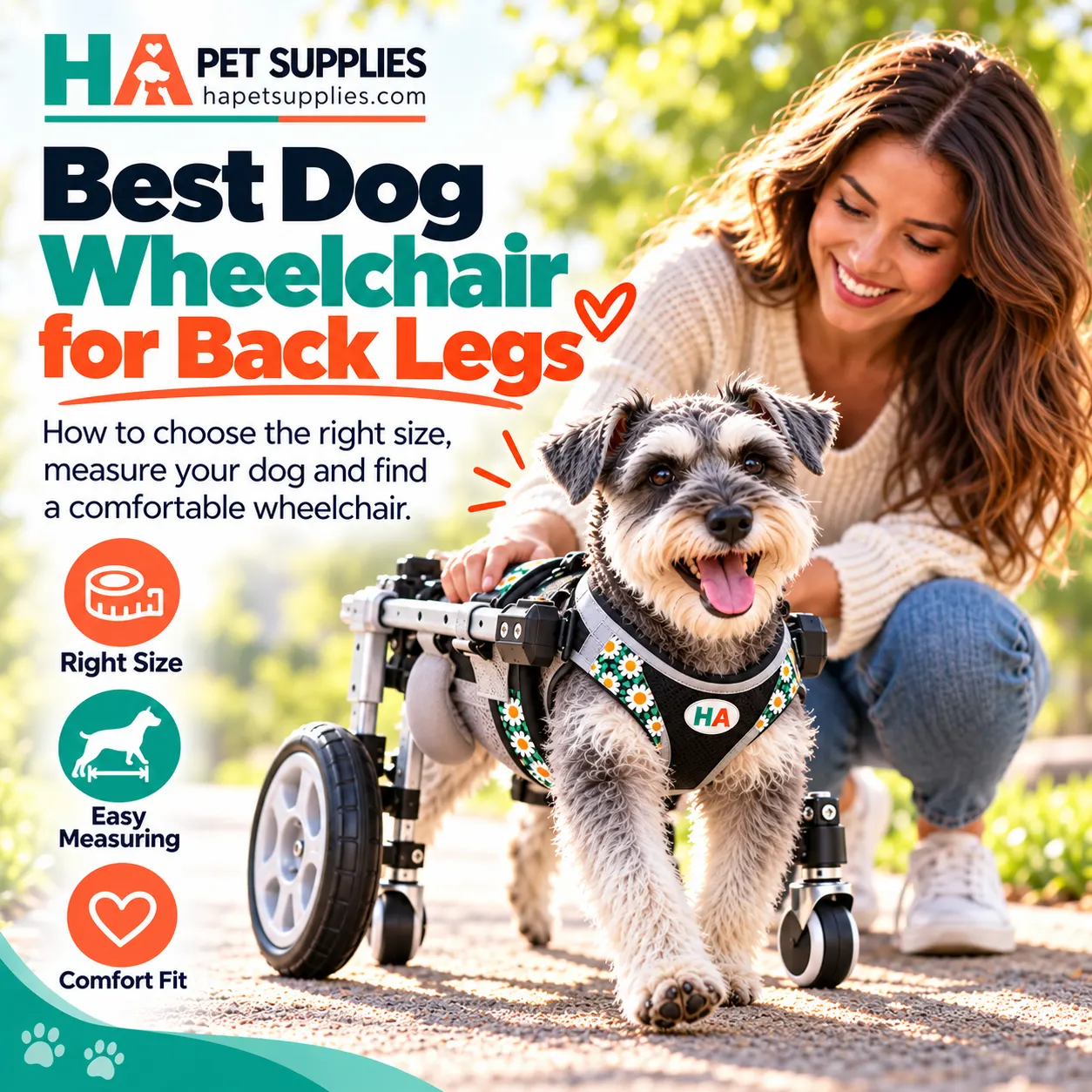
Finding the best dog wheelchair for back legs can feel overwhelming, especially when your dog is struggling to stand, dragging its hind paws, or losing confidence during everyday walks.
You may already have searched for an adjustable dog wheelchair, compared different rear-leg mobility carts, or watched videos of disabled dogs walking happily with wheels. Yet one important question remains: how can you know which wheelchair will actually fit your dog?
A wheelchair that looks perfect online may be uncomfortable, unstable, or unsuitable for your pet’s medical condition. Choosing the wrong size can create pressure around sensitive areas, interfere with movement, or cause your dog to reject the equipment entirely.
The right buying decision begins with understanding your dog’s mobility needs, checking whether a rear-support cart is appropriate, taking accurate measurements, and confirming the wheelchair’s specifications.
This comprehensive guide explains how to choose a dog wheelchair for back legs, measure your dog correctly, compare wheelchair types, identify comfortable support features, and avoid expensive buying mistakes.
Whether you care for a senior dog with weak hind legs, a dog with diagnosed paralysis, or a pet undergoing rehabilitation, this article will help you approach the decision with greater confidence.
Most importantly, you will learn why choosing a wheelchair should begin with your dog’s wellbeing rather than its breed, the appearance of the product, or the lowest available price.
Quick Answer: What Is the Best Dog Wheelchair for Back Legs?
The best dog wheelchair for back legs is one that matches your dog’s body measurements, provides appropriate rear-body support, allows safe front-leg movement, and fits comfortably without creating excessive pressure.
For dogs with weak or paralyzed hind legs but sufficient front-leg strength, a properly fitted rear-support wheelchair may be suitable.
However, no single wheelchair is best for every dog.
A small Schnauzer, a long-bodied Dachshund, and a large Labrador may require very different frame dimensions, harness configurations, and weight capacities.
Before ordering, confirm five essential details: your dog’s medical suitability, body weight, rear-leg height, body length, and the manufacturer’s exact adjustment range.
The Walkin’ Pets wheelchair sizing calculator illustrates how manufacturers use body measurements to select compatible wheelchair sizes. Its fitting system applies to its own products rather than to every wheelchair brand.
1. Why Choosing the Right Dog Wheelchair Matters
A dog wheelchair is more than a frame with wheels. It is a mobility aid intended to assist a dog whose normal movement has been affected by injury, disease, weakness, or disability.
When properly selected and fitted, a rear-leg wheelchair may allow suitable dogs to enjoy supervised movement while the front legs provide propulsion.
However, wheelchair comfort depends on several factors working together. The frame must fit the dog’s height and length. Body supports must avoid excessive pressure. The wheels should rotate freely and provide suitable traction for the surfaces the dog will use.
An incorrect fit may cause rubbing, restrict natural movement, or make the cart difficult to control. This is particularly concerning for dogs with reduced hind-limb sensation because they may not notice developing pressure injuries.
Why wheelchair suitability comes before wheelchair size
Some dogs need rear support because their hind legs are weak, but their front legs remain strong. Other dogs have weakness in all four limbs or significant balance problems. A basic two-wheel wheelchair may not provide adequate assistance in those circumstances.
Before comparing sizes, ask your veterinarian whether your dog is physically suited to a rear-support cart.
For example, the Cornell University College of Veterinary Medicine’s degenerative myelopathy guide discusses rear-support wheelchairs as one possible mobility aid for dogs affected by progressive hind-limb weakness.
However, a dog with an acute spinal injury may require emergency evaluation, treatment, or movement restrictions instead.
If you are unsure whether a wheelchair is necessary, first read our guide to nine warning signs a dog may need a wheelchair.
The goal is not to buy equipment as quickly as possible. It is to choose the right support without overlooking a treatable medical problem.
2. Understanding the Different Types of Dog Wheelchairs
Not every wheelchair supports the same parts of a dog’s body. Understanding the differences can prevent owners from purchasing the wrong design.
Rear-support dog wheelchair
A rear-support wheelchair is designed for dogs that need assistance with their hindquarters while retaining sufficient strength and coordination in their front legs.
Most rear-wheelchair designs have two wheels positioned toward the back of the body, with a frame and support system that carries part of the dog’s weight.
This design may help selected dogs with stable hind-leg paralysis, chronic neurological impairment, or significant rear-leg weakness. The dog moves forward primarily using its front limbs.
Four-wheel dog wheelchair
A four-wheel mobility cart may be considered for dogs needing additional support in both the front and rear sections of the body.
These wheelchairs can be more complex because they must distribute support across the dog’s entire body while permitting whatever voluntary movement remains.
They are not automatically better than rear-support carts. For a dog with strong front limbs, a rear wheelchair may offer a simpler solution. For a dog with weakness affecting all four legs, a professional mobility assessment is particularly important.
Rear support harness
A support harness is not a wheelchair. It allows a caregiver to help lift or stabilize the dog’s hindquarters.
Harnesses may be useful for short transfers, toileting, or helping a dog rise. However, they typically require the owner to continue providing physical support, making them less practical for some extended walking activities.
Rehabilitation mobility aids
Veterinary rehabilitation may also involve carefully selected supportive devices, controlled exercise, and environmental modifications.
The AAHA’s recommendations for veterinary rehabilitation describe therapeutic exercise and rehabilitation as parts of comprehensive care for appropriate patients.
A wheelchair should complement the dog’s treatment plan rather than replace it.
3. Seven Essential Factors for Choosing the Best Dog Wheelchair for Back Legs
When comparing different mobility carts, seven factors deserve particular attention.
Factor 1: Correct body measurements
A wheelchair must accommodate your dog’s physical proportions. Rear-leg height helps determine the appropriate support height. Body length and width influence the frame fit, while body weight determines whether the wheelchair can safely support the pet.
Selecting by breed alone is unreliable. Two Schnauzers may have different body lengths and body weights. Likewise, a young dog and a senior dog of the same breed may require different support.
Factor 2: Weight capacity
Every wheelchair should have a verified manufacturer-rated weight capacity. Never assume a frame can safely support your dog simply because the promotional photographs show a similar breed. An incorrectly rated frame may bend, become unstable, or fail during use.
Factor 3: Adjustable frame dimensions
An adjustable dog wheelchair can be easier to fit because the frame can be positioned within its designed adjustment range. Look for verified information about adjustable height, length, and width. Not every adjustable model offers adjustment in all three dimensions. Before purchasing, confirm which parts of the actual product can be changed.
Factor 4: Comfortable body support
The harness and supporting components should help distribute weight without concentrating excessive pressure around the abdomen, chest, or groin. The correct fit must also allow breathing, normal front-leg movement, and appropriate elimination. Comfort should be evaluated through the dog’s posture and behavior, not simply through soft-looking materials.
Factor 5: Wheel design and stability
Wheels influence movement and traction. The suitable wheel arrangement depends on the dog’s size, intended walking surfaces, and wheelchair construction. Smooth indoor floors, short grass, and uneven outdoor paths present different challenges. No wheelchair should be assumed suitable for stairs, steep slopes, or rough terrain without explicit manufacturer guidance and professional assessment.
Factor 6: Ease of fitting and removal
A practical wheelchair should allow owners to position and remove the dog safely according to the supplied instructions. This matters especially for dogs that need regular toileting assistance or frequent rest periods. If the dog experiences pain during lifting, ask a veterinarian to demonstrate an appropriate handling method.
Factor 7: Product specifications and customer support
Clear technical information is important when buying a wheelchair online. Before ordering, verify the size range, frame measurements, rated capacity, harness arrangement, package contents, and warranty conditions. When these details are missing, contact the seller.
For HA Pet Supplies customers, our adjustable dog wheelchair product page is a starting point for reviewing the product design and requesting further specifications.
4. How to Measure Your Dog for a Wheelchair: Step-by-Step Guide
Accurate measurements are essential when searching for the best dog wheelchair for back legs. The goal is to identify a wheelchair that supports your dog’s body without forcing an unnatural posture.
Before measuring, prepare a flexible measuring tape, your dog’s weight information, a notebook, and the manufacturer’s sizing instructions.
If your dog has a painful injury, unstable spinal condition, or difficulty tolerating handling, ask a veterinary professional to assist.
Use a suitable pet scale. Wheelchair frames are manufactured for specified load ranges.
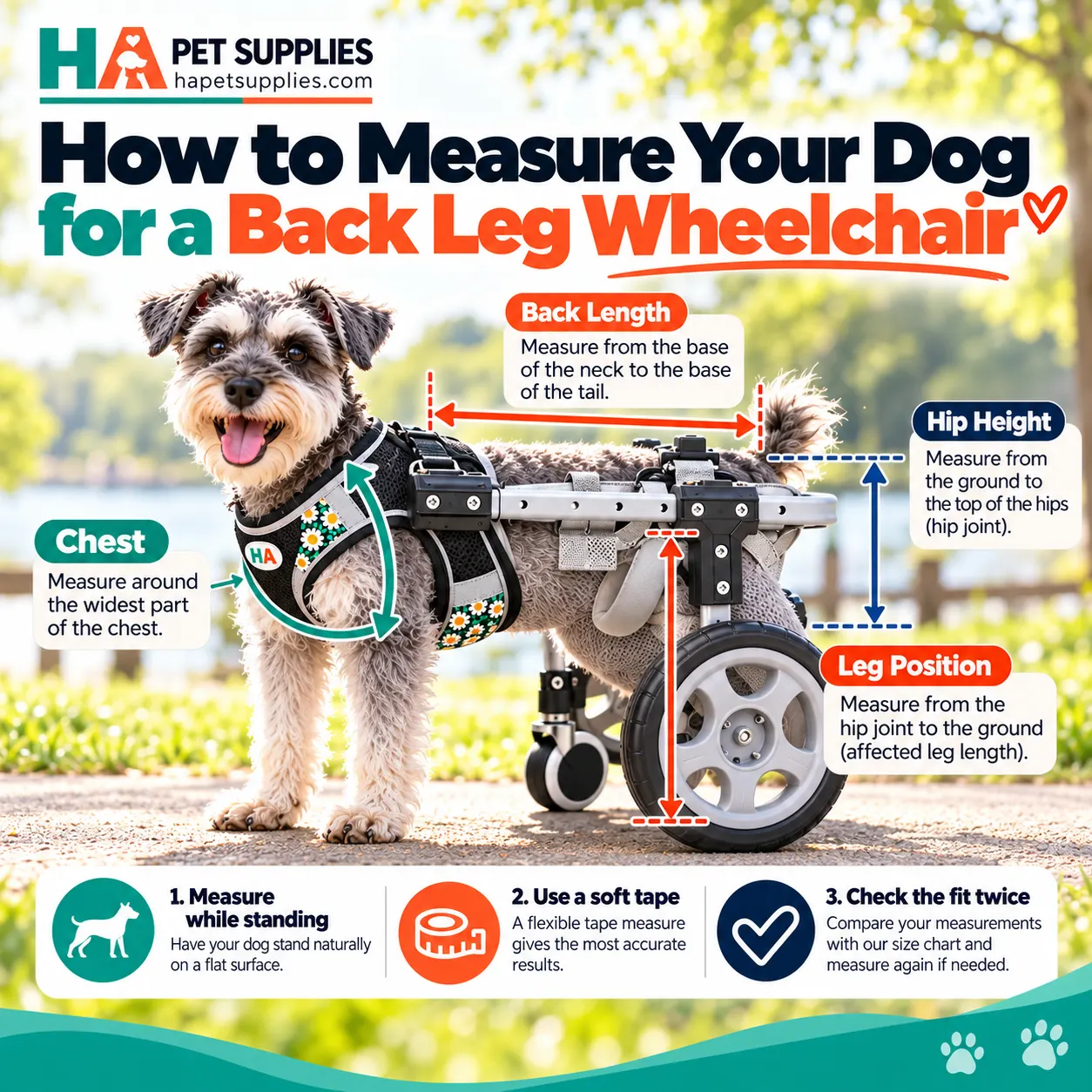
Lay the dog on its side and measure from upper hind leg to paw pad, leg naturally bent.
Use an armpit-to-rump measurement or the manufacturer’s specified reference points.
Use the reference points required by the manufacturer. Avoid squeezing the chest.
A rear wheelchair relies on front limbs for propulsion and stability.
Long-bodied or deep-chested breeds need careful length and width adjustment.
Match measurements to the exact wheelchair variant’s official sizing chart.
Step 1: Record your dog’s current body weight
Start by weighing your dog using a suitable pet scale. Body weight matters because wheelchair frames are manufactured for specified load ranges.
A wheelchair designed for a very small dog may not provide sufficient support for a heavier animal, even if the height appears suitable. Use the dog’s current weight rather than a previous estimate.
For senior dogs, weight changes may occur as a result of reduced exercise, muscle loss, or underlying disease. The AAHA senior pet care guidance highlights weight management and individualized mobility support as important considerations for older pets.
Step 2: Measure your dog’s rear-leg height
Rear-leg height is a key measurement in many rear-wheelchair sizing systems.
Some manufacturers, including Walkin’ Pets, instruct owners to lay the dog comfortably on its side and measure from where the upper hind leg meets the body to the bottom of the paw pad, leaving the leg naturally bent.
Do not stretch the leg straight to obtain a larger measurement. The correct approach depends on the manufacturer’s documented method, so do not assume all wheelchair brands use identical measurement points.
For a visual example, consult the Walkin’ Pets small-wheelchair measurement guide. Its illustrated instructions provide a useful reference, but its measurements should not be substituted for the HA product’s own sizing instructions.
Step 3: Measure your dog’s body length
Body length helps determine whether the wheelchair frame can support the dog’s hindquarters without obstructing its shoulders or front legs.
Some manufacturers use an armpit-to-rump measurement, taken from behind the front limb toward the rear of the dog’s body. Others may require additional measurements.
A frame that is too short can place support components incorrectly. An excessively long frame may make the wheelchair harder to maneuver. Long-bodied breeds deserve particular attention because their proportions differ from those of compact dogs.
Step 4: Measure body width
Depending on the wheelchair design, torso width or other body measurements may also be necessary. Measure using the reference points required by the manufacturer.
An overly narrow frame may press against the dog’s body, while an excessively wide frame can affect stability. A properly adjusted support system should not squeeze the chest or abdomen.
Step 5: Evaluate front-leg function
Because a typical rear wheelchair uses the front legs for movement, your dog must have adequate front-limb strength and coordination.
A dog that struggles to support its front body weight may not be suited to a standard rear cart. The veterinarian should evaluate the dog’s ability to move safely with the proposed device.
Step 6: Check special body proportions
Some breeds have unusually long bodies, short legs, deep chests, or other features that affect fitting.
For example, a Dachshund’s long torso may require more careful length adjustment than a compact dog with similar body weight. A Greyhound’s narrow frame and deep chest present different fitting considerations.
Breed can provide useful context, but actual body measurements determine compatibility.
Step 7: Compare measurements with the selected model
Once you have recorded the relevant measurements, compare them with the exact wheelchair variant’s sizing chart. Do not use another manufacturer’s chart to choose an HA wheelchair size.
If your dog falls between size ranges, contact the seller rather than guessing. The best choice depends on the actual adjustable range, harness configuration, and weight capacity.
Dog wheelchair measurement worksheet
Record your dog’s measurements below and use them when contacting a seller or verifying a sizing chart.
My Dog’s Measurements
This worksheet records measurements only. It does not calculate a wheelchair size or confirm medical suitability.
5. Common Dog Wheelchair Sizing Mistakes
Even careful owners can make mistakes when purchasing their first dog wheelchair for back legs.
One common mistake is measuring a painful leg while trying to straighten it. This may produce an inaccurate result and cause unnecessary discomfort.
Another is relying entirely on a dog’s breed. A product described as suitable for small dogs may still be too short, narrow, or low for a particular individual.
Choosing a wheelchair based only on body weight is similarly unreliable. Weight is important for frame capacity, but it cannot establish the appropriate height and length.
Owners should also avoid buying an oversized cart with the expectation that extra room will improve comfort. Too much space can allow excessive shifting and make movement less stable.
Finally, do not ignore changes in body weight or muscle condition. A dog using a wheelchair over many months may require repeated fit checks as its condition changes.
The AAHA’s senior dog evaluation guidance recommends assessing movement, pain, and musculoskeletal condition as part of appropriate veterinary care.
6. Adjustable vs Fixed-Size Dog Wheelchairs
Adjustable and fixed-size wheelchairs have different fitting considerations. Neither design should be judged solely by its appearance.
| Feature | Adjustable rear wheelchair | Fixed-size rear wheelchair |
|---|---|---|
| Frame dimensions | Some dimensions can be changed within specified ranges | Limited or no frame adjustment |
| Fit flexibility | May accommodate more individual body proportions | Requires a close match to fixed measurements |
| Sizing requirements | Exact measurements still necessary | Exact measurements essential |
| Comfort | Depends on correct setup and harness fit | Depends on correct size and harness fit |
| Reassessment | May allow certain fit changes over time | May require another size when body measurements change |
| Best buying approach | Verify adjustment range and weight rating | Verify all fixed dimensions and weight rating |
Is an adjustable dog wheelchair always better?
Not necessarily. An adjustable design may be more flexible, but a poorly fitted adjustable cart can still cause discomfort.
Conversely, a fixed-size cart that closely matches the dog’s body may function well.
Consider the actual support system, quality of construction, wheelchair specifications, and whether the dog can move safely. A useful design is one that meets the dog’s needs—not necessarily the one with the greatest number of advertised features.
7. Comfortable Dog Wheelchair Features to Look For
Comfort is one of the most important factors when comparing mobility equipment. The right wheelchair should support the dog’s body without causing excessive pressure, rubbing, restricted movement, or anxiety.
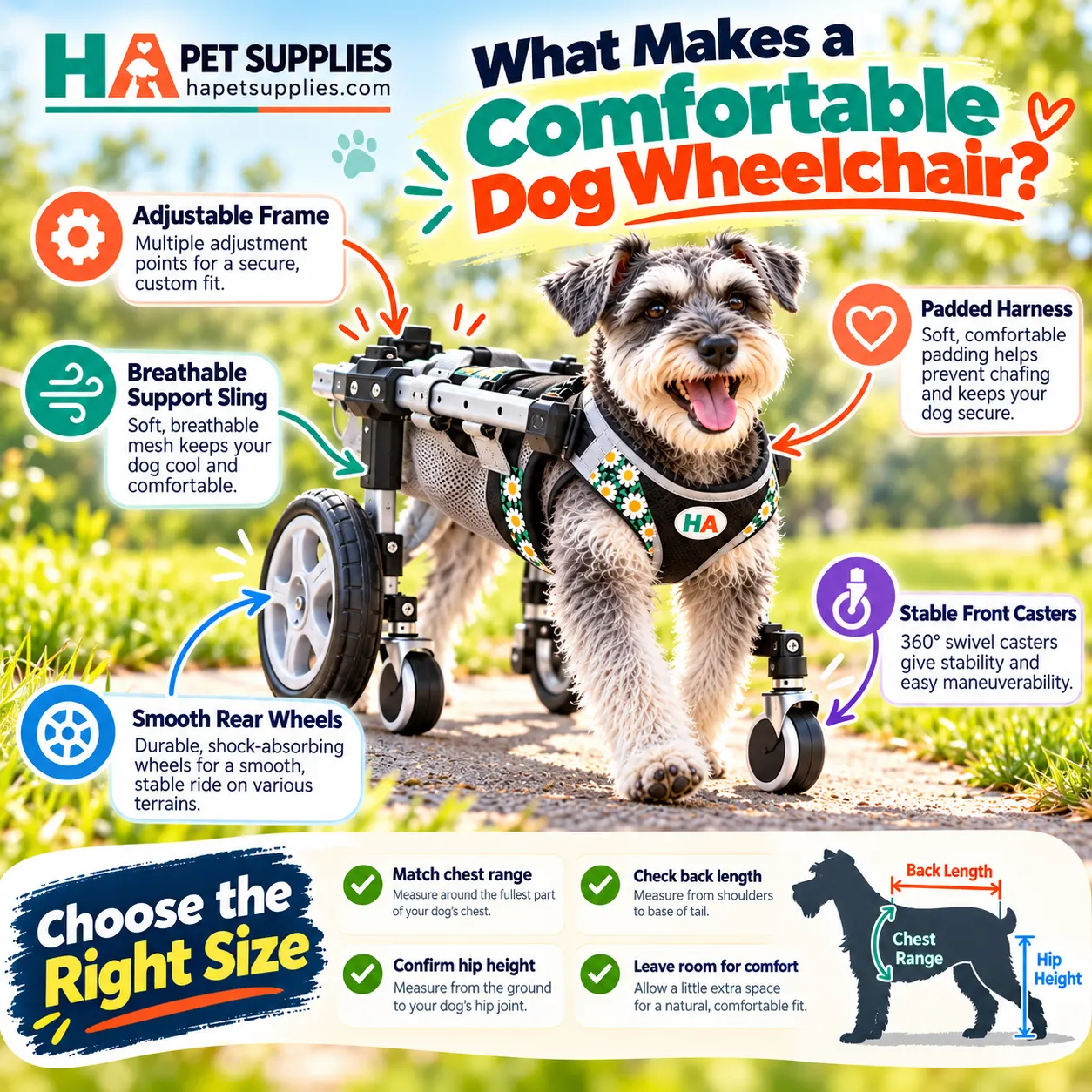
Appropriate harness positioning
The harness helps connect the dog’s body to the wheelchair frame. Support should be distributed according to the manufacturer’s design and the dog’s needs.
Check for concentrated pressure around the groin, abdomen, and chest. A harness that slides repeatedly or produces persistent skin redness needs reassessment.
Suitable frame height
The wheelchair should support the dog’s hindquarters in an appropriate position.
If the frame is too low, the dog may continue dragging its rear legs or experience an abnormal back posture. If it is too high, the dog’s body may be forced into an uncomfortable position.
Observe the dog’s movement from the side and behind during a supervised fitting session.
Free front-leg movement
A rear-support wheelchair must allow the front limbs to function normally. The dog should be able to move forward without repeatedly contacting the frame or straining against the harness. Difficulty moving may indicate an incorrect fit or insufficient strength.
Appropriate wheel clearance
The wheels should rotate without rubbing against the dog’s body or the frame. Wheel size and placement affect ground clearance, turning, and the device’s interaction with surfaces. Always follow the selected product’s setup instructions.
Skin protection
Dogs with reduced sensation require particular attention because they may not feel early skin damage. Inspect harness contact areas before and after use. If the dog develops swelling, abrasions, or persistent redness, stop using the device and seek fitting advice.
Secure components
The wheelchair’s connectors and adjustment mechanisms should remain secure during use. Loose hardware can affect stability and increase the risk of equipment failure. Regular inspections are essential, particularly after outdoor use.
8. Choosing a Dog Wheelchair Based on Your Dog’s Condition
Medical suitability matters just as much as wheelchair size.
Dog wheelchair for paralyzed hind legs
A wheelchair may be considered when a dog has diagnosed, stable hind-limb paralysis but retains sufficient front-leg function.
However, paralysis may involve reduced sensation, bladder dysfunction, or an increased risk of skin injuries.
The Merck Veterinary Manual’s explanation of canine leg paralysis discusses neurological evaluation and the importance of identifying the location and cause of nerve damage.
A dog with newly developed paralysis requires urgent veterinary evaluation, not immediate wheelchair shopping.
Wheelchairs for dogs with degenerative myelopathy
Degenerative myelopathy can progressively affect hind-limb coordination and strength. In selected cases, a wheelchair may help the dog participate in supervised movement as the condition advances.
However, the level of mobility support required can change over time. A dog that initially manages with a rear cart may later require reassessment if front-leg function or overall strength declines.
Dog wheelchair for arthritis
Arthritis can cause pain, stiffness, and difficulty moving, particularly in older dogs. But a wheelchair is not automatically necessary.
Veterinary care may include appropriate medication, weight management, rehabilitation exercises, and home adaptations. The AAHA pain management recommendations for senior pets emphasize individualized care and environmental changes for mobility-compromised animals.
Wheelchair use after spinal surgery
Dogs recovering from spinal surgery may have temporary or long-term mobility limitations. However, activity restrictions and rehabilitation requirements vary significantly.
The American College of Veterinary Surgeons’ guide to IVDD explains that recovery from spinal disc disease varies according to neurological severity and treatment.
Never begin wheelchair training after spinal surgery without approval from the treating veterinary team.
Dog wheelchair for senior dogs
Older dogs may have a combination of arthritis, reduced muscle mass, neurological disease, and other health problems. A mobility assessment should evaluate the whole dog rather than concentrating only on its back legs.
A rear wheelchair may be appropriate for some senior dogs, while others may benefit more from a lifting harness, non-slip flooring, or controlled rehabilitation.
9. Dog Wheelchair Comparison: Which Mobility Solution Should You Choose?
Comparing mobility aids helps owners understand which type of support may be appropriate. A wheelchair should not automatically be selected because it appears more advanced than a harness or ramp.
| Mobility requirement | Rear dog wheelchair | Four-wheel wheelchair | Lifting harness | Dog ramp |
|---|---|---|---|---|
| Hind-leg weakness | Often useful when suitable | May provide more support than needed | Helpful for short transfers | Helps with changes in height |
| Front-leg weakness | Generally not suitable alone | May be considered professionally | Limited assistance | May not address the problem |
| Stable hind-leg paralysis | May be appropriate | Depends on overall function | Requires caregiver assistance | Does not replace mobility support |
| Short indoor transfers | Possible but may be inconvenient | May be cumbersome | Often practical | Useful for specific locations |
| Outdoor assisted walking | Suitable on appropriate surfaces | Depends on design and abilities | Requires continuous handling | Limited to access routes |
| Correct body measurements | Essential | Essential | Important | Important for safe incline and access |
| Veterinary assessment | Recommended | Particularly important | Recommended | Recommended when mobility is impaired |
For many buyers, the most useful question is not which product provides the most features, but which device addresses the dog’s actual mobility limitations.
10. How to Check Whether a Dog Wheelchair Fits Correctly
After selecting a wheelchair, fit verification is essential. The first fitting should take place in a calm environment with secure flooring.
If your dog cannot stand independently, use the handling method recommended by your veterinary team.
Check body alignment
Observe the dog’s posture from both sides and behind. The wheelchair should provide appropriate hindquarter support without forcing severe arching, sagging, or twisting. The dog’s body should not lean excessively toward one wheel.
Check the harness
Make sure the harness remains positioned correctly during movement. Avoid excessive pressure on the abdomen, chest, groin, or other sensitive areas. The dog should be able to breathe normally and move its front legs without obstruction.
Observe the first steps
A successful fit should permit comfortable, controlled movement within the dog’s physical capabilities. Watch for dragging, repeated stumbling, wheels contacting the body, or apparent discomfort.
A dog that refuses to walk may be frightened, painful, fatigued, or experiencing an incorrect fit. Do not assume that training alone will resolve the problem.
Inspect the skin
After the initial session, remove the wheelchair and examine areas that contacted the harness or frame. Persistent redness, abrasions, or swelling may indicate excessive pressure.
Dogs with reduced sensation require especially careful inspection because they may not react normally to discomfort.
Reassess as conditions change
Wheelchair fit should be reviewed after significant weight changes, changes in posture, or worsening mobility.
The AAHA senior care guidelines emphasize ongoing assessment of older pets’ physical condition and quality of life. A wheelchair that fits today may require adjustment as the dog’s needs evolve.
11. How to Introduce Your Dog to a New Wheelchair
Even a well-fitted dog wheelchair for back legs can feel unfamiliar to a pet during the first few sessions. Some dogs adapt quickly. Others need patient, gradual introduction.
Begin by allowing the dog to observe and investigate the wheelchair without wearing it. Reward calm interest with praise or small treats.
When the dog appears comfortable around the device, follow the manufacturer’s fitting instructions and the veterinarian’s activity recommendations.
For the first supervised session, choose a flat, non-slip surface. Encourage a few voluntary steps rather than attempting a full walk immediately. Stop when your dog becomes tired, anxious, or uncomfortable.
Gradually introduce gentle turns and familiar environments as the dog becomes more confident. Avoid pulling the dog forward or using force to make the wheelchair move.
The American Veterinary Society of Animal Behavior promotes humane, evidence-based approaches to animal behavior and training.
For a dedicated training guide, read our seven-step dog wheelchair training article, which covers familiarization, common mistakes, walking practice, and daily care.
12. Daily Dog Wheelchair Safety and Maintenance
A properly fitted wheelchair still requires regular checks.
Before every session, inspect the wheels, fasteners, harness connections, and frame adjustments. Make sure nothing is visibly damaged, loose, or misaligned.
After outdoor walks, remove dirt and debris from the wheels and frame. Clean harness fabrics according to the manufacturer’s care instructions and allow wet components to dry before storage.
Never leave your dog unattended in a mobility cart. Avoid stairs, steep slopes, unstable ground, and slippery surfaces that increase the risk of tipping.
A wheelchair should not normally be worn during sleep or extended rest. The dog needs opportunities to lie comfortably, change position, and avoid continuous harness pressure.
For dogs with severe disability, hygiene and comfortable bedding are equally important. The AAHA’s patient comfort and mobility recommendations discuss the role of physical assistance devices, safe flooring, hygiene, and accessible resting areas in supportive veterinary care.
13. Seven Costly Mistakes to Avoid When Buying a Dog Wheelchair
Mistake 1: Choosing by breed alone
A wheelchair described as suitable for a particular breed may not match your dog’s individual dimensions. Measure your dog instead of relying on labels such as small, medium, or large.
Mistake 2: Ignoring the manufacturer’s weight capacity
A product photograph cannot confirm load capacity. Choose a wheelchair whose verified weight rating accommodates your dog’s current body weight.
Mistake 3: Assuming all adjustable frames are the same
Some carts adjust in height and length. Others offer width changes or a different configuration. Check the actual product’s adjustment capabilities.
Mistake 4: Prioritizing appearance over fit
A beautifully photographed wheelchair can still fit poorly. Comfort, safe support, and correct positioning matter more than color or styling.
Mistake 5: Purchasing before veterinary evaluation
Sudden paralysis or rapidly worsening weakness may require immediate treatment. A mobility cart cannot diagnose or treat a neurological emergency.
Mistake 6: Ignoring the dog’s emotional response
Some dogs need gradual familiarization and encouragement. Persistent refusal, distress, or pain should prompt a fit and medical reassessment rather than forced training.
Mistake 7: Overlooking ongoing care
A wheelchair purchase is not the end of mobility management. Regular skin inspections, cleaning, activity monitoring, and veterinary follow-up remain essential.
14. Dog Wheelchair Buying Checklist
Before purchasing an adjustable dog wheelchair, use the following interactive checklist.
10-Point Wheelchair Buying Checklist 0/10
Complete the remaining checks before making a purchasing decision. Missing size or safety information should be clarified with the seller.
If you are considering an HA mobility cart, review the HA Pet Supplies dog wheelchair for back legs and compare its confirmed specifications against your dog’s measurements.
For availability, fitting information, or purchasing enquiries, you can request a dog wheelchair quote and provide the measurements you have collected.
15. Frequently Asked Questions About the Best Dog Wheelchair for Back Legs
The best wheelchair is the one that matches your dog’s physical measurements, provides appropriate rear support, fits comfortably, and suits its medical condition. No single design works for every dog.
Start with current body weight and follow the manufacturer’s instructions for rear-leg height, body length, and any additional measurements. Never force painful or paralyzed limbs into an unnatural position.
Breed may help narrow a search, but it cannot replace accurate measurements. Individual dogs vary considerably in weight, leg height, and body proportions.
Adjustability may make fitting easier, but comfort depends on correct positioning, suitable body supports, and appropriate weight distribution. An adjustable frame can still fit incorrectly.
Some dogs with stable hind-limb paralysis can use a rear-support wheelchair if their front legs function adequately. Veterinary assessment and protection against pressure injuries and paw dragging are essential.
There is no single correct Schnauzer size. Measure the individual dog’s weight, rear-leg height, body length, and any other dimensions required by the selected manufacturer’s chart.
A wheelchair may be appropriate for selected dogs with severe mobility limitations, but many arthritic dogs benefit more from medication, rehabilitation, weight management, and home modifications.
Possible warning signs include excessive pressure, restricted front-leg movement, uncomfortable body alignment, or harness rubbing. Stop use and review the fit when these signs appear.
An oversized wheelchair may allow excessive body movement, poor support alignment, or unstable positioning. Check the manufacturer’s fitting requirements rather than guessing.
A walking wheelchair should normally be removed for sleeping and extended rest. Dogs need appropriate support for lying down comfortably and avoiding prolonged pressure.
Usually not without further assessment. A dog with significant front-leg weakness may require a different support system, potentially including a four-wheel cart.
There is no universal safe duration. Begin with short supervised sessions approved by the veterinarian and increase activity only as tolerated.
Some designs may work on firm, short grass, depending on wheel construction, fit, and ground conditions. Avoid unstable terrain that creates resistance or tipping hazards.
Some adjustable wheelchairs accommodate long-bodied dogs, but exact frame length and other measurements must be checked. Breed descriptions alone are insufficient.
A wheelchair may provide assisted mobility for some senior dogs. It does not reverse aging, cure arthritis, or restore lost neurological function.
A harness may be practical for short transfers and assisted standing. A rear wheelchair may be more appropriate for selected dogs needing wheeled hindquarter support during supervised walking.
Stop forcing movement and check for discomfort, incorrect sizing, fear, or fatigue. A veterinarian or rehabilitation professional can help determine whether further training or a different mobility solution is needed.
You can explore wheelchair options through the HA Pet Supplies online shop and verify sizing, current availability, included components, and purchase terms before ordering.
16. Final Thoughts: Choosing the Best Dog Wheelchair for Back Legs
Choosing the best dog wheelchair for back legs is not about finding the most expensive mobility cart or selecting the product with the greatest number of features.
It is about understanding what your dog needs and selecting equipment that provides safe, comfortable, appropriate support.
Begin with a veterinary assessment to identify the underlying condition and confirm that wheelchair use is suitable.
Next, take accurate measurements, verify the selected model’s weight capacity and adjustment range, and consider the dog’s ability to move using its front legs.
Pay close attention to harness comfort, frame alignment, wheel stability, and ongoing skin care.
Introduce the wheelchair gradually, monitor the dog’s response, and make adjustments when necessary.
For some pets, a properly fitted mobility cart can provide opportunities for gentle supervised exploration and meaningful daily activities. For others, a lifting harness, rehabilitation plan, pain management, or changes to the home may be more appropriate.
At HA Pet Supplies, our goal is to help owners make informed decisions about mobility products based on the needs of their pets.
If you are ready to explore wheelchair options, review our adjustable rear-support dog wheelchair and confirm its exact dimensions and suitability before purchase.
You can also contact HA Pet Supplies with questions about product specifications or browse the dog supplies category for other relevant care products.
For continuing education on dog wellbeing, the American Animal Hospital Association’s mobility resources provide information about recognizing and addressing mobility difficulties.
The right dog wheelchair is not the one that promises the most. It is the one that helps your individual dog move safely, comfortably, and with dignity.
Need help choosing the right rear-support wheelchair?
Request a personalised quote or contact our team with your dog’s measurements and veterinary recommendations.