



Description




Dog Wheelchair for Back Legs – Comfortable Mobility Support for Dogs
A dog wheelchair can help your companion rediscover
the joy of assisted movement when weak or disabled back legs
make everyday walking difficult.
At HA Pet Supplies, we understand how distressing it can be
to watch a beloved dog struggle to stand, explore the garden,
or join the family for a walk.
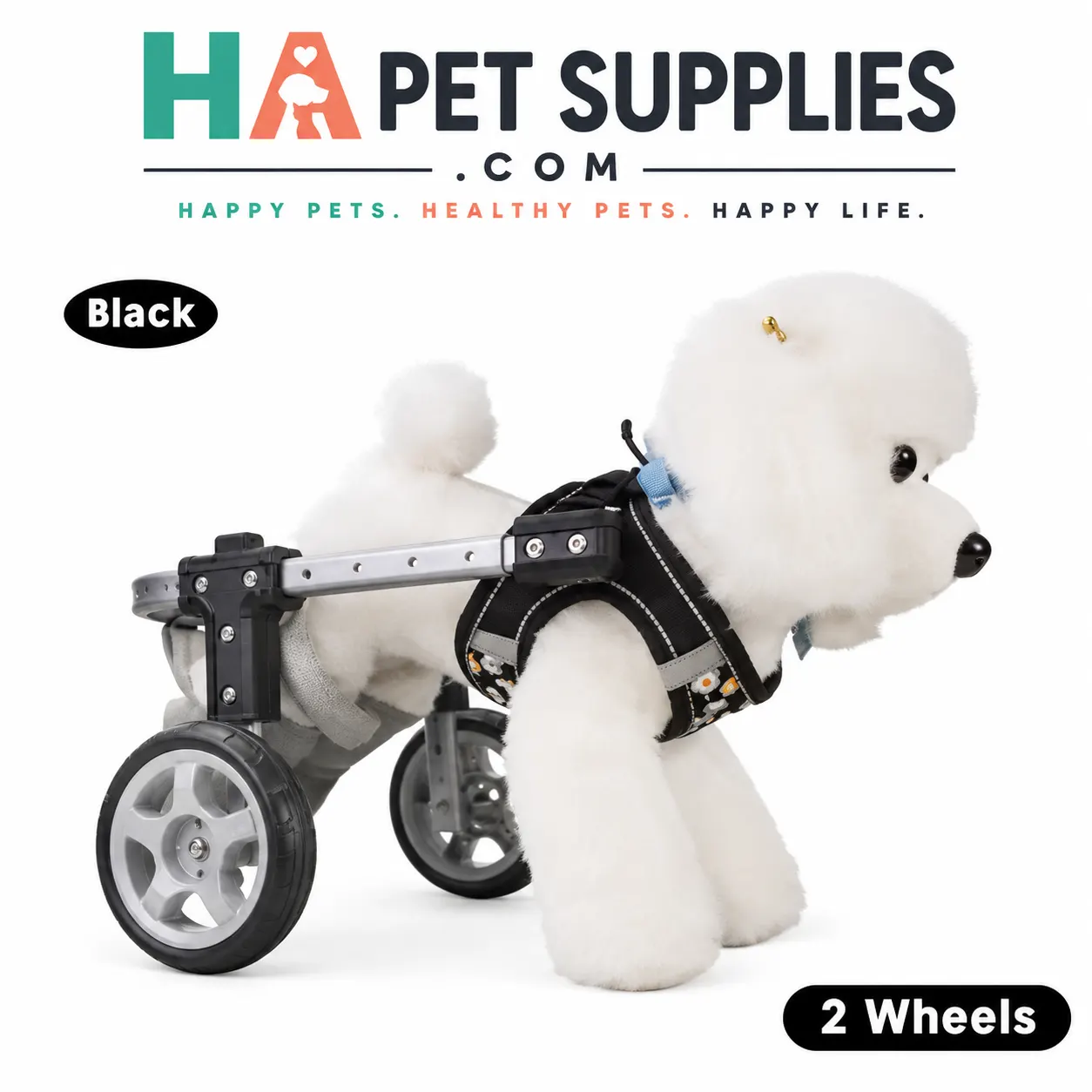
Our rear support dog wheelchair is designed as a mobility aid
for dogs experiencing difficulty using their hind legs.
Its adjustable cart-style design is intended to provide rear
body support while allowing suitable dogs to move forward
using their front legs.
Whether you are looking for a
dog wheelchair for back legs,
a wheelchair for dogs with reduced hind limb movement,
or an adjustable dog mobility cart for supervised outdoor
activities, choosing the correct support begins with your
dog’s individual needs and measurements.
Quick Answer – Is This Dog Wheelchair Right for Your Pet?
A rear leg wheelchair may be appropriate for a dog that has
good front leg strength but needs assistance supporting its
hindquarters. It may help some dogs with chronic hind limb
weakness, stable paralysis, neurological conditions, or
reduced mobility associated with aging.
However, a dog wheelchair is not a substitute for veterinary
diagnosis or treatment. A veterinarian or canine rehabilitation
professional should confirm whether a rear support cart is
appropriate, especially after an injury or during recovery.
If your dog suddenly loses the ability to stand or walk,
develops severe pain, or experiences new bladder problems,
seek urgent veterinary care rather than trying a wheelchair
first.
Not sure whether your pet needs mobility assistance?
Our practical guide,
When Does a Dog Need a Wheelchair? 9 Important Signs
,
explains symptoms that owners should discuss with their
veterinarian.
7 Amazing Benefits of a Properly Fitted Dog Wheelchair
Losing rear leg mobility does not automatically mean a dog
must give up every enjoyable activity.
With appropriate veterinary guidance and a properly fitted
mobility aid, some dogs can continue participating in
comfortable, supervised daily movement.
normally supported by the hind legs, potentially reducing
the effort needed for assisted movement.
short outdoor walks and supervised exploration at their own
pace.
the limits of its design, helping owners work toward a more
natural standing position.
daily activities without requiring their owners to support
their entire hindquarters manually.
of continuous lifting needed during certain short walks,
although dogs may still need assistance.
a professionally supervised mobility or rehabilitation
program.
7. More Shared Moments With Your Dog
Perhaps the most meaningful benefit of a wheelchair for dogs
is the possibility of enjoying familiar routines together.
For some pets, that means joining the family outside.
For others, it means reaching a favorite resting spot or
exploring the garden with support.
A wheelchair does not cure paralysis or reverse arthritis,
and not every dog enjoys using one. However, when suitable
for the animal and introduced patiently, a mobility aid
may improve participation in everyday life.
For additional background about veterinary rehabilitation
and mobility assessment, pet owners can consult the
American College of Veterinary Surgeons
and discuss appropriate treatment with their veterinarian.
Adjustable Dog Wheelchair – Product Features and Details
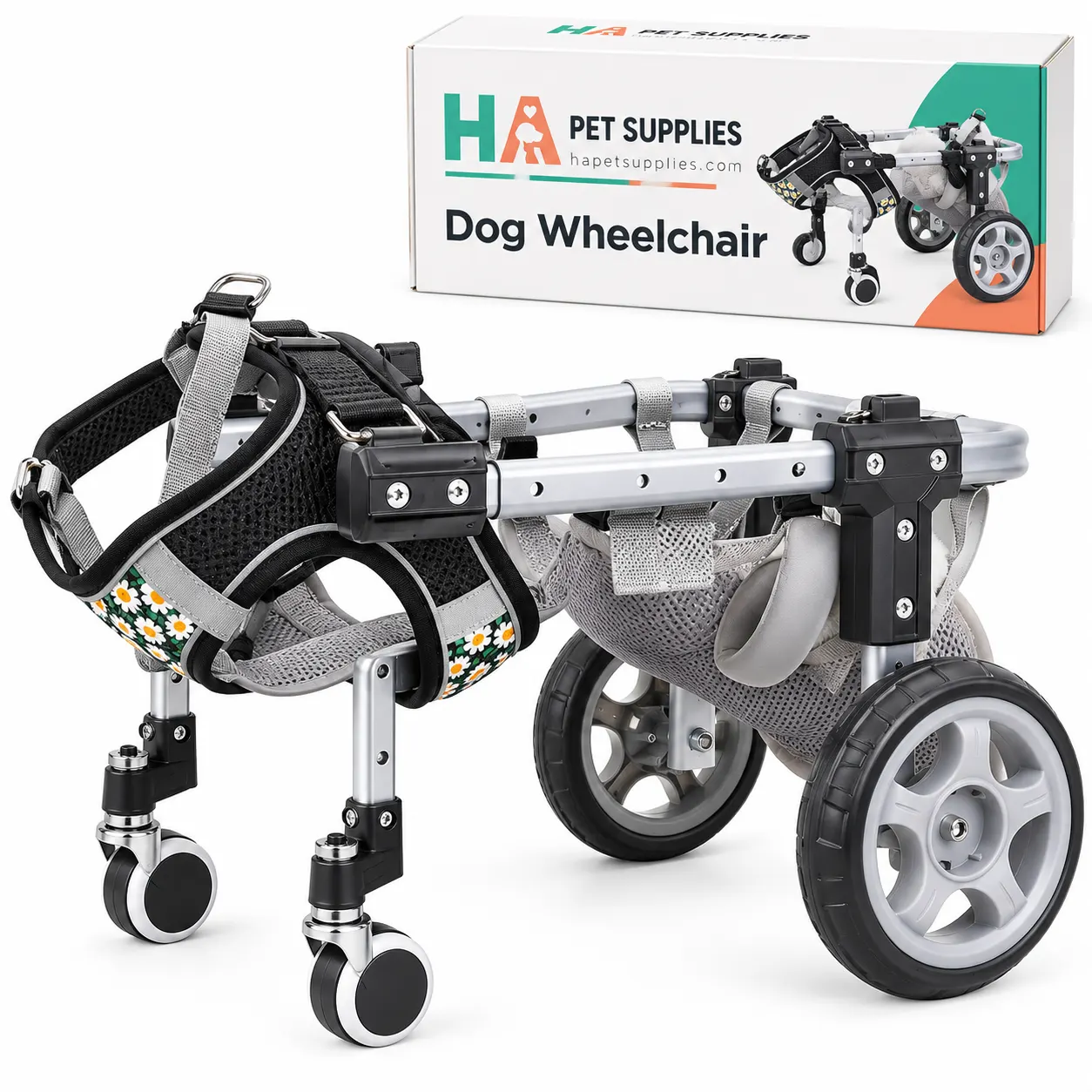
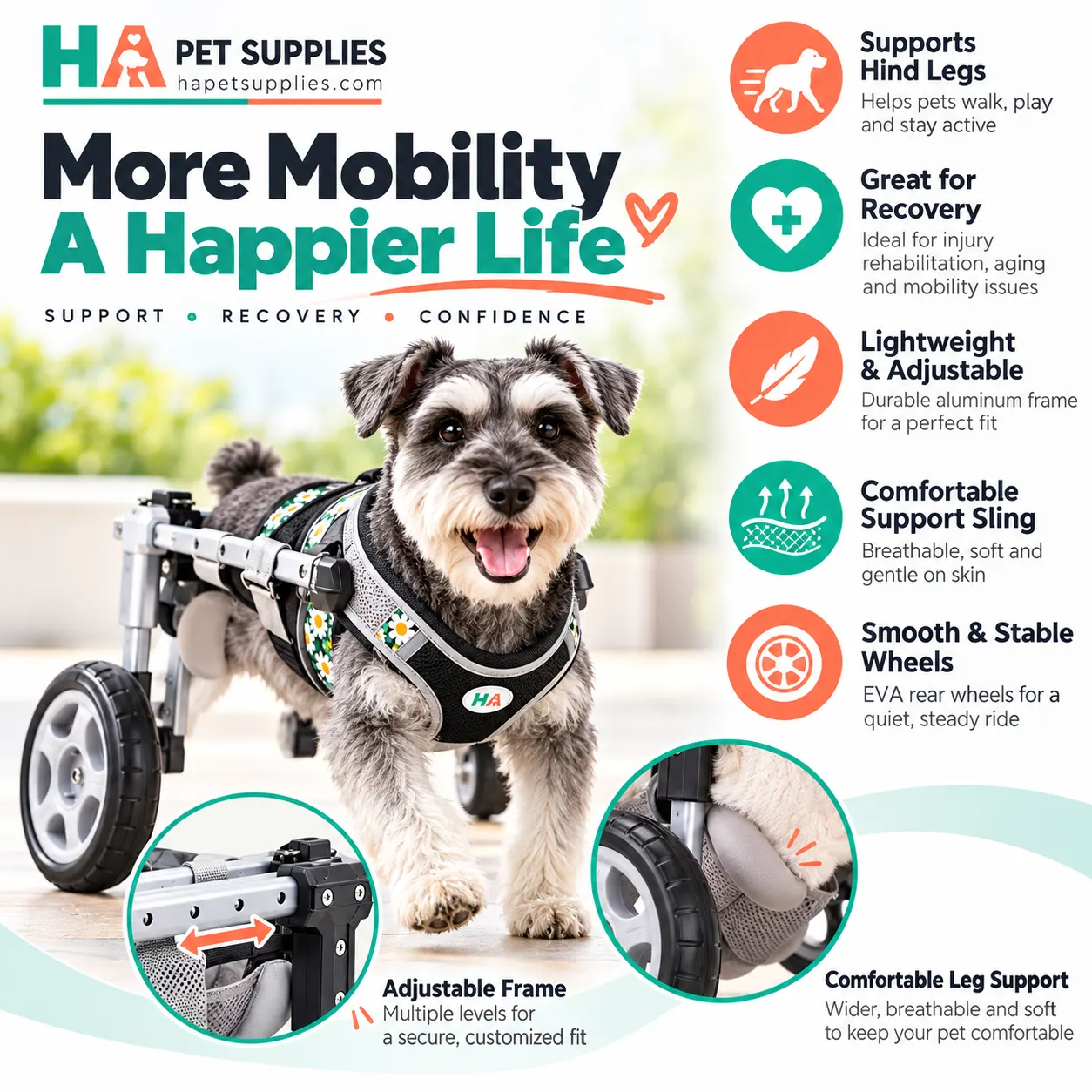
The HA Pet Supplies rear leg wheelchair is intended for
dogs that need assistance with hindquarter support.
Understanding the role of each component helps owners
evaluate whether the design matches their dog’s body shape,
mobility level, and daily routine.
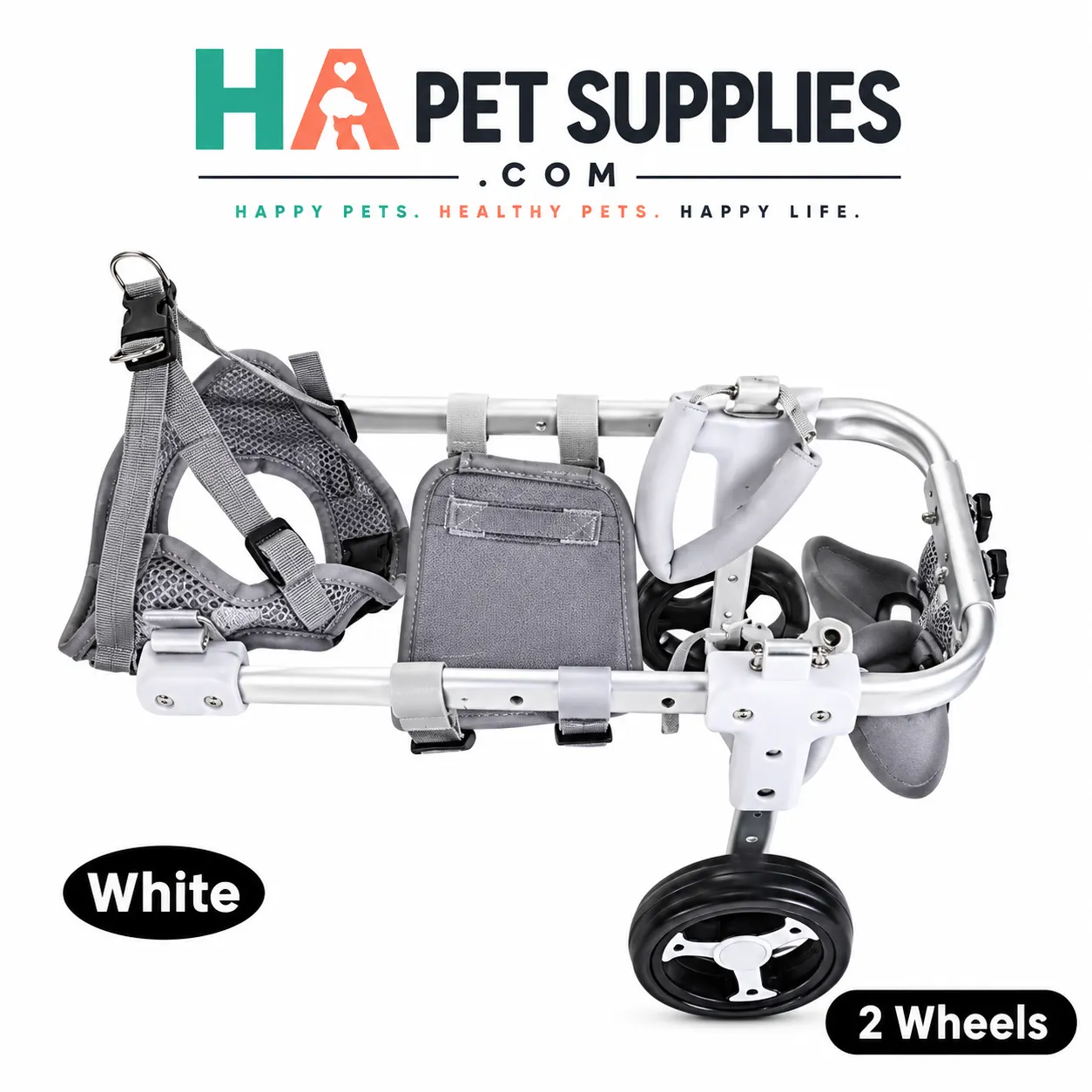
Adjustable Rear Support Frame
The cart-style frame provides a structure for rear body
support. Adjustability is important because dogs differ
significantly in height, body length, chest width, and
hindquarter shape.
Before purchasing, confirm that the chosen variant has
sufficient adjustment for your dog’s measurements.
Two-Wheel Mobility Design
The rear wheel arrangement is intended to assist forward
movement while the dog’s front legs provide propulsion.
This type of wheelchair is generally more suitable for
dogs with adequate front limb function.
Wheel suitability also depends on the walking surface,
overall cart stability, and correct weight distribution.
Body Support and Harness Positioning
A rear mobility cart requires appropriate positioning around
the dog’s body so that weight is supported without placing
harmful pressure on sensitive areas.
Harness contact points should be checked regularly for
rubbing, redness, or skin irritation. Confirm the supplied
harness configuration before purchase.
Support for Weak Hind Legs
For dogs with limited hind leg strength, the wheelchair
may provide partial rear body support while allowing
controlled movement.
Dogs with complete paralysis may need additional leg
positioning support to prevent their paws from dragging.
Compatibility should be confirmed with the actual model.
Practical Mobility Assistance
A rear leg wheelchair can be useful during suitable
supervised activities such as short garden walks,
gentle outdoor exploration, or structured mobility sessions.
It should not be used as an unattended restraint,
a permanent resting device, or an alternative to
medical treatment.
Individual Fit for Different Dogs
An adjustable cart can accommodate different body
proportions within its specified fitting range.
However, adjustability does not mean one wheelchair
fits every dog or breed.
Rear leg height, weight, body length, and width
should all be checked when selecting a suitable variant.
Dog Wheelchair Product Specifications
Use the following specifications to understand the
product type and important selection requirements.
Exact measurements and configuration details should
be verified against the selected HA Pet Supplies
wheelchair variant.
| Specification | HA Pet Supplies Dog Wheelchair |
|---|---|
| Brand | HA Pet Supplies |
| Product Name | Adjustable Dog Wheelchair for Back Legs |
| Product Category | Dog Mobility Aid |
| Wheelchair Type | Rear Support Dog Mobility Cart |
| Primary Purpose | Assisted mobility and hindquarter support |
| Wheel Arrangement | Two rear wheels as shown in the product images |
| Frame Design | Adjustable cart-style structure |
| Frame Material | Confirm material for selected variant |
| Frame Adjustment Range | Confirm height, width and length ranges |
| Wheel Material | Confirm wheel construction and specifications |
| Harness Material | Confirm supplied harness material |
| Available Sizes | Confirm currently available size variants |
| Maximum Supported Weight | Confirm manufacturer-rated limit before ordering |
| Suitable Mobility Needs | Selected cases of hind leg weakness or paralysis, subject to veterinary assessment |
| Required Front Leg Function | Adequate front leg strength and coordination for a rear support cart |
| Recommended Use | Supervised mobility sessions |
| Included Components | Verify package contents before purchase |
| Cleaning | Wipe frame and wheels; clean harness according to its fabric care instructions |
| Warranty | Confirm current product warranty terms |
Important Sizing Information:
Do not select a dog wheelchair using breed or appearance
alone. Two dogs of the same breed may require different
frame dimensions because of differences in body weight,
leg height, and overall proportions.
For help identifying the appropriate size, see our
Dog Wheelchair Sizing and Measurement Guide
.
Dog Wheelchair Comparison – Which Mobility Aid Is Better?
Not all mobility products provide the same level of
support. Some help owners lift a dog’s hindquarters,
while others support the rear body during movement.
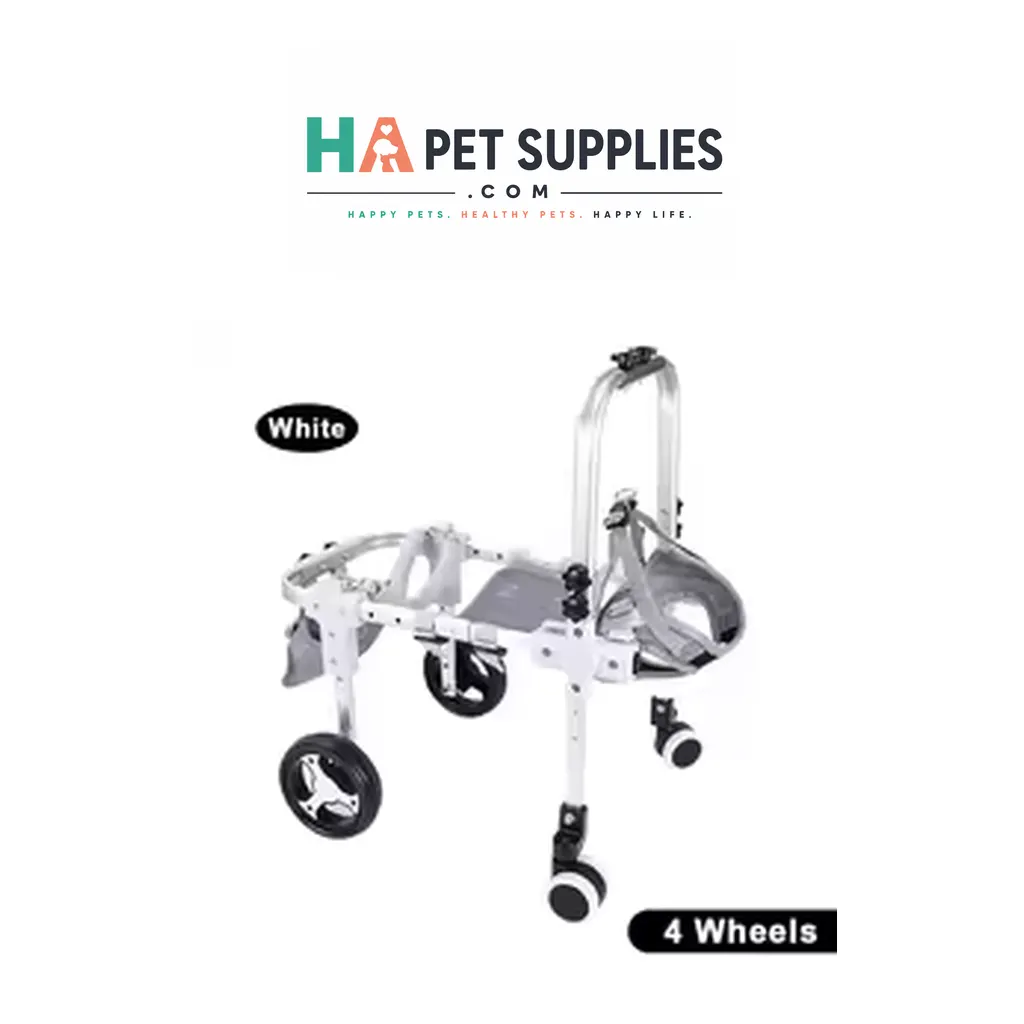
Full support wheelchairs can assist dogs that require
additional front and rear body support.
The following comparison covers product categories
rather than unverified claims about competing brands.
Choosing the appropriate device is more important
than assuming that one design is suitable for every dog.
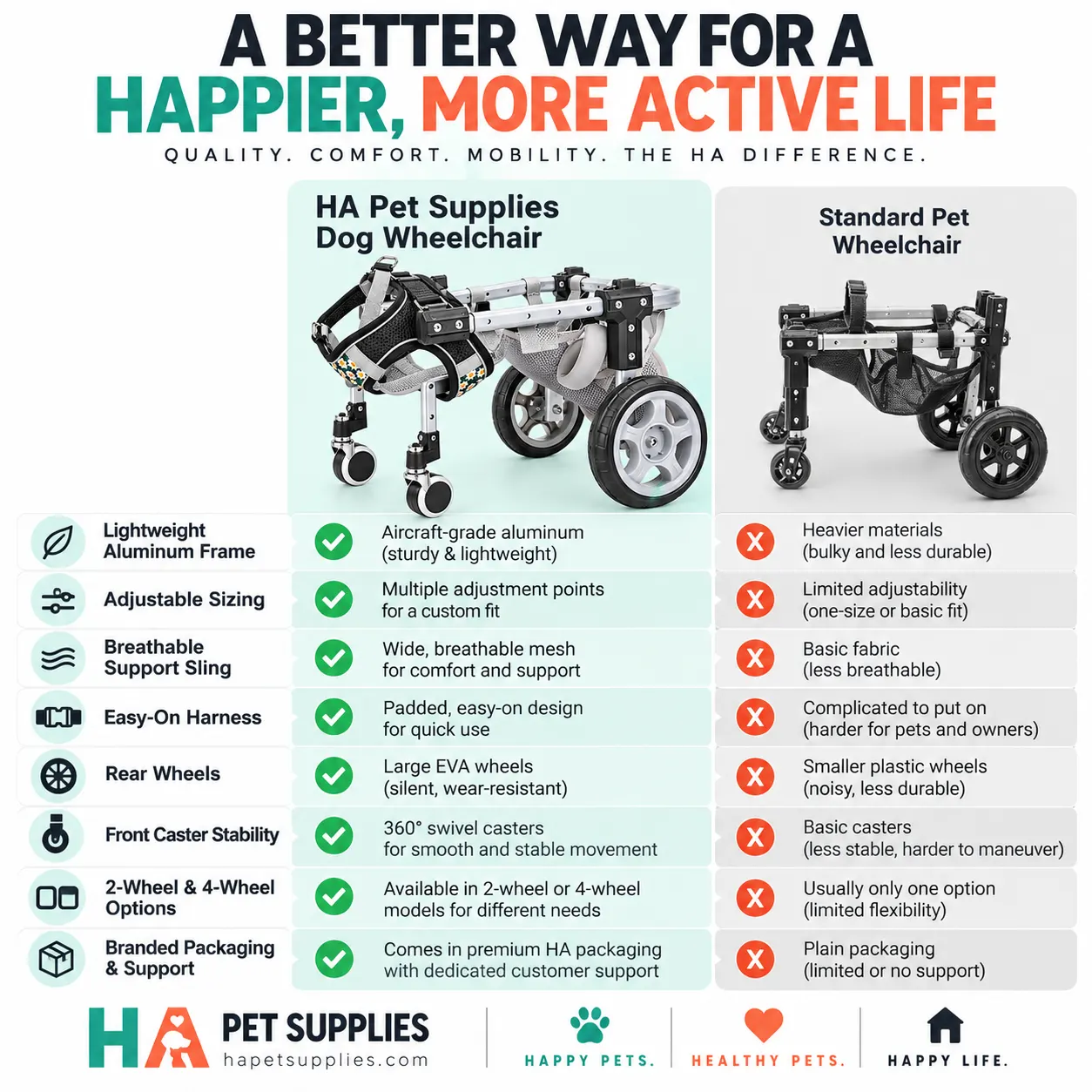
Comparison 1 – HA Rear Wheelchair vs Similar Mobility Products
| Feature | HA Rear Dog Wheelchair | Basic Fixed-Size Rear Cart | Rear Support Sling | Full Support Four-Wheel Cart |
|---|---|---|---|---|
| Primary Purpose | Rear mobility assistance | Rear mobility assistance | Manual lifting support | Front and rear body assistance |
| Adjustability | Adjustable design; range must be checked | Varies; may offer limited adjustments | Usually strap based | Depends on the model |
| Rear Body Support | Yes, when correctly fitted | Yes, when correctly fitted | Depends on owner support | Yes |
| Front Leg Support | No independent front wheel support | No independent front wheel support | No | Yes, depending on design |
| Suitable for Outdoor Assisted Movement | Yes, with appropriate fit and supervision | Yes, depending on fit and terrain | Yes, with continuous handling | Yes, when properly fitted |
| Owner Lifting Required | May be reduced during walking | May be reduced | Usually continuous | May be reduced |
| Best Suited For | Dogs needing rear support with good front leg function | Dogs matching the fixed cart dimensions | Short assisted transfers or toileting | Dogs requiring support in both front and rear limbs |
Comparison 2 – Rear Dog Wheelchair vs Other Rear Cart Designs
| Buying Factor | HA Adjustable Rear Cart | Generic Non-Adjustable Rear Cart | Premium Adjustable Rear Cart |
|---|---|---|---|
| Frame Fitting | Confirm the model’s available adjustments | Requires close match to fixed dimensions | Often offers multiple adjustments |
| Size Selection | Based on dog measurements and available variants | Based on predetermined frame sizes | Based on manufacturer sizing system |
| Wheel System | Rear wheels as pictured; confirm exact specification | Varies by supplier | Varies by supplier |
| Harness Comfort | Requires fit and pressure checks | Depends on harness quality and fit | Depends on harness quality and fit |
| Maintenance | Clean and inspect all components regularly | Depends on materials | Depends on materials |
| Ideal Purchase Approach | Confirm fit with HA Pet Supplies before ordering | Check all fixed measurements | Use the brand’s sizing service |
For an example of how established wheelchair manufacturers
approach sizing, refer to the
Walkin’ Pets wheelchair sizing guide
.
Its measurements and size ranges apply to that
manufacturer’s products and should not be treated
as HA Pet Supplies specifications.
Which Dogs May Benefit From a Rear Leg Wheelchair?
A disabled dog wheelchair can help some pets manage
mobility limitations, but suitability depends on the
underlying medical condition, the dog’s comfort, and
its ability to use the mobility device safely.
Dogs With Weak Back Legs
Hind limb weakness can make standing, balancing, and
walking difficult. A rear support wheelchair may
provide assistance when the dog retains adequate
front leg strength.
Weakness is a symptom rather than a diagnosis.
A veterinarian should investigate the cause before
the owner starts using a mobility aid.
Dogs With Stable Hind Leg Paralysis
A dog wheelchair for paralyzed hind legs may help
selected dogs with stable neurological impairment
participate in supervised walking activities.
Paralyzed dogs may have reduced sensation and may
not notice rubbing or pressure injuries.
They can also require separate bladder care,
skin monitoring, and protection against paw dragging.
Senior Dogs With Reduced Mobility
Older dogs sometimes develop weaker hindquarters
because of chronic disease, muscle loss, or
neurological changes.
A properly chosen wheelchair may support some
senior dogs, provided they have sufficient overall
strength and do not experience increased pain
or fatigue during use.
Dogs With Arthritis
Arthritis can cause stiffness, pain, reduced activity,
and reluctance to walk. However, not every dog with
arthritis needs a wheelchair.
Pain management, weight control, appropriate exercise,
and veterinary rehabilitation are often important
components of treatment.
Owners can learn more about canine osteoarthritis
from the
U.S. Food and Drug Administration’s Animal and Veterinary resources
.
Dogs Recovering From Injury or Surgery
Some dogs may benefit from assisted mobility during
rehabilitation, but only when their veterinary
treatment plan permits it.
A dog rehabilitation wheelchair should never be
introduced against activity restrictions after
spinal surgery, orthopedic procedures, fractures,
or other significant injuries.
When a Wheelchair May Not Be Appropriate
Seek professional guidance if your dog has severe
front leg weakness, an unstable spinal condition,
uncontrolled pain, major balance problems,
significant pressure sores, or serious breathing
or cardiovascular limitations.
Dogs requiring support in all four limbs may need
a different type of mobility device.
A rear wheelchair is not automatically suitable
for these situations.
For additional owner guidance, the
American Animal Hospital Association
provides veterinary care resources.
Your own veterinarian remains the best source
of guidance about your dog’s condition.
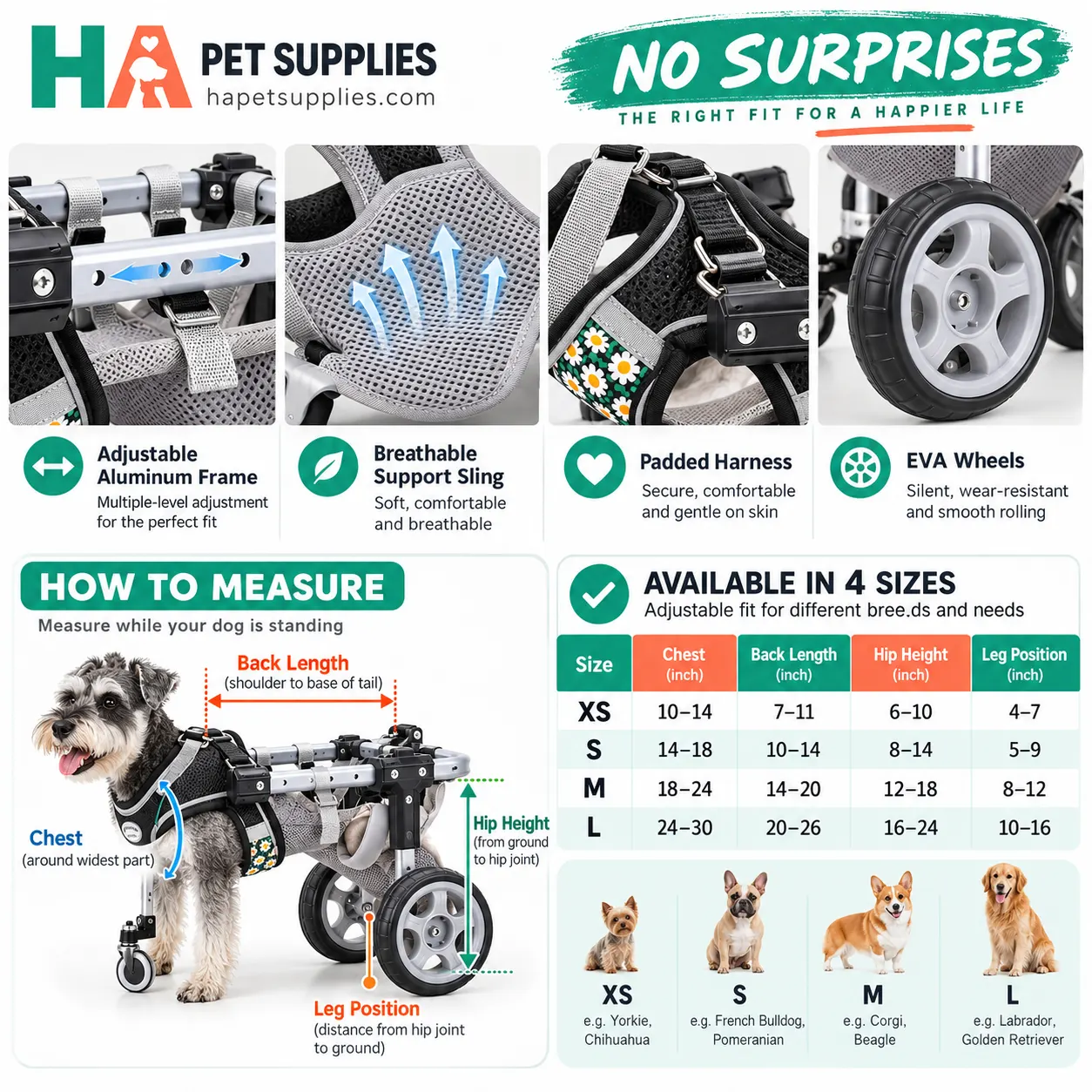
How to Measure Your Dog for a Wheelchair
The correct fit is one of the most important factors
when choosing an adjustable dog wheelchair.
A cart that is too high, too narrow, or too long
can interfere with normal movement and cause
discomfort.
Measure your dog before ordering and compare those
measurements with the specific product variant’s
verified size range.
Step 1 – Weigh Your Dog
Record your dog’s current body weight using a
suitable veterinary or pet scale. Weight is
important because wheelchair frames are designed
to support particular load ranges.
Step 2 – Measure Rear Leg Height
Position your dog comfortably on its side.
With the hind leg in a natural, slightly bent
standing position, measure from where the
upper leg meets the body to the bottom of
the paw.
Do not overstretch the leg while measuring.
If your dog is painful or cannot tolerate
handling, ask a veterinary professional
for assistance.
Step 3 – Measure Body Length
Measure from behind the front leg toward the
rump, according to the measurement method
required by the selected wheelchair.
This measurement helps determine whether
the side frame can be positioned without
interfering with shoulder movement or
rear body clearance.
Step 4 – Check Body Width
Measure the dog’s widest relevant torso
area and confirm the wheelchair provides
an appropriate adjustable width.
A frame should not squeeze the body,
restrict breathing, or rub against the ribs.
Step 5 – Check Front Leg Strength
Because a rear leg wheelchair depends on
the front legs for forward movement,
front limb strength and coordination
are essential considerations.
Ask your veterinarian whether the dog’s
front limbs can safely support the
additional activity.
Step 6 – Confirm the Exact Size
Compare the dog’s measurements with the
wheelchair manufacturer’s fit range.
Contact HA Pet Supplies if the measurements
are close to a size boundary.
Do not select a larger wheelchair merely
because it looks more spacious.
An oversized cart can be difficult
to control.
Dog Wheelchair Measurement Checklist
- Current body weight
- Rear leg height with natural joint bend
- Body length from front leg area toward rump
- Body or chest width
- Front leg strength and mobility level
- Hind leg movement and sensation
- Any existing skin problems or sensitive areas
- Veterinarian’s recommendation
Our detailed article,
Best Dog Wheelchair for Back Legs
,
covers the buying process and important comfort checks
in greater detail.
HA Pet Supplies Dog Wheelchair User Manual
This general user guide explains safe preparation,
fitting, introduction, and care for a rear support
wheelchair for dogs.
The exact assembly sequence and fastening system
must follow the instructions supplied with
your product variant.
Before You Begin
- Confirm that your veterinarian has approved wheelchair use.
- Inspect every delivered component for visible damage.
- Check the wheels for secure attachment and smooth rotation.
- Prepare the manufacturer’s assembly instructions.
- Keep your dog’s measurements available.
- Choose a flat, non-slip area for the first fitting.
- Arrange a second person to help if your dog needs lifting support.
Step-by-Step Wheelchair Setup
Step 1 – Identify All Components
Unpack the wheelchair and identify the frame,
rear wheels, body supports, harness elements,
fasteners, and any other components included
with your selected model.
Compare the contents with the supplied parts
list before assembly. Do not substitute
unapproved fasteners or hardware.
Step 2 – Assemble the Frame
Connect the wheelchair frame components according
to the included assembly diagram.
Ensure all structural connections are correctly
aligned.
Do not force a connection or modify the frame
to make incompatible parts fit.
Step 3 – Install and Check the Wheels
Attach the rear wheels using the manufacturer’s
specified hardware and locking method.
Check that both wheels are secure and move
smoothly without unexpected wobbling or
contact with the frame.
Step 4 – Set the Initial Frame Dimensions
Use your dog’s measurements to establish the
initial frame height, width, and length within
the cart’s documented adjustment range.
Keep the frame balanced and avoid leaving
protruding parts that could catch on furniture,
leashes, or the dog’s body.
Step 5 – Position the Dog Gently
With assistance if needed, support your dog’s
body while positioning it in the wheelchair
according to the supplied fitting instructions.
Never lift the dog by a painful limb, tail,
or an unsupported section of the spine.
Step 6 – Adjust the Harness and Supports
Position the supports so that the dog’s
hindquarters are held appropriately without
excessive pressure on the abdomen, groin,
chest, or other sensitive regions.
Check that harness elements are secure
but do not restrict breathing or normal
front leg movement.
Step 7 – Check Standing Alignment
Assess whether your dog’s back is supported
in a comfortable position.
Look for excessive arching, sagging,
twisting, or leaning.
The wheelchair should allow an appropriate
walking posture and should not force
the dog into an unnatural position.
Step 8 – Protect the Hind Paws
For dogs able to use their back legs,
the veterinarian may recommend allowing
controlled ground contact.
Dogs with paralyzed hind legs may require
appropriate leg supports to prevent
dragging. Use these only if compatible
with the wheelchair and appropriate
for the dog’s condition.
Step 9 – Begin With a Short Introduction
Let your dog investigate the mobility cart
in a calm environment. Reward relaxed behavior
and do not force walking.
Once the fit is confirmed, begin with a
very brief, supervised session on level ground.
Stop immediately if your dog shows pain,
distress, or unusual fatigue.
Step 10 – Recheck the Fit After Movement
After the first steps, inspect the harness
and contact areas again.
Look for rubbing, sliding straps,
uneven wheel position, pressure marks,
or difficulty turning.
Make adjustments according to the
manufacturer’s guide before continued use.
How to Train Your Dog to Accept the Wheelchair
Some dogs adapt quickly to a new mobility aid.
Others may require multiple short sessions
before feeling comfortable.
Begin with familiar surroundings and use
positive reinforcement, including praise,
small treats, and gentle encouragement.
Avoid pulling your dog forward or pushing
the cart when it is resisting.
Gradually introduce simple forward movement,
gentle turns, and familiar outdoor surfaces
as tolerated.
For a complete training plan, follow our article:
How to Train a Dog to Use a Wheelchair – 7 Easy Steps
.
For additional examples of wheelchair positioning,
review the
Walkin’ Pets fitting and adjustment guide
.
Its instructions are model-specific and must
not replace the HA product’s own manual.
Daily Dog Wheelchair Care and Safe Usage Tips
Safe use of a rear support cart involves more
than fastening the harness and beginning
a walk. Dogs with impaired mobility
need regular monitoring, appropriate rest,
and attention to skin health.
1. Supervise Every Wheelchair Session
Do not leave a dog unattended while wearing
a wheelchair. The cart can become caught
on obstacles, furniture, doorways,
or uneven ground.
Supervision is especially important for dogs
that have limited sensation in their
hind limbs.
2. Begin With Short Walks
There is no universal walking duration that
is appropriate for every dog.
Start with very brief sessions approved by
your veterinarian and gradually increase
activity only if your dog remains
comfortable.
Watch for slower movement, heavy panting,
reluctance, abnormal posture, or signs
of exhaustion.
3. Inspect the Skin After Every Session
Check the chest, belly, groin, inner thighs,
and areas underneath harness straps.
Persistent redness, swelling, abrasions,
or unusual licking may indicate excessive
pressure or an incorrect fit.
Remove the wheelchair and seek advice
if these problems occur.
4. Keep the Walking Surface Safe
Choose level, stable walking surfaces
during initial training.
Avoid stairs, steep slopes, slippery
floors, deep mud, loose gravel, or
rough terrain that could cause
the wheelchair to tip or become stuck.
5. Give Your Dog Regular Rest
A wheelchair is a walking aid, not
a device intended for continuous wear
throughout the day.
Remove it for appropriate resting periods,
sleeping, and other activities as
recommended by your veterinarian.
6. Clean the Wheelchair Regularly
Wipe dirt and moisture from the frame
after outdoor use. Remove debris
from around the wheels and axles.
Clean fabric or harness components
according to the care directions
supplied with the product.
Allow cleaned components to dry
before storing or reusing them.
7. Inspect the Hardware
Before each session, check the wheels,
connectors, fasteners, and adjustable
frame sections.
Stop using the cart if a critical
component becomes loose, damaged,
or difficult to secure.
8. Maintain Veterinary Follow-Up
An animal’s physical condition can
change with recovery, aging,
weight fluctuations, or progression
of an underlying disease.
Schedule appropriate reassessments
and review the fit whenever your
dog’s body shape or mobility changes.
Owners can explore professional rehabilitation
information through the
American Association of Rehabilitation Veterinarians
.
Safety Reminder:
Never force a dog to walk when it appears
uncomfortable, painful, distressed,
or exhausted. A wheelchair should
support appropriate movement rather
than create additional physical stress.
Why Choose HA Pet Supplies for Your Dog Wheelchair?
Selecting a dog mobility aid is a meaningful
decision for both the pet and its owner.
At HA Pet Supplies, we believe customers
should be able to evaluate a product’s
purpose, fitting requirements, and
limitations before purchasing.
Pet-Focused Product Selection
Our dog wheelchair offering is intended
for owners seeking a practical rear leg
mobility solution for dogs that may
benefit from assisted walking.
Clear Buying Information
We provide guidance about the importance
of measurements, correct fit, safe use,
and choosing a mobility device
appropriate for the pet.
Helpful Educational Content
Our website includes resources addressing
mobility warning signs, wheelchair sizing,
and introductory training.
Direct Product Enquiries
Customers can contact our team to ask
about available wheelchair options,
product specifications, and ordering.
Broader Dog Supply Range
Explore our
dog supplies collection
for other products designed to support
daily pet care and comfort.
Simple Quote Requests
For product availability, sizing questions,
or purchasing information, customers
can submit an enquiry through
our dedicated quote request page.
We encourage buyers to compare the actual
specifications of each mobility product,
consult their veterinarian, and choose
a wheelchair based on suitability
rather than marketing promises alone.
Dog Wheelchair – Detailed Product Description
The HA Pet Supplies adjustable dog wheelchair
for back legs is a rear support mobility cart
intended to assist selected dogs experiencing
weakness or reduced function in their hind limbs.
For many dog owners, watching a companion
struggle with a once-simple movement
can be emotionally difficult. Walking
to the door, exploring the garden,
or joining the family outdoors
may become challenging when the
back legs no longer provide
adequate support.
A rear support wheelchair is one option
that may help address some of these challenges.
By supporting the hindquarters,
the device may allow suitable dogs
to move using their front legs
during supervised activities.
Designed for Rear Body Support
Unlike a simple lifting strap,
a dog mobility cart incorporates
wheels to help support the rear
of the body during movement.
When appropriately fitted,
this arrangement can reduce
the physical demands of supporting
the hindquarters entirely by hand.
A wheelchair is not a replacement
for veterinary rehabilitation,
medication, or an appropriate
treatment plan. Instead,
it may serve as an additional
mobility aid for selected pets.
Adjustability Matters
Every dog’s body is different.
A short-bodied dog may need
a different frame length from
a similarly weighted dog with
a longer torso.
The adjustable structure of
a dog wheelchair is important
because it allows the fit
to be tailored within the
product’s stated range.
Correct positioning can help
avoid unnecessary pressure,
uneven weight distribution,
and interference with normal
front leg movement.
Before ordering, confirm
that the selected HA wheelchair
variant accommodates your dog’s
rear leg height, weight,
body length, and width.
For Dogs With Different Mobility Challenges
Dog owners may search for a
wheelchair for dogs because
of aging, hind leg weakness,
paralysis, or a veterinary
diagnosis that affects movement.
However, these conditions
are not interchangeable.
Each may require different
support levels and rehabilitation
approaches.
For example, a dog with good
hind limb movement but poor
balance may need different
support from a dog with
complete paralysis and
no paw sensation.
The appropriate wheelchair
must match the animal’s
functional abilities rather
than the condition’s name alone.
Helping Dogs Enjoy Appropriate Activity
Dogs often benefit from
opportunities to explore
their environment,
interact with their owners,
and participate in
appropriate physical activity.
A dog wheelchair may support
these activities when the dog
is physically capable of
using the device and
the walking conditions
are suitable.
Begin slowly, monitor
your pet’s comfort,
and avoid trying to
recreate its previous
walking distance immediately.
Success may involve
a few comfortable steps,
a short garden walk,
or a gentle supervised
session rather than
a long outdoor adventure.
Designed for Responsible Pet Owners
A mobility aid requires
regular fit checks,
skin inspection,
equipment maintenance,
and attention to
the dog’s response.
Owners should monitor
whether the wheelchair
helps their pet move
comfortably and whether
any part of the cart
is causing discomfort.
If a dog appears unwilling
to move, the reason may
be fear, fatigue,
an incorrect fit,
or pain.
Do not assume that hesitation
can always be solved
through additional training.
Wheelchair Use Is Only One Part of Mobility Care
A dog with hind limb impairment
may also benefit from home
adaptations and veterinary care.
Non-slip flooring,
accessible resting areas,
appropriate weight management,
and assistance with transfers
can all be important.
Some dogs may need additional
medical management,
physiotherapy,
or support with
toileting and grooming.
Discuss these needs with
your veterinarian to create
a complete care plan.
For information about the broader
principles of canine health
and owner education,
visit the
American Kennel Club health resources
.
Choosing the Right Dog Wheelchair Online
When buying a dog wheelchair online,
check more than the product photograph.
Review the frame dimensions,
size range, maximum supported
weight, wheel type,
harness configuration,
and included components.
A clear product image can
show the general design,
but it cannot confirm
whether a cart will
fit your individual dog.
Take careful measurements,
review the manufacturer’s
instructions,
and contact the seller
when specifications
are unclear.
At HA Pet Supplies,
you can begin by browsing
our
online pet supplies shop
and contacting the team
with questions about
the wheelchair option
you are considering.
What Makes a Successful Wheelchair Experience?
A successful experience
starts with a realistic goal.
The objective is not
necessarily to make
a disabled dog walk
exactly as it did
before its condition.
Instead, the goal is
to provide suitable
assistance that allows
the dog to enjoy
safe movement and
comfortable daily routines.
That requires correct
equipment selection,
veterinary guidance,
patient training,
and ongoing observation.
Some dogs may use
a mobility cart regularly.
Others may need it
only for selected activities
or may not tolerate
the device at all.
Individual comfort
and welfare must
always come first.
Helping Your Dog Adjust Emotionally
A new mobility device
introduces unfamiliar
sounds, surfaces,
body contact,
and movement patterns.
Allow your dog
to become familiar
with the wheelchair
before expecting
it to walk.
Positive reinforcement
and predictable routines
can make the
introduction less stressful.
If your dog becomes anxious,
end the session calmly
and try again later
after confirming that
the device fits correctly.
The
American Veterinary Society of Animal Behavior
provides resources
about humane,
reward-based approaches
to animal behavior
and training.
Long-Term Care and Mobility Monitoring
The needs of a dog
with limited hind
leg mobility can
change over time.
A dog recovering
from an injury
may improve,
while a dog
with a progressive
condition may
require additional
support.
Regular veterinary
reassessment helps
determine whether
the wheelchair
remains appropriate.
Check the cart’s fit
after meaningful
weight changes,
changes in posture,
or changes in
walking ability.
As your dog’s needs evolve,
continue learning
through our
pet care blog
and seek individualized
veterinary advice.
More Comfortable Moments Together
The bond between a dog
and its owner is built
through everyday moments.
For some dogs,
a properly fitted
rear leg wheelchair
can offer another way
to enjoy selected
shared activities.
Whether that means
visiting a favorite
spot in the garden
or joining a gentle
walk, the focus
should remain on
the dog’s wellbeing.
HA Pet Supplies aims
to help pet owners
make informed decisions
about mobility products,
with an emphasis
on practical use,
appropriate fitting,
and responsible care.
If you need help
understanding the available
product specifications
or choosing a suitable
option, please
contact HA Pet Supplies
before ordering.
Dog Wheelchair FAQs – Frequently Asked Questions
These answers address common questions
from dog owners researching a wheelchair
for dogs with weak back legs
or reduced mobility.
1. What is a dog wheelchair used for?
A dog wheelchair is a mobility aid that helps
support part of a dog’s body during movement.
A rear wheelchair supports the hindquarters
and is generally intended for dogs that
can propel themselves with their front legs.
2. Can a dog with paralyzed back legs use a wheelchair?
Some dogs with stable hind leg paralysis
can use a properly fitted rear support wheelchair.
Suitability depends on overall health,
front leg strength, balance,
and veterinary assessment.
Additional support may be needed
to prevent the hind paws from dragging.
3. How do I know if my dog needs a wheelchair?
Difficulty standing, frequent stumbling,
hind leg dragging, and reduced mobility
are reasons to seek a veterinary evaluation.
These signs do not automatically mean
that a wheelchair is the correct treatment.
Read our
guide to signs your dog may need mobility support
.
4. Is a dog wheelchair suitable for arthritis?
It may be appropriate for some dogs
with arthritis-related mobility problems.
However, many dogs benefit more from
pain management, weight control,
rehabilitation, and environmental changes.
Ask your veterinarian whether
wheelchair support is suitable.
5. How do I choose the correct wheelchair size?
Record your dog’s weight, rear leg height,
body length, and relevant width measurements.
Compare these with the selected model’s
verified sizing chart. Never rely
on breed alone.
6. Can my dog use a wheelchair every day?
Some dogs can use a wheelchair during
appropriate supervised sessions each day.
However, it should be removed for
rest and sleep, and the amount
of activity should follow
veterinary recommendations.
7. How long should my dog stay in a wheelchair?
There is no single safe duration
for every dog. Start with very
short sessions and follow
the veterinarian’s activity plan.
Remove the device if the dog
shows pain, fatigue, distress,
or skin irritation.
8. Can a dog sleep in a wheelchair?
No. A walking wheelchair should
normally be removed for sleeping
and extended rest. Dogs need
a safe, comfortable place
to lie down without
continuous harness pressure.
9. Can a wheelchair help an older dog?
Some senior dogs may benefit
from rear leg support,
but suitability depends
on their specific medical
condition and whether
they have enough strength
to use the device.
10. Does a wheelchair cure hind leg paralysis?
No. A wheelchair provides
mechanical assistance
and does not cure paralysis
or restore damaged nerves.
Treatment and prognosis
depend on the underlying cause.
11. Can my dog go to the toilet while using the wheelchair?
Some wheelchair designs allow
dogs to urinate and defecate
while supported, provided
the harness does not
obstruct normal elimination.
This must be checked
during fitting.
Dogs with neurological
conditions may still need
specific bladder or bowel care.
12. What if my dog’s hind paws drag?
Stop and check the fit.
Dogs with paralysis may
need compatible leg supports
or another method of
protecting the paws.
Ask your veterinarian
or rehabilitation professional
for advice before continuing.
13. Can a wheelchair be used on grass?
Some dog wheelchairs can
be used on short, firm grass,
depending on wheel design,
ground conditions,
and the dog’s abilities.
Avoid unstable surfaces
that could cause tipping
or excessive resistance.
14. Can my dog climb stairs with a wheelchair?
No. Do not attempt stairs
with a rear support
wheelchair unless a
qualified professional
has specifically approved
a suitable method.
Ordinary wheelchair use
on stairs presents
a significant tipping risk.
15. What if my dog refuses to walk?
Do not force movement.
Check the fit and consider
whether the dog may be
afraid, painful, tired,
or physically unable
to use the device.
Our
dog wheelchair training guide
explains a gradual introduction process.
16. How should I clean the dog wheelchair?
Wipe the frame and wheels
with a suitable damp cloth.
Remove dirt from moving
components and follow
the supplied care instructions
for harness fabrics.
Dry components before storage.
17. Does a rear wheelchair support the front legs?
No. A standard rear wheelchair
supports the hindquarters
while the front legs
provide propulsion.
Dogs requiring front limb
assistance may need
a full support
four-wheel mobility cart.
18. Is an adjustable wheelchair suitable for every dog breed?
No single frame fits
every dog. An adjustable
wheelchair can accommodate
different body shapes
only within the
manufacturer’s stated
size and weight range.
19. What should I check before buying online?
Confirm the product’s exact
dimensions, weight capacity,
adjustment range,
harness configuration,
included components,
and warranty terms.
Compare them with
your dog’s measurements
and veterinary needs.
20. Where can I buy an HA Pet Supplies dog wheelchair online?
You can explore products
through the
HA Pet Supplies online shop
or submit a
request for a quote
to enquire about wheelchair
availability, product details,
and suitable options.
Help Your Dog Enjoy More Comfortable Movement
Your dog deserves thoughtful care,
appropriate support, and opportunities
to enjoy life at a comfortable pace.
Explore the HA Pet Supplies dog wheelchair
and ask about available sizes,
adjustment options, and product details
before making your purchase.
Find the right mobility support
for your companion.
Have questions about sizing or suitability?
Contact Our Team
.
HA Pet Supplies – Supporting Happier Moments With Pets
At
HA Pet Supplies
,
we understand that pets are part
of the family.
Our goal is to help owners
find products that support
practical pet care,
comfort, and daily activities.
When choosing a dog wheelchair,
always prioritize proper fitting,
professional veterinary guidance,
and your dog’s individual wellbeing.
Explore our
dog supplies
to discover more pet care products,
and visit our
educational pet care articles
for additional buying and usage guidance.
HA Pet Supplies – Because Every Pet Deserves Care, Comfort, and Compassion.



Reviews
There are no reviews yet.