
Cat airline carrier training should begin before the suitcase comes out, before you arrive at airport security, and definitely before your cat hears an airport announcement for the first time.
Many owners make the same understandable mistake. The carrier stays in a cupboard for months. Then suddenly, on travel day, it appears. The cat is picked up, placed inside, the zipper closes, the house disappears, a car starts moving and hours of unfamiliar experiences begin. From the cat’s point of view, that is a lot of change at once.
A better approach is to make the cat airline carrier part of ordinary life before it becomes part of air travel. You do not need to turn your home into an airport training center. Instead, work gradually: carrier appears → carrier becomes familiar → cat explores → door closes briefly → carrier moves → short practice trips → travel day.
The CDC notes that travel can be stressful for pets and recommends planning ahead. Its current travel guidance also suggests using gradual short drives to prepare pets for vehicle travel rather than making a long journey their first experience with motion. CDC
That same principle is useful when preparing a cat for a flight. If you have not yet chosen the carrier itself, start with How to Choose a Cat Airline Carrier: Size, Airline Requirements & Features to Check Before Flying because training is only useful if the carrier also complies with your airline’s current restrictions.
Quick Answer: How Do You Get a Cat Comfortable in an Airline Carrier?
If your trip is approaching and you need the fast version, follow this progression.
- Step 1 — Leave the carrier visible. Do not make the carrier something that only appears before stressful trips.
- Step 2 — Keep it open. Let your cat investigate without being immediately trapped inside.
- Step 3 — Add familiar comfort. Use an appropriate liner or familiar-smelling bedding.
- Step 4 — Build positive associations. Treats, toys and calm interaction can help make the area more rewarding.
- Step 5 — Close the carrier briefly. Start with seconds or a very short session rather than immediately expecting long confinement.
- Step 6 — Introduce movement. Carry the closed carrier gently around the house.
- Step 7 — Practice realistic travel. Add short car rides and gradually increase travel-like experiences when your cat tolerates them.
That is the basic cat airline carrier training process. The rest of this guide explains how to make each stage practical.
Why Do Cats Often Dislike Their Carrier?
Before trying to fix the problem, understand why it happens. Cats are not necessarily frightened of the physical bag itself. They may dislike what the bag predicts. For some cats, the carrier means: carrier appears → cat is chased → cat is forced inside → car ride → veterinary clinic.
If that sequence repeats for years, the carrier can become a warning signal. That is why you may see a cat disappear underneath the bed the moment the carrier comes out. The solution is to change the pattern. Instead of carrier = stressful event, you want to gradually create carrier = familiar object that sometimes contains comfort, treats and rest. This does not happen instantly. It develops through repetition.
1. Cat Airline Carrier Training Begins Long Before Flight Day
If possible, start weeks before travel rather than the night before. You do not need a rigid calendar where every cat must reach a certain stage on a certain day. Cats differ. One cat may walk into the carrier during the first afternoon. Another may spend several days looking at it from across the room.
Your progress should be based on your cat’s response. A practical principle is: Move forward when the current stage looks ordinary rather than overwhelming. Do not judge progress only by whether the cat physically remains inside. A frightened cat that freezes for ten minutes is not necessarily comfortable simply because it did not move. Instead, watch the overall behavior.
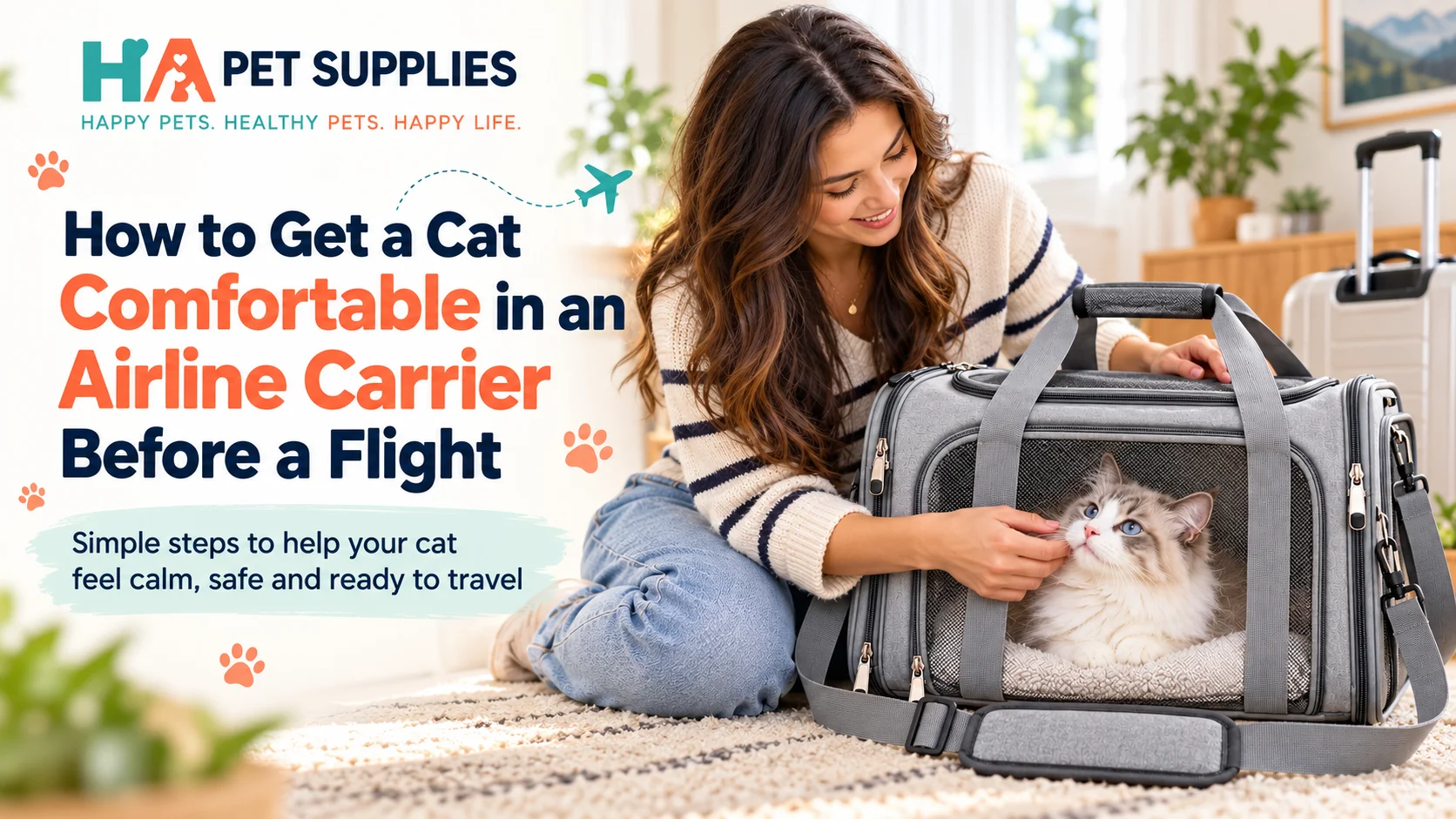
Start cat airline carrier training at home so the carrier becomes familiar before the airport journey begins.
2. Leave the Cat Airline Carrier Out at Home
This is one of the simplest changes you can make. Instead of storing the carrier in a garage, cupboard, basement, closet, or luggage storage, place it somewhere your cat already spends time. Good locations might include a living room, bedroom, quiet hallway, or home office. Do not place it directly beside a loud appliance or in the middle of a busy walkway.
The goal is for the carrier to become visually boring. Your cat should eventually be able to walk past it without thinking: Something bad is about to happen.
3. Keep the Carrier Open During Early Training
A carrier that immediately closes behind the cat can teach: going inside = losing control. During early cat airline carrier training, keep the normal entry point open. Let your cat sniff it, walk around it, touch it, investigate the mesh, look inside, enter voluntarily, and leave voluntarily. Avoid pushing the cat inside simply because it approached the entrance. The first objective is curiosity, not confinement.
4. Make the Inside Feel Familiar
The inside of a brand-new carrier smells unfamiliar. You can make it less strange by adding an appropriate familiar item. Examples include a normal carrier liner, thin familiar blanket, small piece of familiar bedding, or removable padded mat.
Do not fill the carrier with oversized bedding. Your cat still needs usable room, airflow, and stable footing. IATA’s pet travel guidance emphasizes choosing a container with sufficient internal dimensions and accounting for bedding when determining usable height. IATA For airline travel specifically, too much padding can also consume valuable under-seat space.
5. Use Treats to Encourage Exploration
If your cat is food-motivated, treats can help. Start outside the carrier. Stage 1: Treat beside the carrier. Next stage: Treat near the entrance. Next: Treat just inside. Later: Treat farther inside.
This allows your cat to make the decision to move forward. Avoid turning the treat into a trick where the cat follows food inside and the door immediately slams shut. That can destroy trust in the exercise.
6. Toys Can Help Some Cats
Food is not the only positive association. Some cats may respond better to wand toy movement near the carrier, a favorite small toy, a catnip-compatible toy if appropriate for that cat, or gentle interaction from the owner. The objective is not intense play inside a small bag. The point is to make the carrier part of normal enjoyable life.
7. Let Your Cat Rest in the Carrier Voluntarily
One of the strongest signs of familiarity is when a cat uses the carrier without being asked. Some cats eventually treat an open soft carrier almost like another cat bed. You may notice your cat sitting inside, lying down, grooming, watching the room, or sleeping.
If that happens, do not disturb the cat simply because you are excited that the training is working. Let the carrier remain a normal resting option.
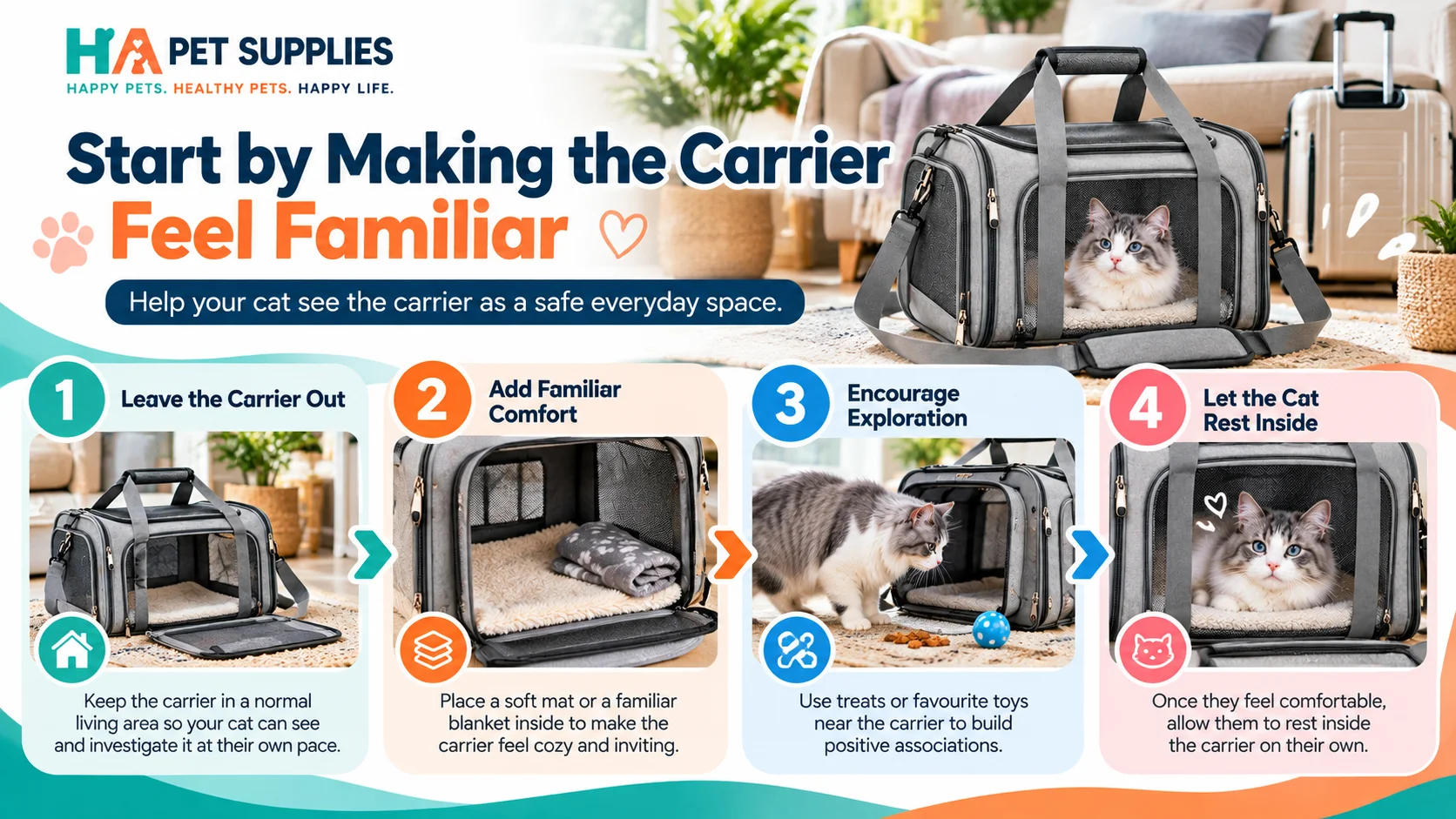
Leave the carrier accessible, add familiar comfort and encourage voluntary exploration before introducing travel.
Rotating 3D view — hover to pause on desktop
8. When Should You Start Closing the Cat Airline Carrier?
Only after your cat can enter without immediately panicking. Then begin with very short closures. For example: cat enters, quietly close the zipper, wait briefly, reopen, and let the cat exit normally.
Do not immediately carry the bag somewhere. You are teaching only one new thing: The door can close and then open again without something bad happening. That matters. If you add closing + carrying + car ride + vet visit all in one session, the cat cannot separate those experiences.
9. Increase Carrier Time Gradually
Once a brief closure is tolerated, gradually extend the session. There is no universal timetable such as Day 1 = 30 seconds, Day 2 = 2 minutes, Day 3 = 10 minutes. Some cats progress faster. Others need slower steps.
Instead, watch for increasing comfort. You are looking for sessions where your cat can settle rather than continuously struggling to escape.
10. What Are Signs Your Cat May Be Uncomfortable?
Behavior varies, but signs that you may be progressing too quickly can include frantic scratching, repeatedly throwing body weight against the carrier, desperate attempts to push through openings, intense vocalization that escalates, rapid breathing not explained by normal exertion, inability to settle at all, immediate avoidance after sessions, or hiding when the carrier appears.
A single behavior does not diagnose a medical or behavioral problem. The pattern matters. If your cat shows extreme distress or you are worried about breathing, health, or severe anxiety, speak with your veterinarian rather than pushing through training. USDA’s air-travel readiness guidance specifically notes that health, temperament, and breed-related factors can affect travel suitability, with some short-nosed breeds requiring additional consideration. APHIS
11. Practice Picking Up the Carrier
A cat may be perfectly comfortable inside a carrier sitting on the floor but react very differently when the ground suddenly starts moving. So movement should become its own training stage.
Begin by closing the carrier, lifting it a few centimeters, placing it down, and reopening it. Later, carry it across the room, set it down, wait, and reopen. Then walk through the house, practice turning corners, walk toward the front door, and return. Keep movement smooth. Avoid swinging the carrier from long straps.
12. Practice With the Carry Handles and Shoulder Strap
Your real airport journey will involve walking, queues, escalators, turns, stops, boarding, and luggage handling. If you plan to use a shoulder strap, test the carrier’s stability beforehand. A bag that stays level in your hand may tilt significantly from the shoulder. Your goal is to reduce sudden movement.
This is also why carrier construction matters. If you are still comparing products, the HA Pet Supplies cat supplies collection is a more relevant browsing destination than choosing a generic bag solely because it appears first in a marketplace search.
13. Take the Training Toward the Front Door
Doors often predict travel. A cat may tolerate the carrier indoors but react when the front door opens, outdoor noise appears, temperature changes, or people pass nearby. Practice small transitions. For example: carrier around room → hallway → front door → briefly outside → back inside. Again, change one variable at a time.
14. Practice Short Car Rides Before Flying
Car travel introduces engine vibration, acceleration, braking, road noise, turns, and changing scenery. CDC travel guidance recommends preparing pets through a series of short drives and gradually increasing the duration. CDC
Start much shorter than your real airport drive. Possible progression: sit inside parked car → engine running → around the block → short local drive → longer practice. Do not make your first practice trip a two-hour drive.
15. Secure the Carrier Properly in the Car
Do not let a loose carrier slide around the vehicle. CDC guidance recommends securing crates so they do not shift when the vehicle stops. CDC Follow your carrier manufacturer’s instructions and vehicle safety guidance for appropriate placement. A stable car experience can help prevent every corner or brake from turning into another frightening event.
16. Do Not Use the Airport as Your First Training Session
The airport adds crowds, rolling bags, announcements, security lines, unfamiliar smells, children, other animals, bright lighting, and boarding queues. That is too many new experiences to introduce alongside a brand-new carrier.
The FAA also notes that airline pet policies differ and that pet containers traveling in the cabin must fit beneath the seat and remain properly stowed during required phases of flight. FAA
So by flight day, your cat should already have experience with carrier entry, carrier closure, movement, being carried, and vehicle travel. The airport should be the new part—not everything.
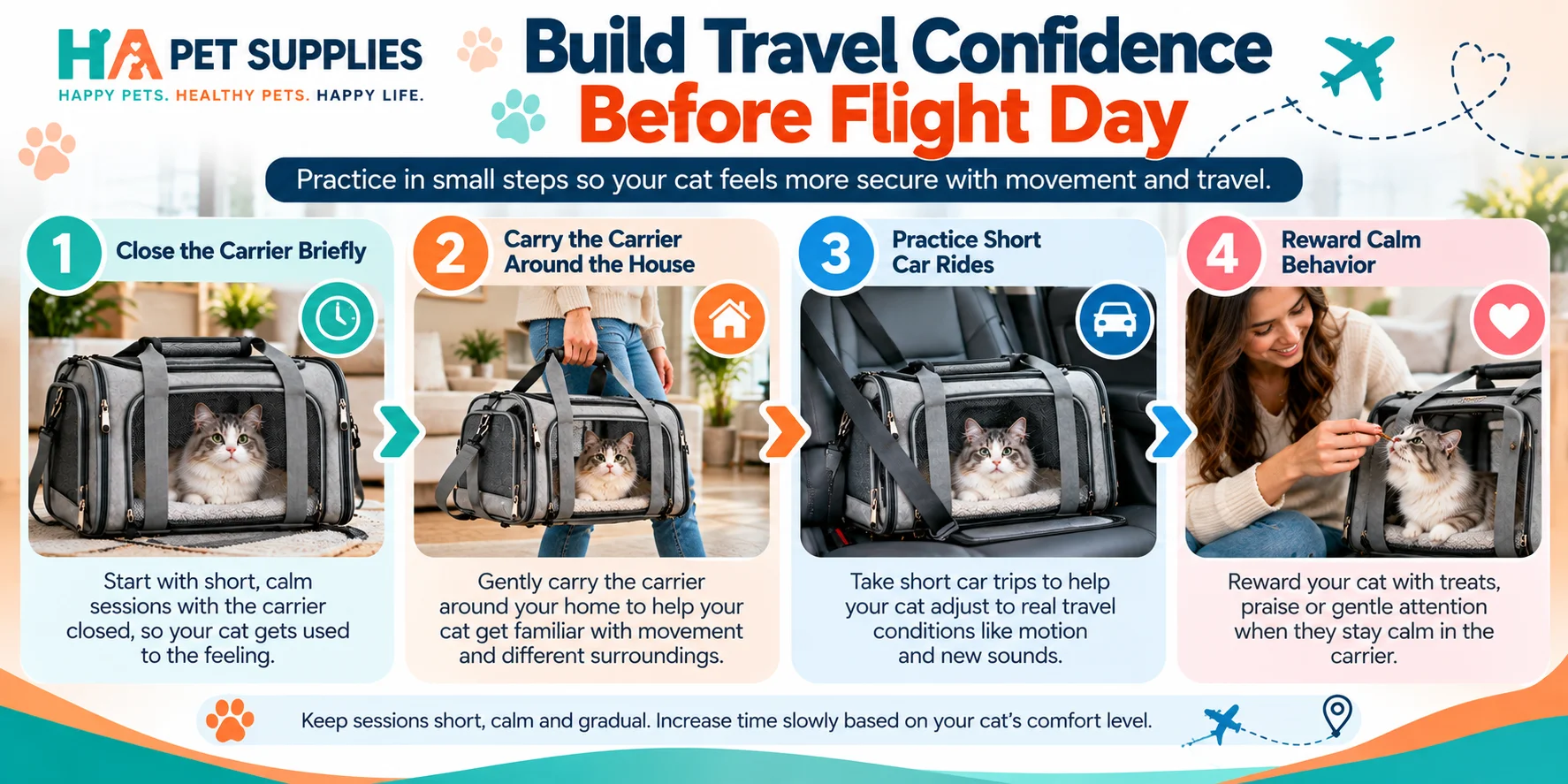
Build travel confidence gradually by closing, carrying and practicing short journeys before flight day.
Rotating 3D view — hover to pause on desktop
17. Reward Calm Behavior After Practice
After a successful session, end on a neutral or positive note. Depending on your cat, this may mean a favorite treat, calm affection, play, being allowed to walk away, or returning to a familiar resting area. Do not overexcite the cat. You are not trying to turn every carrier session into a party. You want the cat to learn: carrier session happens → nothing terrible happens → normal life continues.
18. Keep Training Sessions Short
More training is not always better. If the cat is comfortable for three minutes and becomes distressed at eight, repeatedly forcing eight-minute sessions may slow progress. Short sessions are easier to repeat. A simple pattern could be short exposure → break → normal day rather than one exhausting hour-long session.
19. How Long Does Cat Airline Carrier Training Take?
There is no universal answer. It depends on temperament, previous carrier experiences, age, how often the carrier was associated with stressful events, training consistency, and travel history. Some cats may become noticeably more relaxed within several days. Others may need weeks. If possible, give yourself time. Waiting until the night before removes your ability to slow down.
20. What If Your Flight Is Only a Few Days Away?
You can still improve the situation. Focus on the highest-value steps.
- Day 1: Leave carrier open in a familiar room. Add comfortable lining. Place treats nearby.
- Day 2: Encourage voluntary entry. Begin very short closure.
- Day 3: Repeat closure and introduce gentle lifting.
- Day 4: Carry around home.
- Day 5: Attempt short car exposure if your cat is coping well.
This is not a guarantee. Do not rush through stages solely because the calendar says you should. If severe distress develops, consult your veterinarian.
21. What If Your Cat Refuses to Enter?
Do not immediately turn it into a wrestling match. Go backward. Ask: Is the carrier unfamiliar? Does it smell strongly of storage? Is the opening awkward? Is the interior unstable? Does the cat associate it with vet visits? Are you approaching too quickly?
Start rewarding proximity. Sometimes the first successful training session is simply: cat sits two feet away without hiding.
22. Front-Opening vs Top-Opening Carriers
Different cats respond differently to entry styles. A front-opening carrier works well for cats that walk inside voluntarily. A top-opening option can sometimes make handling easier when a cat needs assistance entering. Multiple-entry carriers may give you more flexibility.
However, every opening creates another closure point. Check zipper security, seams, mesh, latches, and fastening design. Carrier choice belongs primarily in Blog 1, so readers needing more detail should be directed to the complete cat airline carrier buying guide.
23. What If Your Cat Scratches the Mesh?
Some cats test the carrier when stressed. Before flying, inspect mesh, seams, zipper edges, corners, stitching, and strap attachment points. Do not travel with a carrier that is already damaged. A small tear at home can become a larger opening under travel stress.
IATA container guidance emphasizes secure construction and appropriate sizing because the carrier has to contain the animal safely during transport. IATA
24. Should You Cover the Cat Airline Carrier?
Some cats settle better with reduced visual stimulation. Others become more nervous when their view is blocked. If you use any cover: never block ventilation, do not wrap the carrier tightly, monitor temperature, follow airline rules, and use something lightweight and appropriate.
Under-seat ventilation is particularly important. Do not treat a blanket as mandatory. Test your cat’s response before flight day.
25. Should You Put Food Inside During Training?
Small treats can be useful during training. But do not turn the carrier into an all-day feeding station if that conflicts with your normal routine. For travel day itself, feeding decisions should consider your veterinarian’s advice, your cat’s health, flight duration and normal schedule.
If your broader challenge is maintaining feeding routines around travel, your HA Pet Supplies automatic cat feeder may be useful for routine home feeding before or after travel. It should not be presented as something to place inside an airline carrier. That contextual distinction keeps the internal link relevant rather than forced.
26. Should You Use Calming Medication?
Do not independently medicate your cat because a social media post recommended something. Medication decisions depend on individual health, age, existing conditions, drug interactions, travel duration, and airline rules.
If your cat experiences severe anxiety, discuss it with your veterinarian well before travel. USDA’s pet-travel preparation guidance emphasizes evaluating an animal’s health and readiness for air travel before the trip. APHIS Medication advice belongs with a veterinarian, not a generic carrier-training article.
27. International Travel Adds Another Layer
Carrier comfort is only one part of international travel. Depending on the destination, your cat may also need a microchip, vaccination records, health certificate, laboratory testing, treatment, or import permit.
USDA APHIS explains that each country sets its own entry requirements and that preparation can take from a few weeks to many months. APHIS If APHIS does not list official requirements for the destination, it advises travelers to contact the destination country’s animal-health officials. APHIS That is why training should happen alongside paperwork—not instead of it.
28. Keep Identification Information Current
Travel introduces an increased risk of separation. CDC recommends making sure pets are properly identified, microchipped where appropriate and that contact information is kept current before travel. CDC
Review microchip information, collar tag, phone number, emergency contact, and destination details. Do this before the airport.
29. Build a “Travel Practice” Routine
One useful strategy is to rehearse the sequence you will use on flight day. For example: place normal liner inside, invite cat into carrier, close carrier, attach shoulder strap, carry to car, secure carrier, drive for a short period, return home, open carrier, and reward calm behavior. The more pieces that are familiar, the fewer completely new events your cat encounters later.
30. 4-Week Cat Airline Carrier Training Plan
This is an excellent section for an interactive timeline. Move at your cat’s pace.
Week 1 — Familiarity
- Carrier visible at home
- Open door
- Treats nearby
- Voluntary exploration
- Comfortable liner
Week 2 — Short Closed Sessions
- Brief zipper closure
- Slightly longer closed sessions
- Calm interaction nearby
Week 3 — Movement
- Lifting
- Carrying through house
- Walking to front door
- Brief outdoor transitions
Week 4 — Travel Simulation
- Parked car
- Engine running
- Short drives
- Slightly longer trips
This is a framework, not a medical or behavioral guarantee. Move according to your cat’s tolerance.
31. 3D Interactive “Comfort Ladder”
Use this visual ladder to track progress. Each level builds on the last.
Each level rises slightly on hover (desktop). On mobile, view one level per card.
32. Common Cat Airline Carrier Training Mistakes
Mistake 1 — Only bringing out the carrier for stressful events
This reinforces negative association.
Mistake 2 — Forcing the cat inside immediately
You may get the cat physically inside but make future training harder.
Mistake 3 — Closing the door too early
Build voluntary exploration first.
Mistake 4 — Increasing duration too quickly
Progress should follow the cat’s comfort level.
Mistake 5 — Skipping movement practice
Sitting inside a stationary carrier is different from being carried.
Mistake 6 — Making the first car ride the airport drive
Introduce motion earlier.
Mistake 7 — Using too much bedding
It can reduce space and airflow.
Mistake 8 — Ignoring damaged zippers or mesh
Travel is not the time to test weak construction.
Mistake 9 — Giving medication without veterinary guidance
Always discuss severe anxiety or medication with your veterinarian.
Mistake 10 — Assuming training removes all travel stress
Training improves familiarity. It does not turn an airport into your cat’s living room. Keep expectations realistic.
33. What Happens After Carrier Training?
Once your cat is reasonably familiar with the carrier, your focus moves to the actual flight process. That includes airline check-in, documentation, airport security, boarding, under-seat positioning, long-flight preparation, and arrival.
Your companion guide, Flying With a Cat for the First Time: Complete Airport & Airplane Travel Guide, covers those steps in sequence. This internal link belongs here because the reader has completed the training phase and is ready for the travel phase.
34. Browse Other Cat Travel Essentials Before Departure
Carrier training works best when the entire travel setup is organized before the last minute. Readers comparing related items can browse the HA Pet Supplies cat supplies collection. For broader pet products, the HA Pet Supplies shop provides additional categories.
If the reader wants more educational guidance rather than products, they can continue through the HA Pet Supplies blog. If a product specification, order question or travel-related product detail is unclear, direct them naturally to contact HA Pet Supplies. Retailers or larger-volume buyers needing commercial information can use the request-a-quote page rather than a normal retail checkout process. These links should remain in context rather than appearing as an unrelated link directory.
Cat Airline Carrier Training FAQ
Click any question to expand the answer.
How long does cat airline carrier training take?
There is no universal timetable. Some cats become comfortable within days, while cats with strong negative carrier associations may need considerably longer. Start as early as practical.
How do I get my cat to stop being afraid of the carrier?
Leave the carrier accessible at home, keep it open, add familiar bedding and reward voluntary exploration. Avoid only bringing the carrier out before stressful trips.
Should I leave my cat carrier out all the time?
During training, leaving it accessible can help reduce the association between the carrier and stressful events. Some owners continue to leave it available as a resting space afterward.
What should I put inside a cat airline carrier?
Use an appropriate removable liner or thin familiar bedding. Do not fill the carrier so heavily that usable space and ventilation are reduced. IATA’s container guidance notes that bedding must be considered when assessing available internal carrier dimensions. IATA
Should I put treats inside the carrier?
Small treats can help create a positive association if your cat is food-motivated. Avoid luring the cat inside and immediately trapping it every time.
What if my cat will not go near the carrier?
Begin farther away. Reward calm behavior near the carrier without forcing interaction. You may need to work from simple visual tolerance before encouraging entry.
Should I close the carrier during the first training session?
Not necessarily. Early sessions can focus entirely on voluntary exploration. Close it only after your cat shows reasonable comfort entering.
How long should I leave my cat inside during practice?
Start short and build gradually. There is no single correct number of minutes for every cat.
Should I carry the carrier around the house?
Yes, once your cat is comfortable with brief closed-carrier sessions. Carrying introduces movement in a familiar environment before you progress to a vehicle.
Should I practice car rides before flying?
Gradual short rides can help introduce motion before travel day. CDC recommends beginning pet vehicle preparation with short drives and increasing time gradually. CDC
What if my cat cries in the carrier?
Vocalization may occur because the situation is unfamiliar. Monitor the overall behavior rather than assuming every sound means severe distress. If you are concerned about health, breathing or extreme anxiety, consult your veterinarian.
Why does my cat scratch at the mesh?
Scratching can occur when a cat is attempting to escape or reacting to stress. Inspect the carrier regularly and slow the training process if the behavior is intense.
Can I cover the carrier?
Some cats may prefer reduced visual stimulation, while others do not. Never block ventilation, and test the approach at home before travel day.
Should I sedate my cat for a flight?
Do not make that decision without veterinary guidance. Health, medication, dosage and airline considerations are individual matters.
Is a soft carrier better for training?
A soft-sided carrier can be practical for cabin travel, but suitability depends on airline restrictions, your cat’s size and the carrier’s construction. Read the full cat airline carrier selection guide before buying.
When should I start training before an international flight?
Start carrier training early, but also begin documentation work immediately. USDA APHIS says international pet preparation may take weeks to months depending on destination requirements. APHIS
Does carrier training guarantee my cat will be calm on a plane?
No. It reduces unfamiliarity with the carrier. The airport, aircraft, security process and travel duration can still be stressful. Your goal is better preparation, not a guarantee.
Final Cat Airline Carrier Training Checklist
Before travel day, ask:
Familiarity
Closure
Movement
Travel
Flight preparation
The Bottom Line
Effective cat airline carrier training does not begin by asking: “How do I force my cat to stay inside this bag?” A better question is: “How do I make this carrier familiar before my cat needs to depend on it?”
Start with the carrier open at home. Let your cat investigate. Add familiar comfort. Build positive associations. Close it briefly. Introduce carrying. Practice movement. Then introduce short vehicle trips when appropriate. By the time you leave for the airport, the goal is for the carrier itself to be familiar even though the surroundings are not.
CDC guidance supports gradual travel preparation and recommends planning ahead for pets rather than introducing major travel experiences all at once. CDC IATA likewise emphasizes proper carrier sizing and container preparation for pet travel. IATA And for actual cabin travel, FAA rules require an accepted pet carrier to fit beneath the seat and remain properly stowed when required, while individual airlines can impose additional policies. FAA
Once your cat is comfortable with the carrier, move to the next stage with Flying With a Cat for the First Time: Complete Airport & Airplane Travel Guide so you can prepare for security, boarding and the flight itself.
The purpose of training is not to promise a completely stress-free flight. It is to remove one major source of uncertainty: the carrier. And when the carrier already feels familiar, your cat has one known space to return to while everything else around them changes.