
Dog cooling vest — if you’re searching for a fast, clear answer about whether these vests actually help, you’re in the right place. This guide cuts through the confusion for mid-crisis buyers who need practical, science-backed information without the fluff.
A dog cooling vest can look almost too simple. You soak it, wring it, put it on your dog, and hope it helps. So does it really work, or is it just a wet jacket?
The honest answer: Yes, an appropriately designed cooling vest can help support cooling under the right conditions — but it is not an air conditioner, it does not make heat safe, and it should never be treated as protection against heatstroke.
Dogs primarily regulate body temperature through panting, not widespread sweating. They have sweat glands in their paw pads, but this contributes only a small amount to overall cooling. American Kennel Club
Many dog cooling vests use evaporative cooling. Water stored in the wet fabric absorbs heat as it evaporates into the surrounding air. Air movement helps that evaporation continue, which is why a properly wetted breathable cooling vest can feel cooler than dry fabric.
There is scientific evidence supporting cooling-vest use. A study of exercising military working dogs compared two cooling-vest designs with no vest and reported that both vest conditions helped cooling, with the evaporative cooling vest performing best. PubMed Central (PMC)
However, this does not mean every cooling vest works equally well, that every dog benefits equally, or that a dog can safely exercise in dangerous heat simply because it is wearing one.
Research on post-exercise cooling has also emphasized that evidence for cooling coats remains limited and further evaluation is needed. DOI
That distinction should guide this entire article: A cooling vest is a support tool. It is not permission to ignore temperature, humidity, shade, hydration, rest, exercise intensity, your dog’s breed, or warning signs of overheating.
If you already know you want one but need help choosing the right size, material and fit, your supporting guide on how to choose the right dog cooling vest handles the buying decision. This pillar article answers the bigger question first: What does a dog cooling vest actually do — and when should you trust it?
📋 What’s Inside
Quick Answer: Do Dog Cooling Vests Really Work?
Yes, evaporative dog cooling vests can provide useful cooling support when water can evaporate efficiently from the fabric.
They work best when:
- the vest is properly soaked
- excess water is removed
- air can move through or across the material
- the vest remains wet
- humidity is not extremely high
- the dog is not being pushed beyond safe exercise limits
They work less effectively when:
- the vest dries out
- airflow is poor
- humidity is very high
- the vest fits too tightly
- the material is overly heavy or poorly ventilated
And they should never replace: shade, water, rest, cooler exercise times, or careful monitoring.
The CDC recommends shade, fresh water, and avoiding parked cars during hot weather. CDC The AVMA likewise recommends unlimited access to fresh water and shade and warns that pets should never be left in parked vehicles. AVMA
Use the vest to support your hot-weather plan — not to replace one.
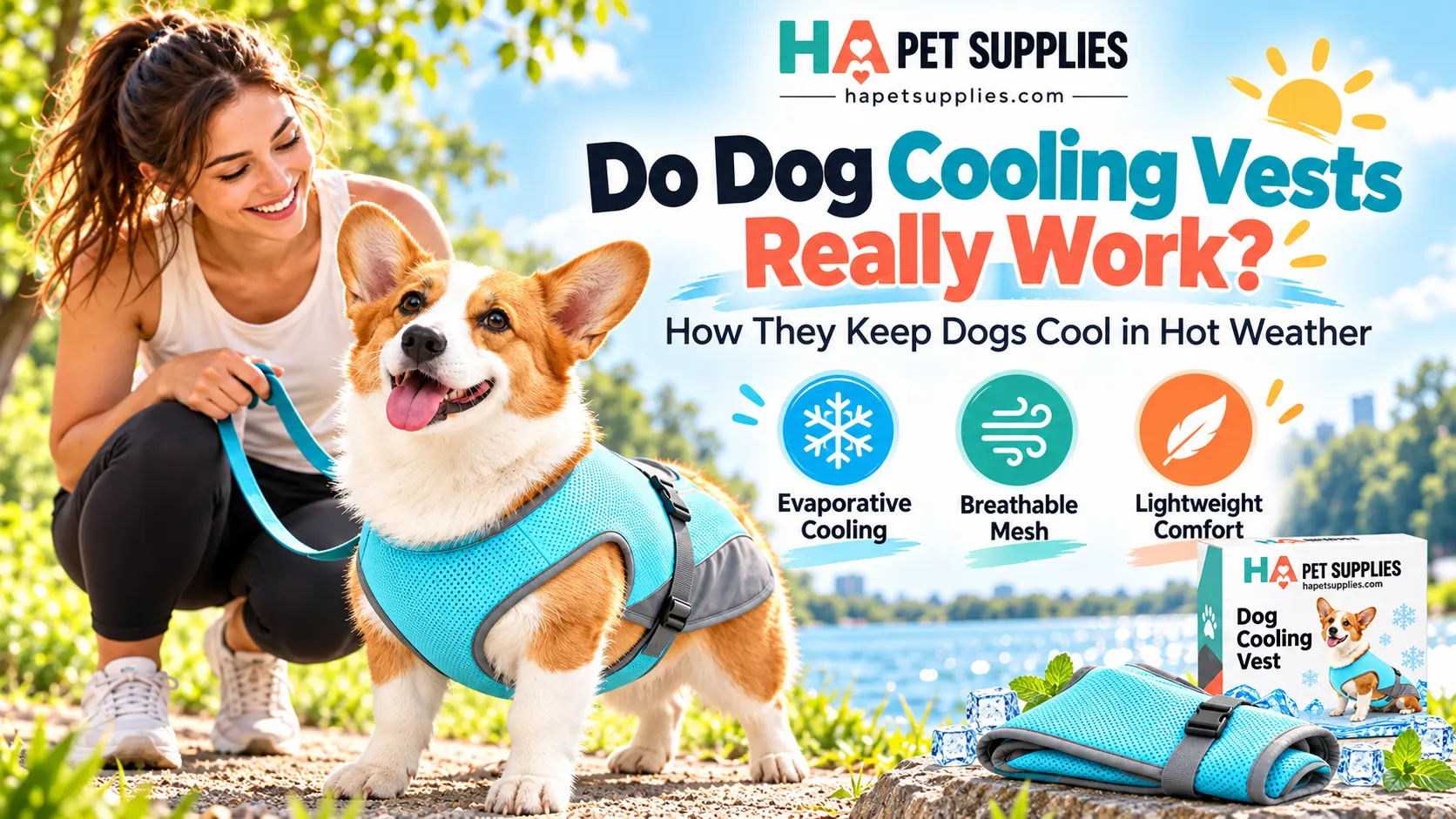
A breathable dog cooling vest can provide additional cooling support during warm-weather activities when used alongside water, shade and appropriate rest.
How Dogs Keep Themselves Cool
To understand why a dog cooling vest can help, first understand the dog. Humans rely heavily on sweating. Dogs do not.
AKC explains that dogs do have sweat glands in their paw pads, but they rely primarily on panting, along with other heat-regulation mechanisms, to cool themselves. American Kennel Club
Cornell similarly notes that dogs have sweat glands mainly in their paws and therefore rely heavily on panting to dissipate heat. Cornell Vet School
Panting helps through evaporation. Moisture evaporates from surfaces in the respiratory tract, carrying heat away. That works well within limits. But as environmental temperature rises, humidity increases, and exercise becomes more intense, the dog’s ability to release heat can become less effective.
This is why warm weather that feels merely uncomfortable to a person can become dangerous for a dog.
Why Dogs Can Overheat Faster Than People Expect
Dogs do not understand weather forecasts. They may continue chasing a ball, running, hiking, playing, or following their owner even as heat builds.
AAHA explains that heatstroke occurs when an animal’s body temperature rises to dangerous levels and normal cooling processes can no longer keep up. AAHA
Cornell describes canine heatstroke as a life-threatening medical emergency that can cause severe organ damage and death. Cornell Vet School
VCA lists warning signs including rapid breathing, abnormal gums, lethargy, disorientation, and seizures. VCA
This is why cooling equipment should be framed as prevention support, never treatment for an overheating dog.
How an Evaporative Dog Cooling Vest Works
Most simple cooling vests are based on a familiar physical process: evaporation. When liquid water becomes water vapor, energy is required. That energy can be drawn from heat in the surrounding environment.
A cooling vest holds water within its fabric. As air moves across the wet material: water evaporates → heat energy is carried away → the vest surface remains cooler than it otherwise would.
This is similar in principle to why wet skin can feel cool in moving air. Evaporative cooling itself is a well-established mechanism.
Veterinary research has also investigated water-plus-air evaporative techniques in overheated dogs, although emergency heatstroke treatment is very different from wearing a consumer cooling vest. Historic experimental studies found that evaporative cooling could reduce body temperature effectively in canine heatstroke models. PubMed
Do not turn that into the claim: “A cooling vest treats heatstroke.” It does not. The research simply supports the underlying fact that evaporation can remove heat.
3D Infographic: How a Dog Cooling Vest Works
Click or hover on each card to explore the four-step evaporative process.
1. SOAK
Water enters the absorbent layer. The vest becomes the moisture reservoir.
2. WRING
Remove excess water. The vest should be wet enough to cool but not dripping heavy.
3. WEAR
Place the breathable vest on the dog. Air should still move around the material.
4. EVAPORATE
Heat helps turn stored water into vapor. As evaporation occurs, heat leaves with it.
Does Science Support Dog Cooling Vests?
There is some evidence. But this section should remain balanced because overselling weakens trust.
One controlled study involving military working dogs evaluated two types of cooling vests during moderate exercise in warm conditions. The researchers reported physiological differences between vest and no-vest conditions and concluded that the evaporative cooling waistcoat performed best among the options tested. PubMed Central (PMC)
A later review of dog-worn equipment summarized that study and noted slightly lower mean body temperatures in dogs wearing cooling vests, with the evaporative model performing better than a phase-change cooling vest. PubMed Central (PMC)
However, a 2024 study on post-exercise management in canicross dogs emphasized that evidence for cooling coats is still limited and that more research is needed. DOI
Cooling vests have a plausible mechanism and some supporting evidence, but results depend on the vest, environment, activity and dog.
Why a Dog Cooling Vest May Feel Cooler Than Dry Fabric
Dry fabric sitting in direct sun can absorb heat. A properly designed wet cooling vest behaves differently. The wet surface continually loses water to evaporation. If evaporation remains active, the fabric can stay cooler than a dry garment exposed to the same environment.
This is one reason many cooling vests use light-colored exterior fabric, absorbent middle layers, breathable mesh, and open airflow channels. A cooling vest should not simply be a heavy wet coat. The design needs to help water evaporate.
That distinction becomes important when comparing products. The HA Pet Supplies dog cooling vest can be introduced naturally here as an example of the cooling-vest category discussed throughout this guide.
Why Airflow Matters
Evaporative cooling depends on water leaving the fabric. Moving air helps remove humid air from directly around the wet vest and allows more evaporation to continue.
That is why a vest may feel more effective during walking, hiking, or breezy outdoor use than when a dog is lying motionless somewhere humid with little air movement.
This does not mean you should force the dog to keep exercising to “activate” the vest. The dog’s need for rest always comes first.
Think: safe movement can support airflow — not: exercise harder to make the vest work.
Why Humidity Changes Dog Cooling Vest Performance
This is one of the most important limitations. Evaporative cooling becomes less effective as surrounding air becomes more humid. Why? Because humid air already contains more water vapor. When the air is closer to saturation, additional water evaporates more slowly.
That means the cooling vest may remain wet without losing water as efficiently. This is especially important in humid summer regions, coastal environments, rainy hot days, and enclosed outdoor spaces with poor airflow.
A cooling vest can still provide some physical comfort, but you should not assume the same performance you might get in a hot, dry environment. This is another reason the vest should never become your only cooling strategy.
Does a Wet Cooling Vest Trap Heat?
A poorly designed, dried-out, overly heavy or excessively tight garment potentially could become uncomfortable. That is why design and maintenance matter.
A useful evaporative cooling vest should prioritize breathable material, adequate fit, reasonable weight, moisture retention without excessive insulation, and easy rewetting.
If the vest has dried out in hot conditions, it may no longer provide its intended evaporative function. At that point: rewet it or remove it according to the product instructions.
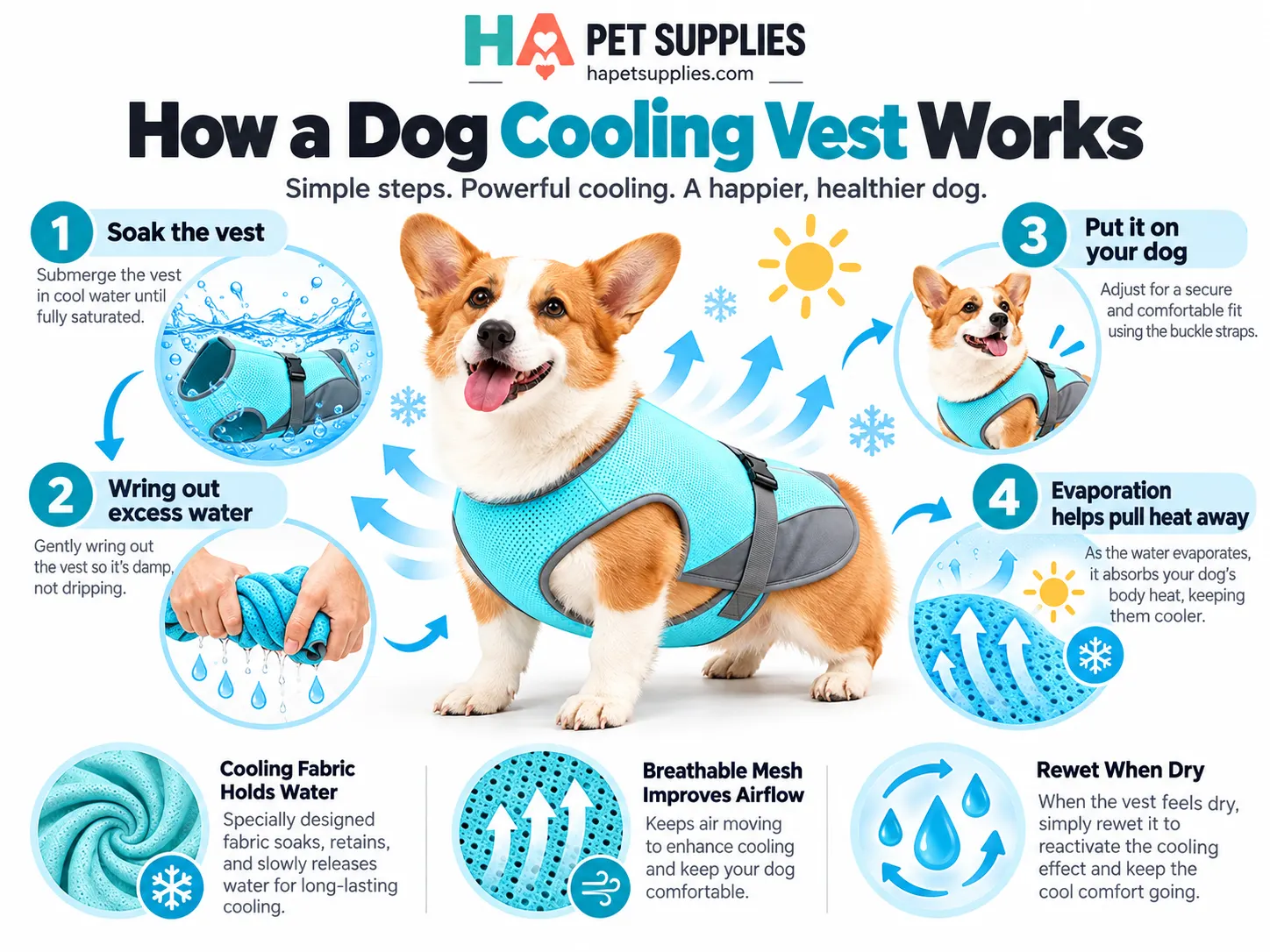
Evaporative cooling depends on keeping the vest appropriately wet and allowing airflow to help moisture evaporate from the fabric.
How Long Does a Dog Cooling Vest Stay Cool?
There is no universal number. Cooling duration depends on air temperature, humidity, sunlight, wind, vest material, vest thickness, dog activity, vest size, and how thoroughly it was soaked.
A vest may dry relatively quickly in hot, dry, windy conditions. It may remain wet longer in humid, still air. But longer wetness does not automatically mean stronger cooling. Remember: cooling depends on evaporation, not simply on staying wet.
How Do You Know When to Rewet a Dog Cooling Vest?
Check the vest during use. If it feels mostly dry, warm, or significantly less damp, its evaporative effect may be decreasing.
At that point:
- stop in a safe shaded area
- remove the vest if necessary
- re-soak it according to its instructions
- wring out excess water
- refit it correctly
Your Blog 2 article should handle this process in detail, so link naturally to How to Use a Dog Cooling Vest Safely: Soaking, Wearing, Rewetting and Hot-Weather Tips.
Does a Dog Cooling Vest Replace Drinking Water?
Absolutely not. Cooling equipment does not replace hydration. The CDC recommends giving pets plenty of fresh water and providing shade during hot weather. CDC AVMA likewise recommends unlimited access to fresh water during warm conditions. AVMA AAHA emphasizes hydration as a fundamental part of preventing heat-related illness. AAHA
So your hot-weather kit should be: cooling vest + water + shade + rest — not: cooling vest instead of water.
Does a Dog Cooling Vest Make Midday Exercise Safe?
No. This is one of the most dangerous misconceptions. A cooling vest does not cancel strong solar radiation, high pavement temperature, humidity, dehydration, or excessive exercise intensity.
Cornell recommends exercising dogs during cooler times of day and avoiding strenuous outdoor activity during high heat. Cornell Vet School AVMA also recommends reducing exposure to extreme heat and recognizing signs of heat stress. AVMA
So if the afternoon is dangerously hot: change the schedule instead of depending on the vest.
Hot Pavement Still Matters
A vest cools the torso. It does not cool the pavement. Your dog’s paw pads may still contact hot asphalt, concrete, sand, or artificial turf. AAHA identifies paw-pad burns as one of the hot-weather hazards owners need to prevent. AAHA
Who Benefits Most From a Dog Cooling Vest?
Cooling vests may be particularly useful during moderate hot-weather activities for dogs that still need to go outside — walking, hiking, camping, outdoor training, travel stops, or outdoor events.
They may be especially attractive for owners of dogs that become uncomfortable quickly in warm conditions, have dark coats, have thick coats, or participate in outdoor activities.
However, dogs with increased heat risk need more caution, not simply more cooling equipment. Cornell identifies higher-risk groups including brachycephalic dogs, older dogs, overweight dogs, thick-coated or dark-coated dogs, and dogs with respiratory or cardiac disorders. Cornell Vet School
Brachycephalic Dogs Need Extra Caution
Brachycephalic breeds include Bulldogs, Pugs, and French Bulldogs. Their shortened airway anatomy can make efficient cooling through panting more difficult. Cornell specifically lists brachycephalic dogs among dogs at greater heatstroke risk. Cornell Vet School
A cooling vest should not be used to justify longer exercise in these breeds. A better approach is shorter outings, cooler times, shade, water, and close monitoring.
Senior Dogs, Overweight Dogs, and Thick-Coated Dogs
Older dogs may have reduced fitness, underlying heart disease, respiratory problems, or less heat tolerance. Cornell identifies older dogs among groups at higher heatstroke risk. Cornell Vet School If your senior dog struggles unusually in heat, speak with a veterinarian before relying on any cooling accessory.
Extra body weight can make heat regulation more challenging. Cornell lists overweight dogs among higher-risk groups. Cornell Vet School Again: higher risk does not mean “use a stronger cooling vest.” It means the entire exercise plan should be more conservative.
Owners sometimes assume that shaving the coat is the obvious solution. That can be problematic for some coat types. AKC explains that a dog’s coat plays a role in temperature regulation and should not automatically be removed simply because weather is hot. American Kennel Club Instead, maintain the coat appropriately and use safe hot-weather management.
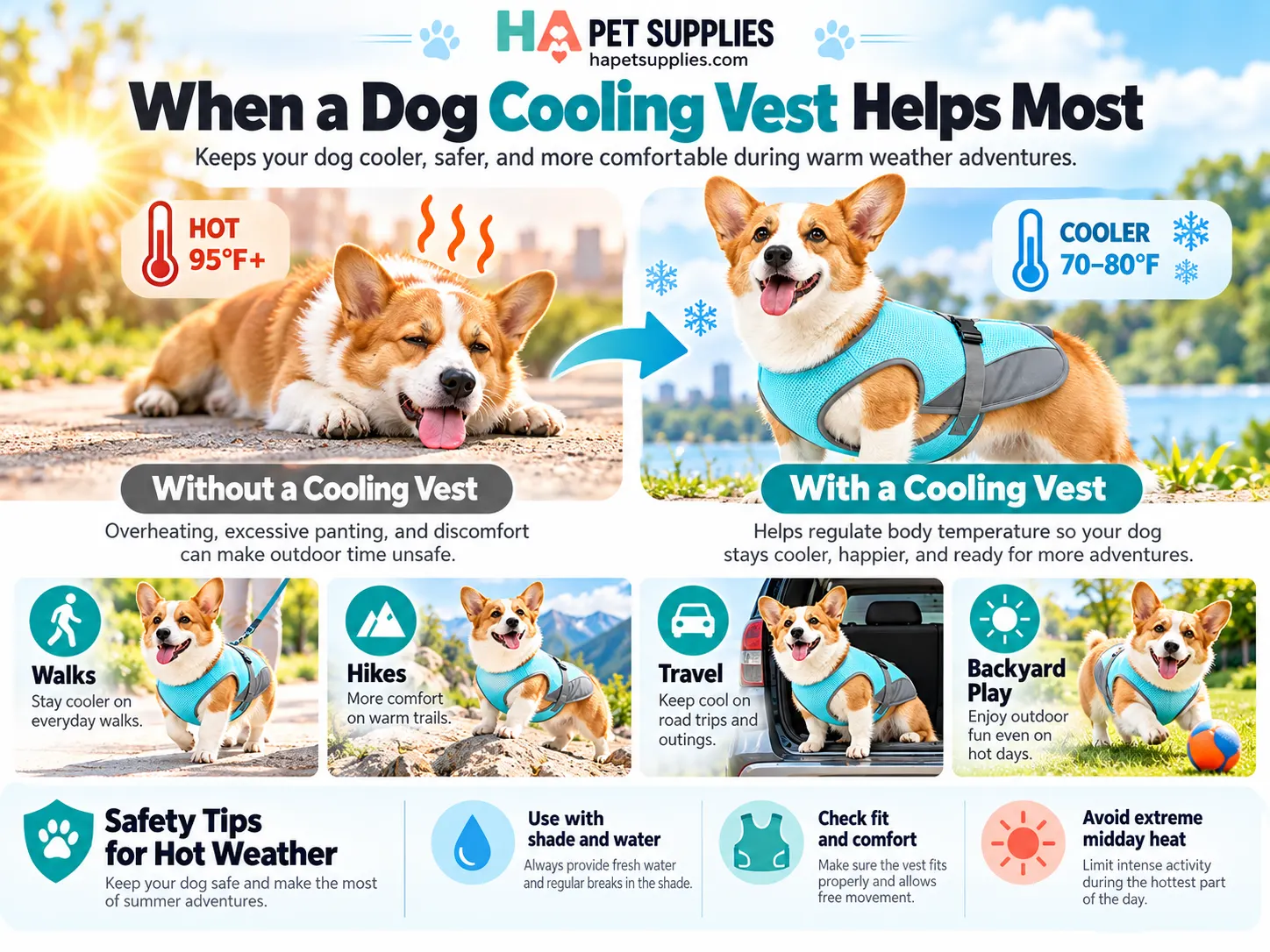
Cooling vests are most useful as one layer of a broader warm-weather plan for walks, hiking, travel stops and outdoor activity.
3D Infographic: Where a Dog Cooling Vest Can Help
Explore the four key scenarios where a cooling vest provides the most value.
WALKING
Useful when: Conditions are warm but still appropriate for exercise.
Pair with: Water + shorter routes + shade
HIKING
Useful when: The dog is active and airflow can support evaporation.
Pair with: Frequent rest + rewetting + hydration
TRAVEL
Useful when: Stopping for outdoor breaks during warm conditions.
Never use as justification for: Leaving the dog in a parked vehicle
OUTDOOR PLAY
Useful when: Activity is controlled and monitored.
Stop immediately if: The dog shows overheating signs.
Cooling Vest vs Cooling Mat vs Wet Towel vs Ice Vest
Cooling Vest: Moves with the dog. Useful during walks, hikes, and active outdoor time.
Cooling Mat: Provides a cool resting surface. Useful during shade breaks, home rest, and stationary recovery. A mat may be better for a dog that needs to stop exercising.
Wet Towel: A wet towel can provide evaporative cooling. But a towel is not designed to stay fitted, allow normal movement, distribute water consistently, or remain secure during walking. A purpose-built vest is more practical.
Ice Vest / Phase-Change: Some products use gel packs, frozen inserts, or phase-change materials. The military working dog study compared an evaporative cooling vest with another cooling technology and found the evaporative design performed best in that specific test. PubMed Central (PMC) That does not prove every evaporative vest is superior to every alternative. Construction matters.
How Should a Dog Cooling Vest Fit?
The vest should be secure without being restrictive. Too tight restricts movement, reduces airflow, and may rub the skin. Too loose shifts, twists, reduces coverage, and may interfere with walking.
The dog should be able to walk, sit, turn, and lie down without obvious restriction. Size selection should be based on measurements rather than relying only on labels such as “large.” Your Blog 3 guide handles these details, so naturally link readers to How to Choose the Right Dog Cooling Vest: Size, Fit, Material and Cooling Features Explained.
Can a Cooling Vest Cause Chafing?
Any wearable dog product can potentially rub if fit is wrong, fabric bunches, straps are overtightened, the dog wears it for long periods, or sand and dirt collect underneath. Check armpits, chest, neck, and belly edges after use. If you see redness, hair loss, or irritation, adjust or remove the vest.
3D Infographic: When a Cooling Vest Helps — and When It Does Not
✅ HELPS
- warm-weather walks
- moderate outdoor play
- hiking in appropriate conditions
- travel rest stops
- adding evaporative cooling
⚠️ DOES NOT REPLACE
- hydration
- shade
- rest
- cooler exercise times
- veterinary treatment
- recognizing heatstroke
What Are the Signs of a Dog Getting Too Hot?
Cornell identifies heatstroke signs including heavy panting, drooling, vomiting, diarrhea, weakness, confusion, seizures, and collapse. Cornell Vet School VCA also lists signs such as increased breathing rate, dry or sticky gums, abnormal gum color, lethargy, disorientation, and seizures. VCA
Do not wait for collapse. If the dog appears increasingly distressed: stop activity immediately.
3D Heat Warning Infographic
LEVEL 1 — STOP AND COOL DOWN
Watch for: excessive panting, slowing down, seeking shade, unusual restlessness
Action: Stop activity and move to a cooler environment.
LEVEL 2 — POSSIBLE HEAT ILLNESS
Watch for: weakness, heavy drooling, vomiting, confusion
Action: Begin safe cooling and contact a veterinarian.
LEVEL 3 — EMERGENCY
Watch for: collapse, seizures, severe disorientation
Action: Immediate veterinary emergency.
What Should You Do if Heatstroke Is Suspected?
Heatstroke is an emergency. Cornell recommends safely and immediately cooling the dog while seeking veterinary care. Cornell Vet School VCA likewise emphasizes rapid treatment and veterinary attention for heatstroke. VCA
Do not waste time re-soaking the vest, continuing the walk, or testing another cooling accessory. Move the dog out of the heat and contact veterinary care.
⚠️ A consumer cooling vest is not a heatstroke treatment.
Never Leave a Dog in a Parked Car
A cooling vest does not make this safe. CDC states that vehicles can heat rapidly and that cracking a window does not prevent dangerous temperature rise. CDC AVMA also says never leave pets in parked cars, even in the shade or with the windows cracked. AVMA
Important: Cooling vest + cracked window does not make a parked car safe.
Travel and Hiking With a Dog Cooling Vest
Travel: Potentially useful during outdoor portions of a journey — rest stops, short walks, waiting outdoors, campsite setup. But inside an adequately air-conditioned vehicle, active evaporative cooling may not always be necessary. Your main travel priorities remain climate control, water, breaks, and never leaving the dog unattended in a hot vehicle.
Hiking: Useful if conditions are suitable for the dog, the vest remains wet, water is available for rewetting, and rest breaks are frequent. Carry enough water for both the dog to drink and the vest to be reactivated. Hydration always takes priority.
Common Dog Cooling Vest Mistakes
❌ Mistake 1
Treating the vest like heatstroke protection. Wrong idea: “My dog is wearing a cooling vest, so heat is no longer dangerous.” Better: Treat the vest as supplemental cooling only.
❌ Mistake 2
Forgetting to rewet it. A dry evaporative vest loses its main cooling mechanism. Better: Check moisture regularly.
❌ Mistake 3
Using it in dangerous midday heat. Better: Change the walk schedule.
❌ Mistake 4
Ignoring humidity. Evaporation becomes less effective in very humid air. Better: Shorten activity and monitor closely.
❌ Mistake 5
Choosing the wrong size. Too tight or too loose reduces comfort and effectiveness. Better: Measure your dog.
❌ Mistake 6
Restricting airflow. Heavy or poorly fitted coverage reduces ventilation. Better: Choose breathable construction.
❌ Mistake 7
Forgetting drinking water. Vest water and drinking water are separate needs.
❌ Mistake 8
Continuing exercise after warning signs. Better: Stop immediately if the dog looks distressed.
Is a Cooling Vest Worth Buying?
For some owners, yes. It makes the most sense when you regularly walk in warm weather, your dog hikes with you, you travel in summer, outdoor training is unavoidable, or you want an additional cooling tool.
It makes less sense if the dog stays mostly indoors in air conditioning, you rarely exercise outdoors in warm weather, local humidity makes evaporative cooling consistently weak, or you expect the vest to let you exercise during dangerous heat.
The product should solve a real problem. If you’re ready to explore options, the HA Pet Supplies dog cooling vest is a practical example. For other summer and general pet items, the HA Pet Supplies dog supplies range is the appropriate internal category.
Fast Hot-Weather Checklist
🌤️ WEATHER
- Is the temperature appropriate?
- Is humidity very high?
- Can you choose a cooler time?
🐕 DOG
- Healthy enough for activity?
- High-risk breed or condition?
- Already panting heavily before leaving?
🧥 VEST
- Correct size?
- Properly soaked?
- Excess water removed?
- Comfortable fit?
🎒 SUPPLIES
- Fresh drinking water?
- Extra water for rewetting?
- Shade available?
- Planned rest?
Interactive FAQ: Dog Cooling Vest
Do dog cooling vests really work?
Yes, evaporative dog cooling vests can provide cooling support when properly wetted and used in conditions where evaporation can occur. Research in exercising military working dogs found cooling-vest benefits, with the evaporative design performing best in that study. PubMed Central (PMC)
How does a dog cooling vest work?
Most basic cooling vests hold water in absorbent material. As that water evaporates, heat energy is carried away from the wet surface.
Do cooling vests lower a dog’s body temperature?
Some controlled research has found lower body temperatures in dogs using cooling vests compared with no vest, but evidence is still limited and results depend on conditions and vest design. PubMed Central (PMC)
Is a dog cooling vest safe?
It can be when correctly fitted and used according to instructions. It should not be used to justify activity in unsafe temperatures.
Does a cooling vest prevent heatstroke?
No. A cooling vest is not guaranteed heatstroke prevention and should never replace water, shade, rest or safe exercise planning.
Does a cooling vest treat heatstroke?
No. Heatstroke is a veterinary emergency requiring immediate cooling and veterinary care. Cornell Vet School
How often should I rewet a dog cooling vest?
Rewet it whenever the vest begins drying and according to the manufacturer’s instructions. Drying rate varies with temperature, humidity and airflow.
Does a cooling vest work in humid weather?
Evaporative cooling generally becomes less effective as humidity rises because water evaporates more slowly.
Should a dog cooling vest be soaking wet?
It should generally be wet enough to support evaporation without carrying unnecessary excess water. Follow the specific product instructions.
Can I use ice water or freeze the vest?
Follow the manufacturer’s instructions. Extremely cold water is not necessary for the evaporative mechanism. Only freeze if the manufacturer explicitly allows it.
Can a dog wear a cooling vest all day?
Do not think in terms of a fixed all-day duration. Check fit, skin, vest moisture, activity level and environmental conditions regularly.
Can my dog still overheat while wearing one?
Yes. Dogs can overheat even while wearing cooling equipment.
What dogs are most vulnerable to heat?
Cornell identifies brachycephalic, older, overweight, thick- or dark-coated dogs and dogs with respiratory or cardiac problems as higher-risk groups. Cornell Vet School
Are cooling vests good for Bulldogs and Pugs?
They may provide support, but brachycephalic breeds have increased heat risk. Outdoor activity should still be conservative and carefully monitored.
Can a cooling vest replace shade or drinking water?
No. Fresh drinking water and shade remain essential. CDC
Can my dog exercise at midday if wearing a cooling vest?
Do not use the vest to override dangerous environmental conditions. Choose cooler times whenever possible. Cornell Vet School
What are signs the vest is not enough?
Heavy panting, excessive drooling, weakness, vomiting, confusion, abnormal gums, collapse or seizures are warning signs that require stopping activity and potentially urgent veterinary care. Cornell Vet School
Can I use a wet T-shirt instead?
A wet shirt may use the same basic evaporative principle, but a purpose-built cooling vest is designed for fit, movement, moisture distribution and repeated use.
Is an ice vest better than an evaporative vest?
Not automatically. One controlled military-dog study found the evaporative vest performed better than the other vest design tested, but product designs and conditions differ. PubMed Central (PMC)
Final Buying and Use Decision
A dog cooling vest is most valuable when all of the following are true:
- Your dog needs to be outdoors in warm — but still reasonable — conditions.
- You understand the vest is supplemental cooling rather than heat protection.
- You can provide drinking water and rest.
- You can rewet the vest as required.
- You monitor the dog instead of assuming the vest is working indefinitely.
If any of those are missing, the vest alone is not the answer. Sometimes the best cooling decision is simply: stay inside until conditions improve. CDC’s heat-wave guidance specifically recommends that people and animals stay indoors during dangerous heat when possible. CDC
Conclusion: Dog Cooling Vests Can Work — But They Have Limits
So, do dog cooling vests really work? Yes — there is a legitimate physical mechanism behind them. Evaporative cooling uses water, airflow and evaporation to transfer heat away from the wet vest surface. Controlled canine research has also reported cooling benefits from cooling vests during exercise, including better results for an evaporative design in one military working dog study. PubMed Central (PMC)
But that does not mean: “Put on vest, ignore heat.” A dog cooling vest works best as one part of a complete hot-weather strategy: cooler exercise time + shade + water + rest + breathable cooling vest + continuous observation.
Its effectiveness can also change with humidity, airflow, vest moisture, fit, and activity level. And most importantly, a cooling vest does not make heatstroke safe to manage at home. Cornell calls canine heatstroke a life-threatening emergency and emphasizes immediate safe cooling and veterinary treatment. Cornell Vet School VCA likewise describes heatstroke as a serious hyperthermic emergency. VCA
For owners who already understand the science and now need the practical method, the natural next article is How to Use a Dog Cooling Vest Safely: Soaking, Wearing, Rewetting and Hot-Weather Tips.
For buyers deciding which vest to purchase, continue to How to Choose the Right Dog Cooling Vest: Size, Fit, Material and Cooling Features Explained.
If they want to review the product discussed throughout the article, the HA Pet Supplies dog cooling vest can be linked directly from the relevant product section. For broader pet gear, readers can browse the HA Pet Supplies dog supplies collection, while customers who are uncertain about sizing or suitability can contact HA Pet Supplies instead of guessing. For custom quotes, there’s also the request a quote page.
That gives the three-blog cluster a clear search-intent structure: Blog 1: Do dog cooling vests actually work and why? Blog 2: How do I use one correctly and safely? Blog 3: Which size, fit and features should I buy? Blog 1 therefore works as the pillar article.