
Dog car travel safety becomes confusing very quickly because several different products are often marketed with similar words: safety, secure, protective, harness, seat belt, hammock, and back seat extender.
That can leave an owner wondering: If my dog is lying on a hard-bottom back seat extender, is that enough to keep them safe in the car?
The simple answer is no. A dog seat extender and a dog restraint perform two different jobs.
A dog seat extender can provide a larger, flatter surface across the rear seat and footwell. It can help your dog avoid stepping into the open footwell, give a larger dog more room to settle, and protect the upholstery from fur, claws, mud, and everyday travel mess.
A suitable vehicle restraint system, on the other hand, is intended to control the dog’s movement while travelling. That distinction should guide your entire setup.
The CDC’s current pet travel guidance recommends keeping a dog riding on a vehicle seat in the back seat with an appropriate harness attached to the vehicle’s seat-belt system. It also warns against allowing pets to roam around the car. CDC pet travel guidance
ASPCA similarly recommends keeping pets secure during car travel and identifies an appropriately secured crate as one option; when owners do not use a crate, it advises keeping dogs in the rear seat with an appropriate harness arrangement. ASPCA travel safety tips
So the easiest way to understand the setup is: Extender = usable space and vehicle protection. Restraint = controlled movement. You usually need to think about both.
If you have not yet chosen the extender itself, first read the pillar guide on how to choose a dog seat extender by size, hard-bottom support, vehicle fit and features. That article covers the buying decision; this guide starts once you are thinking about actually using one.
Quick Answer: How Do You Use a Dog Seat Extender Safely?
Before driving:
- Install the extender according to its instructions.
- Confirm the platform is correctly positioned and stable.
- Keep necessary seat-belt/restraint access available.
- Choose an appropriate dog restraint independently of the extender.
- Fit the dog’s harness correctly.
- Follow the restraint manufacturer’s exact attachment instructions.
- Avoid improvised extension tethers or attachments.
- Give the dog enough room to sit or lie comfortably without allowing uncontrolled roaming.
- Test the complete setup before a long journey.
A seat extender should support the travel environment, not become an improvised restraint point.
The independent nonprofit Center for Pet Safety warns specifically against assuming that extension tethers or zipline-style accessories provide crash protection. Center for Pet Safety advisory
What Does a Dog Seat Extender Actually Do?
A dog seat extender is primarily a space, stability, comfort, and vehicle-protection accessory. Most designs attempt to cover or bridge the rear footwell between the back bench and the front seats.
That can create a continuous area where your dog can: sit, reposition, lie down, stretch out, and avoid stepping directly into the footwell. A hard-bottom design can also reduce the sagging associated with some fabric-only hammock covers.
The HA Pet Supplies dog seat extender represents this type of setup, using the back-seat area to create a larger travel surface rather than leaving the rear footwell completely open.
This can be especially useful for: Golden Retrievers, Labradors, German Shepherds, large mixed breeds, older dogs, two-dog households, and frequent road-trip users. But additional usable space does not automatically mean additional crash protection.
That is why a responsible dog car travel safety article should never tell readers: “Install an extender and your dog is safe.” Instead, explain: Install the extender for the environment. Choose restraint separately for movement control.
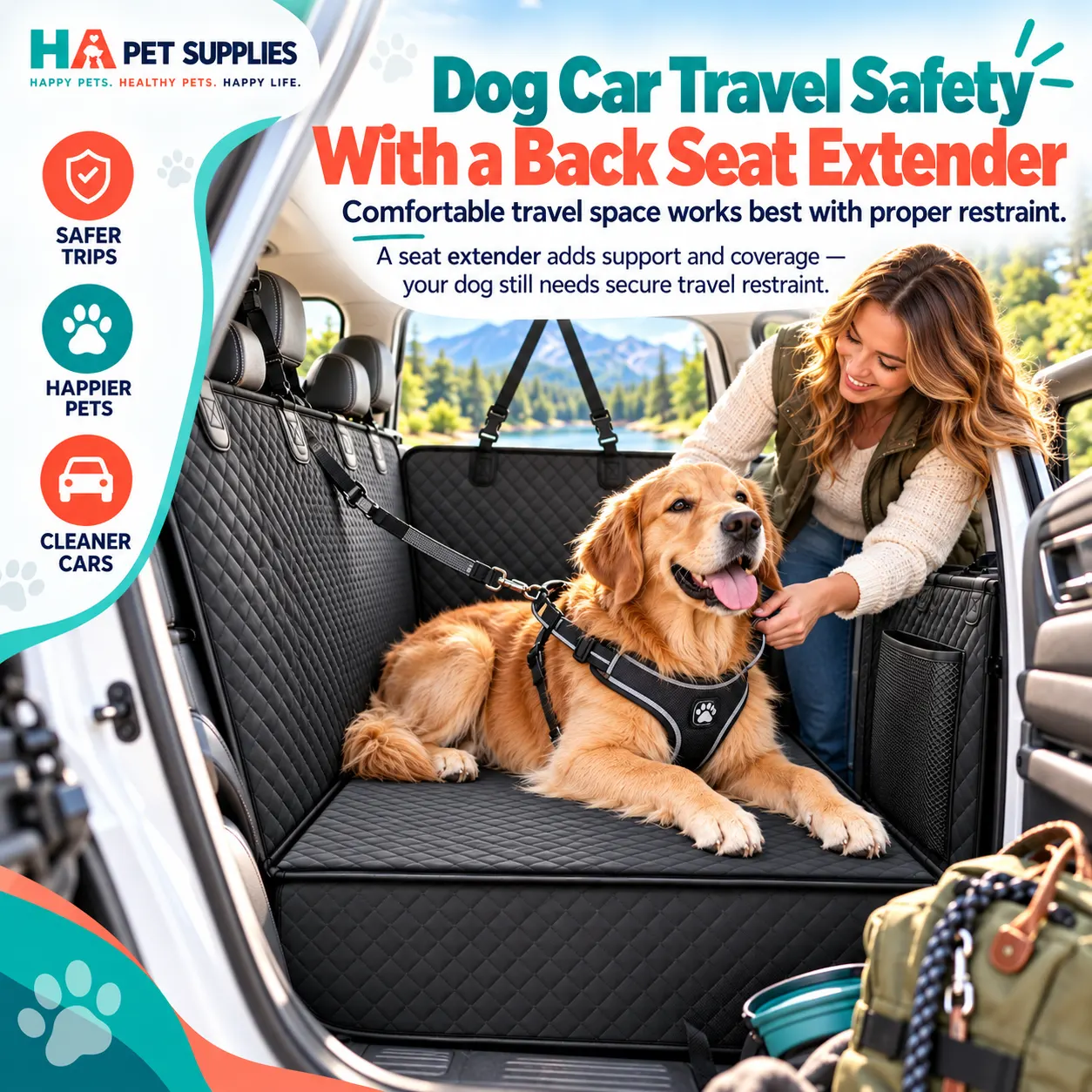
A back seat extender creates the travel surface, while an appropriate restraint system manages the dog’s movement.
Why Dog Car Travel Safety Requires More Than a Flat Back Seat
A flat platform solves a physical-space problem. It does not change the laws of motion. If a vehicle stops abruptly, turns sharply, or is involved in a collision, anything that is not properly restrained can continue moving. That includes bags, water bottles, equipment, people, and dogs.
A dog might look perfectly calm lying on a large back seat extender during normal cruising. That does not mean the extender itself will restrain the dog during a sudden event.
VCA Animal Hospitals advises that dogs should be secured in vehicles using an appropriate crate or seat-belt-and-harness arrangement, noting that an unsecured dog may move around the cabin, interfere with the driver, or potentially escape when a door or window opens. VCA Hospitals
Dog Car Travel Safety Rule 1: Keep Your Dog in the Rear Seating Area
For most passenger vehicles, the rear seating area is generally the more appropriate location for a dog travelling on a seat. The CDC specifically recommends keeping dogs riding on vehicle seats in the back seat rather than allowing them to roam.
AKC likewise recommends back-seat travel and notes the front-seat airbag concern. American Kennel Club
This is one reason the dog seat extender category exists in the first place. Instead of trying to make the front passenger seat work for a large dog, the owner can turn the rear area into a more usable dedicated travel space. That does not mean you should simply move the dog to the rear and let them walk around freely. Rear-seat positioning and restraint are separate decisions.
For further reading, readers can consult AKC’s dog car safety guide.
Dog Car Travel Safety Rule 2: Use a Properly Fitted Restraint System
One of the biggest mistakes is focusing intensely on the dog seat extender and barely thinking about the harness. The opposite should happen. Your restraint system should receive at least as much attention as the travel surface.
Consider: correct harness size, correct fit, correct attachment, manufacturer’s instructions, the dog’s body type, and independent testing where available. Do not assume that every product labelled dog seat belt has been crash tested. Those terms are widely used in marketing.
If crash performance matters to you, look for independently evaluated products rather than relying solely on advertising language. The Center for Pet Safety maintains information about independently certified products. Center for Pet Safety certified products
Harness vs Collar for Car Restraint
The restraint should not simply pull against the dog’s neck. A body harness distributes forces across a much larger area than a collar. That is why authoritative pet travel guidance commonly discusses harness-based vehicle restraint rather than attaching the dog’s movement directly to a neck collar.
This becomes especially important when you combine restraint with a hard-bottom extender. The larger platform can allow the dog to find a comfortable position, while the correctly fitted harness arrangement controls how far they can move. The objective is not: “Make the dog unable to move at all.” The objective is: “Give the dog enough practical comfort without allowing unrestricted movement around the vehicle.”
Dog Car Travel Safety Rule 3: Do Not Use the Extender as an Improvised Restraint Point
This deserves its own section because it is an easy mistake. Owners may see a strap, a loop, a headrest attachment, a side handle, or a mesh panel and assume: “I can clip the dog’s leash here.” Do not do that unless the manufacturer explicitly says that component is engineered as a restraint attachment point.
The straps that hold the seat extender to the headrests may be designed only to position the cover. A storage loop may only be designed to hold accessories. A mesh panel is not automatically a crash barrier. The safer principle is: Never turn a convenience feature into a restraint point unless it was specifically designed and verified for that job.
Why Extension Tethers Need Special Attention
A long tether may appear safer because the dog has more freedom. But more freedom also means more distance over which the dog can accelerate before the restraint becomes fully loaded.
The Center for Pet Safety has issued a specific warning about extension tethers, reporting severe injury risks and advising pet owners to use certified harnesses, crates, or carriers rather than extension tether or zipline systems. Center for Pet Safety extension tether advisory
This is an important nuance because many consumers assume: Longer tether = more comfort = safer. That equation is not necessarily true.
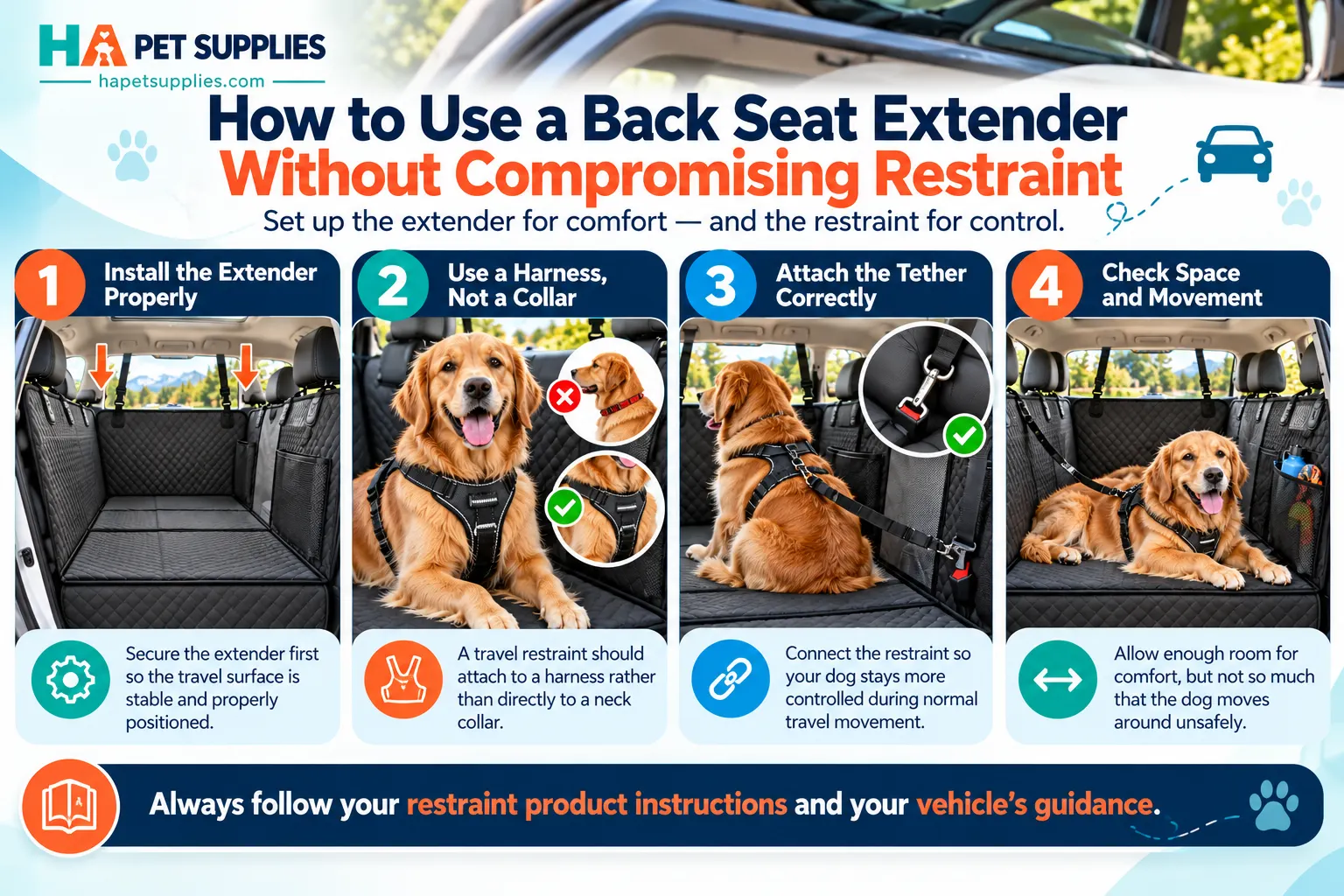
Install the extender correctly, fit the harness properly, follow the restraint instructions, and check the dog’s available movement before driving.
3D Infographic: Extender vs Restraint
🛡️ Dog Seat Extender
Main job: Creates usable rear-seat space.
Helps with:
- Footwell coverage
- Flatter travel surface
- Upholstery protection
- Door protection
- Storage
- Everyday comfort
🔗 Dog Travel Restraint
Main job: Controls movement according to the restraint design.
Consider:
- Harness fit
- Attachment method
- Instructions
- Independent testing
- Dog size
- Vehicle compatibility
✅ Combined Setup
Goal: Comfort + appropriate movement control.
Key message: Do not expect one product to perform both jobs unless it has actually been designed and tested for both.
Complete SafetyDog Car Travel Safety Rule 4: Keep Seat-Belt and Restraint Access Available
A dog seat extender can cover a large part of the rear bench. That creates a practical question: Where are the seat-belt buckles?
Before installing the extender permanently, locate: left rear buckle, center buckle, right rear buckle, any openings provided by the extender, and the attachment area required by your dog’s restraint. Never simply bury everything underneath the platform and decide you will “figure it out later.”
This should have been considered when buying the extender. If it was not, go back to the pillar article on choosing the correct dog seat extender for your vehicle and check the measurement and buckle-access sections.
Can Someone Sit Beside a Dog on a Back Seat Extender?
Sometimes, depending on the product, vehicle, and configuration. But you must evaluate the passenger’s needs independently. A person needs a usable seating position, an accessible seat belt, appropriate seat-belt geometry, and sufficient space.
Do not sacrifice passenger restraint merely to create more room for the dog. If you regularly need both passengers and pets in the rear seat, look for a setup that can be folded or configured partially rather than occupying the entire bench. The broader HA Pet Supplies dog supplies range can be referenced naturally here for owners comparing different travel arrangements.
Dog Car Travel Safety Rule 5: Prevent Uncontrolled Roaming
A dog moving freely around the cabin can become a distraction. They may climb toward the driver, stand between the front seats, block mirrors, interfere with controls, jump toward an opening door, or become tangled around passengers.
AKC emphasizes that drivers must remain focused on driving and that dogs should be properly trained and controlled inside the vehicle. VCA similarly notes that an unsecured dog can interfere with the driver’s movement or visibility.
The extender’s larger space should therefore be understood as comfortable controlled space, not permission for unrestricted movement.
How Much Movement Should a Restrained Dog Have?
There is no universal measurement that works for every dog and every restraint. That is why this article should not tell readers: “Leave exactly 12 inches of slack.” Instead say: Follow the specific restraint manufacturer’s instructions.
The dog should generally be able to adopt the positions the restraint system is designed to permit without roaming freely around the entire rear cabin. If using a certified product, follow its exact fitting and vehicle attachment instructions rather than combining it with additional aftermarket tether extensions.
Dog Car Travel Safety Rule 6: Install the Back Seat Extender Correctly
A poorly installed extender defeats much of the reason for buying one. Before putting the dog inside:
Check the headrest straps
Confirm that the straps are attached to the intended headrests, adjusted correctly, not twisted, and not hanging loose.
Check the hard-bottom panels
They should lie in the intended orientation. Watch for folding, uneven positioning, unsupported gaps, and panels shifting off the bench.
Check side flaps
Ensure they do not interfere with door closure, door handles, seat belts, or passengers.
Check storage pockets
Do not overload them with heavy objects that could become loose during travel.
Check the whole platform
Push gently on different areas. Look for movement, tilting, sagging, and straps slipping. This is basic setup testing—not crash testing.
Should You Put Extra Bedding on a Hard-Bottom Extender?
Potentially. A thin familiar mat or blanket may make the surface more comfortable, particularly on longer drives. But avoid creating a thick, slippery stack of bedding that moves independently of the platform.
The dog’s surface should remain comfortable, reasonably flat, easy to clean, and stable underfoot. If long-distance comfort is your main concern, naturally send readers to your supporting article on making car rides more comfortable for dogs through space, stability, anxiety management and long-trip planning.
Dog Car Travel Safety Rule 7: Introduce the Setup Before a Long Journey
Never assume your dog will understand a new car setup immediately. To a dog, you may have suddenly changed the floor texture, the available space, the boundaries, the harness, the attachment point, and the loading routine.
Introduce changes progressively. AKC recommends gradually introducing dogs to vehicle travel and restraint equipment, using short, positive training sessions. AKC car anxiety prevention
A practical sequence is:
- Stage 1 — Parked car: Install the extender. Let the dog investigate without driving.
- Stage 2 — Harness familiarization: Let the dog wear the travel harness outside the car first.
- Stage 3 — Full setup while stationary: Place the dog in the complete travel arrangement. Reward calm behavior.
- Stage 4 — Engine on: Start the vehicle without going anywhere.
- Stage 5 — Short drive: Drive a very short distance.
- Stage 6 — Gradual increase: Increase trip duration only if the dog remains comfortable.
What If My Dog Pants, Drools or Whines?
Do not automatically assume the seat extender is the problem. Dogs may show travel distress because of anxiety, motion sickness, heat, overexcitement, unfamiliar restraint, negative associations, or a medical issue.
VCA notes that car-related distress can include salivation, restlessness, pacing, whining, barking, and vomiting, and recommends veterinary consultation when motion sickness or persistent distress is suspected. This is where the article should avoid pretending that a product solves a health or behavioral issue. A flatter surface may improve the physical environment. It cannot diagnose or treat anxiety or nausea.
Dog Car Travel Safety Rule 8: Keep the Cabin Comfortable
Safety and comfort overlap. An overheated or distressed dog may become restless regardless of how good the platform is.
AKC recommends keeping the vehicle well ventilated and planning water and bathroom stops during longer journeys. CDC similarly recommends taking frequent stops so dogs can stretch and go to the bathroom.
You can naturally direct readers to CDC’s current pet travel safety guidance for broader trip preparation.
Never Leave a Dog Alone in a Parked Vehicle
This deserves a short standalone warning. Do not assume that mild outdoor weather, cracked windows, shade, or a bowl of water make an unattended parked vehicle safe. CDC and ASPCA both warn against leaving pets alone in parked vehicles. Readers can also consult ASPCA’s travel safety tips.
Should Your Dog Put Their Head Out of the Window?
It may look fun. It is not a good dog car travel safety practice. CDC warns against allowing pets to ride with their heads outside the window. AKC likewise notes the risk of injury from debris or a dog jumping from the vehicle. A dog enjoying the larger back-seat platform should still remain appropriately positioned inside the cabin.
Dog Car Travel Safety Rule 9: Secure Loose Travel Items Too
The dog is not the only thing in the back seat. Owners often add water bottle, food container, collapsible bowl, toys, leash, wipes, backpack, and grooming equipment. Do not leave heavy or hard objects loose around the dog. Use storage compartments where practical.
Your dog seat extender’s storage pocket is useful for lightweight everyday accessories such as waste bags, wipes, lightweight leash, and small soft toy. Keep heavier items properly stowed elsewhere.
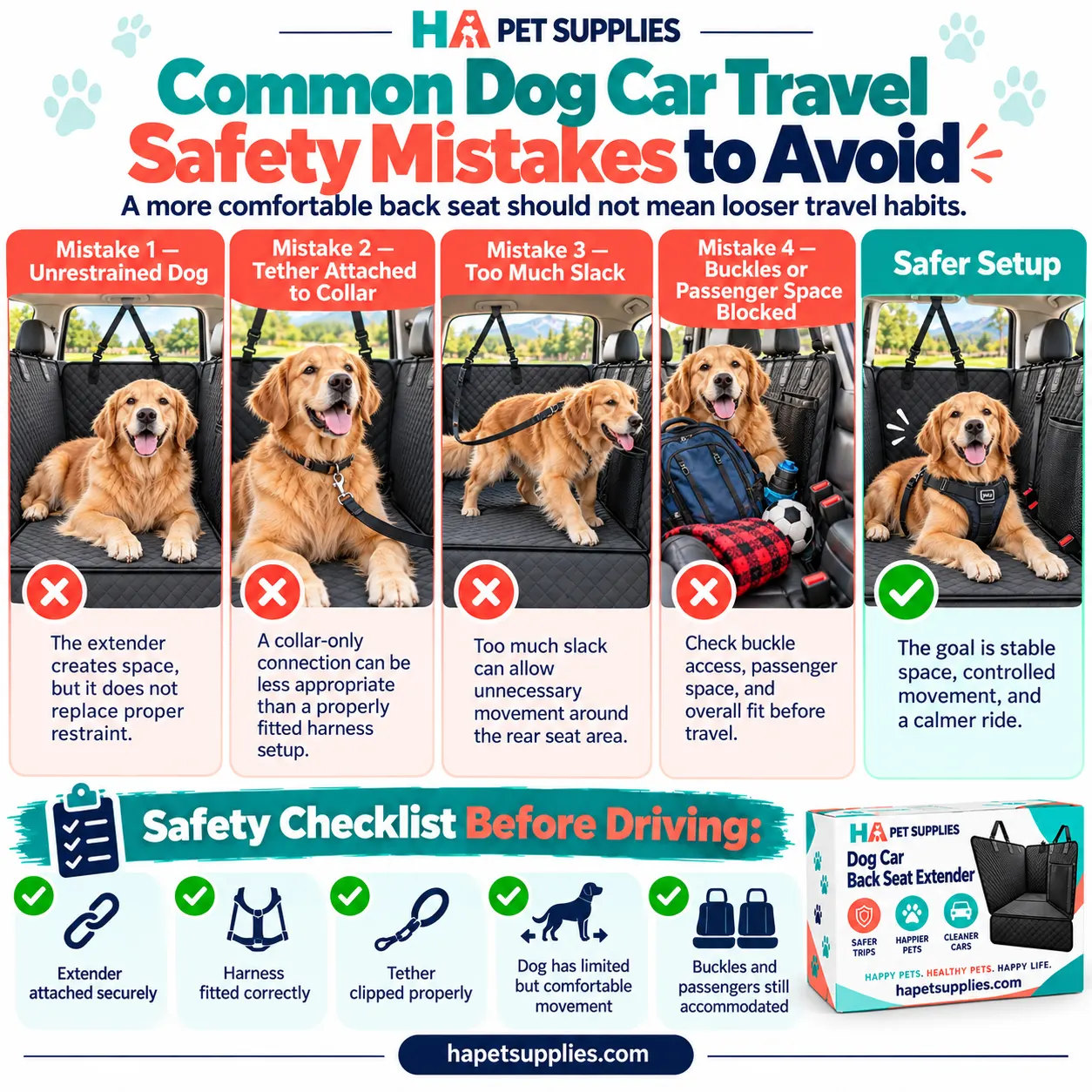
A stable extender is only one part of the setup—restraint fit, attachment, buckle access and movement still matter.
Common Dog Car Travel Safety Mistakes to Avoid
Mistake 1 — Letting the Dog Ride Completely Loose
The platform creates space. It does not restrain the dog.
Mistake 2 — Connecting the Restraint to a Collar
Use equipment according to the restraint manufacturer’s instructions rather than relying on a neck collar as an improvised vehicle restraint.
Mistake 3 — Adding an Extra-Long Tether
More slack is not automatically safer. Center for Pet Safety specifically warns about extension tether risks.
Mistake 4 — Clipping the Leash to the Extender
Headrest straps and cover loops are not automatically restraint anchors.
Mistake 5 — Blocking Every Rear Buckle
Plan restraint access before securing the platform.
Mistake 6 — Putting Heavy Objects Beside the Dog
Secure luggage and equipment.
Mistake 7 — Allowing the Dog Into the Front Seat
Keep the dog in the appropriate rear travel area.
Mistake 8 — Letting the Dog Hang Out the Window
Keep the dog’s body inside the vehicle.
Mistake 9 — Testing Everything for the First Time on Vacation Day
Introduce the setup gradually.
3D Safety Checklist: Before You Start the Engine
Extender
- Installed according to instructions
- Headrest straps adjusted
- Platform lies flat
- Side panels positioned correctly
Dog
- Appropriate harness fitted
- ID information current
- Dog calm enough to travel
Restraint
- Correct product for dog
- Correct attachment method
- No improvised extension tether
- Instructions followed
Vehicle
- Required seat belt access remains available
- Doors close correctly
- Nothing interferes with driver
- Loose heavy items secured
Journey
- Water packed
- Leash available
- Waste bags packed
- Stops planned
- Weather considered
Crate vs Harness vs Back Seat Extender
These products should not be treated as identical.
| Product | Main function |
|---|---|
| Back seat extender | Increases usable space and protects interior |
| Harness-based restraint | Controls movement according to product design |
| Secured crate | Contains dog within an enclosure |
| Dog hammock | Primarily protects seat and creates a barrier-like layout |
| Vehicle barrier | Helps limit access to parts of cabin; not automatically crash restraint |
ASPCA states that a secured, well-ventilated crate is a strong travel option and says the crate should be large enough for the pet to stand, sit, lie down and turn around. CDC similarly advises securing a crate so it will not slide or shift when the vehicle stops. For another authoritative overview, send readers to AKC’s complete guide to travelling with a dog.
Does a Hard-Bottom Dog Seat Extender Stop a Dog Falling Into the Footwell?
During ordinary movement, a properly positioned platform can cover the rear footwell and provide a surface where there would otherwise be a gap. That is one of its most obvious functional advantages.
But phrase this carefully. Do not say: “Prevents injury in an accident.” Say: “Bridges the footwell and provides a larger, flatter surface during normal use.” Those are not the same claim. This careful wording builds more trust than exaggerated safety language.
Can a Mesh Divider Keep a Dog Safely in the Back?
Treat mesh as a comfort or organization feature unless the manufacturer has specifically tested it as a vehicle barrier. Mesh can help with visibility, airflow, separation, and discouraging casual movement forward.
It should not automatically be described as collision protection, crash barrier, or restraint system. Again, the article should teach readers to distinguish features from tested safety functions.
What About Two Dogs on One Seat Extender?
Two dogs introduce extra considerations. Check total available space, combined load, restraint compatibility, tether entanglement risk, whether each dog can settle separately, and whether either dog guards space or resources.
Do not use one restraint attachment for two dogs unless the product specifically allows it. Each dog’s travel equipment should be selected and fitted appropriately. For owners who routinely travel with multiple dogs, the HA Pet Supplies shop can be linked naturally when discussing other travel accessories and supplies rather than placed as a random CTA at the end.
Large-Dog Car Travel Safety
Large dogs benefit noticeably from the additional surface area of a hard-bottom extender. However, they also place greater demands on platform construction, restraint equipment, available cabin space, and loading and unloading.
A 70-pound dog standing suddenly places load differently from the same dog lying still. Therefore: verify the extender’s stated load capacity, verify the restraint’s size limits, check the dog’s chest measurements, check the vehicle fit, and test ordinary movement before longer travel. Never invent a product’s load rating.
Senior Dogs and Car Safety
Older dogs may have reduced balance, arthritis, stiffness, difficulty jumping, and reduced confidence on slippery surfaces. A flat platform may make the environment easier to navigate, but getting into and out of the vehicle is another issue.
Some senior dogs may benefit from a ramp, steps, supportive harness, or non-slip surface. If mobility has noticeably changed, veterinary advice is appropriate.
Puppies and First-Time Car Travel
Puppies should not be expected to understand vehicle travel automatically. Introduce harness, extender, doors, engine sound, and vehicle motion gradually.
AKC emphasizes short, positive training and gradual introduction to restraint equipment. ASPCA similarly recommends preparing pets for longer journeys by beginning with short drives and gradually extending them. Readers can also use ASPCA’s updated expert travel dos and don’ts.
What Should You Carry on a Dog Road Trip?
A good dog car travel safety plan continues outside the car. CDC recommends bringing items including food, water, bowls, leash, waste bags, medication, first-aid supplies and required travel documentation.
A practical list includes: fresh water, portable bowl, normal food, leash, harness, waste bags, cleaning wipes, towel, regular medication, first-aid supplies, ID details, vaccination documentation when applicable, and familiar mat or blanket. Your extender’s side storage pocket may keep smaller items organized, but do not overload it with heavy objects.
How Often Should You Stop on a Long Drive?
There is no perfect number that fits every dog. Consider age, bladder control, medical needs, temperature, journey length, and activity level. CDC recommends frequent stops for bathroom breaks and stretching during long trips. AKC also recommends planning water and potty breaks.
This is an ideal point to link again—once only—to your more detailed long-trip article rather than over-explaining comfort here.
When Should You Ask a Veterinarian Before Car Travel?
Contact a veterinarian if your dog repeatedly experiences vomiting, excessive drooling, severe panting, panic, persistent whining, inability to settle, signs of pain, or significant mobility difficulties.
VCA explains that nausea and anxiety can overlap and that some dogs may need veterinary assessment for motion sickness or travel-related anxiety. Do not tell readers to self-medicate their dogs.
Interactive FAQ: Dog Car Travel Safety and Seat Extenders
No. A seat extender primarily creates usable space and protects the vehicle. Unless a product has been specifically tested and certified for restraint performance, do not treat it as a crash restraint.
Yes, the extender does not remove the need to consider appropriate vehicle restraint. CDC recommends that dogs riding on a seat remain in the rear seat with an appropriate harness arrangement.
A larger platform may be comfortable, but authoritative travel guidance generally recommends securing dogs rather than allowing them to roam freely.
Not unless the attachment point is specifically designed and approved by the product manufacturer for that purpose.
Follow the restraint manufacturer’s instructions. Vehicle restraint systems are generally designed around appropriate body harnesses rather than an improvised connection to a neck collar.
Not necessarily. Center for Pet Safety specifically warns about extension tether injury risks.
Some installations can cover buckle areas. Check restraint and passenger buckle access during setup.
It depends on the extender configuration and vehicle. Never compromise a passenger’s seat-belt access or seating position.
It can bridge the footwell during ordinary use and provide a larger continuous surface, but that is different from crash restraint.
Not automatically. Unless specifically tested for that purpose, treat it primarily as a visibility, airflow or separation feature.
Authoritative pet travel guidance generally favors rear-seat travel, particularly because of concerns such as airbags and driver distraction.
No. CDC and AKC warn against this because dogs can be injured or escape.
Introduce travel gradually. If distress, drooling, vomiting, or severe anxiety continues, consult your veterinarian.
No. Test the complete setup with short, positive sessions and short drives first.
Independent testing gives owners more information than marketing terminology alone. Center for Pet Safety publishes information about certified products.
Fast Pre-Drive Check
Before every trip, ask yourself:
- Is the extender secure?
- Can I still access the required restraint points?
- Is the harness fitted properly?
- Is the restraint attached exactly as instructed?
- Can my dog settle without roaming throughout the cabin?
- Are bags and heavy objects secured?
- Are the doors and windows controlled?
- Do I have water, leash and essentials?
If one answer is no, fix it before moving the vehicle. That 30-second check is more useful than assuming the setup is correct because it worked yesterday.
Choosing the Right Extender Is Still Important
Safety begins before installation. If your extender does not fit the vehicle, shifts excessively, blocks required buckles, interferes with the doors, cannot support the intended load, or leaves large unsupported areas, then no amount of careful travel planning will make it the right product for that car.
Readers who reached this article before purchasing should return to the complete dog seat extender buying guide before ordering.
If they want to inspect the HA Pet Supplies option discussed throughout the content, naturally direct them to the HA Pet Supplies dog seat extender product page.
If they remain unsure whether the extender will work with their vehicle, invite them to contact HA Pet Supplies before purchase rather than guessing.
For trade, retailer or bulk enquiries, a contextual link to the request-a-quote page belongs here rather than in an unrelated link block.
Conclusion: Comfortable Space and Proper Restraint Work Together
Good dog car travel safety is not about buying one accessory and assuming the problem is solved. A back seat extender can address an important part of the travel experience.
It can: bridge the rear footwell, provide more usable space, create a flatter platform, help large dogs settle, protect seats and doors, and organize travel essentials.
But it cannot automatically: restrain the dog in a collision, turn a leash into a vehicle restraint, make an untested tether crash-safe, compensate for a badly fitted harness, eliminate motion sickness, or remove the need for thoughtful travel planning.
The clearest way to think about the system is: The extender supports the dog. The restraint controls movement. The vehicle carries both. The driver remains responsible for the complete setup.
Follow the extender manufacturer’s installation instructions, follow the restraint manufacturer’s attachment instructions, and avoid combining products in ways their manufacturers never intended.
For owners still deciding which extender is appropriate, continue with How to Choose a Dog Seat Extender: Size, Hard-Bottom Support, Car Fit & Features to Check Before Buying.
For owners whose setup is already safe but whose dog still struggles to settle, continue with How to Make Car Rides More Comfortable for Dogs: Space, Stability, Anxiety & Long-Trip Tips.
And for broader pet products and travel accessories, readers can browse the HA Pet Supplies shop or explore practical guides in the HA Pet Supplies blog as their next step.
That gives Blog 2 a clear purpose inside your content cluster:
- Blog 1: Which dog seat extender should I buy?
- Blog 2: How do I use a dog seat extender without weakening proper restraint?
- Blog 3: How do I make the journey more comfortable once the setup is correct?
The three articles therefore support each other without competing for exactly the same search intent.