
A dog seat extender can look like a simple car accessory, but choosing the wrong one can create more problems than it solves.
Maybe your dog keeps sliding toward the rear footwell. Maybe a regular hammock sags under your Labrador or Golden Retriever. Perhaps you need more usable back-seat space for a large dog, two dogs, or longer road trips. Or maybe you are simply tired of fur, muddy paws, scratches, and spills reaching your seats and doors.
The difficult part is that many dog back seat extenders look similar in product photos. They are not necessarily similar in real use.
So if you are staring at several listings wondering, “Which dog seat extender should I actually buy?”, start with five questions: Will it fit your vehicle? Will it provide enough usable space for your dog? Is the bottom sufficiently stable? Can you still use an appropriate vehicle restraint system? Will the materials and layout work with the way you actually travel?
This guide walks through those questions without assuming that a dog seat extender is automatically a safety restraint. For broader car-travel guidance, the CDC recommends planning ahead and keeping pets appropriately secured during travel. CDC travel guidance
If you want to see an example of the product style discussed throughout this guide, you can naturally reference the HA Pet Supplies dog seat extender on the product page.
Quick answer: what should you check before buying a dog seat extender?
- Measure rear-seat width
- Measure rear footwell gap
- Check headrest spacing
- Confirm seat-belt buckle access
- Check stated load capacity
- Decide rigid vs hard-bottom
- Look for door-side protection
- Check cleaning requirements
- Compare storage & passenger flexibility
- Confirm separate restraint system
What Is a Dog Seat Extender?
A dog seat extender is a back-seat accessory designed to increase the usable travel area available to a dog. Instead of leaving the rear footwell open between the back seat and front seats, the extender spans or covers that area so the dog has a larger continuous surface.
Depending on the design, it may include: a hard or reinforced bottom, quilted protective fabric, side panels, a mesh divider, headrest straps, seat anchors, storage pockets, non-slip backing, and seat-belt access openings.
The main goal is not to make the vehicle physically larger. It is to make unused footwell space usable. That can be especially valuable for large breeds that struggle to lie comfortably on a narrow bench seat.
A traditional hammock-style cover mainly protects the upholstery and forms a flexible sling. A hard-bottom extender goes a step further by attempting to create a more level platform. If readers want to compare other dog-travel accessories, naturally direct them to the broader HA Pet Supplies dog supplies collection.
Why Do Dog Owners Search for a Dog Seat Extender?
Most people do not start by thinking, “I need a back-seat extender.” They start with a problem. Common situations include: a large dog has nowhere comfortable to lie, the dog repeatedly steps toward the rear footwell, a soft hammock collapses downward, two dogs compete for limited bench space, muddy paws damage upholstery, claws scratch door panels, and travel supplies end up scattered.
A dog seat extender is therefore best understood as a space-management and comfort product. It can also support a cleaner and more organized travel setup, but it should not be presented as a substitute for a properly designed restraint. AKC recommends using a dog crate or crash-tested seat-belt restraint rather than allowing a dog to ride loose. American Kennel Club
That makes the buying decision more logical: Choose the extender for space and stability. Choose an appropriate restraint for occupant control.
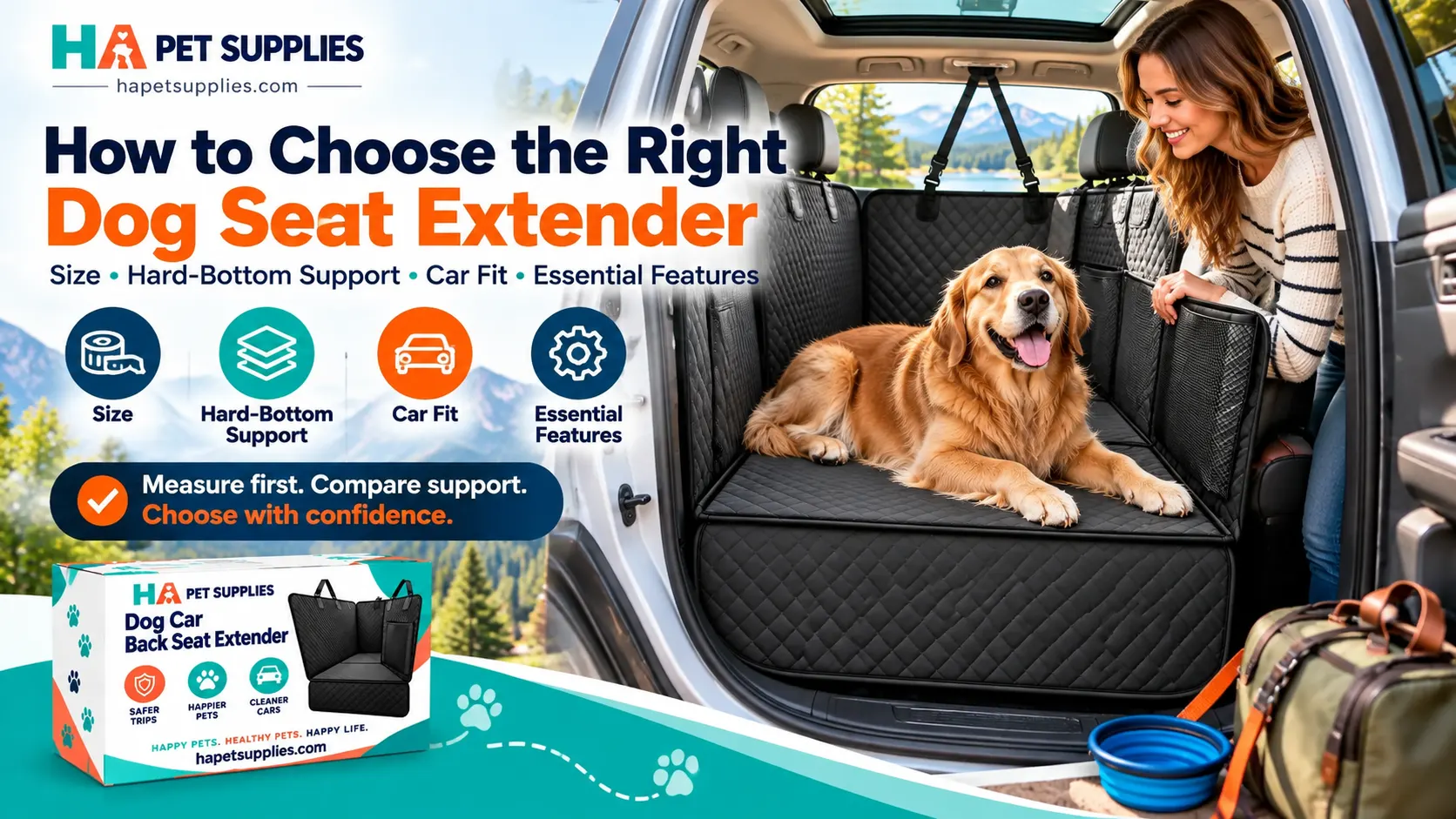
A hard-bottom dog seat extender can turn unused rear footwell space into a larger travel surface.
Hard-Bottom Dog Seat Extender vs Regular Dog Hammock
Regular dog hammock
A traditional hammock typically hangs between the front and rear headrests. Its strengths may include: seat protection, simple installation, lightweight construction, compact storage, and reduced access to the front seats. But because the center section is fabric, it can sag toward the footwell, especially under a larger dog.
Hard-bottom dog seat extender
A hard-bottom version incorporates supportive panels underneath the travel surface. That can bridge the rear footwell, create a flatter area, reduce sagging, give a large dog more room to lie down, and support more predictable footing. However, “hard bottom” does not automatically mean every product is equally strong. Buyers should compare panel material, panel thickness, stated weight capacity, number of support sections, hinge or folding points, and how the panels rest over the seat/footwell area.
Do not rely only on the phrase “hard bottom.” Look at how the product is actually built.
Is a Hard-Bottom Dog Seat Extender Better?
Not always. It depends on the dog and the vehicle. A hard-bottom extender is usually more relevant when you have a medium or large dog, the dog needs room to stretch out, a hammock sags excessively, you regularly take longer trips, two dogs share the rear area, or you specifically want the rear footwell bridged.
A simple hammock may be adequate when the dog is small, seat protection is the main goal, the footwell gap is not a concern, the vehicle is very compact, or you frequently remove and reinstall the cover. The right answer comes down to function, not marketing language.
How to Measure Your Car for a Dog Seat Extender
This is where many buyers make mistakes. Do not buy only because a listing says “Fits most SUVs.” Vehicles vary too much. Before ordering, take a measuring tape to the rear seat.
1. Measure rear-seat width
Measure across the usable rear bench area. This determines whether the extender will cover the seat adequately, bunch at the sides, leave excessive gaps, or interfere with doors or buckles.
2. Measure the rear footwell depth
Measure the horizontal distance between the front edge of the rear seat and the back of the front seats. This tells you how much space the platform must bridge.
3. Check headrest spacing
Many extenders attach using adjustable straps around front and rear headrests. Check whether your vehicle has removable or fixed headrests and how far apart they are.
4. Locate seat-belt buckles
This is critical. A dog seat extender should not make you forget about restraint access. Mark the location of rear seat-belt buckles, ISOFIX/LATCH areas, center-seat belt, and any passenger seat belt you still need.
5. Check rear-door clearance
Side flaps may extend upward to protect the door. Check whether the flap can sit flat, the door closes normally, and the panel does not interfere with handles or trim.
6. Consider front-seat position
If different family members drive the car, the front seats may move. Measure with the seats in your normal driving position.
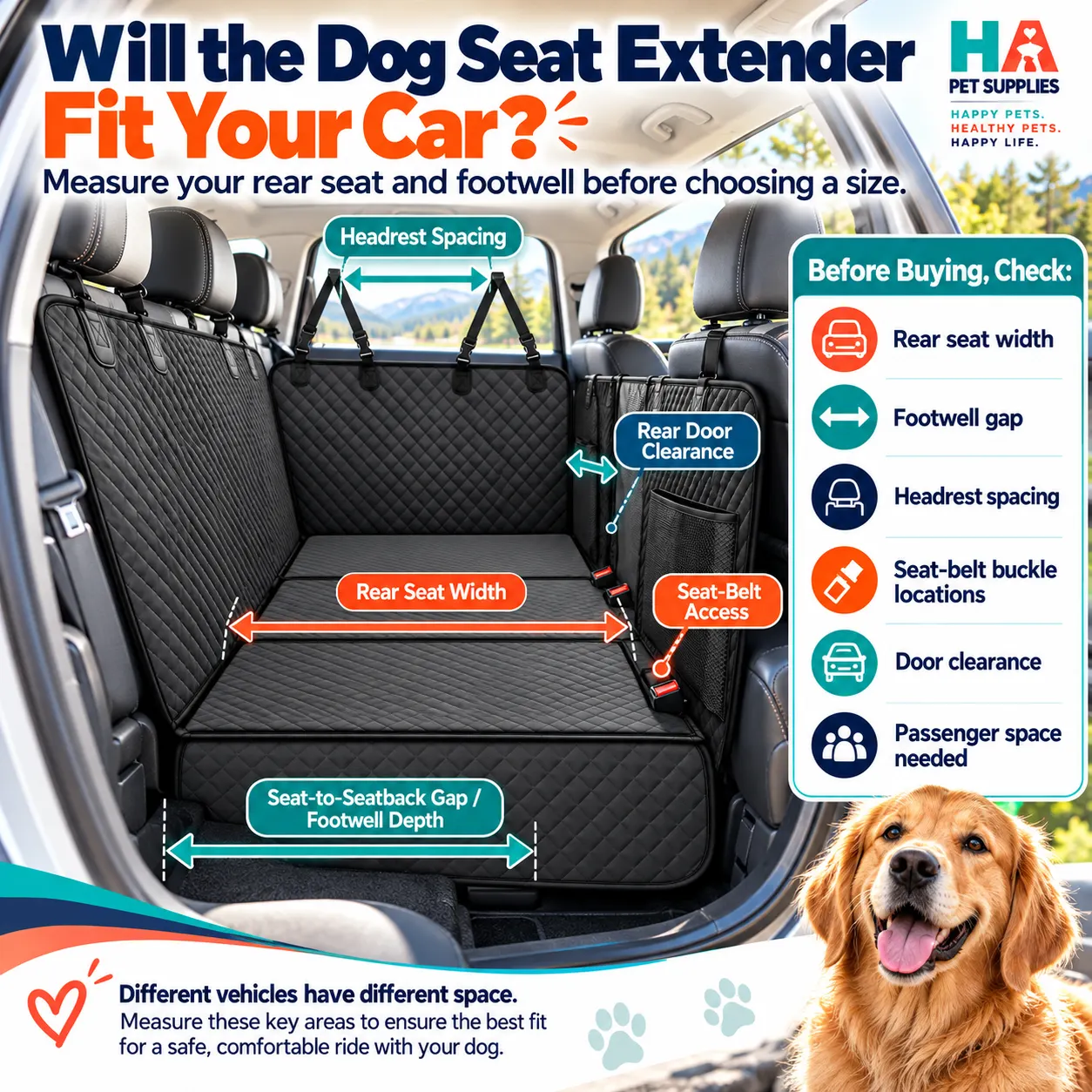
Measure rear-seat width, footwell depth, headrest spacing, and buckle positions before buying.
Will a Dog Seat Extender Fit My Sedan?
Many will, but you need to check the width and depth carefully. Sedans often have narrower rear benches, deeper seat contours, lower roof height, and less room between front and rear seats. That does not mean an extender is unsuitable. It simply means the fit may be less forgiving than in a large SUV.
Will a Dog Seat Extender Fit an SUV?
SUVs are one of the most common use cases because they often offer wider rear seats, more cabin height, more room for large dogs, and larger rear doors. But SUVs vary significantly. A compact crossover and a full-size SUV can have very different back-seat dimensions. Treat “SUV compatible” as a starting point, not proof of fit.
Will a Dog Seat Extender Fit a Pickup Truck?
Possibly, but truck cab design deserves extra attention. Check rear-seat depth, whether the seat folds, headrest availability, center tunnel height, seat-base geometry, door width, and front-seat clearance. Small or extended-cab trucks can have much more limited rear space.
How Much Weight Should a Dog Seat Extender Support?
This matters more than many people realize. A 75-pound dog is not simply a 75-pound static load. When the dog jumps onto the platform, turns quickly, braces during a curve, stands on one section, or shifts weight suddenly, the force can be concentrated in a smaller area.
That is why buyers should look for a verified manufacturer weight capacity rather than assuming that a large-looking product can support a large dog. If your product has a documented load rating, state it exactly as supplied by the manufacturer. If not, write: Check the manufacturer’s stated load capacity before using the extender with a large dog or multiple dogs.
Can Two Dogs Use a Dog Seat Extender?
Potentially, if the platform is wide enough, the combined dog weight is within the product rating, both dogs have enough room to settle, appropriate restraint can still be used, and the dogs are comfortable sharing space. Do not assume two small dogs are automatically easier than one large dog. Two dogs may tangle restraints, compete for position, move more frequently, and block seat-belt access. Plan the setup before the trip.
Is a Dog Seat Extender Safe?
This requires precise wording. A dog seat extender can help make the rear seat flatter, more usable, and potentially more stable for normal travel, but that does not mean it has been crash tested. The CDC advises securing pets during vehicle travel. AKC similarly recommends a crate or crash-tested dog seat belt rather than allowing a dog to ride loose. The Center for Pet Safety maintains an independent certification program for products that have met its testing standards. Center for Pet Safety
This distinction is valuable because it keeps the product claim credible: Dog seat extender = travel surface and interior protection. Crash-tested restraint = occupant-control system.
Can I Attach a Dog Restraint to the Seat Extender?
Only if the manufacturer specifically provides and validates an attachment point for that purpose. In most cases, the safer general approach is to use the vehicle’s intended restraint arrangement with an appropriate dog harness or travel system according to its instructions. The Center for Pet Safety has specifically warned that extension tethers can introduce excess movement and should not be assumed to provide crash protection. Center for Pet Safety advisory
Why Seat-Belt Access Matters
A good dog seat extender should be designed so you can still access the restraint points you need. This becomes especially important if a passenger also sits in the rear, you use a dog harness system, you frequently switch between pet and passenger use, or you use the center rear seat. If the extender completely buries the buckles, you may end up creating an inconvenient or unsafe setup. Make buckle access part of the buying checklist.
Does the Surface Material Matter?
Yes. The surface influences grip, cleaning, durability, comfort, and resistance to mud and moisture. A highly slick surface may look easy to clean but can make it harder for a dog to maintain footing. A textured or quilted surface can provide better grip, although the actual performance depends on the material and construction.
Waterproof vs Water-Resistant Dog Seat Extender
Do not use these terms interchangeably. Water-resistant usually means the material can resist limited moisture. Waterproof implies a stronger barrier against water penetration. But even if the main material is waterproof, seams, zippers, stitching, and openings can still allow moisture through. That means owners should still clean spills promptly. For muddy dogs, outdoor trips, swimming, or rainy weather, moisture protection is a major feature worth comparing.
Why Scratch Resistance Matters
Dogs use their claws when standing up, repositioning, bracing, and climbing into the vehicle. That means repeated travel can wear down weak fabric. A scratch-resistant surface can help increase durability, especially for large dogs, active dogs, dogs with longer nails, and frequent road-trip use. But “scratch resistant” does not mean “scratch proof.” Keep that wording realistic.
Protective Side Panels: Are They Worth It?
For many owners, yes. Dogs commonly place paws against the doors when looking outside, turning around, entering the vehicle, or trying to reposition. Side flaps can help reduce direct contact between claws, fur, mud, and the door panel. They can also help create a more enclosed-feeling travel area. Still, check that they do not obstruct door handles, window controls, passenger movement, or door closure.
Does a Mesh Divider Help?
A mesh divider can be useful for three reasons: Visibility — the dog can see toward the front rather than facing a solid wall. Airflow — a mesh panel allows more open air movement. Organization — it can visually separate the dog area from the front cabin. But it should not be described as a crash barrier unless tested for that function.
Are Storage Pockets Actually Useful?
For longer trips, yes. A side pocket can hold waste bags, wipes, leash, collapsible bowl, toy, small towel, and treats. Keeping these items accessible means you do not have to dig through luggage during stops. For more road-trip-focused advice, naturally link readers to your third supporting blog: How to Make Car Rides More Comfortable for Dogs: Space, Stability, Anxiety & Long-Trip Tips.
Is a Dog Seat Extender Good for Large Dogs?
Large dogs are among the clearest use cases. A large breed may struggle with a standard rear bench because their body length exceeds the seat depth, paws hang near the footwell, they need more turning room, and they may not be able to lie comfortably lengthwise. A hard-bottom extender can convert the gap into additional usable surface. That does not mean every large dog will fit comfortably in every vehicle. You still need to compare dog body length, dog weight, seat width, extender capacity, available headroom, and restraint setup.
Is a Dog Seat Extender Good for Older Dogs?
It may help by creating a flatter platform, but senior dogs have additional needs. Consider joint stiffness, difficulty jumping, balance, arthritis, and reduced mobility. For some dogs, a ramp or step may be just as important as the extender. If a senior dog struggles to enter or exit the vehicle, speak with a veterinarian about mobility needs.
Is a Dog Seat Extender Good for Puppies?
It can help with space and interior protection, but puppies are often more active, more likely to chew, more likely to have accidents, and less experienced with car travel. Start with short trips. ASPCA recommends preparing pets for longer road trips by gradually increasing the duration of short drives. AKC also recommends introducing dogs gradually to the car and restraint equipment. ASPCA travel safety tips
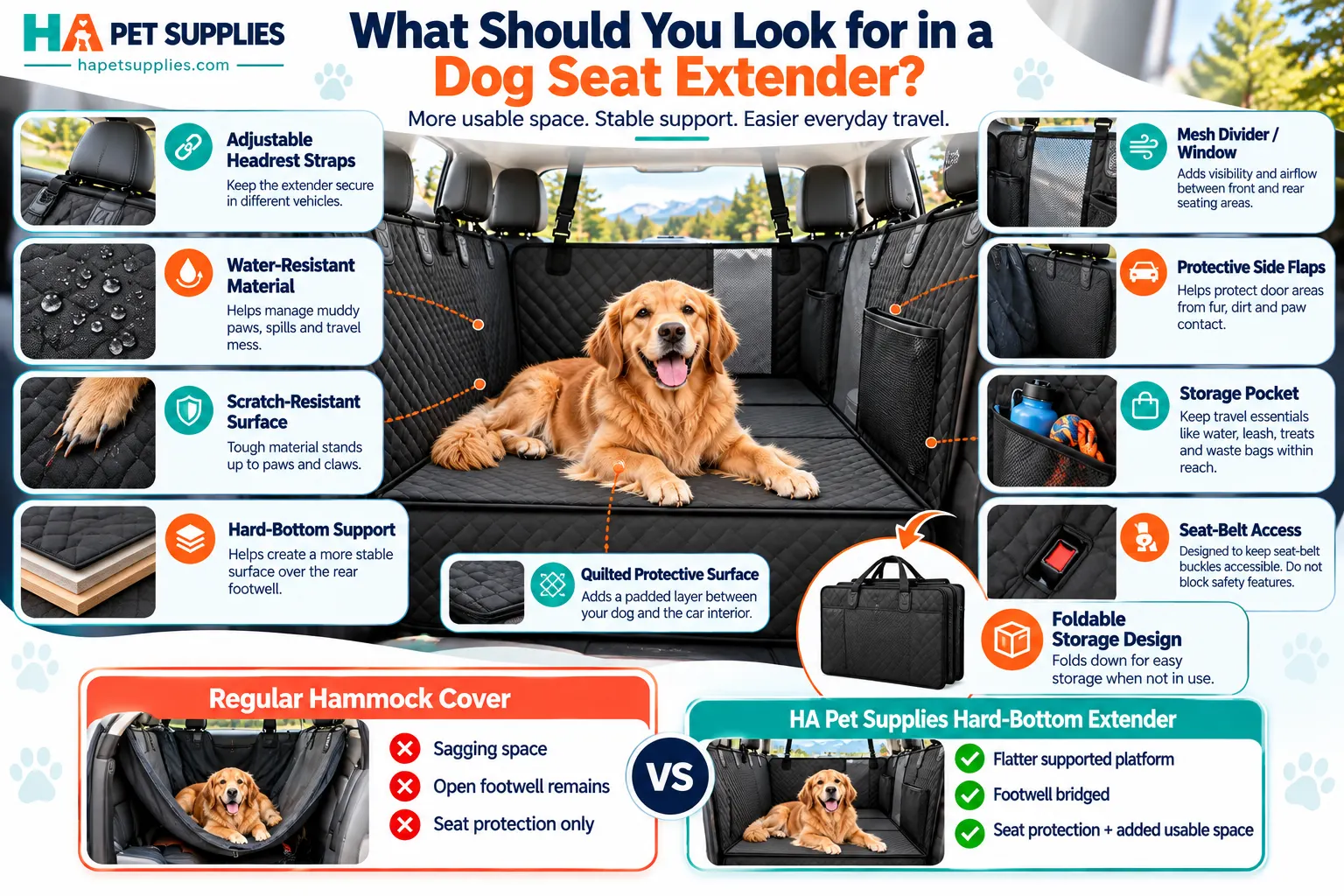
Compare support, materials, side protection, buckle access, straps, and storage before choosing a dog seat extender.
10 Features to Check Before Buying a Dog Seat Extender
Hard-Bottom Support
Does the platform actually span the footwell?
CriticalVerified Load Capacity
Especially important for large or multiple dogs.
EssentialRear-Seat Fit
Measure width, depth, and attachment points.
Must-checkSeat-Belt Access
Do not sacrifice restraint access.
SafetyAdjustable Straps
Look for adjustable headrest attachment.
ConvenienceSide-Door Protection
Useful for fur, mud, and scratching.
ProtectionTextured Surface
Helps with comfort and grip.
ComfortWater Resistance
Useful for wet paws and spills.
PracticalStorage Pockets
Helpful on daily outings and longer trips.
HandyFoldable Construction
Important if you need the rear seat for passengers.
FlexibleDog Seat Extender vs Dog Car Seat vs Crate
| Product | Primary purpose |
|---|---|
| Dog seat extender | More usable rear-seat space and protection |
| Dog hammock | Seat protection and separation |
| Dog car seat | Smaller-dog containment/positioning |
| Dog crate | Enclosed containment |
| Crash-tested harness | Vehicle restraint |
Dog Seat Extender vs Hard Bottom Dog Car Seat Cover
These phrases are often used almost interchangeably online. A hard bottom dog car seat cover generally describes a protective cover with structural panels. A dog seat extender emphasizes the fact that those panels create additional usable area over the footwell. In practice, one product may fit both descriptions. That makes this a useful SEO section for related keywords without keyword stuffing.
Common Dog Seat Extender Buying Mistakes
- Buying without measuring — probably the biggest mistake.
- Choosing only by dog weight — weight does not tell you body length.
- Assuming “universal fit” means perfect fit — it rarely does.
- Ignoring buckle access — this can create restraint problems later.
- Treating it as a safety restraint — a platform and a restraint are different things.
- Ignoring front-seat movement — the footwell depth can change when seats move.
- Buying a soft hammock when you really need structural support — know which problem you are solving.
- Choosing a product that is difficult to clean — this becomes annoying very quickly with muddy dogs.
- Ignoring door protection — especially important with larger breeds.
- Forgetting about human passengers — think about whether the rear seat needs to switch between pets and people.
How to Use a Dog Seat Extender With Proper Restraint
This is where you should naturally link to Blog 2 rather than repeating the entire safety article. Briefly: install the extender correctly, make sure it lies flat, keep seat-belt access available, fit the dog with the appropriate restraint system, follow the restraint manufacturer’s instructions, and test the setup before driving.
Then link: For a full safety setup, read our guide to using a back seat extender without compromising restraint: Dog Car Travel Safety: How to Use a Back Seat Extender Without Compromising Restraint. This is a highly topical internal link and strengthens the content cluster.
NHTSA also advises drivers to eliminate in-vehicle distractions and specifically recommends properly securing pets in a carrier or portable kennel before moving the vehicle. NHTSA
What About Car Anxiety?
A larger, more stable back-seat area may improve the physical environment, but it will not automatically fix anxiety. Dogs can be distressed because of motion sickness, previous bad experiences, unfamiliar noise, anticipation of veterinary visits, poor acclimation, or travel duration. VCA notes that restlessness, drooling, vocalizing, and vomiting can be associated with motion sickness or anxiety, and veterinary advice may be needed when symptoms persist. VCA Hospitals
Blue Cross also recommends introducing dogs to the car gradually, beginning with short exposure and short trips. Blue Cross This is another natural place to internally link Blog 3.
How to Test the Dog Seat Extender Before a Long Trip
Do not install it for the first time on vacation morning. Instead:
- Day 1: Install it in the parked car. Let the dog investigate.
- Day 2: Let the dog sit on it while the vehicle remains stationary.
- Day 3: Take a short drive.
- Day 4: Increase the drive slightly.
- Day 5: Check whether the dog slips, paces, refuses to lie down, overheats, chews the sides, or becomes anxious.
AVMA recommends acclimating pets to car travel with shorter rides before longer trips. AVMA traveling brochure AAHA also encourages helping dogs become accustomed to safe automobile travel before stressful events such as veterinary visits. AAHA
Long-Trip Preparation
If the extender passes the short-trip test, prepare the rest of the travel setup. Bring: water, collapsible bowl, waste bags, leash, harness, towels, wipes, regular food, medication if prescribed, current identification, and vaccination records when needed. CDC recommends planning ahead, carrying appropriate pet supplies, and checking destination requirements before travel. RSPCA guidance also emphasizes keeping pets secure, comfortable, and adequately ventilated during travel. RSPCA
Should Dogs Ride With Their Head Out the Window?
No. AKC advises against letting dogs ride with their heads out of windows because debris and other hazards can cause injury. AVMA similarly warns that dirt and debris may injure the eyes, ears, or nose. This section adds useful safety value without turning the article away from its main buying focus.
Can a Dog Seat Extender Reduce Driver Distraction?
It may help create a more organized rear area, but do not make a strong safety claim. The broader goal should be that the dog is appropriately restrained and not roaming around the vehicle. NHTSA defines distracted driving broadly as anything that diverts attention from driving. NHTSA distracted driving
Who Should Consider a Dog Seat Extender?
A dog seat extender may be especially useful if you own a medium or large dog, travel with two dogs, take regular road trips, have a dog that struggles on narrow rear seats, want more protection for seats and doors, frequently travel after hiking, swimming, or outdoor activities, or want a flatter rear-seat surface.
You may not need one if your dog travels entirely in a secured crate, your vehicle has limited rear space, the dog is very small and comfortable in another suitable setup, or you rarely transport your dog.
Why Consider HA Pet Supplies?
If you are comparing options, the HA Pet Supplies dog seat extender is designed around the same features discussed in this guide: a hard-bottom travel platform, protective quilted coverage, side protection, adjustable attachment points, and storage functionality.
For more dog travel and care products, browse the dog supplies collection or view the broader shop. If buyers need help confirming suitability before purchasing, naturally direct them to contact us. For wholesale or business enquiries: request a quote.
FAQ: Dog Seat Extender Buying Questions
A dog seat extender is a rear-seat accessory that bridges some or all of the footwell area to create a larger usable platform for the dog while helping protect the vehicle interior.
They can be particularly useful for medium and large dogs, dogs that need more lying space, owners who dislike sagging hammock covers, and frequent road-trip users.
It is usually better when the goal is structural support and additional usable surface. A hammock may be sufficient if upholstery protection is your main concern.
No. Measure your rear-seat width, footwell gap, headrest spacing, and buckle locations before buying.
Many are suitable for SUVs, but SUV dimensions vary. Measure first.
Yes, depending on the model and product dimensions.
Potentially, if there is adequate space and the combined weight is within the product’s verified capacity.
Large dogs are one of the main use cases, but you must verify platform size and load capacity.
No. Unless the product has been independently tested and certified for crash restraint, treat it as a platform and interior-protection accessory, not as the dog’s primary restraint system.
Follow the instructions for the restraint system you use. AKC and veterinary guidance generally recommend appropriate restraint rather than allowing dogs to ride loose.
Some can, depending on design. Check for accessible buckle openings before buying.
A reinforced platform can reduce the sagging associated with simple hammock covers, although stability depends on the specific construction and installation.
Only describe the product as waterproof if the manufacturer verifies that claim. Otherwise use terms such as water-resistant where accurate.
Models with raised side flaps can help reduce direct contact from fur, mud, and claws.
That depends on the design. Some products can fold partly away; others occupy most of the rear area.
It may improve physical comfort, but anxiety can have behavioral or medical causes. Persistent distress or motion sickness should be discussed with a veterinarian.
Yes. Introduce the setup gradually with short stationary sessions and short drives before a long trip. This matches general acclimation advice from AVMA, AKC, and ASPCA.
Final Buying Checklist
Vehicle
- Rear-seat width
- Footwell depth
- Headrest spacing
- Door clearance
- Buckle positions
Dog
- Body size
- Weight
- Number of dogs
- Mobility
- Travel behavior
Product
- Hard-bottom construction
- Stated load capacity
- Quilted or textured surface
- Water resistance
- Side protection
- Storage
- Folding design
- Strap adjustment
- Buckle access
Travel
- Compatible restraint arrangement
- Ventilation
- Cleaning plan
- Passenger needs
- Long-trip supplies
Conclusion
Choosing the right dog seat extender becomes much easier once you stop comparing product photos and start comparing how the product will actually work in your vehicle.
The best choice is not simply the thickest, widest, or most heavily advertised model. It is the one that fits your rear seat correctly, bridges the footwell in the way you need, supports your dog appropriately, keeps required restraint access available, protects the areas of the car you care about, is practical to clean and store, and works with your normal passengers and travel routine.
For many larger dogs, the biggest improvement comes from converting the open rear footwell into a flatter, more usable platform. For other owners, the most important benefits may be easier cleaning, better door protection, or more organized long-distance travel.
And remember the most important distinction: A dog seat extender can improve the travel environment, but it does not replace an appropriate restraint system.
For the next step, readers should naturally continue to your supporting safety guide: Dog Car Travel Safety: How to Use a Back Seat Extender Without Compromising Restraint.
And for long-distance comfort: How to Make Car Rides More Comfortable for Dogs: Space, Stability, Anxiety & Long-Trip Tips.
The result is a strong three-post topical cluster in which Blog 1 answers what to buy, Blog 2 answers how to use it safely, and Blog 3 answers how to make the whole journey more comfortable.