
Flying with a cat for the first time can feel far more complicated than booking your own ticket. You may already have dozens of questions running through your head: Will my cat be allowed in the cabin? Does the carrier go through airport security? Do I have to take my cat out? What happens if my cat meows during the flight? What should I pack? Can my cat eat or drink? What if there is an accident inside the carrier? And perhaps the biggest concern: What if I forget something important and only discover it at the airport?
The good news is that flying with a cat becomes much easier to understand when you divide the journey into clear stages: plan → prepare → pack → arrive → security → board → fly → arrive safely. Instead of trying to understand everything at once, handle each stage separately.
The Federal Aviation Administration explains that airlines determine their own policies for pets traveling in passenger cabins. If your airline permits a cat in the cabin, the pet container is treated as carry-on baggage and must fit beneath the seat and remain properly stowed when required. FAA
That is why your first step should not be packing a suitcase. It should be checking the rules for the exact airline operating your flight.
If you are still deciding which carrier to use, read How to Choose a Cat Airline Carrier: Size, Airline Requirements & Features to Check Before Flying before continuing. That guide deals specifically with carrier size, under-seat fit, ventilation, closures and buying features. This article assumes you are now preparing for the actual travel day.
Quick Answer: What Should First-Time Cat Flyers Do?
If your flight is approaching and you need the fast version, follow this order:
- Before booking: Check whether the airline allows cats in the cabin on your route.
- Before buying a carrier: Verify carrier size and weight restrictions.
- Several weeks before travel: Start getting your cat comfortable with the carrier.
- Before the trip: Confirm veterinary and destination-document requirements.
- A few days before departure: Recheck your airline’s current pet rules.
- Before leaving home: Pack documents, absorbent pads, wipes, waste bags, water arrangements and other essentials.
- At airport security: Be prepared for the carrier to be screened separately from your cat.
- On the aircraft: Follow cabin crew instructions and keep the carrier properly stowed.
- During the journey: Monitor your cat without repeatedly opening the carrier.
1. Can You Fly With a Cat in the Cabin?
Sometimes yes. But not every airline, aircraft, route or destination follows the same rules. The FAA allows airlines to decide whether they permit pets in passenger cabins. Airlines may also limit the number of pets, require the pet to stay inside the container throughout the flight, request health documentation, and impose other conditions. FAA
So before planning anything else, confirm: cats are permitted, your route allows cabin pets, your aircraft can accommodate the carrier, your chosen seat is compatible with pet travel, there is still space available for a cabin pet, your cat meets age or other eligibility requirements, your carrier meets the airline’s measurements, and applicable pet fees are understood.
Southwest, for example, currently allows small vaccinated domestic cats and dogs in the cabin on qualifying domestic flights, limits the number of pets, requires advance planning, and requires the carrier to remain beneath the seat during flight. Southwest Airlines Do not assume another airline uses identical rules.
2. Flying With a Cat Starts With the Right Cat Airline Carrier
The carrier is not simply luggage. For much of the trip, it becomes your cat’s temporary travel environment. That means you need to think about ventilation, usable interior space, security, stability, comfort, weight, handles, shoulder strap, cleaning, and under-seat fit.
The FAA requires the container to fit beneath the seat without blocking access to the aisle and to remain properly stowed during aircraft movement, takeoff and landing. FAA
IATA’s in-cabin guidance also emphasizes suitable sizing, secure construction, escape resistance, ventilation, and introducing the animal to the container before travel. IATA
If your carrier is still unfamiliar to your cat, do not wait until flight morning to introduce it. Use your dedicated carrier-training article, How to Get a Cat Comfortable in an Airline Carrier Before a Flight, to build familiarity in advance.
Flying with a cat is easier when you prepare the carrier, documents and airport routine before travel day.
3. Book Your Cat Before You Reach the Airport
One of the easiest mistakes to avoid is assuming your cat can simply accompany you because you purchased your own ticket. Airlines often limit the number of pets allowed in passenger cabins. Southwest currently says cabin pet space is limited and recommends making the reservation in advance. Southwest Airlines Other airlines may use different booking processes.
Your safest sequence is: Book flight → contact airline → reserve pet → confirm rules → verify carrier. Do not leave pet registration until check-in unless your airline specifically tells you to.
4. Recheck the Airline Pet Policy Before Departure
You may have checked the rules when you booked months ago. Check again. Policies, aircraft, schedules, seat assignments and operational conditions can change. Before travel day verify: cabin pet eligibility, carrier measurements, combined pet/carrier weight rules, check-in instructions, pet fee, documentation, seat restrictions, international requirements, and boarding procedure.
The FAA specifically advises travelers to contact their airline because carriers may impose additional requirements beyond federal cabin rules. FAA A useful habit is to save the airline’s pet-policy page to your phone before departure.
5. Visit Your Veterinarian Before Flying With a Cat
Not every healthy-looking cat should automatically be assumed ready for a long travel day. Speak with your veterinarian if you have concerns about age, chronic conditions, respiratory issues, severe travel anxiety, medication, long-haul journeys, previous travel problems, or international documentation.
For international trips, veterinary preparation becomes even more important. USDA APHIS advises travelers leaving the United States with a pet to contact a USDA-accredited veterinarian as soon as they decide to travel because destination countries can require vaccines, tests, treatments, microchips or health certificates. APHIS The process may take several weeks or even months depending on the destination. APHIS FAQ
6. International Cat Travel Needs Extra Planning
Flying domestically and flying internationally are not the same task. For international travel, you may need to satisfy airline rules (whether the cat can board), destination-country requirements (whether the cat can enter), and transit-country requirements (which may apply even if you are only connecting).
USDA APHIS explains that every destination country establishes its own health requirements and there is no single universal pet health certificate. APHIS Possible requirements include microchip, rabies vaccination, additional vaccinations, veterinary examination, laboratory testing, parasite treatments, import permit, health certificate, USDA endorsement, and country-specific documentation. APHIS also warns that international entry requirements can change and should be checked carefully. APHIS
7. Start Carrier Training Well Before Flight Day
A cat that only sees its carrier before vet appointments may already associate it with stressful experiences. Flight day is not the ideal time to reverse that association. Instead: leave the carrier out, keep the door open, add familiar bedding, reward exploration, practice closing it briefly, introduce movement, and practice short vehicle trips.
IATA’s guidance recommends introducing dogs and cats to their travel container well before the journey to reduce stress associated with confinement. IATA For the full process, send readers naturally to your complete cat airline carrier training guide.
8. What Should You Put Inside a Cat Airline Carrier?
Keep the interior simple. Your cat needs usable space more than decorative accessories. A practical setup may include a secure removable mat, absorbent pad, thin familiar bedding, and identification where appropriate. Avoid oversized blankets, loose toys that crowd the cat, heavy accessories, and anything blocking ventilation.
IATA guidance states that the container should be leak-proof and able to contain urine or feces, with absorbent bedding provided. IATA A spare liner in your travel bag is also a smart backup.
9. What Should You Pack When Flying With a Cat?
This is where first-time travelers often overpack the wrong things and forget the essentials. Prioritize items that solve likely travel-day problems.
Travel documents
Carry any required airline confirmation, veterinary records, vaccination documents, destination paperwork, health certificates, and import permits. Keep both digital and physical copies where appropriate.
Absorbent pads
Useful for unexpected accidents.
Spare carrier liner
If the primary liner becomes wet or dirty, you have a replacement.
Waste bags & pet-safe wipes
Bring several. Useful for quick cleanup.
Collapsible water bowl
Convenient for long travel days or layovers where water can safely be offered.
Harness and leash
Particularly helpful during required security handling.
Small food supply & prescribed medication
Carry an appropriate amount according to your cat’s routine and veterinary guidance. Only give medication if your veterinarian has prescribed it and explained how it should be used.
Identification details
Ensure collar/tag and contact information are current if appropriate for your cat.
The CDC’s pet-travel guidance similarly emphasizes planning ahead, bringing necessary supplies and documents, and keeping identification and health information current. APHIS
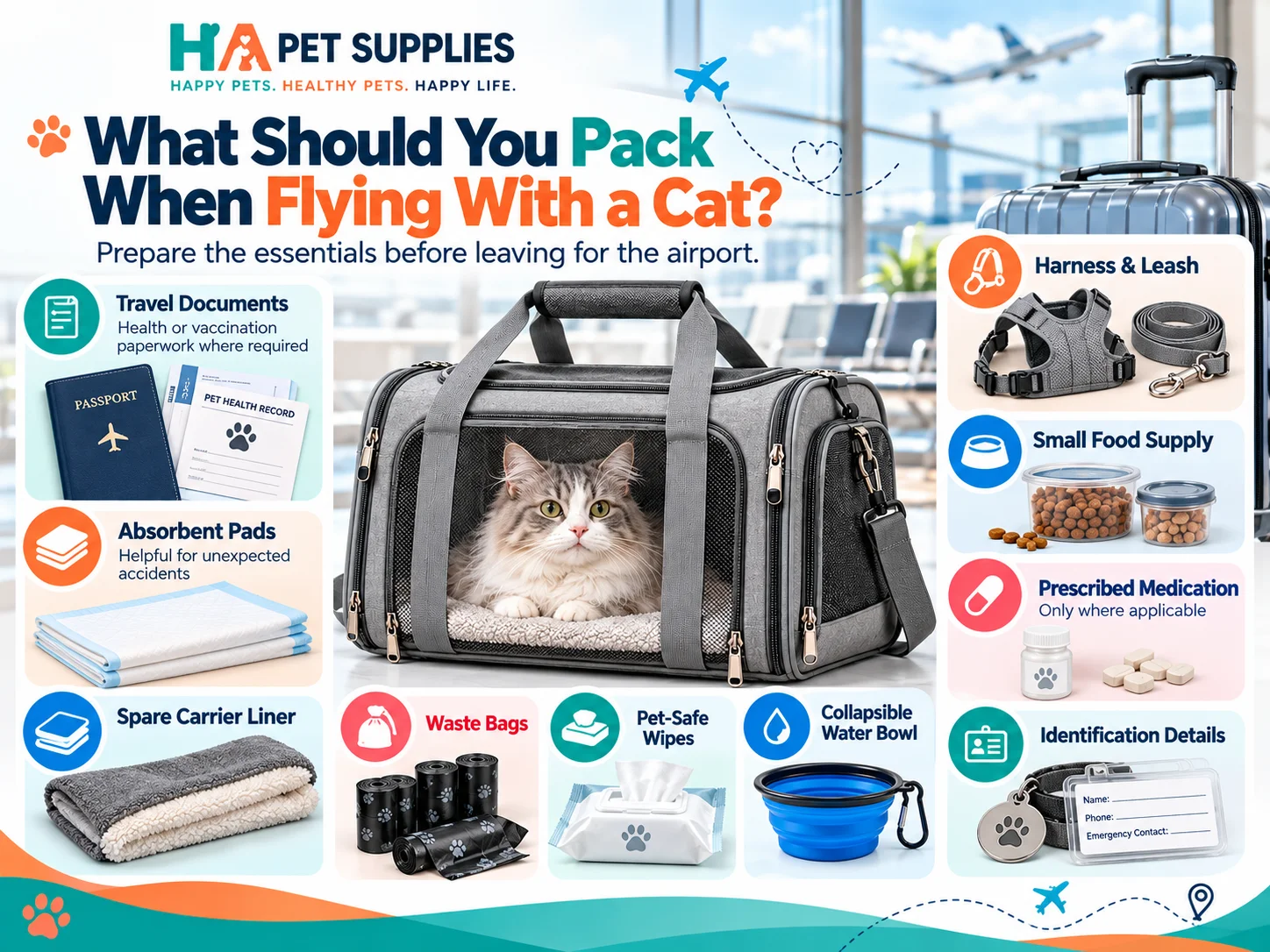
Pack documents, absorbent pads, wipes, water supplies, identification and other essentials before flying with a cat.
10. Feeding Your Cat Before a Flight
This is one area where generic internet advice can become risky. Do not tell every owner: “Do not feed for exactly X hours.” Individual needs can differ. Your veterinarian may recommend different arrangements depending on age, medical conditions, journey length, medication, feeding schedule, previous nausea, and destination timing.
IATA’s general guidance says an animal may ideally receive a light meal before travel rather than a heavy feeding immediately before the flight. IATA However, individualized veterinary advice should take priority.
If readers are also trying to manage feeding routines around departures and arrivals, this is one of the few places where your automatic cat feeder product can be linked naturally. That link fits here because the reader is already thinking about feeding logistics.
11. What Happens When You Arrive at the Airport?
Do not rush. First-time pet travelers benefit from arriving early enough to handle airline check-in, pet paperwork, carrier inspection, payment of pet fees, security screening, and unexpected questions. Do not arrive excessively early solely because you have a pet unless the airline advises it, but give yourself more margin than you would for a normal flight.
Keep your cat securely inside the carrier until the screening procedure requires otherwise. Avoid opening the carrier casually in crowded terminal areas.
12. What Happens at Airport Security With Your Cat?
This is one of the most confusing moments for first-time travelers. The exact process depends on the airport and country. In the United States, travelers should follow current TSA procedures and security staff instructions. In general, the pet is handled separately while the empty carrier is screened.
This is why your carrier needs to be easy to open and securely close again. It is also why a properly fitted harness can be useful during airport handling. Never assume your cat can remain sealed inside the carrier while the entire bag goes through ordinary baggage X-ray screening. Follow security personnel’s instructions at the checkpoint.
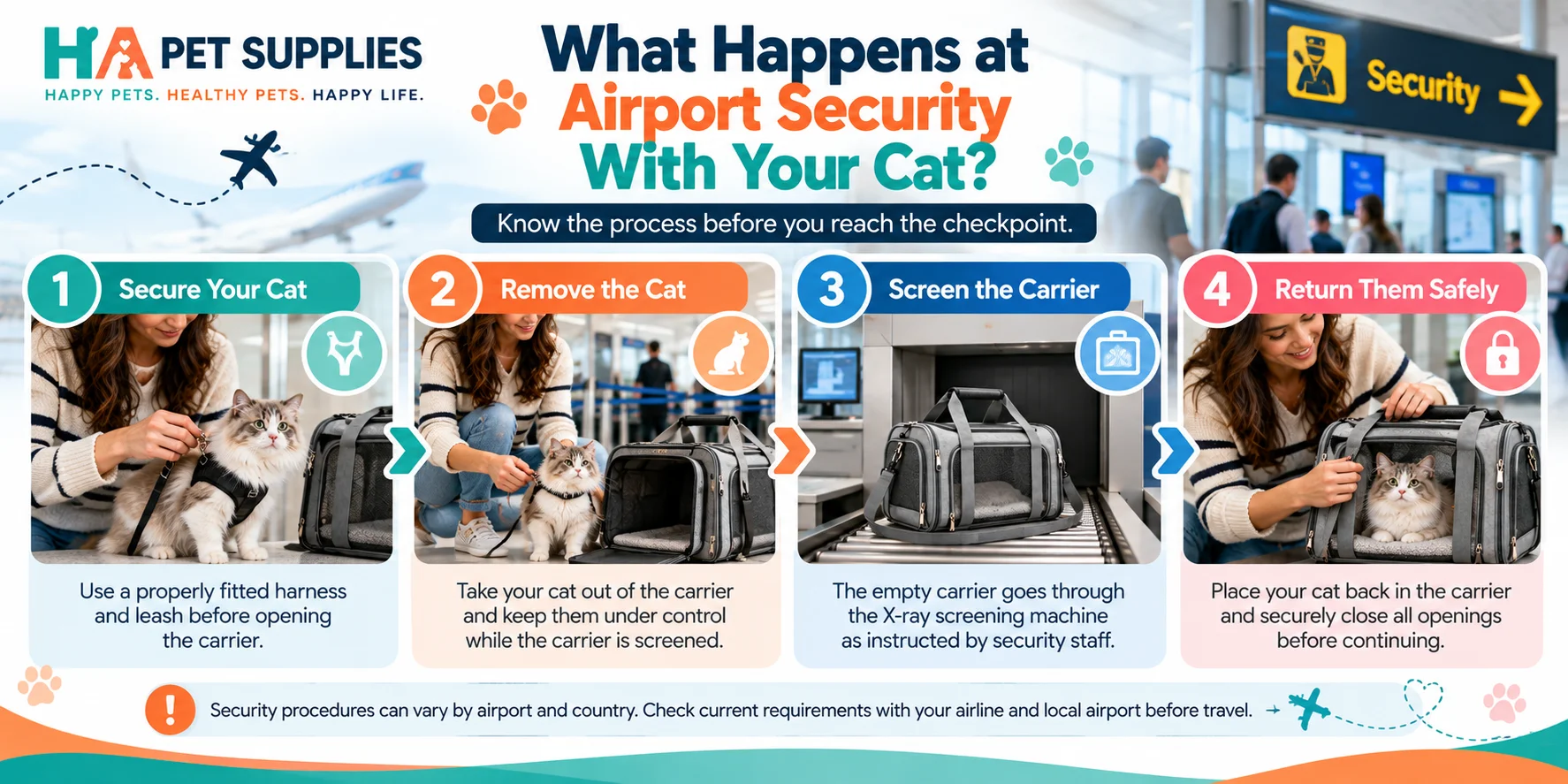
Airport security may require your cat to be removed while the empty carrier is screened, so prepare before reaching the checkpoint.
Rotating 3D view — hover to pause on desktop
13. Should Your Cat Wear a Harness at the Airport?
A harness can provide an additional level of handling control when the carrier must be opened. However, it only helps if it fits properly, your cat cannot easily back out of it, your cat has already worn it at home, and the leash remains under your control. Do not introduce a completely unfamiliar harness in the security line. Practice before the trip.
If your cat is extremely difficult to handle outside the carrier, contact the airport or security authority in advance and ask whether alternative screening arrangements are available.
14. What If Your Cat Tries to Escape at Security?
Prepare for this possibility before arriving. Use a secure harness, leash, fully closed carrier until instructed, controlled handling, and minimal opening time. Avoid setting the cat loose, opening the carrier while distracted, removing the harness too soon, or using a damaged carrier.
Your goal is simple: The cat is either securely contained in the carrier or securely controlled by you. There should be no uncontrolled transition between the two.
15. What Happens After Airport Security?
Once your cat is safely back inside the carrier: check every zipper, verify all panels are secure, reattach any permitted accessories, confirm your gate, find a quieter waiting area when possible, keep the carrier ventilated, and avoid repeated opening.
Airport terminals can expose cats to unfamiliar voices, announcements, rolling luggage, children, other animals, cleaning equipment, bright lights, and crowds. A familiar carrier becomes especially valuable here.
16. Can You Take Your Cat Out at the Gate?
Do not assume you can. Individual airport and airline rules matter. Some airlines require pets to remain in the carrier throughout the gate area. Southwest, for example, currently requires cats and dogs to remain secured in the carrier in the gate area, during boarding and deplaning, and throughout the flight. Southwest Airlines Even where a rule is less explicit, opening the carrier in a busy terminal may introduce unnecessary escape risk.
17. Boarding the Plane With a Cat
Before boarding: confirm carrier is fully closed, organize your boarding pass and identification, ensure documents are easy to access, keep your shoulder strap manageable, and avoid balancing excessive loose bags. Once onboard, follow the cabin crew’s directions.
The FAA requires the container to remain properly stowed during surface movement, takeoff and landing. FAA Do not place the carrier somewhere that blocks the aisle.
18. Where Does the Cat Airline Carrier Go?
For normal in-cabin pet travel, the carrier generally goes beneath the seat in front of you according to the airline’s rules. The FAA says the container must fit beneath the seat without blocking access to the main aisle. FAA
Do not force a carrier into a position that crushes ventilation panels. IATA specifically warns that soft-sided containers can compress under seats and that blocked ventilation can contribute to heat buildup. IATA That means: under-seat fit should never come at the cost of completely obstructing airflow.
19. Can You Take Your Cat Out During the Flight?
Usually, you should assume no unless your airline and cabin crew explicitly allow otherwise. IATA’s guidance states that cats and dogs traveling in cabin should not be removed from or have their travel containers opened during the flight. IATA Many airline policies similarly require animals to remain inside the carrier.
Opening the carrier unnecessarily creates escape risk, conflict with airline rules, stress for nearby passengers, and handling problems in a confined cabin. Keep the carrier securely closed.
20. What If Your Cat Meows During the Flight?
Some cats vocalize because of unfamiliar sounds, motion, confinement, or separation from normal surroundings. If your cat meows: remain calm, speak softly, avoid repeatedly opening the carrier, make sure ventilation is unobstructed, observe for unusual physical distress, and follow cabin crew instructions.
Do not interpret every meow as an emergency. At the same time, unusual breathing, collapse, extreme agitation or other worrying symptoms deserve attention.
21. How Does a Cat Go to the Bathroom on an Airplane?
This question worries many first-time travelers. Some cats may not eliminate during shorter journeys. Others may urinate or defecate in the carrier. Prepare instead of trying to guarantee it will not happen. Bring an absorbent pad, spare pad, waste bags, pet-safe wipes, and a replacement liner.
IATA guidance specifically says the container must be capable of containing feces or urine and should include absorbent bedding. IATA If an accident occurs, follow airline instructions and clean the carrier when it is safe and practical to do so.
22. How Should You Handle Water During a Flight?
Hydration matters, especially on long travel days. But offering water inside a confined carrier can create spills. Plan based on flight duration, layovers, airport facilities, your cat’s health, and veterinary advice. A collapsible bowl can be useful during safe layover periods. Do not obstruct the carrier interior with a large water container unless the travel setup specifically supports it.
23. What If Your Cat Becomes Very Anxious?
Do not wait until boarding to solve severe travel anxiety. If your cat pants heavily, panics in the carrier, injures itself trying to escape, or cannot tolerate even short practice sessions, speak with your veterinarian before traveling.
Do not independently give human medication, leftover prescriptions, or sedatives based on online comments. IATA cautions against routine sedation and tranquilization during air travel. IATA Any medication decision should be made with a veterinarian.
24. Flying With a Cat on a Long Flight
Long-haul travel needs extra planning. Think about the total door-to-door journey, not only scheduled flight time. For example: 30-minute drive + 2-hour airport wait + 8-hour flight + 2-hour connection + 4-hour second flight + arrival processing can turn into a very long day.
Before choosing such an itinerary, think about direct versus connecting flights, layover duration, bathroom planning, carrier comfort, hydration, documentation, temperature exposure, and destination transport. Where practical, fewer transfers often reduce handling complexity.
25. Direct Flight vs Connecting Flight
A direct itinerary may reduce carrier movement, airport transfers, missed-connection risk, repeated boarding, and environmental changes. But availability, cost and route restrictions may make connections unavoidable.
If connecting: verify every operating airline, check pet policies for all segments, confirm transit-country rules on international itineraries, allow sufficient connection time, and know where you can safely tend to your cat. USDA APHIS specifically warns that travelers may also need to consider countries they transit through, not only the final destination. APHIS
26. What About Layovers?
During a layover, prioritize security and calm. Do not assume every airport has a cat-specific relief area. Instead, plan around secure carrier handling, quiet waiting locations, hydration where appropriate, replacement pads, gate-change time, and airport rules. If you need to open the carrier, find out where it is safe and permitted to do so.
27. What Happens When You Land?
Do not open the carrier immediately after landing. The aircraft may still be moving. Passengers may be standing. Doors may open suddenly. Wait until you are in a secure location.
Then: check your cat, assess the carrier liner, offer water where appropriate, confirm transportation arrangements, and complete any required destination inspection. For international travel, arrival may involve customs, animal-health inspection, document verification, quarantine procedures, and import checks. Again, destination rules matter.
28. First-Time Cat Flight Timeline
Use this interactive timeline to plan your preparation. On mobile, these cards stack vertically.
2–6 months before
- Research destination requirements
- Contact veterinarian
- Begin paperwork
- Confirm airline routes
USDA APHIS warns some international processes can take months.
4–8 weeks before
- Choose carrier
- Start carrier training
- Practice short trips
- Confirm pet reservation
2–3 weeks before
- Verify documentation
- Check identification
- Confirm vet instructions
- Review itinerary
3–7 days before
- Recheck airline pet policy
- Review carrier measurements
- Prepare travel kit
- Print documents
Day before
- Pack supplies
- Charge phone
- Confirm flight status
- Organize paperwork
- Prepare carrier
Flight morning
- Follow veterinary feeding guidance
- Check carrier closures
- Arrive with enough time
- Keep cat secure
29. Common First-Time Mistakes When Flying With a Cat
Mistake 1: Assuming every airline accepts cabin cats
Not all do. Check first. FAA
Mistake 2: Buying the carrier before checking airline measurements
Reverse that process. Check airline rules first.
Mistake 3: Introducing the carrier on flight day
Carrier training should begin earlier.
Mistake 4: Forgetting the pet reservation
Cabin pet space may be limited.
Mistake 5: Arriving without backup pads
Accidents happen. Prepare for them.
Mistake 6: Opening the carrier unnecessarily
Every opening creates escape risk.
Mistake 7: Assuming domestic and international rules are the same
They are not.
Mistake 8: Using medication without veterinary guidance
Avoid improvised medication decisions.
Mistake 9: Ignoring the connection airport
Transit-country rules may matter.
Mistake 10: Treating an “airline-approved” product label as a guarantee
Always verify the actual airline.
30. Interactive First-Time Flyer Checklist
Use this checklist to confirm you’re ready at each stage.
Before booking
Before travel
Packing
At airport
On aircraft
Flying With a Cat FAQ
Click any question to expand the answer.
Is flying with a cat difficult for the first time?
It can feel confusing because airline rules, airport security, veterinary requirements and carrier restrictions all need to be coordinated. The easiest approach is to plan in stages rather than solving everything at once.
Can cats fly in airplane cabins?
Some airlines permit eligible cats in the cabin, while others do not. The FAA allows airlines to determine their own passenger-cabin pet policies. FAA
Where does my cat sit on the plane?
In normal cabin pet travel, the cat remains inside the carrier, which is usually stowed beneath the seat in front of you according to the airline’s requirements.
Does my cat have to come out at airport security?
Security procedures vary by country and airport. In many systems, the empty carrier is screened separately, meaning the cat must be securely removed and controlled temporarily. Follow the security authority’s instructions.
Should my cat wear a harness at the airport?
A properly fitted harness can make handling safer when the carrier needs to be opened. Introduce the harness at home before the trip rather than using it for the first time at the checkpoint.
Can I take my cat out of the carrier on the airplane?
Do not assume so. IATA guidance says cats and dogs should not be removed from or have their travel container opened during the flight. IATA Your airline may impose the same requirement.
What if my cat cries during the flight?
Quiet vocalization can occur because of unfamiliar sounds and confinement. Remain calm, avoid repeatedly opening the carrier, and monitor for abnormal signs of physical distress.
How does my cat go to the bathroom during a flight?
Many cats may not eliminate during shorter journeys. Prepare with absorbent pads, spare liners, waste bags and wipes.
Should I feed my cat before flying?
Follow your veterinarian’s recommendation, particularly for long flights, kittens, older cats or cats with medical conditions. Avoid a one-size-fits-all fasting rule.
Can I give my cat something to make them sleep?
Do not administer medication without veterinary guidance. IATA advises against routine sedation or tranquilization for air transport. IATA
How early should I arrive at the airport when flying with a cat?
Follow your airline’s check-in recommendation and leave additional time for pet check-in, documentation and security. Avoid arriving so late that an unexpected pet-related question puts your flight at risk.
Does a cat need a health certificate to fly?
It depends on airline policy, route and destination. For international travel, destination countries commonly establish their own documentation requirements. USDA APHIS confirms there is no single standard international health certificate. APHIS
Do cats need a passport?
The United States does not issue one universal pet passport for international travel. APHIS explains that destination-specific health certificates and other documents are used instead. APHIS
How long can a cat stay in a carrier during travel?
There is no single safe universal number that applies to every cat. Consider your cat’s health, age, carrier size, itinerary, connections and veterinarian’s advice when evaluating a long journey.
Is a direct flight better when traveling with a cat?
A direct flight often reduces the number of transfers and handling events, but the best itinerary depends on the route, airline and your cat’s needs.
What if my cat is too large for an airline carrier?
Do not force the cat into an undersized carrier. Check the airline’s cabin restrictions and contact the airline about available alternatives. Your carrier selection guide explains this in more detail: How to Choose a Cat Airline Carrier.
Useful HA Pet Supplies Resources During Your Planning
If you are still comparing cat travel products, browse the HA Pet Supplies cat supplies category rather than choosing an unsuitable product solely because it appears in a search result. If you want broader care and travel advice, the HA Pet Supplies blog can serve as your next research step. For general shopping across categories, use the HA Pet Supplies shop.
For product questions related to travel preparation, you can also contact HA Pet Supplies. Businesses, retailers or larger buyers who need product sourcing information can use the HA Pet Supplies request-a-quote page rather than a normal retail inquiry. These links should stay inside the relevant context instead of being dumped into a separate internal-links list on the final page.
The Bottom Line
Flying with a cat for the first time feels difficult mainly because several small tasks have to happen in the right order. You need to: check the airline → reserve the pet → choose the right cat airline carrier → prepare your cat → organize documents → pack intelligently → handle security → follow cabin rules. Once those pieces are separated, the process becomes much easier to manage.
The most important rule is to avoid assumptions. Do not assume every airline accepts cats, every “airline approved” carrier will fit, your cat can come out during the flight, airport security works the same everywhere, international paperwork can be completed at the last minute, or medication is automatically necessary.
Instead, verify the airline’s current policy, work with your veterinarian when health or documentation questions arise, and start carrier preparation early. The FAA says airlines determine their own pet policies and that in-cabin carriers must fit beneath the seat and remain appropriately stowed. FAA
USDA APHIS emphasizes starting international travel planning early because entry requirements can involve vaccinations, testing, treatments, identification and health documentation. APHIS
And IATA recommends introducing your cat to the carrier well before the journey rather than making the flight the first prolonged carrier experience. IATA
So if this is your first flight with a cat, your best strategy is not to search for one magical travel trick. It is to make the journey predictable. A familiar carrier, clear documents, sensible packing, secure airport handling and realistic expectations can remove much of the uncertainty for both you and your cat.
Once you’re comfortable with the travel-day process, continue with your dedicated article on getting a cat comfortable in an airline carrier before a flight so the carrier itself becomes less unfamiliar before departure.