
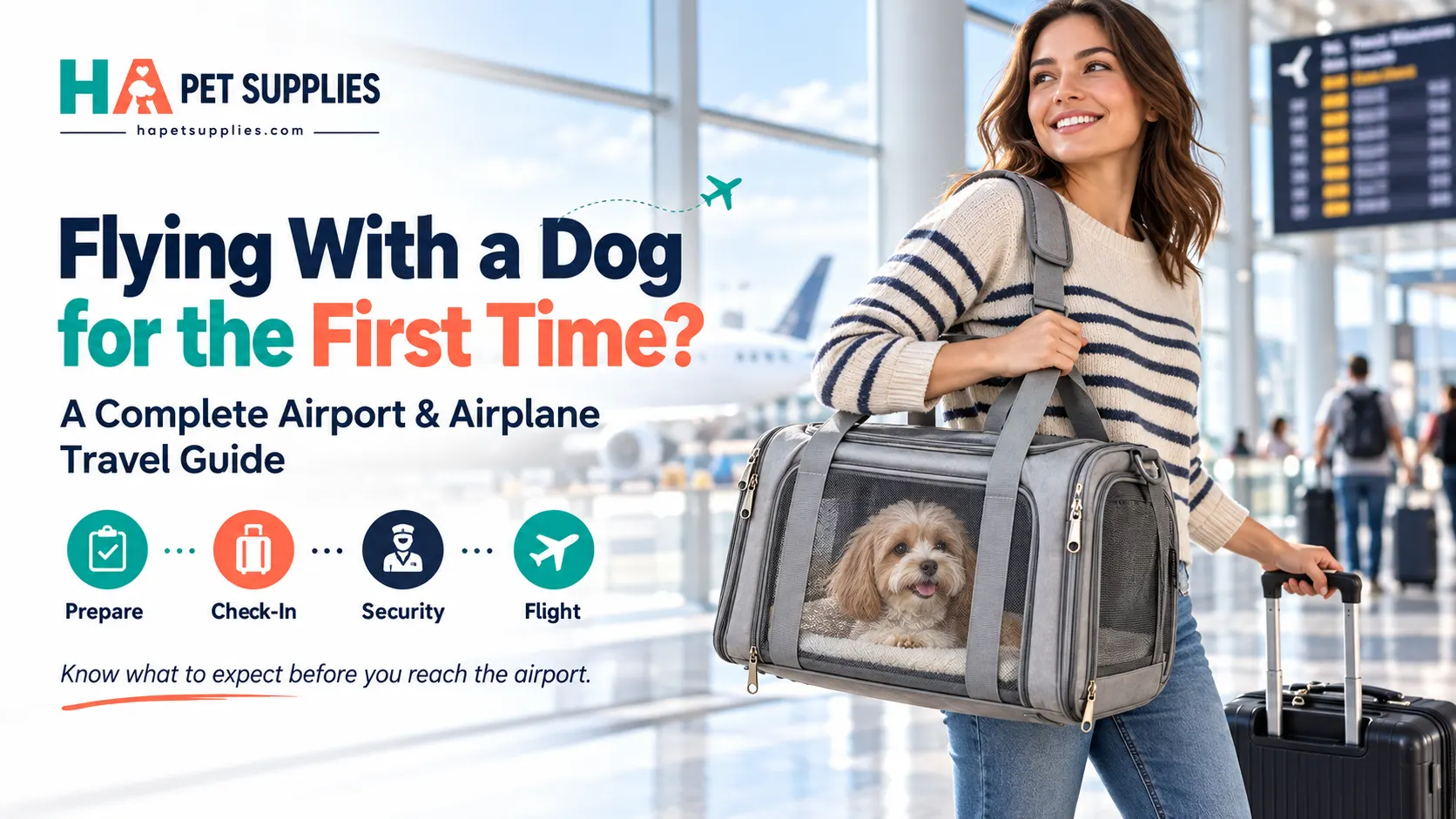
Flying with a dog for the first time can feel much more complicated than booking an ordinary flight. You are not only thinking about your ticket, luggage and airport timing. You may also be wondering whether your dog can travel in the cabin, what carrier you need, what happens at airport security, whether documents are required, when your dog should eat, and what you will do if your dog becomes nervous.
For a first-time traveler, that is a lot of decisions at once.
The good news is that most of the confusion becomes manageable when you separate the trip into stages: before booking, preparing your dog, packing, arriving at the airport, going through security, boarding, flying and arriving at your destination.
The most important rule is to never assume that one airline’s pet policy applies to another. Airline requirements can differ by route, aircraft, destination, carrier dimensions and the number of pets already booked on the flight. Delta, for example, tells passengers to confirm that the kennel will fit beneath the specific aircraft seat and limits the number of pets accepted in each cabin. Southwest likewise requires an in-cabin pet carrier to fit beneath the seat and publishes its own carrier limits. Delta
If you are still choosing your travel setup, start with HA Pet Supplies’ guide to choosing the right dog airline carrier. You can also review the HA Pet Supplies dog airline carrier while comparing your dog’s measurements with the requirements of your specific airline.
The goal of this guide is simple: by the time you finish reading, you should know what to check, what to pack, what happens at the airport and what mistakes to avoid when flying with a dog for the first time.
1. Flying With a Dog for the First Time Starts Before You Book
A common first-time mistake is buying the passenger ticket first and checking the pet policy afterward.
Reverse that order.
Before paying for a flight, open the operating airline’s official pet-travel page and confirm whether your dog is eligible for that exact journey.
You need answers to several questions:
Does the airline accept pets in the cabin?
Some airlines allow small dogs that fit inside an under-seat carrier.
Does your route allow pets?
Rules may change for international destinations, certain countries, specific aircraft or connecting itineraries.
Is there a pet limit per flight?
Yes, some airlines limit how many animals may travel in the cabin. Delta, for example, says in-cabin pet spaces are limited and recommends contacting reservations as soon as possible. Delta
Do you need to reserve your dog separately?
Often, yes.
What carrier size is permitted?
Do not rely on a generic label such as “airline approved.” Check the actual dimensions allowed by your airline and aircraft.
For examples of how much policies can differ, compare the official Delta pet travel requirements, Southwest pet policy and Alaska Airlines pet travel policy. These should be treated as examples of airline-specific policies, not universal standards.
If you are still comparing products, browse HA Pet Supplies’ dog supplies collection rather than selecting a carrier simply because its title contains the words “airline carrier.”
2. Understand How Your Dog Will Travel
The phrase flying with a dog can describe several very different arrangements.
In-cabin travel
For smaller dogs, this generally means your dog travels inside a suitable carrier that fits beneath the seat in front of you.
This option gives the owner closer access to the dog, but it also creates strict size limitations.
Southwest says pets must remain completely inside their carriers and the carrier must fit under the seat. Delta likewise requires the kennel to fit fully beneath the seat in front of the passenger. Help Center | Southwest Airlines
Checked or baggage-compartment travel
Availability varies substantially by airline.
Do not assume every airline transports dogs this way. Southwest, for example, states that it does not transport pets in its cargo compartment, while Alaska offers both cabin and baggage-compartment options subject to its restrictions. Help Center | Southwest Airlines
Cargo transport
Cargo programs are usually governed by a different set of procedures than ordinary in-cabin pet travel.
For larger dogs or routes where cabin travel is unavailable, research this separately rather than assuming an in-cabin soft carrier can be used.
The International Air Transport Association describes its Live Animals Regulations as the worldwide standard used for safe and humane commercial air transportation of live animals. IATA
You can review the official IATA Live Animals guidance when researching broader international animal-transport standards.
3. How to Choose a Dog Carrier for Flying With a Dog for the First Time
Your carrier is not simply luggage. It becomes your dog’s temporary travel environment.
A first-time buyer should evaluate both airline compatibility and dog comfort.
Look for:
- adequate ventilation
- secure closures
- sturdy construction
- enough usable interior space
- a comfortable base
- manageable carrying handles
- a shoulder strap where appropriate
- leak-resistant or easy-to-clean interior surfaces
- dimensions compatible with your airline
USDA guidance for air travel says an appropriate kennel should allow the animal to stand, turn around, sit erect and lie down naturally. Its guidance also emphasizes ventilation, secure latches and safe construction. APHS
For cabin travel, however, you must balance that comfort requirement with the much smaller under-seat dimensions imposed by the airline.
That is exactly why travelers should read the detailed HA Pet Supplies guide on dog airline carrier sizing and airline requirements before ordering.
You can then compare those requirements against the HA Pet Supplies dog airline carrier.
Fast decision rule
Do not ask:
“Is this carrier airline approved?”
Ask:
“Does this carrier, with my dog inside it, meet the current requirements for my specific airline, aircraft, seat and route?”
That is a much safer buying question.
4. Veterinary Checks and Health Documents
Do not wait until the night before travel to investigate health paperwork.
Your requirements may depend on:
- airline
- origin country
- destination country
- transit countries
- state or territorial rules
- vaccination status
- whether your dog travels in-cabin or another way
The U.S. Department of Transportation notes that airlines may impose health-document requirements for animal transportation. USDA also tells travelers to ensure their dog has the appropriate travel documentation before flying. Department of Transportation
Useful official references include the U.S. Department of Transportation animal-travel guidance and the USDA’s Pets on Planes preparation guidance.
If your itinerary involves entering the United States, CDC requirements become especially important.
CDC says requirements depend on factors such as where the dog has been during the preceding six months and where it was vaccinated. CDC
Start with the official CDC Bringing a Dog into the U.S. page.
CDC also currently requires a Dog Import Form receipt for dogs entering the U.S., with additional requirements applying in some situations. CDC
The official form instructions are available through the CDC Dog Import Form guidance.
5. Prepare Your Dog Before Flight Day
A beautiful carrier is not useful if the first time your dog spends meaningful time inside it is at the airport.
Carrier familiarity should begin at home.
Set the carrier in a quiet area with the opening accessible. Allow your dog to investigate it voluntarily. Depending on your dog’s temperament, you can use treats, familiar bedding and short sessions to create a positive association.
Then gradually progress through stages:
Stage 1 — Carrier appears in the room
No pressure. Let your dog investigate.
Stage 2 — Dog enters voluntarily
Reward calm interaction.
Stage 3 — Briefly close the carrier
Start with very short periods.
Stage 4 — Carry the dog around the home
Introduce gentle movement.
Stage 5 — Short vehicle practice
If appropriate for your dog, add realistic travel sensations.
Stage 6 — Longer calm carrier periods
Build duration gradually without turning every practice session into a major event.
If your dog is struggling, the related HA Pet Supplies guide on getting a dog comfortable in an airline carrier before a flight provides the deeper training sequence.
USDA’s air-travel guidance also emphasizes the dog’s temperament and readiness for travel, not simply whether the owner has bought a kennel. APHS
6. What to Pack When Flying With a Dog for the First Time
Avoid turning the dog’s travel kit into another oversized suitcase.
Prioritize essentials that solve likely problems.
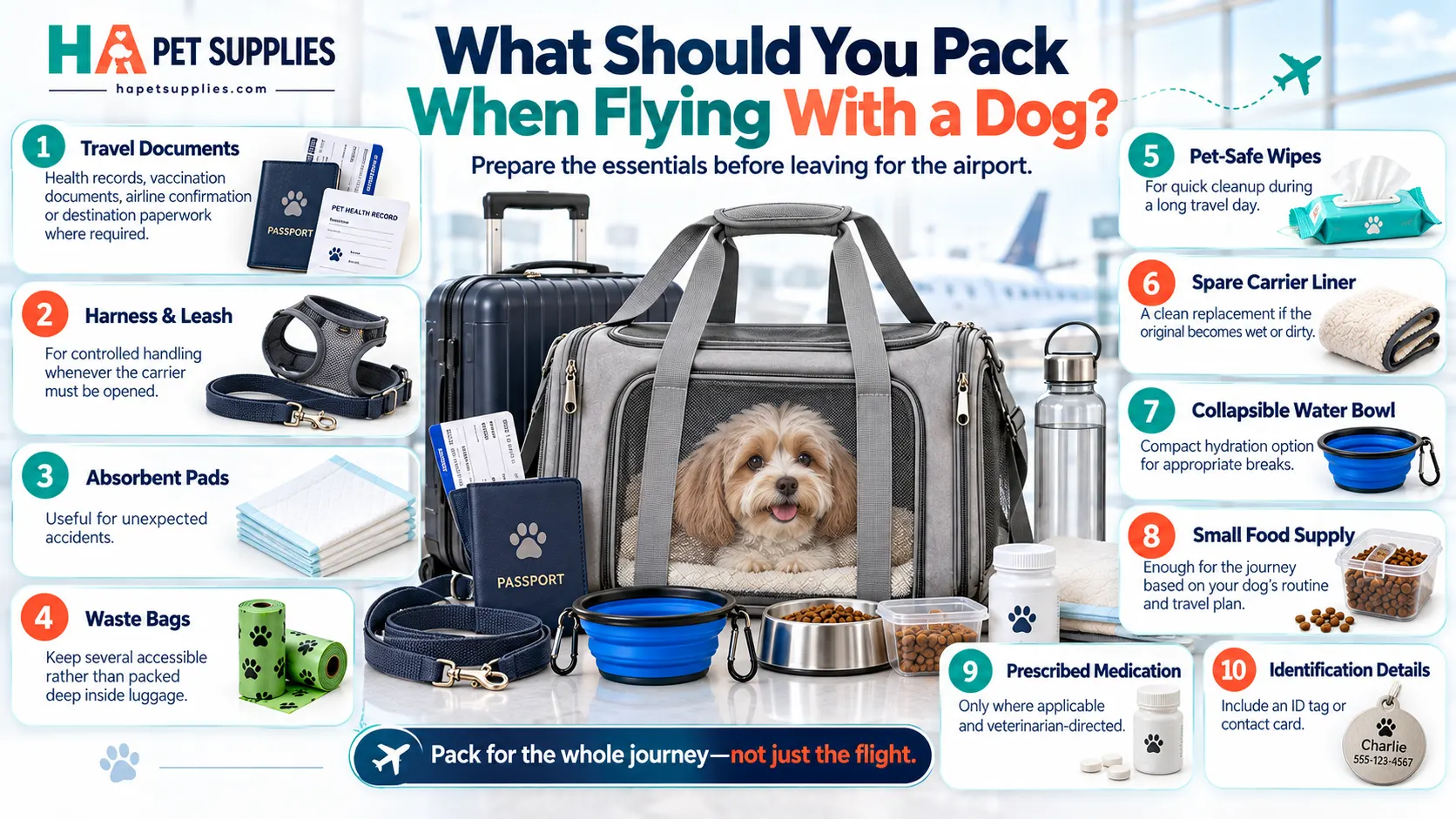
A practical kit may include:
- required health and entry documents
- vaccination records where applicable
- current identification
- leash and properly fitted collar or harness
- waste bags
- absorbent pads
- small amount of appropriate food
- collapsible water container
- familiar low-bulk comfort item if safe
- cleaning wipes
- spare absorbent liner
- medication your veterinarian has prescribed
- recent photo of your dog
- airline reservation information
- emergency veterinary contact information
CDC recommends making sure pets are properly identified and microchipped, with contact information kept up to date, and checking required documentation before traveling. CDC
You can review the full CDC pet travel safety guidance before finalizing your checklist.
What not to pack inside the carrier without thinking
Do not fill the interior with thick blankets, loose accessories or toys that reduce ventilation or usable space.
The dog needs a clean, stable resting area more than a heavily furnished miniature bedroom.
7. Give Your Dog a Calm Start on Travel Day
Your goal on travel morning is not to exhaust the dog or create a highly stimulating adventure before reaching the airport.
Keep the schedule predictable.
Give enough time for:
- normal morning routine
- an appropriate walk
- bathroom opportunity
- final document check
- calm carrier setup
- transport to the airport without rushing
Alaska’s current pet-travel guidance recommends a pre-flight workout, identification, extra check-in time and a pre-flight potty trip. Alaska Airlines
For feeding, avoid copying a generic rule from social media. Your dog’s age, health, routine and flight length matter.
Discuss feeding and hydration with your veterinarian, particularly if the dog has medical needs.
8. How Early Should You Arrive at the Airport With a Dog?
Earlier than you would for your normal solo trip.
Why?
Because flying with a dog often adds:
- airline counter check-in
- pet reservation verification
- carrier inspection
- document checks
- pet fee payment
- security handling
- bathroom planning
- extra walking time through the terminal
Delta, for example, instructs passengers traveling with in-cabin pets to visit the Special Service Counter, where staff verify the pet and kennel and collect the applicable fee. Delta
A sensible rule is to check your airline’s specific recommendation rather than inventing a universal arrival time.
TSA’s general travel guidance recommends arriving in advance and preparing for the checkpoint process; pet travelers should build additional margin into that plan. Transportation Security Administration
9. Checking In With Your Dog
At check-in, the airline may confirm:
- your pet reservation
- route eligibility
- carrier size
- dog’s ability to fit appropriately
- required documentation
- applicable pet fee
- destination restrictions
Do not assume online passenger check-in eliminates the need to visit a counter.
For example, Delta currently requires travelers with cabin pets to check in at a Special Service Counter. Delta
Keep documents together in one easily accessible folder rather than buried under clothing in your carry-on.
A small organization step here can save a large amount of stress.
10. Flying With a Dog for the First Time: What Happens at Airport Security?
This is one of the parts first-time travelers worry about most.
For U.S. TSA screening, the general process is straightforward:
Your dog does not stay inside the carrier while the carrier goes through the X-ray machine.
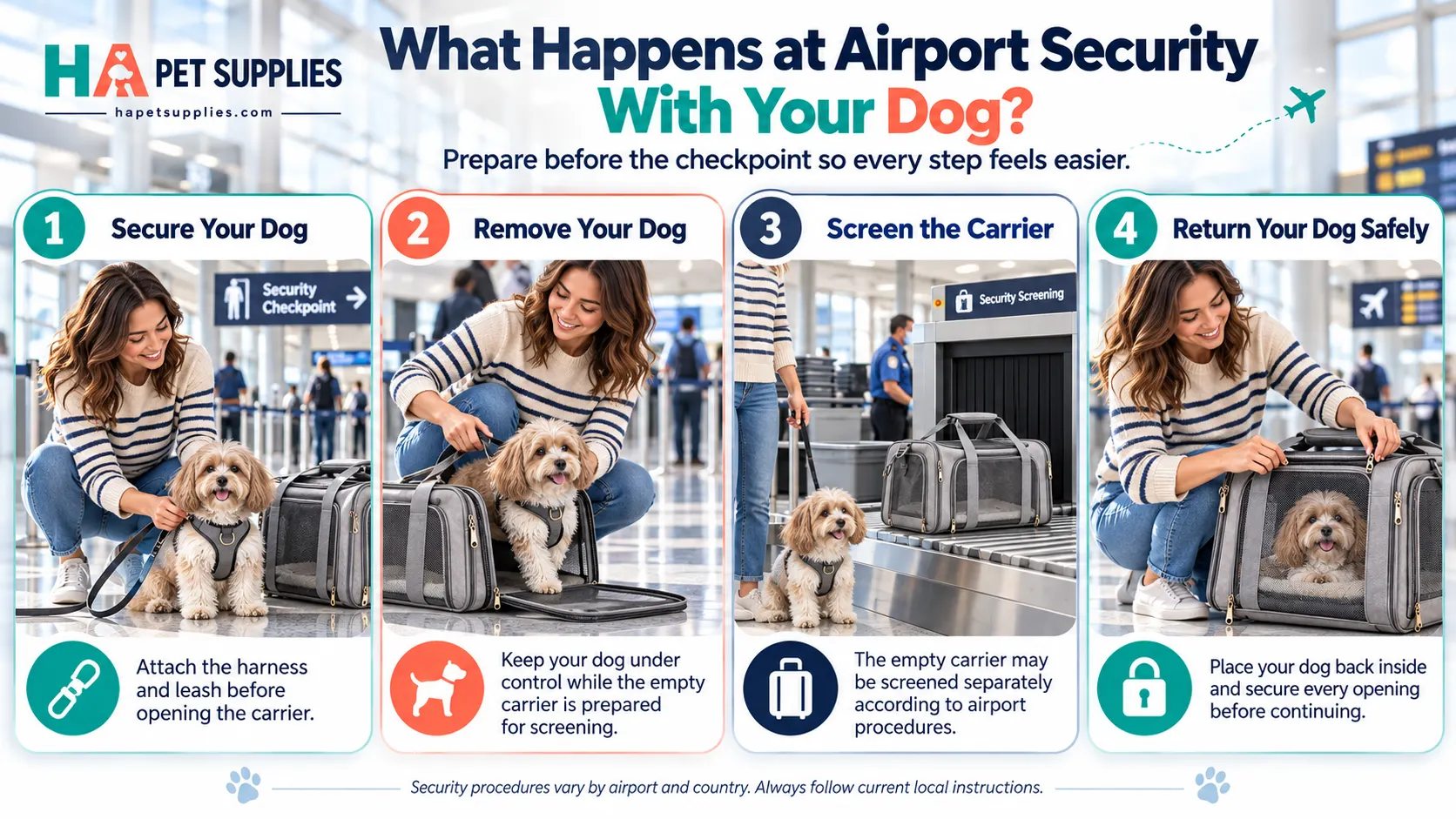
TSA says small pets are permitted through the checkpoint, but passengers should remove the pet from the carrying case while the empty case is screened. The traveler maintains control of the animal during screening. Transportation Security Administration
Review the official TSA guidance for small pets at airport security before your trip.
TSA also says a leash can help maintain control before screening, although it should be removed when carrying the pet through the metal detector. Transportation Security Administration
This is exactly why carrier training alone is not enough.
Your dog should also be reasonably comfortable being handled and secured outside the carrier for a short period.
11. Four Simple Airport Security Steps
Think about airport security as four actions.
Secure Your Dog Before Opening the Carrier
Do not open the carrier casually in a busy terminal. Make sure you have secure physical control of your dog first. A frightened first-time traveler can react unpredictably to rolling luggage, announcements, crowds and unfamiliar smells.
Remove Your Dog From the Carrier
Follow the security officer’s instructions. The empty carrier will normally be screened separately.
Pass Through Screening With Your Dog
Maintain control of your dog as instructed. TSA explicitly states that pets should not be sent through the X-ray machine inside their carrier. Transportation Security Administration
Return Your Dog to the Carrier
Once screening is complete, move to an appropriate area and calmly secure the dog back inside. Do not turn the checkpoint into an obedience test. The objective is simple, predictable handling.
12. What Happens After Security?
Once you clear the checkpoint, the most difficult part may actually be resisting the temptation to constantly take your dog in and out of the carrier.
Follow your airline’s rules.
Southwest states that pets must remain inside the carrier while in the gate area, boarding, deplaning and during the flight. Delta similarly requires pets to stay secured in their kennel at the airport except in designated relief areas. Help Center | Southwest Airlines
This matters because airport pet rules are not simply about your own dog’s behavior.
They also reduce:
- escapes
- contact with unfamiliar animals
- disruption near boarding gates
- accidents in busy walkways
- interference with other passengers
If your airport has a designated pet-relief area, locate it before you settle at the gate.
13. Boarding the Airplane With Your Dog
Boarding may be visually and acoustically intense for a first-time dog traveler.
There can be:
- crowds forming
- boarding announcements
- rolling luggage
- people standing close together
- narrow jet bridges
- cabin noise
Your job is to make this stage uneventful.
Keep the dog secured according to airline policy.
Have boarding documents ready before reaching the gate agent.
Do not open the carrier during the boarding line simply because your dog seems restless.
Once seated, place the carrier exactly where the airline requires it.
For in-cabin pet travel, that generally means beneath the seat in front of you rather than on the seat or in the aisle.
14. Where Does the Dog Carrier Go During the Flight?
For ordinary in-cabin pets, airline rules commonly require the carrier to remain underneath the seat in front of the passenger.
Delta explicitly requires the kennel to fit fully under the seat and restricts cabin pets from certain seat types, including exit rows and some seats without appropriate stowage. Delta
Southwest likewise requires carriers to be stowed under the seat in front of the passenger. Help Center | Southwest Airlines
This is why dimensions matter more than marketing language.
An attractive carrier can still be the wrong carrier for a particular aircraft.
15. What If Your Dog Whines During the Flight?
First-time owners can become anxious as soon as they hear one whine.
Avoid immediately assuming something is wrong.
Dogs can vocalize because of:
- unfamiliar vibration
- engine sounds
- movement
- frustration
- excitement
- anxiety
- needing a bathroom break
- discomfort
Stay calm and observe.
Do not violate airline rules by opening the carrier in the cabin simply because the dog vocalizes.
If behavior becomes concerning or the animal appears physically distressed, inform cabin crew.
For travel preparation, repeated positive carrier practice before the trip is much more useful than trying to solve carrier anxiety at 30,000 feet.
That is another reason to work through the HA Pet Supplies guide to dog airline carrier comfort training before a flight.
16. Should You Sedate a Dog Before Flying?
Do not independently give a dog tranquilizers or sedatives simply to make air travel easier.
The American Veterinary Medical Association warns that tranquilizing pets for air travel can increase risks and recommends consulting a veterinarian. AVMA
Read the AVMA’s air-travel guidance for short-nosed dogs and sedation concerns.
If medication is medically appropriate for your individual dog, that decision should come from your veterinarian with full knowledge of the travel conditions.
17. Food and Water Before a Dog’s First Flight
There is no reason to turn feeding into guesswork.
A large meal immediately before a stressful journey may not be ideal for every dog, but the correct feeding approach depends on:
- age
- health
- medical conditions
- flight duration
- regular routine
- travel method
Ask your veterinarian for individual guidance.
Keep hydration in mind without encouraging excessive drinking right before a long period inside the carrier.
For cargo transport, USDA has more specific feeding, watering and handling rules, so owners using that form of travel should read the official material rather than applying cabin-travel advice. APHS
18. International Flying With a Dog for the First Time
International trips require more planning than ordinary domestic journeys.
You may need to investigate:
- destination-country import rules
- rabies vaccination
- microchip requirements
- veterinary certificates
- import permits
- airline restrictions
- transit-country requirements
- return-entry requirements
Do this before buying a nonrefundable ticket whenever possible.
If traveling to the United States, CDC states that entry requirements depend on your dog’s vaccination situation and where the dog has been during the six months before arrival. CDC
The CDC Dog Importation Navigator can help travelers determine which U.S. requirements apply. CDC
Do not assume that a dog returning home is exempt.
CDC notes that pets returning to the United States remain subject to applicable entry rules. CDC
19. Be Careful With International Layovers
A layover is not always legally invisible just because you remain inside the airport.
CDC explains that dog-entry requirements can sometimes be affected by where an international layover occurs, whether customs is cleared and whether the dog enters a high-risk country during the itinerary. CDC
Review the official CDC guidance on dog-travel layovers if your journey involves connections outside your home country.
When booking complicated itineraries, simple routes are often easier for both dog and owner.
Fewer transfers can mean fewer opportunities for:
- missed connections
- carrier handling errors
- additional screening
- unfamiliar terminals
- pet stress
20. Extra Considerations for Short-Nosed Dogs
Owners of brachycephalic or short-nosed breeds should be particularly cautious.
Examples include some bulldogs, pugs, Boston terriers and similar breeds.
USDA notes that short-nosed animals may face increased risk of breathing difficulty and heat-related problems during air travel. APHS
The AVMA also discusses the elevated respiratory risks for brachycephalic dogs during air travel. AVMA
If your dog is short-nosed, older, medically vulnerable or has a history of breathing problems, speak with your veterinarian before committing to air travel.
21. Common Mistakes When Flying With a Dog for the First Time
Mistake 1: Buying a carrier based only on the words “airline approved”
There is no universal guarantee that one soft carrier fits every aircraft and airline. Check dimensions directly.
Mistake 2: Waiting until the airport to introduce the carrier
Carrier training should begin before travel day.
Mistake 3: Forgetting to reserve a pet space
Some airlines limit the number of animals permitted on each flight.
Mistake 4: Assuming security works like normal baggage screening
Your dog may need to leave the carrier while the carrier itself is screened.
Mistake 5: Packing too much inside the carrier
Interior clutter can reduce usable space and airflow.
Mistake 6: Opening the carrier unnecessarily at the gate
Follow airline rules and use designated relief areas when appropriate.
Mistake 7: Ignoring connecting-airline rules
If another airline operates part of your itinerary, its own pet requirements may apply.
Mistake 8: Ignoring destination rules
Airline approval does not automatically mean the destination country will admit your dog.
Mistake 9: Sedating without veterinary direction
Speak with your veterinarian first.
Mistake 10: Rushing
A rushed owner usually creates a more chaotic environment for the dog.
22. 3D Infographic — Your Dog’s First Flight Roadmap
Flying With a Dog for the First Time: Your Airport Roadmap
Card 1 — Before Booking
Check the airline
Confirm pet availability, route restrictions, carrier dimensions and reservation requirements.
Card 2 — Before Travel
Prepare your dog
Build carrier familiarity gradually and confirm veterinary or destination paperwork.
Card 3 — Airport Arrival
Check in early
Allow extra time for pet verification, documents and carrier inspection.
Card 4 — Security
Dog out, carrier screened
Maintain control of your dog while the empty carrier is screened according to airport procedures.
Card 5 — Gate
Keep things calm
Use designated relief areas and follow the airline’s carrier rules.
Card 6 — Flight
Carrier under the seat
Keep the carrier properly stowed and monitor your dog calmly.
Card 7 — Arrival
Relief, water and reset
Find an appropriate relief area, check your dog and transition gradually into the destination.
23. First-Time Dog Flight Checklist
7–14+ Days Before
- Confirm airline pet policy
- Confirm route restrictions
- Reserve your dog’s space
- Confirm carrier dimensions
- Verify destination entry requirements
- Speak with your veterinarian if necessary
- Start or continue carrier practice
- Check identification and microchip details
24–48 Hours Before
- Reconfirm the flight
- Recheck airline pet rules
- Organize paperwork
- Pack pet essentials
- Check weather and disruptions
- Locate airport pet-relief areas
- Confirm airport arrival plan
Travel Morning
- Give appropriate exercise
- Provide a bathroom opportunity
- Follow veterinarian feeding advice
- Secure identification
- Install clean carrier liner
- Double-check documents
- Leave with extra time
At the Airport
- Complete airline pet check-in
- Keep dog securely controlled
- Prepare for security screening
- Use pet-relief area if needed
- Keep dog secured at gate
- Have boarding documents ready
On the Plane
- Position carrier as required
- Keep dog inside according to airline rules
- Monitor calmly
- Inform crew if your dog appears physically distressed
24. Should You Buy Your Carrier Before Booking the Flight?
Ideally, research them together.
First determine the likely airline and route. Then compare the airline’s published requirements with your dog’s measurements and the carrier specifications.
The HA Pet Supplies dog airline carrier product page can be used when comparing carrier features, while the related carrier buying guide explains what you should verify before flying.
If you want to compare other pet products at the same time, browse the broader HA Pet Supplies shop.
25. A Simple Rule for Nervous First-Time Owners
When you become confused, separate the decision into three questions:
1. Is my dog eligible for this journey?
Check the airline, route and health considerations.
2. Is my carrier suitable for both my dog and this specific flight?
Check physical fit and airline dimensions.
3. Do I understand what happens at the airport?
Know check-in, security, relief-area and boarding procedures before you leave home.
If all three answers are clear, your travel plan is already much stronger.
26. When Flying May Not Be the Right Choice
Not every dog should fly simply because transportation is technically available.
Reconsider the journey if your dog:
- is medically unstable
- becomes severely distressed in enclosed spaces
- cannot safely tolerate the travel carrier
- has respiratory concerns
- displays severe panic or aggression
- has a condition your veterinarian believes makes air travel unsuitable
USDA advises that animals should be healthy and suitable for air transportation, and animals showing obvious illness, injury or physical distress should not be transported except for veterinary care. APHS
A road trip, pet sitter, boarding arrangement or different travel plan may sometimes be more appropriate.
27. Before You Leave: Verify Everything One Last Time
Twenty-four hours before departure, reconfirm:
- flight status
- operating airline
- aircraft if available
- pet reservation
- carrier requirements
- documents
- destination requirements
- weather
- airport terminal
- relief-area locations
Policies can change.
Your saved screenshot from six months ago should never outrank the airline’s current official instructions.
For more educational dog-travel guidance, you can explore the HA Pet Supplies blog or return to the main HA Pet Supplies website.
If you need product assistance before ordering, use the HA Pet Supplies contact page.
Frequently Asked Questions About Flying With a Dog for the First Time
Check the operating airline’s current pet policy before booking. Confirm whether your dog can travel on the route, whether cabin travel is available, how pet reservations work and what carrier dimensions apply.
Do not buy a random carrier first and try to make the airline policy fit afterward.
At U.S. TSA checkpoints, pets generally need to be removed from their carrier while the carrier is screened. TSA tells travelers to maintain control of the pet during the process. Transportation Security Administration
Airport procedures outside the United States may differ, so follow local security instructions.
For ordinary in-cabin pet travel, airlines commonly require the carrier to fit completely beneath the seat in front of you.
Check your specific airline and aircraft because under-seat space can vary.
Do not assume that you can.
Airline pet policies often require the dog to remain inside the carrier for the entire flight.
Southwest explicitly requires pets to remain secured in the carrier throughout the flight. Help Center | Southwest Airlines
Follow the operating airline’s rules.
Treat “airline approved” as a marketing description, not a universal guarantee.
Compare the carrier’s external dimensions and design against the current requirements for your exact airline and flight.
You can read the related HA Pet Supplies guide on how to choose a dog airline carrier for a deeper explanation.
Ask your veterinarian for advice that accounts for your dog’s age, health and flight duration.
Avoid making major feeding changes on travel morning unless medically recommended.
Do not give a sedative simply because you expect your dog to be nervous.
The AVMA cautions against tranquilizing pets for air travel because of potential health risks. AVMA
Speak with your veterinarian about your individual dog.
That depends on the airline, route and destination.
Possible requirements can involve health documentation, vaccination records, import forms, permits or microchip information.
International travelers should check government requirements for both the destination and return journey.
There is no single answer for every route.
Airline rules, government rules and destination requirements can differ.
Check your carrier and applicable government agencies well before departure.
Keep the environment as predictable as possible.
Avoid constantly removing the dog from the carrier. Use designated relief areas where appropriate and follow airline rules.
If your dog has not yet learned to settle in the carrier, work through the HA Pet Supplies guide to getting a dog comfortable in an airline carrier before travel day.
No.
Size is only one factor. The airline may also consider route, destination, age, breed, carrier dimensions, aircraft, availability and other restrictions.
Short-nosed breeds deserve additional caution because they can be more vulnerable to respiratory problems and heat stress during air travel. USDA and AVMA both discuss those increased risks. APHS
Talk with your veterinarian before booking.
Potentially, but international dog travel can involve much more paperwork and route-specific restrictions.
You must satisfy both airline requirements and the legal entry requirements of your destination and, where applicable, your return country.
Do not assume that a layover has no effect on pet-entry requirements.
Transit-country rules and customs procedures can matter, and CDC specifically warns that some layovers can affect U.S. dog-entry requirements. CDC
Preparation.
Choose an appropriate flight, confirm policies, use the correct carrier, train your dog to feel comfortable inside it, organize your paperwork, arrive early and know what happens at security before you reach the airport.
Final Thoughts: Flying With a Dog for the First Time Is Mostly About Preparation
Flying with a dog for the first time feels intimidating because many unfamiliar steps happen in one day.
But the actual journey becomes much simpler when you prepare those steps individually.
First, verify the airline.
Then verify the carrier.
Then prepare your dog.
Then organize the paperwork.
Then learn the airport process.
By travel day, very little should be a surprise.
A calm first flight does not begin at the boarding gate. It begins days or weeks earlier when your dog becomes familiar with the carrier and you begin checking the rules that apply to your specific itinerary.
If you still need to choose a travel carrier, review the HA Pet Supplies dog airline carrier and compare it carefully against your dog’s measurements and your airline’s current requirements.
For travelers who want to solve the carrier-comfort problem before worrying about the airport itself, continue with How to Get a Dog Comfortable in an Airline Carrier Before a Flight.
For product, wholesale or purchasing enquiries, you can also request a quote from HA Pet Supplies.
The most useful mindset is:
Don’t try to make your dog deal with the airport on travel day. Prepare your dog and yourself so the airport is simply the next familiar step.
Ready for Your Dog’s First Flight?
Get a personalised quote for HA Pet Supplies’ travel-friendly dog airline carriers and accessories. Our team can help you compare sizes and features against your airline’s requirements.
Request a Quote →