
A cat airline carrier can look perfect online and still turn into a problem at the airport. Maybe the carrier seems roomy enough for your cat, but it is too tall for the space beneath your aircraft seat. Maybe the listing says “airline approved,” but your airline applies different dimensions. Or perhaps the bag fits the airline’s size limit but leaves your cat cramped, poorly ventilated, or unable to settle comfortably.
If you’re already comparing carriers while your flight date gets closer, don’t make the decision more complicated than it needs to be. The fastest way to choose is to check three things in this order: your airline → your cat → the carrier.
First, verify what your airline actually permits. Second, measure your cat rather than relying only on body weight. Third, inspect the carrier’s ventilation, structure, closures, padding, portability, and actual external dimensions. The U.S. Federal Aviation Administration explains that airlines decide whether pets may travel in the passenger cabin and can impose their own procedures and limitations. A pet container traveling in the cabin must be small enough to fit underneath the seat without blocking access to the aisle and must be properly stowed when required. FAA
This guide walks you through the decision step by step so you can stop comparing dozens of nearly identical bags and start checking the details that actually matter. If you’re still browsing different pet products before your trip, you can also explore the broader HA Pet Supplies cat supplies collection rather than choosing purely from a marketplace search result.
Quick Answer: What Should You Look for in a Cat Airline Carrier?
If your flight is approaching and you need the short version, use this checklist before buying:
- Check the airline first. Confirm that cats are allowed in the cabin, reserve the pet where required, and verify the permitted carrier dimensions for your route and aircraft.
- Measure the actual carrier. Look at external length, width, and height—not only the seller’s weight recommendation.
- Measure your cat. Body shape matters just as much as weight.
- Check usable space. Your cat should not be forced into an obviously cramped or distorted position simply to meet a marketing claim.
- Prioritize ventilation. Look for breathable mesh or ventilation openings that won’t become blocked under the seat.
- Inspect the closures. Zippers, seams, mesh, and entry panels should remain securely closed during transport.
- Look at the base. A carrier that folds completely around the cat may be difficult to manage even if it technically fits underneath a seat.
- Think about the complete journey. You’ll carry it through parking areas, check-in, security, boarding, connections, and arrival—not just place it beneath the airplane seat.
The U.S. Department of Transportation likewise recommends checking the individual airline because restrictions can involve pet size, carrier size and weight, ventilation, age, and behavior. Department of Transportation
1. Start With the Airline, Not the Cat Airline Carrier
This is the most important buying rule in the entire guide. Many shoppers do the opposite. They find a carrier they like, buy it, and only afterward search: “Will my airline accept this?” Reverse that process.
Before choosing a cat airline carrier, open the pet policy for the exact airline operating your flight. Do not rely only on marketplace descriptions, product packaging, an influencer’s airline list, a carrier that worked for a friend, a generic “airline approved” label, or an airline requirement you checked several years ago. The FAA states that airlines establish their own passenger-cabin pet policies. Airlines may also limit the number or type of pets permitted and impose additional requirements beyond basic federal cabin-stowage rules. FAA
Fast airline-check checklist
Before purchasing the carrier, answer these questions:
Why “Airline Approved Cat Carrier” Can Be Misleading
“Airline approved” sounds reassuring. It can also create false confidence. IATA’s passenger guidance specifically notes that IATA does not certify, approve, sell, or endorse commercial dog and cat travel containers as universally compliant products. Airlines remain responsible for accepting or rejecting a container under their own requirements. IATA
That distinction matters. An airline approved cat carrier should therefore not be treated like a passport that guarantees boarding. A better question is: “Does this carrier comply with the requirements of the airline, aircraft, route, and seat I am actually using?”
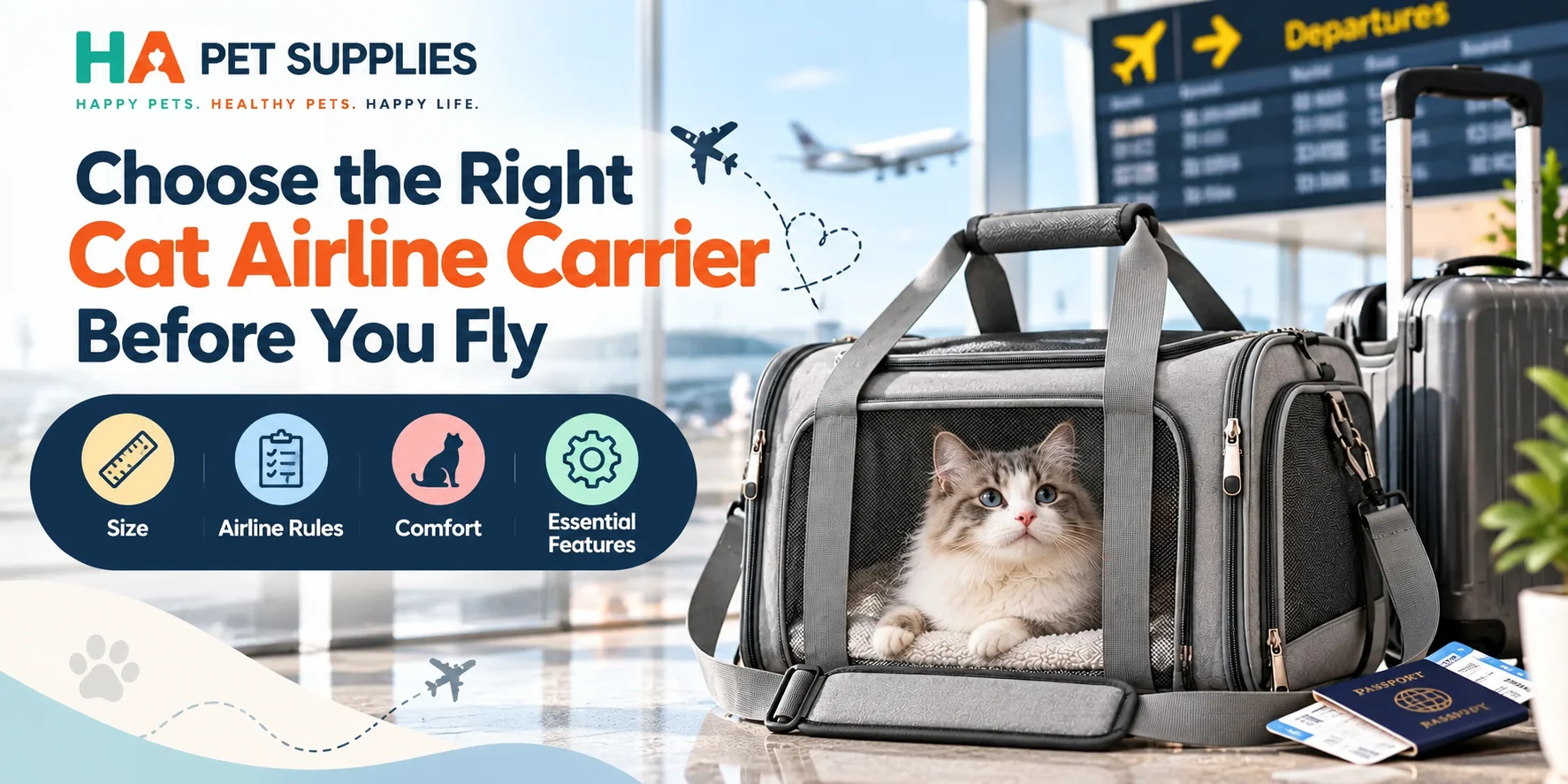
Choose a cat airline carrier only after checking your airline, your cat’s size and the carrier’s travel features.
2. Cat Airline Carrier Dimensions: Why There Is No Universal Size
One of the most common questions buyers ask is: What size cat carrier fits under an airplane seat? There isn’t one universal answer. Under-seat clearances differ between airlines, aircraft, cabins, and sometimes seat positions.
For example, Delta tells passengers that maximum in-cabin kennel dimensions are determined by aircraft dimensions because under-seat space varies by aircraft. Delta currently recommends a soft-sided carrier around 18 × 11 × 11 inches for many of its aircraft, but still tells passengers to verify the specific aircraft. Delta
American Airlines also recommends soft-sided collapsible kennels and currently lists 18 × 11 × 11 inches for its soft-sided carry-on pet guidance, while making clear that the carrier must fit beneath the seat. American Airlines
Southwest publishes different limits: its own pet carrier is listed at 15 × 10 × 10 inches, while other carriers may currently be accepted up to 18 × 10.5 × 10 inches, subject to its requirements. Southwest also notes that under-seat space can differ based on seat type and location. Southwest Airlines
The point is not that you should buy one of those exact sizes. The point is that even major airlines do not all present identical requirements. The rule to remember: Check your airline immediately before buying and recheck before departure. Do not copy dimensions from a blog—even this one—and assume they override the airline.
Rotating 3D view — hover to pause on desktop
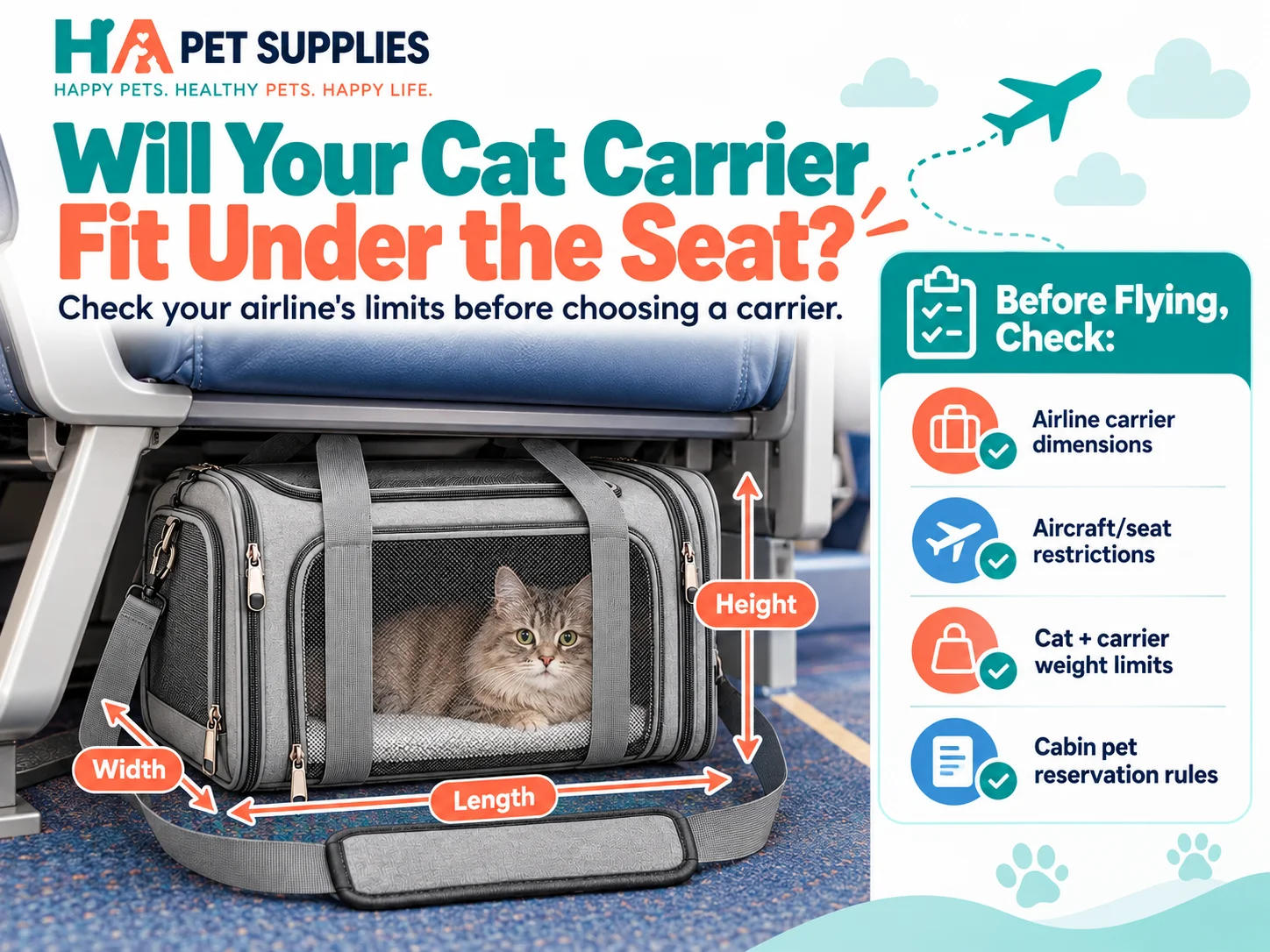
Check the carrier’s length, width and height against your airline’s current under-seat limits before flying.
3. Measure the Carrier in Three Directions
When reviewing a cat airline carrier, find the actual external length (usually the longest horizontal measurement), width (the side-to-side depth), and height (from base to highest structural point). Do not assume a carrier’s listed “medium” or “large” classification tells you anything about aircraft compatibility. Those size names are marketing categories, not aviation standards. A “medium” carrier from one manufacturer could easily be taller than a “large” carrier from another. This is why the dimensions shown on the actual product listing matter more than the product’s size label.
4. Will Your Cat Airline Carrier Fit Under the Seat?
The FAA requires in-cabin pet containers to be small enough to fit beneath the seat without blocking access to the aisle. The container must also be stowed when required during aircraft movement, takeoff, and landing. FAA So the real challenge is balancing two limits: airline space versus cat comfort.
A carrier cannot be so large that it cannot be properly stowed. But choosing the smallest carrier you can physically squeeze your cat into is not the solution either. IATA’s pet-travel guidance emphasizes selecting an appropriately sized container that allows the animal to stand, sit, turn around, and lie in a natural position under the applicable travel requirements. IATA
For in-cabin travel, you therefore need to reconcile your airline’s under-seat restrictions with your cat’s physical dimensions. If you’re still in the research phase, you can compare different options in the HA Pet Supplies shop.
5. How to Measure Your Cat for an Airline Carrier
Airline restrictions are only half of the sizing decision. Now measure the passenger. Do not buy solely according to weight. Two cats that both weigh 12 pounds can have very different body proportions. One may be short and stocky. Another may be tall and long-bodied.
Measure body length
Measure your cat’s approximate usable body length according to the sizing instructions provided by the carrier manufacturer.
Measure standing height
Check the cat’s natural standing height, particularly if the carrier has a low roof.
Consider body width
A larger or broad-bodied cat needs enough floor area to settle naturally.
Weigh the cat
Weight remains useful because both manufacturers and some airlines apply weight restrictions. But it should be one measurement, not the only measurement.
6. Large Cats Need More Careful Carrier Selection
Owners of larger cats often face the hardest decision. The airline wants a compact under-seat carrier. The cat needs sufficient usable room. If your cat appears too large to travel appropriately within the airline’s permitted cabin carrier, do not simply purchase an oversized soft bag and hope that airport staff will allow it. Contact the airline.
Ask specifically about the aircraft, cabin pet limits, under-seat clearance, acceptable carrier construction, the cat’s size, and available travel alternatives. This is one area where a five-minute call can save a much larger problem at the airport.
7. Soft-Sided vs Hard-Sided Cat Airline Carrier
For cabin travel, shoppers commonly compare a soft-sided cat airline carrier with a rigid plastic carrier. Neither construction should automatically be described as universally better. The best choice depends on your airline and your travel situation.
Soft-sided carrier advantages
A soft carrier may weigh less, be easier to carry through the airport, provide multiple mesh ventilation panels, flex slightly beneath certain seats, be easier to store after travel, and offer padded carrying straps. Several major U.S. airlines explicitly discuss or recommend soft-sided carriers for in-cabin travel. American, for example, recommends soft-sided collapsible kennels under its current carry-on pet guidance. American Airlines Southwest similarly notes that it recommends soft-sided carriers because under-seat space can vary. Southwest Airlines
Hard-sided carrier advantages
A rigid carrier may maintain its structure better, resist crushing, offer a rigid door, and provide a more fixed internal space. However, rigidity can make the carrier less forgiving when under-seat clearance is tight. Always prioritize the airline’s permitted dimensions rather than assuming either style is automatically accepted.
8. Ten Cat Airline Carrier Features Worth Checking
Once you know the carrier can potentially meet your airline’s limits, inspect how it is actually built. This is where general buyers should slow down for five minutes. The prettiest carrier is not necessarily the most practical one.
8.1 Breathable Mesh Panels
Ventilation is fundamental. Look for multiple ventilation areas rather than a carrier with one small mesh window surrounded by heavy fabric. Airline policies can specify ventilation requirements. Delta, for example, currently requires soft-sided in-cabin kennels to be leak-proof and ventilated on three sides for domestic travel and four sides for international travel. Delta Your goal is adequate airflow even when portions of the carrier are near an airplane seat or your luggage.
8.2 Secure Zipper Closures
Check every opening. The zipper should run smoothly, close completely, remain secured during handling, and connect to durable surrounding material. An airport is not the place to discover that your cat can push apart a weak zipper.
8.3 Strong Mesh and Seams
Mesh provides ventilation but also becomes part of the carrier’s containment structure. Look at stitching, reinforcement, connection points, corners, and zipper-to-mesh joins. If your cat scratches carrier walls when nervous, mesh durability becomes particularly important.
8.4 Stable Reinforced Base
A soft carrier still needs a reasonably stable floor. A supportive base helps the carrier maintain usable shape while you carry it and gives your cat a more predictable surface. The base should not become so heavily structured that it prevents compliance with your airline’s dimensions. Balance matters.
8.5 Comfortable Interior Padding
A removable liner or pad can create a more comfortable resting surface. It can also simplify cleaning after travel. Choose padding that supports comfort without taking up excessive internal height. For general pet travel, CDC guidance also recommends preparing pets in advance and keeping carriers appropriate, ventilated, and safely secured. CDC
8.6 Comfortable Carry Handles
Remember that the aircraft is only one part of the journey. You may carry the bag from the car, across the terminal, through check-in, toward security, to the gate, during boarding, through a connecting airport, and to ground transportation. Padded handles become much more important on a long travel day.
8.7 Adjustable Shoulder Strap
A shoulder strap can free one hand for your rolling suitcase, documents, or phone. Look for secure attachment points, sufficient strap width, adjustability, and shoulder padding. Again, the feature should support the journey rather than simply appearing in the product specification.
8.8 Multiple Entry Points
Some cats strongly resist front-entry carriers. A carrier with multiple access points can sometimes make loading and handling easier. Depending on the product, these might include front opening, side opening, or top opening. Every opening should close securely.
8.9 Easy-Clean Interior
Long travel days do not always go according to plan. Cats may vomit, urinate, shed, spill water, or soil bedding. A removable liner and wipeable surfaces can make cleanup considerably easier. CDC’s broader travel guidance recommends bringing items such as waste bags, water, medication where needed, and appropriate pet supplies when traveling. CDC
8.10 Lightweight, Compact Construction
If an airline applies a combined pet-and-carrier weight limit, the carrier’s empty weight becomes relevant. Even where there is no combined limit, a lighter carrier is usually easier for the owner to manage throughout the airport. But lightweight should not mean flimsy. Look for a useful balance between low weight, structural stability, and secure construction.
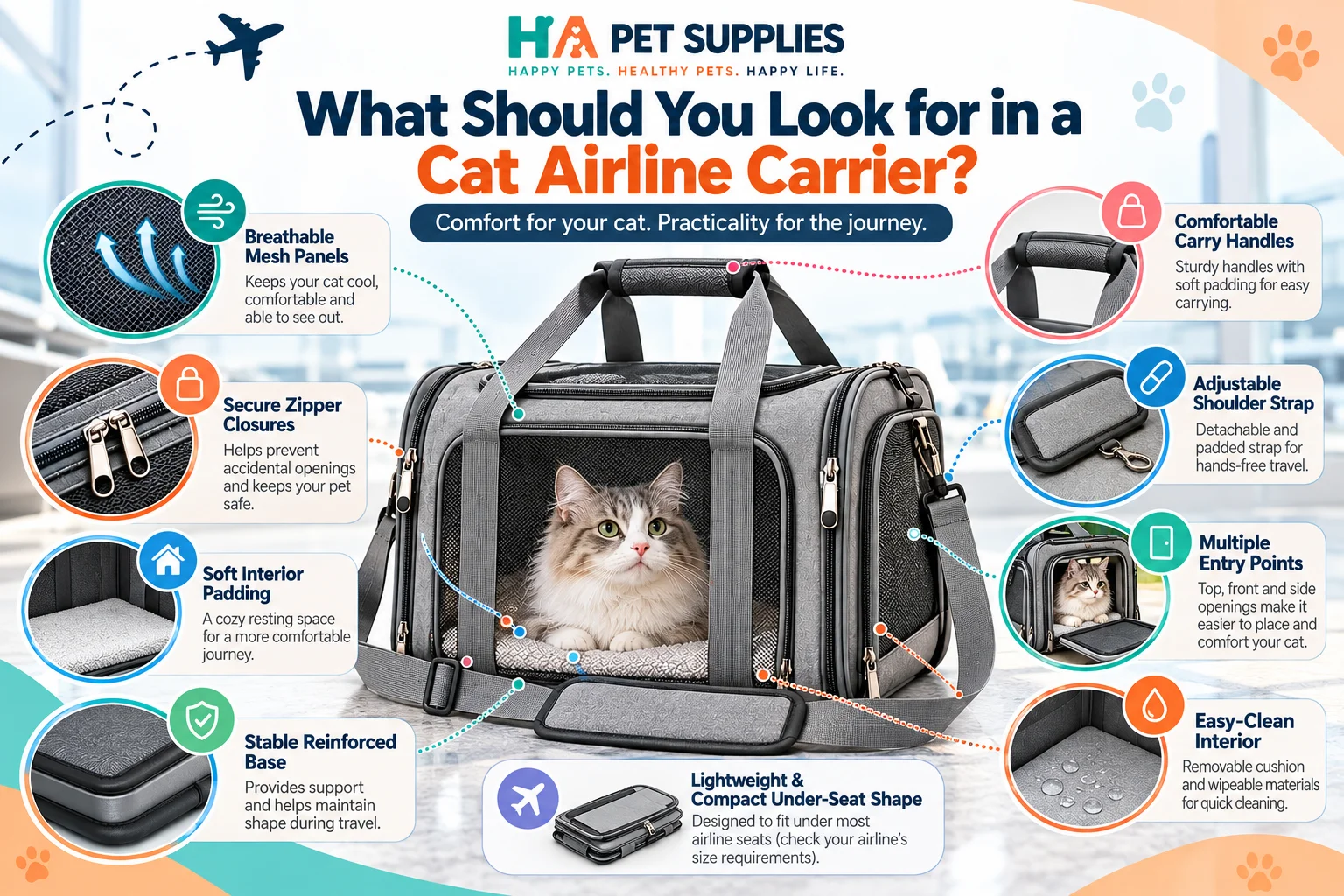
Compare ventilation, secure closures, padding, handles, entry points and under-seat design before choosing a cat airline carrier.
9. Don’t Ignore the Cat Airline Carrier’s Actual Shape
Two carriers can have identical external dimensions and still provide different usable interiors. Why? Because of sloping side walls, thick padding, internal frames, oversized pockets, heavily rounded corners, structural supports, and collapsible sections. So do not evaluate dimensions in isolation. Look at the shape your cat actually occupies. A 17-inch carrier with heavily curved ends may provide less practical floor length than another carrier with straighter walls.
10. Is an Expandable Cat Airline Carrier Better?
Expandable carriers can look appealing because they provide additional resting area when opened. That does not mean the carrier can remain expanded beneath an aircraft seat. During periods when the airline requires the carrier to be properly stowed, FAA rules still apply. FAA If considering an expandable design, ask two separate questions: Does the closed carrier meet the airline’s requirements? and When, if ever, does the airline allow the expandable section to be opened? Never assume expansion is allowed onboard simply because the feature exists.
11. What About Cat Airline Carrier Weight Limits?
This is another area where buyers become confused. There are three different numbers you may encounter: the manufacturer pet-weight recommendation (concerns the physical product), the airline carrier dimension limit (concerns whether the carrier fits the permitted area), and the airline combined pet/carrier weight limit (some airlines or routes may apply one). These numbers are not interchangeable. For that reason, always check both your carrier manufacturer and your airline.
12. Does a Cat Airline Carrier Count as Carry-On Luggage?
Sometimes. The treatment depends on the airline. FAA guidance states that when pets travel in a passenger cabin, the pet container is considered carry-on baggage under federal cabin-stowage rules, but individual airlines determine their specific baggage and pet policies. FAA Southwest currently says a pet carrier counts as either a personal item or carry-on item under its policy. Southwest Delta currently permits one additional personal item or carry-on item alongside an in-cabin kennel, subject to its policy. Delta That difference is exactly why you should verify your own flight rather than rely on a generic answer.
13. Reserve Your Cat’s Cabin Place Before Flying
Buying the right cat airline carrier does not automatically reserve space for your cat. Many airlines limit the total number of pets allowed in a cabin. Delta, for instance, currently uses a first-come, first-served in-cabin pet policy and advises passengers to contact reservations to book the pet. Delta So your travel sequence should ideally be: Check airline pet policy → confirm availability → understand carrier limits → buy appropriate carrier. Not: Buy carrier → arrive at airport → ask if cat can board.
14. Domestic vs International Cat Air Travel
International travel introduces another layer. Your airline controls transportation requirements. Your destination country controls entry requirements. Transit countries may introduce additional requirements. Those are separate systems. USDA APHIS recommends contacting a USDA-accredited veterinarian as soon as you decide to travel internationally because destination requirements can include microchips, vaccinations, laboratory testing, treatments, permits, and health certificates. APHIS APHIS also notes that the process can take anything from weeks to months depending on the destination. APHIS FAQ The CDC similarly advises travelers to plan ahead, keep vaccinations current, verify destination documentation, and maintain accurate identification information for pets. CDC If international travel is involved, don’t treat documentation as a last-week task.
15. Health Considerations Before Flying With a Cat
A carrier guide should not pretend that every cat is automatically suited to air travel. Discuss your trip with your veterinarian if you have concerns about your cat’s age, respiratory health, chronic illness, severe travel stress, medication, long travel times, or international requirements. The CDC Yellow Book notes that travel planning should consider factors such as age, health conditions, destination requirements, transit countries, time of year, and mode of transportation. It specifically identifies older animals, animals with chronic conditions, very young animals, and some short-nosed breeds as deserving additional consideration. CDC Yellow Book This article should therefore help readers choose equipment—not replace individualized veterinary advice.
16. Do Not Automatically Sedate a Cat for Air Travel
A nervous cat does not automatically need sedation. Do not give medications simply because someone online used them successfully. IATA’s passenger guidance advises against routine sedation or tranquilization for dogs and cats traveling by air because these drugs can affect animals’ responses during transportation. If medication is considered, it should be handled under veterinary direction and in accordance with airline requirements. IATA If your cat becomes extremely anxious during travel, discuss the situation with your veterinarian well before flight day.
17. Carrier Training Matters Almost as Much as Carrier Choice
Even the best-designed cat airline carrier can become frightening if your cat only sees it five minutes before leaving for the airport. Once you choose your carrier, start familiarization early. Leave it open at home. Add familiar bedding. Allow exploration. Reward voluntary entry. Practice short periods with the carrier closed. Gradually introduce movement. Then practice short car trips where appropriate. CDC travel guidance similarly recommends getting pets accustomed to their carriers before flight and practicing travel preparation in advance. CDC For a full step-by-step routine, guide readers naturally to your dedicated article, How to Get a Cat Comfortable in an Airline Carrier Before a Flight. That is a much more relevant internal link than dropping a generic blog URL at the bottom.
18. Think Beyond the Carrier: What Happens at Airport Security?
A buyer choosing a cat airline carrier should also understand that the carrier may need to be opened during security screening. This affects how you think about entry points, zipper security, harness preparation, handling, and re-closing the carrier quickly. Your second pillar article, Flying With a Cat for the First Time: Complete Airport & Airplane Travel Guide, can cover the airport process in detail. Keep this pillar article focused mainly on choosing the carrier, then use that contextual internal link for the actual travel process.
19. Common Cat Airline Carrier Buying Mistakes
Mistake 1: Believing “airline approved” means universal approval
It doesn’t. Check the operating airline.
Mistake 2: Shopping only by cat weight
Length and body shape matter too.
Mistake 3: Using generic under-seat measurements
Aircraft and seat configurations can differ.
Mistake 4: Buying immediately before departure
You lose valuable carrier-training time.
Mistake 5: Ignoring ventilation
The carrier spends part of the journey beneath a seat. Airflow matters.
Mistake 6: Ignoring zipper security
A nervous cat may test weak closures more forcefully than a relaxed cat at home.
Mistake 7: Overstuffing the interior
A huge blanket may look cozy but reduce usable space and airflow.
Mistake 8: Forgetting the full airport journey
A carrier comfortable to hold for two minutes may be exhausting after a terminal walk.
Mistake 9: Forgetting documentation
International travel can require substantial preparation. USDA APHIS specifically advises travelers to begin early and verify destination requirements every time they travel. APHIS
Mistake 10: Assuming airline policies never change
Recheck before departure. Pet policies, aircraft assignments, routes, documentation rules, and destination requirements can change.
20. Interactive Cat Airline Carrier Buying Decision
This is one of the strongest interactive sections when converted to HTML. On desktop, view this as a 3D pathway. On mobile, it stacks as accordion cards.
21. Preparing Food and Water Around Travel
Travel preparation extends beyond the carrier. Your cat’s feeding routine may need to be planned around departure time, trip duration, medical needs, and veterinary advice. Avoid giving readers an arbitrary universal fasting rule. Instead, tell them to follow their veterinarian’s recommendations for their individual cat. If readers are also trying to make everyday feeding easier before or after travel, this is the one place where your automatic cat feeder product page can be linked naturally. That internal link belongs here because the section genuinely concerns feeding routines—not because every internal URL needs to appear somewhere.
22. Where to Compare Cat Travel Supplies
Once readers know what specifications they actually need, they can compare suitable options through the HA Pet Supplies shop or browse the dedicated cat supplies category. Readers who are still researching pet care and travel preparation can continue through the HA Pet Supplies pet-care blog rather than being pushed immediately toward a purchase. For bulk, wholesale, or sourcing inquiries, direct the relevant audience to request a quote from HA Pet Supplies. If someone instead needs help deciding which product information applies to their situation, they can use the HA Pet Supplies contact page. These links are contextually separated because each serves a different visitor intent.
Cat Airline Carrier FAQ
These are interactive accordion cards. Click to expand.
What size cat airline carrier do I need?
Start with the maximum carrier measurements published by your airline for the actual journey, then compare those restrictions with your cat’s physical size. Do not choose solely according to weight. Airlines can apply different limits, and aircraft configuration can affect under-seat space. FAA guidance confirms that the container must fit properly beneath the seat when required. FAA
Is there one standard airline approved cat carrier size?
No. There is no single universal cabin-carrier dimension that automatically applies to every airline. Delta, American Airlines, and Southwest, for example, publish their own pet-carrier guidance rather than relying on one universal measurement. Delta
What does “airline approved cat carrier” mean?
Treat it as a marketing description rather than a guarantee that every airline will accept the carrier. IATA does not certify individual commercial pet carrier products as universally approved. IATA Always compare the actual carrier specifications with your airline’s current rules.
Does a cat airline carrier have to fit under the seat?
For normal U.S. in-cabin pet travel, FAA cabin rules require the pet container to be appropriately stowed and small enough to fit beneath the seat without blocking access to the aisle. FAA Your airline may add further requirements.
Is a soft-sided cat airline carrier better?
A soft carrier is often practical for cabin travel because it may provide some flexibility and can be easier to transport. Several airlines specifically recommend soft-sided carriers. That does not mean every soft bag is appropriate. Dimensions, ventilation, construction, security, usable interior space, and airline compliance still matter.
Can I use a hard cat carrier on an airplane?
Possibly. Whether a rigid carrier is permitted depends on the airline and whether it complies with the carrier dimensions and pet rules for your flight. Because rigid carriers cannot flex beneath the seat, precise measurements become particularly important.
Can a 15-pound cat fly in the cabin?
There is no universal yes/no answer based solely on 15 pounds. Airline policy, carrier dimensions, the cat’s body size, and any applicable combined-weight limits must all be checked. A compact 15-pound cat and a long-bodied 15-pound cat may require different usable space.
Can a 20-pound cat use a cat airline carrier?
Weight alone does not answer this. A large cat may be unable to use a carrier appropriately while staying within a particular airline’s cabin limits. Contact the airline if you are uncertain instead of forcing a large cat into an undersized bag.
Does the cat carrier count as carry-on luggage?
Policies vary. Under FAA rules, an in-cabin pet container is treated as carry-on baggage for stowage purposes, while individual airlines determine exactly how the carrier affects your baggage allowance. FAA Check the airline before packing your normal cabin luggage.
Do I need to book my cat before going to the airport?
Frequently, yes. Airlines can limit the number of pets traveling in the cabin. Delta, for example, currently tells customers to contact reservations because in-cabin pet space is limited and handled on a first-come basis. Delta Do not assume buying your own ticket automatically reserves your cat.
What should be inside a cat airline carrier?
Keep the interior practical. Depending on your cat and travel plan, this may include an appropriate removable liner, absorbent material, a comfortable but not oversized mat, and familiar-smelling bedding where suitable. Avoid filling the carrier so heavily that you reduce usable space or ventilation.
Should I put a pee pad inside the cat carrier?
An absorbent liner can be useful for unexpected accidents during a long travel day. Make sure it remains flat, does not obstruct ventilation, and does not create loose material that interferes with your cat’s usable area.
Can I put food inside the carrier?
Feeding decisions can depend on journey length, your cat’s routine, health needs, and veterinary recommendations. For individualized advice—especially for kittens, older cats, or cats with medical conditions—ask your veterinarian rather than following a one-size-fits-all internet schedule.
Does my cat need a health certificate to fly?
It depends on the airline, route, destination, and type of travel. International destinations can impose their own health-document requirements. USDA APHIS states that there is no single health certificate accepted by every country and recommends working with an accredited veterinarian for international pet travel. APHIS
How early should I start checking international requirements?
As soon as practical. APHIS says preparation can take several weeks to many months depending on the destination. APHIS Do not wait until you have already purchased the flight.
Should I sedate my cat before flying?
Do not make that decision without your veterinarian. IATA advises against routine sedation or tranquilization during air transport and says any such medication should be administered under veterinary direction. IATA
How do I make my cat comfortable with the carrier?
Introduce it before travel day. Leave it accessible at home, allow voluntary exploration, create positive associations and gradually practice short closed-carrier and movement sessions. Your full training process belongs in How to Get a Cat Comfortable in an Airline Carrier Before a Flight.
Final Cat Airline Carrier Checklist Before You Buy
Before pressing Buy, make sure you can check every box:
Airline
Cat
Carrier
The Bottom Line
Choosing a cat airline carrier becomes much easier when you stop asking, “Which carrier looks best?” and start asking three practical questions: Will my airline accept it? Will my cat fit appropriately inside it? Does it have the features I need for the entire journey?
Airlines can differ in carrier dimensions, pet limits, seat restrictions, reservations, fees, and documentation requirements. The FAA therefore recommends checking directly with your airline rather than assuming one policy applies everywhere. FAA
Once those rules are clear, measure your cat and compare the carrier’s actual external and internal design. Look closely at ventilation, closures, mesh, padding, base stability, entry points, cleaning, weight, handles, and portability. Then start carrier familiarization before flight day.
If this is your first trip, continue with the full first-time guide to flying with a cat so you know what to prepare for check-in, airport security, boarding, and the flight itself. And if your next step is comparing pet supplies rather than simply researching them, you can explore HA Pet Supplies for available cat-travel and everyday pet-care options.
The goal isn’t to find a bag carrying the right marketing phrase. It is to choose a carrier that makes sense for your cat, your airline, your aircraft, and your journey.