
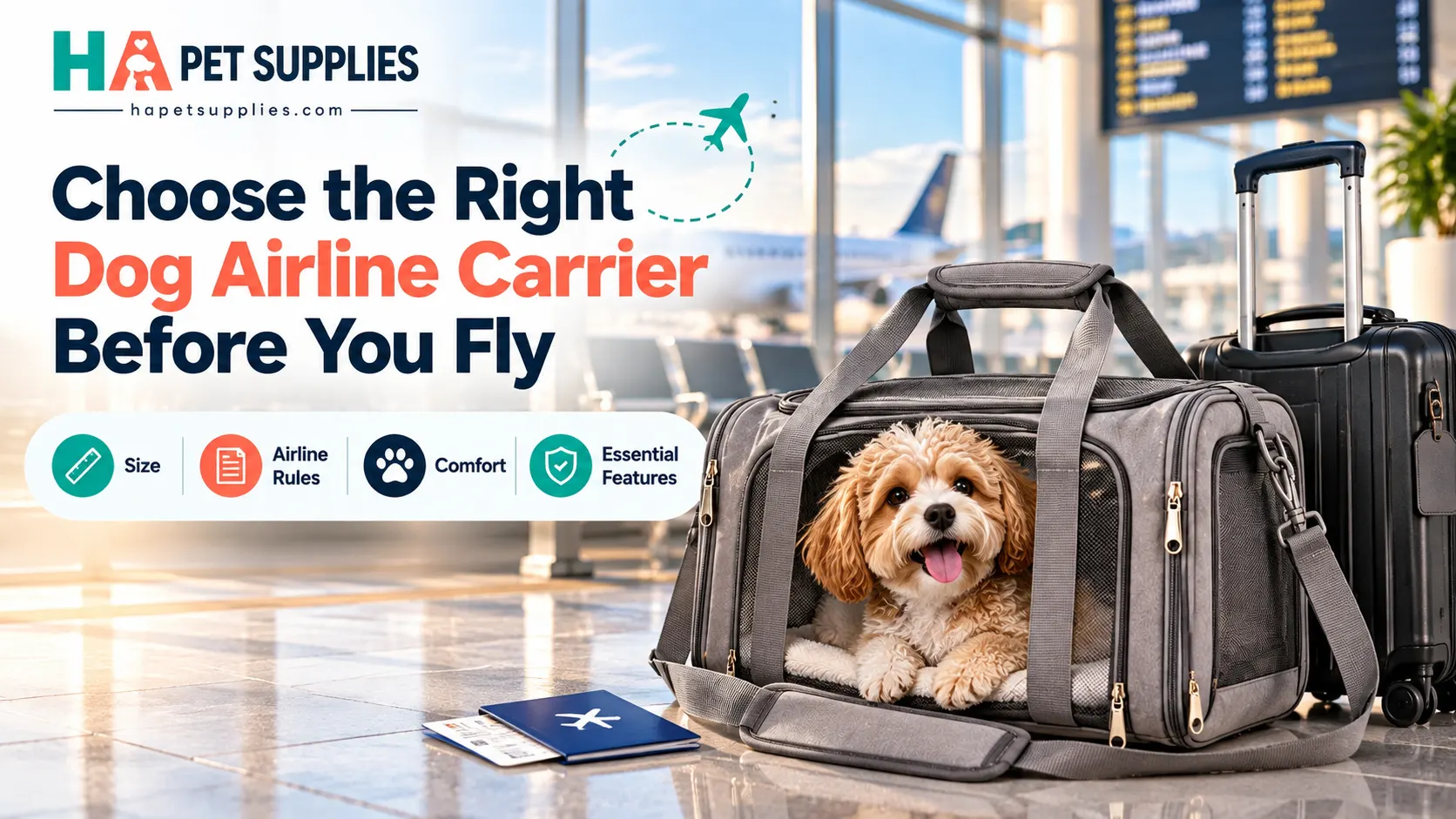
Choosing a dog airline carrier can become surprisingly confusing once a flight is involved.
At first, it seems simple: find a carrier that fits your dog and book the trip. Then you start reading airline policies. One carrier says “airline approved.” Another provides dimensions that appear suitable for cabin travel. Your airline lists its own restrictions. The aircraft may have a different amount of under-seat space. Then there are questions about ventilation, padding, security, documentation and whether your dog will actually be comfortable inside the carrier for several hours.
If your flight is approaching, you probably do not want another vague shopping guide.
You need to know what to check before you buy, before you arrive at the airport and before your dog is zipped inside the carrier.
The most important rule is this:
Do not choose a dog airline carrier based only on the words “airline approved.”
The U.S. Federal Aviation Administration explains that individual airlines determine whether pets may travel in the cabin and may impose their own additional requirements. For cabin travel, the carrier normally has to fit under the seat and comply with the airline’s rules. Federal Aviation Administration
That means there are really three things that have to fit at the same time:
Your dog → the carrier → the airline/aircraft.
If even one of those three does not work, you may have a problem on travel day.
This guide walks you through the seven checks that matter most so you can choose your carrier with considerably more confidence.
If you are currently comparing products, you can also review the HA Pet Supplies dog airline carrier while working through the measurements and features below rather than choosing purely from appearance.
What Does “Airline Approved Dog Carrier” Actually Mean?
This is one of the most important things for first-time pet travellers to understand.
An airline approved dog carrier is not necessarily universally approved by every airline.
Different airlines can have different limits for:
- carrier dimensions
- pet weight
- accepted animals
- number of in-cabin pets
- ventilation
- soft versus hard construction
- seating locations
- routes and destinations
- advance reservations
- pet fees
The FAA specifically tells passengers to contact their airline because airlines establish their own policies for pets travelling in passenger cabins. When a pet is accepted in the cabin, its carrier is generally treated as carry-on baggage and has to be properly stowed. Federal Aviation Administration
The U.S. Department of Transportation makes the same fundamental point: pet policies vary among airlines, so travellers should verify their chosen carrier’s requirements before travelling. Department of Transportation
Buyer shortcut
Instead of asking:
“Is this carrier airline approved?”
ask:
“Does this carrier meet the requirements for my dog, airline, aircraft, route and travel date?”
That is a much safer purchasing question.
CARD 1 — YOUR DOG
- stand naturally?
- turn around?
- lie down?
- settle without being tightly compressed?
CARD 2 — YOUR CARRIER
- ventilation?
- secure closure?
- a stable base?
- comfortable interior space?
CARD 3 — YOUR AIRLINE
- carrier dimensions?
- pet reservation?
- aircraft restrictions?
- route restrictions?
1. Measure Your Dog Before Choosing a Dog Airline Carrier
A common buying mistake is starting with the dimensions of the carrier instead of the dimensions of the dog.
Start with your dog.
International Air Transport Association guidance says an appropriate container should provide enough room for the animal to stand, sit, turn around and lie in a natural position. IATA also provides measurement principles for determining appropriate container dimensions. IATA
For cabin travel, however, there is another constraint: under-seat space is limited.
That creates a balancing act.
Your dog needs adequate space, but the carrier also needs to fit into the space permitted by the airline.
Measurements worth taking
Measure your dog while standing naturally.
Look at:
Body length
Measure the approximate length needed for your dog to settle naturally.
Standing height
Measure from the floor to the dog’s highest natural point.
Body width
Check the widest portion of the body.
Weight
Some airlines consider the weight of the pet, while others may evaluate the combined dog-and-carrier weight or impose different route requirements.
Do not assume that because your dog is described as “small,” a standard cabin carrier will automatically work.
Two dogs of similar weight can have very different body shapes.
A long-bodied dog, tall-legged dog or broad-chested dog may need significantly different usable space.
If your dog cannot comfortably fit within an airline-compliant cabin carrier, you may need to investigate another permitted mode of transport rather than forcing the dog into an undersized bag.
Dog Airline Carrier Size Should Be Based on Usable Space
Marketing dimensions are useful, but you also need to look at interior usable space.
Thick walls, padding, structured frames and curved corners can reduce the amount of actual room available to your dog.
So compare:
outside dimensions → airline compatibility
and
inside dimensions → dog compatibility.
You need both.
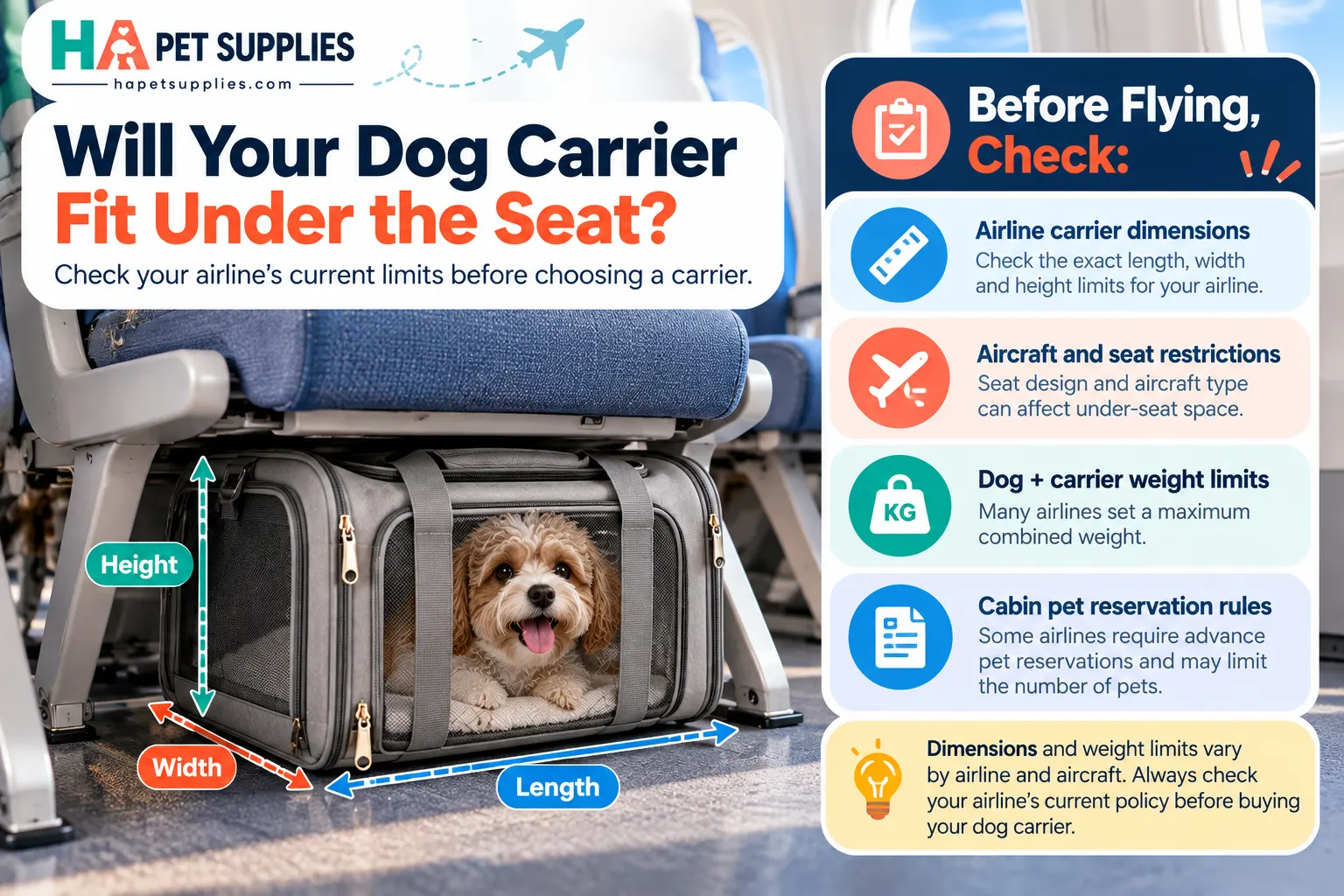
2. Check Dog Airline Carrier Requirements With Your Airline
This step should happen before purchasing your carrier whenever possible.
Do not rely solely on a generic dimensions chart.
Under-seat spaces can vary between aircraft, cabins and seat positions.
For example, American Airlines currently recommends a soft-sided carrier measuring approximately 18 × 11 × 11 inches for its flights, while also warning that non-collapsible kennels cannot exceed the under-seat dimensions of the particular aircraft in your journey. AA
Delta likewise recommends checking the aircraft for your flight and notes that under-seat space varies. It currently recommends an 18 × 11 × 11-inch soft-sided kennel as a size that fits most of its aircraft rather than presenting that as a universal standard. Delta
Southwest publishes different limits. It currently permits its own pet carrier at 15 × 10 × 10 inches and other carriers up to 18 × 10.5 × 10 inches, subject to its policy. Help Center | Southwest Airlines
This difference is exactly why “airline approved” should never be interpreted as “accepted everywhere.”
Verify the Actual Flight, Not Just the Airline
Your itinerary may involve:
- different aircraft
- a connection
- a regional operating carrier
- a codeshare partner
- a different return aircraft
- international segments
A carrier that works perfectly on flight one may encounter different restrictions on flight two.
Delta, for example, specifically advises passengers using partner airlines to verify those airlines’ individual animal policies. Delta
Fast-action checklist
Before purchasing:
Step 1: Find the official pet policy for your airline.
Step 2: Identify your aircraft where possible.
Step 3: Confirm maximum carrier dimensions.
Step 4: Confirm your seat type allows an in-cabin pet.
Step 5: Ask whether pet space must be reserved in advance.
Step 6: Check every airline involved in a connecting itinerary.
Step 7: Recheck before departure because policies can change.
3. Look for Proper Ventilation in a Dog Carrier for Air Travel
Ventilation is not simply a decorative feature.
Your dog may spend several hours inside the dog carrier for air travel, including:
- travelling to the airport
- waiting at check-in
- passing security
- waiting at the gate
- boarding
- taxiing
- the flight
- deplaning
Mesh panels can support airflow and allow you to visually monitor your dog.
But more mesh is not automatically better if the mesh is weak, easily damaged or positioned where it becomes blocked when the carrier is stowed.
IATA’s cabin guidance warns that soft-sided containers can become compressed under seats and that ventilation openings should not be obstructed because reduced ventilation can create heat-related problems. IATA
What to inspect
Look for:
- multiple ventilation areas
- strong mesh
- openings unlikely to be blocked completely
- sufficient structure to avoid collapsing around your dog
- airflow from more than one direction
For more travel-oriented products and accessories, buyers can also browse the HA Pet Supplies dog supplies collection rather than choosing unrelated equipment independently.
4. Check Zippers, Closures and Containment
A comfortable dog airline carrier also needs to remain securely closed.
Airport terminals are not good places to discover that your dog can nose open a zipper.
Look closely at:
- zipper construction
- closure points
- stitching
- mesh attachment
- seams
- strap attachment points
- openings around doors
- interior restraint features, where appropriate
The goal is not to “lock” the dog into an uncomfortable enclosure.
The goal is to prevent an accidental escape while keeping the dog comfortably contained.
USDA air-travel guidance emphasizes suitable kennel construction, adequate ventilation, secure closures and sufficient room for the animal when assessing kennels used for air transport. APHS
For cabin travel, requirements differ from cargo kennels, so do not assume cargo-container standards and cabin-carrier requirements are identical.
5. Comfort Matters More Than It Looks
Imagine buying shoes based only on whether they fit inside a suitcase.
That would tell you very little about whether they are comfortable to wear.
The same problem occurs when buyers select a dog flight carrier based only on maximum airline dimensions.
Your dog needs a usable resting area.
Look for:
- a stable floor
- soft but supportive padding
- enough room to reposition
- smooth interior surfaces
- ventilation
- appropriate head clearance
- material that is manageable if minor accidents happen
A removable comfort mat can also make routine cleaning easier.
Your dog should ideally become familiar with the carrier before travel day, rather than experiencing confinement in it for the first time at the airport.
For a complete step-by-step process, read HA Pet Supplies’ guide to getting a dog comfortable in an airline carrier before a flight.
IATA similarly advises familiarising dogs and cats with their travel container well before the journey to reduce the stress associated with confinement. IATA
6. Choose a Dog Airline Carrier You Can Actually Carry
Most buyers think about the dog sitting inside.
Fewer think about themselves carrying the combined weight through:
- parking areas
- terminals
- security lines
- gates
- connections
- boarding queues
That matters.
A dog plus the carrier, bedding and permitted accessories can become uncomfortable to carry much faster than the empty carrier suggests.
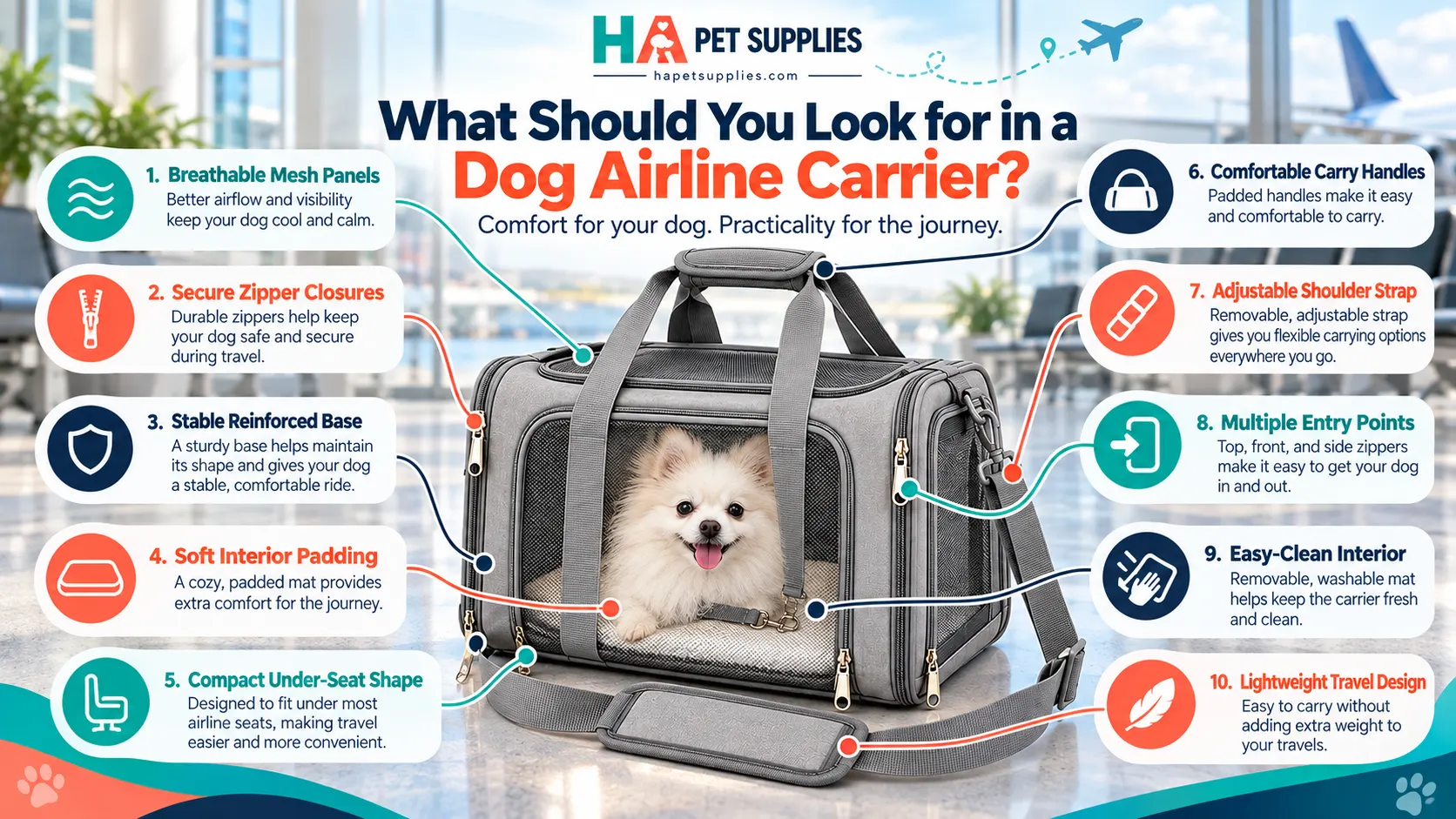
Useful features may include:
Padded handles
Helpful for short lifts and check-in.
Shoulder strap
Useful for longer airport movement.
Balanced construction
The carrier should not tilt dramatically when lifted.
Storage pocket
Can be convenient for permitted travel essentials, although it should not make the carrier exceed size limits.
Lightweight materials
Every unnecessary kilogram or pound becomes noticeable during a long terminal walk.
If you want to compare additional pet travel solutions, HA Pet Supplies’ online shop can help you keep related purchases within the same product ecosystem.
7. Check Health, Documentation and Destination Rules Before Flying
The perfect dog airline carrier cannot compensate for missing paperwork.
This is especially important for international travel.
Travel requirements can depend on:
- departure country
- destination
- countries visited recently
- rabies status
- vaccination location
- microchip
- health certification
- dog age
- airline
- transit country
USDA APHIS advises international pet travellers to begin researching destination requirements early because vaccination, testing and health-documentation steps can take time. APHS
For dogs entering the United States, current CDC rules depend partly on where the dog has been and its vaccination circumstances. CDC also requires a Dog Import Form in applicable travel situations. CDC
If you’re travelling to Europe, EU rules can involve identification, rabies vaccination, documentation and additional destination-specific conditions. European Union
Important distinction
Carrier compliance and entry compliance are separate issues.
You could have:
✅ the correct carrier
but
❌ incorrect paperwork.
Or:
✅ complete veterinary paperwork
but
❌ a carrier that does not meet the airline’s cabin requirements.
Both must be checked.
DOG
- Size
- Health
- Temperament
- Carrier familiarity
CARRIER
- Dimensions
- Ventilation
- Security
- Comfort
AIRLINE
- Pet reservation
- Aircraft limits
- Seat restrictions
- Fees
DESTINATION
- Vaccines
- Microchip
- Forms
- Entry rules
Soft-Sided vs Hard-Sided Dog Airline Carrier
For in-cabin air travel, soft-sided carriers are common because they can offer slight flexibility when going beneath a seat.
But “soft” should not mean unstable.
A quality soft-sided carrier should retain enough structure to avoid collapsing onto your dog.
Several major airlines specifically discuss soft-sided carriers in their policies.
American Airlines currently recommends soft-sided collapsible kennels and lists ventilation, padding and water-resistant construction among its requirements. AA
Delta also discusses soft-sided, leak-proof carriers and under-seat fit. Delta
Air Canada now requires soft-sided carriers for in-cabin pet travel on its applicable services and still requires the pet to be able to stand, turn and lie down within the carrier. Air Canada
That does not mean every soft-sided carrier is accepted by every airline.
It means flexibility is useful—but dimensions and current airline rules still control the decision.
Dog Airline Carrier Comparison Checklist
| Feature | Better Choice | Warning Sign |
|---|---|---|
| Size | Fits dog naturally and airline limits | Chosen only from breed or weight |
| Ventilation | Multiple strong mesh areas | Minimal or easily blocked airflow |
| Base | Stable and comfortable | Sagging unsupported floor |
| Closure | Secure zippers/fasteners | Easy for dog to push open |
| Structure | Holds shape while remaining flexible | Collapses heavily on dog |
| Carrying | Padded handles/strap | Thin uncomfortable straps |
| Cleaning | Removable/easy-clean interior | Difficult-to-clean fabric |
| Airline fit | Verified with actual airline | “Airline approved” claim only |
| Comfort | Dog can reposition naturally | Dog tightly compressed |
| Familiarity | Practised before travel | First use at airport |
Common Mistakes When Buying a Dog Airline Carrier
Mistake 1 — Buying Based on Breed
“Suitable for Pomeranians” is not a measurement. Dogs of the same breed vary. Measure yours.
Mistake 2 — Trusting “Airline Approved” Without Checking
No single marketing phrase guarantees acceptance across airlines, aircraft and routes. The FAA explicitly leaves cabin-pet acceptance and many related conditions to individual airlines. Federal Aviation Administration
Mistake 3 — Choosing the Biggest Carrier Possible
Bigger can sound more comfortable. But a carrier that exceeds the permitted under-seat dimensions can create a different problem. The goal is appropriate space within the maximum dimensions your flight permits.
Mistake 4 — Buying the Smallest Carrier Possible
The opposite strategy is also problematic. Do not squeeze your dog into an undersized carrier simply because it will fit under the seat. Your dog still needs enough space to adopt normal resting and repositioning postures.
Mistake 5 — Ignoring the Return Flight
Different aircraft can have different under-seat configurations. Check the full itinerary.
Mistake 6 — Waiting Until Travel Day for Carrier Introduction
A dog that happily enters the carrier at home is much easier to manage than one seeing it for the first time amid crowds, announcements and luggage. Read the dedicated dog carrier training guide before departure.
Mistake 7 — Forgetting That Airline Rules Change
Policies, fees, dimensions and destination restrictions can change. Always perform a final check with your airline before travelling.
Your Dog Airline Carrier Pre-Purchase Decision Tree
Can my dog comfortably use an in-cabin-size carrier?
Yes → Continue.
No → Investigate other airline-permitted arrangements rather than forcing the fit.
Do I know my airline and aircraft?
Yes → Check its current pet dimensions.
No → Confirm your itinerary before finalising the carrier.
Does the carrier fall within those limits?
Yes → Continue.
No → Choose another size/model.
Does my dog still have sufficient usable room inside it?
Yes → Continue.
No → The flight arrangement may not be suitable for cabin transport.
Does it provide adequate ventilation, security and support?
Yes → Continue.
Have I checked destination paperwork and restrictions?
Yes → Begin carrier familiarisation.
What to Do After Choosing Your Carrier
Buying the carrier solves only the first part of the problem.
Next comes preparation.
Leave the carrier accessible at home.
Allow your dog to investigate it voluntarily.
Use familiar bedding where appropriate.
Reward calm interactions.
Progress gradually toward short periods inside.
Then introduce realistic movement.
Your goal is for the carrier to become familiar before the unfamiliar airport experience begins.
For a detailed training progression, move next to How to Get a Dog Comfortable in an Airline Carrier Before a Flight.
When the flight itself approaches, use Flying With a Dog for the First Time: Complete Airport & Airplane Travel Guide to understand the airport-to-aircraft sequence.
Together, those articles create a logical path:
Choose the carrier → prepare the dog → understand travel day.
Quick Airline Comparison — Why You Must Check Directly
Airline rules illustrate why there is no single universal carrier measurement.
American Airlines discusses an 18 × 11 × 11-inch soft-sided recommendation. AA
Delta also recommends approximately 18 × 11 × 11 inches for many aircraft but tells passengers to verify the actual aircraft because under-seat dimensions vary. Delta
Southwest currently states different maximum dimensions for third-party carriers. Help Center | Southwest Airlines
Air Canada uses aircraft-specific size tables and currently requires flexible soft-sided cabin carriers. Air Canada
Therefore, your buying sequence should always be:
Dog measurement → airline → aircraft → carrier.
Not:
Carrier → hope it works.
Should You Choose the HA Pet Supplies Dog Airline Carrier?
If you are looking for a soft travel carrier rather than a rigid shipping crate, the HA Pet Supplies dog airline carrier is designed around practical travel-oriented features such as breathable mesh, a padded carrying arrangement and a comfortable interior.
However, the same rule applies to our product as any other carrier:
Always verify your airline.
We do not recommend buying purely from the phrase “airline approved” without checking your specific flight.
Start by:
- measuring your dog;
- checking the airline;
- checking the aircraft;
- comparing those requirements with the selected carrier size.
If you are uncertain about which HA Pet Supplies option to consider, you can contact HA Pet Supplies before ordering.
You can also explore the broader HA Pet Supplies website or read more practical pet-care information in the HA Pet Supplies blog.
Dog Airline Carrier Final Checklist Before Buying
Use this as your screenshot/save section.
DOG FIT
- Measured dog length
- Measured dog height
- Considered dog width
- Checked body shape, not breed only
- Dog can use carrier comfortably
CARRIER
- Correct external dimensions
- Suitable usable interior space
- Breathable mesh
- Secure closures
- Stable base
- Comfortable mat
- Strong stitching
- Convenient carrying system
FLIGHT
- Airline pet policy checked
- Aircraft checked
- Seat restrictions checked
- Pet reservation made if required
- Pet fee checked
- Return flight checked
- Connecting carrier checked
DOCUMENTS
- Destination rules checked
- Vaccination requirements checked
- Microchip requirements checked
- Health documentation checked
- Import/export requirements checked
Frequently Asked Questions About Choosing a Dog Airline Carrier
Measure your individual dog and compare the required usable interior space with the maximum dimensions permitted by your airline. Do not select a carrier from breed alone. Your dog should be able to settle and reposition naturally while the carrier still fits the airline’s permitted storage space.
Treat “airline approved” as a product-category description rather than a guarantee of acceptance by every airline. Airlines maintain their own requirements, and aircraft can have different under-seat dimensions. The FAA specifically recommends contacting the airline regarding its pet policies. Federal Aviation Administration
Do not assume so. Some soft-sided carriers may have limited flexibility, but acceptance is determined by the airline and how the carrier fits the required space. Verify directly instead of depending on compression.
Your carrier should be appropriately sized for your dog. IATA guidance describes sufficient container space as allowing the animal to stand, turn and lie naturally. Individual airline cabin requirements and limited under-seat space still apply. IATA
They are often practical because of their flexibility, and some airlines recommend or require soft-sided cabin carriers. That does not automatically make every soft carrier compliant. Check dimensions, stability, ventilation and your specific airline’s rules.
Do not assume this is permitted. Rules differ significantly by airline, animal age and situation. Some airlines allow limited exceptions while others have stricter restrictions. Ask your airline before booking.
Often it does, but airline rules differ. For example, several U.S. airlines treat the pet carrier as part of the passenger’s cabin baggage allowance. Confirm what additional personal or carry-on item you are allowed to bring.
For normal in-cabin pet travel, airlines commonly require the dog to remain in the closed carrier throughout the relevant portions of travel. Check your airline’s current policy. IATA’s cabin guidance also advises against opening the carrier during flight. IATA
Ideally, buy it early enough to check airline compliance and gradually familiarise your dog with it. Waiting until the day before the flight gives you very little time to correct sizing problems or help your dog adjust.
Introduce it at home, keep sessions short and positive, reward voluntary investigation and gradually increase the amount of time your dog spends inside. Our dog airline carrier training guide covers the process in detail.
Possibly. Requirements depend on the airline, route, destination and dog’s travel history. International travel frequently requires additional documentation. Check your airline plus the relevant government authority rather than relying on general advice.
CDC requirements depend on factors including the dog’s recent travel and vaccination situation. The CDC provides a Dog Importation Navigator and currently requires a CDC Dog Import Form for dogs entering the U.S., with additional requirements in some situations. CDC
Do not independently sedate a dog for air travel. IATA warns about risks associated with tranquillisation during air transport and recommends that any medication decisions be made under veterinary direction. IATA
Many soft travel carriers can be useful for other trips, but safe car restraint requirements differ from airline cabin rules. Follow the carrier manufacturer’s instructions and use a vehicle-appropriate restraint arrangement rather than assuming airline suitability automatically means crash protection.
Final Verdict — Choose for the Dog and the Flight
Choosing the right dog airline carrier is much easier when you stop looking for a universal “best carrier” and start looking for the right combination of dog fit, carrier design and flight requirements.
Remember the order:
Measure your dog.
Then check your airline.
Then confirm your aircraft where possible.
Then compare the carrier.
After that, evaluate ventilation, structure, security, comfort and carrying convenience.
Finally, verify health and destination requirements and give your dog enough time to become comfortable inside the carrier.
That process takes slightly longer than clicking the first product labelled “airline approved,” but it can prevent much more stressful problems at the airport.
If you’re still deciding, explore the HA Pet Supplies dog airline carrier and compare its available size and travel features against your airline’s current requirements.
For broader options, browse dog supplies or the complete HA Pet Supplies shop.
For buyers, retailers or larger purchasing enquiries, request a quote from HA Pet Supplies.
And after choosing your carrier, your next two steps are straightforward: teach your dog to feel comfortable inside it, then prepare for the airport experience itself.
That is what turns a carrier purchase into an actual travel plan.
Ready to Find the Right Dog Airline Carrier?
Get a personalised quote for HA Pet Supplies’ travel-friendly dog carriers and accessories. Our team can help you compare sizes and features against your airline’s requirements.
Request a Quote →