
How to dry a dog after a bath sounds like one of the easiest parts of home grooming. Grab a towel. Rub the dog. Wait until the coat feels dry. But that simple approach can become frustrating very quickly. Your dog may shake water across the bathroom, run through the house still dripping, develop tangles from rough towel rubbing, or stay damp underneath even though the coat looks dry on top.
The problem is that different coats hold water differently. A short-coated dog may need only a thorough towel dry. A long-haired dog can trap moisture deep in the coat. A dense double coat may feel dry on the outer layer while the undercoat remains damp. Curly coats need another approach because excessive rubbing can increase tangling and matting.
So the best drying routine is not “rub every dog as quickly as possible.” It is: remove excess water gently, use an absorbent towel correctly, work according to coat type, and make sure moisture is not trapped close to the skin.
The American Kennel Club specifically advises pressing or blotting the towel into the coat rather than vigorously rubbing, because aggressive rubbing can contribute to tangles and matting. That single change can make home bath time easier.

Start by gently pressing an absorbent towel into wet fur rather than aggressively rubbing the coat.
⚡ Quick Answer: What Is the Best Way to Dry a Dog After a Bath?
If your dog is already wet and you need the fast answer, follow this sequence:
- Let excess water drain before leaving the bath.
- Allow one controlled shake if practical.
- Wrap or cover the dog with an absorbent towel.
- Press and blot instead of aggressively rubbing.
- Work from the body toward the legs, paws, chest and belly.
- Change to a dry towel when the first becomes saturated.
- For thick or long coats, finish with an appropriate dog dryer if needed and if the dog tolerates it.
The AKC recommends towel drying first and notes that longer or thicker coats may need a dog dryer afterward. PetMD similarly recommends gently patting or pressing rather than excessive rubbing.
The main rule is simple: Remove water without turning the coat into knots.
Why Proper Drying Matters
Drying is not just about preventing wet footprints. A damp coat can take a long time to finish drying, become tangled, make the dog uncomfortable, contribute to odor, hide irritated skin, and leave moisture in folds or dense undercoat.
The American Kennel Club notes that thorough drying can help reduce matting and tangles and gives the owner a chance to inspect the dog’s skin for bumps, scrapes or irritation.
Drying also matters because the dog’s skin is underneath the coat. A fluffy exterior can fool you. The top may feel dry while the fur closer to the skin still holds moisture. That is particularly common with double-coated breeds, long-haired dogs, and dense curly coats.
Step 1: Prepare Before the Bath Ends
One of the biggest drying mistakes happens before the dog even leaves the tub. The owner suddenly realizes towels are in another room, the floor is slippery, the dog is already shaking, and there is nowhere safe to stand.
Keep within reach: at least one large absorbent dog bath towel, a backup towel, non-slip floor mat, comb or brush appropriate for the coat, treats if the dog needs reassurance, and a dog dryer if you intend to use one.
PetMD recommends preparing the bathing environment in advance, including towels and a non-slip surface. Purina similarly recommends having supplies ready before starting.
Step 2: Rinse Thoroughly Before You Start Drying
Drying cannot fix a poorly rinsed coat. Any shampoo or conditioner remaining in the fur may contribute to irritation. The AKC emphasizes thorough rinsing and notes that shampoo residue can irritate skin. Purina also advises rinsing until the coat is free of product.
Before you reach for the towel: rinse the back, chest, belly, legs, under the neck, and around the tail. Dense coats may need longer rinsing than expected.
Step 3: Let Excess Water Come Off First
Do not immediately wrap a dog that is still holding a huge amount of free water. Let some of the water drip away. If your dog reliably shakes after a bath, you can prepare for it. A controlled shake can remove a surprising amount of water before towel drying begins.
The key word is controlled. Do not let the dog race through the house and shake beside the sofa. Keep the dog in the bathroom or grooming space, then start towel drying immediately.
Step 4: Press and Blot Instead of Rubbing
This is the most important technique in the entire article. Many owners automatically rub the towel back and forth over the coat. It feels faster. But with medium, long, curly or fine coats, that friction can create tangles, knots, matting, frizz, and uncomfortable pulling.
The AKC specifically recommends gently pressing a towel into the fur so it absorbs water without creating tangles. Another AKC grooming guide advises owners to blot out rather than rub as much water as possible. PetMD similarly recommends gently patting or squeezing water from the coat.
Think: press → lift → move → press again rather than: scrub → scrub → scrub
Step 5: Dry in Sections
Trying to dry the entire dog randomly wastes time. Use an order. A practical sequence is: back and sides, chest, belly, legs, paws, tail, neck, and face. The AKC specifically recommends towel drying the paws after bathing to reduce slipping.
Step 6: Change Towels When the First One Is Saturated
A saturated towel cannot keep absorbing efficiently. This sounds obvious, but many owners continue pressing a completely soaked towel against the coat. For large dogs, long-haired dogs, and double coats, you may need two or more towels.
This is one reason a high-absorbency dog towel can make the process easier. If you are evaluating towel materials, naturally send readers to the supporting guide on how to choose an absorbent microfiber dog bath towel. The HA Pet Supplies dog bath towel can also be introduced here as the relevant product example.
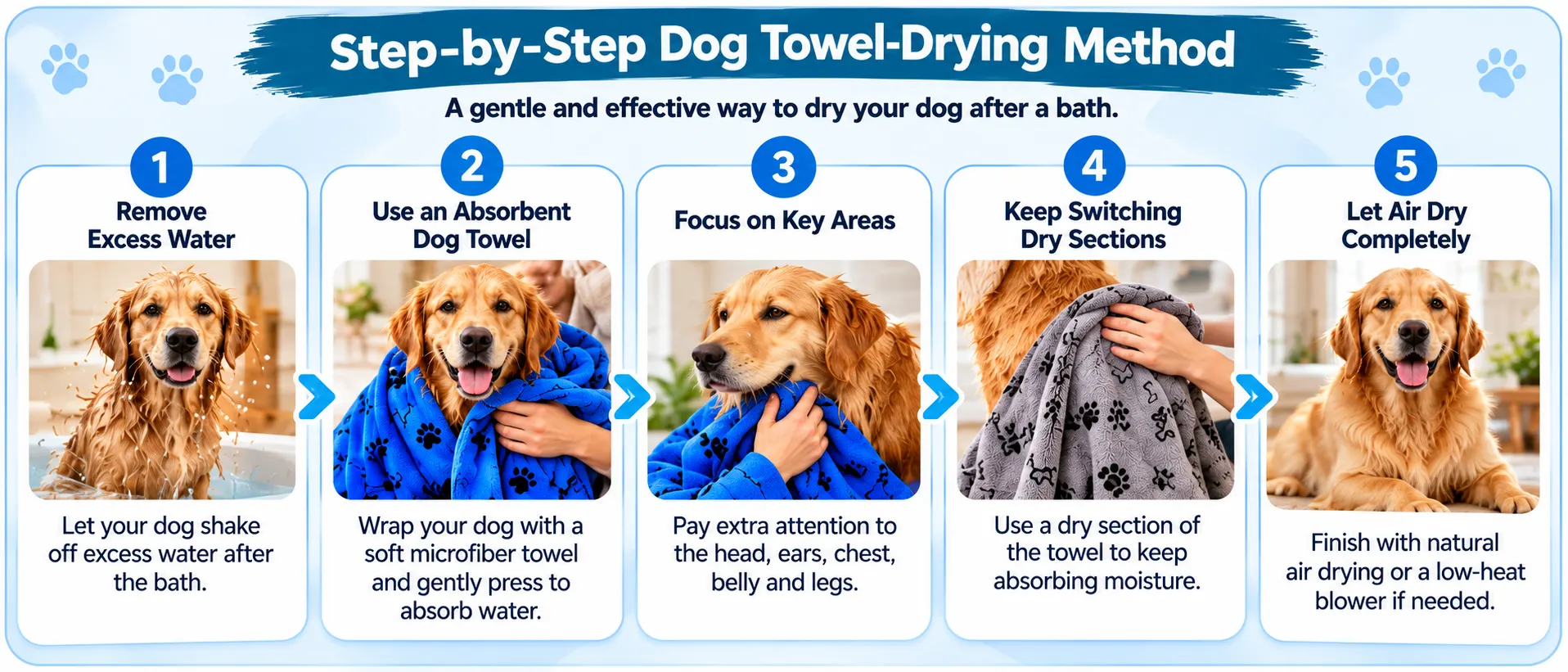
A simple drying sequence helps remove water efficiently while reducing unnecessary rubbing and tangling.
🧊 3D Infographic: The 5-Step Dog Towel-Drying Method
Drain
Let excess water run from the coat before using the towel.
Cover
Place an absorbent towel over the wet dog to catch surface moisture.
Press
Press and blot rather than scrubbing back and forth.
Section
Dry body, chest, belly, legs, paws, tail and neck systematically.
Finish
Use another dry towel or an appropriate dog dryer when the coat still holds moisture.
The goal is not friction. The goal is moisture transfer.
How to Dry Different Coat Types
Short-Haired Dogs
Short-coated dogs are usually the simplest to dry. Examples may include Beagles, Boxers, Dobermans, short-coated Chihuahuas, and many terriers. Their coats generally retain less water than dense long or double coats. A good routine is: let excess water drain, press a towel over the back and sides, blot chest and belly, dry legs, dry paws carefully, and allow the remaining light dampness to finish drying in a warm environment.
The AKC notes that short-coated dogs may often be adequately dried with a dog towel alone. Do not assume that short coat means you should rub harder. The same gentle blotting principle applies.
Medium-Coated Dogs
Medium coats usually require more attention because water can sit beneath the upper layer. Think about dogs such as some spaniels, Border Collies, and mixed breeds with moderate feathering. Use the towel in sections. Press through the coat rather than only wiping across the top. Pay extra attention to chest feathering, backs of legs, belly, and tail. If the coat is still significantly damp close to the skin, an appropriate dog dryer may help finish the process.
Long-Haired Dogs
Long coats require patience. Aggressive rubbing is particularly problematic because long strands can twist around each other. Possible results include tangles, mats, breakage, and difficult brushing. Use a towel to squeeze and blot sections gently. Work in the direction the coat naturally falls.
PetMD recommends gentle drying rather than rubbing excessively because friction can tangle the fur. The AKC also recommends working shampoo through long coats in the direction of hair growth during bathing to help avoid tangles later.
Double-Coated Dogs
Double coats are where many home-grooming mistakes happen. Examples include Golden Retrievers, German Shepherds, Huskies, Malamutes, and many retrievers. These coats contain protective outer hairs and dense undercoat. The outer surface may feel almost dry while moisture remains underneath. That makes towel drying alone slower.
Start by removing as much water as possible with the towel. Then check closer to the skin. The AKC notes that thick or double-coated dogs may benefit from towel drying followed by an appropriate dog dryer. The AKC Golden Retriever grooming guidance similarly recommends thorough towel drying and describes the use of a canine dryer for the dense coat.
Curly or Wavy Coats
Curly coats can mat surprisingly quickly when wet. Examples include Poodles, Bichon Frises, many doodle-type mixes, and some water dogs. Avoid rough circular rubbing. Instead: squeeze sections gently, blot repeatedly, change towels as needed, and work carefully around areas prone to tangling. Typical mat-prone areas include behind the ears, under the collar, armpits, inner legs, and tail base.
Dogs With Wrinkles and Skin Folds
Wrinkle-prone dogs need special attention. Examples include Pugs, Bulldogs, and Shar Peis. Moisture can remain between folds even when the surrounding coat appears dry. The ASPCA specifically advises thoroughly drying the areas between skin folds in wrinkled breeds. Use a clean dry section of towel and gently blot between folds. Do not aggressively rub sensitive skin.
Hairless Dogs
Hairless dogs do not have a large wet coat, but drying still matters. Their exposed skin can become chilled after bathing. The AKC recommends patting hairless dogs down with a towel rather than simply leaving them wet to air dry in cooler conditions. Be gentle. The skin has less fur protecting it from friction.
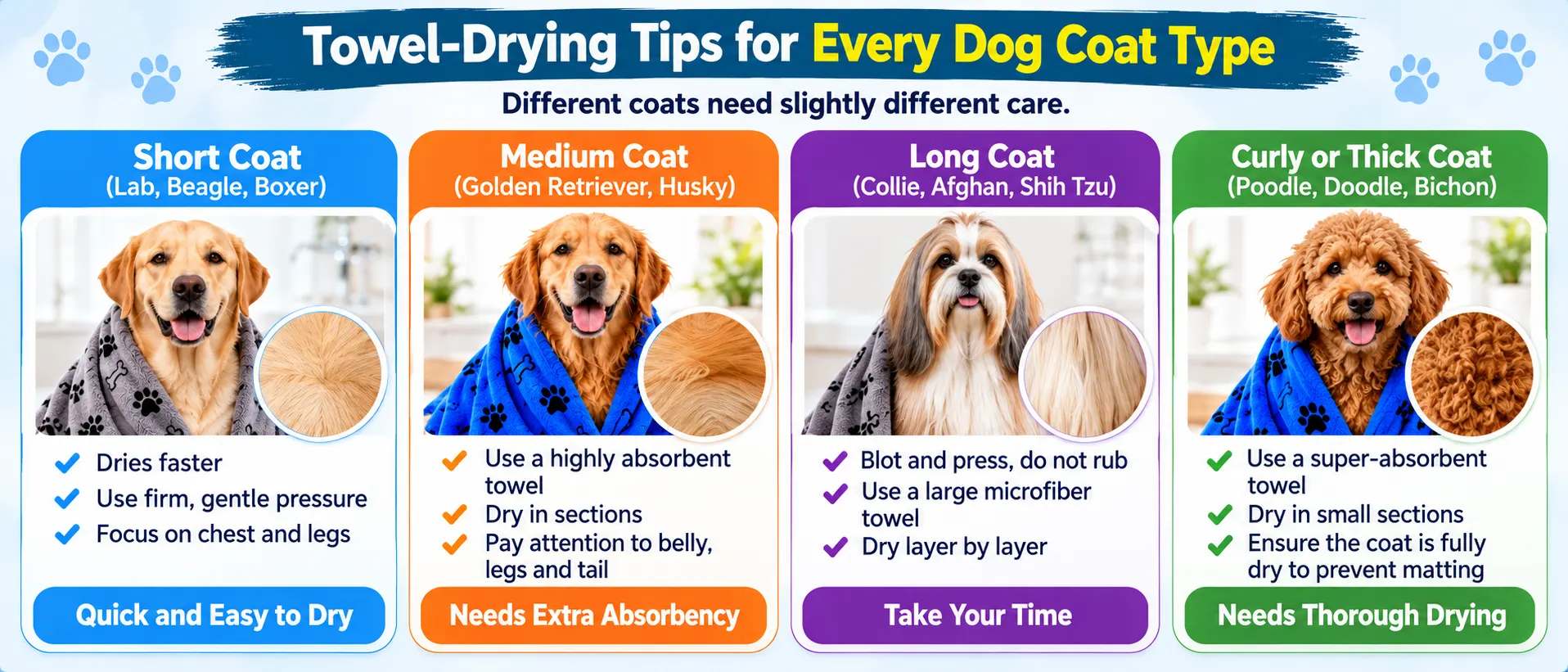
Different coat types hold water differently, so towel pressure, drying time and follow-up grooming should be adjusted accordingly.
🧊 3D Infographic: Match the Drying Method to the Coat
Short Coat
Challenge: Surface moisture.
Method: Thorough towel drying.
Medium Coat
Challenge: Moisture under the surface.
Method: Sectioned towel drying.
Long Coat
Challenge: Tangling.
Method: Gentle pressing and squeezing, minimal rubbing.
Double / Dense Coat
Challenge: Hidden moisture in the undercoat.
Method: Towel first, appropriate dog dryer if needed.
The wetter and denser the coat, the more important it becomes to check underneath—not just the surface.
Is Air Drying a Dog Enough?
Sometimes. For a healthy short-coated dog in a warm indoor environment, minor remaining dampness may finish drying naturally. But air drying becomes less ideal when the coat is thick, the undercoat remains wet, the environment is cold, the dog is shivering, the coat mats easily, or skin folds retain moisture.
The AKC advises drying wet dogs thoroughly and keeping them warm during the process. The key is not to turn “air drying” into: leave the dog soaking wet and hope for the best. Remove as much moisture as possible first.
Can You Use a Hair Dryer on a Dog?
This needs careful wording. A dryer may help with thick or long coats, but heat and noise can create problems. The AKC recommends dog-specific dryers and warns against excessive heat that could burn sensitive skin. Purina advises using a cool setting when using a dryer and gradually acclimating dogs to the sound beforehand. PetMD similarly recommends a low, cool setting with appropriate pet-safe equipment.
So the practical rule is: airflow matters more than high heat.
Do not try to speed up drying by making the air extremely hot. The AKC specifically cautions against hot airflow because it can burn the skin. A dryer should not feel uncomfortably hot against your own hand. Keep it moving.
How to Introduce a Nervous Dog to a Dryer or Towel
Some dogs are more afraid of the sound than the airflow. Do not switch the dryer on directly beside the dog’s head without introduction. Instead: let the dog see the dryer while it is off, reward calm behavior, turn it on farther away, reward, gradually bring it closer, use short sessions, and stop if the dog becomes highly distressed.
The AKC recommends gradual conditioning to drying equipment rather than forcing dogs through the experience. Purina gives similar advice about acclimating dogs to the sound in advance.
If your dog hates towels too, practice when the dog is dry. Stage 1: let the dog sniff the towel. Stage 2: touch the towel to the back briefly. Stage 3: reward. Stage 4: apply light pressure. Stage 5: gradually work toward more sensitive areas. This makes bath day much easier later.
Common Dog-Drying Mistakes
Rub vigorously
Can increase tangles and matting.
Use only one saturated towel
Once soaked, the towel removes less additional water.
Switch to a fresh dry towel
Keep absorbency high throughout the process.
Dry only the back
Chest, belly, armpits, legs and paws remain wet.
Work systematically
Follow a section-by-section routine.
Assume the surface represents the undercoat
Dense coats can remain damp close to the skin.
Check underneath
Part the coat and feel near the skin.
Use excessive dryer heat
Can make the dog uncomfortable and potentially burn the skin.
Ignore the dog’s fear
The dog begins to associate bath time with panic.
Introduce towels gradually
Build positive associations over time.
Interactive FAQ: How to Dry a Dog After a Bath
What is the best way to dry a dog after a bath?
Let excess water drain, then press and blot an absorbent towel into the coat rather than aggressively rubbing. Dense or long coats may need additional appropriate drying. AKC
Should I rub or pat my dog dry?
Gentle pressing, squeezing and blotting are preferable for many coats because aggressive rubbing can contribute to tangles. AKC
Is towel drying enough for every dog?
No. Short-coated dogs may dry well with a towel, while long or thick coats may require additional drying. AKC
Can I let my dog air dry?
Minor dampness may finish drying naturally in a suitable warm environment, but dense coats should not simply be left saturated.
Can I use a human hair dryer?
Use caution. Dog-specific drying equipment is preferable, and excessive heat should be avoided. AKC
What dryer setting is best?
Use an appropriate low or cool setting according to the dryer instructions and your dog’s comfort. Avoid very hot airflow. Purina
How do I dry a long-haired dog without causing tangles?
Press and squeeze water from sections instead of rubbing the coat back and forth.
How do I dry a double-coated dog?
Towel dry thoroughly first, then check the undercoat close to the skin. A suitable dog dryer may help remove remaining moisture. AKC
Why does my dog still smell wet after towel drying?
The coat may still hold moisture close to the skin or in dense areas.
Should I brush my dog while the coat is soaking wet?
Avoid pulling aggressively through a highly saturated tangled coat. Brush before bathing and follow coat-appropriate grooming practices afterward. PetMD
How do I dry my dog’s ears?
Gently dry the visible outer area and around the ear opening. Avoid inserting objects deeply into the ear canal. PetMD
Should I dry between skin folds?
Yes. ASPCA recommends thoroughly drying between wrinkles and folds in breeds that have them.
Why does my dog hate the towel?
Some dogs dislike handling, pressure or unfamiliar objects. Gradual towel introduction and positive reinforcement can help. AKC
Is microfiber better for drying dogs?
Microfiber dog towels can absorb substantial amounts of water and may be lighter than ordinary bath towels, but size, texture and construction also matter. AKC
How many towels do I need for a large dog?
Possibly more than one. Switch towels when the first becomes saturated.
Should I dry my dog’s paws?
Yes. Wet paws can make smooth flooring slippery. AKC
What if my dog’s coat is still damp hours later?
Dense fur may be retaining moisture near the skin. Recheck the coat and use appropriate drying methods. If the skin develops irritation or odor, consult your veterinarian.
Should I use heat to make the coat dry faster?
Avoid high heat. It can make the dog uncomfortable and potentially burn sensitive skin. AKC
✅ Final Dog-Drying Checklist
Before bath time: Prepare
- Absorbent dog towel
- Backup towel
- Non-slip surface
- Brush or comb
- Treats if needed
- Appropriate dog dryer if required
During rinsing: Check
- Shampoo removed
- Conditioner removed
- Belly rinsed
- Legs rinsed
- Paws rinsed
After bathing: Dry
- Allow excess water off
- Blot the back
- Blot chest
- Dry belly
- Dry legs
- Dry paws
- Dry tail
- Check skin folds
- Check dense undercoat
Before release: Confirm
- Dog is warm
- Paws are not slippery
- Coat is not heavily damp near skin
- No obvious skin irritation
- Towels are ready for washing
Conclusion: The Best Dog-Drying Method Depends on the Coat
Learning how to dry a dog after a bath is not about discovering one trick that works for every breed. It is about understanding how water behaves in your dog’s coat. A short coat may need little more than thorough towel drying. A long coat needs gentle section-by-section blotting to reduce tangles. A curly coat needs low-friction handling. A double coat needs extra attention because water can remain hidden underneath. Dogs with wrinkles need moisture removed from the folds. And dogs who are nervous about towels or dryers need gradual, positive introduction rather than being forced through the process.
The most important towel technique is also the simplest: press and blot instead of aggressively rubbing. From there, let coat type determine the rest. The right routine should leave your dog comfortably dry, warm, less tangled, and ready for brushing or normal activity.
For owners choosing a towel to make this process easier, the natural next step is Best Dog Bath Towel: How to Choose an Absorbent Microfiber Towel for Fast, Easy Drying. Readers wondering whether a dedicated pet towel is really worth buying can continue to Dog Bath Towel vs Regular Towel: Is a Microfiber Dog Towel Really Better?
If they want to review the towel used throughout this content, direct them naturally to the HA Pet Supplies dog bath towel. For other grooming and dog-care items, the HA Pet Supplies dog supplies collection is the relevant next category, while readers with a product-fit or ordering question can contact HA Pet Supplies rather than guessing.
This article is part of a three-blog cluster: Blog 1: How should I dry my dog correctly? Blog 2: Which dog towel should I buy? Blog 3: Is a microfiber dog towel actually better than a regular towel?
© HA Pet Supplies — Helping you care for your dog with practical, vet-informed guidance.