
How to keep fish alive in a bucket is one of the most important questions anglers face when holding live bait or temporarily keeping a legal catch. You catch a fish, carefully place it in your portable fishing bucket, and return to fishing. A few minutes later, the fish seems unusually quiet, begins swimming near the surface, or starts struggling.
Suddenly, you wonder whether something is wrong. Is the water too warm? Does the fish need more oxygen? Is the bucket too small? Should you replace the water immediately?
These questions become especially stressful when you are fishing away from home without professional equipment. The good news is that understanding a few basic fish-care principles can help you avoid many preventable problems. However, an ordinary bucket cannot guarantee fish survival. A small container may lose oxygen quickly, accumulate harmful waste, and become dangerously warm in direct sunlight.
This guide explains 11 practical steps for maintaining safer short-term holding conditions when temporary storage is legal and necessary. You will discover how to manage water quality, choose suitable equipment, recognize warning signs, and decide when releasing a fish is the safest option.
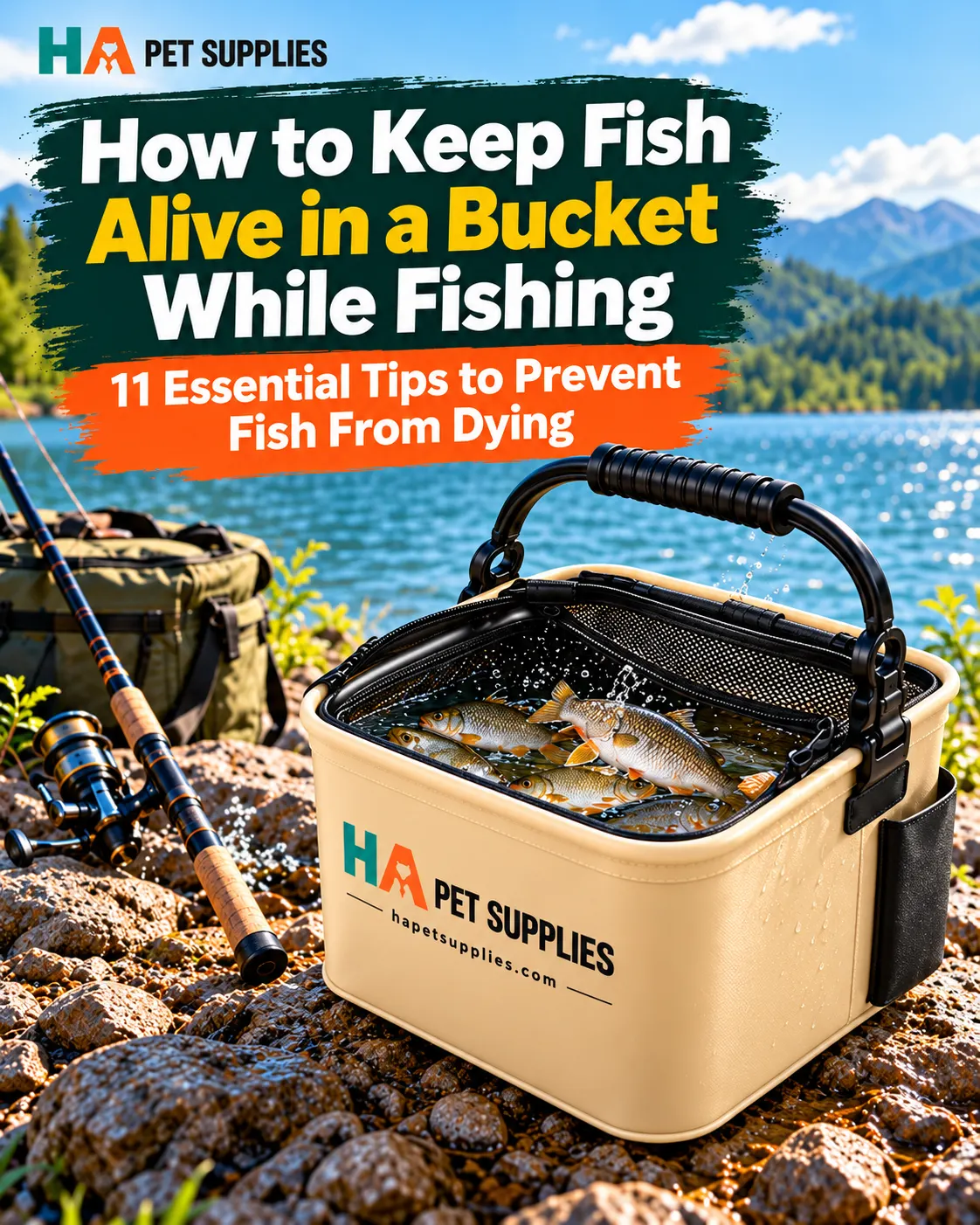
Fresh water and proper fish care beside the lake.
Quick Answer: How to Keep Fish Alive in a Bucket
If you need a fast answer while standing beside a lake or river, concentrate on these essentials:
- Move the bucket into shade immediately.
- Provide aeration if suitable equipment is available.
- Reduce overcrowding and avoid adding more fish.
- Check water temperature and look for contamination.
- Replace some water with suitable, temperature-matched water when needed.
- Release fish promptly when lawful, appropriate, and safe.
Never add untreated tap water, ice cubes made from chlorinated water, or random chemicals in an attempt to save struggling fish. The NOAA Fisheries recommends minimizing handling and air exposure to improve the chances of fish surviving release.
Why Do Fish Die in Buckets While Fishing?
Before learning how to keep fish alive in a bucket, it helps to understand why a fish can survive in a lake but struggle inside a small container. Natural bodies of water provide circulation, access to dissolved oxygen, and environments with varying temperatures and depths. Fish also have room to move away from unfavorable conditions.
A bucket is different. Its water volume is limited, circulation may be inadequate, and any waste released by the fish remains concentrated in a relatively small space. Several problems can develop simultaneously.
Oxygen depletion
Fish extract dissolved oxygen from water through their gills. In a small, poorly aerated bucket, fish respiration and other processes may reduce available oxygen faster than it is replenished. The U.S. Geological Survey explains that dissolved oxygen is essential for aquatic life and that warm water generally holds less oxygen than cold water.
Dangerous temperature changes
A bucket placed on hot rocks, a dock, or the side of a boat can warm considerably. Even when the surrounding air feels comfortable, direct sunlight can raise the water temperature. This creates two problems: less oxygen may be available in warmer water, and many fish require more oxygen as their metabolic activity increases.
Ammonia and waste accumulation
Fish naturally produce ammonia through their metabolism. Waste and decaying organic material can further worsen water conditions. According to the U.S. Environmental Protection Agency, ammonia can produce direct toxic effects on aquatic life when concentrations become sufficiently high.
Physical injuries and stress
Fish can injure themselves when repeatedly striking the sides of a small bucket. Rough handling, dry hands, damaged fins, and prolonged exposure to air may cause further harm. A fish that appears healthy immediately after being caught may still experience stress from the capture process.
3D Infographic: The Five Factors That Keep Bucket-Held Fish Healthier
Hover or tap the cube below to rotate it. Each face represents one critical factor. If any single factor deteriorates significantly, the entire holding environment can become unsafe.
A healthy holding environment is not created by a bucket alone. Oxygen, temperature, water quality, space, and gentle handling work together.
Tip 1: Choose the Right Portable Fishing Bucket
One of the first steps in learning how to keep fish alive in a bucket is selecting a container suitable for the fish you need to hold. A bucket may look like a simple accessory, but its size, material, construction, and design can influence short-term fish welfare.
Many beginners purchase the smallest container available because it is inexpensive and easy to carry. However, a small bucket can become overcrowded quickly, particularly when several fish are added.
What makes a suitable fishing bucket?
Look for a container with smooth interior surfaces, stable construction, a reliable carrying handle, and enough usable water volume for the intended fish. If you need to walk long distances, a collapsible design may be convenient. Nevertheless, portability should never come at the expense of sufficient capacity.
- Adequate capacity: Allows fish to remain fully submerged and move without repeatedly striking the sides.
- Stable base: Reduces the possibility of accidental tipping.
- Smooth interior: Helps reduce abrasion and physical injuries.
- Secure construction: Prevents leaks during ordinary use.
- Aerator compatibility: Allows you to use a suitable air pump when needed.
A collapsible fishing bucket may be particularly useful for occasional trips because it occupies less storage space when empty. However, remember that a collapsible bucket does not automatically maintain dissolved oxygen. You must still manage the holding conditions.
For shoppers comparing different designs, our guide to choosing the best portable fishing bucket in 2026 explains the factors to check before buying.
Tip 2: Use Suitable Water From the Fishing Location
The water you place inside a fishing bucket matters just as much as the container itself. Fish are adapted to specific environmental conditions, including temperature, salinity, and water chemistry. Suddenly transferring them into substantially different water can create additional stress.
For short-term holding, clean and suitable water from the same fishing location is often preferable to untreated household water, provided the source water itself is safe.
Why untreated tap water can be harmful
Municipal drinking water may contain chlorine or chloramine used for disinfection. Although these chemicals help protect people from waterborne pathogens, they can damage aquatic animals. Never assume tap water is safe simply because it looks clear.
A university extension guide from Mississippi State University Extension Service warns that untreated municipal water can contain chemicals toxic to fish and highlights the importance of suitable water during fish transport.
How to fill a portable fishing bucket correctly
Start with a clean bucket that is free from soap, detergent, fuel, and other chemical residues. Collect water from the permitted fishing location, choosing a cleaner area rather than obviously polluted shallows. Avoid stirring up mud and debris when collecting water. Add enough water for the fish to remain fully submerged, while leaving appropriate room for aeration and preventing spills.
If you are replacing water, avoid sudden differences in temperature or salinity. Do not transfer saltwater fish into freshwater or freshwater fish into saltwater.
Tip 3: Keep Enough Oxygen Available in the Water
Oxygen availability is often the most important immediate concern when fish begin struggling inside a bucket. Learning how to keep fish alive in a bucket requires understanding that fish breathe dissolved oxygen, not air bubbles themselves. An air pump helps by circulating water and increasing the exchange of gases with the atmosphere.
How can you oxygenate a fishing bucket?
A battery-powered aerator with an air stone is one of the most practical options for temporary live-fish holding. This setup is convenient because it does not require access to a household electrical outlet. For suitable small fish and bait, a correctly sized aerator can help support oxygen exchange during transport or short-term holding.
What if you do not have an aerator?
If an aerator is unavailable, your options are more limited. Reduce the number of fish being held, keep the container shaded, and minimize holding time. For a short emergency, gently increasing surface movement may improve gas exchange, but it is not a reliable substitute for continuous aeration. Avoid vigorously shaking a container holding fish, which can injure or stress them.
For anyone transporting live fish, the Southern Regional Aquaculture Center provides technical guidance on the water-quality factors affecting live-fish transport.
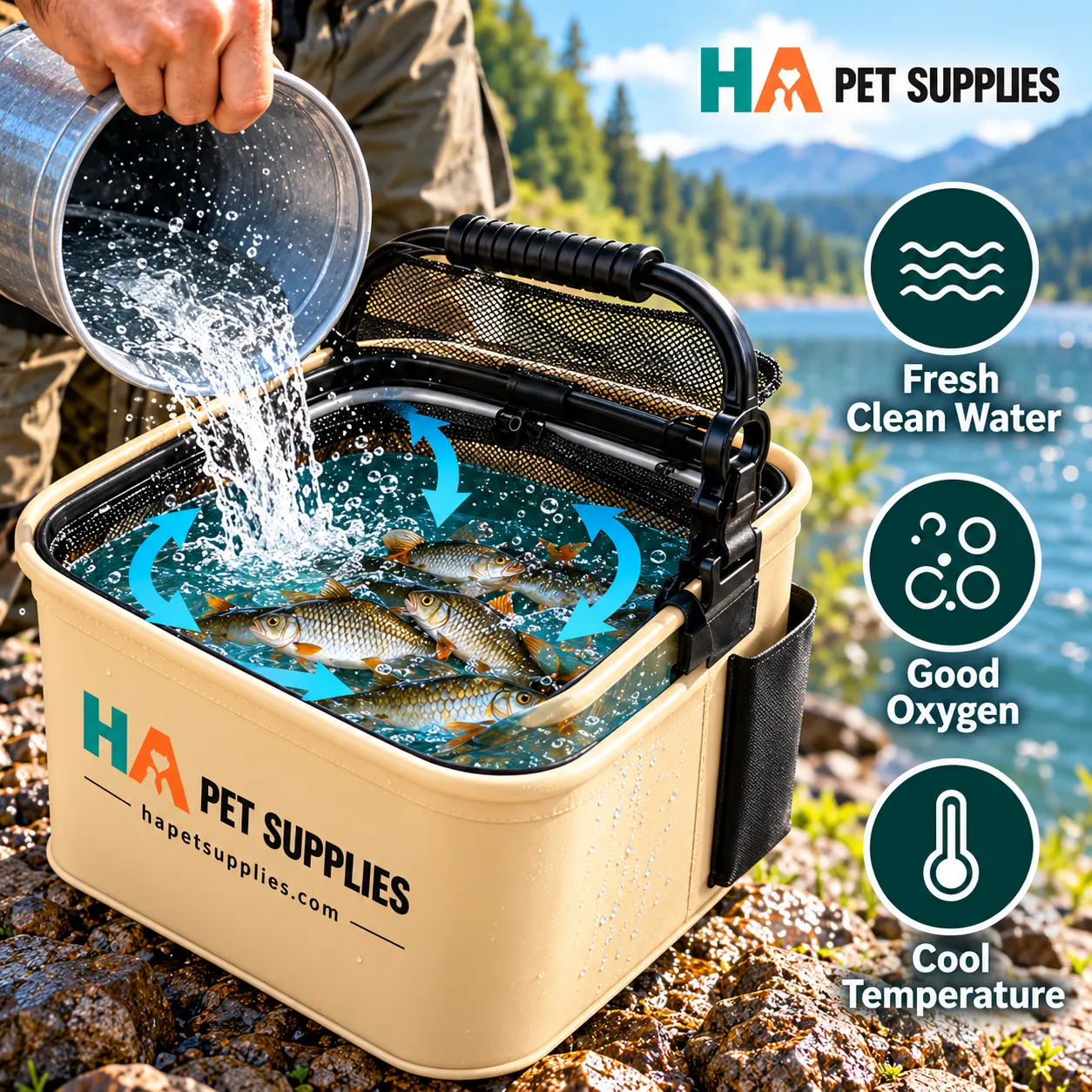
Maintain suitable water conditions during temporary live-fish holding.
Tip 4: Protect Your Fish From Excessive Heat
Hot weather can quickly turn a fishing bucket into an unfavorable environment. A bucket left in direct sunlight absorbs heat, and its relatively small water volume can warm faster than a lake or river. Many fish become more stressed when temperatures exceed their normal tolerance. Because warmer water generally contains less dissolved oxygen at saturation, overheating can make oxygen problems worse.
Where should you place your bucket?
Keep it in a naturally shaded location wherever possible. For shoreline fishing, choose a stable surface protected from direct sunlight. On a boat, avoid placing the bucket beside hot engines or exposed metal surfaces. A light-colored cover may help reduce exposure to sunlight, provided ventilation is maintained and the bucket is not sealed.
Should you add ice?
Do not place ordinary ice directly into a fish bucket without knowing its composition and the species’ temperature requirements. Ice made from untreated municipal water may introduce unwanted chemicals. Sudden cooling can also cause temperature shock. A safer approach is to prevent overheating from the beginning.
Tip 5: Prevent Overcrowding in Your Fishing Bucket
Adding too many fish is one of the most common mistakes beginners make. When several fish occupy the same small volume of water, they collectively consume more oxygen and produce more waste. They may also collide with each other or struggle to maintain a comfortable swimming position.
How many fish can survive in a bucket?
There is no safe universal number. The answer depends on the species, body size, water volume, temperature, aeration, and length of time the fish will remain inside. A simple rule is to choose the lowest practical stocking density rather than filling every available space. Fish should have enough room to remain submerged and maintain a natural body position.
Signs that the bucket may be overcrowded
Potential warning signs include frequent surface activity, collisions, unusually rapid breathing, and fish repeatedly attempting to escape. However, these behaviors can also indicate other problems. Never interpret a fish swimming near the surface as definite proof of overcrowding. Instead, check the complete environment.
Tip 6: Maintain Clean Water and Control Waste
A fishing bucket may look clean while its water quality is deteriorating. Fish continuously release metabolic waste into their surroundings. Over time, ammonia and other dissolved substances can accumulate. This becomes particularly important when fish are crowded or held longer than planned.
Why fish waste is dangerous
Ammonia can interfere with normal biological processes in aquatic animals. Its potential toxicity depends on several factors, including pH and temperature. The EPA explains that ammonia exposure can damage aquatic organisms and affect their survival.
Should you replace the bucket water?
When water quality deteriorates, carefully replacing part of the water with suitable, temperature-matched water may help. Avoid abrupt full replacements unless a specific emergency requires them and you can prevent additional stress. Never use water from a different habitat without considering salinity, contaminants, and fish health.
Can an air pump remove ammonia?
No. An air pump primarily supports circulation and gas exchange. It does not automatically remove dissolved ammonia or provide the biological filtration needed for longer-term fish keeping. This is an important distinction for beginners who assume a bubbling bucket is always safe.
Tip 7: Handle Fish Gently to Prevent Injuries
Proper fish handling is another essential part of keeping fish alive while fishing. Even when water quality is good, rough handling can cause significant harm. Fish have protective mucus on their skin that helps defend against infections and physical damage. Dry hands, rough surfaces, and abrasive nets can damage this protective coating.
Wet your hands before touching fish
Whenever handling is necessary, wet your hands first. This reduces the risk of removing the fish’s protective mucus. Avoid unnecessary contact with the gills and eyes. Support the fish along its body rather than allowing it to hang vertically, especially if the species requires full-body support.
Use a fish-friendly landing net
A soft, knotless rubber net can help reduce injuries during landing. The Florida Fish and Wildlife Conservation Commission recommends minimal handling, wet hands, and suitable landing gear to improve fish survival.
Tip 8: Reduce Fish Stress Immediately After Catching
Fish experience physiological stress during capture. The longer they fight against fishing tackle, the greater their potential exhaustion. A fish that appears healthy after being landed may still require recovery. This matters because placing an already exhausted fish inside a poorly oxygenated bucket can compound the problem.
Land fish efficiently
Use tackle appropriate for the species being targeted. Avoid intentionally prolonging the fight for entertainment or photographs. The goal should be to bring the fish under control without unnecessary exhaustion.
Make the release decision early
Before fishing, decide whether you intend to retain legal catches for consumption, keep permitted bait, or practice catch-and-release fishing. This decision affects the equipment you need and how you handle the catch. The Florida Fish and Wildlife Conservation Commission emphasizes that fish intended for release should generally be released quickly rather than held in a livewell while an angler decides what to keep.
Tip 9: Monitor Fish Behavior and Recognize Warning Signs
Learning how to keep fish alive in a bucket also means learning to recognize when the environment may be becoming unsafe. Fish cannot tell you that the water is too warm or that oxygen is declining. Instead, anglers must observe behavior and check water conditions.
Warning signs to watch for
- Repeated gasping or unusually frequent movement near the surface
- Rapid or abnormal gill movements
- Loss of balance or swimming sideways
- Sudden frantic movement or repeated collisions
- Marked lethargy or loss of responsiveness
- Unusual changes in color or visible injury
These signs are not specific to oxygen deficiency. They may also result from temperature shock, toxic water conditions, handling injuries, or other problems.
The NOAA National Marine Sanctuaries program provides practical guidance about releasing fish gently, minimizing air exposure, and supporting their bodies correctly.
Tip 10: Prepare for Safe Fish Transportation
Transporting live fish creates additional challenges. The container may move, water may spill, and oxygen demand continues throughout the journey. Temperature can also change rapidly inside a parked vehicle. For beginners, the most important question is whether transportation is truly necessary.
Before transporting fish
Choose a suitable container with enough water volume. Check that the handle and seams are secure. Make sure the fish cannot escape during normal movement, while maintaining appropriate gas exchange. Place the container on a stable, shaded surface. Use suitable aeration equipment for the duration and stocking density. Avoid leaving live fish unattended in a vehicle.
Do not move fish between different lakes
Transporting fish or bait between waterbodies can spread invasive organisms and diseases. Some jurisdictions prohibit certain forms of live-fish transportation altogether. The Stop Aquatic Hitchhikers! campaign recommends cleaning, draining, and drying fishing equipment and never releasing live bait into a different waterbody.
For a more detailed preparation process, read our practical guide explaining how to use a portable fishing bucket in nine easy steps.
Tip 11: Know When to Release Fish Instead of Keeping Them in a Bucket
The final tip is perhaps the most important. Not every fish should be placed in a bucket. For many catch-and-release situations, the safest strategy is to keep the fish in the water, remove the hook carefully, and return it promptly. A bucket should not be used simply because an angler wants more time to decide what to do with the catch.
When should fish be released immediately?
Fish should generally be released promptly when they are legally required to be released, are not intended for lawful retention, or cannot be held under appropriate conditions. Release must follow applicable regulations and species-specific guidance. Avoid returning fish to an entirely different waterbody.
What about fish caught in deep water?
Fish brought rapidly from significant depths can experience barotrauma, a condition related to pressure changes. Symptoms may include a swollen abdomen, bulging eyes, or difficulty returning to depth. These fish may need approved descending or recompression techniques rather than ordinary surface release. NOAA Fisheries explains that special release equipment can improve the survival prospects of some deep-water fish.
For freshwater anglers, FWC provides additional guidance on landing fish efficiently and releasing them with minimal handling.
Common Mistakes That Cause Fish to Die in a Bucket
Even experienced anglers can overlook small details that create serious problems. Understanding these common mistakes makes it easier to prevent avoidable fish deaths.
| Common mistake | Why it can be harmful | Better approach |
|---|---|---|
| Leaving the bucket in direct sunlight | Water can overheat | Move it into shade |
| Adding too many fish | Increases oxygen demand and waste | Reduce stocking density |
| Using untreated tap water | May contain chlorine or chloramine | Use suitable conditioned water |
| Ignoring aeration | Oxygen can become depleted | Use an appropriately sized aerator |
| Adding ice directly | May cause chemical exposure or temperature shock | Use controlled temperature management |
| Handling fish with dry hands | Can damage protective mucus | Wet hands and minimize touching |
| Keeping fish for too long | Increases cumulative stress and water-quality risks | Minimize holding time |
| Adding random chemicals | May poison or stress fish | Avoid unverified treatments |
| Mixing incompatible species | Can cause injury or stress | Follow species-specific requirements |
| Releasing bait into new waters | Can spread invasive species and pathogens | Follow local bait-disposal rules |
For additional guidance on protecting fish populations and reducing angling-related harm, the FWC offers practical conservation recommendations.
Emergency Troubleshooting: What to Do When Fish Are Dying in a Bucket
Sometimes you notice a problem despite taking precautions. A fish may become unusually inactive, lose its balance, or start gasping near the surface. In this situation, the goal is to identify the immediate risk without making conditions worse.
Problem 1: Fish repeatedly gather near the water surface
Possible causes: Inadequate dissolved oxygen, heat, crowding, water-quality problems, or species-specific behavior.
Recommended response: Check the aerator, move the container into shade, reduce crowding where appropriate, and assess water quality. Do not assume oxygen is the only concern.
Problem 2: Fish are swimming sideways
Possible causes: Severe stress, injury, abnormal water conditions, illness, or capture-related complications.
Recommended response: Minimize handling, check water conditions, and avoid sudden chemical or temperature adjustments. If appropriate and permitted, seek species-specific guidance rather than continuing unsafe holding.
Problem 3: Water is becoming unusually warm
Possible causes: Direct sunlight, hot surrounding surfaces, inadequate insulation, or warm ambient conditions.
Recommended response: Move the bucket to a cooler shaded area and prevent further heating. Avoid abrupt cooling that may create temperature shock.
Problem 4: Water smells unpleasant or becomes heavily contaminated
Possible causes: Accumulated waste, dead organisms, spoiled bait, or contamination.
Recommended response: Remove the source of contamination where safe, consider a careful water change, and reduce the time fish remain confined. Never use household cleaning chemicals while fish are present.
Problem 5: The aerator stops working
Possible causes: Battery failure, damaged wiring, blocked tubing, or equipment malfunction.
Recommended response: Replace the batteries or repair the system if possible. If you cannot maintain suitable conditions, shorten holding time and follow safe, lawful release or transfer procedures.
Problem 6: Fish have visible injuries
Possible causes: Hook damage, collisions, rough handling, or contact with abrasive surfaces.
Recommended response: Minimize handling and follow species-specific fish welfare and fisheries regulations. Do not assume an injured fish can recover merely because oxygen is present.
How to Choose a Portable Fishing Bucket for Beginners
After learning the basic fish-care principles, many beginners wonder whether they need a specialized bucket. The answer depends on what they intend to do. An angler who needs a container for transporting water has different requirements from someone holding live bait. Similarly, someone who practices immediate catch-and-release fishing may not need a live-fish bucket at all.
Collapsible fishing bucket versus standard bucket
A collapsible bucket is convenient because it can be folded when empty. This makes it useful for anglers who travel on foot, store equipment in limited spaces, or prefer lightweight accessories. A traditional rigid bucket may provide a more stable shape and can be easier to equip with certain aeration accessories. Neither design inherently provides safe conditions for live fish.
| Feature | Collapsible bucket | Rigid bucket | Dedicated aerated livewell |
|---|---|---|---|
| Easy storage | Excellent | Moderate | Varies |
| Convenient carrying | Often good | Often good | Depends on size |
| Built-in aeration | Not necessarily | Not necessarily | Often included |
| Short-term water holding | Yes, if suitable | Yes, if suitable | Yes |
| Longer live-fish holding | Limited without support | Limited without support | Better suited when correctly operated |
| Space required | Low when folded | Moderate | Often higher |
HA Pet Supplies offers a portable fishing bucket option for shoppers exploring compact fishing equipment. You can inspect the available product details before deciding whether it matches your needs. For broader options, explore the fish and aquarium category.
How to Clean Your Fishing Bucket After Every Trip
Cleaning your equipment is important for practical maintenance and environmental protection. A dirty bucket may contain organic waste, sediment, or unwanted organisms. When equipment is moved between fishing locations, it can also contribute to the spread of aquatic invasive species.
- Empty the bucket responsibly. Follow local regulations for disposing of water, bait, and any retained organisms. Do not transfer live organisms or untreated water into another waterbody.
- Remove visible debris. Inspect the bucket for mud, vegetation, leftover bait, and other material.
- Clean the bucket appropriately. Follow the manufacturer’s instructions for the bucket material. If cleaning agents are needed, use appropriate equipment-cleaning procedures and rinse thoroughly.
- Dry the bucket completely. Allow the container to dry thoroughly before folding or storing it.
- Inspect for damage. Look for worn seams, cracks, weak handles, and damaged folding sections.
The Stop Aquatic Hitchhikers campaign emphasizes cleaning, draining, and drying equipment to help prevent invasive species from spreading. For a complete setup and maintenance walkthrough, our nine-step portable fishing bucket guide covers preparation, use, cleaning, and storage.
Can You Keep Fish Alive Without an Aerator?
This is one of the most common questions from anglers who have forgotten their equipment or are fishing for the first time. Some fish may survive brief periods in unaerated water, but there is no universally safe holding duration. The result depends on the species, water volume, temperature, stocking density, and starting oxygen concentration.
If you are without a pump, keep as few fish as possible, protect the bucket from direct sunlight, and avoid unnecessary holding time. If you are legally and safely able to return the fish to its capture location, immediate release is often a better option. Pouring water can create temporary surface agitation, but it is unreliable as the sole oxygen supply for live fish.
The Take Me Fishing educational resource discusses keeping fish fresh, handling live catches, and appropriate alternatives for retaining or releasing fish.
Frequently Asked Questions About How to Keep Fish Alive in a Bucket
How long can fish stay alive in a bucket?
There is no universal answer. Small baitfish in a large, shaded, aerated bucket may survive several hours. A larger game fish in a small, warm, unaerated bucket may become distressed within minutes. The key variables are species, water volume, temperature, aeration, and stocking density. Always aim to minimize holding time.
How do you keep fish alive in a bucket without an air pump?
Reduce the number of fish, keep the bucket in deep shade, use the largest container available, and minimize holding time. Gentle surface agitation can help temporarily, but it is not a reliable substitute for continuous aeration. If conditions cannot be maintained safely, release fish promptly where lawful.
Why are fish dying in my fishing bucket?
Common causes include oxygen depletion, overheating, ammonia accumulation from waste, overcrowding, rough handling, and contaminated water. Often several problems develop together. Check aeration, shade, water temperature, stocking density, and water source before assuming a single cause.
Can I use normal tap water for fish in a bucket?
No, not without treatment. Municipal tap water often contains chlorine or chloramine, which are toxic to fish. If you must use tap water, treat it with a suitable aquarium water conditioner that neutralizes these chemicals. For short-term holding, water from the fishing location is generally preferable if it is clean and safe.
Should I put ice in my live fish bucket?
Avoid adding ice directly. Ice made from untreated tap water may introduce chlorine, and sudden cooling can cause temperature shock. Prevent overheating by keeping the bucket shaded and using an insulated container when appropriate. Never rapidly cool fish by dumping very cold water into the bucket.
Do portable fishing buckets need aerators?
For anything beyond very brief holding, yes. A battery-powered aerator with an air stone significantly improves oxygen availability. Without aeration, oxygen can deplete quickly, especially in warm weather or when multiple fish are present. An aerator is part of a wider system that also includes shade, suitable water, and low stocking density.
How many live fish can I put in a bucket?
There is no safe universal number. It depends on species, size, water volume, temperature, aeration, and holding time. A simple rule is to choose the lowest practical density rather than filling every available space. Fish should have enough room to remain fully submerged and maintain a natural body position without repeated collisions.
Can fish survive overnight in a bucket?
A basic bucket is not appropriate for overnight holding. Overnight increases risks from temperature swings, oxygen depletion, waste accumulation, and equipment failure. If you routinely need long-term live storage, research species-specific livewell or bait-tank systems rather than relying on a small collapsible bucket.
Should I change the bucket water regularly?
If water quality is deteriorating, carefully replace part of the water with suitable, temperature-matched water. Avoid abrupt full replacements unless a specific emergency requires it. Never use water from a different habitat without considering salinity, contaminants, and fish health. An air pump does not remove ammonia.
Is a collapsible fishing bucket safe for live fish?
It can be, if it has sufficient capacity, is shaded, is paired with suitable aeration, and is not overcrowded. However, collapsible buckets are not automatically safe — the same management principles apply. Check that seams are secure, the base is stable, and the interior is smooth.
Can I release fish from a bucket into another lake?
Generally no. Transporting fish or bait between waterbodies can spread invasive species and diseases, and may be illegal. Follow local regulations. The Stop Aquatic Hitchhikers campaign recommends cleaning, draining, and drying equipment and never releasing live bait into a different waterbody.
What should I do if a fish starts swimming sideways?
Swimming sideways can indicate severe stress, injury, barotrauma, or water-quality problems. Minimize handling, check aeration and temperature, and avoid sudden chemical or temperature changes. If the fish was caught from deep water, it may need recompression or descending techniques. If it cannot recover and release is appropriate, follow local regulations.
Final Checklist Before Your Next Fishing Trip
A successful fishing trip begins with preparation. When you know how to keep fish alive in a bucket, you can make better decisions about equipment, water quality, and responsible fish handling. Use this checklist before your next trip.
Fishing Trip Preparation Checklist
0 of 10 complete
Why Responsible Fishing Practices Matter
Responsible fishing protects both individual fish and the ecosystems they inhabit. Small actions can make a meaningful difference. Releasing fish that do not need to be retained, minimizing handling, using appropriate tackle, and preventing the spread of invasive species all support healthier aquatic environments.
Fishing equipment should make the activity easier without encouraging unnecessary harm to fish. A portable bucket is useful for certain tasks, but responsible anglers understand its limitations. For example, a collapsible bucket may help transport water, organize equipment, or temporarily hold legally collected bait under suitable conditions. It should not be treated as an all-purpose solution for keeping any fish alive indefinitely.
The best results come from matching the equipment to the species, circumstances, and intended use. Readers interested in learning more about safe temporary storage can explore the full HA Pet Supplies fishing bucket care guide and related educational content. For broader product information and additional guides, visit the HA Pet Supplies blog or explore the online fishing and pet supplies shop.
Conclusion: How to Keep Fish Alive in a Bucket Safely
Knowing how to keep fish alive in a bucket involves far more than filling a container with water. The most important factors are suitable water, sufficient dissolved oxygen, appropriate temperature, low stocking density, gentle handling, and minimizing the time fish spend confined.
A quality portable fishing bucket can make fishing trips more convenient, but the container itself does not guarantee survival. When a fish begins showing signs of distress, act promptly by assessing its environment instead of adding unverified chemicals or making abrupt water changes. If a fish is intended for release, returning it quickly and appropriately to its original habitat is generally safer than keeping it in a bucket unnecessarily.
For anglers who need a compact container for fishing trips, HA Pet Supplies offers portable fishing equipment worth exploring. Compare the product details and choose the option that best matches your intended use.
You can also visit the HA Pet Supplies homepage for more products and educational resources.
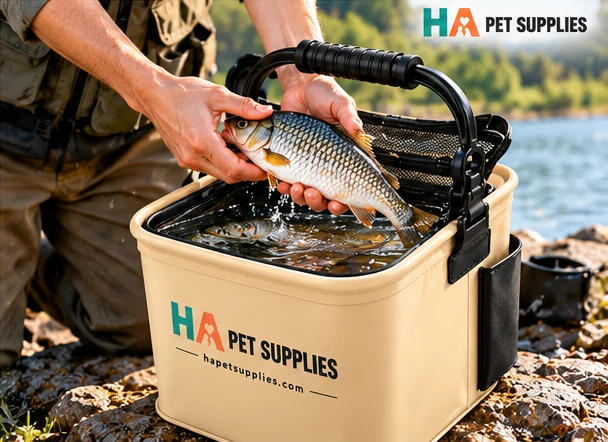
Handle live fish carefully to minimize injuries and stress.
HA Pet Supplies | Fishing Guides | 2026