
Your dog’s new boots just arrived. They look perfect, but the moment your dog starts walking, one boot twists sideways, another slips off, and your dog begins lifting its feet awkwardly. What went wrong?
For many dog owners, this is where buying protective footwear becomes frustrating. You may have chosen the size recommended for your dog’s breed. You may have ordered according to body weight. Perhaps the boots even seemed to fit when your dog was sitting.
Yet during an actual walk, everything changes. The problem is often related to paw measurements, boot shape, fastening position, or the way your dog’s paws expand while standing.
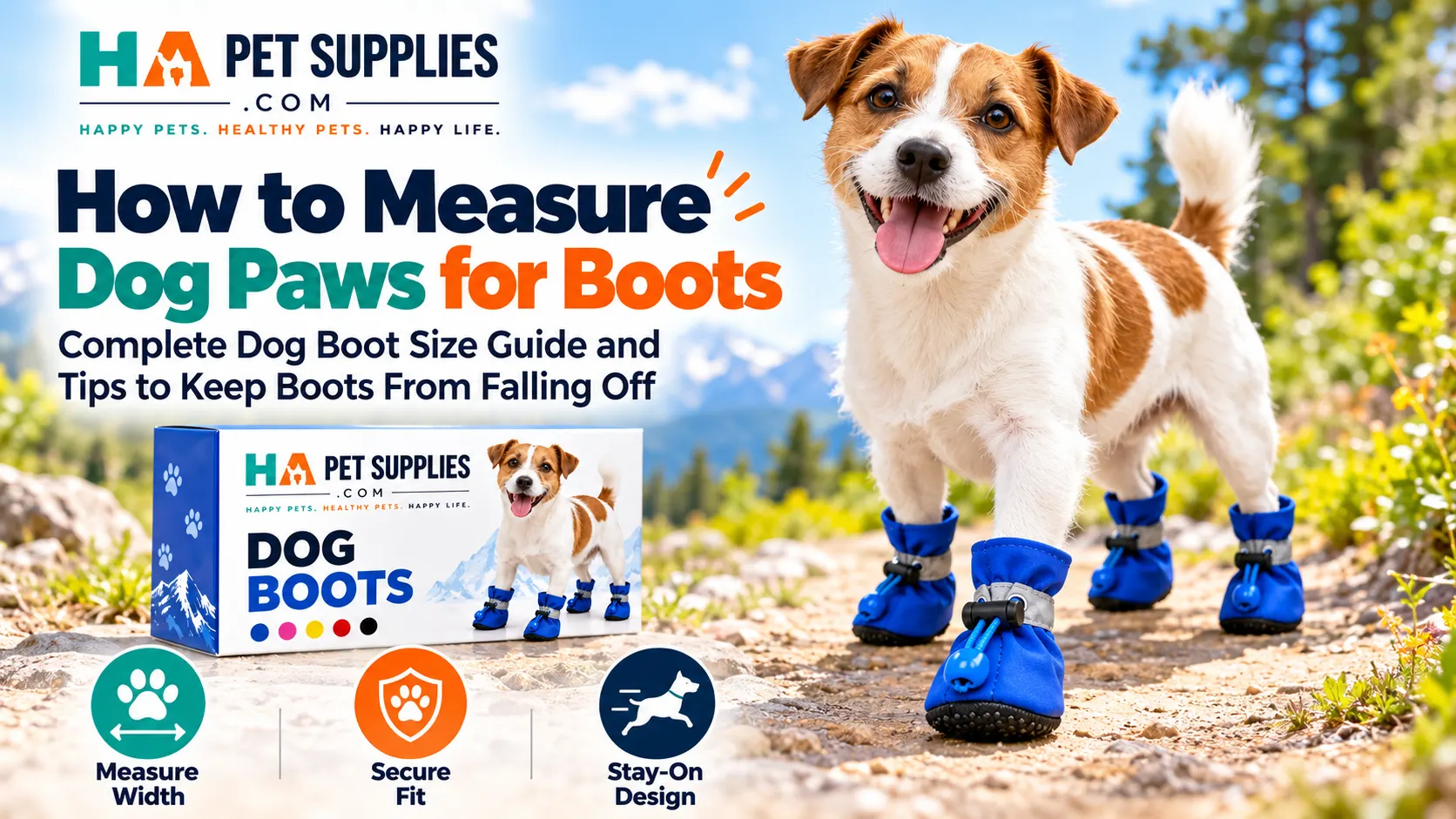
Learning how to measure dog paws for boots is the first step toward finding footwear that stays securely positioned without squeezing your dog’s feet.
This complete dog boot size guide will explain exactly how to measure paw width and length, compare measurements with sizing charts, and recognize the difference between a loose boot and one that is simply unfamiliar.
Important: If your dog is limping, has an injured paw, or appears to be in pain, remove the boots and assess the problem. Do not force the dog to continue walking.
- 1. Quick Answer: How to Measure
- 2. Why Correct Sizing Matters
- 3. What You Need Before Measuring
- 4. 7 Easy Steps to Measure
- 5. Paw Width, Length & Shape
- 6. Dog Boot Size Chart
- 7. Front vs Back Paw Sizes
- 8. How to Know Boots Fit
- 9. Why Boots Keep Falling Off
- 10. 10 Tips to Keep Boots Secure
- 11. Training Your Dog
- 12. Common Sizing Mistakes
- 13. Boots for Different Activities
- 14. Paw Care Before & After
- 15. Choosing HA Pet Supplies
- 16. FAQs
- 17. Final Checklist
1. Quick Answer: How to Measure Dog Paws for Boots
If you need to determine your dog’s boot size quickly, begin with a piece of paper, a pencil, and a ruler.
Follow this simple method:
- Place a sheet of paper on a level, non-slip surface.
- Encourage your dog to stand naturally with one paw on the paper.
- Mark the left and right edges of the widest part of the weight-bearing paw.
- Measure the distance between those two marks.
- Measure paw length if the boot manufacturer requires it.
- Repeat the process for the remaining paws.
- Compare the measurements with the specific manufacturer’s size chart.
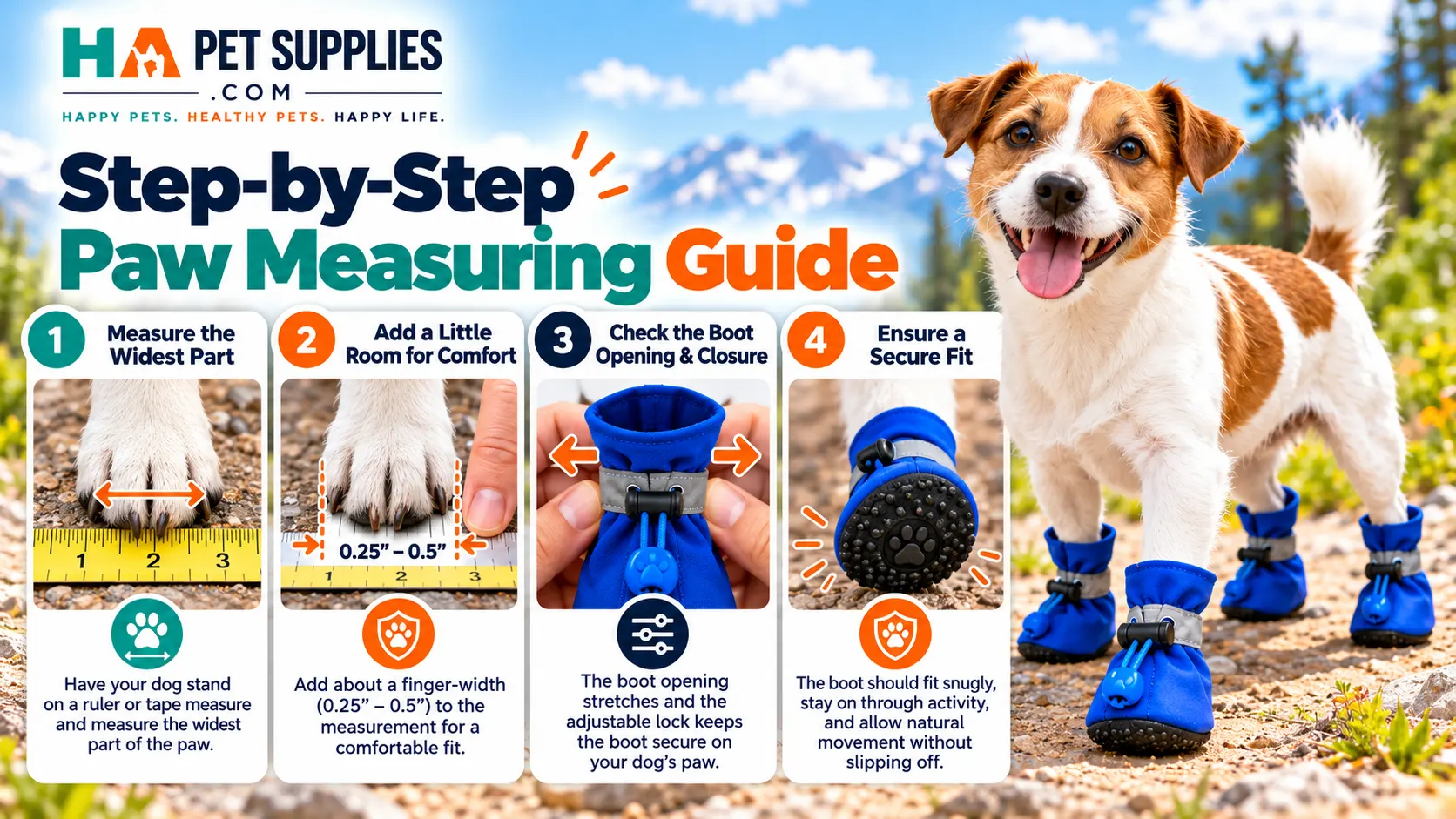
The most important detail is to measure the paw while your dog is standing and bearing weight. When a dog puts weight onto its foot, the toes naturally spread. This means that measuring a paw while it is lifted can produce a different result.
The American Kennel Club’s dog boot buying guide recommends using a paw impression or tracing to help determine the width needed for protective footwear.
Quick Fix If Your Dog Boots Are Falling Off
If your dog is already wearing boots that repeatedly slip, check the following immediately.
First, check the size. A boot that is too wide may rotate or slide away from the paw. Second, check the fastening position. The closure should be positioned according to the manufacturer’s instructions. Third, check the paw shape. A dog with narrow ankles and wide paws may need a different boot design. Fourth, inspect the sole. A stiff or poorly positioned sole may interfere with natural movement. Fifth, observe your dog’s behavior.
Do not solve a slipping problem by tightening straps until they leave deep marks. If the boot remains insecure after proper adjustment, reconsider the size or design.
2. Why Correct Dog Boot Sizing Matters
Many people treat dog boots like ordinary accessories. However, protective footwear directly affects the way a dog’s paws contact the ground. Dogs use their paws for balance, traction, movement, and shock absorption.
What Happens When Dog Boots Are Too Large?
Oversized boots allow the paw to move around inside the footwear. This can cause the boot to rotate, slide forward, fold beneath the foot, or detach during movement. A loose boot may also create friction.
What Happens When Dog Boots Are Too Small?
An undersized boot may compress the toes or prevent the paw from spreading naturally. The dog may resist walking, lift its feet repeatedly, or develop redness around pressure points.
Why Breed-Based Sizing Can Be Misleading
Not every Labrador Retriever has identical paws. Two German Shepherds of similar weight may have different paw widths. Manufacturers such as Ruffwear explain how accurate measurements improve dog gear sizing.
3. What You Need Before Measuring Your Dog’s Paws
You do not need expensive measuring equipment to determine paw width. Most households already have the essential materials.
| Tool | Purpose |
|---|---|
| Plain paper | Provides a surface for marking paw edges |
| Pencil or fine-tip pen | Marks the paw’s position |
| Ruler | Measures width and length |
| Measuring tape | Optional alternative for measuring |
| Non-slip floor or mat | Helps your dog stand securely |
| Small dog treats | Encourages calm cooperation |
| Notebook or phone | Records the measurement of each paw |
Should You Trim Your Dog’s Nails First?
Nail length can affect paw comfort and the space required inside some boot designs. VCA Animal Hospitals provides veterinary guidance on trimming dog nails safely.
What If Your Dog Refuses Paw Handling?
Some dogs dislike having their feet touched. If your dog pulls away, freezes, growls, or shows discomfort, stop the measurement session. Use short, gentle handling exercises with positive rewards.
4. How to Measure Dog Paws for Boots in 7 Easy Steps
This is the most important section of the guide. Follow these seven steps carefully, especially if you previously ordered dog boots that did not fit properly.
Flat surface
Stand naturally
Mark widest part
Measure width
Measure length
Repeat all paws
Compare chart
Measure the paw that actually touches the ground.
Step 1: Choose a Flat Surface
Start by placing a clean sheet of paper on a stable floor. The surface should not be slippery.
Step 2: Let Your Dog Stand Naturally
Encourage your dog to stand with all four paws supporting its weight. The dog should not be sitting, lying down, or leaning heavily to one side.
Step 3: Mark the Widest Part of the Paw
Identify the outer edges of the paw at its widest point. Usually, this is across the toe area rather than around the narrower section above the paw.
Step 4: Measure the Paw Width
Remove the paper and use the ruler to measure the distance between the marks. Record the result in millimeters or centimeters.
Step 5: Measure Paw Length When Required
Some manufacturers use width as the primary sizing measurement. Others also request paw length. If length is required, mark the distance from the rear of the main paw-pad footprint to the frontmost relevant point.
Step 6: Repeat for Every Paw
Measure the front right, rear left, and rear right paws. Front paws are often larger than rear paws, but the amount of difference varies.
| Paw | Width | Length |
|---|---|---|
| Front left | 55 mm | 65 mm |
| Front right | 54 mm | 64 mm |
| Rear left | 48 mm | 58 mm |
| Rear right | 49 mm | 59 mm |
These are fictional example measurements for illustration only.
Step 7: Compare With the Manufacturer’s Size Chart
Once you have recorded the measurements, review the exact size chart for the footwear you intend to buy. For example, Ruffwear’s Grip Trex size guide specifically addresses paw width and differences between front and rear feet.
5. Understanding Dog Paw Width, Length and Shape
Learning how to measure dog paws for boots involves more than obtaining one number. You also need to understand what that measurement represents.
Paw Width
Paw width is the distance across the widest part of the paw while it is supporting the dog’s weight. For many boot manufacturers, this is the primary sizing measurement.
Paw Length
Paw length helps indicate whether there is sufficient space from the rear of the paw to the toe area.
Paw Shape
Dogs have different paw shapes. Some paws are broad and rounded. Others appear longer and narrower.
Toe Spread
When a dog stands, its toes naturally spread under pressure. Measuring while standing better reflects the space that the footwear must accommodate during normal use.
Fur Around the Paw
Long fur can make paw measurements more difficult. The AKC dog grooming guide discusses the importance of safe nail care and trimming excessive paw hair carefully.
6. Dog Boot Size Chart and Measurement Examples
Dog boot sizing is not standardized across all manufacturers. That means a medium boot from one brand may fit differently from a medium boot made by another company.
| Paw Width | Example Measurement Description | What to Do |
|---|---|---|
| 30 mm | Narrow paw | Check smallest available boot widths |
| 40 mm | Relatively small paw | Compare with the brand’s exact chart |
| 50 mm | Medium-width paw | Check width and required length |
| 60 mm | Wider paw | Confirm toe space and closure fit |
| 70 mm | Broad paw | Look for suitable wide-size options |
| 80 mm | Very broad paw | Verify the manufacturer’s maximum dimensions |
Important: These are measurement examples, not a universal dog boot size chart.
Some brands offer boots in pairs for different front and rear sizes. For example, Ruffwear’s Polar Trex winter boot options allow customers to choose front and rear sizes separately.
7. Why Front and Back Paws May Need Different Sizes
Dog owners are often surprised to discover that their dog’s front paws are not the same size as its rear paws. This difference is common.
Why It Matters
If you purchase four boots according to the widest front paw, the rear boots may become loose. Alternatively, if you choose one size based on a smaller rear paw, the front boots may feel restrictive.
How to Handle Different Paw Sizes
First, record all four measurements. Second, compare front and rear measurements separately with the manufacturer’s chart. Third, investigate whether the product is sold in pairs or allows mixed sizes.
8. How to Know Whether Dog Boots Fit Correctly
Accurate measurements are important, but the real test begins when the dog wears the footwear.
Signs of a Good Fit
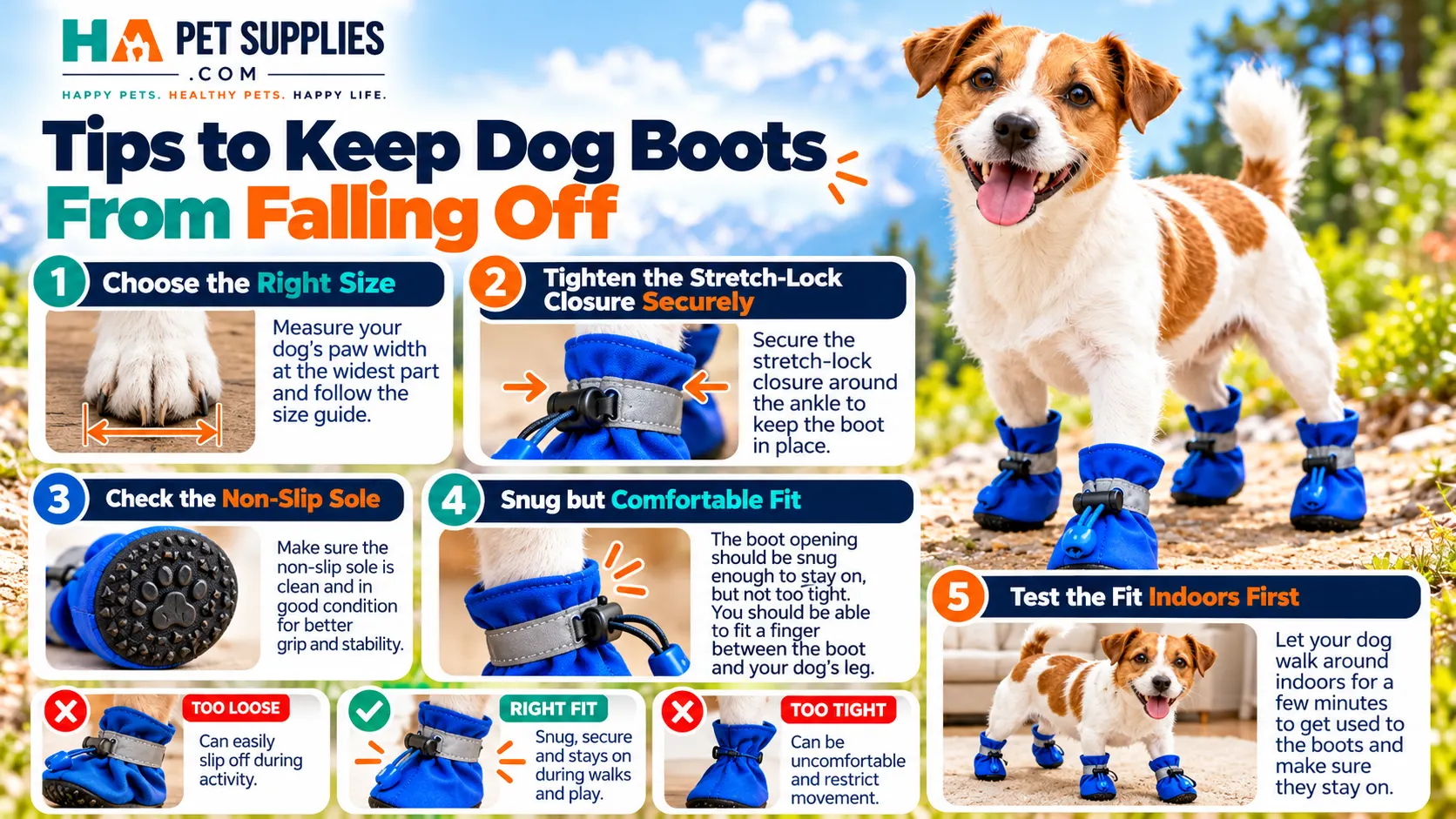
The boot stays positioned on the paw while the dog stands and walks. The sole remains under the foot rather than rotating around it.
Signs a Boot Is Too Tight
Your dog may resist wearing it, refuse to move, or repeatedly lick the affected paw. The toes may appear compressed.
Signs a Boot Is Too Loose
The boot rotates sideways. The sole shifts away from the bottom of the paw. The paw repeatedly slides forward.
The American Kennel Club’s boot fitting advice recommends trying boots indoors to assess fit and movement before relying on them outdoors.
9. Why Dog Boots Keep Falling Off
Dog boots falling off is one of the biggest frustrations for owners. Understanding the likely cause is more useful than repeatedly fastening the same straps.
Cause 1: Incorrect Paw Measurements
If the measured paw width was too small or too large, the selected boot may not fit correctly.
Cause 2: The Boot Is Too Large
Oversized boots create excess room around the paw. Adjustable straps cannot always compensate for this extra space.
Cause 3: The Closure Is Too Loose
The fastening system needs to be secured according to the product instructions.
Cause 4: The Boot Shape Is Unsuitable
Some dogs have especially narrow feet or legs. A boot shape that does not match this anatomy may be difficult to secure.
Cause 5: The Sole Is Too Stiff
Stiff footwear may interfere with natural foot movement.
Cause 6: The Dog Is Kicking Its Feet
Dogs unfamiliar with boots sometimes lift their paws exaggeratedly or shake their legs.
Cause 7: Dirt or Hair Is Affecting the Fasteners
Hook-and-loop closures can accumulate fur, dust, and debris. Clean the closures according to the manufacturer’s instructions.
Cause 8: Your Dog’s Paws Have Changed
Growing puppies may require new sizes. Weight changes, swelling, or changes in nail length can also affect fit.
10. Ten Practical Tips to Keep Dog Boots Secure
If you are struggling with footwear that repeatedly comes off, work through these ten practical tips.
Tip 1: Re-Measure All Four Paws
Start with actual measurements, not assumptions.
Tip 2: Use the Correct Front and Rear Sizes
If your dog’s rear paws are narrower than the front paws, check whether separate sizes are available.
Tip 3: Position the Paw Fully Inside the Boot
Open the boot according to the manufacturer’s instructions. Gently guide the paw into the correct position.
Tip 4: Secure the Fastening System Properly
Fasten straps where the product is designed to sit. They should hold the boot without excessive pressure.
Tip 5: Check the Sole Alignment
Before walking, look underneath the boot. The sole should be positioned beneath the paw.
Tip 6: Introduce Boots Gradually
Begin with short indoor sessions and reward calm behavior.
Tip 7: Start With Short Walks
Once your dog is comfortable indoors, try a brief walk on a safe surface.
Tip 8: Recheck Fasteners During Activity
For example, Ruffwear’s Grip Trex product guidance recommends rechecking closure adjustment during use.
Tip 9: Keep Fasteners Clean
Remove trapped fur and dirt. Allow wet footwear to dry completely after cleaning.
Tip 10: Choose a Different Design When Necessary
Sometimes the problem is not your adjustment technique. The boot may simply be the wrong shape for your dog.
11. How to Train Your Dog to Wear Boots
Even perfectly sized boots may feel unusual at first. Dogs rely on sensory information from their paws, so adding footwear changes the feeling of walking.
Stage 1: Let Your Dog Investigate the Boots
Place the footwear nearby. Allow your dog to sniff it without pressure. Reward relaxed behavior.
Stage 2: Practice Gentle Paw Handling
Touch one paw briefly. Reward the dog and release it.
Stage 3: Introduce One Boot
Place one boot on a paw for a few seconds. Offer a reward and remove the boot.
Stage 4: Try Two Boots
If your dog is comfortable, introduce footwear on two paws.
Stage 5: Introduce All Four Boots
Once the dog tolerates the earlier stages, practice wearing all four boots.
Stage 6: Encourage Natural Movement
Use positive reinforcement to encourage a few voluntary steps.
Stage 7: Practice Outside
Choose mild weather and a safe walking surface. The AKC nail-care training guidance illustrates how patient handling and positive reinforcement can help dogs become more comfortable with having their paws touched.
12. Common Dog Boot Sizing Mistakes
Avoiding common errors can save time, reduce unnecessary returns, and make footwear more comfortable.
Mistake 1: Measuring While the Dog Is Sitting
A seated dog may not distribute weight through the paw in the same way as a standing dog.
Mistake 2: Measuring Only One Paw
Front and rear paws may differ. Even left and right paws can vary slightly.
Mistake 3: Guessing by Breed
A breed name does not provide a precise paw measurement.
Mistake 4: Ignoring the Boot’s Shape
Paw width is important, but some designs may not suit unusually narrow or broad feet.
Mistake 5: Buying a Larger Size for Comfort
Extra space is not always beneficial. Too much room can cause movement inside the boot and increase friction.
Mistake 6: Tightening Straps Too Much
A painfully tight strap is not a substitute for correct sizing.
Mistake 7: Ignoring Nail Length
The AKC guide to nail trimming explains why regular maintenance matters for paw health and natural movement.
Mistake 8: Skipping the Indoor Test
A boot may appear secure when first fastened but slip once the dog moves.
Mistake 9: Ignoring Irritation
Redness, rubbing, or limping indicates that something may be wrong.
Mistake 10: Assuming Every Brand Uses the Same Sizes
A medium in one product line may be completely different from a medium in another.
13. Choosing Dog Boots for Different Activities
Correct fit is important regardless of weather, but the type of activity also influences the footwear you should choose.
Everyday Walking
For short neighborhood walks, prioritize comfort, flexibility, and reliable fastening.
Rainy Weather
Water-resistant or waterproof construction may help reduce direct contact with water.
Winter Walks
Cold weather may require insulation, moisture protection, and traction.
Hot Pavement
Appropriate boots may reduce direct paw contact with warm surfaces. If you are also managing hot-weather comfort, explore the HA Pet Supplies dog cooling vest as another product to evaluate.
Hiking and Rough Trails
Rocky terrain may require stronger protective soles and durable construction. If you are comparing different protective features for seasonal use, read our related guide: Best Dog Boots for All Weather.
14. Paw Care Before and After Wearing Boots
A good dog boot routine begins before the footwear goes on and continues after it comes off.
Before Wearing Boots
Check the paws for injuries, swelling, or foreign objects. Ensure the paws are clean and reasonably dry.
During the Walk
Observe how the dog moves. Check the boot position after the initial walking period.
After Removing Boots
Inspect the paws for redness, rubbing, or dampness. The American Kennel Club’s paw cleaning guide provides useful advice.
Check for Injuries
The VCA Animal Hospitals guide to injured paw pads explains why paw-pad injuries can interfere with walking and may need veterinary treatment.
Should You Use Dog Socks Inside Boots?
For example, Ruffwear’s Bark’n Boot liners show how specialized liners can be designed to work with protective dog footwear.
15. Choosing HA Pet Supplies Dog Boots
Once you understand how to measure dog paws for boots, the next step is choosing footwear that suits your dog’s activities and individual needs. At HA Pet Supplies, we aim to make product selection easier by providing pet owners with relevant information about available accessories.
If you are looking for protective footwear for walking and outdoor activities, you can explore the HA Pet Supplies dog boots product page.
What Should You Check Before Ordering?
First, review the product images and listed dimensions. Second, compare your dog’s paw measurements against the sizing information available for that product. Third, review the fastening system and intended use.
Why Buyers Should Focus on Fit Before Features
It is tempting to prioritize waterproof construction, reflective straps, or protective soles. But none can compensate for footwear that does not fit comfortably.
Need Help Choosing?
If you are unsure about a size or product detail, use the HA Pet Supplies contact page to request clarification. You can include the front and rear paw measurements in your message. For suitable purchasing inquiries, you can also request a quotation from HA Pet Supplies.
You can explore other accessories in our dog supplies category or browse available products through the HA Pet Supplies shop. If you are still deciding whether your dog needs footwear at all, our related article Do Dogs Need Boots? explains when protection may be helpful.
16. Frequently Asked Questions About How to Measure Dog Paws for Boots
Click each question to reveal the answer.
17. Final Checklist and Recommendations
Learning how to measure dog paws for boots can save you from purchasing footwear that repeatedly falls off, rotates during walks, or makes your dog uncomfortable.
- Your dog was standing during measurement. The toes were able to spread naturally under weight.
- You measured the widest part of each paw. Measurements were not based on breed or body weight alone.
- You recorded front and rear measurements separately. Any differences were considered before choosing sizes.
- You checked paw length if required. The measurement followed the manufacturer’s specific instructions.
- You used the correct size chart. You did not assume sizing labels were standardized.
- You considered boot shape and fasteners. The design appeared suitable for your dog’s paws.
- You planned a gradual introduction. The dog would have time to adapt before longer walks.
- You checked for discomfort. You understood the warning signs of rubbing, slipping, and pressure.
- You confirmed the intended use. The footwear matched the weather and surface conditions.
- You knew when to ask for help. Unclear sizing information would be confirmed before buying.
Final Thoughts: Secure Boots Begin With Accurate Measurements
A dog owner does not buy protective footwear because they want to spend more time adjusting straps. They buy it because they want their dog to walk comfortably and enjoy safe outdoor activity.
When a boot repeatedly falls off, it is easy to assume the dog is being difficult. But often, the problem is something that can be investigated: an incorrect measurement, an unsuitable boot shape, an improperly positioned strap, or a lack of gradual training.
If you are ready to compare protective footwear, explore the HA Pet Supplies dog boots selection and review the available sizing information before choosing a product. For additional practical guidance, visit the HA Pet Supplies pet-care blog or return to the HA Pet Supplies homepage to discover more helpful resources.
Measure carefully. Choose the right fit. Help every step feel more comfortable.