
Have you ever wondered why your cat ignores an expensive toy but becomes fascinated by a simple object rolling across the floor?
One moment, your cat is resting peacefully on the sofa. The next, it spots a small moving object, crouches low, wiggles its body, and suddenly pounces. That behavior is not random.
Cats are naturally motivated to investigate movement, pursue prey-like objects, and engage in activities that resemble hunting. This is one reason cat spring toys may be appealing to indoor cats. Unlike complicated electronic toys, lightweight spring toys rely on simple movement. A gentle paw tap can cause them to roll, shift, or move in an unexpected direction, depending on their shape and the surface beneath them.
But why do some cats become so interested in these simple toys? Are they attracted to the colors, the texture, the movement, or the opportunity to chase something? And can spring toys actually contribute to a healthier indoor play routine?
In this comprehensive guide, we will explain seven reasons cats may enjoy spring toys, how these toys relate to natural feline hunting behaviors, and what owners should understand before choosing them. You will also discover how to introduce spring toys to a cat that refuses to play, how to select appropriate toys for different life stages, and how to keep indoor play enjoyable and safe.
Quick answer: Cats may love spring toys because their lightweight, movable design encourages batting, chasing, pouncing, and investigating. Depending on the toy, unexpected rolling or spring-like movement can maintain curiosity. However, cats have individual toy preferences, and movement may matter more than bright colors.
If your cat is healthy but uninterested in its usual toys, you can try introducing a suitable spring toy during a short supervised session. If your cat suddenly stops playing, becomes unusually lethargic, or shows other concerning symptoms, contact your veterinarian rather than assuming boredom.
📋 Table of Contents
- Why cats are naturally attracted to moving toys
- What are cat spring toys?
- Seven reasons cats love spring toys
- The science of feline hunting behavior
- Do cats actually see colorful spring toys?
- Why cats carry spring toys in their mouths
- Cat spring toys compared with other interactive toys
- Are spring toys suitable for kittens, adults and seniors?
- Seven games to play with cat spring toys
- Why some cats ignore spring toys
- Creating a daily indoor play routine
- Choosing appropriate HA Pet Supplies Cat Spring Toys
- Safety precautions every owner should know
- Frequently asked questions
- Final recommendations
1. Why Are Cats Naturally Attracted to Moving Toys?
To understand why cats love spring toys, you first need to understand an important part of feline behavior. Cats are predators. Their natural behavioral repertoire includes searching, stalking, chasing, pouncing, grabbing, and sometimes carrying prey. These behaviors do not disappear simply because a cat lives indoors and receives regular meals.
A well-fed indoor cat may still become fascinated by a moving toy. The reason is that hunting-related behavior is not controlled by hunger alone. The VCA Animal Hospitals guide to enrichment for indoor cats explains that even well-fed cats remain motivated to stalk moving objects. This helps explain why a cat can ignore its food bowl yet spend several minutes watching a toy roll across the floor.
The connection between movement and curiosity
Imagine a small object lying completely still. Your cat may look at it briefly and walk away. Now imagine the same object moving across the floor. The movement creates something new for your cat to investigate. Your cat may begin tracking the object with its eyes, crouching, adjusting its position, or preparing to pounce. These responses can occur during ordinary play. The object does not need to look exactly like a mouse or insect. Its movement may be enough to encourage investigation.
Why indoor cats need suitable play opportunities
Indoor cats are protected from many outdoor hazards, but they still need opportunities to express natural behaviors. Appropriate toys can help provide some of these opportunities. According to the Feline Veterinary Medical Association’s environmental needs guidelines, cats benefit from an environment that supports play, exploration, predatory behavior, and positive interaction. Without enough opportunities for appropriate activity, some cats may develop unwanted behaviors or experience stress.
This does not mean that every inactive cat is bored. Cats naturally spend considerable time resting. However, creating opportunities for voluntary play is an important part of responsible indoor cat care.
A simple observation exercise
The next time your cat notices a moving object, watch how it responds. Does it follow the object with its eyes? Does it lower its body? Does it extend one paw? Does it chase the object once it moves away? These observations can help you identify which toys your cat enjoys most. Some cats love fast-moving objects. Others prefer slow, unpredictable movements. Understanding these preferences is more useful than assuming every cat likes the same toy.
2. What Are Cat Spring Toys and How Do They Work?
Cat spring toys are lightweight play objects designed to encourage movement-based interaction. Several designs exist. Traditional plastic spring toys often resemble small coils. Other products use flexible woven mesh in an elongated spring-like shape. These different designs may move differently. Some bounce or compress noticeably. Others primarily roll, flex, or shift when touched.
For example, HA Pet Supplies Cat Spring Toys feature colorful woven mesh designs intended for playful indoor activity. The appeal of these toys lies partly in their simplicity. A cat can touch the toy with one paw and observe how it moves.
How the spring-like structure creates movement
When a cat taps an appropriate spring toy, the force from the paw can cause the object to move. Depending on the toy’s shape, weight, flexibility, and the floor surface, it may roll, change direction, bend, or move away. This creates an opportunity for the cat to respond. The cat may chase the toy, touch it again, or watch it settle. Not every spring toy will bounce dramatically, and owners should not expect identical performance from different designs.
Why lightweight toys are useful
A lightweight toy may require less force to move. This can make it suitable for cats that enjoy batting rather than wrestling with heavy objects. Lightweight construction also allows owners to create simple rolling games. However, a toy must still be appropriately sized and made from material that does not pose an unacceptable ingestion risk. Small, flexible toys may be unsuitable for cats that chew or swallow non-food objects.
What makes spring toys different?
Unlike wand toys, spring toys do not necessarily require a person to control every movement. Unlike motorized toys, they do not require batteries. Unlike food puzzles, they are primarily intended for play rather than feeding. This makes them one possible addition to an enrichment routine. But spring toys are not a complete enrichment system. Cats also need appropriate scratching surfaces, comfortable resting locations, hiding places, and opportunities for positive social interaction. The goal is to create variety rather than rely on one product.
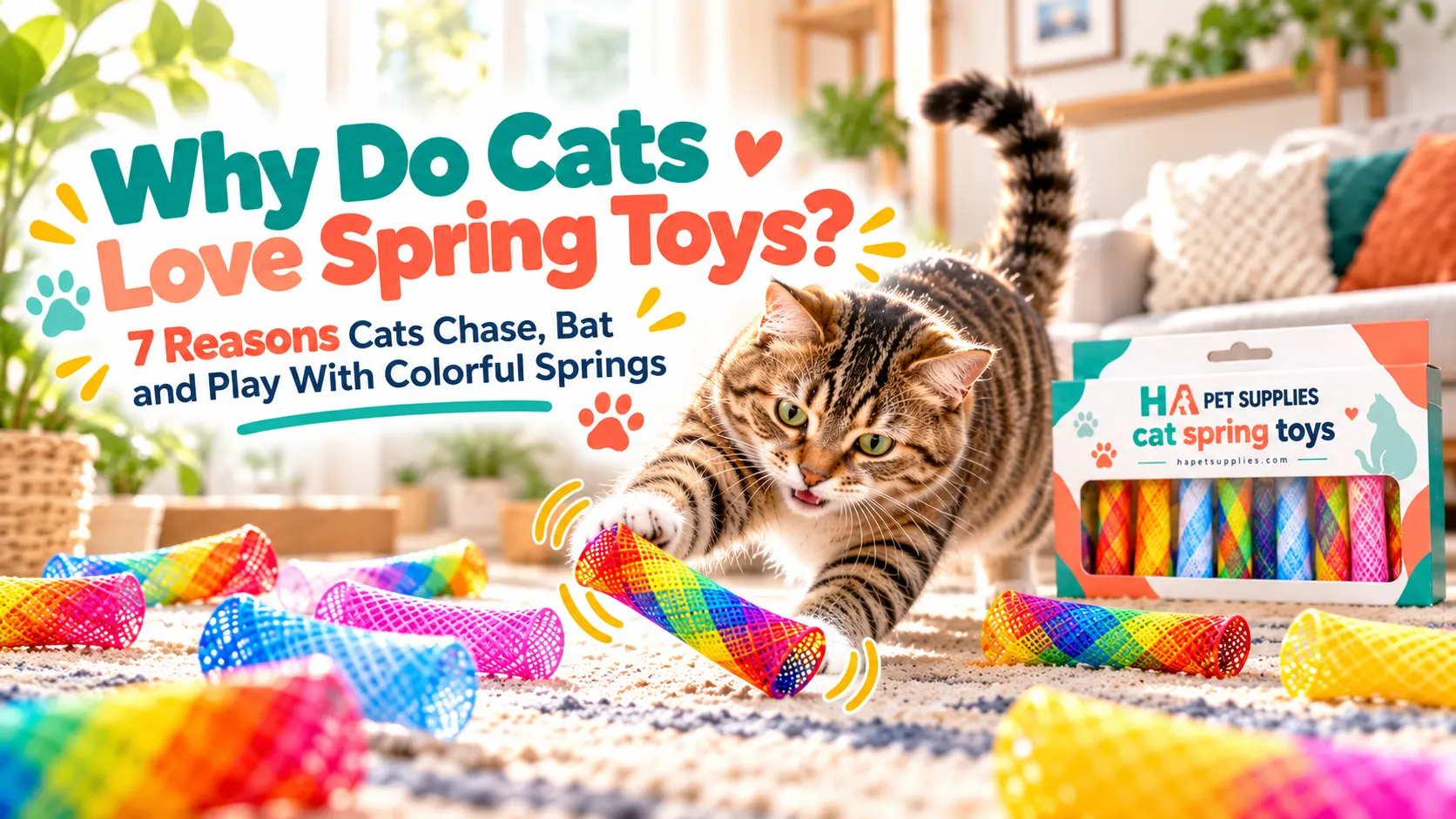
HA Pet Supplies cat spring toys encourage curious indoor play
3. Seven Reasons Cats Love Spring Toys
Now we can explore the most important question. Why do cats love spring toys so much? The answer involves several overlapping factors, including movement, curiosity, individual preferences, and opportunities to express hunting-related behavior. The following seven explanations are practical reasons why some cats may find spring toys engaging. They are not a scientifically established ranking of toy benefits, and individual reactions will vary.
🎲 Interactive 3D: Seven Reasons Cats Love Spring Toys
Hover to pause. Each face shows one reason.
1. Unpredictable Movement
Rolls in changing directions — keeps curiosity alive.
2. Easy to Bat
Lightweight design responds to gentle paw taps.
3. Hunting Instincts
Stalking, chasing, and pouncing in safe play.
4. Different Textures
Woven mesh offers a new tactile experience.
5. Short Activity Bursts
Perfect for brief, energetic play sessions.
🖱️ Hover to pause · 7 reasons in rotation
Reason 1: Unpredictable Movement Can Capture Attention
One of the most interesting features of spring toys is movement. When a cat taps a toy, it may roll or shift in a direction that is not perfectly predictable. This changing movement can encourage the cat to investigate further. For example, your cat touches a toy with its left paw. The toy rolls away. Your cat follows. It touches the toy again, causing it to move in another direction. This can create a repeating sequence of observation and action. The VCA guide to cat play and play toys explains why moving objects are appealing to cats.
Reason 2: Lightweight Toys Are Easy to Bat
Cats frequently use their front paws to investigate objects. A moving toy provides opportunities for paw-based interaction. Because many spring toys are lightweight, a relatively gentle touch may be enough to move them. This can encourage repeated batting. Some cats prefer activities involving small paw movements rather than extended running. The VCA discussion of play and investigative behavior in kittens describes how young cats naturally explore and practice chasing and batting behaviors.
Reason 3: Movement May Stimulate Hunting Instincts
Spring toys can encourage aspects of predatory play. When a toy moves, a cat may observe, stalk, chase, and pounce. These behaviors resemble parts of a natural hunting sequence. Cats do not need to capture real prey to benefit from appropriate play opportunities. A suitable toy can provide an alternative target. The Feline Veterinary Medical Association’s guide to setting up an appropriate feline environment explains that normal object play includes behaviors resembling hunting.
Reason 4: Different Textures Can Encourage Exploration
Cats investigate their surroundings using multiple senses. Touch, sight, sound, and smell can all influence how they respond to an object. A woven mesh spring toy has a different surface from a plush mouse or smooth plastic ball. Some cats may be curious about this difference. Others may prefer a smoother texture. It is important not to assume that woven mesh is universally more comfortable or enjoyable. Watch how your cat interacts with the material. If your cat damages the material or attempts to swallow strands, remove the toy.
Reason 5: Spring Toys Can Support Short Bursts of Physical Activity
Cats do not necessarily need long periods of continuous exercise to enjoy play. Many prefer short activity bursts separated by rest. A spring toy may encourage a cat to move across a small section of the floor, bat an object, or pursue it briefly. These movements can contribute to daily activity. However, the amount of exercise varies considerably. The VCA guidance on enrichment and activity toys discusses how appropriate enrichment can encourage species-specific behavior.
Reason 6: Spring Toys Offer Opportunities for Independent Interaction
Not every cat wants its owner involved in every moment of play. Some cats enjoy investigating objects independently. A suitable spring toy may give a cat the opportunity to initiate its own batting or chasing activity. However, this does not mean every spring toy is safe to leave accessible when no one is present. Flexible materials, broken components, and individual chewing habits can create hazards. Start with supervised play and evaluate the specific toy and your cat’s behavior. The 2024 Feline Veterinary Medical Association indoor and outdoor lifestyle statement highlights the importance of environmental enrichment and simulated hunting for indoor cats.
Reason 7: Spring Toys Can Add Variety to a Daily Routine
Cats may lose interest when they encounter the same toy in the same way every day. Offering different activities can make playtime more interesting. One day, your cat may enjoy batting a spring toy. Another day, it may prefer a wand or puzzle feeder. Rotating toys can provide novelty. The PetMD guide to choosing cat toys recommends considering movement, individual preferences, and toy rotation. You do not need to buy something new every week. Simply storing a suitable toy temporarily and reintroducing it later may help maintain interest.
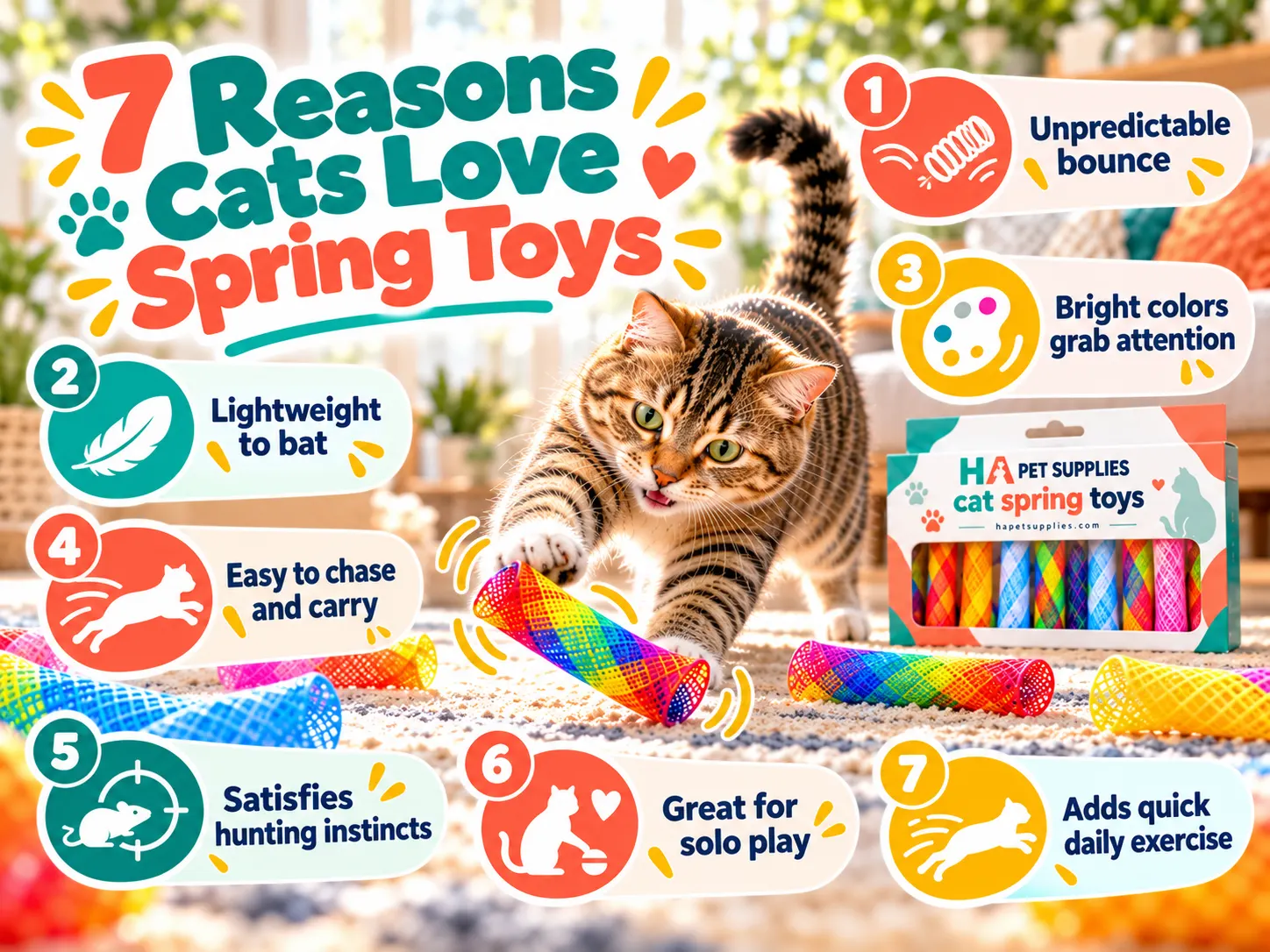
Seven reasons cats enjoy batting and chasing spring toys
4. The Science Behind Feline Hunting Behavior
Understanding how cats hunt can explain why apparently simple toys become interesting. A typical predatory sequence may involve several behaviors. These include searching, watching, approaching, stalking, chasing, pouncing, and capturing. Not every hunting event contains every stage. During play, cats may perform parts of this sequence repeatedly.
Watching and tracking
Before moving, a cat often observes a target. You may notice focused eyes, forward-directed ears, or a crouched position. The cat is gathering information about the object’s movement.
Stalking
A cat may lower its body and approach slowly. This can help it prepare to pounce. During a spring-toy game, the cat may stalk the object as it moves across the floor.
Chasing
Once the target moves, the cat may pursue it. The speed and distance of the chase depend on the cat’s physical condition and interest.
Pouncing and batting
A cat may jump toward the toy or strike it with a front paw. This is commonly observed in ordinary play.
Capturing
Cats often benefit from opportunities to catch their toys. If the target always escapes, some cats become frustrated or lose interest. The AAFP and ISFM Environmental Needs Guidelines explain that simulated prey should be available for capture at intervals during play.
Why this matters for indoor cats
An indoor cat may spend most of its time in a predictable environment. Providing moving toys, puzzle feeders, and interactive games creates opportunities for behaviors that would otherwise occur less often. However, play is only one part of enrichment. Cats also need spaces where they feel safe, comfortable resting areas, appropriate scratching opportunities, and predictable access to essential resources.
5. Do Cats Actually See the Bright Colors of Spring Toys?
Many spring toys are available in bright pink, blue, yellow, green, and multicolored combinations. But do cats see those colors the same way humans do? Not exactly. Cats have different visual capabilities from humans. Their color vision is more limited, with sensitivity generally associated with blue and yellow ranges. Red and green may be more difficult for cats to distinguish. The PetMD veterinary-reviewed guide to cat vision explains these differences in feline eyesight and highlights the importance of movement.
Why color is not the whole story
A brightly colored toy may look attractive to a human buyer. But a cat may respond more strongly to how the object moves than to its color. Contrast with the floor can also affect visibility. For example, a blue or yellow toy might stand out on certain surfaces. A toy that blends into the background may be harder to notice. However, the exact response depends on the environment and the individual cat.
Does this mean multicolored toys are pointless?
No. Color can still contribute to visibility and presentation. Multicolored toys can also be easier for people to find during cleaning. But owners should avoid claims that rainbow colors automatically create excitement or guarantee more activity.
How to test your cat’s preferences
Try presenting appropriately sized toys in different colors or textures during separate play sessions. Keep the surrounding environment similar. Observe whether your cat consistently chooses one option. Do not force a preference. Individual behavior is more useful than broad assumptions.
6. Why Do Cats Carry Spring Toys in Their Mouths?
Some cats do more than bat spring toys. They may pick them up, carry them across the room, or place them near their owners. This behavior can be surprising, especially when the cat repeatedly returns to the same toy.
Carrying is part of the feline play repertoire
Cats sometimes pick up and carry objects during play. This behavior resembles aspects of prey handling. A cat may capture an object, hold it briefly, and move to another location. However, carrying a toy does not prove that the cat believes it is real prey. It is simply one possible expression of normal object play.
Why cats bring toys to people
Some cats bring toys to their owners. The reasons may vary. The cat may be seeking interaction, transporting a preferred object, or repeating a behavior that has previously received attention. Avoid assigning a single emotional explanation to every cat. Instead, observe the context. If your cat brings a toy and appears interested in interaction, you can offer an appropriate game.
What about cats that hide spring toys?
A cat may push toys under furniture or carry them to a familiar area. This can be part of ordinary exploration and play. However, toys trapped beneath heavy furniture should only be retrieved safely. Do not encourage a cat to reach into dangerous gaps.
Important safety consideration
Carrying a suitable toy is different from chewing off and swallowing pieces. If your cat tears mesh strands, bites off fragments, or attempts to eat the toy, remove it immediately. Choose a more appropriate alternative and contact your veterinarian if your cat repeatedly consumes non-food materials.
7. Cat Spring Toys vs Other Interactive Cat Toys
With so many products available, how should you choose between cat spring toys, balls, feather wands, plush toys, and puzzle feeders? The answer depends on the experience you want to provide. Different toys support different activities.
| Toy Type | Main Activity | Owner Involvement | Best For |
|---|---|---|---|
| Cat spring toys | Batting and chasing | Low to moderate | Cats attracted to moving floor toys |
| Feather wand toys | Stalking and pursuit | High | Interactive hunting-style games |
| Rolling balls | Batting and running | Low to moderate | Cats that enjoy rolling movement |
| Puzzle feeders | Foraging and problem-solving | Setup and monitoring | Food-motivated cats |
| Plush mouse toys | Grabbing and carrying | Varies | Cats that enjoy capturing objects |
| Play tunnels | Hiding and exploration | Low to moderate | Cats that enjoy enclosed spaces |
| Ball track toys | Repeated batting | Low to moderate | Cats that prefer contained movement |
When should you choose cat spring toys?
Spring toys may be a good option when your cat enjoys chasing lightweight objects. They may also appeal to owners looking for simple, non-electronic play opportunities. However, they should be selected according to size, material quality, and the cat’s chewing habits.
When are feather wands better?
Wand toys allow owners to direct movement. This may be helpful for cats that prefer interactive games. They should be stored securely after play because strings and attachments can create hazards.
When are puzzle feeders more useful?
Puzzle feeders may be especially helpful for food-motivated cats. They encourage manipulation, investigation, and foraging. The VCA guide to enrichment and foraging toys explains how food-based enrichment encourages species-specific behaviors.
Should you buy several toy types?
Usually, offering a small variety is more practical than depending on one toy. For example, you might combine a supervised spring-toy session with a wand game and a suitable puzzle feeder. You can browse the HA Pet Supplies cat supplies collection to compare products intended for different kinds of feline enrichment.
If you are still deciding which toy type to purchase first, read our related article on the best cat toys for bored indoor cats. That guide explains how to combine toys for movement, exploration, and mental stimulation.
8. Are Cat Spring Toys Suitable for Kittens, Adult Cats and Senior Cats?
Age can influence how a cat interacts with toys. However, age alone does not determine what a cat will enjoy. Health, mobility, personality, confidence, and previous experiences also matter.
Cat spring toys for kittens
Kittens often demonstrate strong play motivation. They may enjoy chasing lightweight objects, exploring textures, and practicing paw movements. However, kittens also investigate objects with their mouths. Choose appropriate sizes and supervise new toys closely. Avoid damaged toys or anything containing loose strands or detachable pieces. The VCA kitten play and investigative behavior guide explains the importance of age-appropriate exploration and play.
Cat spring toys for adult cats
Many adult cats enjoy short play sessions throughout the day. Some respond to moving toys immediately. Others prefer to watch before approaching. Use your cat’s behavior to guide the activity.
Cat spring toys for senior cats
Senior cats can continue enjoying play. However, mobility limitations, reduced vision, pain, and other medical conditions may change their preferences. A senior cat may prefer gentle floor-based batting rather than jumping. Choose an activity that allows your cat to remain comfortable. Stop if your cat shows pain or exhaustion.
What about overweight cats?
Appropriate movement can contribute to a healthy routine. However, an overweight cat may need a gradual approach. Avoid forcing prolonged activity. Discuss weight management and exercise with your veterinarian, particularly if your cat has existing health problems.
9. Seven Fun Games to Play With Cat Spring Toys
Knowing why cats love spring toys is useful, but owners also need practical ideas. Here are seven simple games that can turn a basic toy into an enjoyable supervised activity.
Gentle Floor Roll
Bat & Chase
Short Retrieval
Safe Tunnel Game
Toy Choice
Obstacle Course
Family Play
Game 1: Gentle Floor Roll
Place one inspected spring toy on a clear floor. Roll it a short distance. Allow your cat to watch and decide whether to chase. If your cat follows the toy, allow it to touch and capture it. This is an excellent introductory game.
Game 2: Bat and Chase
Place the toy within comfortable paw reach. Wait for your cat to touch it. If it moves, allow your cat to follow. Avoid interfering with the toy every few seconds. Let your cat control part of the activity.
Game 3: Short-Distance Retrieval
Some cats enjoy retrieving toys. If your cat naturally carries objects, gently roll a suitable spring toy across the floor. Allow your cat to collect it. If the cat brings it back, reward the behavior with attention or another appropriate positive experience. Do not force retrieval.
Game 4: The Safe Tunnel Game
Place a cat tunnel on the floor. Roll a spring toy near one entrance. Your cat may investigate the toy or move through the tunnel. Keep both exits clear. Never trap your cat inside the tunnel.
Game 5: Toy Choice Challenge
Present two different suitable toys during a supervised session. Place them a short distance apart. Observe which one your cat approaches. You can use this information to understand preferences. Do not assume one choice represents a permanent preference.
Game 6: Gentle Obstacle Course
Create a simple route using safe, stable household objects. Leave enough space for your cat to move comfortably. Roll a spring toy along a clear section of the route. Allow your cat to investigate without pressure. Do not create obstacles that encourage dangerous jumping.
Game 7: Interactive Family Play
Invite one family member to gently roll an appropriate toy toward a clear play area. Allow your cat to chase or bat it. Another family member may participate during a separate turn. Avoid throwing toys toward the cat’s face or surrounding the cat with people. Every game should remain voluntary.
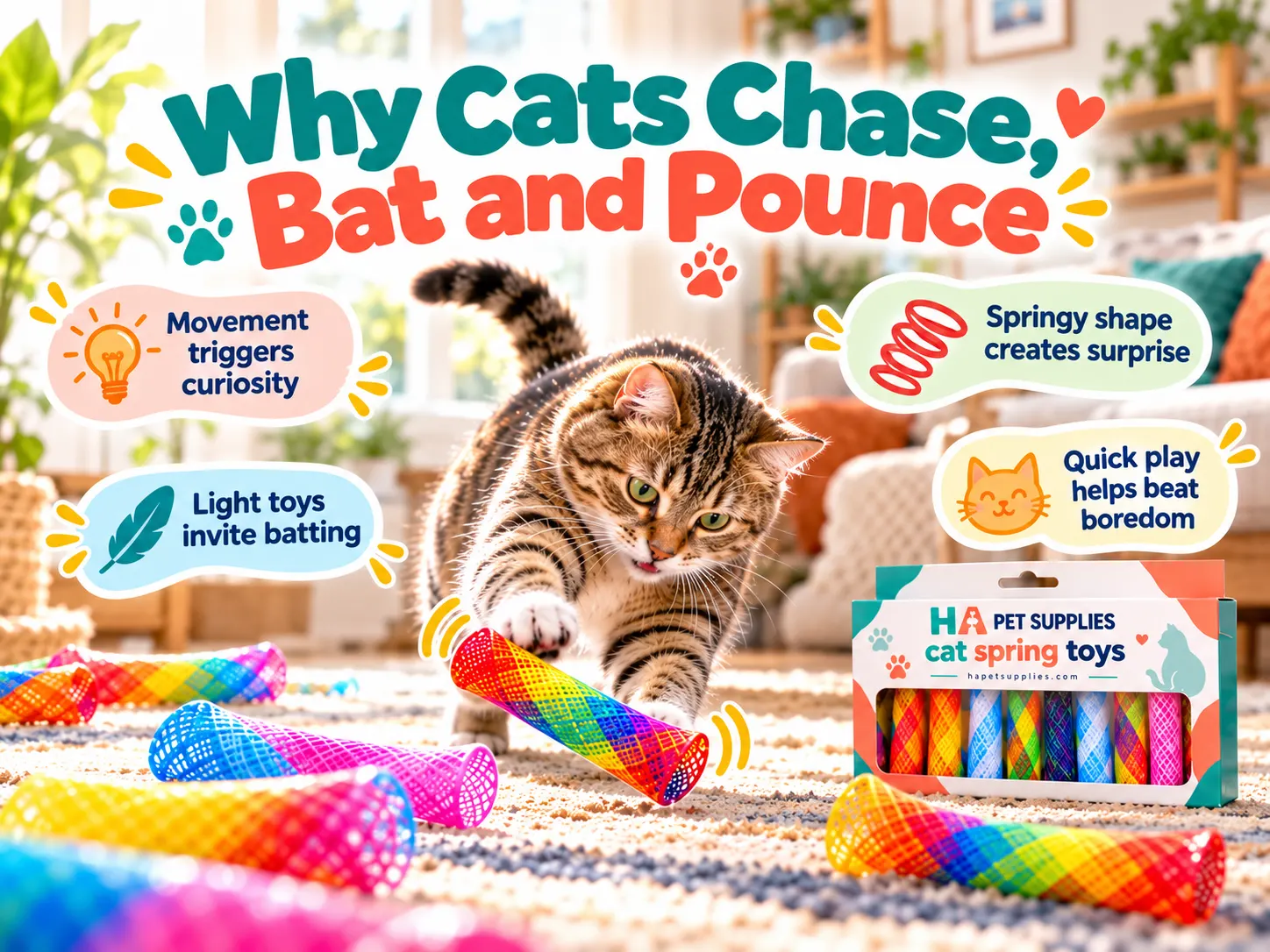
Colorful mesh spring toys for enjoyable supervised cat play
10. Why Does My Cat Ignore Spring Toys?
Not every cat will love spring toys. This is completely normal. Some cats prefer feather wands, plush mice, food puzzles, or different kinds of movement. Others may need more time to become comfortable with an unfamiliar object.
The movement may not be interesting
A toy lying motionless may not attract attention. Try gently rolling it across the floor. Observe whether movement changes your cat’s response.
Your cat prefers another texture
Some cats like soft toys. Others prefer smooth balls or toys with different sounds. There is no universal preference.
Your cat feels uncomfortable
A nervous cat may avoid a new object if the environment feels unpredictable. Introduce toys in a calm location. Allow the cat to retreat whenever it chooses.
Your cat is not interested in playing right now
Cats have natural periods of rest and activity. A cat that ignores a toy at midday may become more interested later. Try offering play during periods when your cat is normally alert.
The toy may be inappropriate
A toy that is too large, too small, noisy, or difficult to manipulate may not suit your cat. Evaluate the product rather than assuming your cat simply dislikes playing.
Your cat may be unwell
Sudden loss of interest in previously enjoyable activities can be a sign of pain, illness, or other problems. If your cat becomes unusually inactive, stops eating, hides persistently, or shows other concerning changes, contact your veterinarian.
How to reintroduce a spring toy
Start with a quiet room. Place the toy on the floor. Let your cat investigate. If the cat appears comfortable, move it gently. Keep the session short. End positively. Repeat later if your cat shows interest. Do not force interaction.
11. How to Build a Daily Indoor Play Routine
For many owners, the biggest challenge is not choosing a toy. It is finding time to use it consistently. A simple daily routine can make enrichment easier to maintain.
🕐 Interactive 3D: Daily Cat Enrichment Timeline
Hover over each stage to see its purpose.
Morning Play
Short interactive game when your cat is naturally active.
Afternoon Enrichment
Safe resting, scratching, climbing, and observation spots.
Evening Interaction
Supervised spring toy or wand session on a clear floor.
Rest
Quiet time and comfortable sleeping areas.
Morning: A short interactive game
Offer an appropriate toy during a time when your cat is naturally active. This could involve a wand toy or an inspected spring toy. Let your cat investigate, chase, and catch it. End before the cat becomes tired or frustrated.
Afternoon: Environmental enrichment
Provide safe places to rest, scratch, climb, or observe the surroundings. If someone is available to supervise, offer another short play session. If no one is home, do not leave hazardous toys or loose materials accessible.
Evening: A supervised movement game
Try a short spring toy activity on a clear floor. Allow your cat to choose whether to participate. You can finish with a suitable meal or reward if that fits your cat’s feeding plan.
How long should play sessions last?
There is no single correct duration for every cat. Some cats enjoy brief sessions lasting a few minutes. Others may prefer longer periods of interaction. The VCA guide to cat play and toys recommends adjusting playtime according to the cat’s interest and natural activity periods. As a practical starting point, owners can try several short sessions and modify the routine based on their cat’s comfort and enthusiasm.
Signs that a session should end
Stop when your cat walks away, becomes distressed, or shows signs of discomfort. Also stop if the toy becomes damaged. Play should be an enjoyable choice, not something imposed on your cat.
12. How to Choose HA Pet Supplies Cat Spring Toys
If your cat enjoys batting and chasing lightweight objects, spring toys may be worth considering. HA Pet Supplies offers woven mesh spring toys designed for indoor play. Their colorful appearance and lightweight construction can make them an interesting option for cats that respond to moving objects. However, a product’s appearance does not guarantee that every cat will enjoy it.
Understand the toy design
The HA Pet Supplies design uses an elongated woven mesh structure. Unlike some molded coil-style toys, the mesh design may flex and roll differently. Choose based on the kind of movement your cat seems to prefer.
Inspect materials carefully
Before offering any toy, check the construction. Look for loose strands, rough edges, weakened sections, or other damage. If the toy begins to unravel or break, remove it.
Consider your cat’s size
Choose toys that are appropriate for your cat’s mouth and body size. Avoid toys that can be swallowed whole.
Observe your cat’s behavior
A cat that enjoys batting objects may respond positively. A cat that chews or eats non-food materials may need a different toy type.
Use supervised play initially
Introduce the toy while you are present. Observe whether your cat bats, chases, carries, or chews it. This helps determine whether the product is suitable for continued use.
Why choose HA Pet Supplies?
HA Pet Supplies focuses on practical pet products designed for everyday care and activity. Its cat spring toys offer a simple option for owners seeking colorful, lightweight enrichment toys. You can explore the available design on the HA Pet Supplies Cat Spring Toys product page. For additional products, browse the HA Pet Supplies online shop and compare toys according to the type of activity they encourage.
13. Are Cat Spring Toys Safe? Important Precautions
Spring toys can be entertaining, but they are not automatically suitable for every cat. Safety depends on the toy’s construction, size, condition, and the individual cat’s behavior.
Inspect before play
Check for loose strands, broken sections, sharp edges, or detached components. Remove damaged toys immediately.
Supervise play
Supervision is particularly important when introducing a toy. It is also essential for cats that chew unfamiliar objects or attempt to ingest non-food materials.
Prevent ingestion hazards
Flexible mesh may become unsafe if it tears or frays. Do not continue using a toy once strands begin separating. The Cornell Feline Health Center’s guide to safe toys and gifts advises owners to avoid toys with parts that can separate and be swallowed.
Keep the play area clear
Remove fragile objects, electrical cords, and other hazards from the immediate play area.
Watch for unusual chewing behavior
If your cat repeatedly tries to eat pieces of toys, remove the object and consult your veterinarian.
Store toys appropriately
Do not leave unsafe or damaged items accessible. Store toys in a suitable container when they are not being used.
Clean toys as directed
Follow the manufacturer’s care instructions. Allow cleaned toys to dry thoroughly before storing them.
Stop if your cat becomes distressed
If your cat appears frightened, uncomfortable, or exhausted, end the session. Avoid forcing continued play.
Seek veterinary help when needed
If your cat swallows a piece of a toy or begins showing signs such as vomiting, repeated retching, abdominal discomfort, or lack of appetite, contact a veterinarian promptly. Do not induce vomiting or pull visible swallowed string without veterinary instructions. For a detailed safety checklist, visit our related article on cat spring toy safety for kittens and adult cats.
14. Frequently Asked Questions About Cat Spring Toys
Some cats enjoy spring toys because their movement creates opportunities for batting, chasing, and pouncing. The lightweight structure may allow the toy to move after relatively gentle contact. Individual preferences vary.
Appropriately sized and intact spring toys may provide useful play opportunities for indoor cats. They should complement other enrichment activities and be used with suitable supervision.
Color may contribute to visibility, but movement, contrast, texture, and individual preference can be more important. Cats do not see colors exactly as humans do.
Carrying objects can be part of normal feline play. Some cats pick up toys after capturing them. Others move preferred objects to familiar areas.
Some kittens may enjoy appropriate spring toys, but close supervision is important. Avoid small or damaged toys that could be swallowed.
Some senior cats enjoy gentle batting games. However, activities should suit their mobility, comfort, and health.
Some cats enjoy interacting with spring toys independently. However, owners should not assume every toy is safe to leave available without supervision. Consider the toy’s material, condition, size, and the cat’s chewing behavior.
Your cat may prefer another texture, movement pattern, or type of interaction. Temporary toy rotation and changes in playtime may help. Sudden loss of interest in all activities deserves veterinary attention.
Spring toys may contribute to enrichment by providing movement-based activities. However, they cannot replace the broader environmental and social needs of an indoor cat.
Neither is universally better. Spring toys may suit cats that enjoy batting floor objects. Wand toys allow owners to control movement during interactive games.
There is no required schedule. Some owners rotate toys every few days or weekly. Observe how your cat responds.
No. Many cats enjoy simple, appropriate toys and safe household enrichment activities. Material quality, safety, movement, and individual preference matter more than price. The ASPCA’s feline DIY enrichment guide provides ideas for low-cost supervised activities.
During play, a moving object may roll beneath furniture. Some cats then attempt to retrieve it. Make sure retrieval areas are safe and do not allow access beneath unstable or hazardous furniture.
Movement-based play may contribute to activity, but weight management also involves nutrition and veterinary guidance. Start slowly and avoid forcing prolonged exercise.
Yes. Different materials and shapes may influence how toys flex, roll, bounce, and feel. Choose based on your cat’s preferences and safe use requirements.
Place it in a safe area, allow your cat to investigate, and gently introduce movement. Use short supervised sessions and avoid forcing interaction.
Remove the toy if your cat bites off material or attempts to swallow it. Inspect for damage and choose a safer alternative. Contact a veterinarian if your cat has swallowed part of the toy.
Look for voluntary interest, repeated engagement, relaxed behavior between activity bursts, and willingness to return to the toy. A cat walking away is also communicating a preference. Respect the decision to stop.
15. Final Thoughts: Why Cats Love Spring Toys and How to Choose the Right Ones
Cats are naturally curious animals with a strong capacity for play. They may enjoy investigating movement, batting lightweight objects, chasing toys, and practicing aspects of hunting behavior. That is why cat spring toys can be appealing to some indoor cats. Their simple design can offer opportunities for repeated interaction without complicated electronic features.
However, the real value of a toy depends on how well it matches your individual cat. A toy that one cat loves may be ignored by another. Instead of purchasing large numbers of similar products, start with a small selection of suitable toys. Observe your cat’s preferences. Offer predictable opportunities for positive interaction. Rotate toys when appropriate. And always prioritize safety.
For cats that enjoy batting and chasing lightweight moving objects, HA Pet Supplies Cat Spring Toys may be a useful addition to a varied indoor enrichment routine. You can also explore more educational articles through the HA Pet Supplies blog to better understand your cat’s behavior and needs.
If you have questions about product selection or suitability, contact the HA Pet Supplies team. For wholesale, bulk, or business purchasing inquiries, you can request a quote from HA Pet Supplies.
At HA Pet Supplies, we believe that thoughtful pet care begins with understanding the everyday needs of cats and their owners.
The best toy is not necessarily the most expensive or colorful. It is the one your cat can enjoy safely, comfortably, and voluntarily.
Shop Cat Spring Toys Browse Cat Supplies