
Dog car travel comfort is not just about giving your dog a soft place to lie down. A dog can have a padded seat and still spend the entire journey panting, pacing, slipping, standing awkwardly, trying to climb forward, whining, refusing to lie down, drooling, or becoming nauseous.
That is because car comfort depends on several different things at once. Your dog needs enough physical space to settle. The travel surface needs to feel stable. The vehicle needs appropriate ventilation and temperature. Your dog needs to understand the travel routine. And if anxiety or motion sickness is involved, simply adding more padding may not solve the real problem.
For some dogs, one of the biggest physical problems is the shape of the rear seat itself. A large dog may technically “fit” on the bench but still have nowhere comfortable to stretch out because the rear footwell interrupts the usable area. A soft hammock may protect the seats but still sag toward the gap. A slippery leather seat may make every turn feel like work.
That is where a dog seat extender can become useful. A hard-bottom back seat extender can bridge the rear footwell and create a larger continuous surface where the dog can sit, turn, and lie down more naturally. But it should be viewed as one part of the comfort equation, not a magic fix for every travel problem.
If you are still deciding which extender actually fits your vehicle, start with the pillar guide on how to choose a dog seat extender by size, hard-bottom support, vehicle fit and features.
If you already own one and your main question is restraint, read the supporting safety guide on dog car travel safety and using a back seat extender without compromising restraint.
This article focuses on a different question: How do you make the entire ride physically and emotionally easier for the dog?
Quick Answer: What Makes Car Rides More Comfortable for Dogs?
If the reader is stressed and wants the fastest answer, give them this early. A more comfortable dog car setup usually includes:
- Enough room to sit, turn, and lie naturally
- A stable, non-sagging travel surface
- Appropriate restraint
- Familiar bedding or comfort items
- Gradual practice before long journeys
- Good cabin ventilation and temperature
- Planned water and bathroom breaks
- Positive destinations and travel associations
- Veterinary advice when anxiety or motion sickness persists
AKC specifically recommends short pleasant trips, familiar comfort items, regular water and potty breaks, and a cool, well-ventilated cabin. American Kennel Club
The CDC likewise recommends gradually increasing car-trip duration, bringing water and travel essentials, and making frequent stops so dogs can stretch and relieve themselves. CDC pet travel guidance
Why Are Some Dogs Uncomfortable in the Car?
Before buying more accessories, identify the actual problem. A dog may struggle in the car because of: poor footing, limited space, sagging support, anxiety, motion sickness, heat, unfamiliar noise, negative past experiences, restraint discomfort, too much energy before departure, or trips that always lead somewhere unpleasant.
AKC notes that dogs may dislike car travel because of motion sickness, anxiety, negative associations, or stressful destinations. AKC car anxiety prevention
VCA similarly explains that distressed dogs may salivate, pace, whine, bark, or vomit, and that anxiety and nausea can occur together. VCA Hospitals
That means the best solution starts with diagnosis.
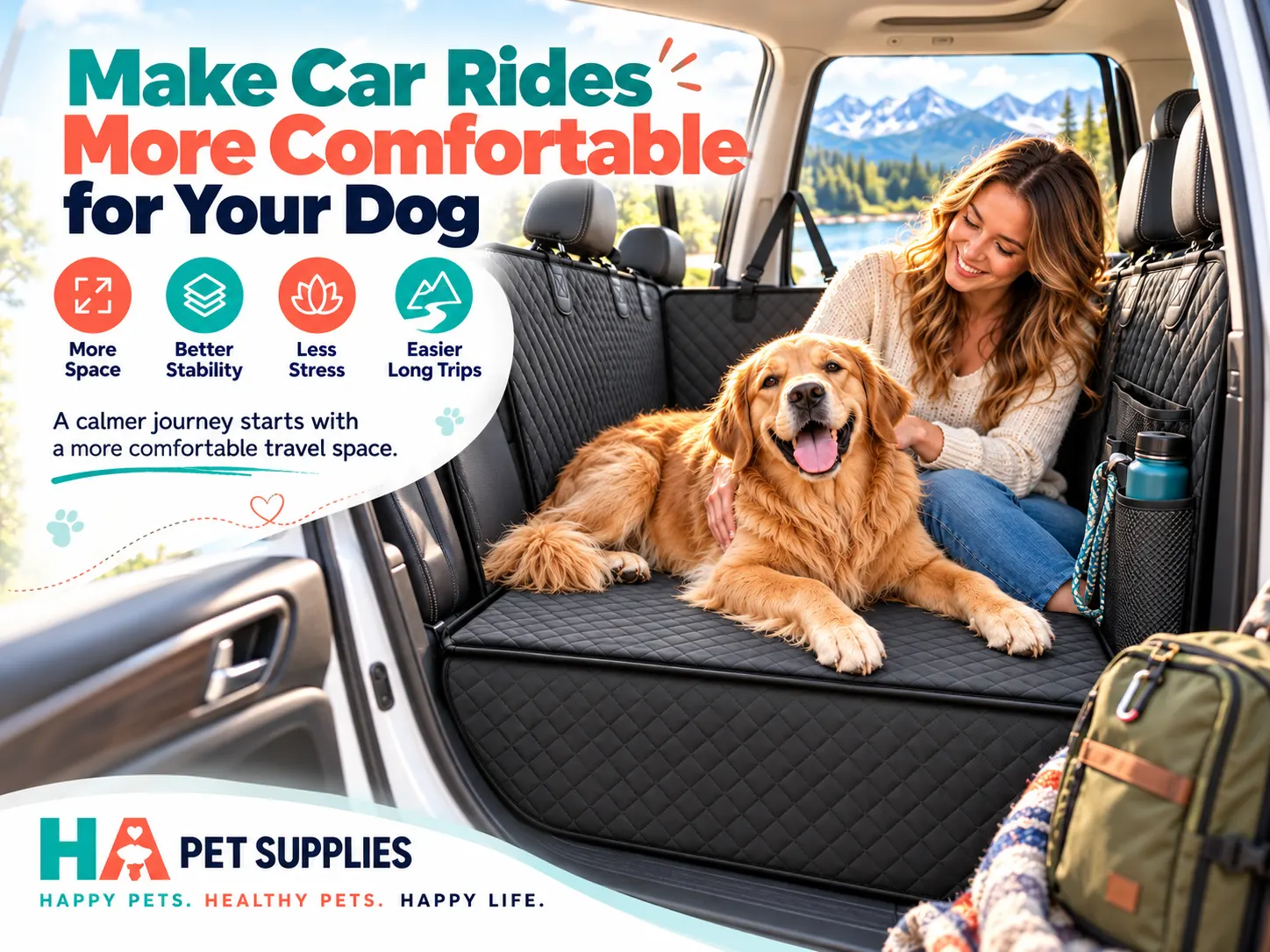
More usable back-seat space can help a dog stretch out and settle more naturally during everyday travel.
Dog Car Travel Comfort Starts With Space
One of the simplest physical problems is not having enough usable room. A standard rear bench may look wide enough from outside the vehicle. But the usable area is often much smaller once you consider: seat depth, the footwell gap, front-seat position, door shape, seat-belt buckles, center console, and the dog’s body length.
A large dog may spend the trip with front paws near the seat edge, hindquarters twisted sideways, body partly supported and partly over the footwell, and no room to lie lengthwise. That can lead to constant repositioning. A dog that keeps standing up is not always anxious. Sometimes the dog simply cannot find a comfortable position.
How a Dog Seat Extender Creates More Usable Space
A dog seat extender does not make the vehicle itself bigger. Instead, it converts part of the rear footwell into usable surface area. Think of it this way: Standard back seat: bench + open gap + front seat. With hard-bottom extender: bench + supported platform over gap + larger continuous surface.
This can matter particularly for: Golden Retrievers, Labradors, German Shepherds, older dogs, long-bodied dogs, and two-dog households. The HA Pet Supplies dog seat extender is an example of this hard-bottom style, intended to create a broader travel surface across the rear seating area.
Does More Space Automatically Mean More Comfort?
No. More space is helpful only if the surface itself feels usable. A large platform that slides, sags, folds unexpectedly, feels unstable, or has slippery fabric may still make the dog uncomfortable. So space and stability must be considered together. That is why hard-bottom support is such an important difference between an extender and many basic hammock covers.
Dog Car Travel Comfort Depends on Stability
Imagine trying to relax on a sofa that moves under you every time the car turns. That is roughly what an unstable back-seat surface can feel like to a dog. Dogs rely on their paws and body position to brace themselves during acceleration, braking, curves, lane changes, and rough roads.
A flat, supported travel surface can make these normal movements easier to manage. This does not mean a hard-bottom extender should be described as a crash-safety device. It simply means it can improve ordinary physical stability.
For restraint-specific guidance, readers should be sent naturally to your dog car travel safety guide.
Hard-Bottom Extender vs Sagging Hammock for Comfort
A regular hammock may be perfectly adequate for some dogs. Its main advantages can include: seat protection, light weight, fast installation, and easy folding. But larger dogs may cause the middle section to sag downward toward the footwell. That can create: uneven footing, reduced lying space, pressure toward the center, and constant repositioning.
A hard-bottom extender attempts to keep that area flatter. For a small dog, the difference may be minor. For a large dog that wants to stretch out, it can be much more noticeable. This is another reason the dog seat extender buying guide belongs naturally in this section.
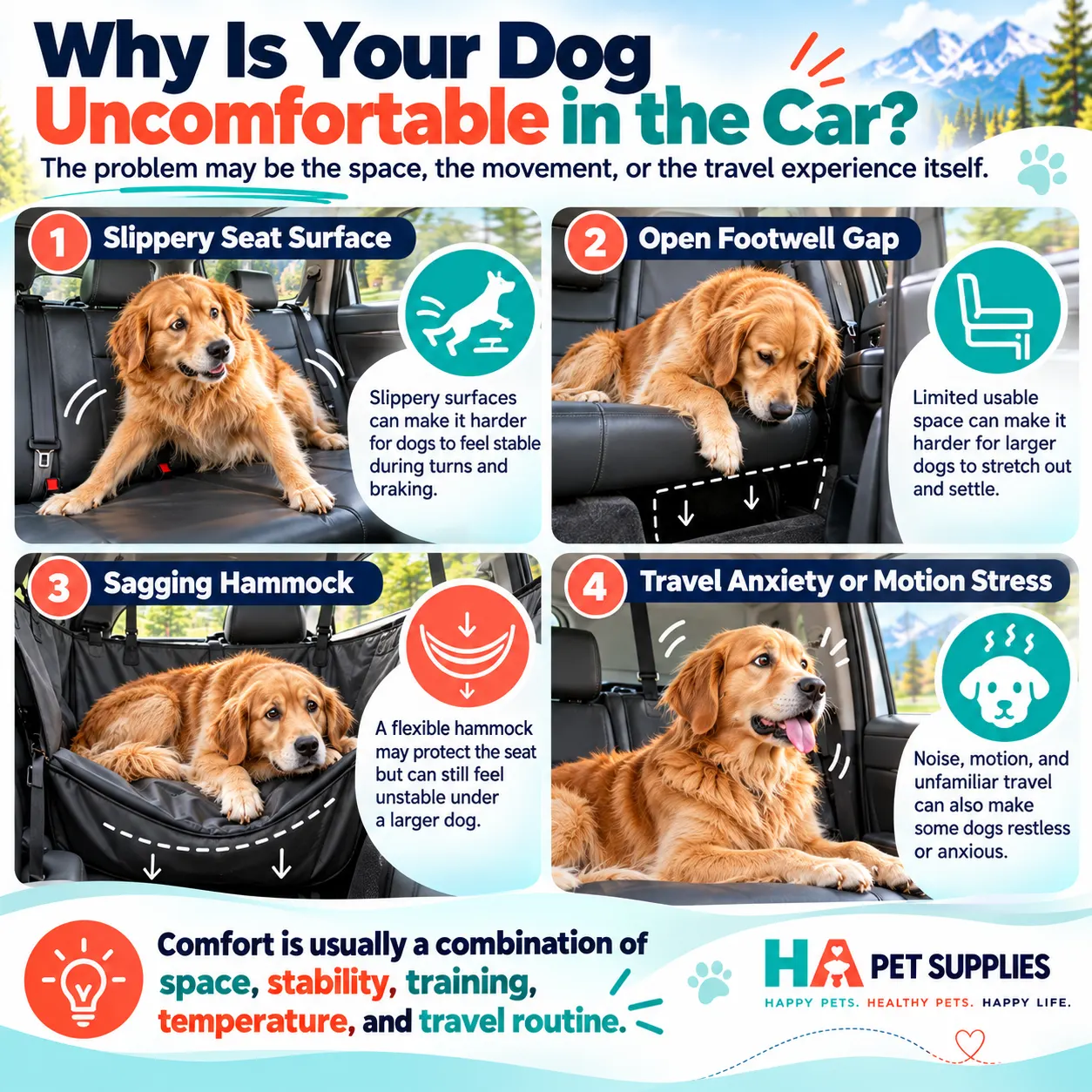
Slippery surfaces, an open footwell, sagging support, and travel anxiety can all make car rides harder for dogs.
3D Infographic: Why Your Dog May Not Be Settling
🛝 Slippery Surface
Problem: The dog keeps bracing during turns.
Possible improvement: Use a more stable, grippy surface.
Stability Fix📏 Limited Space
Problem: The dog repeatedly stands up because there is no natural lying position.
Possible improvement: Create more usable rear-seat area.
Space Fix📉 Sagging Support
Problem: The travel surface dips toward the footwell.
Possible improvement: Consider a reinforced platform if appropriate for the vehicle and dog.
Support Fix😰 Anxiety or Motion Sickness
Problem: Panting, whining, drooling, pacing, vomiting, or refusing to enter the car.
Possible improvement: Use gradual training and speak with a veterinarian if symptoms persist.
Vet SupportDog Car Travel Comfort and Anxiety Are Not the Same Thing
This distinction is critical. A dog can be physically comfortable but emotionally distressed. And a dog can be emotionally calm but physically unable to settle on a poor surface.
Signs of possible anxiety may include: trembling, panting, whining, refusing treats, hiding, reluctance to enter the vehicle, pacing, and trying to escape.
AKC recommends gradual desensitization and counter-conditioning, introducing the car at a level where the dog remains relaxed and pairing the experience with things the dog enjoys. AKC car anxiety prevention
Blue Cross also recommends introducing dogs to the vehicle gradually, beginning with short exposure while the car is stationary and rewarding calm behaviour. Blue Cross
How to Help a Dog Become More Comfortable With the Car
A good progression is:
Start Outside the Parked Vehicle
Let the dog approach the car without forcing entry. Reward calm behaviour.
Sit in the Stationary Car
No driving. No pressure. Let the dog experience the space.
Introduce the Complete Travel Setup
Include extender, mat, harness, restraint, and familiar blanket.
Start the Engine
Stay parked. Let the dog hear and feel the vibration.
Drive a Very Short Distance
Think: driveway, around the block, nearby park.
Increase Duration Gradually
Only progress when the dog remains comfortable.
AKC and VCA both support this gradual approach to reducing travel anxiety and motion-related stress.
Do Not Force an Anxious Dog Into the Car
This is worth saying clearly. Forcing the dog into the vehicle can increase the negative association. AKC specifically recommends moving at a pace where the dog remains comfortable rather than progressing when the dog is showing stress.
If the dog refuses food, trembles, backs away, tries to escape, or freezes, you may be moving too fast. Go back to the previous stage.
Use Positive Destinations, Not Just Veterinary Trips
Many dogs learn: Car = vet. Then owners wonder why the dog hates the car. Break that association. Take short rides to a park, a quiet walking trail, a friend’s house, a training class, or a safe outdoor area.
AKC recommends mixing pleasant destinations into the dog’s routine so car travel is not associated only with stressful events. This is especially useful for dogs that show anxiety before the vehicle even starts moving.
Can a Familiar Blanket Help?
Yes, for some dogs. AKC recommends bringing familiar comfort items such as a blanket or favourite toy because familiar smells can help dogs settle in new environments.
A thin familiar blanket can also make a hard-bottom extender feel more familiar. But do not create a thick pile of loose bedding. You still want the travel surface to remain flat, stable, breathable, and easy to clean. A thin mat is usually more practical than several loose blankets.
Dog Car Travel Comfort and Motion Sickness
Motion sickness and anxiety are often confused. Possible motion-sickness signs include: excessive drooling, lip licking, nausea, vomiting, restlessness, and whining.
AKC notes that puppies are particularly susceptible to motion sickness and that some dogs improve as they mature. VCA also explains that nausea and anxiety may occur together, because dogs can learn to associate the car with feeling sick.
If vomiting or heavy drooling happens repeatedly, speak with your veterinarian rather than assuming the dog simply “doesn’t like the car.”
Should You Feed a Dog Right Before a Long Drive?
Generally, avoid a large meal immediately before travel. AKC recommends planning meals several hours before departure rather than feeding immediately before getting in the car. CDC similarly recommends feeding several hours before departure to reduce the chance of vomiting or car sickness.
However, individual dogs and medical needs vary. If your dog has diabetes, medication timing requirements, digestive conditions, or special feeding needs, follow veterinary advice.
Exercise Before Departure
A dog bursting with energy may have a much harder time settling. AKC recommends giving dogs an appropriate walk or exercise session before travel because a dog that has had physical and mental activity may settle more readily. That does not mean exhausting the dog. The goal is simply: reduce excess energy before confinement. A calm pre-trip walk can become part of the travel routine.
Dog Car Travel Comfort Requires Good Temperature Control
Your extender can be perfect and your dog can still be miserable if the cabin is too hot. Keep the vehicle comfortably ventilated. AKC recommends maintaining a comfortable temperature and proper airflow. RSPCA also emphasizes adequate ventilation and keeping animals comfortable during travel.
Pay extra attention to: thick-coated breeds, brachycephalic dogs, senior dogs, puppies, and dogs with health conditions.
Never Leave Your Dog in a Parked Car
This should be a clear standalone warning. Do not rely on cracked windows, shade, leaving water, or “just a few minutes.” CDC warns against leaving pets alone in parked vehicles. ASPCA gives the same warning because vehicle temperatures can become dangerous quickly.
How Often Should You Stop on Long Car Trips?
There is no universal minute-by-minute rule. A puppy, senior dog, adult Labrador, and dog with urinary problems will not all have the same needs. However, long trips should include regular opportunities for: bathroom breaks, stretching, hydration, and short decompression.
AKC recommends stopping every few hours to give dogs water and bathroom opportunities. AAHA similarly recommends regular breaks during long journeys so pets can stretch, relieve themselves, and stay hydrated. CDC also recommends frequent stops during long drives.
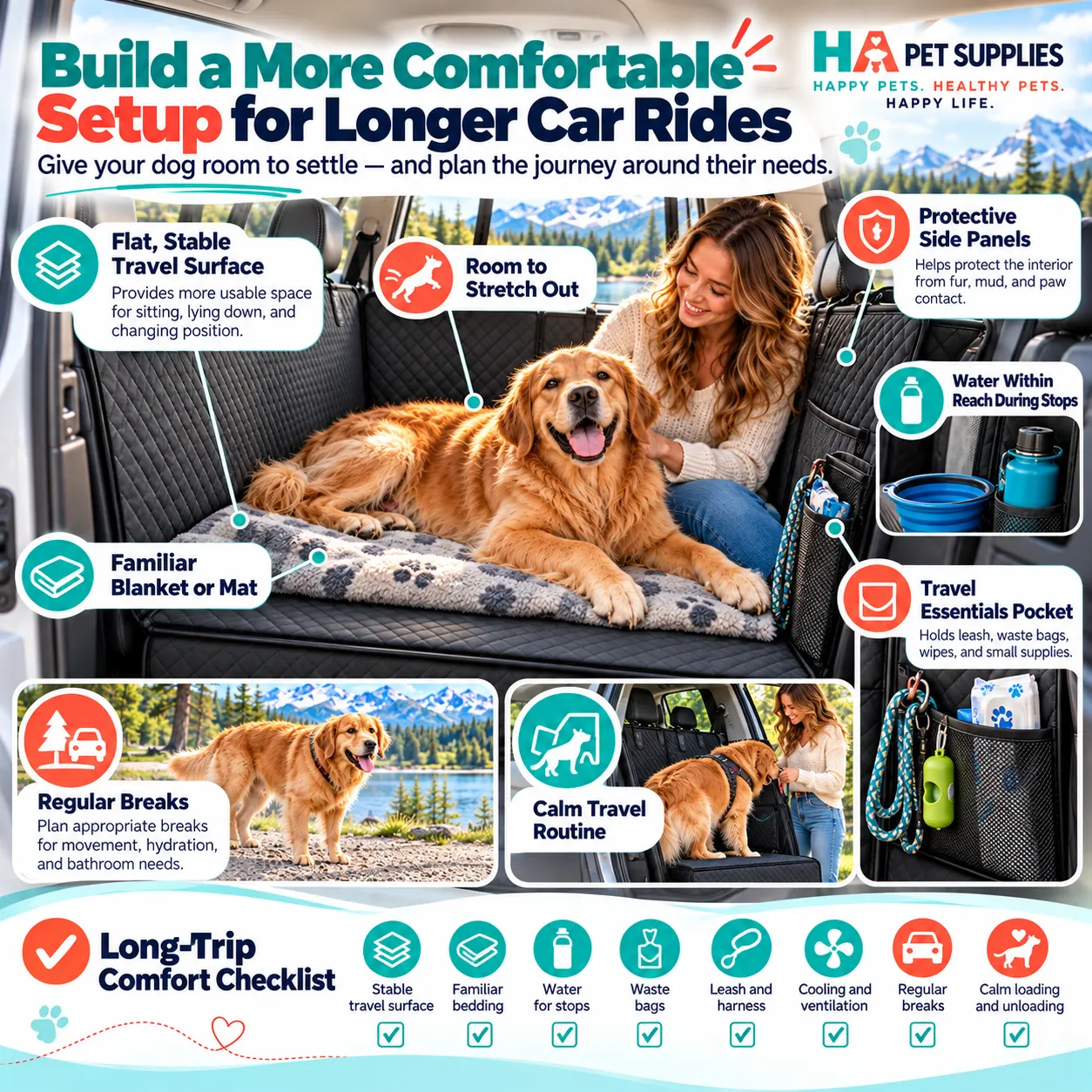
A good long-trip setup combines stable space with familiar bedding, water, planned breaks, and easy access to travel essentials.
3D Infographic: Build a Better Long-Trip Setup
Flat Stable Surface
Provides usable room for sitting, lying, and repositioning.
SpaceFamiliar Bedding
Use a thin mat or familiar blanket for comfort.
ComfortWater for Stops
Carry clean water and a portable bowl.
HydrationTravel Essentials Pocket
Keep lightweight items accessible: waste bags, wipes, leash, small towel.
OrganizationPlanned Breaks
Include appropriate opportunities for movement, bathroom needs, and hydration.
PlanningComfortable Cabin Temperature
Use ventilation and climate control appropriately.
ClimateCalm Loading Routine
Avoid rushing or dragging the dog into the vehicle.
RoutineAppropriate Restraint
Comfort does not replace restraint.
SafetyWhat Should You Pack for a Long Dog Road Trip?
CDC recommends bringing: water, food, bowl, leash, waste bags, grooming supplies, medication, first-aid supplies, and travel documentation where needed. AAHA also recommends a travel kit containing food, water, bowls, medication, leash, waste bags, bedding and familiar toys.
A practical HA Pet Supplies checklist could be:
Travel Essentials
- Fresh water
- Collapsible bowl
- Normal food
- Leash
- Harness
- Waste bags
- Wipes
- Towel
- Medication
- First-aid kit
- ID information
- Familiar blanket
For owners looking for broader dog travel products, you can naturally direct them to the HA Pet Supplies dog supplies category.
Why the Storage Pocket Matters More on Long Trips
A storage pocket seems minor during a ten-minute drive. On a six-hour journey, it becomes much more useful. Good items to keep there include: waste bags, cleaning wipes, spare lightweight leash, small towel, and collapsible bowl. Avoid putting heavy hard objects beside the dog. Store those elsewhere in the vehicle.
Can a Dog Seat Extender Help With Mud and Mess?
Yes, this is one of the practical benefits. Road trips often involve muddy parks, beaches, hiking, wet grass, snow, and sand. A protective surface can reduce direct exposure of the seats to dirt, fur, moisture, and claws. Side panels may also help reduce direct contact with door upholstery.
If your product is specifically verified as waterproof, use that exact claim. If not, use water-resistant or protective surface rather than overstating it.
How to Keep the Travel Surface Clean
A simple cleaning routine can make a big difference.
- After light use: shake out loose fur, wipe visible dust, air the cover if damp.
- After muddy trips: remove loose dirt first, wipe according to manufacturer instructions, allow the product to dry fully.
- After accidents: clean promptly, follow material-specific care instructions, make sure padding and seams dry completely before storage.
Never store the extender while wet. That can encourage odour, mildew, and material degradation.
Dog Car Travel Comfort for Large Dogs
Large dogs often benefit most from extra platform space. They need room to turn around, change position, stretch forelegs, lie laterally, and support their entire body. But they also put more load on the platform.
So comfort depends on both: usable area and verified support capacity. Do not assume that because an extender looks large, it can support every large breed. For weight-capacity and vehicle-fit considerations, point readers back to the complete dog seat extender buying guide.
Dog Car Travel Comfort for Senior Dogs
Senior dogs may have additional challenges: arthritis, reduced balance, stiffness, joint pain, reluctance to jump, and slower repositioning. A flatter travel surface may help them settle more easily.
But entering and leaving the vehicle may be the bigger problem. Consider a ramp, steps, non-slip footing, supportive harness, and slower loading. If mobility changes are significant, discuss them with a veterinarian.
Dog Car Travel Comfort for Puppies
Puppies may be more likely to get motion sick, have accidents, chew, become overwhelmed, and struggle with restraint. AKC notes that puppies are especially prone to motion sickness.
Keep their introduction gradual, positive, short, and predictable. Do not make the puppy’s first car experience a four-hour highway trip if you can avoid it.
Travelling With Two Dogs
Two dogs can share a larger rear platform, but this introduces new issues. Check whether both can lie down, total weight, restraint separation, whether tethers can tangle, whether one dog crowds the other, and whether resources trigger conflict.
Do not assume a physically larger platform automatically makes two-dog travel comfortable. Each dog still needs enough personal space.
Can Music Help a Dog Relax in the Car?
For some dogs, yes. AKC notes that low-volume relaxing music may help some dogs settle during travel. The important thing is not to turn it into another stimulus. Keep the volume moderate. If the dog appears more agitated, switch it off.
Should Dogs Look Out the Window?
Some dogs enjoy looking outside. Others become more nauseated when watching scenery move quickly past the side windows. AKC notes that changing what the dog sees can sometimes help dogs prone to motion sickness.
You may need to experiment with forward-facing position, lower visual exposure, crate placement, and seat position. But do not let the dog hang its head out of the window. CDC and AKC both caution against this practice.
Should Your Dog Ride Loose for Comfort?
No. More freedom does not necessarily equal more comfort or safety. A dog moving constantly around the cabin may become more restless, distract the driver, interfere with passengers, lose balance during braking, and attempt to climb forward.
AAHA states that pets should be securely restrained during car travel. The Center for Pet Safety also publishes independently tested travel products for owners who want to compare certified restraints, crates, and carriers. Center for Pet Safety
For the detailed restraint discussion, keep Blog 3 concise and link to the dog car travel safety guide.
A Comfortable Dog Is Not Always a Safe Dog
This is an important misconception. A dog can look completely relaxed while riding unrestrained, lying beside loose luggage, sitting in the front seat, or leaning through an open window. Comfort is only one part of responsible travel.
Your goal should be: comfort + appropriate restraint + controlled environment + good trip planning.
When Should You Speak With a Veterinarian?
Talk with a veterinarian if your dog repeatedly shows: vomiting, excessive drooling, severe panting, trembling, panic, refusal to enter the vehicle, extreme restlessness, signs of pain, or breathing difficulty.
VCA notes that motion sickness and anxiety may overlap and that veterinary treatment may be appropriate for dogs with persistent symptoms. Do not give human anti-nausea or sedative medication without veterinary guidance.
How to Prepare the Day Before a Long Trip
A simple day-before checklist can reduce stress for both owner and dog.
Day-Before Checklist
Check the Vehicle
- Fuel
- Tyre pressure
- Air conditioning
- Back-seat setup
Check the Extender
- Straps
- Platform
- Side panels
- Storage
- Cleanliness
Check Dog Equipment
- Harness
- Leash
- ID tag
- Restraint
Pack
- Food
- Water
- Bowls
- Medication
- Waste bags
- Wipes
- Bedding
- Travel documents
Plan
- Rest stops
- Destination rules
- Pet-friendly overnight accommodation if needed
The Morning of the Trip
Keep the routine calm. Avoid frantic packing, shouting, and repeatedly calling the dog into and out of the car. Instead:
- Give the dog an appropriate walk
- Allow bathroom time
- Load bags first
- Check the back-seat setup
- Fit the harness
- Load the dog last
- Start calmly
Consistency makes future journeys easier too.
During the Journey
Keep an eye on: panting, drooling, repeated standing, whining, inability to settle, body temperature, and signs the dog needs a bathroom break. If the dog suddenly behaves very differently from normal, stop safely and investigate. Do not attempt to adjust the dog or travel setup while actively driving.
At Rest Stops
Use a predictable routine.
- Park safely.
- Secure the dog before opening the vehicle.
- Attach the leash.
- Exit in a controlled way.
- Offer bathroom opportunity.
- Offer water as appropriate.
- Give the dog a brief chance to move.
- Reload calmly.
This is particularly important at highway service areas where traffic and unfamiliar dogs may be nearby.
Interactive FAQ: Dog Car Travel Comfort
Possible reasons include insufficient space, slippery footing, instability, anxiety, motion sickness, heat, or unfamiliarity with the travel setup.
It can create more usable rear-seat space and a flatter platform, particularly for medium and large dogs. It will not automatically solve anxiety or motion sickness.
For dogs that dislike sagging surfaces or need more room to lie down, a hard-bottom platform may be more comfortable. Some small dogs may be perfectly comfortable on a standard hammock.
The dog may be unable to find a stable lying position, may feel anxious, may be nauseated, or may simply have too much energy.
A familiar thin blanket or mat can help some dogs feel more comfortable and provide a familiar scent. AKC recommends familiar comfort items for travel.
Use gradual exposure, short sessions, positive reinforcement, and pleasant destinations. If anxiety is severe or persistent, discuss it with a veterinarian.
The signs can overlap. Drooling, nausea and vomiting may point toward motion sickness, while anxiety may begin before movement. Some dogs experience both.
Avoid a large meal immediately before travel. CDC and AKC recommend allowing several hours between feeding and departure where appropriate.
Plan regular stops appropriate to your dog’s age, health and needs. CDC, AKC and AAHA all recommend breaks for hydration, movement and bathroom needs.
Carry fresh water and offer it appropriately during stops. Keep hydration available throughout the journey.
It may provide a flatter and larger surface, but senior dogs may also need help entering and leaving the vehicle.
Potentially, if the platform, weight capacity, vehicle space and restraint arrangement are appropriate for both dogs.
No. Comfort and restraint are different issues. Appropriate restraint should still be considered.
No. CDC and ASPCA both warn against leaving pets unattended in parked vehicles.
Persistent distress may involve anxiety or motion sickness. Speak with your veterinarian rather than continuing to force longer journeys.
Quick Long-Trip Comfort Checklist
Space
- Enough room to lie naturally
- No open unsupported gaps
- Stable surface
Comfort
- Thin familiar bedding
- Comfortable temperature
- Adequate ventilation
Safety
- Appropriate restraint
- Doors secure
- Loose objects stored
Supplies
- Water
- Bowl
- Leash
- Waste bags
- Wipes
- Medication
- First-aid supplies
Planning
- Rest stops
- Destination rules
- Emergency veterinary information where appropriate
When a Dog Seat Extender Makes the Most Sense
A dog seat extender is particularly useful when: your dog is too large for the rear bench depth, the dog keeps approaching the footwell edge, a soft hammock sags excessively, you travel long distances, the dog needs room to lie down, your vehicle interior needs protection, you carry two dogs, or you regularly travel after hiking or outdoor activities.
If those sound like your problems, readers can naturally review the HA Pet Supplies dog seat extender.
For other dog travel and care products, point them toward the HA Pet Supplies dog supplies collection.
If they are still unsure whether the product will fit their car, direct them to contact HA Pet Supplies rather than encouraging them to guess.
For trade or bulk enquiries, use the request a quote page only in that commercial context.
Final Conclusion: Better Car Rides Start With the Whole Setup
Improving dog car travel comfort is rarely about one product. A comfortable journey comes from combining: enough physical space, stable footing, familiar surroundings, gradual training, appropriate restraint, good ventilation, thoughtful feeding, regular stops, hydration, and a calm routine.
A dog seat extender can solve an important physical problem by turning the rear footwell into more usable space. That can help a large dog stretch out, change position, settle more naturally, and avoid balancing near an open gap.
But if the dog is panting, drooling, vomiting, trembling, or panicking, the answer may not be “buy a bigger platform.” It may be: gradual desensitization, shorter trips, more positive destinations, better temperature control, or a veterinary conversation about motion sickness or anxiety.
That is why this article completes the three-blog cluster so well.
- Blog 1 answers: Which dog seat extender should I buy?
- Blog 2 answers: How do I use a back seat extender without compromising restraint?
- Blog 3 answers: How do I make the whole journey more comfortable once the setup is right?
For more dog travel and care guidance, readers can naturally continue exploring the HA Pet Supplies blog or browse the broader HA Pet Supplies shop.