
Description
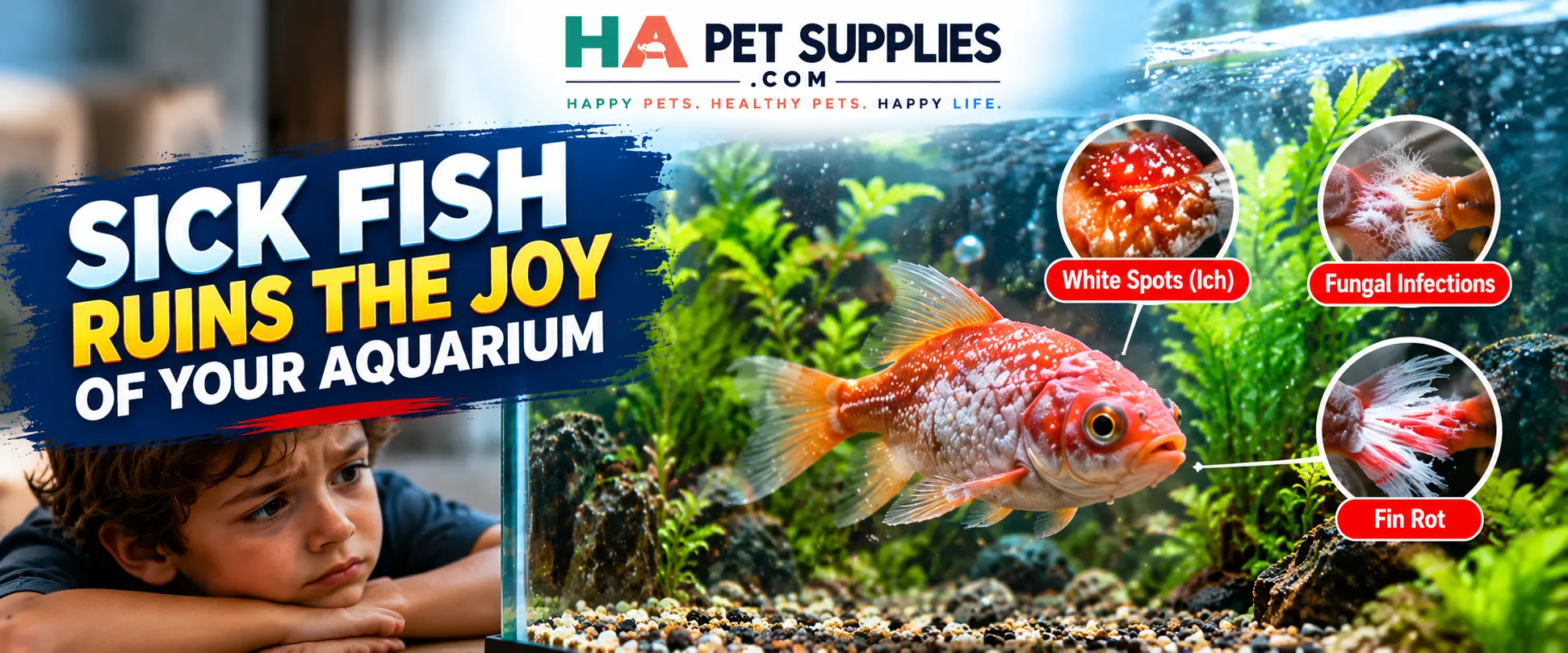
and damaged fins.
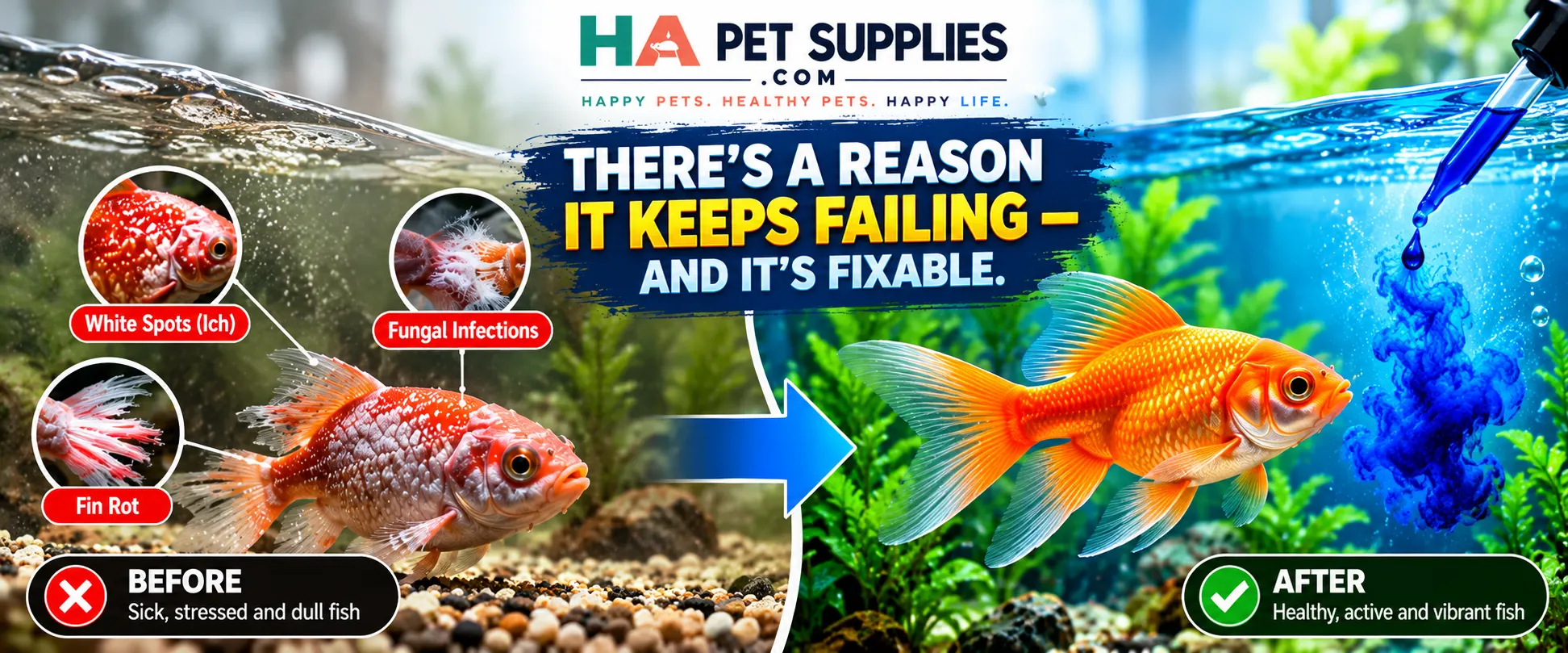
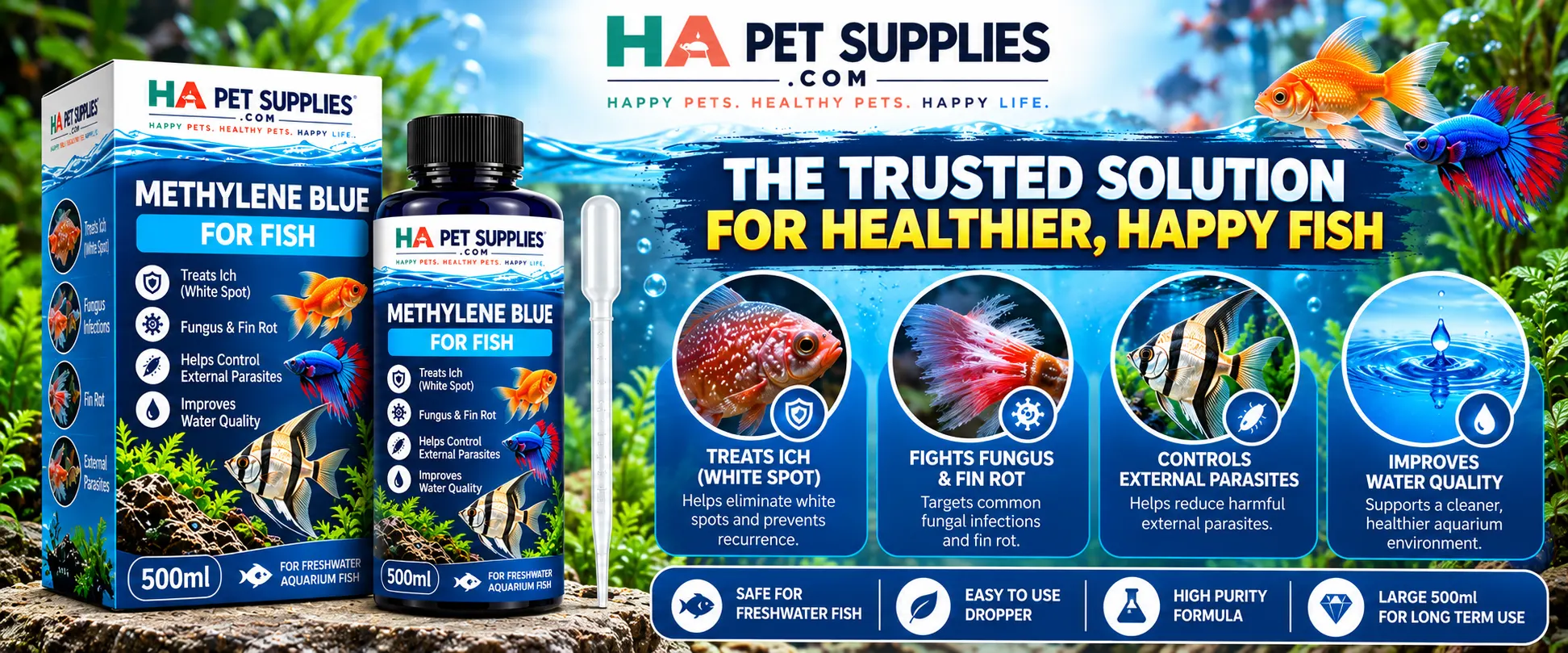
aquarium-care applications.
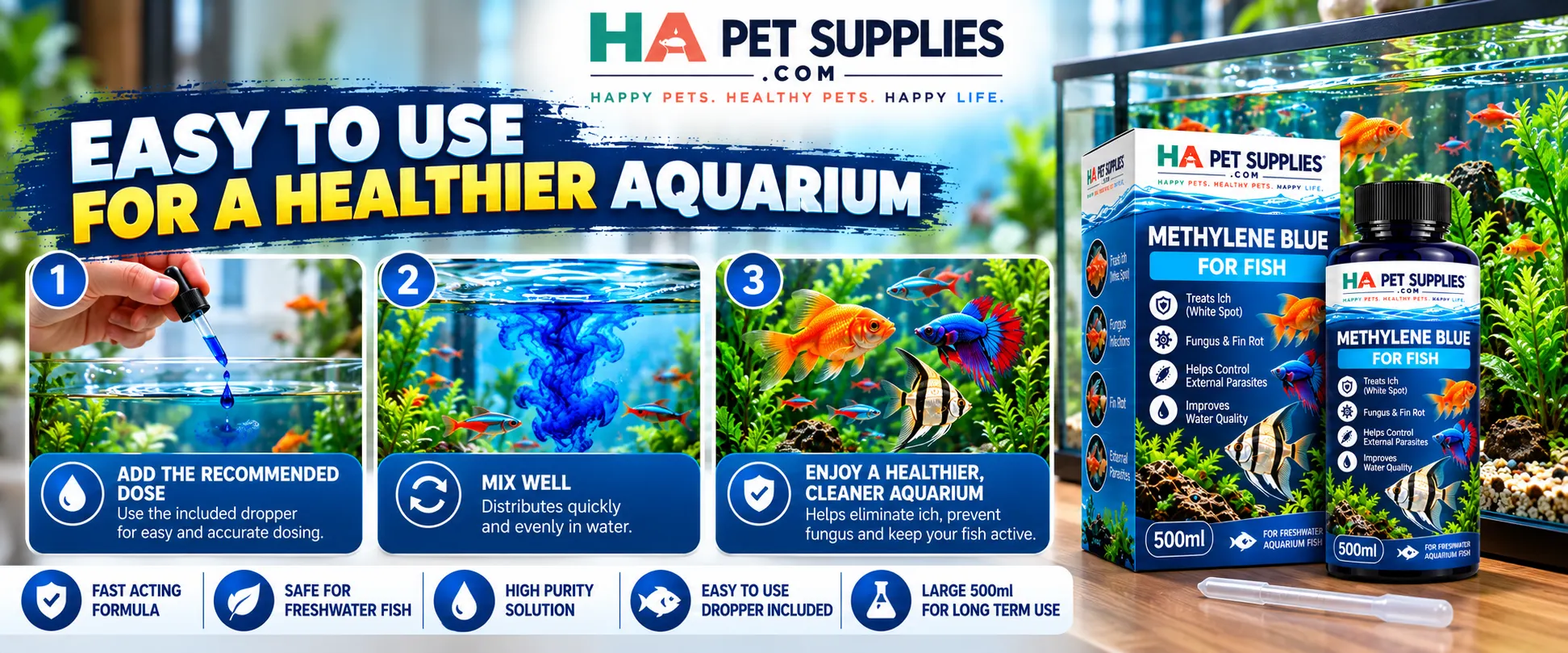
Freshwater Fish Treatment
HA Pet Supplies
Methylene blue for fish is a familiar aquarium treatment
used in certain external fish-health applications, particularly
superficial fungal problems and selected situations involving fish eggs
and external organisms. For aquarium owners, the most important question
is not simply whether a treatment is available. It is whether the
treatment matches the problem affecting their fish.
HA Pet Supplies introduces a practical approach to
aquarium fish treatment that begins with observation,
accurate diagnosis, careful dosing, and responsible aquarium management.
Our Methylene Blue for Fish product is presented as part of that approach,
helping fishkeepers understand when this type of medication may be
appropriate and when another treatment or water-quality correction is
required.
Whether you keep goldfish, bettas, angelfish, guppies, tetras, or other
ornamental freshwater fish, seeing unusual marks, fuzzy patches, or
damaged fins can be worrying. This detailed guide explains the
potential uses of methylene blue, common misconceptions, precautions,
treatment planning, and product selection without encouraging
unnecessary medication.
Methylene blue is not suitable for every fish disease, aquarium, or
species. The correct concentration, dose, and treatment duration depend
on the exact formulation and intended use. Always follow the verified
product label and seek aquatic veterinary guidance when the diagnosis
is unclear.
1. Methylene Blue for Fish – Product Overview
Maintaining a healthy aquarium involves much more than keeping the
glass clean and the water visually attractive. Fish live in continuous
contact with their aquatic environment. Temperature, oxygen availability,
ammonia, nitrite, water chemistry, stocking density, feeding practices,
and the introduction of new livestock can all influence their health.
When a fish begins scratching against decorations, develops a fuzzy
patch, shows frayed fins, or loses its appetite, it is understandable
that owners search for freshwater fish medicine.
However, several unrelated conditions can produce similar symptoms.
Choosing the wrong medicine may delay appropriate care.
That is why HA Pet Supplies encourages customers to identify the
likely cause before beginning treatment. A well-planned aquarium
treatment combines appropriate medication, suitable water conditions,
careful observation, and ongoing fish husbandry.
For beginners who want a clear introduction, our educational article
Methylene Blue for Fish – Uses, Benefits, and When to Use It
explains the role of this familiar blue treatment and the situations
where further investigation may be necessary.
HA Pet Supplies aims to make shopping for aquarium products more
straightforward by connecting product information with practical
instructions. Customers can browse our
fish supplies collection
to find complementary aquarium-care essentials and evaluate which
products fit their setup.
Check symptoms and fish behavior.
Review ammonia, nitrite, pH, and oxygen.
Select treatment appropriate to the diagnosis.
Track fish response and water conditions.
2. What Is Methylene Blue for Fish?
Methylene blue is a strongly colored chemical dye with a history
of use in certain aquatic animal health applications. In ornamental
fishkeeping, it is commonly associated with treatment baths for
superficial fungal conditions and selected external health problems.
It is also used in some fish-breeding situations involving fungal
contamination of eggs.
The striking blue color makes the solution easy to recognize, but
color alone tells you nothing reliable about strength or suitability.
Two bottles may look similar while containing different concentrations
or requiring different dosing instructions.
This distinction matters because aquarium medication must be
measured according to the active-ingredient concentration and the
volume of water being treated. A larger bottle does not automatically
mean a stronger formula, and a stronger-colored solution should
never be assumed to be more effective.
Why Do Fishkeepers Search for Methylene Blue?
Many aquarium owners begin searching for fish medicine after noticing
a visible symptom. Others learn about methylene blue while researching
quarantine tanks, breeding tanks, fish egg fungus, or emergency fish
care. They are often trying to answer a practical question: can this
product help the specific problem they have found?
Typical concerns include whether methylene blue can help control
fungus, whether it works against white spot disease, how long treatment
should continue, and whether it is safe for plants, shrimp, snails,
or the biological filter.
Understanding these concerns is essential because a useful aquarium
medication is not necessarily a universal treatment. Professional
guidance from the
Merck Veterinary Manual
emphasizes accurate water-volume measurement, environmental management,
and targeted therapy rather than routine preventive medication.
How Is It Different From General Aquarium Maintenance?
Regular aquarium maintenance is designed to keep the environment
stable. That includes filtration, water changes, suitable stocking,
balanced feeding, and testing water parameters. Methylene blue,
by contrast, is a treatment chemical used for specific purposes.
It does not replace dechlorinator, biological filtration, a water
testing kit, adequate aeration, or appropriate husbandry. If a fish
is distressed because of excess ammonia, adding medication without
addressing the water problem may make the situation worse.
This is why a responsible aquarium-care plan treats water-quality
testing as an early step, not an optional extra.
3. Methylene Blue for Fish – Uses and Potential Benefits
Methylene blue has several recognized applications in ornamental
fish care, but effectiveness varies according to the disease,
organism, concentration, treatment method, and fish species.
The following sections explain where it may be useful and where
expectations should be more cautious.
Superficial Fungal Problems
Methylene blue is commonly used in carefully controlled treatment
baths for certain superficial fungal or fungus-like conditions.
The source of the infection must still be identified, especially
if damaged tissue or poor water quality is involved.
Selected External Conditions
Certain aquarium treatment formulations are used for selected
external organisms. Suitability depends on the confirmed
condition and the exact product directions. Not every parasite
responds to methylene blue.
Fish Egg Care
In some breeding systems, methylene blue is used to reduce
fungal contamination of fish eggs. The correct method depends
on the fish species, breeding environment, and treatment protocol.
Quarantine Applications
A separate treatment aquarium may provide greater control over
medication exposure while protecting established display-tank
filtration, plants, and sensitive inhabitants.
Use 1: Addressing Certain Superficial Fungal Conditions
White or gray cotton-like patches on fish can prompt searches for
fish fungus treatment or
aquarium fungal infection treatment. Methylene
blue has established use against some superficial fungal problems,
but appearance alone is not enough to confirm a diagnosis.
Some bacterial diseases can resemble fungal growth. In those
cases, using an antifungal treatment alone may not address the
underlying cause. Fish with rapidly spreading lesions, severe
ulceration, breathing difficulty, or multiple affected tankmates
should receive prompt professional evaluation.
Use 2: Supporting Appropriate Fish Egg Management
Fish breeders sometimes use methylene blue to limit fungal growth
on eggs. This application requires attention to the developmental
stage, egg sensitivity, oxygenation, and species-specific guidance.
A method used successfully for one species should not automatically
be copied for another.
If you maintain a breeding aquarium, review the compatibility of
the medication with eggs, newly hatched fry, plants, and any
invertebrates. Carefully controlled conditions are particularly
important in small containers because dosing errors have less
room for correction.
Use 3: Targeted Quarantine Treatments
A quarantine setup can help separate a sick fish from healthy
tankmates while enabling more controlled observation. This can
also reduce unwanted exposure of sensitive plants and animals
to medications intended for a particular fish.
A suitable quarantine tank generally needs stable temperature,
adequate aeration, safe water chemistry, and a practical method
for monitoring ammonia. The equipment should be selected for
the needs of the fish being treated.
For an additional explanation of product-specific treatment
considerations, read our
methylene blue dosage, treatment time, and safety guide
.
It explains why accurate water-volume calculations and product
concentration matter more than following a generic number of drops.
What About Ich and Fin Rot?
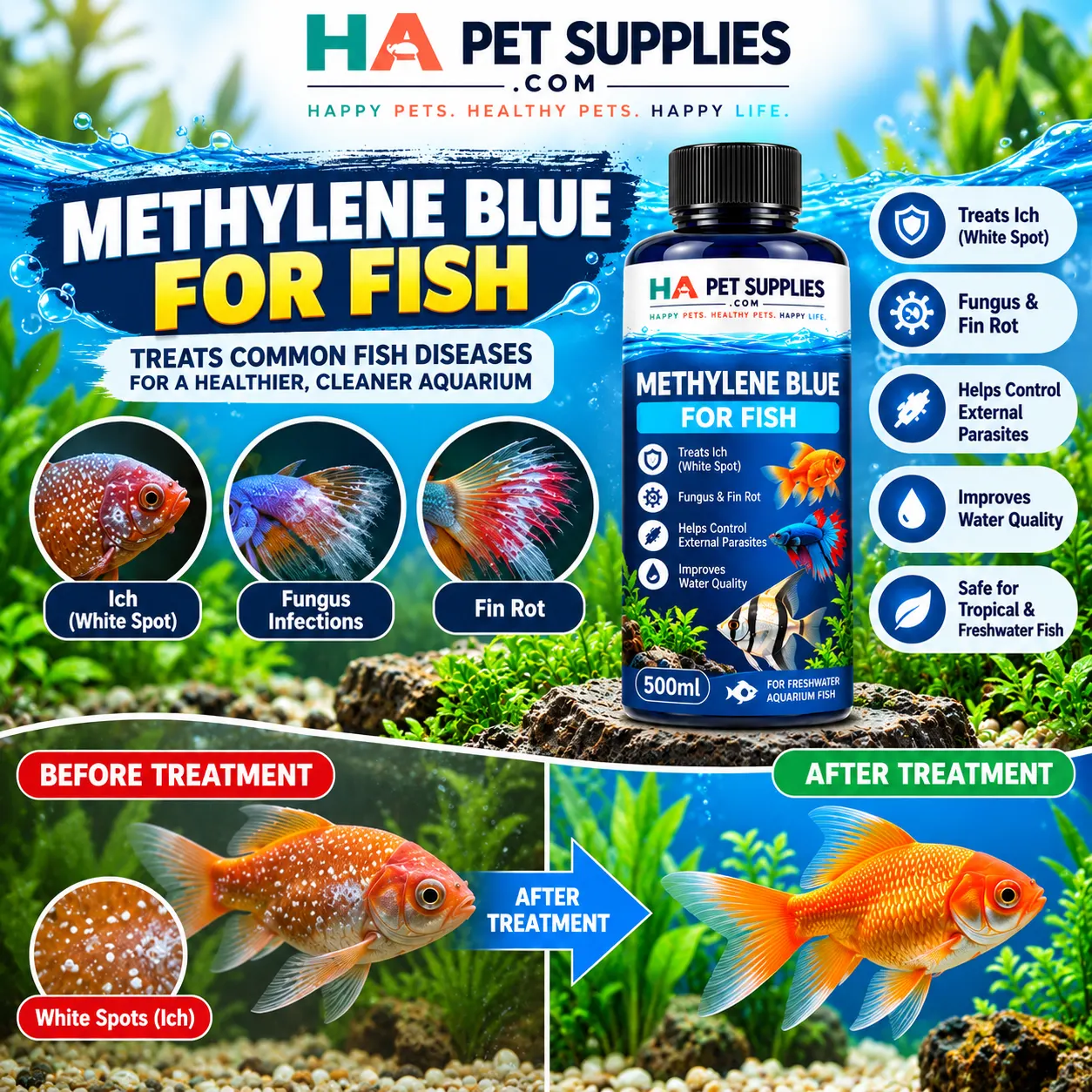
Aquarium ich treatment and fin rot care require more specific
discussion because these names describe different biological
problems. White spot disease is generally associated with a
protozoan parasite, while fin rot often involves bacterial
infection, tissue injury, or underlying environmental stress.
Methylene blue should not be advertised as a universally reliable
cure for either condition. Other targeted treatments may be more
appropriate, and fish may also need correction of the environmental
factors contributing to illness.
Our article
Does Methylene Blue Treat Ich, Fungus, and Fin Rot?
examines the differences between these common diagnoses and
explains why treatment selection should be condition-specific.
4. Common Fish Symptoms and What They May Mean
A fish can look unhealthy for several reasons, including infectious
disease, unsuitable water chemistry, injury, nutritional problems,
or stress. The same visible symptom may appear in more than one
condition, so the purpose of this table is to help fishkeepers
recognize warning signs rather than self-diagnose with certainty.
| Visible Symptom | Possible Explanation | Recommended First Action | Medication Consideration |
|---|---|---|---|
| Small white spots | Ich or another condition affecting skin and fins | Check water conditions and obtain an accurate diagnosis | Use a treatment specifically appropriate to the confirmed cause |
| Cotton-like growth | Fungal, fungus-like, or bacterial disease | Examine affected tissue and investigate environmental stress | Methylene blue may be considered for certain superficial fungal conditions |
| Frayed or eroded fins | Injury, fin rot, or water-quality-related damage | Test water and identify bullying or sharp decorations | Select medication only after identifying the likely cause |
| Rapid breathing | Oxygen shortage, gill disease, toxicity, or stress | Check aeration and critical water parameters immediately | Avoid guessing at medication while urgent causes remain unchecked |
| Unusual rubbing or flashing | External irritation, parasites, or poor water chemistry | Review recent additions and test the aquarium water | Confirm the organism before choosing antiparasitic treatment |
The
University of Florida’s Introduction to Fish Health Management
explains the connection between environmental stress, fish behavior,
infectious conditions, and water quality. Its guidance supports
checking the aquatic environment early when symptoms appear.
If a fish stops eating, becomes unusually lethargic, struggles to
breathe, or deteriorates quickly, treat the situation as more urgent
than a routine product-shopping decision. A qualified aquatic
veterinarian or fish-health professional can help determine
whether medication, improved husbandry, or both are necessary.
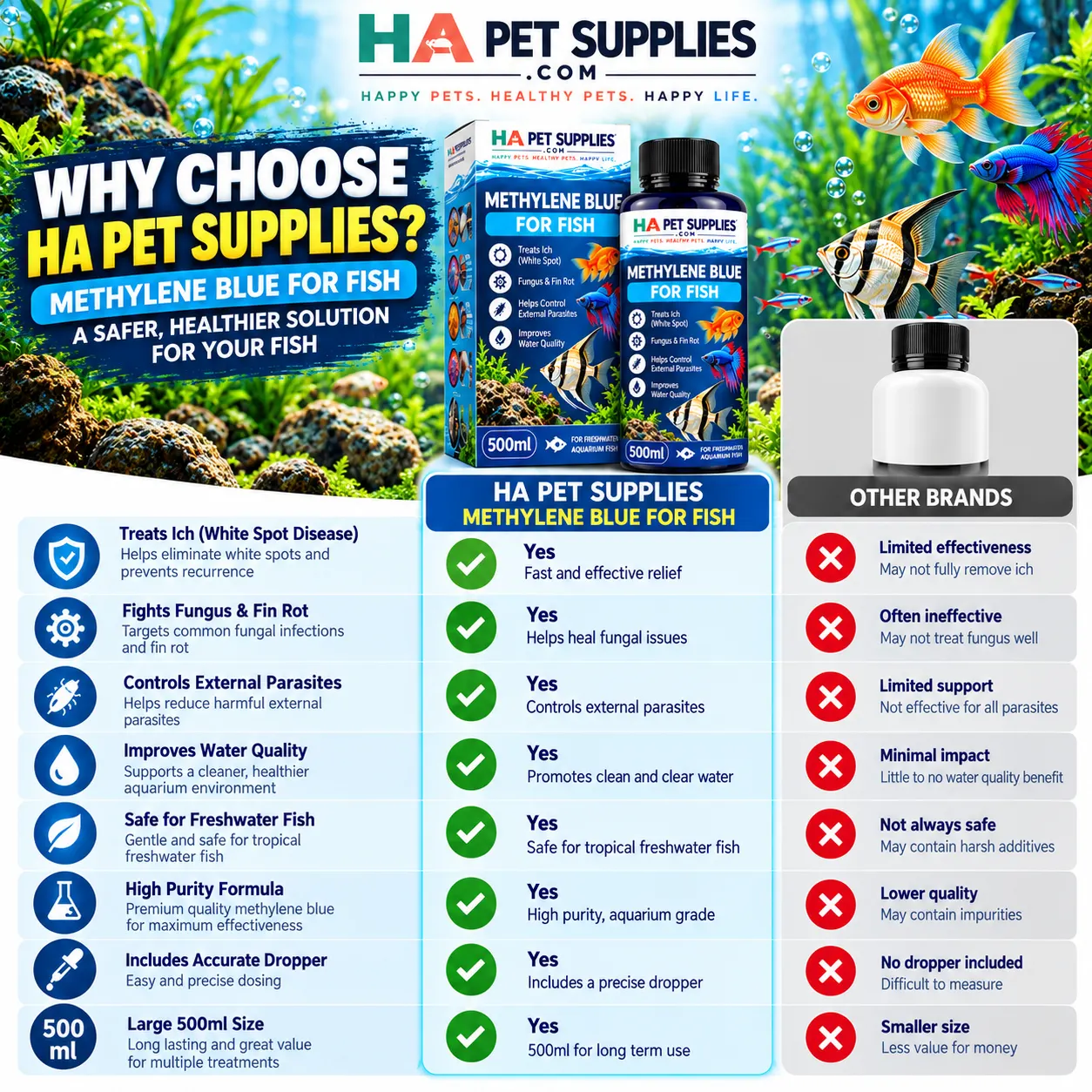
5. HA Pet Supplies Product Comparison Table
When shopping for aquarium fish medication, it is
useful to compare more than the product name. Two treatments may
have entirely different purposes even if both appear in the same
aquarium-care category.
The table below compares the HA Pet Supplies methylene blue product
with common categories of aquarium-care supplies. It also explains
what to check when comparing another methylene blue product.
These comparisons describe product types rather than making
unsupported claims about competing brands.
| Feature | HA Pet Supplies Methylene Blue for Fish | Other Methylene Blue Products | Other Aquarium Care Products |
|---|---|---|---|
| Primary Purpose | Selected fish treatment applications | Depends on formulation and labeling | Depends on product category |
| Active Ingredient | Methylene blue; verify concentration on final label | May have different concentrations | May contain different active ingredients or none |
| Fungal Applications | Relevant to selected superficial fungal conditions | Depends on approved instructions | Some treatments target different organisms |
| Ich Treatment | Not a universal first-choice solution | Evidence and suitability vary | Specific ich medications may be available |
| Fin Rot Care | Requires correct diagnosis and veterinary guidance | Not all formulations target bacterial causes | Other targeted treatments may be appropriate |
| Dosing | Follow the exact product label | Follow the competing product’s own label | Use directions for each product category |
| Biofilter Compatibility | May interfere with beneficial bacteria | Methylene blue carries similar concerns | Varies by product |
| Plant and Invertebrate Compatibility | Use caution; separate treatment is often preferable | Check product precautions | Depends on the formula and species |
| Staining Potential | Strong blue dye may stain surfaces and materials | Comparable dye formulations can also stain | Depends on the product |
| Purchase Support | HA Pet Supplies product information and enquiry options | Varies by seller | Varies by brand and seller |
How Does Methylene Blue Compare With Other Fish Care Products?
A water conditioner is designed to prepare tap water for aquarium
use by handling specific substances such as chlorine or chloramine.
A biological filter supports the nitrogen cycle. A water testing
kit identifies important chemical parameters. None of those products
performs the same function as methylene blue.
Likewise, an aquarium ich medication, an antibacterial product,
and a broad-spectrum treatment may differ significantly in
mechanism, compatibility, and appropriate use. Buying several
medicines simultaneously is not necessarily a better approach,
especially if mixing medications creates additional risk.
If you are building a complete aquarium-care routine, browse the
HA Pet Supplies online shop
to compare available maintenance supplies and treatment products.
Choose products according to a clear purpose rather than assuming
all fish medications are interchangeable.
This is a category-level comparison, not a laboratory performance
ranking. No superior efficacy, purity, or safety is claimed without
supporting product-specific testing.
6. Methylene Blue for Fish – Product Specifications
Before purchasing any aquarium medication, check the precise
formulation and packaging information. Clear specifications help
customers understand what is being purchased and prevent mistakes
involving bottle capacity, concentration, and dosing.
| Specification | Product Information |
|---|---|
| Brand | HA Pet Supplies |
| Product Name | Methylene Blue for Fish |
| Product Category | Fish Supplies and Aquarium Care |
| Product Type | Liquid aquarium treatment |
| Active Ingredient | Methylene blue; concentration must be confirmed |
| Appearance | Blue liquid solution |
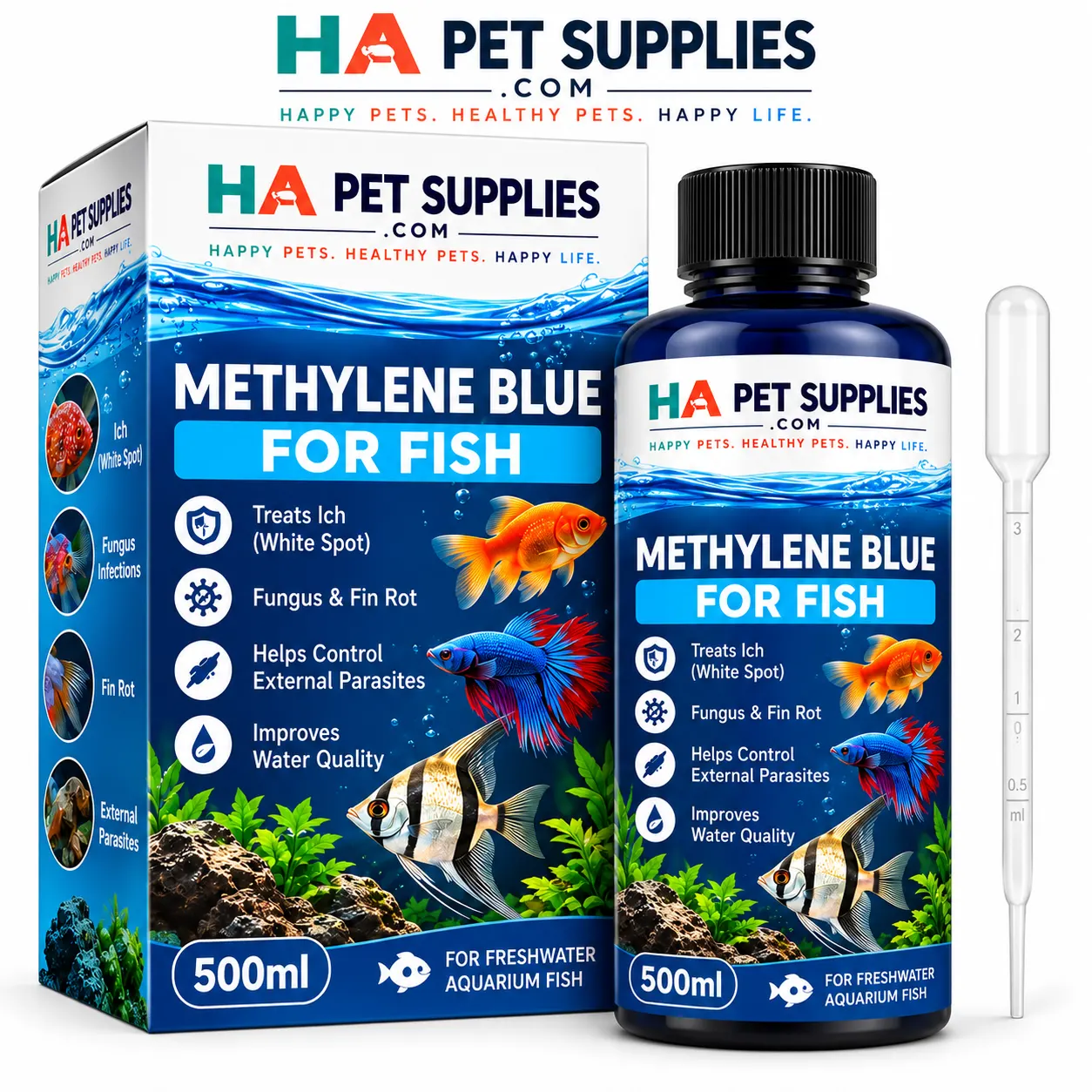
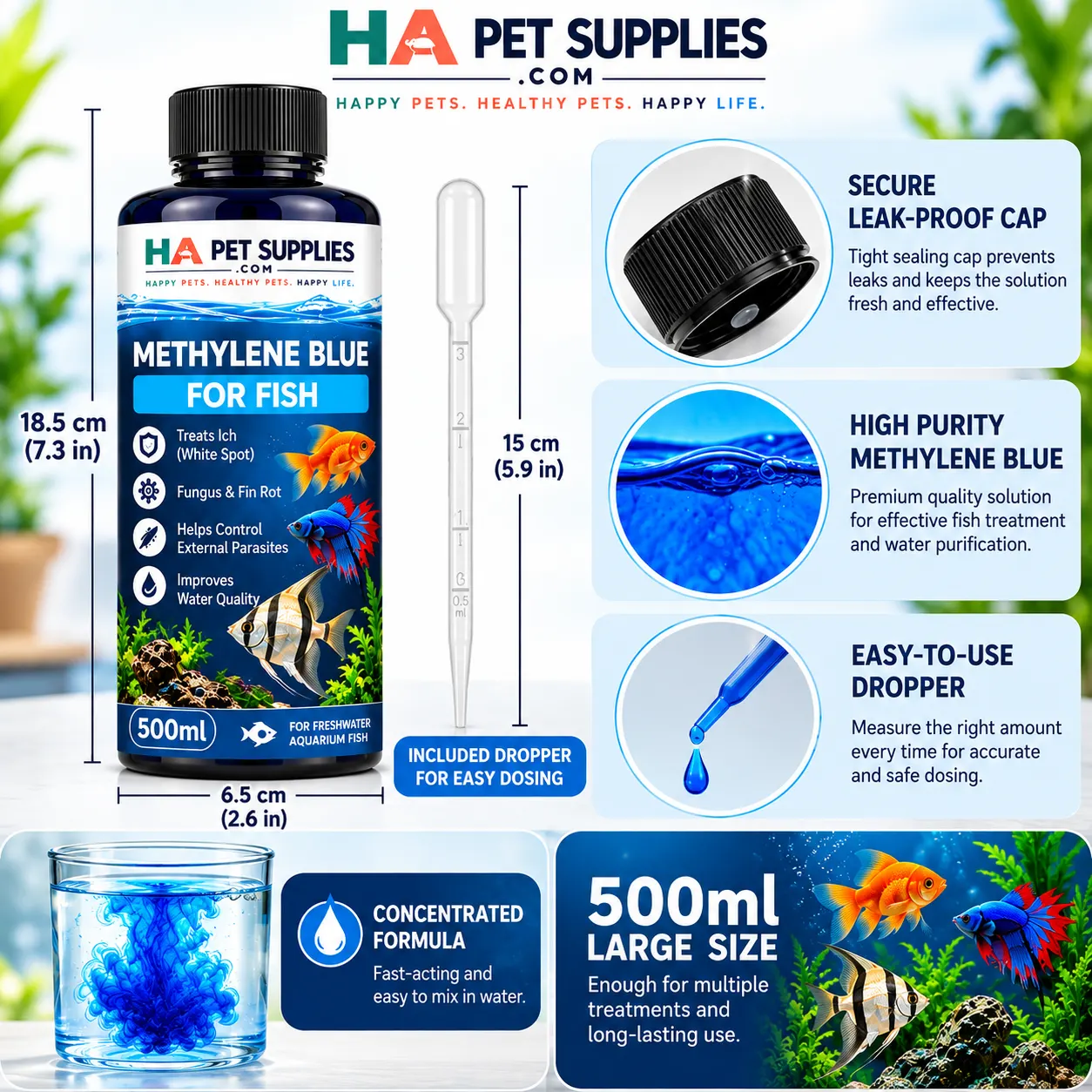
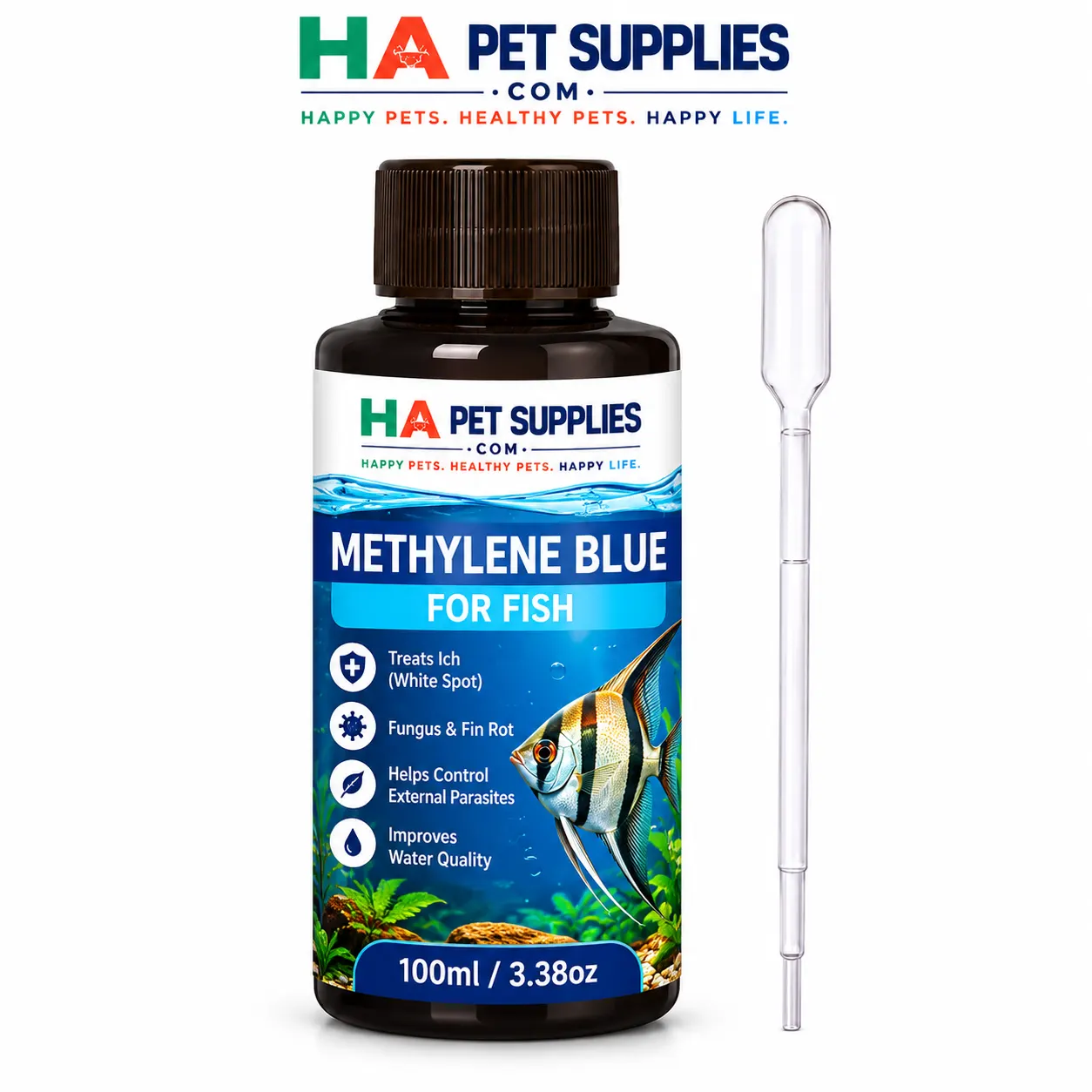
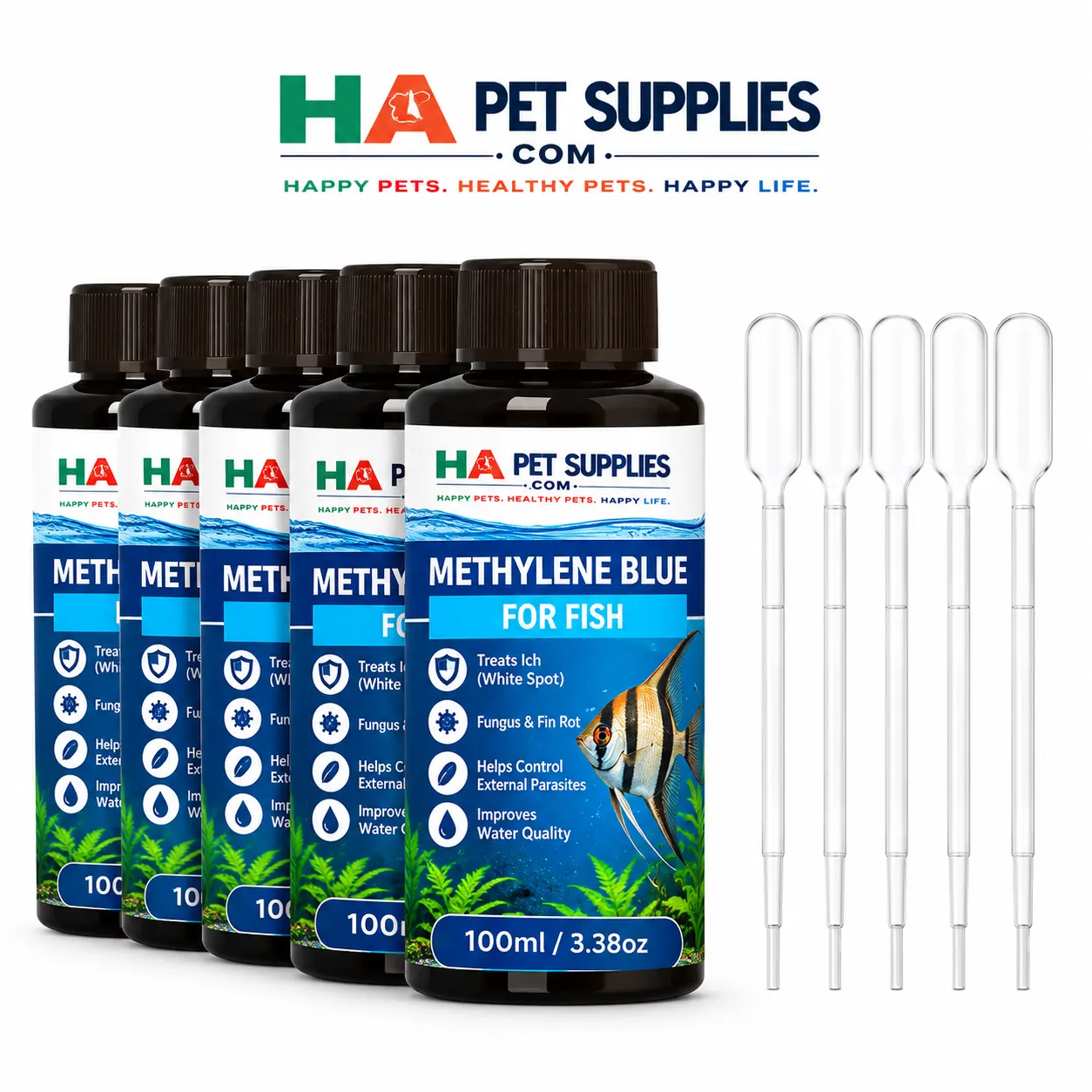
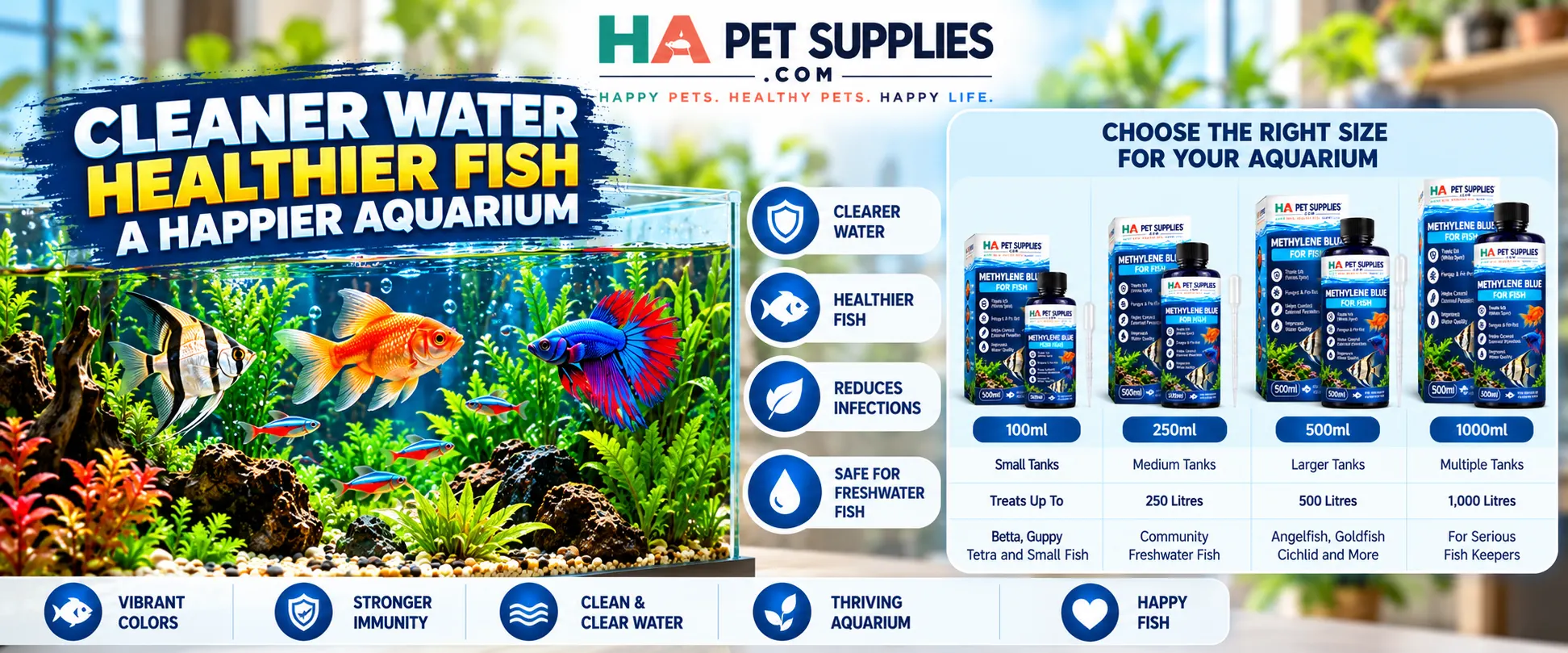
| Illustrated Bottle Size | 500ml in the supplied A+ images |
| Other Illustrated Variant | 100ml in earlier product images; availability unconfirmed |
| Intended Use | Ornamental fish care according to validated label directions |
| Suitable Species | Only species confirmed compatible by the final product label |
| Recommended Application | Use the labeled method; separate treatment may be preferable |
| Included Accessories | Confirm dropper inclusion before publishing |
| Treatment Duration | Follow the verified formulation-specific instructions |
| Storage | Follow label requirements and keep out of children’s reach |
| Product Website | hapetsupplies.com |
The most important missing numerical specification is the actual
concentration of methylene blue in the bottle. Once this is
verified, it should appear in both the product specifications
and user instructions. A safe dose cannot be established from
the bottle size or photographs alone.
Accurate specifications also matter when comparing product value.
A 500ml bottle contains five times the liquid volume of a 100ml
bottle, but that says nothing about the total amount of active
ingredient unless the concentrations are identical.
7. HA Pet Supplies Methylene Blue – Product Details
Liquid Aquarium Treatment Format
Liquid treatment products are familiar to many aquarium keepers
because they can be measured and mixed according to specific
instructions. The quantity required depends on the exact formulation,
water volume, and prescribed treatment method.
A liquid format can be convenient when the proper measuring
equipment is available. However, convenience should never replace
precision. Guessing a dose based on bottle-cap size or the color
of the resulting water is not a reliable approach.
Easy-to-Identify Blue Solution
Methylene blue produces a strong blue coloration. This appearance
is characteristic of the substance, but the intensity of color
should not be used to judge the dose, effectiveness, or remaining
treatment time.
The dye may discolor hands, clothing, aquarium silicone, porous
decorations, and other surfaces. Protect your work area and
handle the container carefully. Avoid using household utensils
that will later come into contact with food.
Measuring and Dosing Accessories
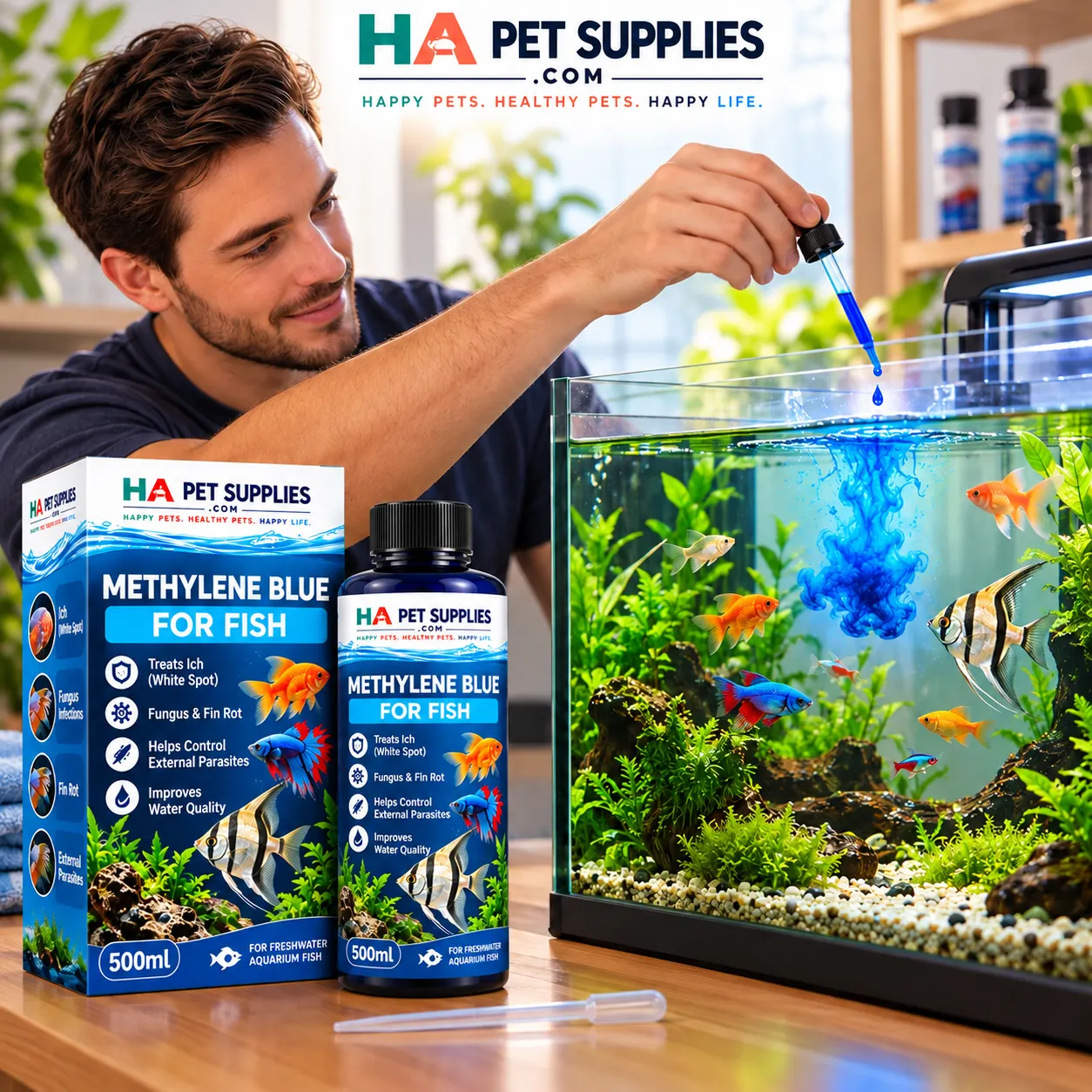
Some aquarium treatment packages include a plastic dropper or
similar measuring accessory. If the selected HA Pet Supplies
variant includes one, use it only according to the verified label
and its measurement limitations.
Drops are not always interchangeable with milliliters. Drop
size can vary according to the accessory, liquid properties,
and user technique. For a medicine requiring a measured volume,
a clearly graduated device is preferable to estimating by eye.
Packaging and Handling
Keep the bottle securely closed between uses and store it
according to the final product label. Avoid cross-contamination
by keeping dispensing accessories clean and away from untreated
containers or aquarium equipment that may carry pathogens.
The packaging should clearly identify the product, its volume,
concentration, batch details, expiry information where applicable,
and essential safety directions. Consumers should be able to
recognize the product and understand its intended purpose without
relying on promotional images alone.
Designed for Responsible Aquarium Care
Fish treatment products should fit within a wider aquarium
management routine. Stable water conditions, appropriate feeding,
gentle handling, quarantine practices, and timely health
assessments remain important even when medication is needed.
Our broader
aquarium and pet care articles
provide additional educational reading for customers who want
to improve their everyday animal-care decisions.
8. HA Pet Supplies Methylene Blue for Fish – User Manual
This section provides a general safety-oriented workflow for
customers using a labeled methylene blue aquarium product.
It is not a replacement for the instructions supplied with the
actual bottle. Exact dosing, water volume, exposure time,
repeat-treatment rules, and compatibility information must
come from the verified product label or an aquatic veterinarian.
Identify the Fish Health Problem
Observe the affected fish carefully. Look for visible
abnormalities, appetite changes, unusual swimming behavior,
rubbing, surface breathing, damaged fins, and any recent
changes in the aquarium.
Record when symptoms first appeared and whether other fish
are affected. This information can help distinguish a
localized problem from a tank-wide environmental issue.
Check Essential Water Parameters
Test the aquarium water before beginning treatment wherever
practical. Review ammonia, nitrite, pH, and temperature.
Evaluate aeration and oxygen supply, particularly if fish
show signs of respiratory distress.
Correct unsafe environmental conditions promptly using
appropriate aquarium-management practices. Medication
should not be used to hide an untreated water-quality problem.
Confirm Treatment Suitability
Verify that methylene blue is appropriate for the suspected
condition and the species involved. Check the presence of
sensitive invertebrates, aquarium plants, eggs, fry, and
biological filtration equipment.
If the diagnosis is uncertain, consult a fish-health
professional before starting medication.
Prepare an Appropriate Treatment Setup
Follow the verified label when deciding whether treatment
belongs in a separate quarantine aquarium, a controlled
treatment bath, or another specified setup.
A separate setup is often preferable because methylene blue
can affect beneficial nitrifying bacteria, stain aquarium
materials, and create compatibility concerns for plants
and invertebrates.
Measure the Actual Water Volume
Determine the water volume being treated rather than relying
only on the advertised capacity of the aquarium. Gravel,
decorations, equipment, and partially filled tanks can
affect actual water volume.
The
Merck Veterinary Manual’s aquarium management guidance
discusses why measuring treatment water volume accurately
matters for bath medication.
Measure the Label-Approved Dose
Read the product concentration and dosing instructions.
Measure the recommended quantity using a suitable
graduated device. Never assume a universal number
of drops per gallon or liter.
Do not increase the amount in an attempt to speed up
treatment. More medication does not automatically produce
a better outcome and may increase risk.
Apply Treatment Exactly as Directed
Follow the product’s approved preparation and application
method. If the instructions specify dilution or mixing,
use the stated procedure and maintain the required
treatment conditions.
Do not mix methylene blue with other medications unless
compatibility and the combined treatment have been
specifically approved by a qualified professional.
Monitor Fish and Water Quality
Watch the fish for changes in breathing, movement,
appetite, posture, and overall condition. Monitor
ammonia and other important parameters, especially
if the treatment environment relies on biological
filtration.
If fish develop severe distress or symptoms worsen,
seek professional guidance. Do not continue an
unsuitable treatment simply because it has already
been started.
Complete Treatment and Restore Normal Care
Finish or discontinue treatment according to the
verified directions and professional guidance.
Follow the prescribed process for replacing water,
removing medication residue, and returning fish
to their normal aquarium.
Continue monitoring fish after treatment. Recovery
depends on the original condition, the fish’s health,
water quality, and whether the underlying cause
has been resolved.
No milliliter-per-liter or drop-per-gallon dose is provided
here because the active-ingredient concentration of this
particular HA Pet Supplies bottle has not been confirmed.
Do not substitute internet dosage examples for the
actual product instructions.
For further help understanding fish treatment planning,
review the detailed
HA Pet Supplies Methylene Blue Safety Guide
before beginning any aquarium medication.
9. Important Aquarium Treatment Safety Precautions
Responsible medication use is a major part of fish care.
Even products that are familiar to experienced fishkeepers
can cause problems when used at the wrong concentration,
in the wrong aquarium, or for an incorrectly diagnosed disease.
Protect Beneficial Filter Bacteria
An established aquarium depends on microorganisms that
help process nitrogenous waste. Disturbing these organisms
can result in increases in ammonia or nitrite, potentially
creating new health concerns for fish.
Methylene blue may interfere with normal biological
filtration. For this reason, a separate treatment
aquarium is often preferable to exposing a mature
display tank’s filter unnecessarily.
Consider Plants, Shrimp, and Snails
Aquarium plants and invertebrates may respond differently
to chemical treatments than fish. Do not assume that a
medicine described as suitable for freshwater fish is
automatically safe for shrimp, snails, or planted aquariums.
Check the approved instructions for the complete list
of compatible species and conditions. When compatibility
cannot be confirmed, seek guidance rather than testing
an unknown dose on a mixed community aquarium.
Prevent Staining
Methylene blue can stain porous decorations, tank
silicone, clothing, skin, and nearby surfaces.
Handle the solution over a protected work area and
avoid spilling it on materials that may be permanently
discolored.
Use dedicated measuring equipment and clean up according
to the manufacturer’s handling instructions. Keep all
aquarium chemicals away from food-preparation surfaces.
Do Not Treat Every Fish Problem as an Infection
Rapid breathing, clamped fins, lack of appetite, and
unusual swimming are not necessarily signs that a fish
needs antimicrobial treatment. Ammonia exposure,
poor oxygenation, extreme temperature changes, and
environmental stress can produce overlapping symptoms.
The
University of Florida’s fish diagnostic evaluation guidance
explains how inaccurate disease identification can
lead to inappropriate treatment and delayed care.
Avoid Unnecessary Preventive Medication
Routine medication of healthy fish is not an automatic
substitute for quarantine, observation, or good aquarium
maintenance. Use prophylactic treatment only when it is
supported by an appropriate professional protocol.
If a fish has recently arrived from another aquarium,
isolation and observation can help identify health
problems before introducing it into an established
community. The appropriate quarantine period and
procedures will depend on the species and circumstances.
Check Species-Specific Sensitivity
Fish species differ in physiology and tolerance to
handling, water conditions, and chemical exposure.
Sensitive species, very young fish, and fish already
weakened by illness may require special precautions.
Do not assume treatment methods suitable for adult
goldfish are appropriate for all catfish, loaches,
bettas, fry, or other aquarium animals. Verify
the instructions for your particular fish.
Know When to Get Professional Help
Contact an aquatic veterinarian or qualified fish-health
professional if fish are dying, breathing abnormally,
showing spreading lesions, losing balance, or continuing
to deteriorate despite environmental corrections.
Bringing water-test results, a history of recent
tank changes, photographs of symptoms, and details
of previously used medication can help a professional
make a better-informed assessment.
Correct diagnosis, safe water quality, suitable
treatment conditions, and careful monitoring are
more important than using the largest possible
quantity of medication.
10. Why Choose HA Pet Supplies for Aquarium Fish Care?
Choosing a fish-care product should be based on accurate
information and suitability rather than dramatic promises.
HA Pet Supplies aims to help customers approach aquarium
ownership with greater confidence by combining product
discovery with clear educational content.
Clear Product Information
Customers can review product details, intended
applications, and important treatment considerations
before deciding whether a purchase fits their needs.
Helpful Educational Resources
Our fish-care blog topics cover disease symptoms,
product uses, dosing considerations, and safety
questions commonly raised by aquarium owners.
Simple Product Enquiries
Customers can use our enquiry and quotation pages
to request product information, discuss availability,
or ask about suitable purchasing options.
Focused Aquarium Care
Our fish supplies category helps customers explore
products relevant to the maintenance and care
of ornamental aquariums.
Practical Shopping Experience
Buyers can browse products online and compare the
details that matter, including intended purpose,
packaging, and compatibility.
Responsible Fish Health Guidance
We encourage buyers to confirm the diagnosis,
follow verified instructions, and avoid
unnecessary or excessive medication.
If you are unsure whether this product is right for
your aquarium, visit our
contact page
to ask a product-specific question. You may also explore
the full HA Pet Supplies website for other pet-care
categories and educational resources.
11. Methylene Blue for Fish – Detailed Product Description
A Thoughtful Addition to Your Aquarium-Care Supplies
Aquarium keeping is rewarding because fish bring movement,
color, and life into a home. A peaceful tank filled with
healthy aquatic animals can become a favorite part
of everyday living.
Unfortunately, even carefully maintained aquariums
can experience health problems. New livestock may
introduce organisms that were not previously present.
Environmental stress may weaken fish. Injuries
can create opportunities for secondary infections,
and visible symptoms may appear suddenly.
During these situations, owners often begin searching
for an aquarium fish treatment that
can help them respond responsibly. HA Pet Supplies
Methylene Blue for Fish is intended to be considered
within a properly informed treatment plan rather than
used as a solution for every aquarium problem.
Understanding the difference between common diseases
can help fishkeepers avoid wasted time and reduce
unnecessary exposure to medication. A diagnosis
should guide treatment, not the other way around.
When a Goldfish Develops White Spots
Imagine noticing small pale dots on a goldfish
that normally looks bright and active. The fish
may begin scratching against decorations or
behaving differently during feeding.
Many aquarium owners immediately search for
white spot treatment for fish.
This is understandable, but they should first
consider whether the spots are consistent with
ich or another skin condition.
Ich involves a particular parasite with a
life cycle that influences treatment strategy.
The correct medication and treatment duration
depend on the diagnosis and the applicable
protocol. A visible improvement after one day
does not necessarily mean the underlying
problem has been eliminated.
Methylene blue is sometimes discussed in
connection with parasitic conditions, but
it should not be represented as a guaranteed
ich cure. A targeted aquarium ich treatment
may be more suitable depending on the fish,
diagnosis, and aquarium environment.
When a Fish Develops Cotton-Like Patches
Another common situation involves a fish with
white, fluffy growth on its body or fins.
Owners often search for fish fungus treatment
because the affected area resembles cotton.
Certain superficial fungal problems are among
the more established applications of methylene
blue in ornamental fish care. However, the
presence of white material alone cannot
confirm that the condition is fungal.
Some bacterial infections can produce similar
appearances. Injured tissue may also become
secondarily infected. Proper diagnosis helps
determine whether a topical approach, controlled
treatment bath, environmental correction, or
another intervention is appropriate.
Fishkeepers should review the aquarium’s recent
history. Has water quality changed? Was the
fish recently transported? Has another fish
been biting its fins? Have decorations caused
visible injury? These observations may help
explain why the condition developed.
When a Betta Has Damaged Fins
Bettas are admired for their large, colorful
fins. Fraying, discoloration, or a sudden
change in fin shape can be especially noticeable.
However, not every torn fin indicates an
infection. Physical damage, sharp decorations,
aggressive tankmates, and environmental issues
can contribute to fin deterioration.
If a bacterial process is involved, the
treatment may differ from one used for
superficial fungus. Providing suitable
water conditions and identifying the
original cause remain essential.
An aquarium medication should therefore
be selected after considering the complete
clinical picture. Treating the wrong cause
can delay recovery even when the medicine
is used exactly according to its label.
Why Quarantine Can Make Treatment Easier
A dedicated quarantine or treatment tank
gives owners an opportunity to observe
individual fish more closely. It may
also reduce exposure of unaffected
tankmates, plants, and invertebrates.
This is particularly relevant to methylene
blue because of its staining properties
and potential effects on biological
filtration. Separate treatment can make
water changes, observation, and post-treatment
cleanup more manageable.
A quarantine tank still requires careful
management. It must have adequate oxygen,
suitable temperature, and safe water
chemistry. Moving a fish into an unstable
container can create new stress rather
than solve the original problem.
Why Water Quality Is Part of Every Treatment Plan
Fish can only recover successfully when
their environment supports normal
physiological function. Elevated ammonia,
nitrite exposure, inadequate oxygen, and
major pH fluctuations can all interfere
with fish health.
Testing the water provides information
that cannot be obtained merely by
looking into the tank. Even clear
aquarium water can contain harmful
concentrations of dissolved substances.
Correcting poor water quality may be
necessary before, during, and after
a medication course. This is why
methylene blue should not be confused
with a water conditioner or routine
aquarium cleaner.
The most successful long-term aquarium
routines focus on prevention through
stable husbandry practices. Treatment
becomes one targeted tool when a
specific health concern requires it.
Choosing Between a Small and Large Bottle
Customers may prefer different packaging
capacities depending on the number
of aquariums they maintain. However,
bottle size should be chosen only
after confirming actual availability,
shelf life, and the concentration
of the selected formulation.
A larger volume can be convenient
for a customer managing multiple
tanks, but the amount used in
any treatment must still follow
the verified directions.
Never increase the dose because
the bottle is large or because
more solution remains available.
A treatment’s safety depends on
the correct exposure, not the
quantity purchased.
Helping Beginners Make Better Decisions
New aquarium owners are often overwhelmed
by conflicting advice online. One source
may suggest treating every visible symptom
with the same medicine, while another
recommends a different chemical for
an apparently similar condition.
The most useful approach begins with
the species, symptoms, water-test
results, and treatment history.
These details help narrow down
the likely causes and identify
when professional advice is needed.
HA Pet Supplies encourages beginners
to learn about common aquarium
health problems before buying multiple
medications. Our educational content
is intended to support informed
decisions while recognizing that
serious fish illness requires
professional diagnosis and care.
If you want to develop a broader
aquarium-care routine, visit our
aquarium fish supplies category
and compare equipment and products
relevant to your particular tank.
The Importance of Following the Exact Label
Methylene blue products should not
be dosed solely from advice written
for another brand. Concentrations,
intended methods, and treatment
durations may differ.
Product instructions should explain
the correct water volume, application
method, exposure duration, precautions,
and any necessary post-treatment
water changes.
If any of this information is missing,
obtain the verified instructions
before using the product. When
dealing with a living animal,
uncertain dosing is not an
acceptable substitute for
reliable directions.
By combining a clearly identified
product with accurate information,
careful handling, and appropriate
aquarium management, fishkeepers
can approach treatment decisions
more confidently and responsibly.
12. Frequently Asked Questions About Methylene Blue for Fish
The following answers address common questions asked
by aquarium owners researching methylene blue.
Open each question to read the explanation.
1. What is methylene blue for fish used for?
Methylene blue is used in certain ornamental fish
treatment applications, particularly selected
superficial fungal conditions and some fish
egg-care protocols. The exact use must match
the product label and confirmed diagnosis.
2. Can methylene blue treat ich or white spot disease?
Methylene blue has been discussed for some
external parasitic applications, but it is
not a universal or guaranteed ich treatment.
Confirm the disease and choose an appropriate
protocol for the fish species involved.
3. Does methylene blue help with fish fungus?
Certain superficial fungal conditions are
recognized applications of methylene blue.
However, white patches may also be caused
by other diseases. Proper diagnosis is
necessary before selecting treatment.
4. Is methylene blue effective for fin rot?
Fin rot can involve bacterial infection,
tissue injury, or environmental problems.
Methylene blue should not be considered
a guaranteed cure. The appropriate
treatment depends on the underlying cause.
5. How much methylene blue should I add to my aquarium?
Use only the dose specified for the actual
product concentration and treatment method.
There is no reliable universal number
of drops or milliliters for all bottles.
Confirm the label before treatment.
6. How long should methylene blue treatment last?
Treatment time depends on the condition,
formulation, species, and method used.
Follow the validated product instructions
or an aquatic veterinarian’s directions.
Do not extend exposure without guidance.
7. Can I put methylene blue in my main aquarium?
It may interfere with biological filtration,
affect some plants or invertebrates, and
stain aquarium materials. A separate
treatment tank is often preferable.
Follow the specific product directions.
8. Is methylene blue safe for beneficial filter bacteria?
Methylene blue can interfere with
beneficial nitrifying bacteria,
potentially affecting the nitrogen
cycle. Protecting established
biological filtration is an
important treatment consideration.
9. Can I use methylene blue with shrimp and snails?
Do not assume compatibility with
aquarium invertebrates. Sensitivity
varies, and certain formulations
may be unsuitable. Check the
product instructions and seek
specialist advice when necessary.
10. Is methylene blue safe for aquarium plants?
Methylene blue can interfere with
plant growth and may discolor
aquarium materials. Consider a
separate treatment setup when
compatible with the fish’s needs.
11. Why does methylene blue turn water blue?
The active substance is a strongly
colored dye. Its appearance can
color treated water, but the
depth of the blue color is not
a reliable dosing measurement.
12. Can methylene blue improve aquarium water quality?
Methylene blue is not a substitute
for filtration, water conditioning,
or water-quality testing. It should
not be relied on to remove ammonia,
nitrite, or other routine pollutants.
Good water management remains essential.
13. Can I use methylene blue on fish eggs?
Methylene blue is used in certain
fish-breeding protocols to manage
fungal contamination of eggs.
Suitable concentrations and
procedures are species-specific.
14. Can methylene blue be used for betta fish?
Treatment suitability depends on
the actual condition, product
formulation, and fish’s health.
Do not treat a betta without
confirming the intended use
and species compatibility.
15. Can methylene blue be used for goldfish?
Some methylene blue treatments
are used in ornamental fish care,
including situations involving
goldfish. However, suitability
is condition-specific and the
dose must follow the exact label.
16. Can I combine methylene blue with aquarium salt?
Do not combine treatments simply
because individual products are
commonly used in fishkeeping.
Combined exposure can alter
safety and treatment outcomes.
Follow an approved protocol
or professional guidance.
17. Will methylene blue stain aquarium silicone?
It can stain silicone, porous
decorations, and other materials.
Work carefully and consider a
separate treatment container
when appropriate.
18. Does the bottle size determine the dose?
No. Bottle capacity tells you how
much liquid the container holds.
Treatment dosage depends on
active-ingredient concentration,
the treatment method, and the
water volume being treated.
19. What should I do if my fish gets worse during treatment?
Worsening symptoms, severe
distress, or breathing difficulty
require prompt assessment.
Check water conditions and seek
advice from an aquatic
veterinarian or qualified
fish-health professional.
20. Where can I buy methylene blue for fish online?
You can explore product availability
through the
HA Pet Supplies shop
.
For information about packaging,
concentration, and ordering,
use our
product quotation form
.
Explore Methylene Blue for Fish at HA Pet Supplies
Looking for aquarium fish treatment information,
product availability, or a quotation?
Explore HA Pet Supplies and find the details
you need to make an informed purchase.
Confirm the bottle size, formulation,
label instructions, and suitability
for your aquarium before use.
Educational product information only. Disease diagnosis,
medication selection, dosage, and treatment duration
should follow the verified product label and qualified
aquatic veterinary advice.

Reviews
There are no reviews yet.