
Choosing the best aquarium sponge filter can feel confusing especially when your tank is cloudy, your betta battles the current, or your shrimp need safe filtration. This interactive guide simplifies everything with 3D visuals, a sizing chart, and a fast decision path.
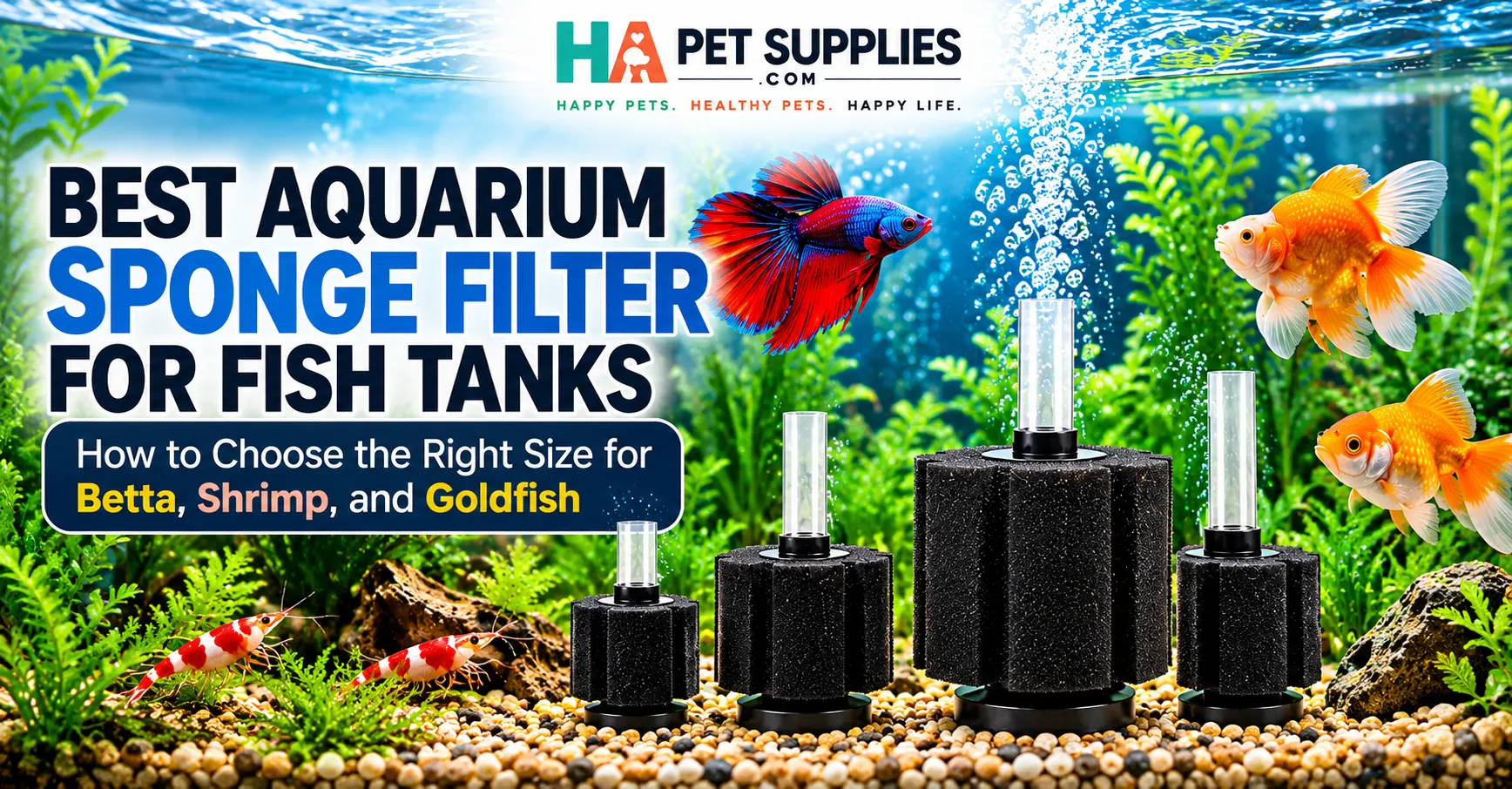
Choosing the best aquarium sponge filter for betta, shrimp, and goldfish tanks.
Quick shopping option: Explore HA Pet Supplies Aquarium Filter Sponge →
Quick Answer: What Is the Best Aquarium Sponge Filter for Your Fish Tank?
The best aquarium sponge filter delivers adequate biological filtration, mechanical debris collection, and appropriate water movement for your inhabitants. For a small betta tank, choose a compact filter with adjustable airflow. For shrimp, prioritize gentle intake and suitable foam porosity. For goldfish, go for generous capacity and consider supplementary filtration.
Betta Tank
Nano/Small filter, adjustable gentle flow
5–10 galShrimp Tank
Fine foam, gentle intake, breeding-safe
10–20 galGoldfish Tank
Large sponge + extra mechanical filtration
30+ galImportant: These are starting points, not universal ratings. Always check the manufacturer’s actual tank-capacity recommendation. For a reliable sizing reference, see the Aquarium Co-Op sponge filter sizing guide.
What if your aquarium water is cloudy right now?
Don’t rush to buy the largest filter or replace all media. First test ammonia and nitrite. A new sponge filter helps collect debris and supports bacteria, but it does not instantly cycle your tank. If fish are gasping or lethargic, treat it as a water-quality emergency — test promptly, increase aeration, and follow proper emergency care.
📋 Table of Contents
- 1. What Is an Aquarium Sponge Filter?
- 2. How Does a Sponge Filter Work?
- 3. Why Filter Size Matters
- 4. Aquarium Sponge Filter Size Chart
- 5. Best Sponge Filter for Betta Fish
- 6. Best Sponge Filter for Shrimp Tanks
- 7. Best Sponge Filter for Goldfish
- 8. Seven Essential Buying Factors
- 9. Sponge vs HOB vs Canister
- 10. Choosing the Right Air Pump
- 11. Common Buying Mistakes
- 12. Installation Steps
- 13. Cleaning & Maintenance
- 14. Troubleshooting
- 15. Why Choose HA Pet Supplies?
- 16. Frequently Asked Questions
- 17. Final Verdict
1. What Is an Aquarium Sponge Filter?
An aquarium sponge filter uses porous foam to trap suspended debris and provide a massive surface for beneficial bacteria. Most traditional designs are air-driven: an external air pump pushes air through tubing into the uplift tube, creating rising bubbles that pull water through the sponge.
Mechanical filtration
As water passes through the foam, fish waste, food fragments, and organic debris get trapped. Over time, this buildup restricts flow, so occasional cleaning is necessary. Mechanical filtration improves particle removal but does not directly eliminate dissolved ammonia.
Biological filtration
Beneficial bacteria colonize the sponge and convert toxic ammonia into nitrite, then nitrate. This nitrogen cycle is essential — elevated ammonia and nitrite can be lethal. The RSPCA aquarium environment guidance explains why both mechanical and biological filtration are fundamental.
Oxygen exchange and circulation
Rising bubbles create surface agitation, aiding gas exchange. However, actual circulation depends on pump strength, depth, and outlet positioning. A sponge filter does not automatically guarantee perfect oxygen levels in every tank.
Suggested resource: Understand How Sponge Filtration Works
2. How Does the Best Aquarium Sponge Filter Work?
Think of it as a miniature biological filtration station. An external air pump introduces air; rising bubbles create upward movement, drawing tank water through the foam. Suspended debris is collected, while microorganisms live on the submerged surfaces.
Stage 1: Water enters the sponge
The foam acts as a mechanical barrier. Fine foam traps smaller particles but clogs faster; coarse foam allows more flow and tolerates debris longer. Neither is universally better.
Stage 2: Water contacts biological media
The sponge provides wet surface area for beneficial bacteria. Once cycled, these microorganisms process ammonia and nitrite. New sponge media must be cycled before relying on it for mature biological filtration.
Stage 3: Filtered water circulates back
The airlift returns moving water to the tank, helping transport waste toward the sponge and contributing to surface agitation. The University of Florida IFAS aquarium setup guide describes mechanical, biological, and chemical filtration as distinct processes.
3. Why Aquarium Sponge Filter Size Matters
The best aquarium sponge filter is not necessarily the largest. An appropriately sized filter provides enough biological surface area and water circulation without reducing swimming space or creating undesirable current.
A filter that’s too small may clog quickly or fail to handle the waste load. One that’s physically oversized may hog space in a compact aquarium. However, increasing sponge size does not automatically increase current — the air pump and filter design play major roles.
Aquarium water volume
Calculate actual water volume: Length × Width × Water Height ÷ 1,000 = approximate liters (dimensions in cm). Substrate, decorations, and equipment reduce actual volume. Always use a realistic estimate.
Fish population and waste production
Two identical tanks can require different filtration. A lightly stocked shrimp tank produces little waste; a tank with large goldfish produces much more. Food quantity, metabolism, and waste production influence debris accumulation — especially when comparing betta, shrimp, and goldfish.
Water circulation requirements
Species respond differently to current. Adjustable airflow offers flexibility, especially for bettas, fry, and shrimp. The goal is suitable circulation without forcing fish to struggle.
4. Aquarium Sponge Filter Size Chart for Beginners
| Tank Capacity | Filter Category to Investigate | Suggested Approach |
|---|---|---|
| 5 gallons | Nano or small | Choose a model explicitly rated for 5 gallons |
| 10 gallons | Small or medium | Prioritize suitable flow and biological capacity |
| 15 gallons | Small or medium | Adjust size for stocking and maintenance |
| 20 gallons | Medium | Consider additional filtration for higher waste loads |
| 29–30 gallons | Medium or large | Verify manufacturer rating and pump capacity |
| 40 gallons | Large or multiple filters | Assess circulation and livestock distribution |
| 55 gallons | Large or multiple filters | May require additional powered filtration |
| 75+ gallons | Multiple rated filters or combined system | Design for total waste load and tank layout |
There’s no industry-wide rule that every “small” filter suits a specific tank. The same label can describe different products. Always compare specifications.
Is a larger aquarium sponge filter always better?
Not necessarily. A larger sponge offers more surface area but occupies more space. For a small betta tank, gentle adjustable airflow may matter more than sheer size. For heavily stocked tanks, multiple sponges or combining with another filter may be justified.
Should you use one large sponge or two smaller sponges?
Two smaller filters can distribute filtration and provide redundancy — if one needs cleaning, the other continues supporting bacteria. But they need appropriate airflow, space, and maintenance.
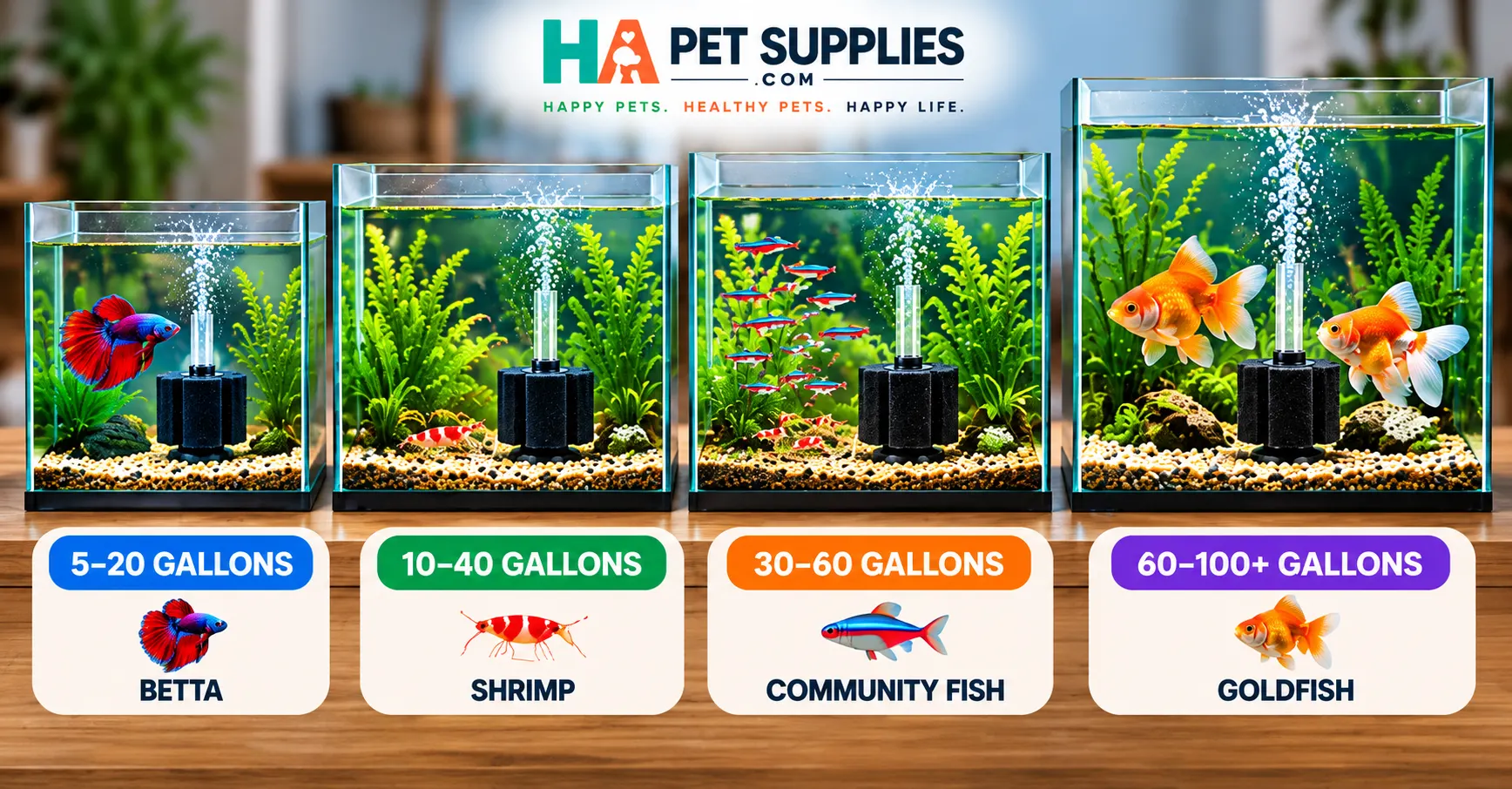
Comparing sponge filter sizes for different aquarium capacities.
Product button: View Aquarium Filter Sponge Options
5. Best Aquarium Sponge Filter for Betta Fish
A betta aquarium requires filtration that supports stable water conditions while respecting the fish’s swimming ability. Long-finned bettas can struggle with excessive current. An air-driven sponge filter is often ideal because circulation can be adjusted.
The SPCA New Zealand betta welfare guidance recommends adjustable filtration and stable water quality.
Best sponge filter for a 5-gallon betta tank
Look for nano or compact sponge filters rated for five gallons. Choose one that fits comfortably without hogging swimming space. Use an adjustable air pump or airflow valve to keep current gentle. Observe your betta: if it’s repeatedly pushed around or avoids areas, reduce airflow.
Best sponge filter for a 10-gallon betta tank
A 10-gallon tank offers flexibility. A suitable small or medium sponge filter may provide useful biological filtration with gentle circulation. Position it so water circulates without excessive turbulence.
How to tell whether your betta likes the water flow
A comfortable betta can swim, rest, explore, and reach the surface without fighting the current. Occasional interaction is fine; persistent difficulty swimming is concerning. Adjust output and avoid blocking all surface movement. The RSPCA Queensland betta care guidance also stresses appropriate space and filtration.
Common betta filtration mistakes
Installing a strong filter without checking swimming comfort is a common error. Another is assuming bettas don’t need filtration because they breathe air. They still require proper water quality and waste management. A sponge filter helps, but it doesn’t replace cycling or maintenance.
6. Best Aquarium Sponge Filter for Shrimp Tanks
Freshwater shrimp tanks have unique priorities. Adult and baby shrimp graze on surfaces, and tiny offspring can be vulnerable to exposed filter intakes. Sponge filtration is popular among shrimp keepers because the foam provides a safe intake surface.
Why shrimp tanks benefit from sponge filters
The porous foam acts as an intake barrier instead of a concentrated suction opening. Shrimp may graze on biofilm that develops on the sponge. However, pore size matters: very small offspring may require finer intake protection, and airflow must remain appropriate.
Best sponge filter for a 10-gallon shrimp aquarium
A small sponge filter rated for the tank is a practical start. Position it so circulation isn’t blocked by plants or decorations. If debris collects in stagnant spots, reposition or adjust airflow.
Best sponge filter for a 20-gallon shrimp breeding tank
A medium sponge or two smaller filters positioned differently can provide distributed biological media and staggered cleaning. Multiple sponges don’t replace appropriate stocking, testing, and maintenance.
Does sponge pore size matter for shrimp?
Yes. Foam porosity affects particle capture and flow resistance. Coarser sponges resist clogging longer; finer intake protection may be preferred for tiny offspring. Choose based on actual livestock and manufacturer guidance. Don’t assume “shrimp-safe” works for every species or stage.
Comparison button: Explore Aquarium Filtration Products
7. Best Aquarium Sponge Filter for Goldfish
Goldfish present a different challenge: they produce substantial waste. The best sponge filter for a goldfish tank must be considered as part of the complete filtration system. The RSPCA Australia goldfish care guide emphasizes efficient filtration, water testing, and high waste production.
Can a goldfish tank use only a sponge filter?
Sometimes, but it depends on tank size, fish population, sponge capacity, and maintenance. A single small sponge is generally not sensible for a heavily stocked goldfish tank. Larger setups may benefit from stronger mechanical filtration, additional biological media, and effective circulation. A sponge filter can supplement biological filtration and aeration.
Fancy goldfish and water flow
Some fancy varieties are weaker swimmers. Strong currents make swimming difficult. Balance is key: provide enough filtration to manage waste without excessive movement. An adjustable powered filter combined with a properly sized sponge may work.
Why tank size still matters
No filtration product can make an extremely small tank suitable for a large fish. Goldfish need swimming space and stable water quality; the aquarium must accommodate adult size. The RSPCA aquarium size recommendations stress choosing tanks based on adult fish size and biological waste.
Recommended approach for goldfish owners
Evaluate adult size, tank dimensions, and stocking level. Then choose the complete filtration system needed for the expected waste load. If using a sponge filter, verify its manufacturer rating and determine whether additional filtration is necessary. Monitor ammonia, nitrite, nitrate, and visible debris.
Buying note: For goldfish, prioritize verified filtration capacity over inexpensive undersized equipment.
8. Seven Essential Factors Before Buying the Best Aquarium Sponge Filter
Factor 1: Tank capacity
Check the manufacturer’s recommended aquarium capacity. A nano filter may not suit a larger or heavily stocked tank. Treat printed capacity as a starting point, then account for livestock and waste.
Factor 2: Biological filtration surface
The sponge should provide enough colonizable surface area. A larger sponge offers more surface, but performance also depends on water movement, oxygen, and established bacteria. Large foam volume isn’t automatically effective if insufficient water passes through it.
Factor 3: Foam pore size
Fine foam captures smaller debris but clogs faster. Coarse foam allows more movement and lasts longer between cleanings. Shrimp breeding tanks need extra attention to pore size and intake protection.
Factor 4: Air pump compatibility
Traditional sponge filters require a compatible air pump. Check if the pump is included or sold separately. Confirm airline tubing size, pump output, and operating depth. The Aquarium Co-Op air pump installation guide explains basic components.
Factor 5: Water flow control
Choose an arrangement that allows airflow adjustment. Gentle circulation is especially useful for bettas and breeding tanks. The correct flow supports filtration while letting inhabitants behave normally.
Factor 6: Maintenance access
The sponge should be easy to remove, inspect, and clean. A filter squeezed behind decorations becomes inconvenient. Consider the complete layout before purchasing.
Factor 7: Overall cost and replacement parts
Total cost may include sponge filter, air pump, tubing, check valve, and airflow controls. Compare complete equipment needs, not just the sponge price. Also consider replacement foam availability.
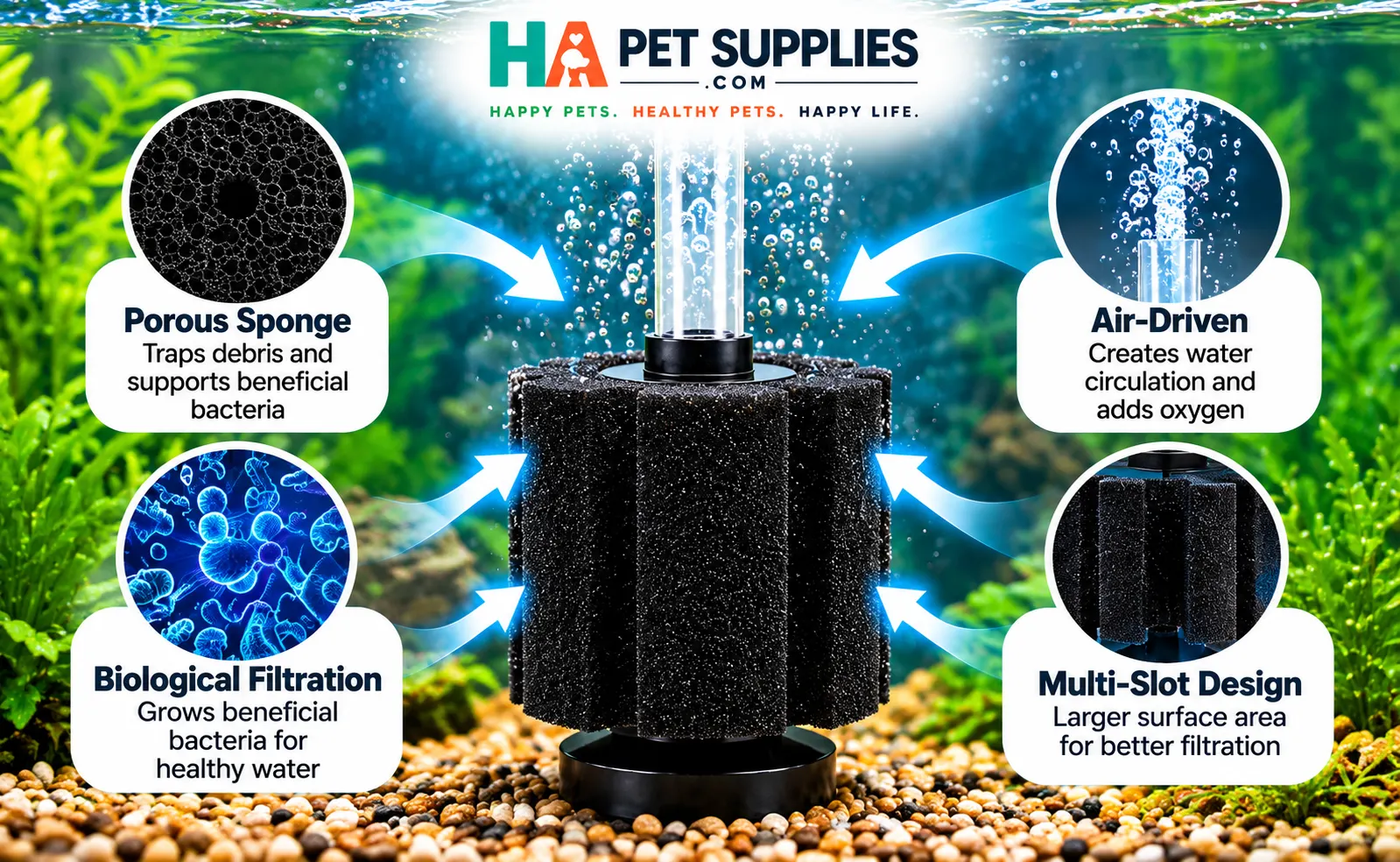
Porous sponge media helps collect debris and supports beneficial bacteria.
Product button: Check HA Pet Supplies Aquarium Filter Sponge
9. Sponge Filter vs Hang-On-Back and Canister Filters
| Feature | Sponge Filter | Hang-On-Back | Canister Filter |
|---|---|---|---|
| Water movement | Gentle to moderate | Depends on model | Depends on configuration |
| Biological media | Sponge surface | Cartridge or basket | Multiple compartments |
| Mechanical filtration | Captures some debris | Multiple mechanical media | Substantial capacity |
| Installation | Straightforward | Moderate | More involved |
| Maintenance | Remove and rinse sponge | Clean housing and media | Clean hoses, housing, media |
| Ideal use | Gentle filtration, breeding, shrimp | Many community aquariums | Larger/demanding setups |
When a sponge filter makes sense
Simple maintenance, reusable media, gentle circulation. Also useful as supplementary biological filtration.
When another system may be better
Tanks with substantial waste, strong circulation needs, or fine-particle filtration may benefit from additional equipment. The Aquarium Co-Op fish tank filtration comparison explains major categories.
10. How to Choose an Air Pump for Your Sponge Filter
The best sponge filter can’t work without appropriate air supply. An undersized pump produces weak movement; an oversized pump creates turbulence or noise. Ideal: compatible pump, suitable tubing, adjustable airflow.
Check the pump’s specifications
Look at stated airflow output, maximum operating depth, and compatibility. Resistance increases with depth and configuration. Two pumps with similar outputs may behave differently underwater.
Use appropriate airline tubing
Choose tubing that fits securely. Loose fittings reduce airflow; damaged tubing leaks. Avoid sharp bends and inspect older tubing for cracks.
Install a check valve where necessary
A check valve prevents water siphoning back when the pump stops — especially important if the pump sits below water level. The Aquarium Co-Op check valve guide explains placement.
Adjust the air supply carefully
Use adjustable output or a control valve to find the right setting. Observe fish and ensure the sponge still moves water effectively.
Should you leave the sponge filter running at night?
In a typical established tank, yes — continuous operation maintains circulation and oxygen delivery to bacteria. If noise is an issue, investigate quieter pump placement and vibration reduction rather than shutting off filtration.
11. Common Aquarium Sponge Filter Buying Mistakes
Mistake 1: Choosing solely by price
A cheap filter may be unsuitable. Compare capacity, materials, compatibility, and maintenance.
Mistake 2: Assuming all small filters are identical
“Small” isn’t standardized. One brand’s small may differ in foam volume or tank rating from another’s.
Mistake 3: Forgetting the air pump
Some listings include only the sponge assembly. Buyers may discover they still need an external pump and tubing. Always check what’s included.
Mistake 4: Ignoring fish swimming ability
A filter for an active community tank may overwhelm a long-finned betta. Choose airflow that suits your livestock.
Mistake 5: Expecting instant biological filtration
Beneficial bacteria take time to establish. A new sponge isn’t the same as mature media. The API Fishcare aquarium cycling article explains the nitrogen cycle.
Mistake 6: Using too little filtration for goldfish
Goldfish produce considerable waste. A small sponge that works in a shrimp tank won’t cut it for goldfish.
Mistake 7: Replacing the sponge too frequently
A mature sponge contains beneficial microorganisms. Replacing it unnecessarily reduces biological capacity. Clean reusable foam and replace only when physically necessary.
12. How to Set Up an Aquarium Sponge Filter
Installation is straightforward. Here’s a typical air-driven setup:
Step 1: Check all parts — sponge, base, uplift assembly, airline connection, accessories.
Step 2: Rinse new foam gently in dechlorinated water. No soap or chemicals.
Step 3: Attach compatible airline tubing securely to the air inlet.
Step 4: Add a check valve where required, following flow-direction instructions.
Step 5: Position the filter securely where the sponge won’t be obstructed.
Step 6: Connect the pump, keeping electrical equipment dry and using a drip loop.
Step 7: Turn on the pump — check bubbles and circulation.
Step 8: Adjust airflow to support filtration without disturbing inhabitants.
Step 9: Monitor circulation, test water quality, and maintain the sponge.
For a detailed walkthrough, read How to Set Up an Aquarium Sponge Filter in 9 Easy Steps.
Tutorial button: Follow the Complete 9-Step Setup Guide
13. Aquarium Sponge Filter Cleaning and Maintenance
Routine maintenance keeps the filter effective. As foam collects debris, flow decreases. Cleaning removes trapped material while allowing established bacteria to remain.
How often should a sponge filter be cleaned?
No universal schedule. A lightly stocked shrimp tank accumulates debris slower than a heavily stocked fish tank. Inspect during water changes and clean when buildup or reduced circulation makes it necessary. The Aquarium Co-Op filter cleaning guide explains how needs depend on waste, capacity, and conditions.
How to clean a sponge without harming bacteria
Switch off the air pump. Collect removed aquarium water in a clean container. Carefully lift the filter, ideally capturing loose debris. Gently squeeze the sponge several times in the removed water. Repeat until waste is removed. Reassemble, return to tank, restart pump, and confirm circulation. Avoid soap, chemicals, and untreated chlorinated water.
Should you replace brown sponge foam?
Not simply because it’s brown. Discoloration reflects accumulated organic material. Inspect for tearing, hardening, structural deterioration, or inability to maintain flow. Replace only when the material can no longer perform.
Should you clean two sponge filters at the same time?
When using multiple mature filters, stagger major cleaning to avoid disturbing all biological media simultaneously. Gentle regular cleaning differs from sterilizing or replacing all media.
Our full maintenance article explains additional mistakes: How to Clean a Sponge Filter Without Killing Beneficial Bacteria.
Cleaning button: Read the Cleaning Guide
14. Troubleshooting Common Aquarium Sponge Filter Problems
Problem: No bubbles
Check the air pump, airline connection, tubing, check valve orientation, and air inlet. A blocked airline or incorrectly installed valve prevents airflow. Disconnect power safely before inspecting electrical equipment near water.
Problem: Weak bubbles
May result from clogged sponge, undersized pump, restricted tubing, or obstructed air passage. Inspect pump and connections before replacing the sponge. Clean when debris restricts circulation.
Problem: Water remains cloudy
Cloudiness can come from suspended particles, bacterial blooms, disturbed substrate, or algae. A sponge filter removes some debris but can’t instantly solve every water-quality issue. Test ammonia and nitrite, review feeding, and check cycling.
Problem: Betta struggles with current
Reduce airflow if possible while keeping sufficient circulation. Reposition the outlet or filter. Observe swimming and adjust gradually.
Problem: Sponge filter is noisy
Noise can come from the air pump, vibration against furniture, or large bubbles. Check pump mounting and tubing connections. The Aquarium Co-Op air pump guide offers sound-reduction tips.
Problem: Ammonia increases after changing filters
Established biological filters contain important bacteria. Replacing mature media abruptly reduces processing capacity. Test water, protect livestock, and rebuild biological filtration. For dangerous ammonia/nitrite levels, prioritize corrective water changes with properly conditioned water and seek qualified aquatic veterinary guidance when fish are unwell.
15. Why Choose HA Pet Supplies Aquarium Filter Sponge?
Choosing aquarium equipment is more than picking an attractive photo. The filter must suit the tank, match the setup, and remain manageable during maintenance. At HA Pet Supplies, buyers can explore aquarium filtration products alongside practical educational resources.
Whether you’re preparing a betta aquarium, comparing shrimp tank filtration, or improving biological filtration in a community tank, understanding equipment requirements helps avoid unnecessary purchases. The HA Pet Supplies aquarium filter sponge product page provides a starting point.
Check the selected product variation for exact dimensions, recommended tank capacity, foam pore grade, and included accessories before buying.
What should buyers confirm before ordering?
Ask whether the product includes a complete assembly or only replacement media. Confirm whether an external air pump, airline tubing, or check valve must be purchased separately. Check the recommended tank size and whether the filter fits comfortably. For additional accessories, explore the HA Pet Supplies aquarium product collection.
Product button: Explore Aquarium Filter Sponge
For pricing or compatibility questions, HA Pet Supplies provides a request form. Request Aquarium Filter Pricing.
16. Frequently Asked Questions About Aquarium Sponge Filters
1. What is the best aquarium sponge filter for a 5-gallon tank?
A nano or compact sponge filter rated for a five-gallon aquarium is a useful starting point. For bettas, prioritize adjustable gentle flow. For shrimp, evaluate foam pore size. The exact model should match stocking and filtration needs.
2. Is a sponge filter enough for a betta fish?
A properly sized, established sponge filter can provide suitable filtration for many betta tanks. However, tank size, stocking, cycling, heating, and water maintenance are also critical. A sponge filter cannot compensate for unsuitable housing.
3. What size sponge filter is best for a 10-gallon aquarium?
Small or medium filters rated for the tank may be appropriate, depending on manufacturer and livestock. Check recommended capacity rather than relying on the size label alone.
4. Are sponge filters safe for shrimp babies?
Sponge filters are commonly used in shrimp breeding tanks because their intake is gentler than exposed powered intakes. Very small offspring require appropriate foam porosity and suitable circulation.
5. Can I use a sponge filter in a goldfish tank?
Yes, but goldfish produce substantial waste. Larger tanks may require supplementary mechanical filtration or a higher-capacity system. Don’t assume a small sponge alone will manage every goldfish tank.
6. Does an aquarium sponge filter need electricity?
Traditional sponge filters are passive, but the external air pump normally requires electrical power or another source. The pump creates airflow for water circulation.
7. How long does it take for sponge filter bacteria to grow?
Biological filtration develops gradually, often over several weeks. Time depends on tank conditions and whether mature media is introduced. Use water testing to verify cycling progress.
8. Can a sponge filter make aquarium water clear?
It can capture some suspended particles and support biological filtration. Cloudy water may result from algae, disturbed substrate, bacterial blooms, or other conditions requiring separate attention.
9. Should an aquarium sponge filter run continuously?
Normally, yes. Continuous operation maintains water movement and oxygen supply to the biological filter. Avoid switching off the air pump every night merely to reduce noise.
10. Is a bigger sponge filter better for every aquarium?
No. The filter should match the tank’s space, livestock, waste load, and desired circulation. Large foam volume may help, but oversized equipment can be impractical in small tanks.
11. What is the difference between fine and coarse sponge filters?
Fine sponges trap smaller particles but clog more readily. Coarse sponges allow different flow and tolerate more debris. Livestock size and filtration goals should guide selection.
12. Can I use two aquarium sponge filters together?
Yes, if the tank has sufficient space and compatible airflow equipment. Multiple filters can distribute filtration and allow staggered maintenance.
13. How often should I replace an aquarium sponge filter?
Replace damaged, deteriorated, or structurally unsuitable foam — not on an arbitrary schedule. Many sponges are reusable after proper cleaning.
14. What should I do if my sponge filter stops working?
Check the air pump, tubing, check valve, and air passage. Inspect the sponge for clogging and restart after resolving the cause. Monitor water quality if filtration was interrupted.
15. Where can I buy an aquarium sponge filter online?
Explore the HA Pet Supplies aquarium filter sponge product and request details about available sizes, specifications, accessories, and pricing.
17. Final Verdict: Which Aquarium Sponge Filter Should You Choose?
The best aquarium sponge filter depends on your tank. For a betta, choose suitable gentle, adjustable circulation. For shrimp, prioritize sponge intake, appropriate foam porosity, and stable biological filtration. For goldfish, focus on filtration capacity and waste management — a sponge filter may be one part of a larger arrangement.
Regardless of livestock, choose a product with verified capacity, suitable accessories, and manageable maintenance. Remember that new sponge filters need time to develop mature biological filtration. Even the right filter must be supported by regular testing, water changes, and responsible stocking.
If unsure which size to purchase, confirm your tank’s water volume and intended species. Then compare product specifications rather than relying only on labels.
For more aquarium equipment and educational resources, visit the HA Pet Supplies website or browse the HA Pet Supplies blog. If you need assistance choosing filtration equipment, contact HA Pet Supplies with details about your aquarium.
Find the Right Aquarium Sponge Filter for Your Fish Tank
A correctly selected sponge filter can become an important part of a cleaner, more stable, and easier-to-maintain aquarium.
Internal links are woven naturally throughout the content. External links point to authoritative aquarium and welfare resources.
© HA Pet Supplies — Aquarium care guides.