
Learning how to set up an aquarium sponge filter is one of the easiest ways to improve your fish tank filtration. Whether you just bought your first aquarium or want gentler filtration for a betta or shrimp tank, this visual guide breaks down the entire process into 9 interactive steps.
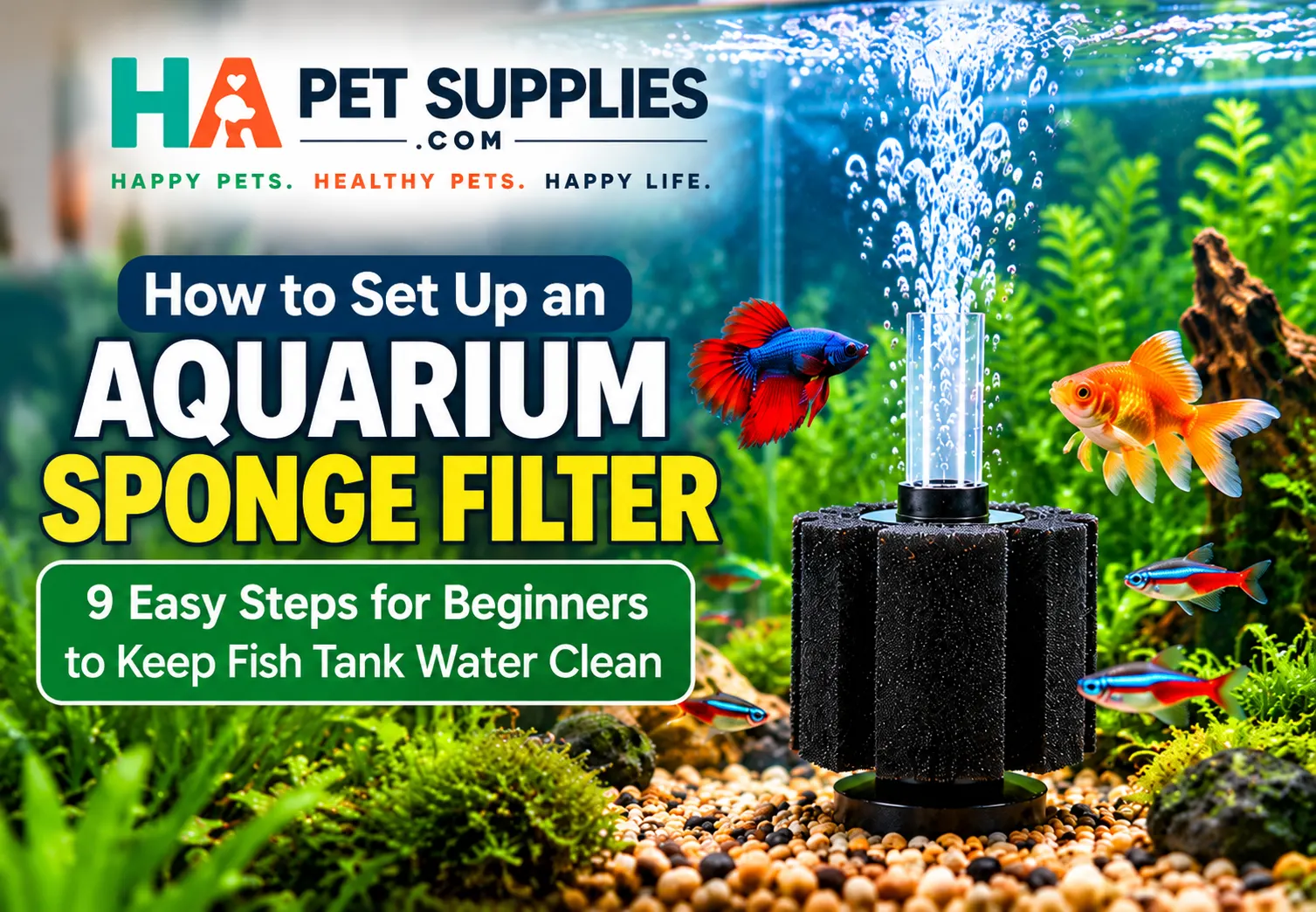
Beginner aquarium sponge filter setup guide.
Quick shopping option: Explore HA Pet Supplies Aquarium Filter Sponge →
Quick Answer: How to Set Up an Aquarium Sponge Filter
To set up an aquarium sponge filter, connect the filter assembly to compatible airline tubing, install a check valve where needed, and attach the tubing to an external air pump. Place the sponge inside the tank, switch on the pump, and adjust the airflow until water circulates properly.
1. Air Pump
External pump pushes air through the tube.
Step 1 & 72. Check Valve
Prevents water from siphoning back.
Step 53. Sponge Filter
Inside the tank, trapping debris & growing bacteria.
Step 2 & 6Important: A new sponge filter may begin circulating water immediately, but it does not instantly provide mature biological filtration. A newly established aquarium must still complete the nitrogen cycle. If fish are showing distress, test ammonia and nitrite immediately.
📋 Table of Contents
- 1. What Is an Aquarium Sponge Filter?
- 2. How Does It Work?
- 3. Equipment Needed
- 4. How to Set It Up in 9 Steps
- 5. 3D Infographic Guide
- 6. Best Placement
- 7. Setup for Betta, Shrimp, Goldfish
- 8. The Nitrogen Cycle
- 9. Why Water Is Still Cloudy
- 10. Common Setup Mistakes
- 11. Troubleshooting
- 12. Cleaning & Maintenance
- 13. Sponge vs Other Filters
- 14. Why Choose HA Pet Supplies?
- 15. FAQ
- 16. Final Checklist
1. What Is an Aquarium Sponge Filter?
An aquarium sponge filter is a filtration device that uses porous foam to collect suspended particles and provide a surface where beneficial microorganisms can grow. Unlike many internal or hang-on-back filters, a traditional sponge filter does not contain an integrated electric water pump.
Instead, an external aquarium air pump supplies air through a tube. Rising bubbles create water movement through the sponge filter. This operating principle makes sponge filters relatively simple to install and maintain.
Mechanical filtration
As water moves through the sponge, food fragments, fish waste, and organic debris become trapped inside the foam. Over time, this accumulation can reduce water movement, so the sponge needs periodic cleaning.
Biological filtration
Fish naturally release ammonia. In a mature aquarium, beneficial bacteria convert ammonia into nitrite and then nitrate. The sponge acts as a surface where these microorganisms establish themselves. The RSPCA guide to aquarium environments explains why filtration is essential for fish welfare.
Air circulation
When the external air pump operates, bubbles rise through the filter’s uplift mechanism. This movement pulls surrounding water through the sponge and returns it to the aquarium, creating surface movement that supports gas exchange.
For help comparing different capacities, our aquarium filter buying guide explains the factors that influence sponge filter selection.
2. How Does an Aquarium Sponge Filter Work?
Before installing your filter, it helps to understand the path taken by air and water. A traditional sponge filter uses an airlift effect. The external pump sends air through airline tubing into the filter. Air bubbles rise through the uplift tube, causing water to move upward.
Stage 1: Aquarium water enters the sponge
Water moves through the porous foam. The sponge captures certain suspended particles. Fine foam may capture smaller debris but can clog more quickly; coarser foam permits greater water movement.
Stage 2: Beneficial bacteria use the sponge surface
The foam provides surface area where microorganisms colonize. In a properly cycled aquarium, these organisms help process harmful nitrogen compounds. Established sponge media should not be unnecessarily sterilized or discarded.
Stage 3: Water returns to the aquarium
As air rises through the uplift system, water circulation continues. The moving water helps transport suspended particles toward the filter. The Aquarium Co-Op guide to sponge filters illustrates this process.
3. Equipment Needed Before Setting Up
One common beginner mistake is assuming that every sponge filter package includes a complete operating system. Some listings contain only the sponge assembly. Check your product package before starting.
| Equipment | Purpose | Necessary? |
|---|---|---|
| Aquarium sponge filter | Mechanical and biological filtration | Yes |
| External air pump | Supplies air to operate the filter | Yes for traditional designs |
| Airline tubing | Carries air from pump to filter | Yes |
| Check valve | Prevents reverse water flow | Strongly recommended |
| Airflow control valve | Adjusts air output | Optional but useful |
| Water conditioner | Treats tap water | Necessary when required |
| Test kit | Measures water quality | Essential |
The Aquarium Co-Op air pump guide explains how air-driven accessories operate and why pump choice matters. For a manufacturer-specific example, see the Aquarium Co-Op sponge filter sizing information.
4. How to Set Up an Aquarium Sponge Filter in 9 Easy Steps
Follow these nine steps carefully. Individual models may have different fittings, so always check the manufacturer’s manual.
Step 1: Gather All Components
Place the filter assembly, air pump, tubing, and check valve on a clean surface. Inspect the sponge for tears and check tubing for holes.
Step 2: Assemble the Filter Correctly
Attach the sponge to its support, fit the uplift tube, and ensure the air connection is accessible. Do not force plastic parts.
Step 3: Rinse the Sponge
Gently rinse new foam in dechlorinated water. Do not use soap or chemicals. If the sponge is already established, keep it wet and avoid untreated chlorinated water.
Step 4: Connect the Airline Tubing
Push tubing securely onto the air inlet. Route it toward the aquarium rim without pinching or sharp bends.
Step 5: Install the Check Valve
Install the valve between the pump and filter. The arrow must point toward the aquarium. The Aquarium Co-Op check valve guide explains why placement matters.
Step 6: Position the Filter in the Tank
Place it securely, usually in a rear corner. Avoid blocking the sponge with decorations. Gently compress the sponge underwater if it floats.
Step 7: Connect the Air Pump Safely
Keep the external pump dry. Create a drip loop in the power cord. If the pump sits below water level, ensure the check valve is correct. See the Aquarium Co-Op air pump installation tutorial.
Step 8: Turn On and Adjust Flow
Turn on the pump. Observe bubbles and water circulation. Adjust airflow to suit your fish — gentle for bettas, adequate for goldfish. The Aquarium Co-Op air stone guide explains how bubble size affects circulation.
Step 9: Monitor and Establish Bacteria
Biological filtration takes time. Test ammonia and nitrite. The API Fishcare cycling guide explains the nitrogen cycle. Do not assume moving water means safe water.
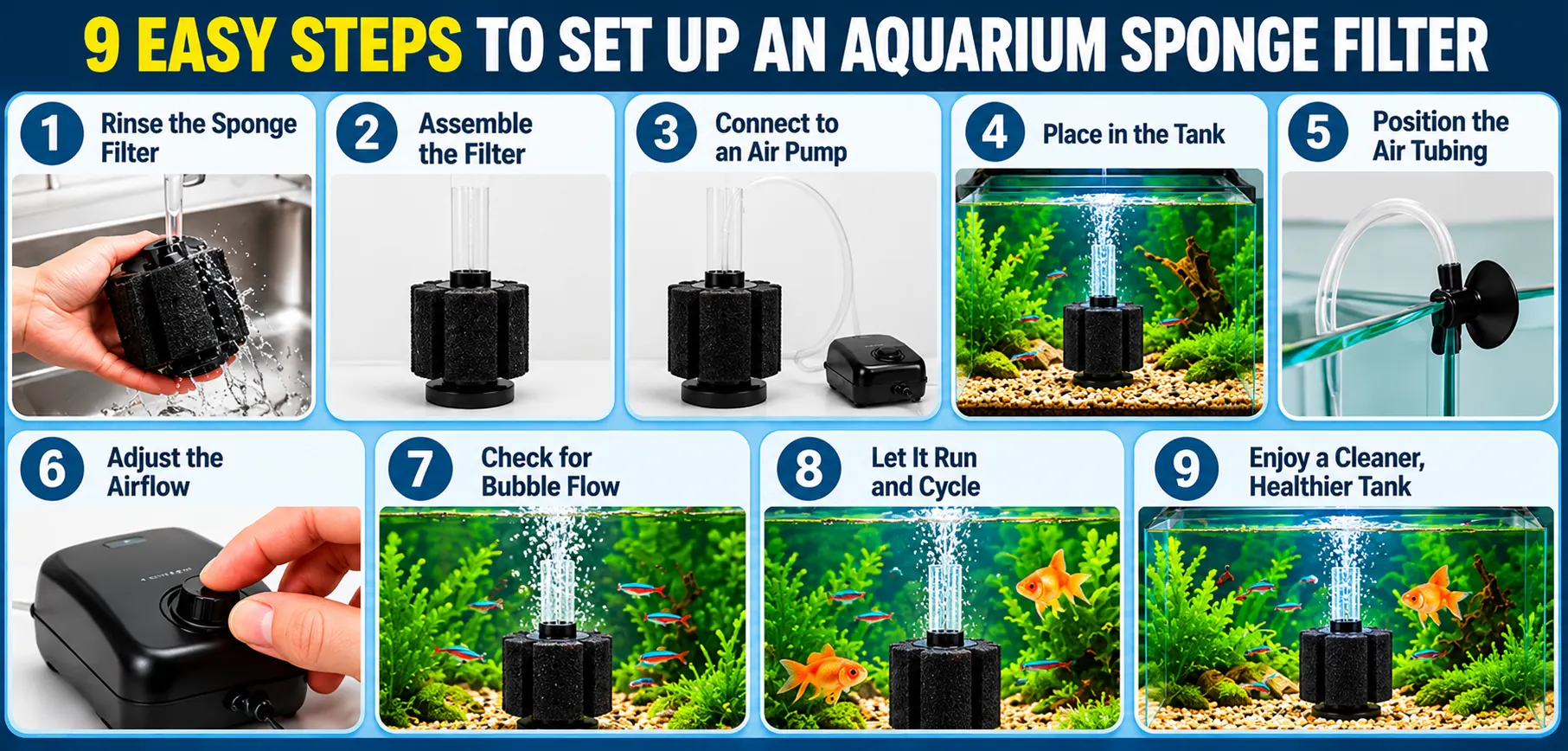
Nine simple steps for connecting a sponge filter.
Product button: Explore HA Pet Supplies Aquarium Filters
5. 3D Infographic: Aquarium Sponge Filter Setup Explained
Imagine a realistic transparent freshwater aquarium with a black porous sponge filter inside. A small external air pump sits beside it, connected with translucent tubing. A clearly marked check valve sits outside the tank.
Visual flow: Glowing blue arrows show air moving from the pump to the filter. Inside the tank, turquoise arrows show water entering the sponge and rising through the uplift tube. The nine steps are arranged as numbered cards around the illustration.
Mobile layout: The 3D illustration stacks above the step cards, using single-column text so nothing breaks on small screens.
6. Where Should You Place an Aquarium Sponge Filter?
A rear corner is often convenient because it keeps the sponge discreet and makes airline tubing easier to route. However, it’s not automatically the best choice for every tank. Dense plants and aquarium shape can affect circulation.
Follow the manufacturer’s guidance on whether the base should rest on the bottom. Keep the exposed filtration surfaces clear. Don’t bury the sponge in gravel unless the design allows it. Leave enough clearance to inspect and lift the sponge during cleaning.
Filter positioning can influence surface agitation. The RSPCA aquarium environment guidance explains why surface area and circulation matter for fish welfare.
7. How to Set Up a Sponge Filter for Different Fish
Betta fish
Bettas do best with manageable water movement. Use an adjustable air pump where possible. Observe whether the betta can swim naturally and rest comfortably. If it’s repeatedly pushed by the current, reduce airflow while maintaining adequate filtration.
Shrimp tanks
Shrimp keepers often choose sponge filtration because of the gentle intake surface. For breeding tanks, select foam porosity appropriate for tiny offspring. Keep the filter accessible because shrimp may graze on its surface.
Goldfish tanks
Goldfish produce considerable waste. A sponge filter may provide useful supplementary biological filtration and aeration, but heavily stocked tanks may require additional mechanical filtration. The RSPCA Australia water-quality guide emphasizes effective biological filtration.
For detailed species-specific sizing, see our guide on choosing a sponge filter for betta, shrimp, or goldfish.
8. Understanding the Aquarium Nitrogen Cycle After Setup
A newly installed sponge filter does not instantly create an established biological filtration system. Fish produce ammonia, and decomposing organic matter adds more. In a properly cycled aquarium, beneficial microorganisms convert ammonia to nitrite and then nitrate.
Ammonia and nitrite are particularly dangerous when allowed to accumulate. As suitable bacteria colonize the sponge, the biological filter gradually develops. This can take several weeks. Verify progress through water testing rather than relying on a fixed number of days.
Clear water can still be dangerous. Mechanical filtration removes suspended particles, not all dissolved pollutants. The API Fishcare nitrogen-cycle guide describes how ammonia, nitrite, and nitrate change as an aquarium establishes biological filtration.
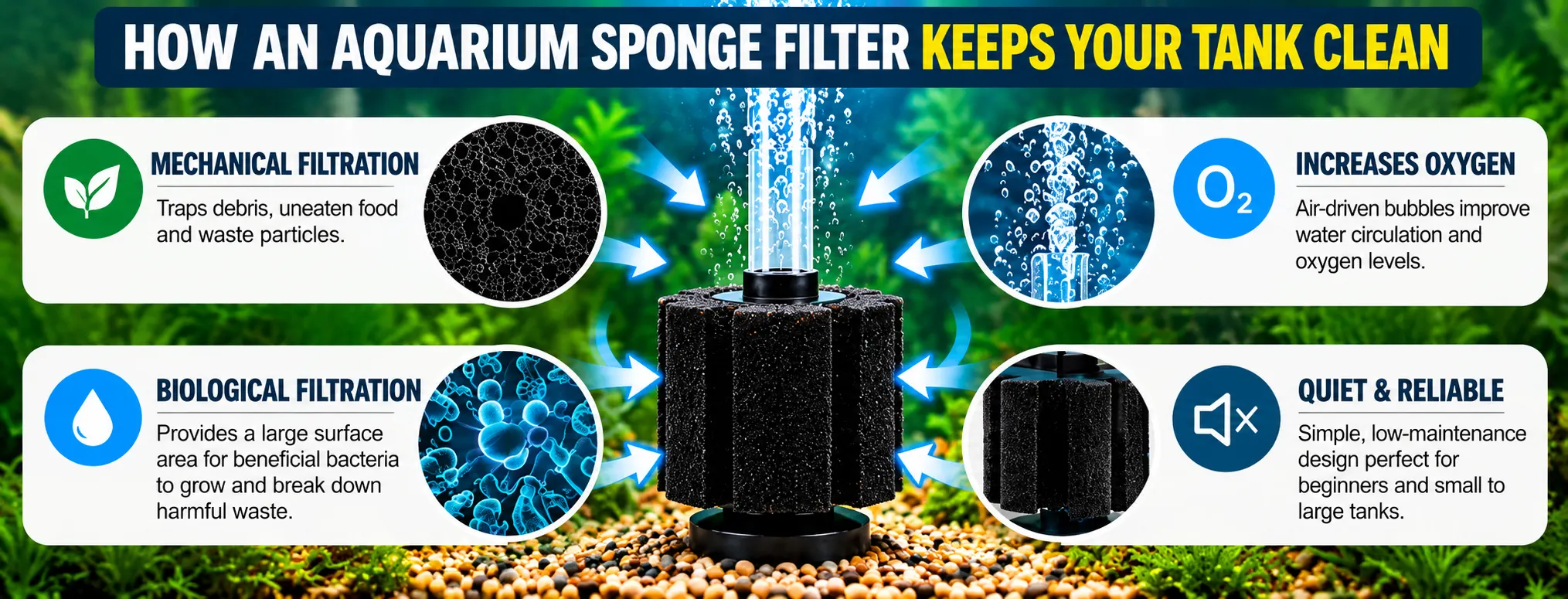
Sponge filtration supports cleaner water and beneficial bacteria.
9. Why Is My Aquarium Water Still Cloudy After Installing a Sponge Filter?
Installing a sponge filter can help capture suspended particles, but it does not guarantee immediate crystal-clear water. Different causes require different responses.
Disturbed substrate
New gravel or rearranged decorations may release fine particles. Mechanical filtration may gradually collect them. Avoid repeatedly disturbing the substrate.
Bacterial bloom
Newly established aquariums sometimes develop cloudy water associated with bacterial growth. Test ammonia and nitrite and review cycling status.
Overfeeding
Uneaten food decays and contributes to organic waste. Feed appropriate amounts. A filter helps manage waste but does not make excessive feeding harmless.
Green water from algae
Green water can be suspended algae. A conventional sponge filter may not efficiently remove microscopic algae cells. Review lighting, nutrients, and maintenance.
When cloudiness is an emergency: If cloudy water is accompanied by gasping or unusual swimming, test water quality promptly. If ammonia or nitrite is elevated, take corrective action, including partial water changes with conditioned, temperature-matched water. A new filter is not a substitute for correcting dangerous water conditions.
10. Common Aquarium Sponge Filter Setup Mistakes
Mistake 1: Forgetting the air pump
An air-driven sponge filter cannot operate without a suitable air supply. Check whether the package includes a pump.
Mistake 2: Installing the check valve backward
A backward-facing check valve can prevent air from reaching the filter. Check the marked direction.
Mistake 3: Using an unsuitable pump
An undersized pump creates insufficient circulation; an excessively strong pump produces unwanted turbulence.
Mistake 4: Blocking the sponge intake
Decorations, gravel, and dense plants can restrict water movement. Leave clearance for the filter to operate.
Mistake 5: Assuming the aquarium is instantly cycled
Bubbles and moving water do not prove that beneficial bacteria have established. Use ammonia and nitrite testing.
Mistake 6: Ignoring electrical safety
Keep external pumps and power connections dry. Use drip loops and check valves.
Mistake 7: Switching the sponge filter off every night
Routine nightly shutdowns interrupt filtration and water circulation. If the pump is noisy, investigate vibration instead.
11. Troubleshooting Aquarium Sponge Filter Problems
| Problem | Possible Reason | What to Check First |
|---|---|---|
| No bubbles | Pump off, disconnected tubing, reversed check valve | Power, tubing, valve direction |
| Weak bubbles | Restricted airline or inadequate pump output | Connections, obstructions, pump compatibility |
| Sponge floats | Air trapped inside foam | Submerge and gently compress sponge |
| Strong current | Excessive airflow | Adjust pump or compatible valve |
| Loud vibration | Pump touching a resonant surface | Pump positioning and mounting |
| Reduced filtration | Debris buildup or restricted airflow | Clean sponge and inspect airline |
| Persistent cloudy water | Substrate disturbance, bacteria, algae, waste | Water testing and cause identification |
| Ammonia readings increase | Incomplete or disrupted biological filtration | Test water and protect livestock |
Why are there no bubbles? Start simple: check power, then airline connections, then valve direction. If the pump operates but no air reaches the filter, check for blocked or damaged tubing.
12. How to Clean and Maintain an Aquarium Sponge Filter
As debris collects in the foam, water movement gradually declines. Cleaning removes accumulated particles without requiring routine replacement of the entire sponge.
When should you clean it?
Inspect during regular maintenance. Clean when visible debris accumulation or reduced circulation suggests clogging. The Aquarium Co-Op filter maintenance guide explains why frequency should reflect actual tank conditions.
Safe cleaning procedure
Switch off the air pump. During a partial water change, collect removed aquarium water in a clean container. Carefully lift the sponge filter. Gently squeeze the foam in the removed water to release debris. Reassemble, return to the tank, and restart the pump.
Why you should protect beneficial bacteria
Established media contains microorganisms that contribute to biological filtration. Avoid unnecessary sterilization. The Aquarium Co-Op guide to cleaning filters explains how to preserve media while removing debris. For a detailed walkthrough, see our dedicated sponge filter cleaning article.
13. Sponge Filter vs Other Aquarium Filtration Systems
| Feature | Sponge Filter | Hang-On-Back | Canister Filter |
|---|---|---|---|
| Power source | External air pump | Electric water pump | Electric water pump |
| Biological filtration | Sponge surface | Various media | Various media |
| Mechanical filtration | Sponge foam | Cartridges or pads | Multiple media options |
| Water movement | Depends on air supply | Depends on model | Depends on model |
| Maintenance | Straightforward | Moderate | More involved |
| Common applications | Shrimp, betta, breeding, supplementary | Community tanks | Larger/demanding systems |
The Aquarium Co-Op pre-filter sponge guide also explains how sponge material can be incorporated into powered filtration systems.
14. Why Choose HA Pet Supplies Aquarium Sponge Filters?
The best filtration setup begins with selecting equipment appropriate for the tank. HA Pet Supplies provides aquarium product options and educational resources that help buyers understand filtration before making a purchase.
Whether you need a compact sponge filter for a betta tank or want to explore biological filtration for a freshwater community aquarium, start by checking product capacity and accessory requirements. The HA Pet Supplies aquarium filter sponge listing provides a starting point.
Air-driven filtration may require additional accessories such as an air pump, tubing, check valve, or airflow regulator. Explore additional items through the HA Pet Supplies fish and aquarium product category.
If you are unsure whether a filter fits your aquarium, contact HA Pet Supplies with your tank dimensions, livestock details, and equipment requirements. More educational resources are available through the HA Pet Supplies blog.
15. Frequently Asked Questions
1. How do I set up an aquarium sponge filter for the first time?
Assemble the filter, prepare the sponge, attach compatible airline tubing, install a check valve where needed, position the filter in the tank, connect the air pump, and adjust airflow. Continue monitoring water quality until biological filtration is established.
2. Can a sponge filter work without an air pump?
A traditional air-driven sponge filter requires an external air source. Some other filtration products may use water pumps, but these should not be confused with a conventional air-driven sponge filter.
3. Does a sponge filter need an air stone?
Not always. Some designs use built-in diffusers, while others can accept an air stone. Follow the specific filter manufacturer’s instructions rather than adding incompatible components.
4. Where should I place a sponge filter in my aquarium?
Position it where the sponge has access to surrounding water, the base remains stable, and decorations do not block the intake. Rear corners are common, but the ideal location depends on aquarium circulation and layout.
5. How long should I run a sponge filter each day?
A sponge filter should normally operate continuously to maintain water circulation and support the biological filtration system.
6. Why is my sponge filter not bubbling?
Possible causes include a disconnected airline, weak pump, blocked tubing, reversed check valve, or incorrectly assembled filter. Inspect the connections and power supply first.
7. Can I use a sponge filter in a betta aquarium?
Yes, provided the filter is appropriately sized and the airflow is adjusted to suit the betta. Avoid current strong enough to interfere with normal swimming.
8. Are sponge filters suitable for shrimp tanks?
Yes. Sponge filtration is commonly used in shrimp tanks. Choose suitable foam porosity and appropriate water movement, especially when tiny shrimp offspring are present.
9. How long does a new sponge filter take to develop beneficial bacteria?
Biological filtration generally develops over several weeks, but the exact time varies. Monitor ammonia and nitrite rather than relying on a fixed schedule.
10. Will a sponge filter make cloudy aquarium water clear?
It can help remove suspended particles, but cloudiness can have several causes. A filter alone may not resolve bacterial blooms, algae, or unsafe water chemistry.
11. Can I wash my aquarium sponge filter under tap water?
For established biological media, removed aquarium water or suitable dechlorinated water is generally preferred. Avoid soap, cleaning chemicals, and unnecessary chlorine exposure.
12. Does a sponge filter provide oxygen?
An air-driven sponge filter creates bubbles and water movement that can contribute to gas exchange. However, oxygen availability still depends on aquarium conditions, temperature, surface movement, and livestock needs.
13. Can I use two sponge filters together?
Yes. Multiple sponge filters can provide additional filtration surfaces and distributed circulation when supported by suitable air pumps and aquarium space.
14. Should I replace my aquarium sponge when it becomes brown?
Not automatically. Brown coloration can result from accumulated debris and established biological material. Replace sponge foam when it becomes damaged, deteriorated, or unable to function properly after cleaning.
15. What is the best sponge filter for a beginner?
A suitable beginner filter is one that matches the aquarium’s volume and livestock, uses accessible reusable media, and works with a compatible air pump. Always verify the manufacturer’s capacity recommendation.
16. What happens if my sponge filter stops during a power outage?
Water circulation stops when the air pump loses power. A check valve can help prevent backflow. Once power returns, confirm normal operation and monitor aquarium water quality, especially after a lengthy interruption.
17. Can I install a sponge filter in an established aquarium?
Yes. A new sponge filter can be added to an established aquarium. Allow it to develop beneficial bacteria while the existing filtration continues operating. Avoid removing mature biological media immediately.
18. Where can I buy an aquarium sponge filter online?
You can explore the HA Pet Supplies aquarium filter sponge listing and request information about model availability, specifications, compatibility, and ordering options.
16. Final Aquarium Sponge Filter Setup Checklist
Before considering your installation complete, confirm the following:
- The sponge filter is assembled correctly and positioned securely.
- The airline tubing is connected without leaks or sharp bends.
- The check valve is installed in the proper direction where needed.
- The external air pump is positioned safely and remains dry.
- Bubbles rise consistently from the filter.
- Water circulates through the sponge.
- Fish are not being pushed around by excessive current.
- The filter has enough clearance for routine cleaning.
- Water testing is part of the aquarium’s maintenance plan.
- Biological filtration has been established before the tank is considered ready.
The most important lesson for beginners is to understand the difference between moving water and biologically safe water. Bubbles show that air is circulating. They do not prove that ammonia and nitrite are being processed effectively.
If you need filtration equipment or want to compare aquarium supplies, explore the HA Pet Supplies online shop. For broader pet and aquarium information, visit the HA Pet Supplies homepage.
Ready to Set Up Your Aquarium Sponge Filter?
Internal links are woven naturally throughout the content. External links point to authoritative aquarium and welfare resources.
© HA Pet Supplies — Aquarium care guides.