
Learning how to clean an aquarium sponge filter is essential for keeping aquarium water healthy without unnecessarily disturbing the beneficial bacteria that help process fish waste. This guide simplifies the process using 7 safe steps and interactive 3D visuals.
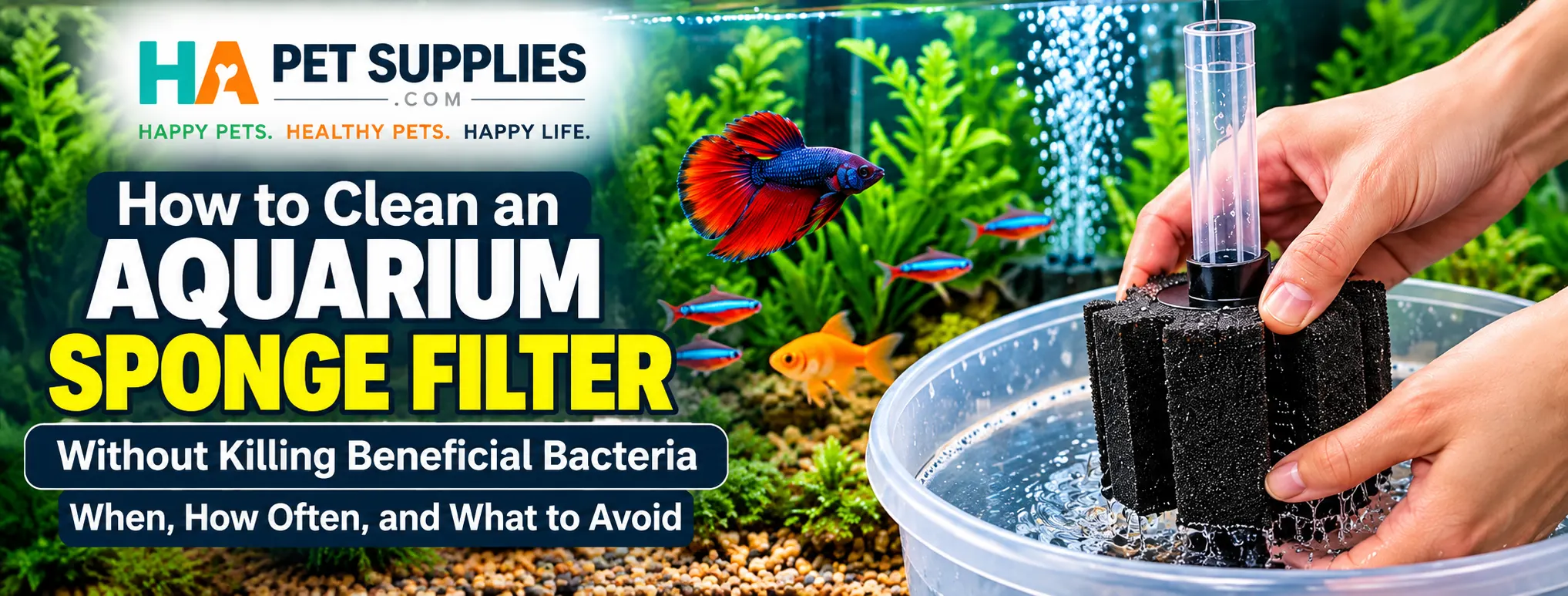
Cleaning a sponge filter in old tank water helps preserve beneficial bacteria.
Quick shopping option: Explore HA Pet Supplies Aquarium Filter Sponge →
Quick Answer: How to Clean an Aquarium Sponge Filter Safely
To clean an aquarium sponge filter without harming beneficial bacteria, switch off the air pump, collect some aquarium water in a clean bucket, carefully remove the sponge, and squeeze it several times in the removed tank water. Once debris is released, inspect, reinstall, restart the pump, and confirm water circulation.
1. Turn Off Pump
Switch off the air pump safely before removing the filter.
Step 12. Collect Tank Water
Use a clean container with removed aquarium water.
Step 23. Squeeze Gently
Squeeze the sponge in the collected water to release debris.
Step 4Important: The goal is to remove accumulated debris while maintaining biological filtration—not to sterilize the sponge or make it look brand new.
📋 Table of Contents
- 1. Why Cleaning Matters
- 2. What Are Beneficial Bacteria?
- 3. When to Clean
- 4. How Often to Clean
- 5. How to Clean in 7 Safe Steps
- 6. 3D Infographic Concept
- 7. Tap Water vs Aquarium Water
- 8. Betta, Shrimp, Goldfish
- 9. 7 Common Mistakes
- 10. What Happens if You Over-Clean?
- 11. Why Water Becomes Cloudy
- 12. When to Replace the Filter
- 13. Troubleshooting
- 14. Sponge Cleaning vs Complete Cleaning
- 15. Why Choose HA Pet Supplies?
- 16. FAQ
- 17. Final Checklist
1. Why Aquarium Sponge Filter Cleaning Matters
An aquarium sponge filter performs two important functions: mechanical filtration and biological filtration support. Mechanical filtration collects suspended particles, while biological filtration depends on microorganisms that colonize the sponge and process nitrogen waste.
As material accumulates, it may restrict water movement. When circulation decreases, the filter becomes less effective. Regular cleaning helps restore circulation, but it must be done carefully because the sponge also contains beneficial microorganisms.
Why a sponge filter becomes dirty
Collecting debris is part of the filter’s intended function. The rate depends on feeding, livestock, sponge structure, and maintenance frequency. A heavily stocked aquarium may fill its sponge with debris much faster than a lightly stocked planted aquarium.
Is a brown sponge dangerous?
Not necessarily. Brown coloration often comes from accumulated organic particles and microbial material. A discolored sponge can still function as biological filtration media. Instead of judging by color, observe bubble output, water circulation, and trapped debris.
The Aquarium Co-Op guide to cleaning sponge filters explains how debris accumulation restricts the filter and why periodic cleaning is necessary.
Suggested button: Read Sponge Filter Maintenance Advice
2. What Are Beneficial Bacteria in an Aquarium Sponge Filter?
Beneficial bacteria play an important role in biological filtration. Fish release ammonia through normal metabolism. In a functioning nitrogen cycle, microorganisms convert ammonia into nitrite and subsequently into nitrate.
Where do beneficial bacteria live?
They colonize suitable wet surfaces throughout an established aquarium, including filter sponges, biological media, substrate, and decorations. The sponge is especially useful because its porous structure provides substantial surface area.
Why bacteria need oxygen and water movement
Many nitrifying microorganisms require oxygen to function effectively. Water circulation helps supply oxygen and dissolved waste compounds to the filter media. Cleaning the filter can support the biological filtration system by maintaining appropriate circulation.
Can cleaning kill all beneficial bacteria?
Ordinary cleaning in appropriate water does not normally remove every beneficial microorganism. However, aggressive sterilization, prolonged drying, chlorine exposure, and replacing established media can reduce biological filtration capacity. The RSPCA Australia water-quality guide explains why protecting biological filtration is important.
The Seachem biological filtration information explains the role of microbial communities in aquarium nitrogen processing.
3. When Should You Clean an Aquarium Sponge Filter?
The best time to clean is when accumulated debris begins restricting performance or routine inspection shows the sponge needs attention. There is no universal rule that every sponge filter must be cleaned weekly.
Sign 1: Reduced bubble output
If bubble output becomes noticeably weaker, the sponge may be clogged. However, check the air pump and airline before assuming dirt is the cause.
Sign 2: Slower water movement
Observe how water moves around the filter. If circulation appears significantly weaker, inspect the sponge for accumulated debris.
Sign 3: Excessive debris in the sponge
Some discoloration is normal, but thick deposits that obstruct the foam may require cleaning.
Sign 4: Debris escapes when disturbed
If clouds of trapped waste enter the aquarium when you touch the filter, cleaning may be overdue. Use a container to capture loose material.
The Aquarium Co-Op complete filter cleaning guide recommends using actual performance and waste accumulation to help determine cleaning needs.
4. How Often Should You Clean an Aquarium Sponge Filter?
Cleaning frequency depends on the aquarium. A sponge in a lightly stocked tank may remain functional longer than one in a heavily stocked fish tank.
| Aquarium Type | Suggested Inspection | When to Clean |
|---|---|---|
| Betta aquarium | During routine water changes | When debris or reduced circulation warrants it |
| Shrimp aquarium | Every 1–2 weeks | Based on debris accumulation and flow |
| Community aquarium | Weekly or during water changes | When the sponge begins restricting flow |
| Goldfish aquarium | At least weekly inspection | Potentially more often due to waste production |
| Breeding aquarium | Regularly, with minimal disruption | When filtration performance declines |
| Quarantine aquarium | Frequently during use | According to water conditions and biosecurity |
Is monthly sponge filter cleaning enough?
For many established aquariums, monthly cleaning may be a reasonable starting point. However, a high-waste aquarium may need more frequent maintenance. The Aquarium Co-Op guide to filter media explains why cleaning frequency depends on filtration materials, feeding, and waste.
Practical rule: Inspect frequently, clean when needed, and record how quickly debris accumulates in your particular aquarium.
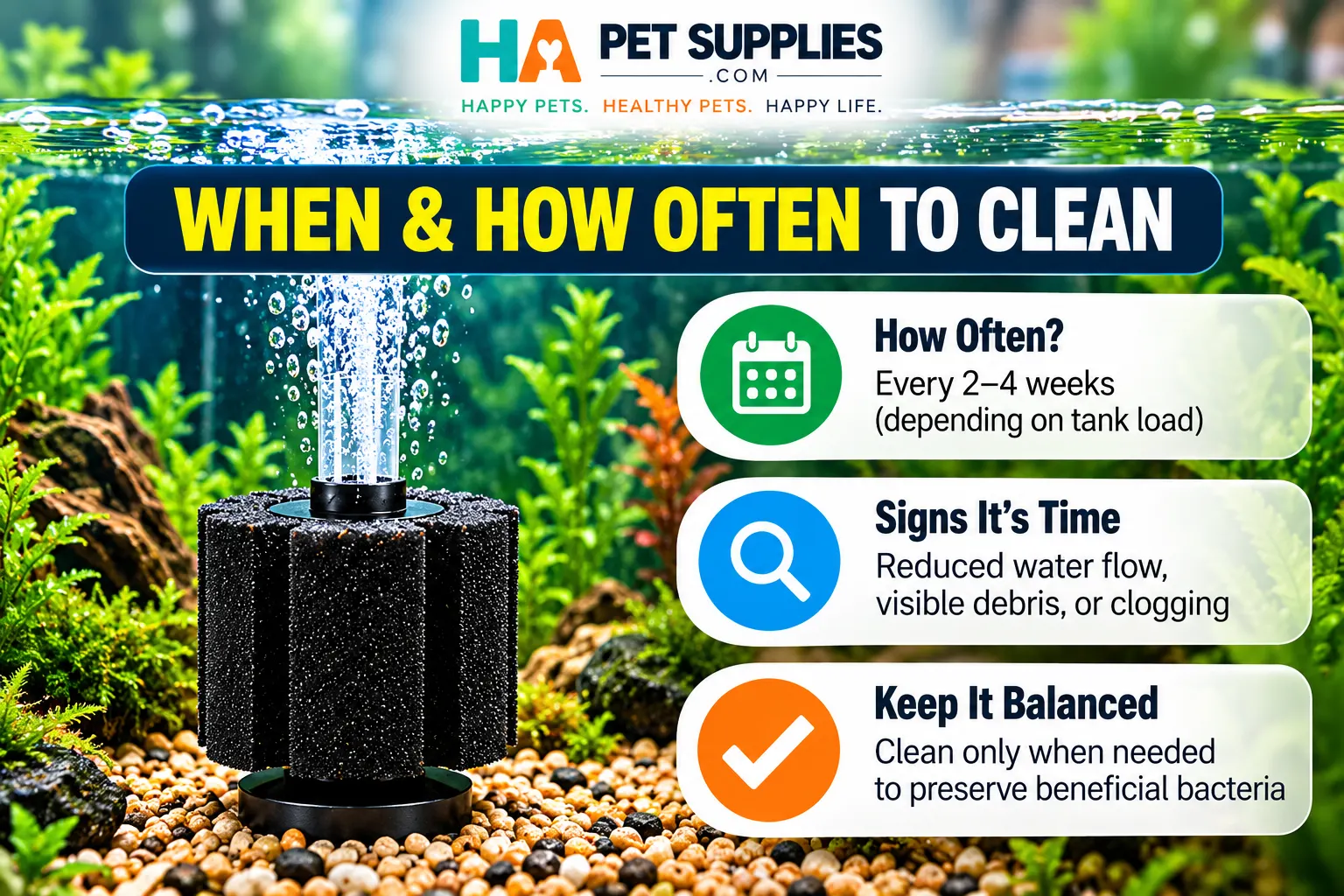
Inspect sponge filters regularly and clean when debris reduces circulation.
5. How to Clean an Aquarium Sponge Filter in 7 Safe Steps
This method protects the established biological filtration system as much as practical. Always follow product-specific instructions if your model has unusual components.
Step 1: Turn Off the Air Pump Safely
Switch off and unplug the external air pump. Keep electrical connections away from water. Keep the interruption as short as practical to maintain water movement.
Step 2: Prepare a Clean Container With Aquarium Water
Collect water during a partial water change in a clean bucket used only for aquarium maintenance. Removed tank water is preferred because it is already conditioned.
Step 3: Remove the Sponge Without Releasing Excessive Dirt
Place a clean aquarium-safe bag around the sponge while submerged to prevent trapped particles from escaping into the tank. Check for shrimp or fry before discarding dirty water.
Step 4: Squeeze the Sponge in Removed Tank Water
Submerge the sponge and gently compress it several times. Repeat until a useful amount of waste is removed. You do not need to make the sponge look brand new. The Aquarium Co-Op biological filter cleaning explanation supports using old tank water for this step.
Step 5: Inspect the Filter Components
Check the plastic base, strainer, uplift tube, and internal diffuser for trapped debris or damage. Clean removable components with an aquarium-only brush. Do not use chemicals.
Step 6: Reassemble and Reinstall the Filter
Reassemble according to instructions. Keep the sponge moist. If you use multiple filters, stagger major cleaning sessions so all mature media is not disturbed at once.
Step 7: Restart the Filter and Check Water Quality
Reconnect the air pump and confirm bubbles return. Test ammonia and nitrite if the sponge was heavily clogged or filtration was interrupted for long.
Suggested button: See Aquarium Sponge Filter Setup Instructions
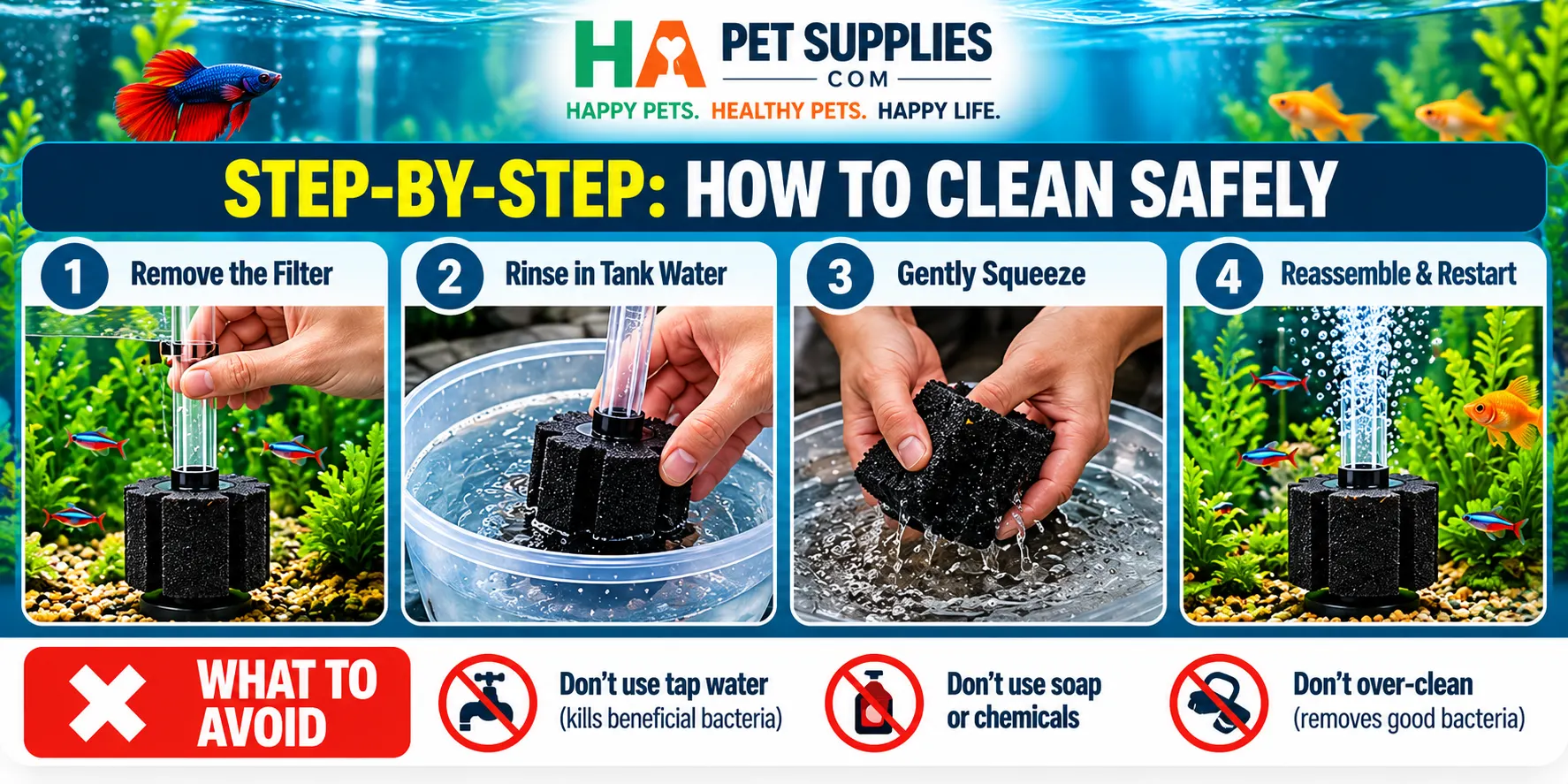
A simple sponge cleaning process for removing debris without unnecessary bacterial loss.
6. 3D Infographic Concept: Safe Aquarium Sponge Filter Cleaning
Top section: Show a sponge filter filled with accumulated debris. Label: “Reduced Water Flow and Trapped Waste.”
Middle section: Display a realistic hand gently squeezing the sponge underwater inside a clean bucket. Blue water arrows and brown debris particles illustrate the cleaning. Label: “Remove Debris Using Old Tank Water.”
Bottom section: Show the cleaned sponge returned to the aquarium with visible air bubbles. Label: “Restore Water Circulation and Protect Biological Filtration.”
Seven compact cards: 1. Turn Off Pump, 2. Collect Tank Water, 3. Remove Sponge, 4. Squeeze Gently, 5. Inspect Components, 6. Reinstall Filter, 7. Check Water Flow.
7. Should You Clean an Aquarium Sponge Filter With Tap Water?
The safer default for established biological filter media is to use removed aquarium water or appropriately dechlorinated water.
Why untreated tap water can be risky
Municipal tap water may contain chlorine or chloramine used for disinfection. These can harm the microorganisms responsible for biological filtration. Routine cleaning in untreated tap water creates an avoidable risk.
Does tap water instantly kill every beneficial bacterium?
Not necessarily. The effect depends on concentration, exposure, and temperature. However, a method that appears harmless in one aquarium may reduce biological filtration in another.
Is dechlorinated tap water acceptable?
Appropriately treated water can be used when old aquarium water is unavailable. Ensure the conditioner targets the specific disinfectants present. The RSPCA tropical fish care guidance recommends avoiding chlorine exposure during cleaning.
8. How to Clean Sponge Filters in Betta, Shrimp, and Goldfish Tanks
Betta aquarium
Bettas require gentle water movement. After restarting the pump, confirm airflow has returned to the previous comfortable setting. A sudden increase in output may create too much current.
Shrimp tank
Shrimp may be grazing on the sponge. Before removing, inspect the surface. Use a container to capture the sponge and surrounding water, and check for offspring before pouring out dirty water.
Goldfish aquarium
Goldfish produce substantial waste. Sponge filters may accumulate debris more quickly. Inspect frequently and clean according to actual waste buildup. If the sponge becomes clogged repeatedly, review whether the filtration system is adequately sized. The RSPCA water-quality guide emphasizes matching filtration capacity to the waste load.
Breeding and quarantine tanks
Handle breeding filters carefully and check for fry. Quarantine equipment may require different handling if exposed to infectious organisms. Fish health and preventing disease transmission take priority.
9. Seven Aquarium Sponge Filter Cleaning Mistakes to Avoid
Mistake 1: Washing with soap or detergent
Residues may be harmful to fish. Use suitable water and aquarium-specific equipment.
Mistake 2: Using untreated chlorinated tap water
Untreated tap water may contain disinfectants that harm beneficial bacteria. Use removed aquarium water or suitably conditioned water.
Mistake 3: Cleaning the sponge too aggressively
Normal squeezing is useful. Repeated scrubbing, tearing, or sterilizing is unnecessary.
Mistake 4: Replacing all mature filter media
Replacing established media all at once reduces the aquarium’s capacity to process ammonia and nitrite.
Mistake 5: Leaving the sponge dry
Extended drying can reduce biological activity. Keep established media wet during maintenance.
Mistake 6: Ignoring a clogged filter
Leaving a severely clogged sponge untouched restricts water movement and reduces filtration performance.
Mistake 7: Cleaning without checking afterward
Always confirm the filter operates correctly after reassembly. Check bubbling, connections, and water movement.
10. What Happens if You Clean an Aquarium Sponge Filter Too Much?
Over-cleaning increases the chance of damaging foam, removing too much attached biological material, or exposing the filter to unsuitable conditions.
Can over-cleaning cause ammonia problems?
If a substantial portion of the biological filtration is lost, the system may become less capable of processing ammonia and nitrite. However, a properly performed routine cleaning does not inevitably cause a cycle crash.
Why water testing matters after major maintenance
If you accidentally replace mature media or leave the filter inactive, monitor water quality closely. Test ammonia and nitrite. Clear water does not guarantee chemical safety. The RSPCA fish environment guidance explains why filtration and testing are central to welfare.
11. Why Is Aquarium Water Cloudy After Cleaning a Sponge Filter?
The most common reason is suspended debris that escaped during removal or reinstallation. However, not every cloudy aquarium is the same.
Brown clouds from released waste
A properly operating mechanical filter may gradually collect suspended particles. The amount of debris and filtration capacity influence how quickly the water clears.
White cloudiness after major maintenance
White or milky water can be associated with bacterial blooms or disturbed fine particles. Do not diagnose solely by color. Check recent maintenance, filtration operation, and test results.
Green cloudy water
Green water is commonly associated with suspended algae. Routine sponge cleaning may not resolve this. Review lighting, nutrients, and maintenance.
What if fish appear distressed? Test ammonia and nitrite. Check aeration. If unsafe, perform partial water changes with conditioned, temperature-appropriate water and seek aquatic veterinary advice if distress continues. The Aquarium Co-Op aquarium cleaning guide discusses routine maintenance and water clarity.
12. When Should You Replace an Aquarium Sponge Filter?
Many filter sponges can be reused for extended periods. You do not need to replace a sponge simply because it has turned brown. Inspect its physical condition instead.
Signs the sponge may need replacement
Replace foam when it becomes torn, brittle, permanently compressed, structurally damaged, or unable to maintain useful water movement after cleaning.
How to replace a sponge without losing biological filtration
If the aquarium has more than one established filter, retain the mature filter while the replacement becomes colonized. Avoid replacing all mature media at once. The Aquarium Co-Op filter media upgrade guide explains how reusable coarse sponge media can reduce repeated cartridge replacement.
Our complete buyer’s guide compares considerations for choosing the right size. Choose the Right Aquarium Sponge Filter Size.
13. Troubleshooting Common Sponge Filter Problems
| Problem | Possible Cause | Recommended Response |
|---|---|---|
| Weak bubbles | Clogged foam, restricted airline, weak pump | Inspect the sponge and air supply |
| No bubbles | Pump failure, disconnection, valve obstruction | Check power, tubing, and valve direction |
| Brown debris escapes | Sponge lifted without containing waste | Remove inside an aquarium-safe bag or container |
| Cloudy water | Suspended particles, bacterial bloom, algae | Test water and identify the cause |
| Persistent ammonia | Inadequate or disrupted biological filtration | Test frequently and protect livestock |
| Filter floats | Trapped air or unstable positioning | Submerge and reposition correctly |
| Sponge falls apart | Material deterioration | Replace while protecting biological filtration |
| Excessive flow | Pump output too high | Adjust airflow using compatible equipment |
If ammonia or nitrite remains elevated, fish behavior is abnormal, or filtration repeatedly fails, seek qualified aquarium or aquatic veterinary advice.
14. Sponge Filter Cleaning vs Complete Aquarium Cleaning
Cleaning a sponge filter and cleaning an aquarium are related but not identical. Sponge maintenance focuses on the filter. General aquarium maintenance includes monitoring water quality, removing waste, and performing partial water changes.
Do you need to remove fish during routine cleaning?
Usually not. Routine filter cleaning can generally be done while fish remain in a stable aquarium. Removing fish unnecessarily causes stress.
Should you clean the substrate at the same time?
Substrate cleaning helps remove accumulated waste. Avoid disrupting all established biological surfaces during major maintenance.
Do water changes remove beneficial bacteria?
Most nitrifying microorganisms live on submerged surfaces rather than floating in the water column. Normal partial water changes do not remove the established biological filtration. The RSPCA Australia freshwater aquarium guidance discusses routine partial water changes.
Can you clean your sponge and change water on the same day?
Yes. A partial water change provides a convenient supply of removed aquarium water for cleaning the sponge. Use the removed water to rinse the foam, discard the dirty water, and refill the aquarium with appropriately conditioned water.
15. Why Choose HA Pet Supplies for Aquarium Sponge Filters?
HA Pet Supplies provides aquarium product options alongside educational resources that help beginners and experienced fishkeepers make informed decisions.
The HA Pet Supplies aquarium filter sponge listing gives buyers a place to explore product options and request additional details. Check dimensions, compatibility, foam grade, and included components before purchasing.
Our 9-step aquarium sponge filter setup guide helps you understand the installation process before adding livestock. A complete setup may require an air pump, tubing, water conditioner, testing equipment, and other accessories. Explore the fish and aquarium collection.
If you are unsure whether your sponge needs replacement, compare the physical condition of the foam with the manufacturer’s guidance. Contact HA Pet Supplies for product questions.
16. Frequently Asked Questions
1. How do you clean an aquarium sponge filter without killing bacteria?
Switch off the pump, remove the sponge carefully, and squeeze accumulated debris out in removed aquarium water or suitable dechlorinated water. Avoid soap, disinfectants, and unnecessary drying. Reinstall and confirm normal circulation.
2. How often should I clean my aquarium sponge filter?
Clean when debris accumulation or reduced circulation indicates the need. Monthly cleaning may be a reasonable starting point for some tanks, but actual frequency depends on waste production, filter size, and conditions.
3. Can I wash a sponge filter under tap water?
Untreated tap water may contain chlorine or chloramine that can harm beneficial bacteria. Removed aquarium water or appropriately dechlorinated water is generally the safer routine choice.
4. Will squeezing the sponge kill beneficial bacteria?
Normal squeezing in suitable water removes debris while leaving much of the established bacterial community attached to the media. Avoid unnecessary sterilization or destructive cleaning.
5. Should a sponge filter be completely clean?
No. The objective is to remove enough accumulated debris to maintain useful water movement, not to sterilize the filter or restore its original appearance.
6. Why is my aquarium sponge filter brown?
Brown coloration usually reflects collected organic debris and normal biological activity. Inspect circulation and material condition rather than replacing the sponge based on color alone.
7. Can I clean an aquarium sponge filter every week?
Yes, if the aquarium’s waste load makes frequent cleaning necessary. However, weekly cleaning is not automatically required in every aquarium. Base cleaning on actual conditions.
8. What happens if I never clean my sponge filter?
Accumulated debris can restrict water movement and reduce mechanical filtration performance. Severe clogging may interfere with the filter’s ability to operate effectively.
9. Can over-cleaning cause an aquarium cycle crash?
Excessive sterilization, chlorine exposure, or removing large amounts of mature biological media can reduce filtration capacity. Normal routine cleaning in suitable water does not automatically cause a cycle crash.
10. Why does aquarium water turn cloudy after sponge cleaning?
Cleaning can release suspended debris. Cloudiness may also reflect bacterial blooms, disturbed substrate, or other conditions. Test water quality if the aquarium’s stability is uncertain.
11. Should I remove fish while cleaning the filter?
Usually not. Fish can generally remain in the aquarium during ordinary sponge cleaning and partial water changes. Avoid unnecessary handling and stress.
12. Can I use the dirty sponge water for plants?
Removed aquarium water may be useful for some ornamental plants, provided it contains no harmful medications, excessive salt, or unsuitable chemicals. Avoid using potentially contaminated quarantine water.
13. How long should an aquarium sponge filter last?
Many reusable sponges can function for extended periods. Replace foam when it tears, deteriorates, loses structure, or no longer operates effectively after cleaning.
14. Can I clean two sponge filters together?
You can, but staggering major cleaning sessions may help preserve established biological filtration. This is particularly useful when both filters are mature and support the same aquarium.
15. What should I do if ammonia rises after cleaning?
Test the water to confirm the result, inspect filtration and aeration, and protect livestock through appropriate corrective measures. Seek qualified advice if harmful readings or fish distress persist.
16. Can I use dechlorinated water to clean aquarium filter media?
Yes, appropriately conditioned water can be used when removed aquarium water is unavailable. Keep temperature and water chemistry reasonably suitable for the established filter media.
17. Does a dirty sponge filter always mean the aquarium is unhealthy?
No. A filter naturally collects debris. Its condition should be evaluated alongside circulation, fish behavior, aquarium maintenance, and water-test results.
18. Should I replace my filter after treating fish disease?
Not automatically. Requirements depend on the disease, treatment, and risk of transmitting pathogens. Follow qualified fish-health guidance and appropriate biosecurity procedures.
19. Is a sponge filter good for a shrimp aquarium?
A properly sized sponge filter with suitable foam porosity can be useful for shrimp aquariums. Take extra care during removal because tiny shrimp may be resting on or near the sponge.
20. Where can I buy a replacement aquarium sponge filter?
You can explore the HA Pet Supplies aquarium sponge filter options and request information about available variants, compatibility, and pricing.
17. Final Aquarium Sponge Filter Maintenance Checklist
Before finishing your cleaning session, confirm that:
- The sponge has been rinsed in appropriate water.
- Visible debris has been removed and the foam remains structurally sound.
- The filter is correctly assembled and positioned.
- Airline tubing is connected securely and the external pump is operating.
- Bubbles and water circulation have returned to normal.
- If you maintain a betta tank, the flow is not unnecessarily strong.
- If you maintain a shrimp tank, no shrimp or offspring remain in the cleaning container.
- If you maintain a goldfish aquarium, the system is collecting waste efficiently.
- Aquarium water testing continues as part of routine care.
The safest routine approach is to use removed aquarium water or suitable dechlorinated water, avoid cleaning chemicals, keep established media wet, and restart filtration promptly. Do not replace the sponge simply because it looks brown, and do not ignore reduced water movement because you are afraid to disturb bacteria.
For more aquarium maintenance articles, explore the HA Pet Supplies blog. If you need replacement equipment, browse the HA Pet Supplies online shop or visit the HA Pet Supplies homepage.
Keep Your Aquarium Filtration System Working Effectively
Internal links are woven naturally throughout the content. External links point to authoritative aquarium and welfare resources.
© HA Pet Supplies — Aquarium care guides.