
Choosing the best dog recovery collar can feel surprisingly difficult, especially when your dog has just returned home from surgery. Your veterinarian may have recommended a traditional plastic cone, but your dog keeps bumping into furniture. Perhaps you have seen a soft inflatable donut collar that looks much more comfortable, or a surgical recovery suit that promises to protect stitches without covering your dog’s head.
Now you are wondering which option is actually safe. Will an inflatable dog collar stop licking after neutering? Is a plastic cone really necessary? Can your dog sleep comfortably in a recovery suit? And how do you choose the correct size without buying the wrong product?
These are important questions because a protective collar must do more than look comfortable. The best dog recovery collar should prevent your dog from reaching the healing incision while allowing them to breathe, rest, eat, drink, and move as comfortably as possible.
This guide compares the three most common recovery options, explains their advantages and limitations, shows how to measure your dog, and helps you identify which protective device may be most appropriate for your dog’s surgery.
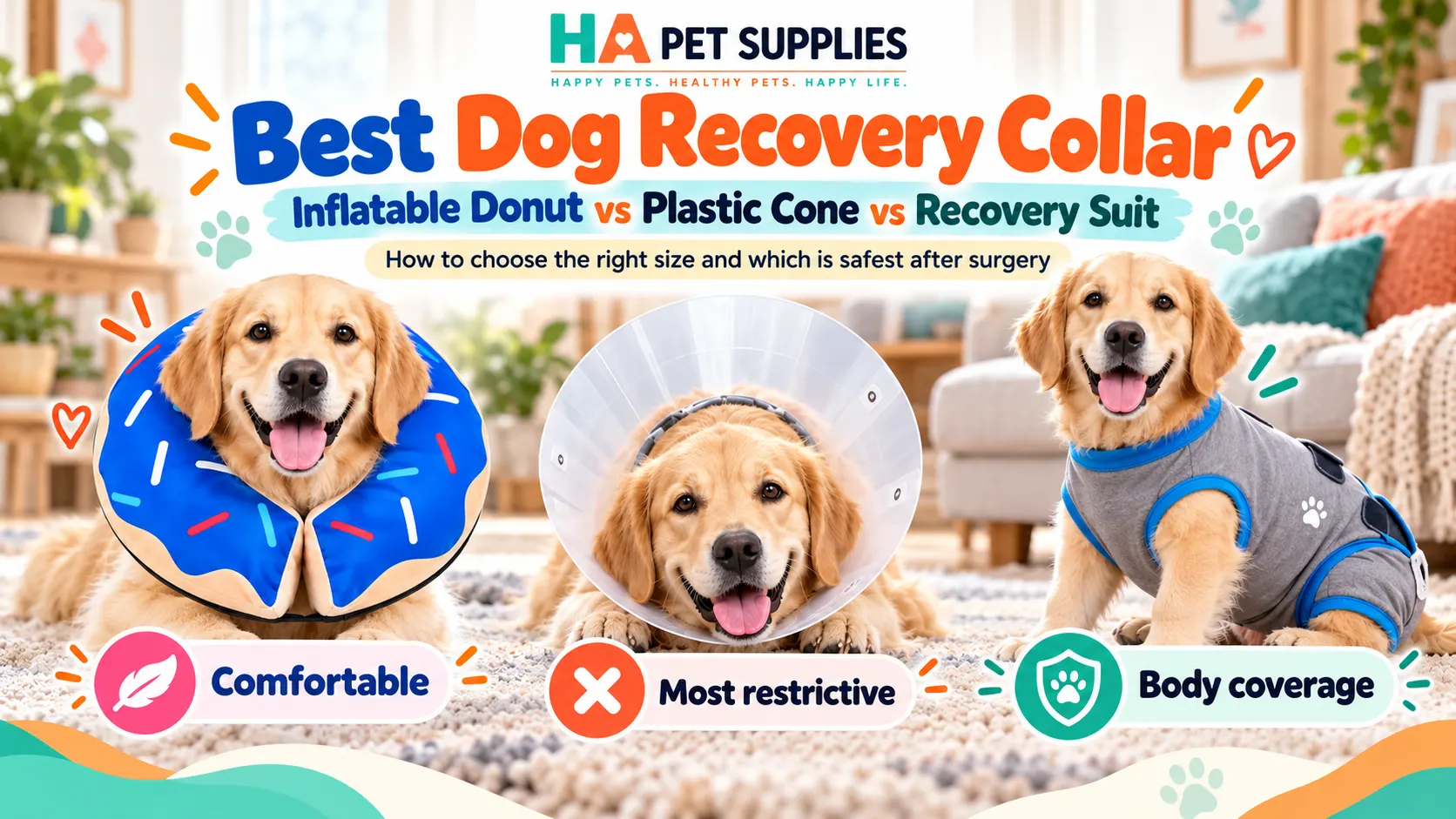
Best dog recovery collar comparison showing inflatable donut, plastic cone and recovery suit
Quick answer: Which is the best dog recovery collar?
For many surgical wounds, a correctly fitted traditional plastic Elizabethan collar is the most broadly protective option because it physically restricts the dog’s ability to reach areas of the body with its mouth.
An inflatable donut collar can be more comfortable for some dogs and may allow better visibility, but it is not reliable for every incision location.
A surgical recovery suit can protect selected wounds on the abdomen or trunk, provided the material fully covers the area, stays clean and dry, and the dog cannot chew through it.
The PDSA veterinary guide to protective collars explains that the most suitable device depends on the dog, the wound’s position, comfort, and whether the animal can still reach the affected area.
📋 Table of Contents
- 1. Why choosing the best collar matters
- 2. Plastic dog cone: Benefits & disadvantages
- 3. Inflatable donut dog recovery collar
- 4. Surgical recovery suit: Safe alternative?
- 5. Inflatable vs plastic vs recovery suit
- 6. Which collar is safest for each surgery?
- 7. How to measure your dog correctly
- 8. 7 essential features to look for
- 9. How to check if a collar actually works
- 10. Collar for small, medium & large dogs
- 11. Helping your dog sleep, eat & drink
- 12. Common buying mistakes
- 13. Frequently asked questions
1. Why choosing the best dog recovery collar matters after surgery
A surgical incision is vulnerable while the body repairs damaged tissue. Even when your dog seems healthy and active, the skin and deeper tissue may not have regained their normal strength.
Dogs often lick uncomfortable areas instinctively. After surgery, a healing incision can feel tight, itchy, or tender. Unfortunately, licking and chewing can irritate the wound, introduce contamination, loosen sutures, and delay healing.
The American College of Veterinary Surgeons postoperative care guide emphasizes protecting surgical incisions from licking and chewing, following activity restrictions, and contacting the veterinary team when complications arise.
What can happen if your dog reaches the stitches?
A dog might begin with one or two seemingly harmless licks. However, repeated licking keeps the area moist and can irritate delicate healing tissue. Some dogs progress to chewing the wound or pulling at stitches, which can cause the incision to open. An opening surgical wound may require urgent assessment and additional treatment.
Is comfort more important than protection?
Comfort is extremely important, but the collar must provide effective wound protection first. A soft collar might allow your dog to sleep more naturally. Yet if that same collar bends easily and lets your dog chew the incision, it is unsuitable for that particular recovery. The ideal solution combines reliable protection, proper fit, and reasonable comfort.
If you are researching general recovery products, the HA Pet Supplies dog supplies collection can help you explore available accessories. For a surgical incision, however, the treating veterinarian should approve the specific protective option.
2. Traditional plastic dog cone: Is it still the safest option?
The traditional plastic dog cone, also called an Elizabethan collar or E-collar, is one of the most widely used forms of postoperative wound protection. It consists of a cone-shaped barrier around the dog’s head. When fitted correctly, the cone extends beyond the dog’s muzzle and makes it difficult to turn around and reach the body with the mouth.
Advantages of a plastic recovery cone
The greatest advantage is its broad protective coverage. A suitably sized rigid cone can reduce a dog’s ability to reach many different areas, including paws, legs, abdomen, and rear-body wounds. It can also help protect the face and ears from scratching with the paws.
Another benefit is its relatively simple construction. Many plastic cones are easy to wipe clean, and their rigid surfaces do not collapse when the dog presses against them. They may also be less expensive than some padded or specially designed alternatives.
The VCA Animal Hospitals’ collar guidance explains that proper cone length is essential for preventing access to surgical sites.
Disadvantages of a traditional plastic cone
Not every dog adjusts immediately. A large cone may collide with furniture, doorways, or the edges of food bowls. Some dogs become hesitant when walking through narrow spaces. Others struggle to settle down because the cone changes how they position their head. Opaque cones may also interfere with peripheral vision more than clear alternatives.
However, these difficulties should be managed through appropriate fitting, environmental adjustments, and veterinary guidance rather than removing necessary protection.
When is a plastic cone usually the better choice?
A traditional cone may be particularly useful when the wound is on an extremity, the dog is flexible enough to reach around softer protection, or the veterinarian requires especially reliable prevention of licking. Eye and ear surgery can also require a rigid protective cone, although the specific design and length should be chosen by the veterinary team.
3. Inflatable donut dog recovery collar: Is it more comfortable?
An inflatable donut recovery collar resembles a padded ring around the dog’s neck. Unlike a traditional cone, it generally does not extend forward around the muzzle. Instead, the raised ring restricts some neck movements and may make it harder for the dog to turn its head toward the body. This design can make inflatable recovery collars appealing to owners who want a less intrusive alternative.
Advantages of an inflatable dog recovery collar
For suitable dogs and incision locations, an inflatable collar may allow more natural peripheral vision. Dogs can often navigate rooms without the wide front edge of a plastic cone striking furniture. Some dogs also find the padded shape more comfortable during rest. Because the muzzle remains relatively unobstructed, reaching food and water bowls may be easier.
The PetMD guide to dog cone alternatives discusses inflatable collars and emphasizes that they must prevent the animal from reaching its specific wound.
Disadvantages of an inflatable recovery collar
The most significant limitation is reduced protection for certain body areas. Some dogs can still bend around a donut collar and reach their hind legs, paws, tail, or genital region. Dogs with long muzzles or particularly flexible bodies may have an easier time reaching around the device. This means an inflatable collar that works for one dog may fail completely for another.
Another concern is sizing. A collar that is too small may not meaningfully restrict head movement. A collar that is too large or tightly secured may cause discomfort or interfere with normal movement. Some inflatable products can also lose air or become damaged.
Can you use an inflatable collar after neutering?
Possibly, but only when it effectively prevents the dog from reaching the surgical incision and the veterinarian agrees that it is appropriate. Neutering incisions are positioned where some dogs can still reach them while wearing a donut collar. For this reason, a traditional cone may be necessary. Never assume that an inflatable collar is suitable for every neutered dog.
Can you use an inflatable collar after spay surgery?
Some dogs may be unable to reach an abdominal incision while wearing an appropriately sized inflatable collar. However, others can bend around the device or use their paws to disturb the wound. A recovery suit or rigid cone may be preferable depending on the dog’s body shape and behavior.
Who might benefit from an inflatable design?
A dog that becomes distressed by a large rigid cone might find an inflatable design easier to tolerate. It may also be useful for selected wounds that remain completely inaccessible when the donut is worn. However, the incision location and the dog’s flexibility are more important than comfort claims.
For owners considering this style, the HA Pet Supplies dog recovery collar product page offers a place to review the available design and product information.
Explore HA Pet Supplies Dog Recovery Collar4. Surgical dog recovery suit: Is it better than a cone?
A surgical recovery suit is a specially designed garment worn over parts of the dog’s body. Rather than restricting the dog’s head, it covers selected areas that might otherwise be accessible for licking or chewing. Recovery suits are frequently considered for abdominal procedures, including some spay surgeries. However, they should not be treated as a universal replacement for cones.
Advantages of a dog recovery suit
One major advantage is freedom of head movement. A dog wearing a suitable recovery suit can usually see their surroundings normally and may find eating, drinking, and sleeping easier. Recovery suits may also be less likely to collide with furniture. For selected abdominal incisions, a properly fitted suit can create a fabric barrier between the dog’s mouth and the surgical site.
Disadvantages of a recovery suit
A surgical suit protects only the body areas it covers. It cannot reliably stop a dog from licking a wound on an uncovered paw, lower leg, ear, or tail. Another concern is moisture. If the garment becomes wet, soiled, or contaminated, it may irritate the incision or create unfavorable conditions for healing. The fabric must also fit correctly.
How should a recovery suit fit?
The suit should sit securely against the body without pulling tightly across the incision. It should allow natural breathing and comfortable movement within the veterinarian’s activity restrictions. The garment should also provide appropriate openings for toileting. Check that the material does not bunch over the wound or place pressure on sensitive areas.
The PDSA’s recovery suit instructions recommend keeping suits clean and dry and checking the wound regularly.
Can a recovery suit replace a cone after spay surgery?
For some dogs, yes, provided the veterinarian approves it and the suit completely protects the incision. However, a suit does not automatically stop chewing. If your dog bites through the fabric, pulls it away, or repeatedly attempts to reach the stitches, additional protection may be necessary.
5. Best dog recovery collar comparison: Inflatable donut vs plastic cone vs recovery suit
The easiest way to compare these products is to focus on how they protect the incision, not simply how comfortable they look.
Plastic Cone
Broad protection when properly fitted
Inflatable Donut
Comfort and visibility, with limited reach protection
Recovery Suit
Covers selected torso wounds
| Feature | Plastic cone | Inflatable donut | Recovery suit |
|---|---|---|---|
| Main protection method | Limits mouth access | Restricts neck movement | Covers selected wound areas |
| Protection for paws | Often effective | Frequently insufficient | Usually insufficient |
| Protection for abdominal incision | Often effective | Depends on flexibility | Can be effective when approved |
| Facial wound protection | Often preferred | Usually inadequate | Inadequate |
| Peripheral vision | May be restricted | Generally less restricted | Unrestricted |
| Eating and drinking | May need bowl adjustment | Often easier | Usually unaffected |
| Cleaning | Usually simple | Depends on design | Requires fabric cleaning |
| Main weakness | Bulk and discomfort | Dog may reach around it | Dog may chew or move fabric |
| Most important fit requirement | Neck fit and cone length | Secure neck fit and effective width | Body fit and coverage |
This comparison is consistent with the general distinctions explained in PetMD’s veterinarian-reviewed recovery collar guide. The safest choice remains the one that adequately prevents access to your dog’s specific injury.
Which recovery collar offers the best overall protection?
A correctly fitted rigid cone is generally the strongest all-purpose starting point when reliable mouth-access prevention is needed. However, even a rigid cone may need to be adjusted or replaced if the dog can still reach the wound.
Which is most comfortable?
Some dogs tolerate inflatable donuts or recovery suits more easily because these designs leave the face uncovered. But individual preferences differ. One dog may relax in a plastic cone while another struggles with it.
Which is best for anxious dogs?
There is no universal answer. Some anxious dogs feel more comfortable with an unobstructed field of vision. Others may resist anything secured around their neck. The American Kennel Club guide to cone training recommends introducing protective equipment through gradual, positive experiences.
6. Which dog recovery collar is safest for each surgery?
This is one of the most important decisions in the entire buying process. Instead of asking which product has the most attractive design, begin with the location of your dog’s incision.
Abdominal or spay incision
A correctly fitted rigid cone commonly provides effective protection. A recovery suit or inflatable collar may be possible if your veterinarian approves it and your dog cannot reach the incision.
This educational guide does not replace the veterinarian’s recommendation or establish that any particular product is safe for your dog.
Paw or lower leg incision
Lower limbs are difficult areas to protect. For these wounds, a suitably sized rigid cone is frequently preferable. A donut collar may allow too much flexibility, and a standard recovery suit may not cover the injured area at all.
Eye, ear, or face incision
Eye and ear procedures require especially careful protection. A rigid cone is frequently prescribed because it can create space between the face and surrounding objects. Do not substitute an inflatable donut without veterinary approval.
Tail or rear body incision
Rear-body wounds can be challenging. Some dogs can still reach their tail or hindquarters while wearing an inflatable donut. A rigid cone or a specialized recovery suit may be required, depending on your dog’s flexibility.
Chest or torso incision
Some upper-body wounds may be covered by a suitable recovery suit. However, a dog may still chew through material or rub the incision against objects. A rigid cone may provide stronger mouth-access protection in some situations.
The VCA surgical incision care recommendations emphasize preventing licking and protecting the incision according to the procedure and wound location.
7. How to measure your dog for the correct recovery collar size
Selecting the correct size is essential because an oversized collar may slip or cause discomfort, while an undersized collar may leave the incision accessible. A proper fit should keep the device secure without interfering with breathing, swallowing, or essential movement.
Neck
Measure circumference comfortably
Length
Check muzzle or body length
Fit
Verify wound protection
Step 1: Measure neck circumference
Use a flexible measuring tape around the part of your dog’s neck where the collar will sit. Keep the tape comfortably snug without pulling tightly into the fur or skin. Record the measurement in centimeters or inches. If your dog has thick fur, make sure the measurement reflects the actual fit rather than compressing the coat excessively.
Step 2: Measure muzzle length for a traditional cone
Neck size is not enough when choosing a traditional Elizabethan collar. Measure the distance from the location where the collar will sit near the neck to just beyond the tip of the dog’s nose. The cone should extend slightly beyond the muzzle, according to the fitting guidance provided by the veterinarian or manufacturer.
The PetMD recovery collar measuring guidance discusses the importance of measuring both neck circumference and the distance toward the nose.
Step 3: Check the collar’s fastening
The collar should remain secure when your dog moves or lowers its head. For many protective cones and inflatable collars, the commonly used two-finger check helps assess whether there is reasonable space between the neck and collar. However, this is a general guide rather than a substitute for the manufacturer’s fitting instructions.
Step 4: Assess the inflatable collar’s actual protection
For an inflatable collar, measure the neck as directed and confirm the product is inflated to the recommended level. Check that it does not shift excessively. But remember that a correct neck measurement does not guarantee incision protection.
Step 5: Measure a recovery suit correctly
Recovery suits often require more than one measurement. Depending on the manufacturer’s sizing chart, you may need chest circumference, body length, and sometimes neck measurements. The garment should cover the intended incision without stretching tightly across it.
Step 6: Check the fit before relying on it
Observe your dog while standing, walking, and resting. Without encouraging them to touch the wound, check whether normal head and body movements could allow access to the surgical area. If your dog can already reach the incision, the protective device is unsuitable.
Step 7: Recheck the fit every day
Collars can loosen, fabric can shift, and inflatable rings can lose pressure. Your dog’s condition may also change during recovery. Inspect the fit daily and check for skin rubbing, discomfort, or damaged fasteners.
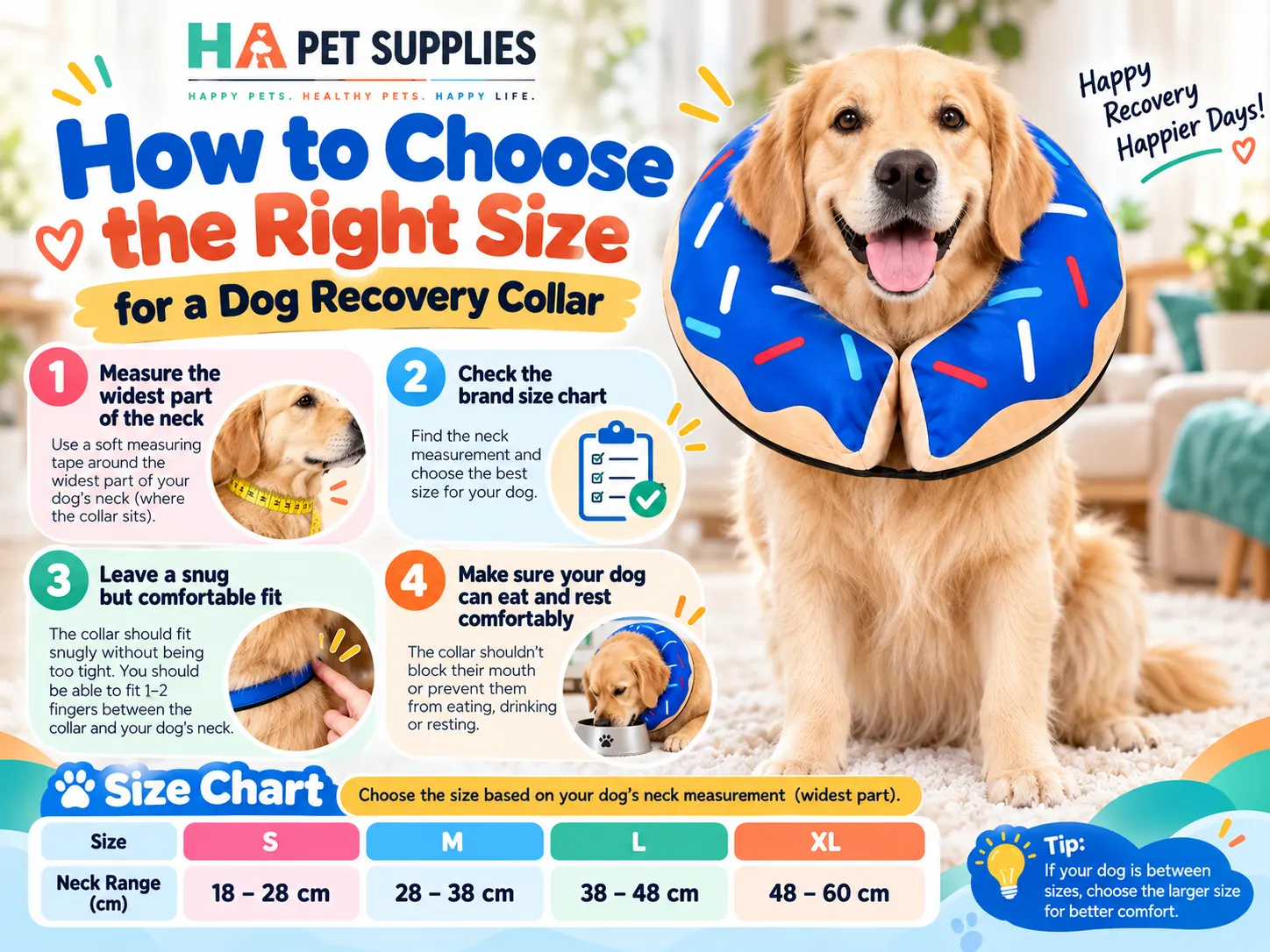
Dog recovery collar size guide showing neck measurement and correct fitting
For more general surgical aftercare guidance, readers can continue to the HA Pet Supplies article on how long a dog should wear a recovery collar after surgery.
8. Seven essential features to look for in the best dog recovery collar
Feature 1: Reliable wound protection
The collar’s most important job is preventing access to the incision. Before purchasing, consider exactly where your dog’s wound is located. No comfort feature or attractive design can compensate for ineffective protection.
Feature 2: Correct sizing
A good recovery collar should have clear sizing instructions. Look for information about neck circumference, cone length, or relevant body measurements. Avoid products that rely exclusively on broad breed recommendations.
Feature 3: Comfortable material
The collar should not have rough edges that repeatedly rub the neck or cause unnecessary discomfort. For inflatable designs, evaluate the outer covering and construction. For soft cones, consider whether the material holds its protective shape.
Feature 4: Secure fastening system
Fasteners should stay in place during normal movement. Some collars attach to an ordinary dog collar for additional security. Check that the protective device cannot easily slip over the head.
Feature 5: Easy cleaning
Recovery products can become dirty from food, water, saliva, and everyday use. A material that is straightforward to clean may be more practical during the postoperative period.
Feature 6: Compatibility with everyday activities
A dog must still be able to rest, eat, drink, and toilet. The VCA Canada postoperative instructions emphasize following prescribed incision protection, while recognizing that dogs may need time to adjust to recovery devices.
Feature 7: Suitability for the full recovery period
Some dogs only need temporary protection, while others require longer periods. Choose a product that maintains its shape and protective function for as long as the veterinarian recommends.
9. How to check if your dog’s recovery collar actually works
Buying the correct size is only the beginning. After fitting the device, assess its effectiveness in a safe and controlled environment.
Test 1: The resting-position check
Watch your dog settle into their preferred resting position. Some dogs curl tightly, bringing their head closer to their legs or abdomen. If this posture allows them to reach the incision, the current device may not provide enough protection.
Test 2: The movement check
Observe ordinary walking within the prescribed activity restrictions. The collar should remain secure without slipping backward or rotating into an ineffective position.
Test 3: The feeding check
Offer food and water in appropriately positioned bowls. Your dog should be able to reach essential resources without significant difficulty.
Test 4: The supervision check
Before leaving your dog in a recovery area, confirm that the collar cannot become caught on nearby objects. Remove obvious hazards and make sure the resting space has enough room.
Test 5: The daily condition check
Inspect seams, fasteners, air pressure, and fabric. A damaged collar may fail even if it originally fitted correctly.
10. Best dog recovery collar for small, medium, and large dogs
Body size is important, but it is not the only factor determining the correct recovery collar.
Small dogs
Small dogs may find oversized rigid cones particularly awkward in narrow spaces. However, the solution is not simply choosing the smallest possible collar. A cone must still extend far enough beyond the muzzle to prevent access to the wound.
Medium-sized dogs
Medium-sized dogs vary greatly in neck size and body proportions. A slender dog may require a very different collar from a broad-necked dog of the same weight. Always measure the actual dog rather than relying solely on a weight-based recommendation.
Large dogs
Large breeds may need more durable equipment and secure fasteners. A broad neck does not always mean the muzzle is short. For example, a long-nosed dog may require a deeper cone than another dog with a similar neck measurement.
Senior dogs and dogs with limited mobility
Older dogs may have difficulty navigating around obstacles or changing sleeping positions. A recovery collar should not create additional fall risks or prevent comfortable access to bedding and water.
11. How to help your dog sleep, eat, and drink with a recovery collar
Create a safe sleeping environment
Place your dog’s bed in a quiet, spacious location. Avoid narrow corners where a large cone might become trapped. Use bedding that provides appropriate support without placing pressure on the surgical incision.
Adjust food and water access
Some dogs struggle with deep bowls while wearing a plastic cone. Try a stable, shallow bowl or an appropriately raised feeding surface. Monitor your dog to confirm they can access water comfortably.
The ASPCA after-surgery instructions explain that if a protective collar must be removed for feeding, the dog should be supervised and the collar replaced immediately afterward.
Introduce positive associations
Give your dog gentle praise or appropriate rewards when they remain relaxed around the protective equipment. Avoid forcing their head into a cone if they become frightened.
Watch for persistent distress
Some discomfort or confusion may occur during initial adjustment. However, persistent panic, significant inability to rest, difficulty breathing, or refusal to drink should not be dismissed. Contact the veterinary team for help.
For a step-by-step comfort routine, the HA Pet Supplies guide Dog Hates Recovery Collar? 9 Ways to Help Your Dog Feel Comfortable provides additional guidance.
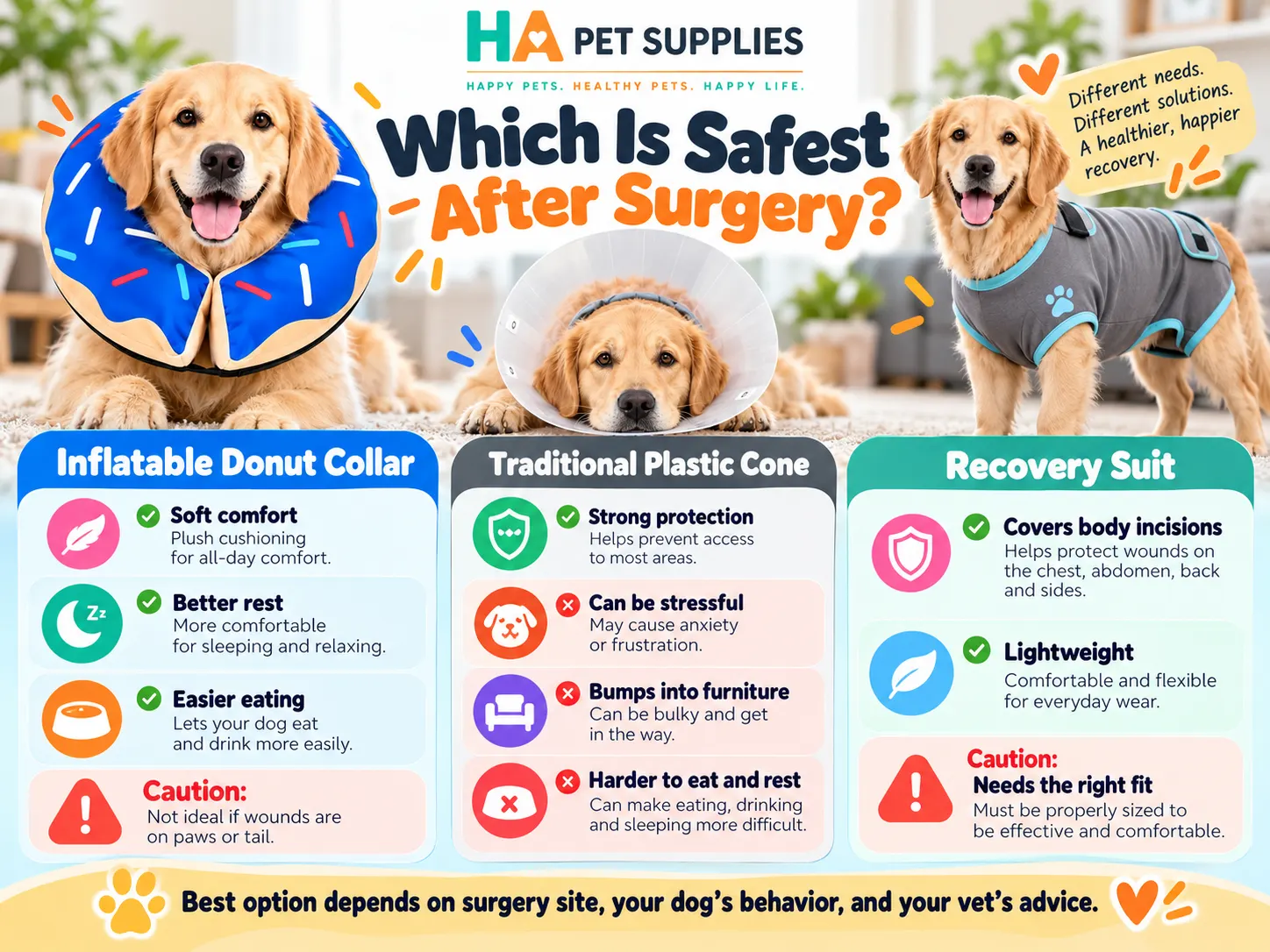
Safest dog recovery collar options after surgery compared
12. Common mistakes people make when buying a dog recovery collar
- Choosing only by price. An inexpensive collar may work perfectly well when it fits correctly and protects the incision.
- Buying according to breed alone. Dogs of the same breed can have different neck sizes, muzzle lengths, and body proportions.
- Assuming all donut collars are safe after neutering. Many dogs can reach their hindquarters despite wearing an inflatable donut.
- Buying a recovery suit without checking coverage. A suit cannot protect a wound it does not cover.
- Switching products without veterinary guidance. An alternative may look more comfortable but provide inadequate protection.
- Ignoring damaged or loose equipment. Fasteners can fail, inflatable collars can lose air, and fabric can stretch.
- Believing the cone can be removed whenever the dog looks healthy. Healing continues beneath the skin even after the dog appears energetic.
Daily recovery collar safety checklist
Use the following checklist alongside your dog’s specific discharge instructions.
Frequently asked questions about the best dog recovery collar
A correctly fitted rigid plastic cone generally provides the broadest protection. An inflatable donut may work for some dogs and incision locations, but flexible dogs can often reach around it. Always follow your veterinarian’s recommendation.
A recovery suit can be suitable for selected abdominal incisions when approved by your veterinarian. However, it does not protect uncovered areas like paws, ears, or tail. It must also stay clean, dry, and intact.
Only if your veterinarian approves it and you have confirmed the collar still prevents access to the incision when your dog is lying down, curling up, and changing positions. Never assume it is safe overnight without testing.
The collar should be secure without compressing the airway or causing discomfort. A common general guide is the two-finger check, but always follow the manufacturer’s specific fitting instructions for your product.
If your dog can still reach the surgical incision with its mouth, the cone is too short or improperly fitted. A correctly sized cone should extend slightly beyond the muzzle. Contact your veterinarian for a fitting assessment.
Some recovery suits are designed to cover the genital area after neutering, but coverage varies by product. You must confirm the suit completely covers the incision and cannot be chewed through or pulled aside. Get veterinary approval first.
If your dog can remove the collar, it is not securely fitted or the design is unsuitable. Do not leave the incision unprotected. Contact your veterinarian about a different size or style that stays in place.
Usually not. Dogs can often bring their paws toward their mouths even while wearing an inflatable donut. A rigid cone is frequently required for lower-limb wounds. Always confirm with your veterinary team.
If your veterinarian prescribed continuous protection, yes — including overnight. Temporary removal is only safe when your vet approves it and you can provide uninterrupted supervision.
Yes, but confirm the correct type and size with your veterinarian beforehand. Measuring your dog in advance and understanding the incision location will help you choose an appropriate option.
Long-nosed breeds often need a deeper cone that extends well beyond the muzzle. Inflatable donuts may be easier for them to reach around. Always measure muzzle length, not just neck size.
Only when your veterinarian confirms the incision is sufficiently healed and no longer requires protection. Stitch removal and collar removal are separate decisions. Follow your discharge instructions carefully.
Why consider HA Pet Supplies when shopping for a dog recovery collar?
Selecting a recovery product requires careful attention to both comfort and practical protection. At HA Pet Supplies, buyers can explore pet care products and review options designed for everyday pet needs.
If you are considering the HA Pet Supplies dog recovery collar, start by examining the product photographs, size information, construction, and intended use. Do not assume that any single collar can protect every surgical incision. Your veterinarian can advise whether the available design is appropriate for your dog’s procedure.
If you’re comparing other useful products for everyday pet care, explore the HA Pet Supplies online shop.
Conclusion: Which is the best dog recovery collar after surgery?
There is no single recovery collar that is safest for every dog. A properly fitted rigid plastic cone generally offers the broadest protection, making it an important option for many surgical wounds. Inflatable donut collars may provide improved visibility and comfort for certain dogs, but their effectiveness depends on the incision’s location and the dog’s flexibility. Recovery suits can be useful for selected abdominal or torso incisions when fitted correctly, kept clean and dry, and approved by the veterinarian.
When choosing the best dog recovery collar, start with wound protection, then evaluate correct sizing, comfort, material quality, cleaning requirements, and secure fastening. Do not select a product solely because it looks softer, more attractive, or easier to wear.
If your dog is already recovering, follow your veterinarian’s instructions and read the related HA Pet Supplies article on how long to use a recovery collar after surgery.
You can also find more practical dog care information in the HA Pet Supplies blog.
The right recovery collar is not simply the one your dog likes wearing most. It is the one that effectively protects the surgical site while allowing your dog to recover as comfortably as possible.
© HA Pet Supplies — Helping you care for your dog’s recovery.