
Cold laser therapy for dogs at home has become one of the most searched topics among pet owners facing a painful reality: their dog is slowing down, and they need a fast, safe solution—without guesswork.
Maybe your dog hesitates before jumping onto the couch. Perhaps stairs have become a challenge. Or your senior companion simply seems stiff after rest. You’re not alone—and you’re not overreacting.
This guide cuts through the confusion. You’ll get an interactive 3D-style decision tool, a step-by-step at-home routine, and honest answers about what cold laser therapy can and cannot do. If you’re in mid-crisis and need clarity now, start with the quick decision guide below.
For a wearable option designed for home use, you can explore the HA Pet Supplies dog cold laser therapy wrap while reading the veterinary information in this article. The goal is not to rush you—it’s to help you make an informed choice.

Dog wearing a cold laser therapy wrap for joint comfort
1. Does Cold Laser Therapy Really Work for Dogs? The Quick Answer
Cold laser therapy for dogs is a form of light-based treatment known as photobiomodulation. It uses selected wavelengths of light to stimulate biological responses in tissues.
Some veterinary studies report improvements in pain scores, lameness, or physical function. These findings are promising—particularly for osteoarthritis—but not every study shows the same benefit, and the overall evidence remains insufficient to guarantee a specific outcome.
The American Animal Hospital Association’s pain-management guidance emphasizes individualized treatment plans that combine medical management with supportive therapies. That distinction matters: a cold laser device does not replace those measures.
Quick decision guide
🟢 Arrange Assessment
If your dog has occasional stiffness but can walk normally, book a veterinary evaluation before deciding on light therapy.
🔵 Discuss Complementary Care
Ask your veterinarian whether photobiomodulation could be added alongside existing treatment.
🔴 Seek Urgent Care
If your dog cannot stand, cries in pain, or drags a limb, seek urgent veterinary attention—do not try a home device.
🟡 Prioritize Proven Measures
Focus on weight, exercise, nutrition, and veterinary screening rather than assuming laser treatment is necessary.
2. What Is Cold Laser Therapy for Dogs?
Cold laser therapy is a non-invasive treatment in which light energy is delivered to targeted tissues. It’s commonly described using several names: cold laser therapy, low-level laser therapy, low-level light therapy, photobiomodulation therapy, and veterinary therapeutic laser treatment.
Although these terms are often used interchangeably in marketing, they do not always describe identical devices. Some emit concentrated laser light; others use light-emitting diodes (LEDs). Their wavelengths, power, and tissue exposure can differ significantly.
According to VCA Animal Hospitals’ explanation of therapeutic lasers, the wavelength of light influences how deeply it penetrates tissues and how it interacts with biological structures. Two devices that both glow red may not deliver equivalent treatment.
Why is it called “cold” laser therapy?
The term “cold” distinguishes low-level therapeutic approaches from high-power surgical lasers that cut or ablate tissue through heat. It does not mean the treatment involves ice or that the device must feel cold.
For dog owners, the important issue is not the name on the packaging—it’s whether the equipment is appropriate for the intended treatment and has documented specifications.
Is red light therapy the same as cold laser therapy?
Not exactly. Red light therapy is a broad description referring to exposure to visible red light. Photobiomodulation can involve red and near-infrared wavelengths delivered by lasers or LEDs. A device advertised as a cold laser should provide clear technical details.
3. How Does Cold Laser Therapy Work for Dogs?
Cold laser therapy aims to influence cellular activity through carefully controlled light exposure. When light of suitable wavelengths reaches tissue, certain molecules called chromophores can absorb that light.
One widely discussed potential mechanism involves components of the mitochondrial respiratory system, although photobiomodulation mechanisms remain an active area of research. Mitochondria are structures within cells that play an important role in energy production.
The VCA overview of veterinary rehabilitation modalities discusses photobiomodulation as one of several techniques used in rehabilitation programs.
Three ways photobiomodulation may influence discomfort
Potential influence on inflammation
Inflammation is involved in many painful musculoskeletal conditions. Photobiomodulation is being studied for its ability to influence inflammatory signaling in certain tissues.
Possible effects on pain perception
Light therapy may influence pathways involved in pain signaling. If a dog experiences reduced discomfort, the owner may notice improvements in movement.
Support for rehabilitation and movement
A dog that is more comfortable may participate more readily in appropriate rehabilitation exercises, which can be valuable for maintaining muscle strength.
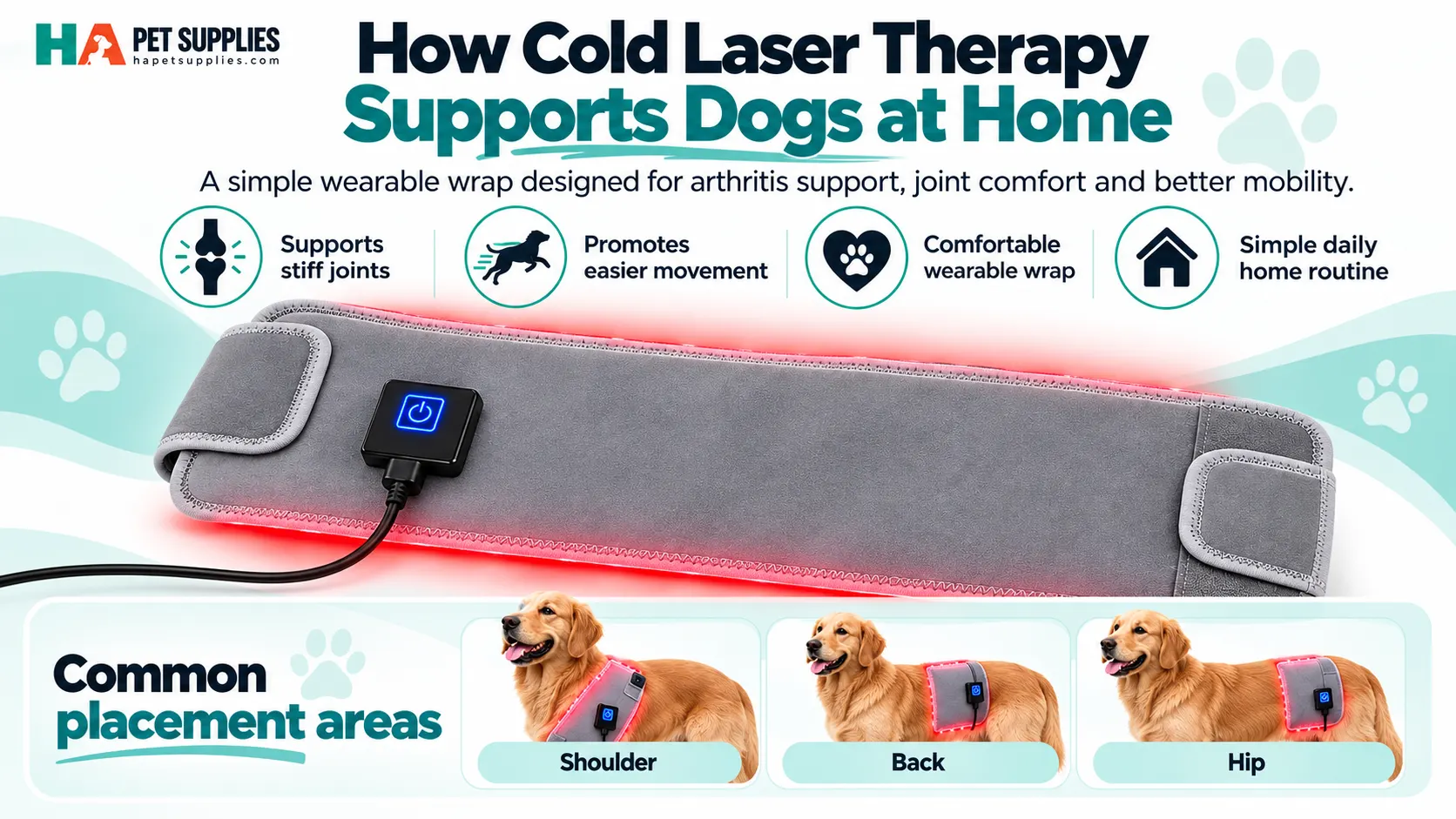
Wearable therapy wrap showing possible treatment placement areas
Placement must follow the device’s instructions and a veterinarian’s advice. Not every anatomical area or medical condition is suitable for treatment.
4. What Does Veterinary Research Actually Show?
Many product advertisements make cold laser therapy sound like an established solution for every dog. The scientific picture is more complicated. There are positive clinical studies, but also important limitations involving sample size, treatment protocols, and evidence quality.
A review of non-pharmaceutical treatments for canine osteoarthritis published in the Journal of Small Animal Practice evaluated several approaches, including photobiomodulation, and described improvements in some measures—while noting study limitations.
A randomized controlled trial published in the American Journal of Veterinary Research investigated photobiomodulation in dogs with hip osteoarthritis. The research involved a relatively small group and a defined therapeutic laser protocol.
A 2025 evidence review published in Veterinary Evidence examined whether laser therapy combined with anti-inflammatory medication was more effective than medication alone. It identified encouraging findings but characterized the strength of the available evidence as weak.
The American College of Veterinary Surgeons describes laser therapy as one of several rehabilitation modalities that may be recommended for dogs with osteoarthritis, while also noting the overall lack of strong studies proving their benefits.
3D evidence comparison
| Evidence Category | What It Tells Us | Practical Meaning |
|---|---|---|
| Small controlled trials | Some dogs may experience improved pain or mobility measures | Encouraging but limited |
| Veterinary reviews | Findings vary across studies and treatment methods | No guaranteed outcome |
| Clinical guidelines | Laser may be considered as a supportive modality | Discuss with a veterinarian |
5. Seven Potential Benefits of Cold Laser Therapy for Dogs
These are potential benefits—not guaranteed outcomes. Each should be considered in the context of your dog’s diagnosis and response to veterinary care.
Benefit 1 — Possible Reduction in Arthritis-Related Discomfort
Photobiomodulation may help some dogs experience reduced discomfort, depending on the treatment protocol. For a clearer understanding of how arthritis affects joints, consult Cornell University’s veterinary explanation of canine osteoarthritis.
Benefit 2 — Potential Support for Mobility
For a senior dog, improved mobility might mean getting out of bed more comfortably or walking to the food bowl with greater ease. Laser treatment alone cannot correct all causes of reduced mobility.
Benefit 3 — Non-Invasive Treatment
Many dogs tolerate properly administered treatments comfortably. However, non-invasive does not mean risk-free—eye exposure, inappropriate treatment areas, and incorrect handling can create safety problems.
Benefit 4 — Possible Support During Rehabilitation
Photobiomodulation may be considered as an adjunct in selected situations. The AAHA guidance on non-pharmacological pain management discusses rehabilitation as part of a wider strategy.
Benefit 5 — Targeted Treatment of Selected Areas
Targeting a particular area may be useful when a diagnosis identifies a localized problem. However, a wearable wrap positioned over fur does not necessarily deliver the same tissue exposure as a professional laser applicator.
Benefit 6 — Potential Complement to Existing Arthritis Care
The World Small Animal Veterinary Association’s global pain guidelines provide further context on individualized protocols. Adding light therapy should not mean discontinuing a treatment that is already helping.
Benefit 7 — Possibility of Convenient Home Sessions
A suitable home device may reduce logistical demands of repeated clinic visits. Still, convenience is valuable only when the device is appropriate and the user understands its limitations.
6. Can Cold Laser Therapy Help Dogs With Arthritis?
Arthritis is one of the most common reasons owners search for cold laser therapy for dogs. Osteoarthritis is a progressive joint condition involving changes to cartilage, bone, and inflammatory processes.
Why arthritis causes difficulty moving
As osteoarthritis progresses, cartilage deteriorates and other joint structures undergo changes. Pain and stiffness can make movement less comfortable. Muscles may also weaken when dogs reduce activity.
Can laser therapy repair damaged cartilage?
There is not enough reliable clinical evidence to claim that a home-use cold laser therapy device rebuilds cartilage destroyed by osteoarthritis. A realistic goal is to explore whether appropriately selected therapy improves comfort or function.
Can laser therapy reduce the need for medication?
Never stop, reduce, or change your dog’s medication without veterinary guidance. The FDA guidance on veterinary nonsteroidal anti-inflammatory drugs explains why these medicines require professional selection and monitoring.
If your dog is showing arthritis symptoms, our related guide, Dog Arthritis and Joint Pain — When to Consider Cold Laser Therapy and How It Fits Into a Treatment Plan, explores how owners can approach ongoing arthritis care.
7. Which Dogs Might Benefit Most From Cold Laser Therapy?
Senior dogs with diagnosed osteoarthritis
After veterinary assessment, some may be candidates for complementary photobiomodulation. The objective should be practical comfort rather than dramatic promises.
Dogs participating in rehabilitation
A veterinarian or veterinary rehabilitation professional may decide whether light therapy is appropriate. Treatment timing and placement should depend on the specific injury.
Dogs experiencing chronic stiffness
Diagnosis comes first. After identifying the cause, your veterinarian can explain which treatments are likely to provide the greatest benefit.
Dogs that become anxious during clinic visits
For dogs that find repeated appointments stressful, a veterinarian-approved home treatment might provide practical convenience. Home-use convenience should never compromise safety.
Dogs for whom treatment may be inappropriate
Exercise caution with dogs that have undiagnosed masses, suspected cancer in the proposed treatment area, photosensitivity, or skin disease. Never direct therapeutic light into the eyes.

Senior dog receiving supportive red light therapy at home
Realistic expectations matter. Monitor comfort over time and reassess with your veterinarian.
8. Cold Laser Therapy vs Other Dog Arthritis Treatments
The important question is not which product sounds most impressive—it’s which combination of measures is appropriate for your dog’s diagnosis.
| Treatment Approach | Primary Purpose | Important Consideration |
|---|---|---|
| Veterinary-prescribed pain medication | Reduce pain and inflammation | Requires appropriate selection and monitoring |
| Weight management | Reduce mechanical stress | Important foundation for many dogs |
| Controlled exercise | Maintain mobility and muscle strength | Must match the dog’s abilities |
| Physical rehabilitation | Improve function and support movement | Often requires professional guidance |
| Cold laser therapy | Potential complementary pain and mobility support | Evidence and device performance vary |
| Orthopedic bedding and home adjustments | Improve comfort and accessibility | Supports daily living but does not treat underlying disease |
| Joint supplements | Possible nutritional support | Evidence depends on formulation and outcome |
The American College of Veterinary Surgeons emphasizes controlled, low-impact activity and weight management in its overview of osteoarthritis treatment.
9. How to Choose a Cold Laser Therapy Device for Dogs
A responsible buying decision should begin with the actual technical characteristics of the device.
Check the light source
Find out whether the device uses laser emitters, LEDs, or a combination. Do not assume all red-light products operate identically.
Verify wavelength information
A credible product listing should state the wavelengths used, typically expressed in nanometers.
Ask about power and treatment dose
Without these details, it is difficult to compare products meaningfully or determine whether a published research protocol is relevant.
Examine the design
A flexible wrap may be more convenient for certain body areas than a rigid handheld device. Avoid wraps that require excessive pressure.
Review safety information
Check whether the seller provides appropriate warnings about eye exposure and inappropriate treatment areas. The FDA explanation of how animal devices are regulated is useful for understanding why consumers should not assume premarket approval.
What to examine on the HA Pet Supplies therapy wrap
The HA Pet Supplies cold laser therapy wrap is presented as a wearable red-light-support product for dogs. Its visible design includes gray fabric, adjustable fastening sections, and a wired controller.
Before purchase, request confirmation of the exact wavelengths, light source, output power, operating instructions, safety precautions, sizing, and any product-specific evidence supporting therapeutic claims.
Owners comparing other products can also explore the wider HA Pet Supplies dog supplies collection for complementary pet-care items.
10. Is Cold Laser Therapy Safe for Dogs?
Protect the eyes
Direct exposure to laser light can be hazardous. Never intentionally shine a laser into a dog’s eyes or allow it to reflect toward the face.
Watch for signs of discomfort
Stop using the device if the dog becomes distressed, attempts repeatedly to escape, shows skin irritation, or appears uncomfortable.
Do not use treatment on unexplained conditions
A painful area may contain more than simple arthritis. Without a diagnosis, owners may delay essential medical care.
Follow device-specific instructions
A professional veterinary laser session does not provide a universal dosage recommendation for a home-use LED wrap.
Supervise your dog
Do not leave a powered wrap operating unattended. Ensure the cable cannot become tangled, chewed, or create a tripping hazard.
Consult your veterinarian about contraindications
A veterinarian familiar with your dog’s history can help identify whether light therapy is suitable.
11. How Often Should Dogs Receive Cold Laser Therapy?
There is no single treatment schedule suitable for every dog or every device. Online advice can easily become misleading because different equipment and clinical protocols deliver different energy levels.
Professional veterinary systems may deliver significantly more energy than consumer devices. A treatment schedule used with a professional laser should not be copied directly for a flexible home wrap.
What determines treatment frequency?
The veterinarian may consider the dog’s diagnosis, severity of symptoms, target tissue, tolerance, and response. The device’s wavelength, output, and intended dose are also relevant.
Can a dog receive too much light therapy?
More exposure is not necessarily better. Photobiomodulation can have dose-dependent effects, and inappropriate exposure may reduce effectiveness or increase risks.
What should owners monitor?
Watch for changes in comfort, sleep, mobility, appetite, and willingness to walk. For an in-depth explanation of at-home routines, follow our companion article, Cold Laser Therapy for Dogs at Home — How to Use It Safely, How Often and What to Expect.
12. What Results Should You Expect From Cold Laser Therapy?
One of the biggest mistakes pet owners make is expecting immediate, dramatic improvement. Even when treatment helps, problems do not necessarily disappear overnight.
What meaningful improvement might look like
Progress can be subtle. Your dog may rise from a resting position with less hesitation, or walking may appear smoother.
Why tracking matters
A simple weekly record can help distinguish meaningful changes from day-to-day variation. The University of Pennsylvania’s Canine Brief Pain Inventory provides an owner-completed method for evaluating chronic pain. The AAHA guidance on chronic pain assessment also emphasizes owner observations.
Interactive mobility tracker
This is an informal owner checklist, not a validated diagnosis or a substitute for veterinary assessment.
13. What If Your Dog Is in Pain Right Now?
Many readers researching cold laser therapy are worried because their dog is uncomfortable today. If this describes your situation, prioritize assessment and safety before shopping.
🚨 Urgent Veterinary Care
Sudden inability to stand, severe pain, paralysis, or major injury.
📅 Book a Veterinary Appointment
Persistent limping, increasing stiffness, difficulty rising, or reduced activity.
✅ Support and Monitor
Follow an existing veterinary plan, maintain safe daily activities, and track changes.
Step 1 — Determine whether the problem is urgent
If your dog cannot bear weight, has severe or sudden pain, or appears seriously injured, seek urgent veterinary care.
Step 2 — Reduce avoidable strain
Until your dog has been assessed, discourage jumping, running, and strenuous play that aggravates symptoms.
Step 3 — Do not give human pain medication
The FDA’s guide to pain relievers for pets explains why owners should contact a veterinarian instead of selecting medication from a household medicine cabinet.
Step 4 — Record what you notice
Make a note of when the problem started and which activities cause difficulty. If safe, record a short video of the dog’s walking pattern.
Step 5 — Ask about the treatment plan
Once the cause is identified, discuss pain relief, rehabilitation, lifestyle changes, and whether photobiomodulation could be useful.
14. How Cold Laser Therapy Fits Into a Complete Dog Arthritis Treatment Plan
Arthritis care usually requires several coordinated steps: veterinary diagnosis, pain management, weight optimization, controlled physical activity, rehabilitation, home modifications, and regular reassessment.
If the veterinarian considers it appropriate, cold laser therapy may be included alongside other measures. Its role should be clearly defined—for example, evaluating whether treatment improves comfort during walking.
For additional practical guidance on arthritis management, browse the HA Pet Supplies educational blog, where related articles discuss pet comfort, mobility, and home-care routines.
15. Why Consider HA Pet Supplies for At-Home Pet Care?
HA Pet Supplies offers pet-care products through its online store, including its wearable dog red light therapy wrap. The product’s gray fabric design and adjustable fastening sections are intended to make positioning practical for selected body areas.
For owners researching appropriate home-care supplies, the HA Pet Supplies online shop provides a place to explore additional products for everyday pet routines.
If you need clarification about product compatibility or available specifications, you can contact HA Pet Supplies before deciding. For product-specific enquiries, you can also request a quote from HA Pet Supplies.
Remember that purchasing a device does not replace obtaining an appropriate diagnosis or treatment plan from a qualified veterinarian.
16. Frequently Asked Questions About Cold Laser Therapy for Dogs
Some clinical studies have reported improvements in certain pain or mobility measures, particularly in dogs with osteoarthritis. However, the research is still limited, and findings cannot be applied automatically to every home-use product. Cold laser therapy is best considered a potential complementary treatment rather than a guaranteed solution.
No. There is insufficient evidence that cold laser therapy cures osteoarthritis or rebuilds cartilage damaged by the disease. Veterinary arthritis management generally focuses on controlling pain, maintaining function, and supporting quality of life.
Properly administered low-level photobiomodulation is generally intended to be comfortable. However, devices vary, and dogs may react differently. Stop treatment if your dog appears uncomfortable or develops irritation, and consult your veterinarian.
There is no universal timeline. Some research measures outcomes over several weeks, but individual responses vary. A veterinarian can help establish realistic monitoring goals.
They are related concepts but not identical. Photobiomodulation may use laser light or LEDs. Different devices have different wavelengths, output characteristics, and treatment capabilities. A red glow alone does not prove therapeutic effectiveness.
It may help selected dogs if their mobility limitations are partly related to discomfort and they respond to treatment. However, difficulty walking can result from many conditions. A veterinary diagnosis is essential.
Treatment around the hip may be considered for certain diagnosed conditions, but appropriate placement and dosage depend on the equipment. Do not assume that a wrap positioned over the hip reaches the affected joint at a therapeutic dose.
It should not be used as an independent replacement for prescribed pain medication. If your dog experiences side effects or you are concerned about medication, discuss the treatment plan with your veterinarian.
Frequency depends on the device, diagnosis, and prescribed treatment protocol. There is no universally correct daily or weekly schedule. Follow the manufacturer’s verified instructions and your veterinarian’s recommendations.
Some home devices may be appropriate when used correctly, but safety depends on their specifications and the dog’s health. A veterinary consultation is strongly recommended before beginning home treatment.
They serve different purposes and should not automatically be viewed as competing treatments. Physical rehabilitation can address strength, movement patterns, coordination, and functional recovery. Photobiomodulation may be considered as a complementary modality.
No treatment produces identical outcomes in every patient. Some dogs may show meaningful improvement, while others may show little or no measurable response. This is why monitoring and veterinary reassessment are essential.
Some veterinary rehabilitation protocols include photobiomodulation following certain procedures. Never apply a home device to a recent surgical area without approval from the treating veterinarian.
Look for clear specifications on the light source, wavelengths, power, operating modes, treatment guidance, safety warnings, fit, and warranty. Avoid relying solely on advertising claims.
That depends on the condition. Certain skin problems, tumors, eye conditions, medications, and other health concerns may require additional precautions. Discuss the dog’s complete medical history with a veterinarian before treatment.
17. Final Verdict — Is Cold Laser Therapy for Dogs Worth Considering?
Cold laser therapy for dogs is an area of veterinary care with promising possibilities, but it should be approached with realistic expectations. Some research suggests that appropriately administered photobiomodulation may help selected dogs experience improvements in pain or movement.
At the same time, the evidence is not strong enough to promise that every dog with arthritis will benefit. Nor is there a scientific basis for assuming that any inexpensive home-use device will reproduce the results achieved with professional veterinary lasers.
If your dog is struggling with stiffness, joint pain, or mobility problems, begin by identifying the cause. A veterinarian can assess whether arthritis is present, explain established treatment options, and determine whether adding photobiomodulation makes sense.
For owners exploring a wearable home-care option, the HA Pet Supplies dog cold laser therapy wrap is one product to investigate after confirming its technical specifications and suitability.
The most important purchase decision is an informed one. A comfortable dog, a realistic treatment plan, and the right veterinary guidance matter more than any product promise.
You can explore the broader HA Pet Supplies website for additional pet-care products and resources, or request product information and a quote if you need help understanding the available therapy wrap.
Because the goal is not simply to buy a device. It is to help your dog enjoy as much comfort, safe movement, and quality time with you as possible.
HA Pet Supplies — Happy Pets. Healthy Pets. Happy Life.