
Your dog is standing beside the bed, looking up at the place where they have slept for years. They try to jump, hesitate, and slowly walk away. Should you buy a dog ramp or a set of pet stairs?
It is a question many dog owners ask when their pets begin struggling with everyday movement. Maybe your senior dog no longer jumps onto the sofa. Perhaps your small dog needs help reaching a high bed. Or your dog has arthritis, and you are worried that repeated jumping could make joint discomfort worse.
You search for a solution and discover dozens of dog ramps, wooden pet stairs, foam steps, folding ramps, and non-slip designs. Every product promises convenience, but the important question remains: Which one is actually suitable for your dog?
The dog ramp vs stairs decision depends on more than convenience or appearance. Your dog’s age, body size, mobility, joint condition, confidence, and the height of the destination all affect which product may work best.
A continuous dog ramp allows a dog to walk up an inclined surface without lifting each paw onto a separate step. Pet stairs divide the height into individual steps, requiring repeated climbing movements. Both can reduce the need for direct jumping when they are appropriately selected and used.
However, the differences become especially important for dogs with painful joints, spinal conditions, weakness, or difficulty balancing.
According to PetMD’s veterinarian-written dog ramps versus stairs guide, ramps are generally preferable for dogs with arthritis and certain back conditions, while stairs can be suitable for smaller, agile dogs.
That does not mean every ramp is safe for every senior dog or that stairs are automatically harmful. A steep, slippery ramp may be more difficult than well-designed steps. Likewise, a staircase with excessively high risers may make climbing uncomfortable for a small dog.
This guide will help you understand the differences and choose a practical mobility solution. You will learn which option may be better for senior dogs, small breeds, dogs with arthritis, and pets recovering from certain medical conditions.
You will also discover how to measure furniture height, identify non-slip features, prevent falls, and introduce your dog to a new ramp or staircase.
If your dog is struggling right now, begin with the quick decision guide below.
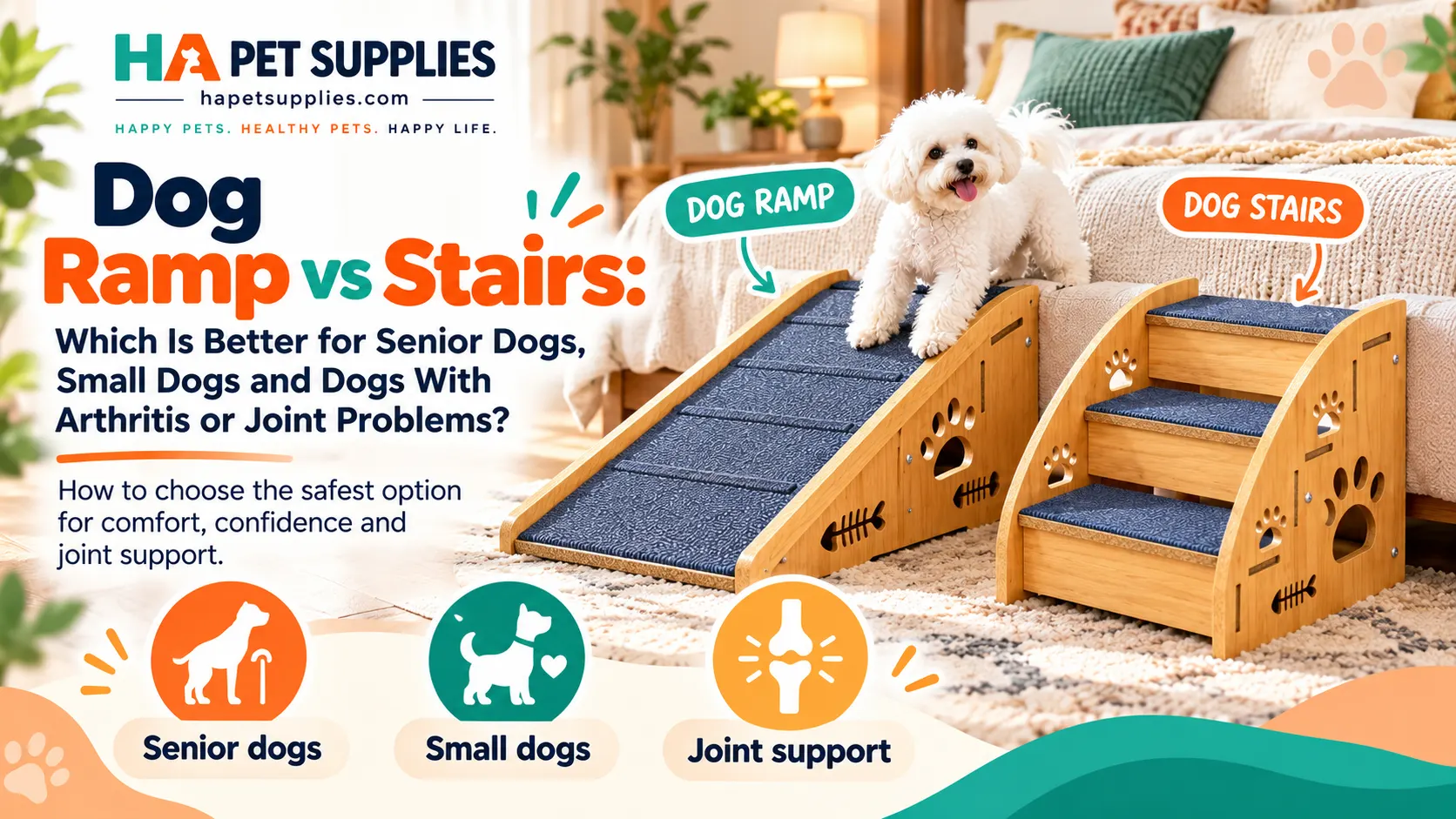
Compare ramps and pet stairs based on your dog’s mobility and comfort
📋 Table of Contents
- 1. Quick Answer: Dog Ramp vs Stairs
- 2. What Is the Difference Between a Dog Ramp and Dog Stairs?
- 3. Dog Ramp vs Stairs for Senior Dogs
- 4. Dog Ramp vs Stairs for Small Dogs
- 5. Dog Ramp vs Stairs for Dogs With Arthritis
- 6. Which Is Better for Dogs With Joint or Back Problems?
- 7. Seven Essential Factors to Consider Before Buying
- 8. Dog Ramp vs Stairs Comparison Table
- 9. Which Is Better for Beds, Sofas, Cars and SUVs?
- 10. How to Measure the Correct Height and Size
- 11. Why Non-Slip Surfaces and Stability Matter
- 12. How to Recognize Signs Your Dog Needs Mobility Assistance
- 13. How to Train Your Dog to Use a Ramp or Stairs
- 14. Common Buying Mistakes and Fast Solutions
- 15. Alternatives When Neither Option Works
- 16. Choosing HA Pet Supplies Wooden Pet Stairs
- 17. Frequently Asked Questions
- 18. Final Recommendation and Buying Checklist
1. Quick Answer: Dog Ramp vs Stairs
If you need a fast answer, start by looking at your dog’s mobility rather than the product design.
A gently sloped, stable dog ramp is often the better starting choice for dogs with arthritis, back problems, or difficulty climbing steps. Well-designed pet stairs may be suitable for healthy, agile dogs that can comfortably lift their paws and navigate individual steps. However, neither choice is universally safe.
| Your Dog’s Situation | Option to Consider First | Main Reason |
|---|---|---|
| Healthy small dog reaching a sofa | Suitable pet stairs or a low ramp | Both may provide convenient access |
| Senior dog with mild mobility changes | Gentle ramp, with veterinary input | May reduce step-climbing demands |
| Dog with diagnosed arthritis | Veterinarian-approved gentle ramp | Avoids repeated individual step rises |
| Dog with back problems | Veterinary guidance before choosing | Movement restrictions vary by condition |
| Large dog entering an SUV | Vehicle-rated ramp | Provides a continuous access route |
| Agile dog reaching a low bed | Stable stairs or ramp | Choice depends on preference and space |
| Dog unable to bear weight | Neither without veterinary direction | Climbing may be unsafe |
| Dog recovering from surgery | Only the veterinarian-approved option | Activity restrictions are condition-specific |
The Three Questions That Matter Most
Question 1: Can your dog comfortably climb individual steps? If the dog struggles with lifting its paws or shows discomfort during stair climbing, a suitably gentle ramp may be preferable.
Question 2: Is there enough room for a safe ramp incline? A ramp requires horizontal space. When the destination is high and the available space is short, the incline may become too steep.
Question 3: Is the dog’s mobility problem already diagnosed? If your dog suddenly begins refusing stairs or jumping, seek veterinary assessment rather than purchasing equipment and assuming the problem is solved.
For a complete overview of measuring access height and choosing equipment, see our related guide: Best Dog Ramp for Cars, SUVs and Beds.
2. What Is the Difference Between a Dog Ramp and Dog Stairs?
The two products serve a similar purpose. They help dogs reach elevated surfaces without performing one large jump. However, the movement required is different.
What Is a Dog Ramp?
A dog ramp is a continuous inclined surface that connects two heights. The dog walks along the slope to reach a car, bed, sofa, or other accessible area. Some ramps are fixed wooden structures designed for indoor use. Others are folding or telescoping products intended for vehicle access. The ramp should have sufficient width, reliable traction, suitable load capacity, and secure support at both ends.
What Are Dog Stairs?
Dog stairs consist of individual steps. Each step includes a horizontal tread and a vertical rise. Dog stairs may be constructed from wood, foam, plastic, or other materials. Some products have carpeted treads to help improve grip. For example, the HA Pet Supplies product shown in this blog’s images is a wooden pet staircase with blue non-slip carpet, rather than a continuous sloped ramp. That distinction matters when comparing movement and joint comfort.
How the Movement Differs
On a ramp, a dog walks along an incline. On stairs, the dog repeatedly lifts its body from one level to another. Ascending stairs requires the hind limbs to help propel the body upward. Descending requires controlled movement and support through the front limbs. This means a dog may handle one direction better than the other.
According to PetMD’s stair safety guidance, difficulty going up versus down stairs may reveal different orthopedic or mobility concerns.
Does a Ramp Eliminate Joint Stress?
No. A ramp still requires muscular effort, balance, and traction. A steep incline may be difficult for a dog with painful joints. The goal is not to eliminate all physical work but to provide a more manageable alternative to jumping or difficult step climbing.
Are Dog Stairs Automatically Bad?
No. For a healthy dog that can comfortably manage the step height, pet stairs may be a useful home accessory. They may also require less horizontal floor space than a long ramp. The best choice depends on the dog and the specific product dimensions.
⚖️ Dog Ramp vs Stairs — Interactive Comparison
Click each panel to reveal movement details
Continuous Dog Ramp
Walking along an incline
Often preferred for: Dogs with arthritis, back conditions, or difficulty climbing individual steps. Can reduce the repeated step-up demands.
Watch for: Steep inclines, slippery surfaces, unstable support, narrow width.
Wooden Pet Stairs
Repeated stepping motion
Often suitable for: Healthy, agile dogs that can comfortably manage the step rise and tread depth.
Watch for: Excessive step rise, shallow tread depth, poor grip, unstable construction.
The right choice depends on your dog’s movement abilities — not just the product design.
3. Dog Ramp vs Stairs for Senior Dogs
One of the most common reasons people compare dog ramps and stairs is a change in their dog’s mobility with age. An older dog may become slower when climbing furniture or may stop jumping altogether.
Why Older Dogs Struggle With Height
Senior dogs may experience reduced strength, joint stiffness, changes in balance, or discomfort associated with age-related medical conditions. However, age alone is not a diagnosis. A dog refusing to jump may have arthritis, an injury, spinal discomfort, or another problem requiring veterinary assessment.
The American Kennel Club’s guide to making homes accessible for senior dogs recommends considering ramps for dogs that struggle with stairs and stable, deep pet steps for older dogs that remain relatively agile.
When a Ramp May Be Better for a Senior Dog
A ramp may be useful if your senior dog struggles to lift its paws onto individual steps. A gradual incline can offer a continuous path to the destination. This may be particularly helpful when entering a vehicle. However, the ramp must be stable and offer adequate traction. A narrow, steep ramp may be frightening or unsuitable.
When Pet Stairs May Still Work
Some older dogs remain active and comfortable using appropriately sized steps. A short staircase with deep, secure treads may help them reach a sofa without performing one large jump. The dog should be able to climb and descend slowly without obvious discomfort. If your dog begins hopping, slipping, or skipping steps, reassess the equipment.
Why Descending Matters
Owners often focus on helping a dog climb upward. But descending can be just as important. A senior dog may climb onto a bed with relative ease and then struggle to control the movement downward. A suitable mobility aid should support both directions.
Senior Dog Buying Recommendation
For older dogs with reduced mobility, begin by considering a stable, gently inclined ramp. If your dog remains agile and a veterinarian considers step climbing appropriate, well-designed stairs may also be an option.
According to PetMD’s senior dog exercise guidance, older dogs benefit from activity suited to their physical capabilities, with new exercise introduced gradually. The same principle applies to learning to use mobility equipment.
4. Dog Ramp vs Stairs for Small Dogs
Small dogs often face a different challenge from senior large dogs. Their legs are shorter, so a bed or sofa may be relatively high compared with their body size.
Why Small Dogs May Need Assistance
A small dog may have to jump a substantial distance to reach a sofa. The dog may appear capable of making the jump, but that does not necessarily mean the movement is comfortable every time. A pet staircase or ramp may reduce the need for repeated jumping.
Are Stairs Better for Small Dogs?
Sometimes. Healthy, agile small dogs may use low pet steps comfortably. Compact wooden stairs can fit beside furniture without occupying as much floor space as a long ramp. However, the individual step rise must suit the dog’s size. A step that appears low to a person may require a very small dog to perform a miniature jump.
Why Step Height Matters
Imagine two different staircases reaching the same sofa. The first has two tall steps. The second has four lower steps. Although the second has more steps, each individual rise may be more manageable for a short-legged dog. But step count alone is not enough. Tread depth and overall stability also matter.
When a Ramp Is Better for Small Dogs
A ramp may be preferable if the dog has difficulty climbing, has a diagnosed mobility condition, or struggles with individual step heights. It may also be suitable for dogs that are physically uncomfortable making repeated step-up movements.
The Canine Arthritis Resources and Education guidance on adapting stairs notes that very small dogs may effectively have to jump between ordinary-sized steps, increasing the demands on their bodies.
What About Dachshunds and Other Long-Backed Breeds?
Long-backed dogs may have particular spinal health considerations. If your dog has a diagnosed spinal condition or develops back pain, the appropriate access method should be discussed with a veterinarian. Do not assume a ramp automatically makes every movement safe. Similarly, avoid forcing a dog with spinal pain to climb.
Small Dog Buying Recommendation
For a healthy, agile small dog needing access to a low sofa, a stable set of suitably proportioned pet stairs may be practical. For a dog with back pain, joint discomfort, or difficulty climbing individual steps, veterinary-guided use of a gentle ramp may be more appropriate.
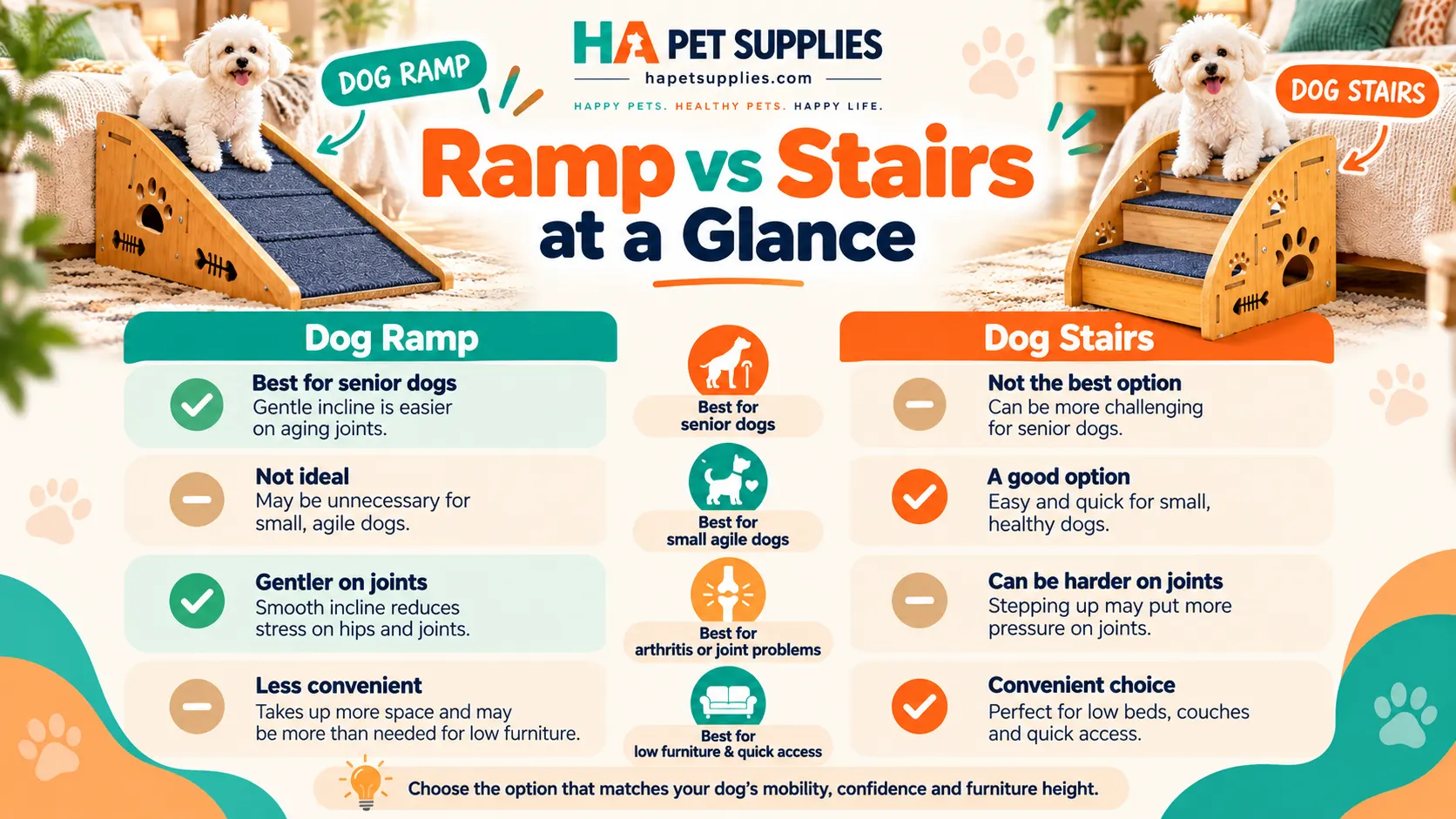
Ramp slope and step height should match the dog’s physical abilities
5. Dog Ramp vs Stairs for Dogs With Arthritis
Arthritis is a major reason dog owners begin looking for mobility assistance. A dog that once jumped onto furniture may develop stiffness, reluctance, or discomfort.
What Is Canine Arthritis?
Osteoarthritis is a chronic joint condition involving changes to joint structures, including cartilage and surrounding tissues. It can cause pain, stiffness, reduced movement, and difficulty with everyday activities.
According to PetMD’s veterinary overview of osteoarthritis in dogs, owners may notice difficulty climbing, reduced activity, and reluctance to perform familiar movements.
Why Jumping May Be Uncomfortable
Jumping requires the body to generate force during takeoff and absorb force during landing. Dogs with painful joints may struggle with either phase. The problem may be especially noticeable when jumping down from elevated surfaces.
Why a Ramp Is Often Preferred
A gradual ramp offers a continuous walking surface. For a dog that struggles with repeated step climbing, this may provide a more manageable movement pattern. However, not every ramp is suitable. A steep incline, slippery surface, or unstable structure may create additional problems.
The American College of Veterinary Surgeons’ osteoarthritis guidance recommends reducing high-impact activity as part of individualized joint-disease management.
Can Arthritic Dogs Still Use Stairs?
Some can, but the answer depends on disease severity, affected joints, strength, and balance. According to Canine Arthritis Resources and Education, controlled stair climbing may have a role for certain dogs, while descending may place greater demands on particular joints. This is why blanket advice to use stairs or avoid stairs entirely can be misleading. A veterinarian or rehabilitation professional can help determine whether a dog should use steps.
The Importance of Non-Slip Traction
Dogs with arthritis may struggle to recover from a slip. Smooth floors, worn carpet, or unstable steps can increase difficulty. The PetMD arthritis treatment guide discusses non-slip rugs, home modifications, and appropriate mobility aids as components of arthritis management.
Arthritis Cannot Be Treated With a Ramp Alone
A ramp is an environmental adaptation, not a medical treatment. Arthritis management may involve weight control, appropriate exercise, veterinary pain management, and rehabilitation. The correct plan depends on the dog’s diagnosis. Never stop prescribed treatment because a mobility aid appears to improve access.
Best Starting Choice for Arthritis
For many dogs with arthritis, a suitably gentle, non-slip ramp is a sensible starting option. But when the dog cannot safely walk on an incline or is recovering from an acute problem, neither ramp nor stairs may be appropriate without professional guidance.
6. Which Is Better for Dogs With Joint or Back Problems?
Not all mobility problems are identical. Different conditions affect different movements.
Dogs With Hip Problems
Hip discomfort may make rising, climbing, or certain movements difficult. A ramp may reduce the need for large jumps, but walking uphill still requires effort. Use a gentle slope and appropriate traction if a veterinarian considers ramp use suitable.
Dogs With Knee Problems
Dogs with knee conditions may struggle with step climbing or controlling their movement downhill. The correct mobility aid depends on the specific diagnosis. Do not assume the same solution works for patellar luxation, ligament injuries, and arthritis.
Dogs With Elbow or Shoulder Problems
Descending steps or steep ramps may be particularly uncomfortable when the front limbs are affected. Some dogs may need assistance, a different access route, or temporary avoidance of elevated furniture.
Dogs With Back Conditions
Spinal problems require special caution. A dog with suspected intervertebral disc disease or another spinal condition may need strict activity limitations during certain stages. Do not encourage a dog with an acute back problem to use a ramp or stairs without veterinary approval.
Dogs Recovering From Surgery
Postoperative instructions vary widely. Some dogs may eventually use rehabilitation-approved mobility aids. Others may need to avoid climbing altogether for a period. Follow the veterinarian’s instructions rather than the product manufacturer’s general recommendations.
Why Individual Assessment Matters
Two dogs may both appear stiff but have completely different underlying problems. One may benefit from gradual ramp training. The other may need urgent treatment and temporary restriction of movement. The PetMD guide to arthritis and mobility comfort explains why environmental adaptations work best as part of individualized care.
7. Seven Essential Factors to Consider Before Buying
The dog ramp vs stairs decision should begin with practical measurements and observed abilities.
🔍 Seven Factors Before You Buy
Click any card to reveal a key detail
Dog’s Health
Destination Height
Incline / Step Rise
Surface Grip
Load Capacity
Floor Space
Dog’s Confidence
8. Dog Ramp vs Stairs Comparison Table
| Feature | Dog Ramp | Dog Stairs |
|---|---|---|
| Basic design | Continuous inclined surface | Individual steps |
| Movement required | Walking uphill or downhill | Repeated stepping |
| Senior dog suitability | Often preferable with a gentle incline | Suitable for some agile seniors |
| Arthritis considerations | Often preferred, depending on condition | May be challenging for painful joints |
| Small dog suitability | Good with appropriate dimensions | Often practical for agile small dogs |
| Large dog suitability | Appropriate if rated and wide enough | Depends on construction and step dimensions |
| Space requirement | Often greater horizontal space | Often more compact |
| Bed access | Yes | Yes |
| Sofa access | Yes | Yes |
| SUV access | Vehicle-rated ramps often useful | Most furniture stairs unsuitable |
| Portability | Many models fold or telescope | Many wooden models are fixed |
| Main safety concern | Slope, grip, attachment | Step rise, grip, stability |
| Important measurement | Height, ramp length, width | Total height, rise, tread depth |
| Training | Gradual introduction | Gradual introduction |
Which Is the Better Overall Choice?
There is no universal winner. A ramp may provide an advantage for dogs that struggle with climbing individual steps. Stairs may work well for dogs that are comfortable stepping and need compact furniture access. The product must still match the dog, the location, and the intended activity.
Why Cheaper Does Not Always Mean Better
A low-cost staircase with shallow steps may be unsuitable for your dog even if it fits the furniture height. Similarly, an inexpensive ramp may lack sufficient length or stability. Choose based on verified product specifications and practical suitability.
Why More Expensive Does Not Automatically Mean Safer
Higher price does not guarantee better traction, appropriate dimensions, or a more comfortable experience. Compare materials, construction, weight rating, and installation requirements.
9. Which Is Better for Beds, Sofas, Cars and SUVs?
Different destinations require different access arrangements.
Dog Ramp vs Stairs for Beds
Beds may be relatively high compared with a small dog’s body. A staircase with suitably low steps may work well for a healthy, agile pet. However, a dog with arthritis or difficulty climbing may benefit more from a gently sloped ramp. Measure the bed height before shopping. Also account for the space needed to approach the equipment comfortably.
Dog Ramp vs Stairs for Sofas
Sofas are often lower than beds. This makes compact pet stairs a practical option for many small dogs. However, the final step should allow the dog to reach the seating surface without another large jump. Check whether the staircase ends at a useful height.
Dog Ramp vs Stairs for Cars
Vehicle entry creates different safety concerns. The surface is often higher than ordinary furniture, and the ramp may be used outdoors. A purpose-designed vehicle ramp is commonly more practical than furniture stairs. The product should have a secure connection to the vehicle and adequate traction.
Dog Ramp vs Stairs for SUVs
SUV loading heights can be substantial. A short ramp may create an excessively steep incline. Measure the actual loading height and available ground space. Select an appropriately rated product that can be deployed securely.
What About Trucks?
Tall trucks may require long ramps and careful positioning. If the setup becomes impractical or unsafe, seek an alternative approved loading method. Do not make a dog climb a steep ramp simply because it is available.
For detailed guidance on choosing the proper dimensions, see our pillar article: Best Dog Ramp for Cars, SUVs and Beds: Size, Height and Non-Slip Buying Guide.
10. How to Measure the Correct Height and Size
A suitable product must match the height and space available.
Measuring for Pet Stairs
Measure from the floor to the furniture surface. Then inspect the product’s total height, individual step rise, tread depth, and usable width. Do not assume that four steps are automatically better than three. For some dogs, smaller step rises may be more manageable. For others, insufficient tread depth can make a staircase awkward.
Measuring for a Ramp
Measure the vertical height between the lower and upper surfaces. Then measure the available horizontal space. A longer ramp can create a gentler incline for the same vertical rise. However, the incline must still suit your dog’s ability.
Ramp Geometry Example
Imagine that your bed is 20 inches above the floor and you have 60 inches of horizontal space. A straight ramp spanning that arrangement would need to be approximately 63.2 inches long. Its incline would be about 18.4 degrees. This is a mathematical example, not a universal veterinary-approved angle. A dog with limited mobility may require a different arrangement.
Step Height Example
Suppose a set of stairs reaches a total height of 18 inches using three equally sized risers. Each rise would be approximately 6 inches. That does not tell you whether the product is suitable. You also need to consider tread depth, walking width, stability, and your dog’s leg length.
Measuring the Dog’s Comfort
Observe the dog standing, turning, and walking on level ground. If the dog already struggles with normal movement, seek veterinary guidance before introducing climbing equipment. The AKC senior home accessibility guide emphasizes deep treads, anti-skid surfaces, appropriate load ratings, and gentle non-slip ramps.
📐 Ramp Angle & Step Height Calculator
This calculation is geometric only. It cannot determine medical suitability for any individual dog. Always consult your veterinarian for mobility concerns.
11. Why Non-Slip Surfaces and Stability Matter
Even a correctly sized ramp or staircase can become unsafe if it slips during use.
The Problem With Smooth Flooring
Wood, tile, laminate, and polished surfaces can be difficult for dogs with reduced mobility. A dog may hesitate when approaching the equipment because its paws slip on the surrounding floor.
Why Carpeted Pet Stairs Can Help
Carpeted treads may provide extra surface texture. The material should be firmly attached. Loose, worn, or excessively smooth carpet can reduce confidence.
Why Ramp Texture Matters
Ramps should offer suitable grip along the entire walking surface. An abrupt change from a textured ramp to a slippery furniture surface may also create difficulty. Consider both the equipment and the surrounding area.
Stable Construction
A mobility aid should not wobble, slide, rock, or shift during use. Check the feet, joints, hinges, fasteners, and contact points. Follow the manufacturer's installation instructions.
Safety Around the Equipment
Keep the approach clear of toys, cords, loose mats, and other obstacles. Avoid placing a staircase where the dog must make a sharp turn near an unprotected edge.
Arthritis and Traction
According to VCA Animal Hospitals' guide to helping dogs with osteoarthritis, non-slip mats, suitable flooring, ramps, and careful stair management can make everyday activities more manageable. The important lesson is that a mobility aid should be part of a safe environment rather than an isolated accessory.
12. How to Recognize Signs Your Dog Needs Mobility Assistance
Sometimes owners notice mobility problems gradually. Other times, the change is sudden. Knowing the difference matters.
Sign 1: Hesitating Before Jumping
A dog that previously jumped confidently may begin pausing. This can indicate discomfort, reduced confidence, or another physical problem.
Sign 2: Difficulty Standing After Rest
Stiffness after sleeping or resting can be associated with joint problems. If this becomes frequent, ask your veterinarian to evaluate the dog.
Sign 3: Trouble Climbing Stairs
Watch for slow movement, skipping steps, or an unusual pattern when climbing. Difficulty may involve pain, weakness, or balance.
Sign 4: Difficulty Descending
A dog may climb upward but become fearful or unstable when descending. Do not assume the dog is being stubborn.
Sign 5: Slipping on Floors
Repeated slipping can create fear and increase injury risk. Improve traction and investigate possible mobility problems.
Sign 6: Reduced Interest in Familiar Activities
A dog that no longer wants to join the family on the sofa or enter the car may be avoiding uncomfortable movements.
Sign 7: Limping or Favoring One Leg
These signs deserve veterinary attention. A ramp cannot correct an underlying injury.
When to Seek Veterinary Help
If the changes are persistent, arrange a veterinary appointment. Seek urgent care for severe pain, inability to stand, dragging limbs, or sudden major weakness. The PetMD overview of osteoarthritis symptoms explains how changes in everyday movement can be signs of joint disease.
13. How to Train Your Dog to Use a Ramp or Stairs
Even a suitable mobility product requires introduction. Some dogs approach new equipment confidently. Others may hesitate because the surface feels unfamiliar.
Step 1: Introduce the Product
Place the equipment in a safe, stable location. Let your dog investigate without pressure. Reward calm curiosity.
Step 2: Practice Approaching
Encourage your dog to walk toward the ramp or stairs. Use treats or praise. Do not drag the dog onto the equipment.
Step 3: Begin With the Easiest Movement
For a ramp, a flat or very gentle setup may be appropriate if the design allows it. For stairs, begin with approaching and stepping onto the lowest tread.
Step 4: Reward Voluntary Participation
Offer rewards when your dog comfortably places paws on the surface. Allow the dog to move away when needed.
Step 5: Gradually Increase Difficulty
Only progress when your dog appears relaxed and physically comfortable. Do not increase the height suddenly.
Step 6: Practice Both Directions
Climbing down may require separate training. Observe the dog's balance and confidence.
Step 7: Introduce the Final Location
Once your dog understands the movement, practice at the bed, sofa, or vehicle using a securely installed setup.
What If the Dog Refuses?
Stop and inspect the equipment. The surface may be slippery, the height may be too challenging, or the dog may have pain. The AKC guide to dog ramps and stairs recommends gradual acclimation and positive reinforcement rather than forcing the dog.
For detailed training instructions, read our third article: How to Train a Dog to Use a Ramp in 7 Easy Steps Without Fear or Slipping.

Choose a stable access method that matches your dog's climbing ability
14. Common Buying Mistakes and Fast Solutions
Mistake 1: Choosing by Appearance Alone
A beautiful wooden staircase may not have suitable dimensions for your dog. Prioritize comfort, stability, and verified product specifications.
Mistake 2: Assuming Every Senior Dog Needs a Ramp
Some senior dogs can comfortably use suitable steps. Others require a ramp or a completely different assistance method. Individual mobility matters more than age alone.
Mistake 3: Choosing Stairs With Excessively High Risers
Small dogs may effectively need to jump between steps that are too tall. Compare step rise with the dog's capabilities.
Mistake 4: Buying a Ramp That Is Too Short
Short ramps can create steep inclines. Measure the destination height before ordering.
Mistake 5: Ignoring the Weight Rating
The product must safely support the dog's weight. Follow manufacturer limits.
Mistake 6: Forgetting About Descending
Some dogs struggle more when descending than ascending. Evaluate both directions.
Mistake 7: Ignoring Grip
Smooth or unstable surfaces can increase slipping risks. Check tread and ramp materials carefully.
Mistake 8: Forcing Training
A nervous dog may become more frightened if pushed or dragged onto a new product. Use gradual, reward-based introduction.
Mistake 9: Treating Equipment as Arthritis Treatment
A ramp or staircase may improve access, but it does not treat the underlying disease. Continue veterinary care.
Mistake 10: Buying Without Measuring the Space
A long ramp may not fit beside a bed. A wide staircase may block a doorway. Measure the intended area before shopping.
15. Alternatives When Neither Option Works
Sometimes neither a ramp nor pet stairs provide a safe solution. This can happen when a dog has significant mobility limitations or the available space is unsuitable.
Low Furniture
A lower resting surface may reduce the need for climbing. For some dogs, a comfortable orthopedic bed placed at floor level can be more practical than trying to access a high human bed.
Non-Slip Rugs
If the main problem is traction rather than height, improving the flooring may help. Use secure rugs or mats that remain flat.
Support Harnesses
Certain dogs may benefit from veterinarian-recommended support harnesses or slings. These devices must be used properly. Do not pull a dog by the collar to force climbing.
Restricting Access to Dangerous Areas
Baby gates or closed doors can prevent unsupervised access to hazardous stairs. This may be especially important during recovery or when the dog has poor balance.
Veterinary Rehabilitation
A rehabilitation professional may provide an individualized activity plan. The American College of Veterinary Surgeons identifies rehabilitation, controlled exercise, and weight management as important parts of osteoarthritis care.
Maintaining Appropriate Activity
Avoid assuming that dogs with arthritis should stop moving entirely. Appropriate low-impact activity may help maintain function when recommended by a veterinarian. The PetMD exercise guide for senior dogs discusses adapting activity to health and mobility.
16. Choosing HA Pet Supplies Wooden Pet Stairs
If your dog is comfortable using individual steps and needs help accessing furniture, wooden pet stairs may be worth considering. The HA Pet Supplies product pictured in this article features a wooden stepped structure with blue carpeted treads. This design is different from a continuous ramp.
What Should You Check Before Buying?
First, measure your bed or sofa height. Second, review the product's total height. Third, check individual step rise and tread depth. Fourth, confirm usable width and the manufacturer's weight capacity. Finally, consider whether your dog's health and climbing ability make stairs appropriate.
Comparing Step Options
If the product offers two-step, three-step, and four-step variations, compare the exact specifications of each. A lower number of steps may suit lower furniture. Additional steps may help reach higher furniture, depending on the actual dimensions. Do not assume a four-step staircase is automatically gentler. The rise and depth of each step matter.
Why Consider HA Pet Supplies?
At HA Pet Supplies, we aim to help pet owners compare practical accessories based on their everyday needs. If you are exploring mobility products, visit our dog ramp and pet stairs product page to review the available product details. You can also browse related accessories through our dog supplies category.
Looking for Other Pet Accessories?
For everyday pet care and travel accessories, explore the HA Pet Supplies shop. If mobility equipment will be used during outdoor travel, consider other seasonal requirements separately. For example, a dog cooling vest may be a relevant accessory to evaluate for hot-weather comfort, but it is not a mobility aid and does not make dangerous heat safe.
Need Help With Product Dimensions?
If the sizing information is unclear, use the HA Pet Supplies contact page to ask about dimensions, product configuration, or intended use. Include your dog's weight, furniture height, and any relevant measurements. For pricing inquiries, you can request a quote from HA Pet Supplies.
Making an Informed Decision
If your dog has significant arthritis, weakness, or back problems, consult your veterinarian before choosing a stepped product. A comfortable and suitable mobility aid is more valuable than a product purchased solely for appearance.
17. Frequently Asked Questions About Dog Ramp vs Stairs
18. Final Recommendation and Buying Checklist
The dog ramp vs stairs decision should begin with your dog's comfort and physical abilities. A healthy small dog may find properly designed pet stairs practical. A senior dog with reduced mobility may benefit more from a gently sloped ramp. A dog with arthritis, spinal disease, or another diagnosed orthopedic condition may require individualized veterinary guidance before using either product.
Final Seven-Point Buying Checklist
- Identify the dog's main difficulty. Is jumping difficult, are steps uncomfortable, or is the dog slipping?
- Check for medical concerns. Sudden mobility changes, persistent pain, or weakness deserve veterinary attention.
- Measure the destination. Record the height of the bed, sofa, car, or SUV.
- Evaluate the movement required. Consider whether your dog can comfortably walk up an incline or climb individual steps.
- Check dimensions and weight capacity. Review the manufacturer's verified specifications.
- Prioritize non-slip stability. Choose secure surfaces and stable construction.
- Introduce the equipment gradually. Use positive reinforcement and monitor your dog's comfort.
Final Thoughts: The Better Choice Is the One Your Dog Can Use Comfortably
Imagine your dog standing beside the sofa. The dog wants to join you but no longer feels comfortable making the jump. A ramp or pet staircase can provide another way to reach that familiar place.
However, the best choice is not always the product that looks attractive or occupies the least space. It is the product that matches your dog's physical abilities, the destination height, and the available environment.
A continuous ramp may make movement easier for dogs that struggle with individual steps. A carefully sized staircase may suit a healthy, agile dog that needs furniture access. Both can be useful, but neither should cause pain, instability, or fear.
Take time to measure your furniture, compare the available designs, and observe how your dog moves. If your dog has arthritis or another mobility condition, work with your veterinarian to choose an appropriate solution.
To compare available options, explore the HA Pet Supplies dog ramp and pet stairs page. For additional practical buying and pet-care advice, browse the HA Pet Supplies blog or visit the HA Pet Supplies homepage.
A thoughtful mobility choice can help your dog enjoy familiar spaces with greater comfort, stability, and confidence.