
How to muzzle train a dog is often one of the first questions owners ask after buying a muzzle, being advised to use one during a veterinary appointment, or discovering that their dog becomes uncomfortable during grooming or close handling.
The good news is that muzzle training does not need to begin with restraint.
In fact, one of the most useful things you can do is introduce the muzzle before you actually need it.
A muzzle that appears for the first time when your dog is frightened, injured, at the veterinary clinic, or already resisting grooming can quickly become associated with stress. A muzzle that has previously appeared during calm, short, reward-based sessions is much more familiar.
Cornell University College of Veterinary Medicine explains that dogs can benefit from learning to wear a muzzle comfortably before an emergency occurs, because even normally friendly dogs may react differently when frightened, stressed, handled by strangers, or experiencing pain. Cornell Vet School provides a detailed basket muzzle training guide.
The goal of this guide is therefore not simply to show you how to put a muzzle on a dog. It is to show you how to build the association: Muzzle appears → something predictable and positive happens.
If you have not chosen a muzzle yet, first review the HA Pet Supplies dog muzzle and make sure its design is appropriate for the situation in which you plan to use it. You can also browse the broader HA Pet Supplies dog supplies collection if you are preparing for grooming, travel, handling, or general dog care.
Quick Answer: How to Muzzle Train a Dog Without Creating Fear
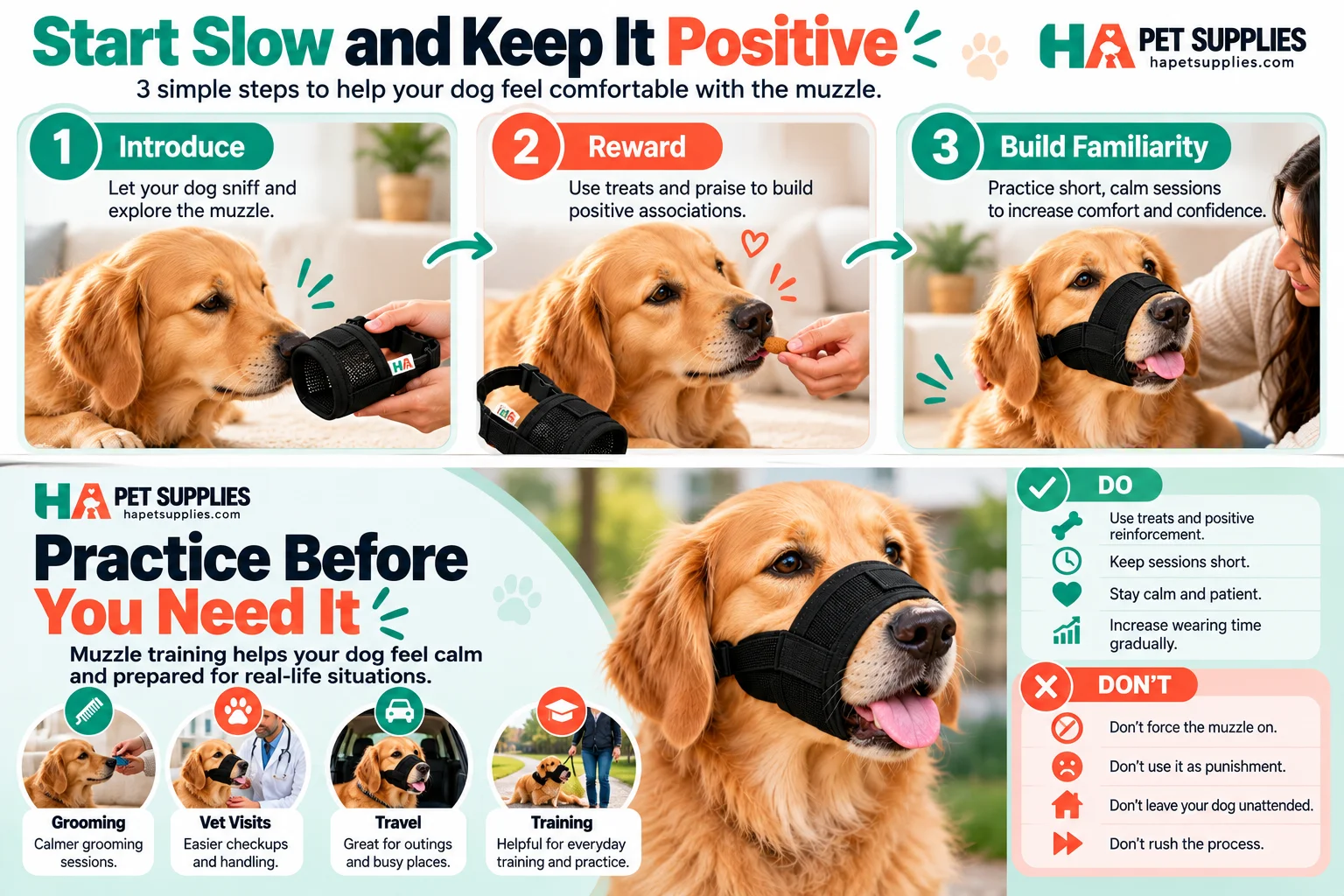
If you are short on time and confused about where to start, remember this: Do not begin by fastening the muzzle onto your dog. Begin by allowing your dog to investigate it. Reward calm interest. Encourage voluntary nose placement. Introduce the straps separately. Fasten the muzzle only after your dog is comfortable with the earlier stages. Then increase wearing time gradually.
Blue Cross recommends a similar progression: let the dog approach and place its own nose into the muzzle, reward the behaviour, gradually introduce fastening, and increase duration only as the dog remains comfortable. Blue Cross muzzle-training guidance.
That is the basic framework for how to muzzle train a dog positively. The detailed seven-step method below builds on that principle.
Why Learn How to Muzzle Train a Dog Before You Actually Need One?
Imagine two dogs entering the same veterinary clinic. The first dog has never seen a muzzle. The dog is already nervous. An unfamiliar person approaches, handling begins, and suddenly something unfamiliar is placed over the dog’s face. The second dog has spent several weeks seeing the muzzle at home. It has sniffed it. Placed its nose inside voluntarily. Received treats while interacting with it. Heard the buckle. Worn it briefly. Walked around the house in it.
Those dogs may still experience the veterinary environment differently, but the second dog is not also encountering completely unfamiliar equipment.
That is why how to muzzle train a dog before a stressful event matters. The American Kennel Club recommends introducing muzzle wearing under low-stress conditions rather than waiting until an injury, frightening experience, or other urgent situation makes it necessary. It also describes muzzles as temporary safety-management tools rather than solutions to underlying behavioural problems. AKC guide to when and how dog muzzles are used.
Muzzle training can be relevant to dogs that have never bitten. Pain can change behaviour. Fear can change behaviour. An unfamiliar handling procedure can change behaviour. A dog does not need to be labelled “aggressive” for muzzle familiarity to be useful.
Before Learning How to Muzzle Train a Dog, Understand Muzzle Type
One important point often gets missed in beginner guides: Not every muzzle has the same safety profile. Basket muzzles generally provide substantially more space around the mouth. When properly fitted, many allow the dog to pant, drink, and take treats. Close-fitting soft or sleeve-style muzzles may restrict how widely a dog can open its mouth.
Cornell distinguishes these designs and generally recommends basket muzzles when a dog needs space to pant, drink, or receive rewards through the muzzle. Cornell guide to choosing a muzzle.
PDSA similarly recommends choosing a design appropriate for the dog’s needs and stresses gradual, positive introduction. PDSA guide to muzzle training.
That distinction is important when considering the HA Pet Supplies product shown in this article, because it is a soft mesh-style muzzle. Mesh may improve airflow through the material, but that does not mean every dog can pant as freely as it could in a roomy basket design. Use a close-fitting muzzle for an appropriate duration, supervise the dog, and pay attention to temperature, activity level, mouth movement, and your individual dog’s comfort.
If you are still deciding whether the product suits your needs, review the specifications on the HA Pet Supplies dog muzzle product page before training begins.
🐾 The 7-Step Muzzle Training Journey
Step 1: How to Muzzle Train a Dog by Introducing the Muzzle Without Wearing It
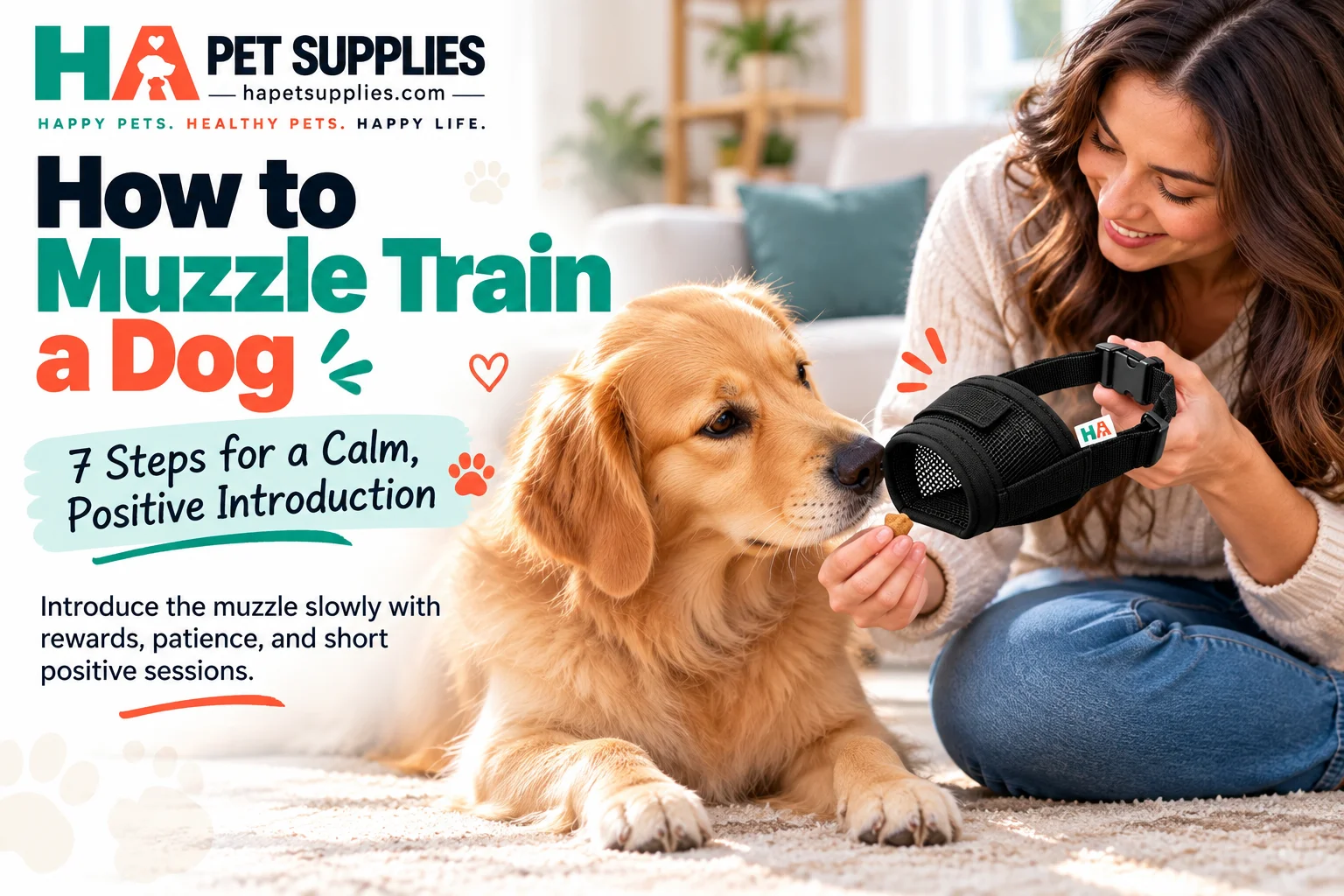
Start somewhere your dog already feels comfortable. A quiet room at home is usually easier than a busy park, veterinary clinic, grooming salon, or crowded environment. Hold the muzzle or place it somewhere visible while supervising your dog. Then do very little. Let the dog look at it. If the dog approaches, reward. If the dog sniffs it, reward. If your dog seems uncertain, increase distance rather than moving the muzzle toward its face.
The purpose of this first step is not wearing. The purpose is neutrality and curiosity. The muzzle appears. Nothing unpleasant happens. Your dog is free to investigate it.
Cornell’s training protocol recommends allowing the dog to approach the muzzle at its own pace rather than pushing the muzzle toward the dog’s face. Cornell Vet School. Blue Cross gives comparable advice and specifically encourages allowing the dog to move toward the muzzle voluntarily. Blue Cross.
That voluntary movement is important. You are not trying to win a contest against your dog. You are trying to make the equipment predictable. Keep the first session short. Thirty seconds of calm curiosity can be more productive than ten minutes of resistance.
Step 2: How to Muzzle Train a Dog With Positive Associations
Once your dog can be around the muzzle without backing away, start pairing the muzzle with things your dog enjoys. For many dogs, food is easiest. Use a high-value treat that your dog can eat comfortably and safely. The muzzle appears. Treat. The dog investigates. Treat. The dog touches the muzzle. Treat.
This is the point where owners sometimes make the process unnecessarily difficult by withholding rewards until the dog performs the entire behaviour. That is too much too soon. Reward the small pieces that eventually build the final behaviour.
The American Veterinary Society of Animal Behavior recommends reward-based methods for dog training and behaviour modification and advises against training methods that rely on fear, pain, or physical or psychological discomfort. AVSAB humane dog-training recommendations. AVSAB also explains that reward-based training means using outcomes dogs value—such as food, play, or affection—to increase desired behaviours rather than relying on punishment. AVSAB explanation of reward-based training.
This principle is especially useful when learning how to muzzle train a dog that is already unsure of the equipment. If your dog backs away, do not punish the retreat. Ask whether you made the exercise too difficult. Then make it easier.
Step 3: Encourage Your Dog to Put Its Nose Into the Muzzle Voluntarily
Now you can move toward one of the most important behaviours in muzzle training: voluntary nose placement. Hold the muzzle steady. Position a treat so your dog needs to place its nose partially into the muzzle to reach it. Let the dog withdraw immediately. Repeat. As confidence grows, position the reward slightly farther inside. Eventually, you want the dog to recognise the muzzle opening and willingly move its nose into position before being rewarded.
Cornell recommends progressing from placing food inside the muzzle to presenting the muzzle without food already inside, rewarding after the dog voluntarily inserts its nose. Cornell Vet School. Fear Free Happy Homes also recommends building duration while the muzzle remains unfastened, rewarding the dog while its nose remains voluntarily inside. Fear Free guide to introducing a muzzle.
Do not rush to the buckle. A dog willingly putting its nose into the muzzle is a much stronger foundation than a dog learning that the muzzle will be pushed onto its face regardless of what it does.

Step 4: How to Muzzle Train a Dog to Accept the Straps
A dog can be completely comfortable putting its nose inside the muzzle and still dislike the sensation of straps moving behind the head. Treat this as a separate skill. Begin with the dog’s nose voluntarily inside. Lift the straps slightly. Reward. Lower them. Repeat. Next, touch the straps gently behind the ears. Reward. Remove. Do not fasten yet if your dog becomes worried.
PDSA recommends holding the straps behind the dog’s ears for short periods before progressing to fastening. PDSA. You can also practise the buckle sound away from your dog’s head. Close the buckle. Treat. Open it. Repeat. This can make the clicking sound less surprising later.
When learning how to muzzle train a dog, breaking the final behaviour into small pieces usually creates less confusion than repeatedly trying to put the entire muzzle on.
Step 5: Fasten the Muzzle Briefly
Only progress when your dog is comfortable with the earlier steps. Let the dog voluntarily place its nose inside. Bring the straps into position. Fasten the buckle. Reward. Then remove the muzzle. The first successful fastening session may last only a few seconds. That is enough.
Do not measure progress by how long you can keep the muzzle on. Measure progress by how comfortably your dog participates. The dog should not need to be physically held in place simply so you can say that it wore the muzzle for thirty seconds.
Blue Cross recommends initially fastening the muzzle only briefly, rewarding, removing it, and gradually building duration as the dog becomes comfortable. Blue Cross. The RSPCA’s dog-welfare guidance similarly recommends gradually introducing muzzle straps and fastening them only after the dog is comfortable with the earlier stages. RSPCA guidance on gradual muzzle introduction.
Step 6: Increase Wearing Time Gradually
Once fastening is uneventful, begin increasing duration. Do this gradually. A practical progression might move from a few seconds to slightly longer periods while the dog remains calm. During these sessions, give the dog something constructive to do. Walk several steps. Practise a familiar cue. Move around the room. Offer appropriate rewards when the muzzle design permits.
Blue Cross suggests adding movement once the dog is comfortable wearing the fastened muzzle and gradually practising in different environments. Blue Cross. Keep sessions manageable. If your dog is happily engaged for a short period, finishing there may be smarter than extending the exercise until the dog becomes frustrated.
This is particularly important when training with a close-fitting soft muzzle. Do not treat a soft muzzle and a roomy basket muzzle as if they permit identical wearing duration, panting, drinking, or activity. A dog that needs to wear a muzzle for extended periods or during physical activity may require a different design. If you are unsure, you can contact HA Pet Supplies for product suitability questions.
Step 7: Practise Before Vet Visits, Grooming and Other Real Situations
The final step is transferring muzzle comfort into real-life contexts. But do not jump directly from your living room to the most stressful appointment your dog experiences all year. Build gradually.
If the muzzle may be used during grooming, practise wearing it while nothing happens. Then gently brush one easy area. Reward. On another session, handle a paw. Reward. Gradually increase the resemblance to real grooming.
If your dog may wear the muzzle at a veterinary appointment, practise calm handling at home. Touch an ear. Reward. Briefly handle a paw. Reward. Look at the collar area. Reward.
The American Animal Hospital Association advocates low-stress handling and recommends teaching dogs to accept muzzles in advance instead of depending on forceful physical restraint. AAHA guidance on humane animal restraint. AAHA’s behaviour-management guidance also notes that dogs should be taught to voluntarily place their faces into basket muzzles using reward-based training. AAHA guidance for anxious or reactive veterinary patients.
The objective is not simply to make the dog wear the muzzle. It is to help the dog experience muzzle + handling without immediately escalating stress.
This helps people who searched how to muzzle train a dog quickly understand that speed is not the correct measure of success.
How Do You Know If Muzzle Training Is Moving Too Fast?
Watch your dog rather than watching the clock. A training plan might look easy on paper but still be too difficult for the individual animal. Possible signs that you should reduce difficulty include repeated avoidance, persistent pawing, sudden reluctance to take food, freezing, frantic attempts to remove the muzzle, or escalating stress.
A single behaviour does not always tell the whole story. Look at the pattern. Ask what changed immediately before the problem appeared. Did you fasten the buckle for the first time? Did you dramatically increase duration? Did you introduce grooming? Did you move outside? Did you increase distractions? Did you alter the fit?
Then return to the last stage where your dog was comfortable. This is one reason fit should be checked separately from training. A dog cannot be positively conditioned into being comfortable with equipment that rubs, pinches, restricts the wrong areas, or repeatedly moves out of position. For a full sizing guide, see how a dog muzzle should fit.
Common Mistakes When Learning How to Muzzle Train a Dog
One of the biggest mistakes is forcing the muzzle onto the dog during the first session. The second is progressing too quickly because the owner is working toward an appointment date. The third is using the muzzle only before unpleasant events.
Imagine that every time the muzzle appears, your dog gets a vaccination, nail trim, or stressful examination. The muzzle itself may eventually become a predictor of those experiences. Mix easy, uneventful training sessions into your routine.
Another major mistake is treating the muzzle as punishment. AKC specifically warns that muzzles should not be used to “teach a lesson” or as a substitute for behaviour modification. American Kennel Club.
Another is using a muzzle to force a dog into situations it cannot cope with. A muzzle can reduce bite risk, but it does not make a frightened dog emotionally comfortable. It also does not cure reactivity. It does not cure anxiety. It does not cure resource guarding. It does not cure fear of veterinary handling. Those problems may require training, environmental management, veterinary evaluation, or individual behaviour support.
What If You Need a Muzzle Tomorrow?
This is an important question because many people search how to muzzle train a dog only after an appointment has already been scheduled. If your dog has never worn a muzzle and needs one tomorrow, you probably do not have enough time to create the same level of positive conditioning that gradual practice can provide.
Do not try to compress a long training process into a stressful evening. Instead, contact the professional involved. If it is a veterinary clinic, explain that your dog is not yet muzzle trained. Ask how they would like to handle the visit. Some dogs may benefit from a modified appointment plan or veterinary-prescribed anti-anxiety medication, but medication decisions must come from a veterinarian.
AAHA encourages veterinary practices to use low-stress handling approaches and considers medication appropriate in some fearful or highly stressed patients when prescribed by the veterinary team. AAHA. After the urgent situation is resolved, begin structured muzzle training before the next appointment. You can find a step-by-step plan in our full muzzle training guide.
How Long Does It Take to Muzzle Train a Dog?
There is no universal answer. One dog may make rapid progress. Another may need many short sessions. A dog with no previous negative experiences may progress differently from a dog whose only experience with a muzzle involved frightening restraint.
PDSA recommends multiple short training sessions and progressing at the dog’s pace. PDSA. Fear Free similarly recommends keeping sessions short and stopping while the dog is still engaged rather than waiting until discomfort appears. Fear Free Happy Homes.
This means that asking “How many days does muzzle training take?” is less useful than asking: “Is my dog comfortable at the current stage?” If yes, gradually progress. If not, make the exercise easier.
How to Muzzle Train a Dog for Veterinary Visits and Grooming
Veterinary handling deserves special attention because dogs may behave very differently when they are ill or in pain. A dog that tolerates ear handling at home may react differently when an infected ear hurts. A dog that normally loves people may react defensively when injured. That is one reason preventive muzzle training can be useful even for friendly dogs.
Blue Cross specifically notes that muzzle familiarity can help prepare dogs for situations where fear or pain changes behaviour. Blue Cross and their puppy socialisation advice.
Practise the muzzle separately from the veterinary visit first. Then introduce mild handling. Do not perform painful or medical procedures as “training.” The objective is simply to make common forms of handling more familiar. If your dog has extreme veterinary fear, discuss it with your veterinarian before the appointment. For more on this topic, read when a dog should wear a muzzle for vet visits, grooming, training and safety.
Grooming can involve sustained body handling, unfamiliar equipment, paws being lifted, nails being trimmed, and sensitive areas being touched. A muzzle can sometimes provide temporary additional safety while appropriate conditioning continues. But the muzzle should not become permission to physically force a highly distressed dog through an entire grooming session.
Break grooming into smaller skills too. Brush for one second. Reward. Touch the paw. Reward. Hold the paw. Reward. Bring nail clippers into view without clipping. Reward. The principle is similar to muzzle training itself: divide the final experience into manageable pieces. If your dog repeatedly tries to bite during grooming, seek qualified support rather than relying indefinitely on the muzzle alone.
Does Muzzle Training Mean My Dog Is Aggressive?
No. A muzzle is equipment. It is not a personality diagnosis. Dogs may wear muzzles because of a known bite risk, but they may also be trained to wear one because of veterinary procedures, grooming, pain-related handling, scavenging, or preparation for emergencies.
Cornell notes that all dogs can potentially experience fear, anxiety, stress, or pain during handling and that even friendly dogs may bite under those circumstances. Cornell Vet School. Responsible use should therefore be viewed as risk management, not stigma.
If you are buying other items as part of your dog’s handling or care setup, browse the HA Pet Supplies shop rather than treating the muzzle as a stand-alone solution to every behavioural problem.
What Type of Reward Should You Use?
Food is practical because it can be delivered quickly and repeatedly. Choose something your dog likes enough to work for. Keep pieces small. You do not need to give a large biscuit after every repetition. High-value rewards are often useful during the first stages. If your dog cannot safely receive food through the muzzle you are using, reinforce the dog before and after very brief wearing sessions instead.
Remember that the ability to feed treats through a muzzle depends heavily on design. This is another area where basket and close-fitting soft muzzles differ. Reward-based training does not require food exclusively. Toys, praise, play, or access to an enjoyable activity may also function as reinforcement for individual dogs.
What If My Dog Tries to Remove the Muzzle?
Some pawing can occur simply because the sensation is new. But persistent or frantic removal attempts deserve attention. First check the fit. Is the muzzle rubbing near the eyes? Has a strap twisted? Is it too tight? Is it moving excessively? Is your dog unable to perform normal mouth movements expected for that muzzle design?
Then evaluate your training pace. You may have moved from nose placement to fastening too quickly. Blue Cross recommends returning to an easier stage when the dog is struggling rather than forcing progression. Blue Cross. Do not interpret every attempt to remove the muzzle as stubbornness. Your dog may be telling you something useful. For a detailed sizing guide, see how a dog muzzle should fit: measuring, sizing and comfort guide.
When Should You Get Professional Help?
General articles can explain how to muzzle train a dog, but they cannot assess an individual bite risk. Seek professional help when your dog has already bitten someone, repeatedly attempts to bite during handling, shows severe fear or distress, guards food or objects intensely, or cannot safely participate in the early training stages.
A veterinary behaviourist can be particularly appropriate where behaviour may involve significant anxiety, fear, aggression, or medical factors. When choosing a trainer, look carefully at methods. AVSAB recommends reward-based training and advises avoiding methods that depend on fear, pain, intimidation, or force. AVSAB guidance on choosing a dog trainer.
If your question is specifically about the HA Pet Supplies muzzle, ordering, availability, or product information, contact HA Pet Supplies directly. Retailers, distributors, groomers, pet businesses, and larger-volume buyers can also request a quote from HA Pet Supplies rather than using the consumer purchase process.
Frequently Asked Questions About How to Muzzle Train a Dog
Muzzle training itself is not inherently cruel. The important factors are muzzle design, fit, duration, supervision, training method, and the reason the muzzle is being used. Reward-based conditioning can help a dog become comfortable with appropriate equipment. Forcing an unsuitable muzzle onto a terrified dog, using it as punishment, or using a restrictive design for inappropriate durations is a different matter.
Start smaller than you think. Let the dog see the muzzle. Reward curiosity. Teach voluntary nose placement. Introduce straps. Fasten briefly. Increase duration gradually. Then practise in different low-stress situations. Trying to skip directly to wearing often creates more work later.
That is not the approach recommended by the veterinary and animal-behaviour sources discussed throughout this guide. Gradual reward-based conditioning gives your dog a clearer opportunity to learn that the equipment is predictable and safe. Cornell Vet School.
Short, successful sessions are usually more useful than long sessions that end in frustration. Cornell suggests short practice sessions, and PDSA similarly recommends gradual training across multiple sessions. Your dog’s response should guide frequency and progression.
Preventive conditioning can be useful. Cornell describes puppyhood as an ideal time because young dogs may not yet have developed negative associations with the equipment. Blue Cross also includes muzzle familiarity among useful puppy-handling preparation.
It depends on the design. Properly fitted basket muzzles generally provide much more room for drinking and panting. Close-fitting soft muzzles may restrict those behaviours. Never assume every muzzle allows the same level of mouth movement.
Again, this depends on muzzle type and fit. Full panting requires enough space for the dog to open its mouth significantly. Basket designs generally provide more pant room than close-fitting soft designs. This is particularly important in warm weather or during physical activity. Blue Cross.
A muzzled dog should be supervised. Equipment can shift, catch on objects, become damaged, or create problems the owner needs to notice quickly. Muzzle use should be active management, not a substitute for supervision.
A close-fitting muzzle may physically restrict some mouth movement, but using a muzzle as the answer to chronic barking does not address why the barking is occurring. AKC specifically cautions against using muzzles as solutions for ongoing behaviours such as barking or chewing. American Kennel Club. Investigate the underlying reason instead.
No. A muzzle may reduce risk while an underlying behavioural problem is being addressed, but it does not resolve fear, anxiety, reactivity, or aggression by itself. Treat it as a management tool, not treatment.
A muzzle may sometimes be part of a temporary safety plan if there is bite risk, but it should not replace gradual conditioning to paw handling and nail-care equipment. If nail trimming consistently causes extreme distress or aggression, discuss the problem with your veterinarian or an appropriate behaviour professional.
It should remain secure without causing unnecessary pressure, rubbing, or poor positioning. Correct fit depends on muzzle design. Measure your individual dog rather than selecting by breed alone. If fit is uncertain, check manufacturer measurements or get knowledgeable professional guidance. For a complete guide, see our muzzle sizing and comfort guide.
How to Muzzle Train a Dog Successfully: Final Takeaway
Learning how to muzzle train a dog is less about putting equipment onto your dog and more about teaching your dog what that equipment means.
Start before a crisis whenever possible. Introduce the muzzle calmly. Reward curiosity. Teach voluntary nose placement. Separate strap training from nose placement. Fasten only after your dog is comfortable. Increase wearing time gradually. Then transfer the skill into carefully controlled real-life situations.
Most importantly, remember what a muzzle can and cannot do. A muzzle can reduce bite risk in appropriate situations. It can add a layer of safety during certain veterinary, grooming, training, or emergency scenarios. It can help professionals use less force when a dog has already been appropriately conditioned to wearing it.
But it cannot resolve the underlying cause of fear. It cannot replace behavioural training. It cannot make an unsuitable environment comfortable. And it should never become punishment.
If you are now ready to compare the product shown throughout this guide, visit the HA Pet Supplies dog muzzle page and check its intended use, sizing, and features before ordering. You can continue researching related products through the HA Pet Supplies dog supplies collection, or browse the complete HA Pet Supplies shop.
For more practical dog and pet-care education, explore the HA Pet Supplies blog. If you need help with an order, product question, or suitability information, use the HA Pet Supplies contact page. You can also return to the HA Pet Supplies homepage whenever you want to explore the wider product range and educational resources.
The goal is not to get a muzzle onto your dog as quickly as possible. The goal is to reach a point where the equipment is familiar, appropriately fitted, responsibly used, and introduced without unnecessary conflict. That is the foundation of successful, positive muzzle training.