
Learning how to train a dog to use a wheelchair can feel challenging when your beloved companion has recently lost strength in its back legs or is struggling to walk independently. You may have purchased a wheelchair hoping your dog would immediately start moving again. Instead, your dog might stand still, look confused, refuse to take a step, or become nervous when the wheels move.
If this sounds familiar, you are not alone. For dogs with mobility limitations, a wheelchair introduces a completely new way of moving. The frame touches unfamiliar parts of the body, the wheels create new sounds, and turning requires different body movements.
Some dogs become comfortable with the equipment quickly. Others require several short sessions before they are willing to move. The important thing is to introduce the wheelchair gradually, reward voluntary movement, and pay close attention to your dog’s physical comfort.
A correctly fitted wheelchair can help certain dogs with weak or disabled hind legs participate in supervised daily activities, but training cannot compensate for poor fit, uncontrolled pain, or an unsuitable device.
In this comprehensive guide, you will learn seven practical steps for introducing a dog wheelchair, how to encourage comfortable walking, what to do when your dog refuses to move, and how to maintain the wheelchair safely. You will also discover common training mistakes, daily care routines, and signs that indicate your dog needs a professional fitting reassessment.
The goal is not to force your dog to walk immediately. It is to help your companion become familiar with appropriate mobility support while maintaining safety, comfort, and confidence.
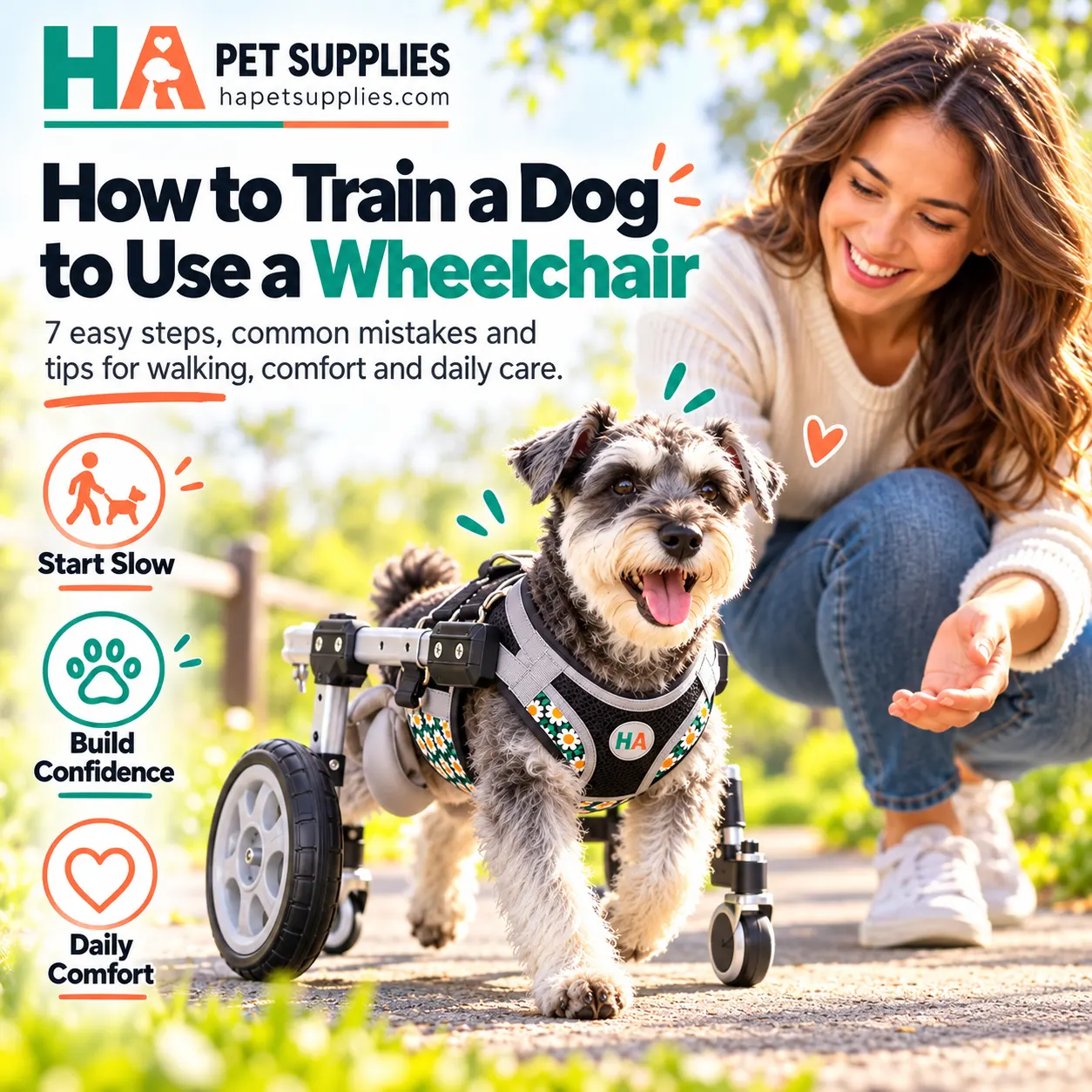
Quick Answer: How Do You Train a Dog to Use a Wheelchair?
The safest way to introduce a dog wheelchair is through short, positive, supervised training sessions after confirming that the wheelchair is medically appropriate and correctly fitted. Start by letting your dog investigate the equipment. Introduce the harness separately if its design permits. Once the dog is comfortable and the cart is properly adjusted, encourage a few voluntary steps on level, non-slip ground. Reward relaxed behavior and avoid forcing the dog forward.
Gradually build familiarity with straight-line walking, gentle turns, and appropriate everyday activities as your dog’s comfort and endurance allow. The Walkin’ Pets guide to introducing a dog wheelchair recommends allowing dogs time to investigate the cart and using encouragement and rewards during their first walking experiences. However, individual dogs vary significantly. Training should always follow veterinary recommendations, especially for dogs recovering from surgery or living with neurological disease.
If your dog suddenly loses the ability to walk, develops severe spinal pain, or experiences rapidly worsening weakness, seek urgent veterinary care before beginning wheelchair training.
Table of Contents
- 1. What to know before wheelchair training
- 2. Why dogs may initially resist wheelchairs
- 3. Seven easy wheelchair training steps
- 4. A gradual first-week training plan
- 5. What to do if your dog refuses to walk
- 6. Common wheelchair training mistakes
- 7. Comfort and fitting checks
- 8. Walking safely on different surfaces
- 9. Daily wheelchair care and hygiene
- 10. Special guidance for paralysis, arthritis, and senior dogs
- 11. Signs your dog is adapting comfortably
- 12. When to stop wheelchair training
- 13. Interactive training checklist
- 14. Frequently asked questions
- 15. Final advice and product guidance
1. Before You Begin: Make Sure Your Dog Is Ready for Wheelchair Training
Before learning how to train a dog to use a wheelchair, confirm that the equipment matches your dog’s physical needs. A wheelchair is not automatically suitable for every dog experiencing hind-leg weakness. Some dogs require a rear-support cart because their back legs cannot provide adequate support, while their front legs still function well. Other dogs need more extensive mobility assistance because weakness affects all four limbs.
A veterinarian or canine rehabilitation professional should help determine which type of support is appropriate.
Confirm the cause of your dog’s mobility problem
Hind-leg weakness can result from conditions such as degenerative myelopathy, intervertebral disc disease, arthritis, traumatic injury, or other neurological and orthopedic disorders. These conditions have different treatment and activity requirements. A dog recovering from spinal surgery may have strict movement restrictions, while a dog with an established chronic mobility condition may be allowed carefully controlled walking.
The Cornell University College of Veterinary Medicine’s degenerative myelopathy guidance discusses supportive measures including harnesses, non-slip surfaces, paw protection, and wheelchairs for affected dogs. For owners uncertain whether their pet requires mobility assistance, our article on nine signs a dog may need a wheelchair explains common symptoms and when to seek veterinary evaluation.
Check the wheelchair before fitting
Before your dog’s first session, inspect the equipment carefully. Check the wheels, frame connections, fasteners, adjustment points, and harness. Make sure the product is assembled according to its actual manufacturer’s instructions. Never use damaged components or modify structural parts without approval.
Confirm the correct size
An incorrectly sized wheelchair can interfere with movement and create pressure against the dog’s body. Check the selected model’s height, width, length, and weight capacity. The dog’s measurements must fall within the manufacturer’s verified fitting ranges. If you have not completed this process, use our dog wheelchair sizing and measurement guide before continuing.
Prepare a safe training area
Choose a quiet location with firm, non-slip flooring. Remove loose objects and avoid narrow spaces where the wheelchair may become trapped. Keep stairs blocked off, and make sure there is enough room for the dog to move forward without colliding with furniture. If possible, arrange for another adult to assist with handling while your dog becomes familiar with the wheelchair.
2. Why Your Dog Might Be Afraid of a Wheelchair
When a dog refuses to move in a wheelchair, owners sometimes assume that the animal is being stubborn. In reality, hesitation may have several causes. The dog may be unfamiliar with the equipment, uncomfortable with the harness, frightened by the wheels, or unsure how to balance and move forward. Some dogs may also experience pain, fatigue, or an incorrect fit. Training should therefore begin with observation rather than repeated attempts to make the dog walk.
The wheelchair is a new physical experience
Dogs are accustomed to movement without a frame surrounding their bodies. A wheelchair changes the way the hindquarters are supported and may require the animal to adjust its movements. The cart can also create unfamiliar sounds as the wheels rotate or contact the ground. These changes may initially make a cautious dog stop and investigate.
Previous mobility difficulties may affect confidence
A dog that has fallen repeatedly or experienced pain during walking may be reluctant to try moving again. Its hesitation can be a protective response rather than a training problem. Before encouraging more movement, confirm that pain is being appropriately managed. The AAHA guide to recognizing chronic pain in dogs emphasizes the importance of observing changes in behavior and normal activity when evaluating discomfort.
Positive reinforcement is more appropriate than force
Reward-based methods help dogs associate unfamiliar experiences with pleasant outcomes. For wheelchair training, rewards may include small treats, verbal praise, a favorite toy, or gentle encouragement. The American Veterinary Society of Animal Behavior’s humane training guidance recommends reward-based methods rather than techniques involving fear, punishment, or discomfort. This principle is particularly important for dogs already experiencing physical limitations. Wheelchair training should feel manageable, predictable, and supportive.
3. How to Train a Dog to Use a Wheelchair: 7 Easy Steps
The following training sequence is designed for a dog that has already been assessed for wheelchair suitability and whose cart has been correctly fitted. These are flexible training stages, not a fixed seven-day schedule. Some dogs may move through several stages during one session, while others may need days or longer to become comfortable.
Introduce the cart
Build familiarity
Introduce harness
Reward calm behavior
Check positioning
Confirm comfort
First steps
Reward movement
Gentle turns
Improve coordination
Short walks
Build endurance
Daily routine
Maintain safety
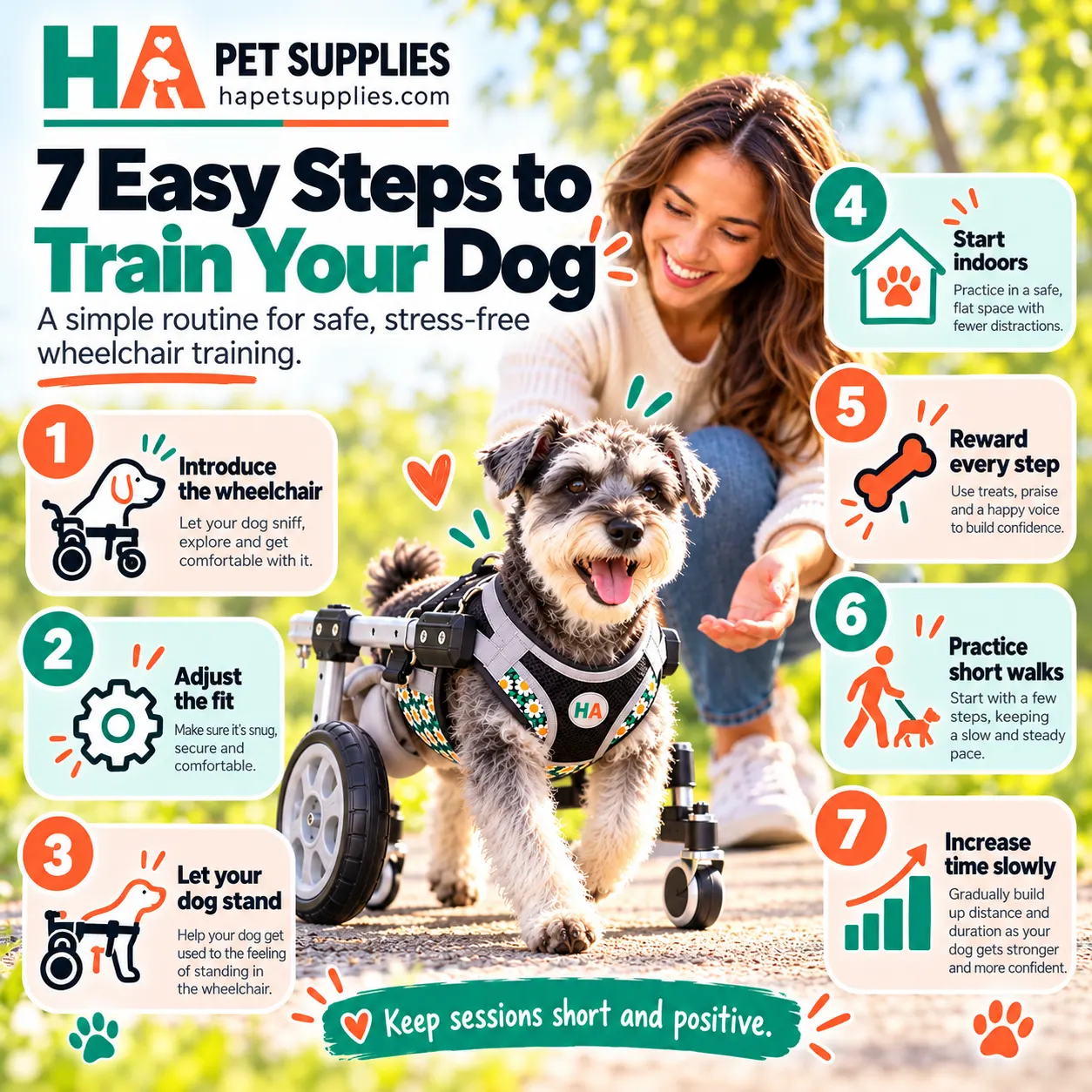
Step 1: Let Your Dog Investigate the Wheelchair
The first step is to help your dog become familiar with the wheelchair before expecting it to wear or move with the equipment. Place the assembled mobility cart in a comfortable, familiar room. Allow the dog to approach and investigate it voluntarily. Do not immediately try to lift your dog into the wheelchair. If your dog sniffs the frame or calmly walks near it, offer a reward. A dog that remains relaxed while the wheelchair is nearby is already making useful progress.
For dogs that appear nervous, move the cart farther away and allow them to observe it without pressure. You can gradually bring the wheelchair closer over later sessions. What you should look for: Relaxed body posture, voluntary investigation, normal breathing, and willingness to accept rewards. Common mistake: Moving the wheels toward the dog repeatedly when it is trying to move away. When to progress: When your dog can remain comfortable near the stationary wheelchair.
Some dogs may need only a brief familiarization period, while others may benefit from repeated sessions. The Walkin’ Pets wheelchair familiarization recommendations also emphasize allowing dogs to approach equipment voluntarily and rewarding calm interaction.
Step 2: Introduce the Wheelchair Harness Gradually
After your dog becomes comfortable around the cart, begin introducing the harness or body-supporting components. Some wheelchair designs have removable harness sections, while others use a different fitting arrangement. Follow the actual manufacturer’s instructions. If the harness can be introduced separately, allow the dog to smell it before gently positioning it. Offer a reward when your dog accepts brief contact. Avoid pulling straps quickly across sensitive parts of the body.
For a dog with arthritis or spinal discomfort, handling may itself be uncomfortable. Ask your veterinarian how to safely support the dog’s body during fitting. Once the harness is positioned, check that it does not restrict breathing or create concentrated pressure. A harness should be secure without compressing the chest, abdomen, or groin. What you should look for: Calm acceptance, normal breathing, freedom of front-leg movement, and no visible distress. Common mistake: Fastening the harness tightly because the dog appears unstable. Excessively tight straps can make movement more difficult rather than easier. When to progress: When the dog comfortably tolerates the required body support and its fit has been checked.
Step 3: Position Your Dog Correctly in the Wheelchair
Once the dog accepts the harness, carefully position it in the wheelchair according to the manufacturer’s instructions. Make sure another person helps if your dog requires substantial lifting or support. Avoid holding the dog by its tail, pulling painful legs, or twisting the body. The goal is to support the hindquarters without forcing an abnormal posture. A rear wheelchair generally depends on the front legs for propulsion. Therefore, the dog must be able to stand and move in a way that is consistent with its medical condition.
Check the frame from the side and behind. Look for excessive leaning, twisting, sagging, or pressure. Make sure the dog’s front legs can move freely and the wheels do not rub against its body. Dogs with paralyzed hind legs may require compatible support to prevent paw dragging. The Walkin’ Pets guide to getting a dog into a wheelchair illustrates the fitting sequence for that manufacturer’s rear-wheelchair design. Because wheelchair models differ, its specific harness and alignment instructions must not be assumed to apply to HA Pet Supplies products. What you should look for: A stable, appropriate body position and an absence of painful pressure. Common mistake: Assuming the wheelchair is fitted correctly because the dog can remain standing. Standing alone does not confirm safe alignment. When to progress: When the dog is comfortable, the frame is properly fitted, and all support connections are secure.
Step 4: Encourage Your Dog to Take Its First Steps
The first voluntary step is an important milestone. Choose a quiet, non-slip area with plenty of space. Stand in front of your dog and use a familiar verbal cue or small reward to encourage forward movement. Allow the dog to move at its own pace. Do not pull the cart forward or drag the dog by its leash. Some dogs may take several steps immediately. Others may stand still and need more familiarization. Both responses can be normal during the introduction process, provided the dog is not experiencing pain or distress.
Reward even small attempts at comfortable movement. The objective is to help the dog learn that forward movement in the wheelchair is possible and safe. Keep the first attempt brief. A dog recovering from reduced activity may fatigue quickly, even if it appears enthusiastic. What you should look for: Voluntary forward movement, appropriate front-leg positioning, and a relaxed response. Common mistake: Trying to complete a long walk during the first successful session. When to progress: When the dog can take several comfortable steps without showing pain, distress, or excessive fatigue.
Step 5: Practice Gentle Turns and Coordination
Once your dog is comfortable walking forward, begin introducing gradual changes of direction. Turning in a wheelchair may feel different because the wheels change the amount of space the dog needs. Begin with wide turns in an open area. Encourage your dog to follow a reward or move toward a familiar person. Avoid sharp turns, sudden pulling, or crowded environments. Some dogs initially turn their front body while the wheels remain stationary. Allow the dog time to learn the relationship between front-leg movement and the mobility cart.
If the wheelchair repeatedly catches on the dog’s body or tips during gentle movement, stop training and reassess the fit. What you should look for: Controlled movement, gradual turning, and stable wheel contact. Common mistake: Immediately attempting narrow doorways, furniture-filled rooms, or tight corners. When to progress: When your dog can move forward and complete gentle turns without losing control or showing discomfort.
Step 6: Gradually Introduce Short Outdoor Walks
After the dog becomes comfortable indoors, you may begin supervised outdoor movement when veterinary guidance permits it. Choose a level, firm surface. A quiet garden path or flat area with suitable traction is often easier than uneven grass, loose gravel, or steep terrain. Walk beside your dog and allow it to set the pace. Avoid crowded locations, unfamiliar dogs, or other distractions during early sessions.
Monitor breathing, posture, front-leg effort, and willingness to continue. Stop before your dog becomes excessively tired. There is no universal training duration for every dog. A safe starting session may be only a few steps or a very short period, depending on the animal’s condition. The Walkin’ Pets getting-started advice recommends gradual introduction and short early sessions, recognizing that dogs vary in their ability to adjust. What you should look for: Comfortable walking, appropriate stamina, and continued willingness to participate. Common mistake: Assuming a dog that moves enthusiastically has unlimited endurance. When to progress: When your dog comfortably manages brief outdoor activity and recovers normally afterward.
Step 7: Establish a Comfortable Daily Wheelchair Routine
The final stage is to incorporate wheelchair use into suitable daily activities without overusing the equipment. Some dogs may use a mobility cart during selected outdoor walks. Others may need support for particular activities or structured rehabilitation sessions. Build a predictable routine that includes fitting checks, supervised walking, rest periods, equipment cleaning, and skin inspection.
Before each session, verify that the wheelchair remains correctly adjusted. After removing the cart, inspect the skin underneath its contact points. Continue using rewards when they help maintain a relaxed experience. If your dog’s mobility changes, arrange reassessment rather than automatically increasing or decreasing activity. For some dogs, the wheelchair becomes a familiar part of daily life. For others, ongoing training or alternative support may be necessary. What you should look for: Consistent comfort, appropriate activity tolerance, and no developing pressure injuries. Common mistake: Leaving the wheelchair on continuously because the dog appears to enjoy moving. A walking wheelchair is not normally intended for sleeping or extended rest.
4. A Practical First-Week Dog Wheelchair Training Plan
A structured approach can help owners avoid attempting too much too quickly. However, this schedule is only an example of training goals, not a medical prescription or requirement to advance every day. A dog recovering from surgery, experiencing neurological disease, or displaying significant weakness may require a slower progression or a different plan.
| Training stage | Suggested activity | Goal |
|---|---|---|
| Day 1 | Introduce the stationary wheelchair | Comfortable investigation |
| Day 2 | Introduce harness contact | Calm acceptance |
| Day 3 | Practice positioning with assistance | Comfortable fitting |
| Day 4 | Encourage a few voluntary steps | Safe forward movement |
| Day 5 | Practice brief straight walking and gentle turns | Coordination |
| Day 6 | Introduce suitable outdoor movement if approved | Familiarity with a new surface |
| Day 7 | Review comfort, routine, and progress | Consistency and reassessment |
There is no requirement to complete these activities within seven days. Remain at an earlier stage whenever your dog needs additional time.
How to decide whether to advance
Before moving to the next training stage, ask three questions. Is the dog physically comfortable? Is the dog willingly participating? Does the wheelchair remain correctly positioned during the activity? If the answer to any question is no, stop and reassess. Training progress is best judged by comfort and voluntary participation, not the number of steps completed.
5. What if Your Dog Refuses to Walk in the Wheelchair?
A dog that refuses to move may need additional familiarization, but hesitation should never automatically be attributed to fear or stubbornness. Start by checking whether the equipment fits correctly. Look for harness rubbing, excessive pressure, wheel obstruction, or an awkward body position. Observe whether the dog appears painful when handled. A dog that has difficulty breathing, cries out, trembles, collapses, or becomes distressed should be removed from the equipment safely and assessed. The AAHA pain management guidelines explain why pain recognition, treatment, and reassessment are central to animal wellbeing.
If your dog freezes
Return to an easier stage of familiarization. Allow the dog to stand comfortably without asking for movement, provided the fit is safe. Offer a reward for relaxed behavior. Then try encouraging a single voluntary step. If the dog remains unwilling, end the session rather than forcing movement.
If your dog walks backward
Some dogs initially shift their weight or take backward steps when learning to maneuver a cart. Check that the equipment is not restricting forward movement. Encourage calm forward movement with a reward positioned ahead of the dog. Do not pull the leash to force a specific direction. Repeated backward movement or apparent loss of control should prompt reassessment of the fit and the training environment.
If your dog becomes anxious
Reduce the difficulty of the exercise. Move to a familiar, quiet setting and shorten the session. Reward calm behavior without pressuring the dog to continue. The AVSAB explanation of reward-based training discusses why humane reinforcement-based approaches are preferable to methods that create fear or distress.
If your dog repeatedly falls
Stop training immediately. A wheelchair should not create repeated tipping or falling. Check for incorrect sizing, inadequate front-leg strength, unstable ground, or a mobility condition requiring different support. Seek veterinary or professional fitting assistance before attempting further movement.
6. Eight Common Dog Wheelchair Training Mistakes to Avoid
Understanding how to train a dog to use a wheelchair also means recognizing mistakes that can slow progress or compromise safety.
Mistake 1: Starting without veterinary approval
One of the most serious mistakes is introducing a wheelchair before the dog’s mobility problem has been medically assessed. Sudden paralysis, severe back pain, or rapidly worsening weakness may signal an urgent neurological condition. The American College of Veterinary Surgeons’ information on intervertebral disc disease explains how spinal disc disease can affect limb function and why treatment depends on the severity of neurological signs. Owners should not replace a necessary medical examination with wheelchair training.
Mistake 2: Using an incorrectly fitted wheelchair
A wheelchair that is too high, too narrow, or incorrectly positioned may create discomfort and interfere with walking. Before each session, confirm that the support components are properly adjusted and the dog can move its front legs freely.
Mistake 3: Forcing the dog to move
Pulling a reluctant dog forward can increase anxiety or aggravate physical discomfort. Instead, use small rewards and allow voluntary movement. If the dog consistently refuses, investigate the reason rather than increasing pressure.
Mistake 4: Training for too long
A dog that has experienced reduced mobility may have limited endurance. Even a dog that appears eager may become tired after a short session. Increase activity gradually according to veterinary advice.
Mistake 5: Ignoring rubbing and pressure
Harnesses and support components can create pressure around sensitive body areas. Dogs with reduced sensation are especially vulnerable because they may not show a normal pain response. Inspect the skin after each session.
Mistake 6: Using unsuitable walking surfaces
Loose gravel, slippery floors, steep hills, and rough terrain increase the difficulty of controlling a wheelchair. Begin with stable, level ground and introduce other surfaces only when appropriate.
Mistake 7: Leaving a dog unattended
A wheelchair can become caught on furniture or obstacles. A dog may also become tired and be unable to lie down comfortably. The Walkin’ Pets wheelchair safety recommendations emphasize supervision and appropriate environmental management during wheelchair use.
Mistake 8: Treating the wheelchair as a complete medical solution
A wheelchair does not cure arthritis, paralysis, or spinal disease. Dogs may still require medication, rehabilitation, bladder care, paw protection, and regular veterinary monitoring. A complete care plan is more valuable than mobility equipment alone.
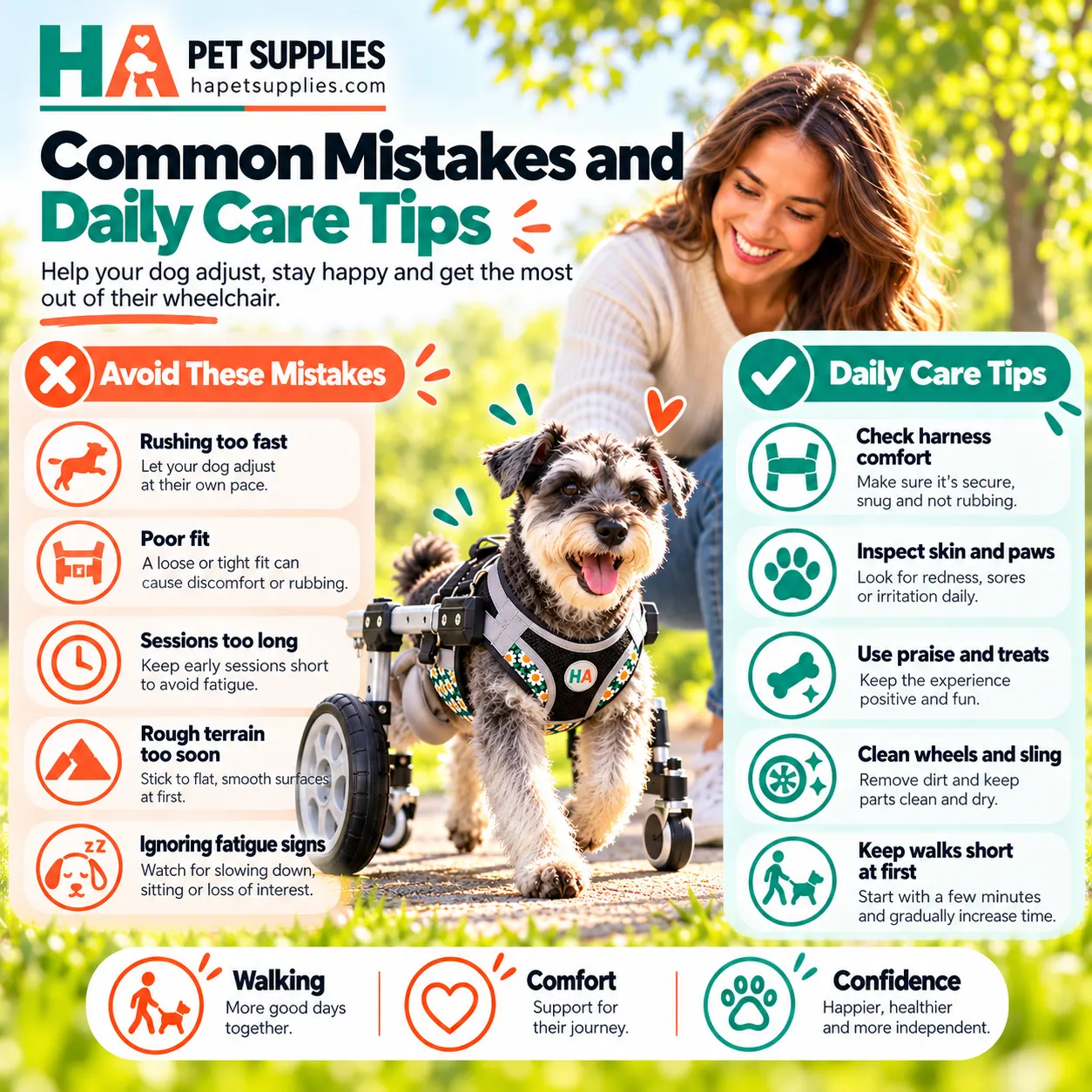
7. How to Check Dog Wheelchair Comfort Before Every Walk
Comfort checks should become part of the regular wheelchair routine. The goal is to identify problems before they cause injury.
Check the frame alignment
Observe the wheelchair from both sides. The dog’s body should remain in an appropriate supported position without severe twisting, sagging, or arching. The frame must not obstruct the front legs.
Check harness pressure
Examine areas around the chest, abdomen, groin, and inner thighs. Harness components should stay securely positioned without creating excessive pressure. A dog that repeatedly struggles against the harness may be experiencing discomfort.
Check the wheels
Make sure both wheels rotate smoothly and remain securely attached. Look for loose fasteners, accumulated debris, or wheel components contacting the dog’s body.
Check the hind paws
Dogs with paralysis or reduced coordination may drag their paws. If the hind legs are not being used for propulsion, ask a professional whether compatible positioning supports are required. Do not improvise restraints that could injure the legs or restrict circulation.
Check the dog’s behavior
A dog that is comfortable may willingly move forward and remain engaged with its surroundings. Warning signs include crying, persistent reluctance, unusual panting, trembling, repeated falling, or sudden changes in behavior. When these signs occur, remove the wheelchair safely and investigate the problem.
8. Walking With a Dog Wheelchair on Different Surfaces
As your dog becomes comfortable with straight-line walking, you may want to explore different environments. However, surface conditions substantially affect wheelchair stability.
| Surface | General suitability | Recommended approach |
|---|---|---|
| Level, non-slip indoor flooring | Often suitable for initial training | Begin with brief supervised movement |
| Firm, short grass | May be suitable | Check traction and wheel resistance |
| Smooth outdoor paths | Often suitable if level and dry | Introduce gradually |
| Loose gravel | Potentially difficult | Avoid during initial training |
| Deep sand or mud | Generally unsuitable for routine training | Avoid surfaces that trap wheels |
| Stairs | Unsafe for ordinary wheelchair use | Use another approved transfer method |
| Steep slopes | Increased tipping and strain risk | Avoid unless professionally assessed |
| Wet or slippery floors | High slipping risk | Use suitable non-slip surfaces |
Indoor wheelchair training
Indoor training is often convenient because the environment is familiar. However, narrow hallways and furniture can create obstacles. Clear a wide path before beginning. Use non-slip mats if the flooring does not provide sufficient traction. Avoid allowing the wheelchair to strike walls repeatedly.
Outdoor wheelchair training
Outdoor movement introduces uneven ground, noises, distractions, and changes in traction. Choose a familiar location with minimal distractions. Monitor the dog’s ability to maintain comfortable movement. Do not attempt long walks simply because your dog appears excited to be outdoors again.
Walking in warm weather
Dogs with reduced mobility may tire quickly, particularly when front legs are working harder than usual. Choose appropriate weather conditions, provide rest, and avoid hot surfaces that can injure paws. The dog’s breathing, activity tolerance, and overall comfort should guide the session.
9. Daily Dog Wheelchair Care and Hygiene
Daily care is essential because the wheelchair contacts the dog’s body and is exposed to dirt, moisture, and movement. A simple maintenance routine can help keep the equipment functional and reduce the risk of irritation.
Before every wheelchair session
Inspect the frame for visible damage. Check that adjustment points remain secure and wheels rotate freely. Review the fit and make sure harness supports are clean and correctly positioned. Check the dog’s skin for irritation that could be worsened by the equipment.
After every wheelchair session
Remove the wheelchair carefully. Inspect contact points for persistent redness, abrasions, swelling, or abnormal moisture. Check the hind paws and nails for signs of dragging. Allow the dog to rest comfortably.
Cleaning the wheelchair
Wipe dirt from the frame and wheels using a cleaning method compatible with the manufacturer’s materials. Remove trapped debris around moving components. Clean removable harness fabrics according to their care instructions and let them dry thoroughly before reuse. Avoid harsh chemicals that may damage materials or irritate the dog’s skin.
Cleaning and protecting your dog
Dogs with limited hind-leg mobility may require additional assistance with hygiene. Pay attention to areas where urine, moisture, or dirt can accumulate. A veterinarian can explain how to protect sensitive skin and manage bladder or bowel difficulties associated with neurological conditions.
Storing the wheelchair
Store the equipment in a clean, dry area. Keep it away from conditions that could damage the frame, straps, or wheels. Periodically inspect all structural connections, especially after frequent outdoor use.
10. Training Considerations for Dogs With Paralysis, Arthritis, or Neurological Conditions
Not every dog requires the same wheelchair training approach. The underlying medical condition affects how much activity is appropriate and what precautions are necessary.
Wheelchair training for dogs with hind-leg paralysis
A dog with stable hind-limb paralysis may be able to use a rear-support wheelchair if its front legs can provide adequate movement. However, some paralyzed dogs have reduced paw sensation or additional bladder and bowel care needs. Protecting the hind feet from dragging may require compatible supports. Owners should also monitor the skin closely because pressure injuries can develop without an obvious pain response. If paralysis is new, suddenly worsening, or associated with significant pain, emergency veterinary evaluation takes priority.
Wheelchair training for dogs with arthritis
Dogs with arthritis may be reluctant to move because of joint pain and stiffness. A wheelchair is not automatically the best solution. Appropriate medication, body-weight management, controlled exercise, rehabilitation, and supportive home modifications may be more useful. The AAHA veterinary rehabilitation and pain management recommendations discuss therapeutic exercise and rehabilitation as parts of comprehensive pain management. When a wheelchair is prescribed, training should respect the dog’s pain and stamina limitations.
Wheelchair training for dogs with degenerative myelopathy
Degenerative myelopathy can gradually affect hind-limb coordination and strength. Some dogs may benefit from supported walking, but their mobility needs can change as the disease progresses. Continue veterinary reassessment and avoid assuming the same cart configuration will remain appropriate indefinitely.
Wheelchair training after surgery
Dogs recovering from spinal or orthopedic surgery may have specific activity restrictions. Do not begin wheelchair sessions simply because the animal appears eager to move. The treating veterinarian should specify when supported movement can begin and what activities are permitted.
Wheelchair training for senior dogs
Senior dogs may have more than one condition affecting mobility. Reduced muscle mass, arthritis, neurological disease, and other medical problems may all influence endurance. Sessions may need to remain brief, with more rest and frequent fit checks.
11. How to Know Whether Dog Wheelchair Training Is Working
Successful wheelchair training does not necessarily mean that your dog can walk long distances. Progress may involve becoming comfortable around the wheelchair, tolerating the harness, standing without distress, or taking a few voluntary steps.
Positive signs
Your dog willingly approaches the equipment. The harness can be positioned without distress. The dog takes voluntary steps and remains comfortable. The wheelchair stays correctly aligned while moving. There are no signs of skin irritation after use. The dog is able to rest and recover normally following activity.
Signs that require reassessment
Your dog repeatedly refuses to move despite gradual introduction. The wheelchair tips or becomes unstable. The dog develops persistent redness or pressure sores. Your dog cries, trembles, pants unusually, or appears exhausted. The dog has increasing difficulty using its front legs. These problems may reflect incorrect fitting, inadequate mobility support, or changes in the medical condition. Training should not continue unchanged when these warning signs appear. The AAHA’s recommendations for ongoing pain reassessment emphasize regular evaluation and adjustment of treatment plans as an animal’s needs change.
12. When Should You Stop Dog Wheelchair Training?
Stop the session and seek prompt professional advice when your dog experiences new pain, substantial distress, repeated falling, or abnormal posture that does not resolve with appropriate fitting adjustments. Persistent skin irritation also requires attention. Sudden paralysis, rapidly progressing weakness, severe spinal pain, or a new inability to urinate warrants urgent veterinary assessment. Do not attempt to train through symptoms that may indicate an emergency. Training should be enjoyable and physically appropriate, not a test of how much discomfort the dog can tolerate.
13. Interactive Dog Wheelchair Training Checklist
For the final HTML version, this checklist can become a mobile-friendly interactive component that lets owners mark completed preparation steps and track their dog’s progress.
Wheelchair Training Progress
0 / 10This is a personal preparation checklist, not a certification of medical suitability. Dogs may require a different training sequence.
14. Frequently Asked Questions About Dog Wheelchair Training
15. Final Thoughts: Help Your Dog Learn to Use a Wheelchair With Confidence
Learning how to train a dog to use a wheelchair takes patience, careful observation, and an understanding of your dog’s individual needs. Some dogs adapt quickly, while others require a slower introduction. The most important factors are medical suitability, correct wheelchair fit, voluntary movement, and consistent attention to comfort.
Begin by allowing your dog to investigate the equipment. Introduce the harness gradually, confirm the fit, and encourage a few steps in a safe environment. As your dog becomes comfortable, progress toward gentle turns and short supervised walks. Do not rush the process or measure success by distance alone. For a dog recovering from mobility loss, even a small, comfortable movement may represent meaningful progress.
Regular skin checks, rest periods, equipment maintenance, and veterinary follow-up should remain part of the routine. If you are preparing to purchase a mobility cart, explore the HA Pet Supplies adjustable dog wheelchair and verify its dimensions and suitability before ordering. You can also browse our dog supplies collection for additional pet care products that may support a comfortable home environment.
For product specifications or questions about availability, contact HA Pet Supplies or request a wheelchair quote with your dog’s measurements. At HA Pet Supplies, we believe mobility assistance should be chosen with the pet’s welfare at the center of every decision. Continue exploring practical pet care advice through our dog care and mobility articles.
A successful wheelchair experience is not about how quickly your dog learns to walk with wheels. It is about helping your dog enjoy safe, comfortable movement at its own pace.
This guide is for informational purposes and does not replace veterinary advice. Always consult your veterinarian before starting wheelchair training.